
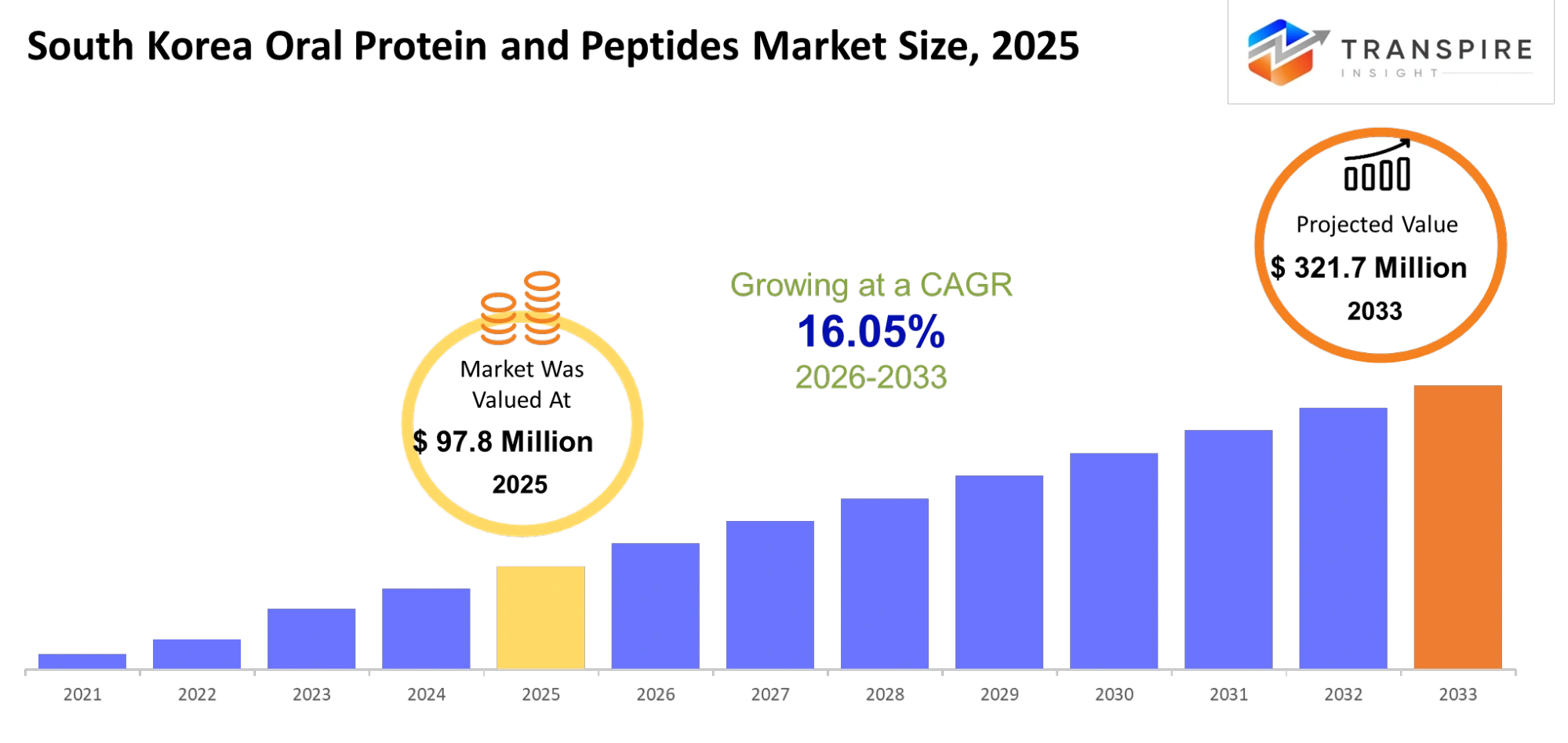
South Korea Oral Protein and Peptides Market Size & Forecast:
- South Korea Oral Protein and Peptides Market Size 2025: USD 97.8 Million
- South Korea Oral Protein and Peptides Market Size 2033: USD 321.7 Million
- South Korea Oral Protein and Peptides Market CAGR: 16.05%
- South Korea Oral Protein and Peptides Market Segments: By Type (Insulin, GLP-1, Growth Hormones, Enzymes, Vaccines, Others); By Application (Diabetes, Cancer, Gastrointestinal Disorders, Hormonal Disorders, Immunotherapy, Others); By End-User (Hospitals, Clinics, Pharma Companies, Research Institutes, Homecare, Others); By Delivery (Capsules, Tablets, Liquid, Nanocarriers, Controlled Release, Others)
To learn more about this report,  Download Free Sample Report
South Korea Oral Protein and Peptides Market Summary:
The South Korea Oral Protein and Peptides Market size is estimated at USD 97.8 Million in 2025 and is anticipated to reach USD 321.7 Million by 2033, growing at a CAGR of from 2026 to 2033.
The biopharmaceutical and nutrition industry will establish a dedicated sector in the South Korea Oral Protein and Peptides Market which will study oral delivery methods for complex molecules. The market development will occur through changing consumer preferences which seek effective treatment methods that require no physical intrusion and suit the needs of elderly people and health-focused urban residents who need daily wellness services.Product design will continue to be influenced by advances in formulation science which focus on developing better absorption and stability solutions for oral medication. The regulatory changes will determine product approval processes and quality standards because they require companies to meet new safety and efficacy evaluation standards. The market will shift its demand trends towards personalized nutrition and targeted therapies, which healthcare providers will deliver through digital health solutions and research-based innovations, creating a more structured and competitive environment.
What Has the Impact of Artificial Intelligence Been on the South Korea Oral Protein and Peptides Market?
Artificial intelligence is reshaping the south korea oral protein and peptides market by improving how companies analyze data, forecast demand, and optimize operations. AI in south korea oral protein and peptides market enables faster processing of large datasets which helps companies identify market trends and consumer preferences and emerging demand patterns with higher accuracy. Machine learning models support predictive analytics which allows businesses to refine product strategies and respond quickly to shifts in healthcare and nutrition needs.
The South Korean oral protein and peptide market uses artificial intelligence to improve production efficiency through intelligent automation and sophisticated systems for quality control. AI-driven tools streamline peptide synthesis while decreasing manufacturing errors and achieving better production consistency. Real-time tracking together with demand forecasting helps companies achieve supply chain optimization which results in cost reductions and shorter delivery times. The company can achieve higher operational efficiency through these capabilities while maintaining its product quality standards.
Artificial intelligence in South Korea's oral protein and peptides market enables companies to create new products which provide custom solutions that create unique advantages for their business operations. Data-driven insights enable development of targeted formulations tailored to specific health conditions and consumer groups. Companies that use artificial intelligence in South Korea's oral protein and peptides market will achieve better decision-making processes and faster research progress and improved customer relationships which will help them succeed in a technology-based competitive environment.
Key Market Trends & Insights:
- The Seoul metropolitan area controls more than 45% of South Korea's oral protein and peptides market which exists because of its advanced healthcare facilities according to 2025 market predictions.
- Insulin-based peptides dominate with nearly 30% share in the south korea oral protein and peptides market due to high diabetes prevalence.
- The GLP-1 segment holds the second-largest market share because more people are choosing to undergo metabolic disorder treatments.
- Nanocarrier-based delivery systems emerge as the fastest-growing segment which will grow at 9% CAGR until 2030.
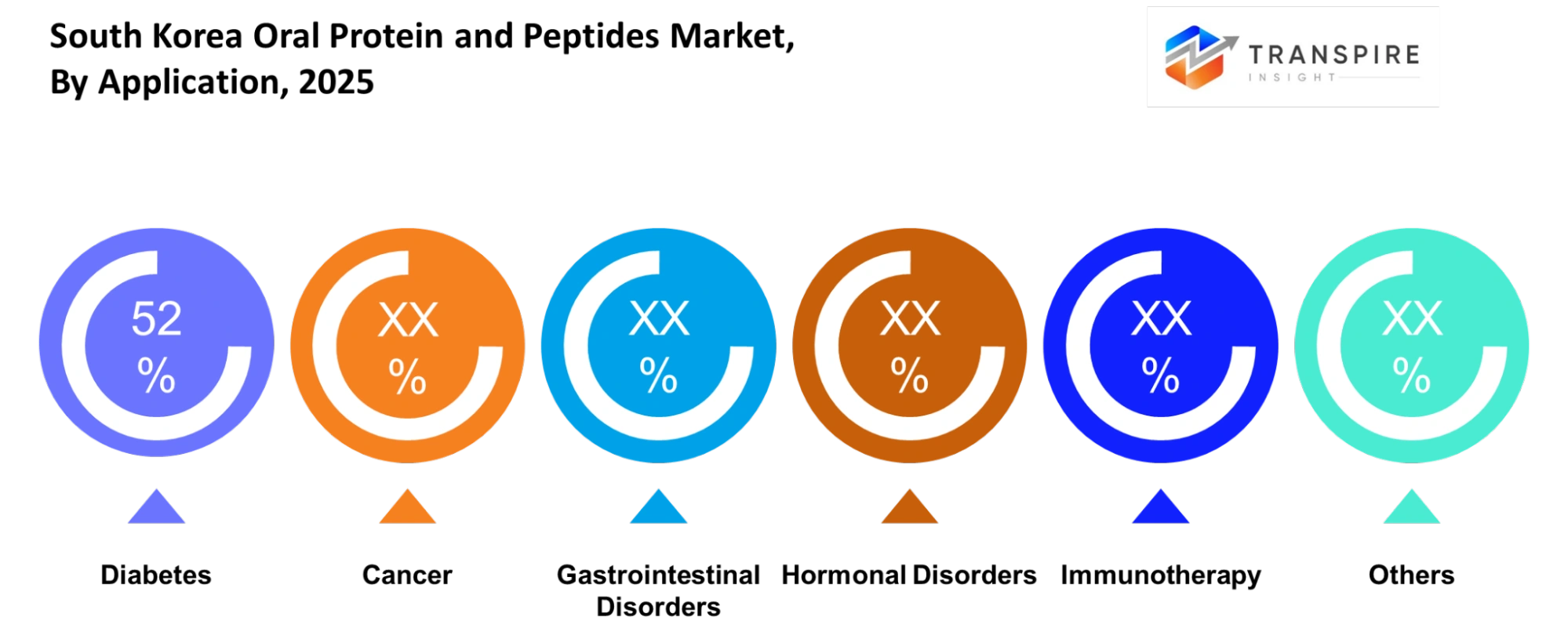
- The diabetes application leads the south korea oral protein and peptides market with more than 35% market share because chronic diseases continue to rise.
- The immunotherapy segment experiences the fastest growing demand because ongoing research work and development of targeted treatments will lead to substantial market growth.
- The hospitals control approximately 40% of South Korea's oral protein and peptides market because they use organized medical protocols to treat patients.
- The homecare segment represents the fastest growth area because more people choose to use oral therapies that provide them with better convenience.
- The company achieves technology progress and market growth through its strategic alliances with research institutes and international partners.
- The companies boost their market presence through regional growth and the implementation of digital health solutions which enables them to meet new market requirements.
South Korea Oral Protein and Peptides Market Segmentation
By Type:
The South Korea Oral Protein and Peptides Market divides into multiple segments which identify different therapeutic needs through its six main product categories which include insulin, GLP-1, growth hormones, enzymes, vaccines, and others. The treatment of diabetes requires insulin and GLP-1, whereas growth hormones and enzymes maintain vital bodily processes. The use of vaccines together with other peptides enables the development of new methods for both general preventive health and advanced medical treatments.
By Application:
The clinical uses of each segment define its purpose, while the disease spread and treatment availability and the ongoing development of new peptide-based treatments determine the demand for these products. The South Korea Oral Protein and Peptides Market divides into multiple segments which define different medical applications through its six main product categories which include diabetes, cancer, gastrointestinal disorders, hormonal disorders, immunotherapy, and others.
Diabetes remains a leading segment due to increasing patient population, while cancer and immunotherapy applications gain attention through research advancements and targeted therapies. The diverse application base of this product line ensures constant market demand, which grows because chronic disease numbers are rising and diagnostic improvements and personalized treatment methods become more common.
To learn more about this report, Download Free Sample Report
By End-User:
The South Korea Oral Protein and Peptides Market divides its market segments through hospitals and clinics and pharmaceutical companies and research institutions and homecare services and additional sectors. The structured treatment environments of hospitals and clinics create operational dominance, while homecare services grow in popularity because their oral formulations enable patients to self-administer medications during extended periods of treatment.
The End-User Segments Include Hospitals, Clinics, Pharma Companies Research Institutes Homecare Services, and Other Institutions. End-users Require Different Solutions Based on Their Treatment Needs and the Availability of Medical Facilities, while research institutes develop new solutions and pharmaceutical companies help market those innovations.
By Delivery:
The South Korean market for oral protein and peptide products divides its products into six delivery methods which include capsules tablets liquids nanocarriers and controlled release systems. The delivery systems of nanocarriers and controlled-release systems improve peptide delivery by providing convenient administration options, such as capsules and tablets.
The delivery system segments include capsules tablets liquid nanocarriers controlled release and other delivery methods) which shows that delivery system innovations improve patient compliance through better absorption while new technologies solve stability issues and deliver effective treatment results across multiple medical disciplines.
What are the Main Challenges for the South Korea Oral Protein and Peptides Market Growth?
The South Korea oral protein and peptides market experiences slow growth because technical and operational difficulties impede progress. The oral delivery system for proteins and peptides faces a major challenge: their stability must be maintained, yet digestion breaks them down. South Korean companies that operate in the oral protein and peptides market need to develop their products through advanced formulation technologies because this process needs more time and makes it hard to grow their businesses.
The South Korea oral protein and peptides market expansion faces challenges because production and sales barriers need to be solved. The production process requires manufacturers to adhere to strict quality standards, which include meeting GMP regulations. The requirement results in higher operating expenses for manufacturers. New companies need to spend money on research and testing and specialized equipment before they can launch their products. The new companies face financial challenges because of these expenditures while pricing pressures reduce their profit potential.
Adoption challenges further affect the south korea oral protein and peptides market, particularly in segments with limited awareness of peptide-based nutrition. Lack of skilled professionals in peptide formulation and limited clinical validation slow market acceptance. Infrastructure gaps in smaller regions also restrict distribution, creating uneven market penetration and reinforcing existing market limitations.
Market competition and future risks add another layer of complexity to the south korea oral protein and peptides market. The combination of substitute products and alternative delivery methods creates powerful competition while new regulatory requirements elevate market unpredictability. The company needs to develop new solutions through ongoing research together with strategic initiatives to achieve its growth targets.
Regional Insights
The South Korea Oral Protein and Peptides Market shows strong demand from urban areas which include Seoul and Busan because people there understand health better and have more money to spend. The advanced retail networks together with digital platforms allow people to access products while metropolitan residents actively search for nutritional supplements which help them maintain their health throughout the day.
The better urban infrastructure enables people to use products more easily than they do in smaller cities which are starting to adopt preventive healthcare solutions because distribution networks are expanding and people are becoming more informed about these products. The South Korea Oral Protein and Peptides Market operates differently in various regions because people develop distinct income patterns and healthcare access routes and lifestyle choices.
The urban centers generate most regional sales but rural markets will become more important in the future because supply chain development will create new sales opportunities through dedicated customer education programs.
The market expansion process in this region receives backing from policy support and regional investment initiatives which create growth opportunities in the market. The innovation hubs develop new products which enable less developed areas to connect with the entire market system.
Recent Development News
In April 2026, Pfizer announced a research collaboration with D&D Pharmatech to develop an oral GLP-1 peptide-based obesity treatment using advanced delivery technology. The partnership focuses on converting injectable drugs into oral formats, which will enhance patient compliance and improve absorption efficiency.https://www.koreabiomed.com
In March 2026, Roche expanded its pipeline of peptide-based treatments which it considers a vital part of its pharmaceutical research program. The company demonstrated its ongoing work for next-generation biologics through its current development activities and regulatory advances which included their peptide-based treatment research for improved patient access and treatment effectiveness.https://assets.roche.com
|
Report Metrics |
Details |
|
Market size value in 2025 |
USD 97.8 Million |
|
Market size value in 2026 |
USD 113.5 Million |
|
Revenue forecast in 2033 |
USD 321.7 Million |
|
Growth rate |
CAGR of 16.05% from 2026 to 2033 |
|
Base year |
2025 |
|
Historical data |
2021 - 2024 |
|
Forecast period |
2026 - 2033 |
|
Report coverage |
Revenue forecast, competitive landscape, growth factors, and trends |
|
Regional scope |
South Korea |
|
Key company profiled |
Novo Nordisk, Eli Lilly, Pfizer, Roche, Sanofi, Merck, Novartis, Amgen, AstraZeneca, Takeda, Johnson & Johnson, AbbVie, Biocon, Ipsen, Teva |
|
Customization scope |
Free report customization (country, regional & segment scope). Avail customized purchase options to meet your exact research needs. |
|
Report Segmentation |
By Type (Insulin, GLP-1, Growth Hormones, Enzymes, Vaccines, Others); By Application (Diabetes, Cancer, Gastrointestinal Disorders, Hormonal Disorders, Immunotherapy, Others); By End-User (Hospitals, Clinics, Pharma Companies, Research Institutes, Homecare, Others); By Delivery (Capsules, Tablets, Liquid, Nanocarriers, Controlled Release, Others) |
How Can New Companies Establish a Strong Foothold in the South Korea Oral Protein and Peptides Market?
New companies aiming to enter the south korea oral protein and peptides market will need a focused approach built on niche targeting and clear value creation. New entrants should focus on specific market segments which include elderly nutrition and sports recovery and plant-based peptides. The south korea oral protein and peptides market shows strong market growth in these areas due to rising health awareness and demographic shifts which make specialization a practical entry strategy.
The south korea oral protein and peptides market needs innovation strategies because they create unique product differentiation. Companies that invest in advanced delivery systems and improved bioavailability together with better taste profiles will solve common consumer issues. NutraNext Labs has developed peptide blends that provide faster absorption while Seoul BioActive produces clean-label formulations that meet current industry trends.
Strategic partnerships will help new players scale faster and overcome entry barriers in the south korea oral protein and peptides market. Local businesses can establish credibility and decrease operational risks through partnerships with local healthcare providers and research institutions and contract manufacturers. The alliances enable companies to solve healthcare challenges which include validating clinical results and establishing product credibility.
Technology differentiation will create a stronger competitive advantage for businesses operating in the south korea oral protein and peptides market.
Key South Korea Oral Protein and Peptides Market Company Insights
South Korea Oral Protein and Peptides Market shows steady growth driven by rising health awareness, aging population, and demand for functional nutrition. The sports nutrition and medical nutrition sectors drive product adoption through their expansion. The new formulation technology delivers better absorption results while creating more appealing taste options, which leads to higher customer approval from people of all ages and various lifestyle backgrounds.
The competitive landscape shows increasing rivalry because both domestic and international firms operate in the market, which leads companies to develop unique products while spending on research and forming partnerships to boost their market share and distribution capacity. The South Korean market for oral protein and peptides benefits from its well-established retail system and the increasing popularity of online shopping which enables more products to reach customers. The sales growth comes from both e-commerce platforms and pharmacy chains. The demand for convenient nutrition products like powders and ready-to-drink beverages maintains steady growth among urban consumers. Competitive insights: Key players emphasize branding, online visibility, and customized offerings to capture market share, while new entrants introduce niche products targeting specific health needs and dietary preferences.
The South Korea Oral Protein and Peptides Market shows growth because more people focus on preventive healthcare and current fitness trends. The market maintains steady demand because elderly people and fitness enthusiasts buy products regularly. Product development in collagen peptides and plant-based proteins meets the dietary patterns and health objectives of modern consumers.
Companies use innovation pipelines and clean-label products and research institution partnerships to build credibility which they need for their competitive edge. The South Korea Oral Protein and Peptides Market operates under three major issues that include regulatory standards and pricing pressure and consumer skepticism about product effectiveness.
The market competition increases because businesses need to meet regulatory standards and obtain quality certifications while enforcing marketing plans that create customer loyalty through brand distinctiveness.
Company List
- Novo Nordisk
- Eli Lilly
- Pfizer
- Roche
- Sanofi
- Merck
- Novartis
- Amgen
- AstraZeneca
- Takeda
- Johnson & Johnson
- AbbVie
- Biocon
- Ipsen
- Teva
What are the Key Use-Cases Driving the Growth of the South Korea Oral Protein and Peptides Market?
The South Korean oral protein and peptides market shows significant growth because therapeutic applications in chronic disease management serve as its primary use case. Patients with diabetes and gastrointestinal disorders and hormonal deficiencies prefer oral peptide-based drugs to injectable treatments because they provide better patient compliance. Patients prefer this method of drug delivery because it provides them with simpler access to treatment options.
The South Korean oral protein and peptides market receives substantial support from nutritional and functional food applications. Sports nutrition and elderly care and general wellness fields use protein supplements and peptide-enriched products as their primary dietary components. The market maintains steady growth because consumers increasingly understand preventive healthcare and active living, which drives their need for protein products that their bodies can digest and absorb with ease.
Cosmeceutical and beauty applications are emerging as another key growth area. Skincare and anti-aging products now contain oral peptides because these ingredients help increase collagen production and support internal skin health improvement. The South Korean beauty and personal care industry creates new business possibilities for the South Korean oral protein and peptide market through this evolving trend.
The future potential of drug delivery technologies and peptide stabilization has been expanded through technological advancements. The use of encapsulation systems and targeted release systems enables better product absorption and higher product effectiveness. The pharmaceutical industry and consumer health field will use these advancements to achieve scalable development which will drive more widespread adoption thus creating long-term market expansion.
South Korea Oral Protein and Peptides Market Report Segmentation
By Type
- Insulin
- GLP-1
- Growth Hormones
- Enzymes
- Vaccines
- Others
By Application
- Diabetes
- Cancer
- Gastrointestinal Disorders
- Hormonal Disorders
- Immunotherapy
- Others
By End-User
- Hospitals
- Clinics
- Pharma Companies
- Research Institutes
- Homecare
- Others
By Delivery
- Capsules
- Tablets
- Liquid
- Nanocarriers
- Controlled Release
- Others
Frequently Asked Questions
Find quick answers to common questions.
The approximate South Korea Oral Protein and Peptides Market size for the market will be USD 321.7 Million in 2033.
Key segments for the South Korea Oral Protein and Peptides Market are By Type (Insulin, GLP-1, Growth Hormones, Enzymes, Vaccines, Others); By Application (Diabetes, Cancer, Gastrointestinal Disorders, Hormonal Disorders, Immunotherapy, Others); By End-User (Hospitals, Clinics, Pharma Companies, Research Institutes, Homecare, Others); By Delivery (Capsules, Tablets, Liquid, Nanocarriers, Controlled Release, Others).
Major South Korea Oral Protein and Peptides Market players are Novo Nordisk, Eli Lilly, Pfizer, Roche, Sanofi, Merck, Novartis, Amgen, AstraZeneca, Takeda, Johnson & Johnson, AbbVie, Biocon, Ipsen, Teva
The South Korea Oral Protein and Peptides Market size is USD 97.8 Million in 2025.
The South Korea Oral Protein and Peptides Market CAGR is USD 321.7 Million.
- Novo Nordisk
- Eli Lilly
- Pfizer
- Roche
- Sanofi
- Merck
- Novartis
- Amgen
- AstraZeneca
- Takeda
- Johnson & Johnson
- AbbVie
- Biocon
- Ipsen
- Teva
Recently Published Reports
-
Dec 2025
Biosimilars Market
Biosimilars Market By Product Type (Monoclonal Antibodies, Recombinant Hormones, Erythropoietin, G-CSF, Others), By Indication (Oncology, Autoimmune Diseases, Blood Disorders, Diabetes, Others), By Manufacturing Type (In-House Manufacturing, Contract Manufacturing), By Distribution Channel (Hospital Pharmacies, Retail Pharmacies, Online Pharmacies), By Industry Analysis, Size, Share, Growth, Trends, and Forecasts 2021-2033
-
Dec 2025
Gastrointestinal Endoscopy Market
Gastrointestinal Endoscopy Market By Type (Rigid Gastrointestinal Endoscope, Flexible Gastrointestinal Endoscopes, Disposable Gastrointestinal Endoscope), By Procedure Type (Colonoscopy, Gastroscopy, Duodenoscopy, Enteroscopy, Flexible Sigmoidoscopy, Others), By Application (Diagnosis, Treatment), By End-Users (Hospitals, Ambulatory Surgical Centers, Specialty Clinics, Laboratories, Others), By Industry Analysis, Size, Share, Growth, Trends, and Forecasts 2021-2033
-
Jan 2026
Rare Inherited Metabolic Disorder Drug Market
Rare Inherited Metabolic Disorder Drug Market By Drug Class (Enzyme Replacement Drugs, Gene Therapy Drugs, Substrate Reduction Drugs, Small Module Drugs, Protein Drugs), By Route of Administration(Parenteral, Oral, Intrathecal), By Clinical Development (Marketed Drugs, Late Stage Clinical Phase III, Early Stage Clinical Phase I-II, Preclinical Candidates), By Indication (Lysosomal Storage Disorders, Urea Cycle Disorders, Amino Acid Metabolic Disorders, organic Acidemias, Peroximal Disorders), By Industry Analysis, Size, Share, Growth, Trends, and Forecasts 2021-2033
-
Jan 2026
Pharmaceutical Cleanroom Technology Market
Pharmaceutical Cleanroom Technology Market By Product (Equipment, Consumables, Services); By Cleanroom Type (Standard Cleanrooms, Modular Cleanrooms); By End Use (Pharmaceutical Companies, Biotechnology Companies), By Industry Analysis, Size, Share, Growth, Trends, and Forecasts 2021-2033