
Asia Pacific Medical Imaging Market Size & Forecast:
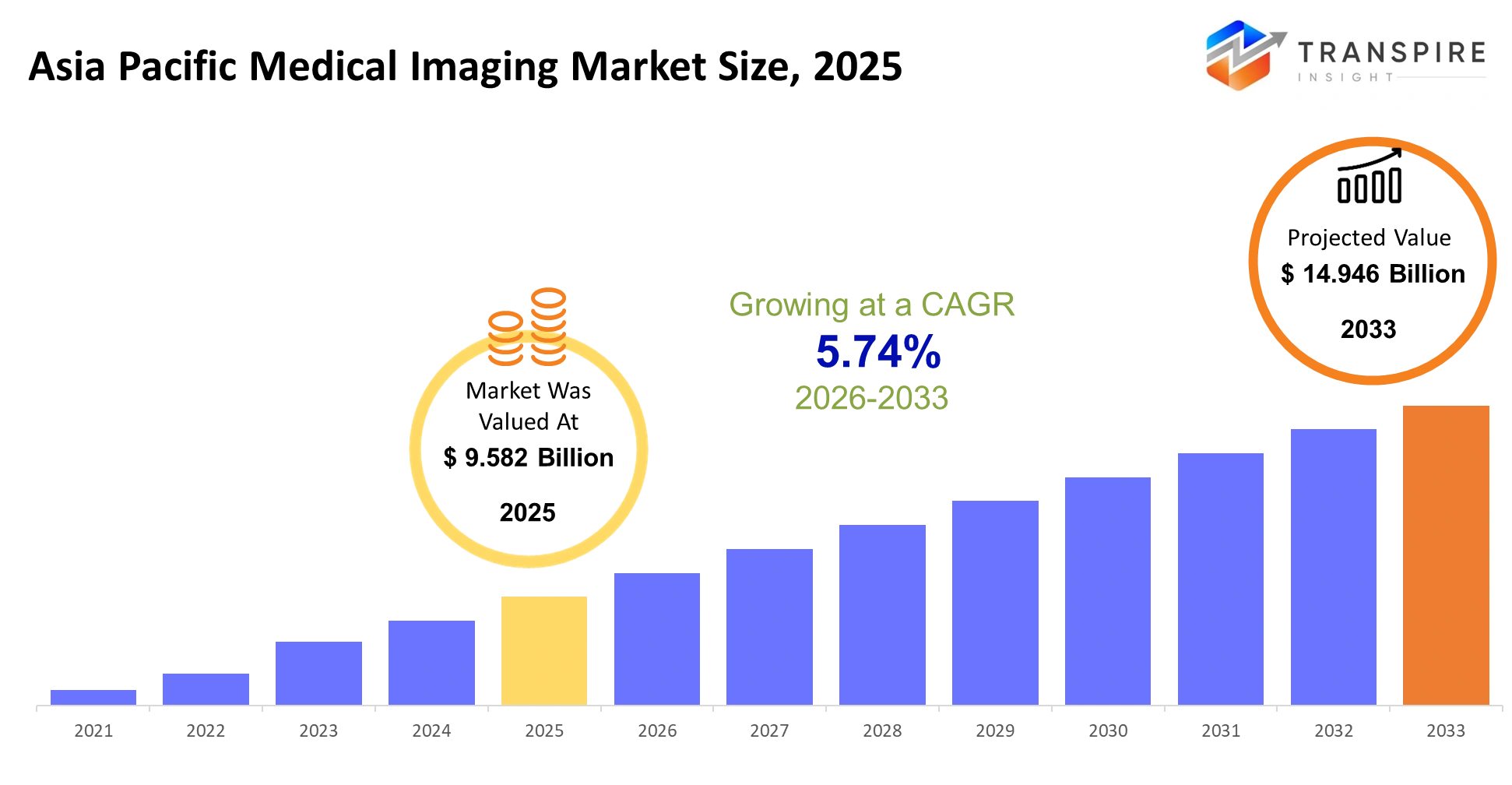
- Asia Pacific Medical Imaging Market Size 2025: USD 9.582 Billion
- Asia Pacific Medical Imaging Market Size 2033: USD 14.946 Billion
- Asia Pacific Medical Imaging Market CAGR: 5.74%
- Asia Pacific Medical Imaging Market Segments: By Type (X-ray, MRI, CT Scan, Ultrasound, Nuclear Imaging, Others); By Application (Cardiology, Oncology, Neurology, Orthopedics, Gynecology, Others); By End-User (Hospitals, Diagnostic Centers, Clinics, Research Institutes, Ambulatory Centers, Others); By Technology (2D Imaging, 3D Imaging, 4D Imaging, AI Imaging, Digital Imaging, Others)
To learn more about this report,  Download Free Sample Report
Asia Pacific Medical Imaging Market Summary:
The Asia Pacific Medical Imaging Market size is estimated at USD 9.582 Billion in 2025 and is anticipated to reach USD 14.946 Billion by 2033, growing at a CAGR of 5.74% from 2026 to 2033.
The healthcare technology industry in the Asia Pacific region will see continuous evolution in its medical imaging market because of growing demands for quicker and better diagnostic results. The countries of China and India, and Japan will see their hospitals and diagnostic centers start using advanced imaging systems, which will enable them to detect diseases at earlier stages and make better clinical decisions. Healthcare providers will prefer purchasing small-sized devices which deliver high-definition output because these devices will work efficiently in both metropolitan hospital environments and smaller medical facilities.
Technological progress will continue to influence system design as artificial intelligence and digital integration technologies enhance image clarity and improve operational efficiency. The regional regulatory frameworks will implement stricter quality standards and patient safety requirements, which will determine the procedures for equipment development and approval. Providers will need to adopt imaging solutions that reduce patient waiting times due to changing patient expectations for their care delivery experience.
What Has the Impact of Artificial Intelligence Been on the Asia Pacific Medical Imaging Market ?
The Asia Pacific medical imaging market implements artificial intelligence which enhances its diagnostic abilities and operational productivity through a system that utilizes data for quick response. The analysis of AI in the Asia Pacific medical imaging market enhances processing efficiency for extensive imaging and patient data, which leads to quicker insights and improved decision-making accuracy. The use of machine learning models enables researchers to detect disease patterns, thereby assisting radiologists and improving their ability to diagnose medical conditions. Predictive analytics enables hospitals and diagnostic centers to identify usage patterns, which enhances their ability to forecast demands, enabling them to optimize their resource allocation and medical equipment distribution throughout the Asia Pacific medical imaging market.
The Asia Pacific medical imaging market uses artificial intelligence to drive automated systems which enhance operational efficiency in both manufacturing processes and supply chain management. Automated quality checks and performance monitoring systems enable factories to produce imaging equipment more efficiently by reducing operational costs and production errors.
AI delivers two benefits to organizations through its operational benefits and its capacity to drive innovative products and create market differentiation. Advanced imaging solutions now integrate AI for real-time image enhancement and personalized diagnostics, improving patient outcomes.Companies that use AI in their medical imaging operations across the Asia Pacific region gain competitive advantages because they provide their clients with quicker and more precise and expandable solutions which help them succeed in a market with intense competition.
Key Market Trends & Insights:
- China controls 38 percent of the Asia Pacific medical imaging market, which makes it the largest market in the region by 2025 because its hospitals maintain extensive facilities and its companies produce medical equipment domestically.
- The fastest-growing area in the world will be India which expects to achieve more than 7 percent compound annual growth during the period from 2026 to 2030 because of better healthcare access and increased need for diagnostic tests.
- The market for X-ray imaging will reach approximately 30 percent market share in 2025 because hospitals and clinics choose to use this method because it delivers cost savings and hospitals and clinics use it widely.
- The second-largest market segment includes MRI systems because customers require these systems to obtain high-definition medical pictures through non-surgical means.
- CT scanners represent the most rapidly expanding market segment which will experience rapid growth until 2030 because of the increasing need to diagnose chronic health conditions.
- The field of oncology imaging dominates the market with more than 35 percent share because cancer detection rates and Asian Pacific regional early detection initiatives continue to grow.
- The field of cardiology imaging experiences its most rapid growthbecause more people develop cardiovascular diseases and require advanced diagnostic tests.
- Hospitals use more than 60 percent of medical resources as their primary operational centers because they have advanced facilities and treat large numbers of patients.
- Diagnostic imaging centers experience fast expansion because they provide outpatient services while people require urgent access to their specialized imaging services.
- The competitive advantage and long-term strategic market position become possible through hospital partnerships which drive development of advanced imaging software technologies.
Asia Pacific Medical Imaging Market Segmentation
By Type:
The study of X-ray systems for medical imaging will continue to experience growth because these systems provide affordable and accessible solutions which hospitals and clinics can use. The combination of MRI and CT scan technologies will enable medical professionals to create sophisticated internal body images which will assist them in diagnosing complicated medical conditions. Ultrasound will become more common for standard medical assessments while nuclear imaging will be used in specific medical situations which need both functional imaging and accurate illness identification.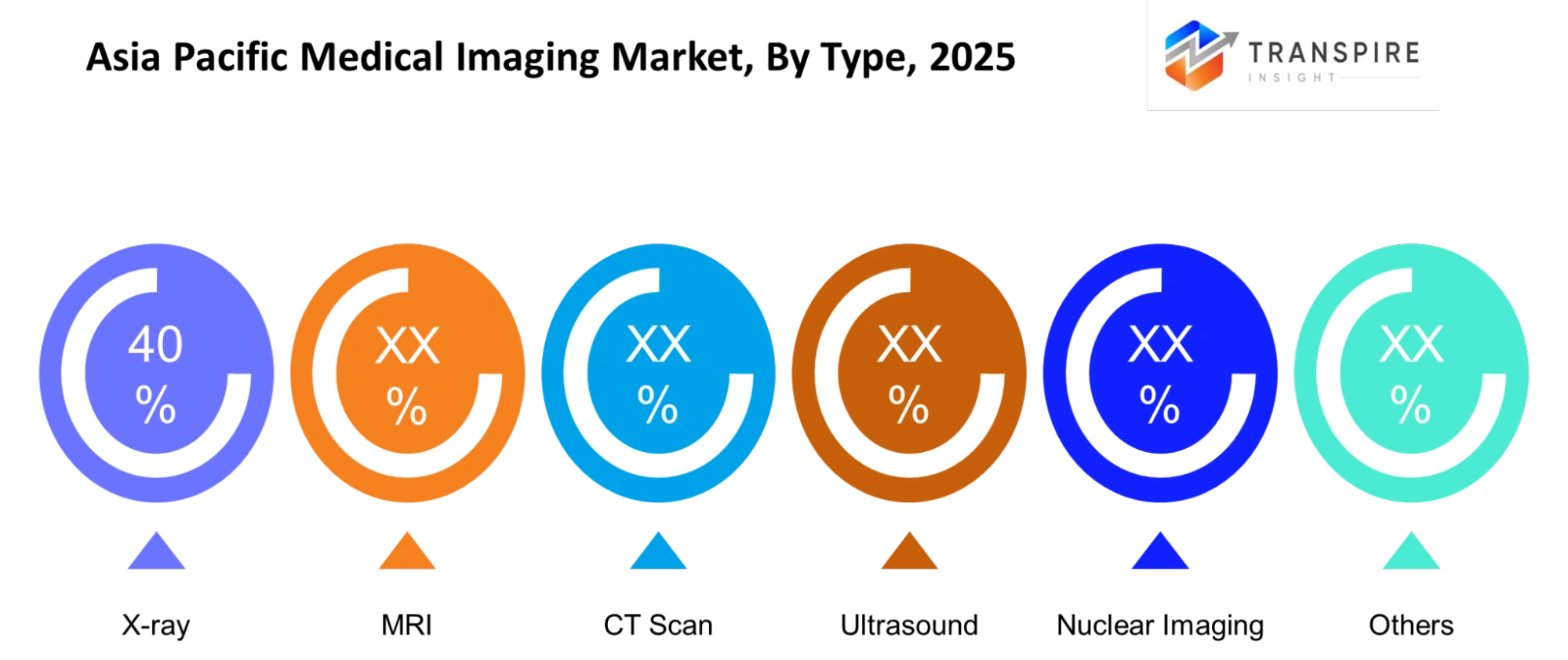
To learn more about this report, Download Free Sample Report
By Application:
The field of oncology will lead as the dominant area of medical imaging because the demand for cancer detection and imaging-based diagnosis continues to grow. The field of cardiology will expand because more patients develop heart conditions which need precise medical imaging. Neurology and orthopedics will rely on imaging for structural analysis, while gynecology will support maternal and reproductive health assessments across clinical environments.
By End-User:
Hospitals will lead usage with advanced infrastructure and high patient volume. Diagnostic centers will expand with specialized imaging services and faster reporting.Clinical environments will use compact systems while clinics perform their daily operations and research institutes will dedicate their resources toward developing and evaluating upcoming imaging solutions.
By Technology:
The medical imaging field uses 2D imaging as its basic diagnostic method while 3D and 4D imaging technologies enable users to experience both depth and real-time visualization. AI imaging technology improves accuracy rates while streamlining operational processes. Digital imaging will replace traditional methods, ensuring better storage, sharing, and analysis of medical images.
What are the Main Challenges for the Asia Pacific Medical Imaging Market Growth?
The asia pacific medical imaging market experiences multiple technical and operational obstacles which reduce its operational efficiency and capacity to grow. The medical equipment used for imaging, which includes MRI and CT scanners, demands high accuracy throughout its operational life, which results in increased challenges for its maintenance procedures. The combination of unstable power sources and equipment failures and the need to use foreign-made parts leads to operational difficulties for the asia pacific medical imaging market which results in service delivery delays and increased operating expenses.
The asia pacific medical imaging market obstacles of manufacturing and product distribution lead to diminished market advancement. Advanced imaging systems require a complete manufacturing process which includes following safety regulations and maintaining operational quality throughout production.
Market forces virtual market dynamics undergo change because of both upcoming competitive threats and current market pressures. The competitive landscape is becoming more challenging for manufacturers, as refurbished equipment and alternative diagnostic technologies put pricing pressure on them. The medical imaging market of Asia Pacific experiences financial uncertainty which stems from both advancing technology and changing regulations that require ongoing expenditures.
Regional Insights
The Asia Pacific Medical Imaging Market will display different results across its various regions because of three factors, which include healthcare investment levels and infrastructure development and government policy backing. The advanced hospital system of developed countries will maintain steady medical needs while developing areas will build their diagnostic systems through combined efforts from government and private organizations.
China will lead regional demand due to large-scale healthcare infrastructure and increasing diagnostic procedures. Japan and South Korea will concentrate their efforts on developing advanced imaging solutions together with their precise diagnostic techniques. India and Southeast Asia will experience constant growth because of better healthcare access and increased patient understanding and the continuous development of diagnostic centers and medical facilities.
Recent Development News
In April 2026, Siemens Healthineers highlighted continued expansion in digital mammography and imaging software solutions. The company strengthened its imaging portfolio with advanced workstation technologies supporting early cancer detection and digital diagnostics adoption across Asia-Pacific. https://www.globenewswire.com
In March 2026, Fujifilm Corporation enhanced its AI-powered medical imaging devices. The company integrated advanced deep learning algorithms to improve early disease detection and diagnostic accuracy, strengthening its position in the Asia-Pacific imaging technology landscape. https://www.openpr.com
|
Report Metrics |
Details |
|
Market size value in 2025 |
USD 9.582 Billion |
|
Market size value in 2026 |
USD 10.115 Billion |
|
Revenue forecast in 2033 |
USD 14.946 Billion |
|
Growth rate |
CAGR of 5.74% from 2026 to 2033 |
|
Base year |
2025 |
|
Historical data |
2021 - 2024 |
|
Forecast period |
2026 - 2033 |
|
Report coverage |
Revenue forecast, competitive landscape, growth factors, and trends |
|
Regional scope |
Asia Pacific ( China, India, Japan, South Korea, Australia, Rest of Asia Pacific) |
|
Key company profiled |
GE Healthcare, Siemens Healthineers, Philips, Canon Medical, Fujifilm, Hitachi, Samsung Medison, Carestream, Shimadzu, Hologic, Agfa-Gevaert, Mindray, Esaote, Konica Minolta, Toshiba |
|
Customization scope |
Free report customization (country, regional & segment scope). Avail customized purchase options to meet your exact research needs. |
|
Report Segmentation |
By Type (X-ray, MRI, CT Scan, Ultrasound, Nuclear Imaging, Others); By Application (Cardiology, Oncology, Neurology, Orthopedics, Gynecology, Others); By End-User (Hospitals, Diagnostic Centers, Clinics, Research Institutes, Ambulatory Centers, Others); By Technology (2D Imaging, 3D Imaging, 4D Imaging, AI Imaging, Digital Imaging, Others) |
How Can New Companies Establish a Strong Foothold in the Asia Pacific Medical Imaging Market ?
New companies entering the asia pacific medical imaging market will need to focus on niche segments where demand is rising but competition remains manageable. Portable imaging devices and AI-assisted diagnostics and low-cost rural healthcare solutions represent three areas which businesses should develop to establish market presence. These focused strategies allow emerging players to align with current market growth trends while addressing gaps in accessibility and affordability.
Innovation will play a central role in building a strong foothold in the asia pacific medical imaging market. Startups that combine artificial intelligence with image interpretation or cloud-based diagnostic systems will eliminate critical obstacles which lead to reporting delays and doctor shortages.
Businesses should use both cost-effective methods and superior solutions to establish themselves in the market. Businesses that establish manufacturing facilities and adhere to regulations and enhance their products will secure a stronger market position. Organizations can achieve sustainable market entry to the asia pacific medical imaging sector through their plans for strategic growth and partnership development.
Key Asia Pacific Medical Imaging Market Company Insights
The Asia Pacific Medical Imaging Market will become more competitive as global manufacturers and local technology companies enter. The market demand for advanced diagnostic systems will drive companies to enhance product quality while reducing costs and expanding service coverage. The hospital systems and diagnostic centers and imaging solution providers will continue to compete with each other at high levels.
The leading companies will strengthen their market position by developing new technologies which improve imaging accuracy and enable better AI integration and faster diagnostic workflows. The establishment of strategic partnerships with healthcare institutions will create trust while enabling wider system adoption. Regional companies will compete with affordable solutions and localised services while international companies will depend on their advanced technologies and extensive distribution networks.
Company List
- GE Healthcare
- Siemens Healthineers
- Philips
- Canon Medical
- Fujifilm
- Hitachi
- Samsung Medison
- Carestream
- Shimadzu
- Hologic
- Agfa-Gevaert
- Mindray
- Esaote
- Konica Minolta
- Toshiba
What are the Key Use-Cases Driving the Growth of the Asia Pacific Medical Imaging Market ?
The essential function of medical imaging in hospitals and diagnostic centers which enables hospitals to detect diseases at their starting point is the fundamental factor that drives the Asia Pacific medical imaging market. The medical imaging systems which include MRI and CT scans and X-rays, enable doctors to correctly identify various medical conditions which include cancer and cardiovascular disorders. The healthcare system will develop diagnostic imaging as an essential element because patient numbers and preventive healthcare efforts keep growing throughout the region.
Oncology imaging represents an essential use-case which develops the Asia Pacific medical imaging market through its advanced scanning technologies which enable tumor detection and staging and treatment monitoring. The rising cancer rates in Asia Pacific have created a higher requirement for imaging systems which deliver high-resolution results that enhance clinical decision-making. Healthcare providers now use imaging tools to identify heart-related conditions during their initial development stage which helps cardiology applications to expand.
The Asia Pacific medical imaging market experiences growth because neurology and orthopaedics serve as essential sectors which contribute to its expansion. Doctors use brain imaging to diagnose strokes and handle neurological disorders whereas orthopedic imaging helps them evaluate injuries and develop surgical plans. The applications achieve higher accuracy through AI integration which helps to produce better diagnostic results and faster reporting times.
The rising need for portable imaging solutions to be used in rural areas and emergency medical situations has created new opportunities for diagnostic testing. Mobile imaging units and compact devices are enhancing healthcare accessibility in areas with limited medical facilities which leads to the creation of new business expansion possibilities throughout the asia pacific medical imaging market.
Asia Pacific Medical Imaging Market Report Segmentation
By Type
- X-ray
- MRI
- CT Scan
- Ultrasound
- Nuclear Imaging
- Others
By Application
- Cardiology
- Oncology
- Neurology
- Orthopedics
- Gynecology
- Others
By End-User
- Hospitals
- Diagnostic Centers
- Clinics
- Research Institutes
- Ambulatory Centers
- Others
By Technology
- 2D Imaging
- 3D Imaging
- 4D Imaging
- AI Imaging
- Digital Imaging
- Others
Frequently Asked Questions
Find quick answers to common questions.
The Approximate Asia Pacific Medical Imaging Market size for the Market will be USD 14.946 Billion in 2033.
Key Segments for the Asia Pacific Medical Imaging Market are By Type (X-ray, MRI, CT Scan, Ultrasound, Nuclear Imaging, Others); By Application (Cardiology, Oncology, Neurology, Orthopedics, Gynecology, Others); By End-User (Hospitals, Diagnostic Centers, Clinics, Research Institutes, Ambulatory Centers, Others); By Technology (2D Imaging, 3D Imaging, 4D Imaging, AI Imaging, Digital Imaging, Others).
Major Asia Pacific Medical Imaging Market Players are GE Healthcare, Siemens Healthineers, Philips, Canon Medical, Fujifilm, Hitachi, Samsung Medison, Carestream, Shimadzu, Hologic, Agfa-Gevaert, Mindray, Esaote, Konica Minolta, Toshiba.
The Current Asia Pacific Medical Imaging Market size is USD 9.582 Billion in 2025.
The Asia Pacific Medical Imaging Market CAGR is 5.74%.
- GE Healthcare
- Siemens Healthineers
- Philips
- Canon Medical
- Fujifilm
- Hitachi
- Samsung Medison
- Carestream
- Shimadzu
- Hologic
- Agfa-Gevaert
- Mindray
- Esaote
- Konica Minolta
- Toshiba
Recently Published Reports
-
Dec 2025
Biosimilars Market
Biosimilars Market By Product Type (Monoclonal Antibodies, Recombinant Hormones, Erythropoietin, G-CSF, Others), By Indication (Oncology, Autoimmune Diseases, Blood Disorders, Diabetes, Others), By Manufacturing Type (In-House Manufacturing, Contract Manufacturing), By Distribution Channel (Hospital Pharmacies, Retail Pharmacies, Online Pharmacies), By Industry Analysis, Size, Share, Growth, Trends, and Forecasts 2021-2033
-
Dec 2025
Gastrointestinal Endoscopy Market
Gastrointestinal Endoscopy Market By Type (Rigid Gastrointestinal Endoscope, Flexible Gastrointestinal Endoscopes, Disposable Gastrointestinal Endoscope), By Procedure Type (Colonoscopy, Gastroscopy, Duodenoscopy, Enteroscopy, Flexible Sigmoidoscopy, Others), By Application (Diagnosis, Treatment), By End-Users (Hospitals, Ambulatory Surgical Centers, Specialty Clinics, Laboratories, Others), By Industry Analysis, Size, Share, Growth, Trends, and Forecasts 2021-2033
-
Jan 2026
Rare Inherited Metabolic Disorder Drug Market
Rare Inherited Metabolic Disorder Drug Market By Drug Class (Enzyme Replacement Drugs, Gene Therapy Drugs, Substrate Reduction Drugs, Small Module Drugs, Protein Drugs), By Route of Administration(Parenteral, Oral, Intrathecal), By Clinical Development (Marketed Drugs, Late Stage Clinical Phase III, Early Stage Clinical Phase I-II, Preclinical Candidates), By Indication (Lysosomal Storage Disorders, Urea Cycle Disorders, Amino Acid Metabolic Disorders, organic Acidemias, Peroximal Disorders), By Industry Analysis, Size, Share, Growth, Trends, and Forecasts 2021-2033
-
Jan 2026
Pharmaceutical Cleanroom Technology Market
Pharmaceutical Cleanroom Technology Market By Product (Equipment, Consumables, Services); By Cleanroom Type (Standard Cleanrooms, Modular Cleanrooms); By End Use (Pharmaceutical Companies, Biotechnology Companies), By Industry Analysis, Size, Share, Growth, Trends, and Forecasts 2021-2033