
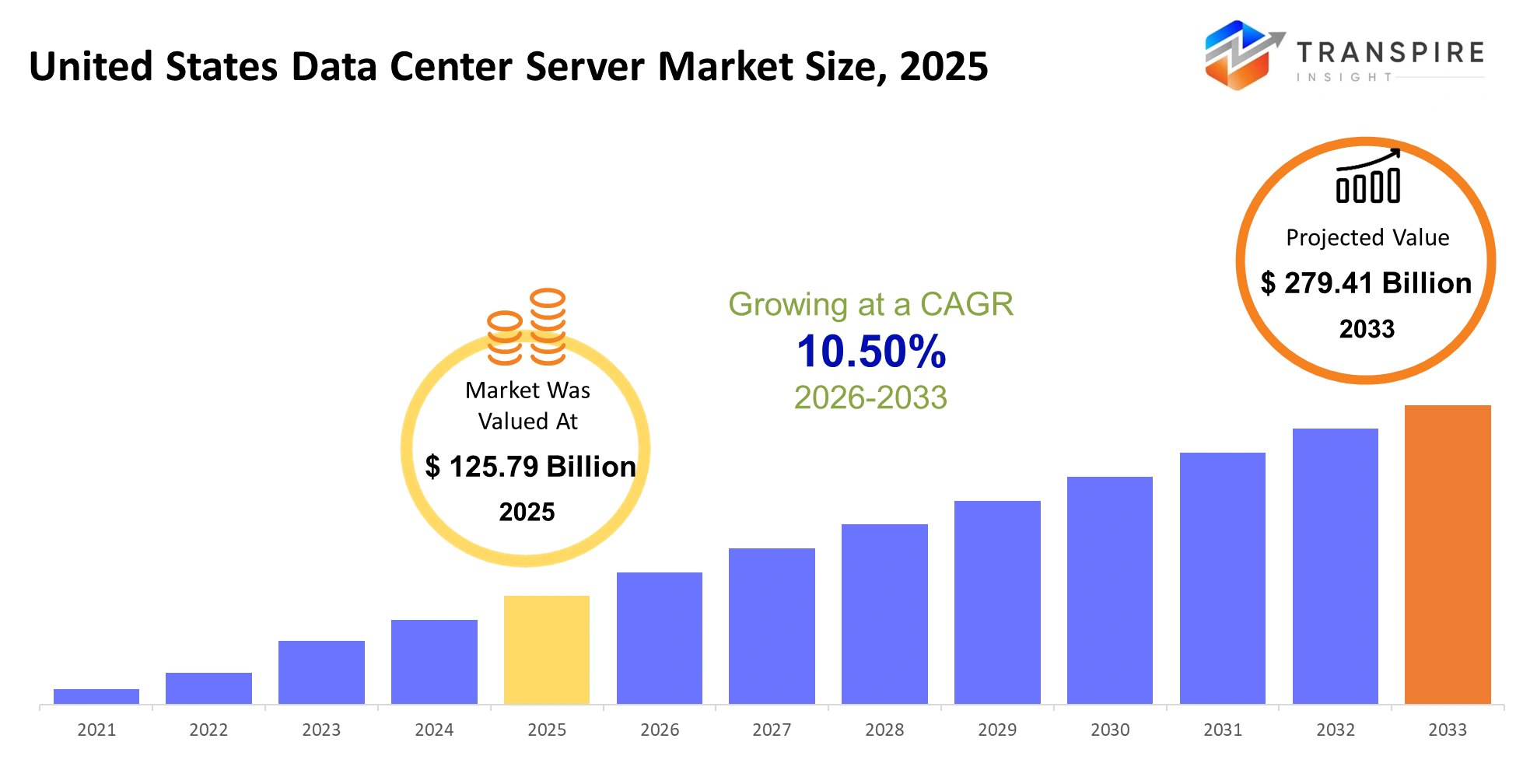
United States Data Center Server Market Size & Forecast:
- United States Data Center Server Market Size 2025: USD 125.79 Billion
- United States Data Center Server Market Size 2033: USD 279.41 Billion
- United States Data Center Server Market CAGR: 10.50%
- United States Data Center Server Market Segments: By Type (Rack Servers, Blade Servers, Tower Servers, Micro Servers, Hyperscale Servers, Others); By Application (Cloud Computing, Enterprise IT, HPC, AI Workloads, Storage, Others); By End-User (IT Companies, Enterprises, Telecom, BFSI, Govt, Others); By Component (Processors, Memory, Storage, Networking, Cooling, Others).
To learn more about this report,  Download Free Sample Report
United States Data Center Server Market Summary
The United States Data Center Server Market was valued at USD 125.79 Billion in 2025. It is forecast to reach USD 279.41 Billion by 2033. That is a CAGR of 10.50% over the period.
The United States data center server market kinda keeps the whole digital machine alive , you know, it supports cloud platforms , business software , streaming services, money movements, and even AI workloads so they stay on , without interruptions. Really, these servers do the behind the scenes work of storing, computing, and moving huge amounts of data super quickly, and companies rely on that for near real time operations. Over the last five years, the market has kinda shifted in a more structural way away from plain old enterprise server deployments and toward hyperscale and AI-optimized designs , where operators basically push for high density compute systems and faster, accelerated processing.
This shift was turned up during the pandemic when remote work expanded fast , and then generative AI got adopted more widely which basically revealed capacity bottlenecks across older infrastructure. At the same time, semiconductor supply limits and global logistics problems made teams revisit procurement cycles. So they started leaning into resilient sourcing strategies and more careful planning. Now, the current market growth really looks like an operational reset. Companies are modernizing their server fleets for heavier computational demands , and that is pulling higher value server setups into everyday mainstream usage , while also growing revenue via premium hardware integration and longer term infrastructure refresh cycles.
Key Market Insights
- The Western United States kinda dominates the United States data center server market, with about 38% share in 2025, mostly led by California’s hyper scale infrastructure cluster, and it just feels very concentrated there.
- The Southern region is the quickest mover, set to grow more than 11% through 2032, backed by tax incentives, plus cheaper power rates.
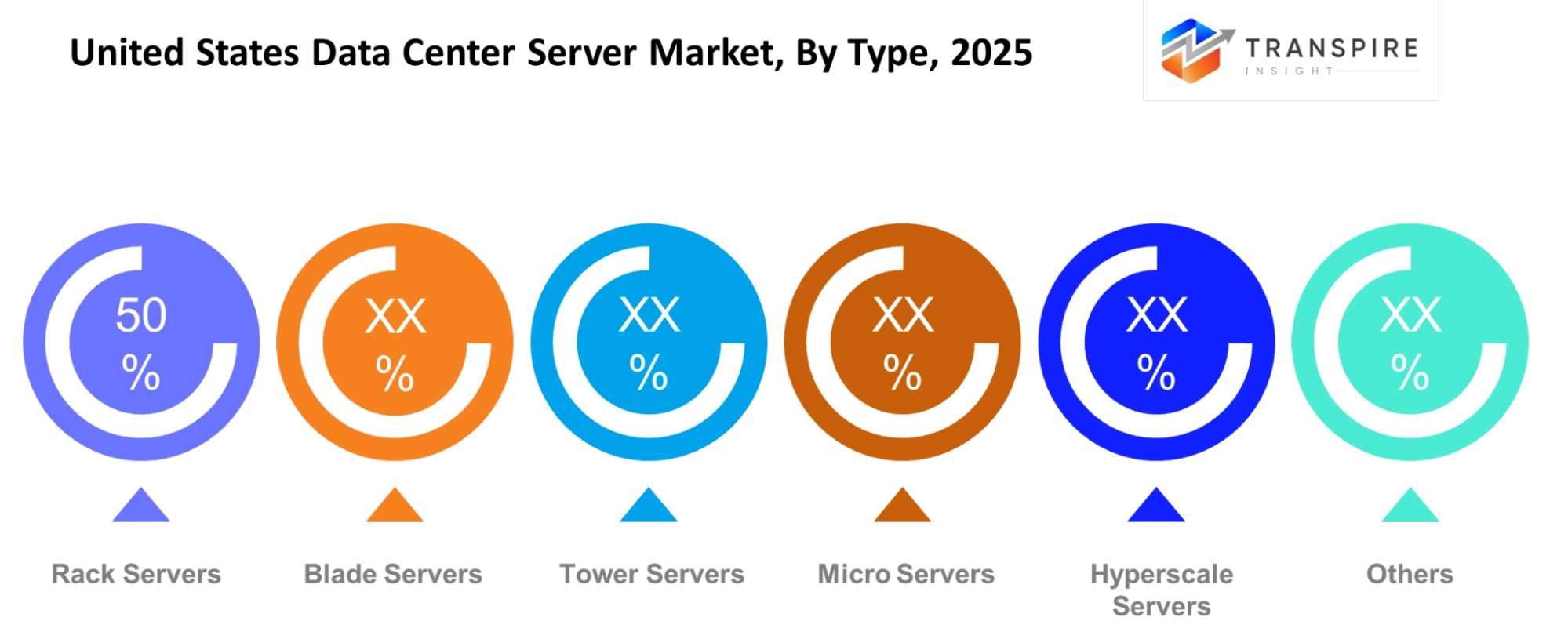
- In terms of server types, rack servers are still on top, taking around 46% of the United States data center server market in 2025, pushed by enterprise modernization initiatives, and upgrades everywhere.
- Blade servers sit in the second position, driven by the need for compact and scalable deployments across colocation sites.
- Also, AI accelerator-integrated servers are the fastest-growing slice, forecasted to expand above 18% each year through 2030, which is pretty telling.
- Cloud computing applications really do dominate, and they account for nearly 52% of all server deployments in 2025, mostly because enterprise migration strategies keep pushing everything forward.
- AI model training and inference workloads are seeing the quickest expanding application demand too, with deployments accelerating sharply somewhere between 2026 and 2031, like a switch got flipped.
- Financial services also stay a major demand driver, and they end up needing low-latency infrastructure for environments packed with transaction-heavy activity.
- Hyperscale cloud providers are leading the United States Data Center Server Market with more than 48% share in 2025 , which mirrors aggressive infrastructure expansion in practice.
- Meanwhile colocation operators show up as the second-largest end-user segment due to those ongoing enterprise outsourcing strategies that just dont stop.
What are the Key Drivers, Restraints, and Opportunities in the United States Data Center Server Market?
The most powerful driver in accelerating the United States data center server market is this rapid shift toward AI-heavy computing. It really got going after 2023, when generative AI platforms moved from experiments into commercial use, and that, sort of, revealed the weak spots of older server setups. Most enterprises and the big hyperscale cloud players moved fast toward GPU-rich, high-density server systems, designed to support model training plus inference, pretty much at scale. Because of this, market revenue has expanded in a direct way, since AI-ready servers often sell for materially higher average prices than the more classic enterprise server lines. Also, the replacement loop got shorter, with operators discarding legacy hardware earlier, just to meet the performance needs , on time.
At the same time, the market’s biggest structural obstacle is power and grid infrastructure limitations across several major data center hubs in the U.S.. Northern Virginia and Silicon Valley, plus portions of Texas, are encountering electricity supply constraints. And it’s not something you can fix overnight, since utility expansion tends to involve years of permitting, transmission upgrades, and big-capital schedules. So even if demand is there, and budgets are there, deployment can still be delayed. The knock-on effect shows up as suppressed revenue for server vendors and slower commissioning timelines for infrastructure work, especially for hyperscale builds that need near-immediate access to high-capacity power.
Looking ahead, the next notable growth opportunity seems to be edge and secondary-market expansion across regions like Ohio, Arizona, and Georgia. Those areas are drawing substantial investment because of lower land expenses, better access to renewable energy, and tax frameworks that feel more supportive. If builders deploy modular liquid-cooled server architectures in these developing locations, they could unlock another phase of scalable infrastructure, and yes, that phrase matters, because scale is the entire game here, for AI workloads and beyond.
What Has the Impact of Artificial Intelligence Been on the United States Data Center Server Market?
Artificial intelligence, and advanced digital technologies, are basically going to keep reshaping the United States data center server market, in a way where server environments become more “autonomous” and yes, more efficient, but also more resilient. With AI driven infrastructure management platforms, workload balancing starts getting automated, along with thermal regulation, and power allocation, across big server clusters. In practice operators are turning toward smart control systems that keep watching rack temperatures, cooling loads, and energy use, then they can do real time tweaks. That helps cut down power waste, plus it generally makes system stability feel better. Some hyperscale sites, report cooling related energy use dropped about 10% to 20%, while at the same time server utilization went up.
On the maintenance side, machine learning models are making predictive maintenance stronger. They ingest telemetry from processors, storage devices, and power distribution units, and then they can catch failure patterns earlier, before hardware degradation turns into an outage. That kind of early warning supports higher uptime, lowers those emergency replacement expenses, and also stretches the equipment life cycle. Separately, AI based performance optimization tools are improving compute efficiency too, by shifting workloads on the fly to cut latency, and push higher processing output.
Still, one notable stumbling block exists, and it’s about integration complexity with legacy infrastructure. A lot of enterprise facilities run mixed server setups, built across multiple hardware generations, so AI deployment can become expensive and technically hard. If data formats are inconsistent, and historical operational datasets are limited, model accuracy can dip during the first phase, which delays the full payoff from intelligent server orchestration.
Key Market Trends
- Since 2023, hyperscalers like Microsoft and Amazon Web Services have shifted their procurement toward GPU-heavy clusters, and that upped average server configuration values by more than 30% or so, not sure exactly.
- Between 2021 and 2025, liquid cooling adoption kind of moved from those more niche rollouts to more mainstream hyperscale projects, while rack densities went from roughly 15 kW, and then beyond 50 kW.
- Since 2022, utility constraints in Northern Virginia made a few commissioning timelines slip, so operators started leaning more on secondary hubs like Ohio and Arizona, instead.
- Enterprise buyers have been shrinking hardware refresh cycles from five years down to three or four years, after generative AI workloads basically showed the processing ceilings.
- Since 2024, server manufacturers including Dell Technologies and Super Micro Computer have sped up direct-to-hyperscaler customization strategies, as in a tighter fit.
- Semiconductor supply disruptions that peaked in 2022, also nudged operators to diversify sourcing, which reduced dependence on any one supplier procurement model.
- AI-based infrastructure orchestration platforms have lowered cooling overhead by about 10% to 20% since 2023, and this is where purchasing priorities got rerouted toward software-integrated hardware ecosystems.
- Regional tax incentives that rolled out across Texas and Georgia starting in 2021 helped redirect large-scale server deployment pipelines away from the usual coastal markets, a bit off track.
- Since 2024, buyers have been favoring energy-per-compute efficiency over raw processing volume because electricity costs started to weigh in much more heavily as a procurement decision factor.
United States Data Center Server Market Segmentation
By Type:
The rack servers segment holds a solid position in the United States Data Center Server Market , mostly because they get used a lot across enterprise sites and colocation spaces. It’s compact , makes efficient use of floor space, and the upkeep stays relatively simple which supports more ongoing deployments. Big operators often choose rack systems because scaling becomes less painful while workloads stay consistent across cloud and enterprise functions.
Blade servers keep picking up traction, especially where dense computing environments are a real thing. They deliver high processing power with less physical space so the adoption is practical for facilities running virtualization and cloud based workloads. Tower servers still matter to smaller businesses, since the rollout is easy and generally cost-effective. Micro servers fit lightweight applications well, and hyperscale servers keep climbing , particularly as major cloud providers expand infrastructure to handle escalating digital traffic and heavy processing requirements.
To learn more about this report, Download Free Sample Report
By Application:
Cloud computing is driving application demand in the United States Data Center Server Market , as organizations continue moving workloads onto digital platforms. The expanding use of software-as-a-service approaches , plus hybrid cloud setups, boosts the demand for servers that can manage steady processing. With flexibility and better resource alignment, cloud focused deployments end up staying central to how the market grows.
AI workloads and high performance computing add strong momentum as businesses work with bigger datasets and more advanced analytics. Storage solutions remain essential too , because digital content keeps swelling and dependable capacity is non negotiable. Enterprise IT keeps adopting steadily for day to day operational systems , while specialized implementations across research and analytics help broaden overall market expansion as infrastructure requirements keep evolving.
By End-User:
IT companies are like a leading end user group , mainly because the whole digital services world needs solid backend infrastructure, and without that it kind of falls apart. They keep doing continuous investment on server modernization , which helps with faster computing, better service reliability , and maybe a bit less stress overall. Telecom companies meanwhile also matter a lot because network expansion , 5G deployment, and the growing data traffic , all push new demands on efficient server systems , you know.
Across many industries, enterprises keep adopting advanced server solutions to chase their digital transformation objectives. In BFSI, institutions need secure and high capacity infrastructure for transaction processing, plus compliance obligations. Government agencies depend on dependable systems for public service operations, while other domains like healthcare and education add more pressure through broader use of connected digital platforms.
By Component:
Processors are still the bedrock of server performance , with ongoing upgrades that bring more speed and efficiency. The demand just keeps climbing for high core count processors that can handle AI applications and heavy enterprise workloads, without the usual slowdown. Memory upgrades also turn into a key factor , since they let multitasking feel smoother and data access become quicker across current data center environments.
Storage systems keep moving toward quicker and more scalable options, because businesses are managing ever larger information volumes. Networking components are just as important , for smooth data transfer and lower latency. And cooling technologies are becoming increasingly vital too, since higher server density creates more heat , so energy efficient thermal management systems are needed to keep things stable, plus to control infrastructure costs in the long run.
What are the Key Use Cases Driving the United States Data Center Server Market?
So, the main thing that is pushing people to adopt servers is this hyperscale cloud infrastructure that kinda supports enterprise software delivery, streaming platforms, and big AI model training. The cloud providers are usually the ones with the most pull, because those workloads need ongoing compute expansion, low latency processing, and they also keep cycling new hardware pretty often, just to hold performance steady.
On the other hand, the neighboring applications are getting more attention too, especially in finance, and in healthcare. Banks are rolling out advanced server environments for real time fraud detection and high frequency transaction processing. Meanwhile, healthcare networks lean on high performance systems for medical imaging analytics, and genomics research. It’s like the same trend but for different reasons, you know.
More recently, we’re seeing edge computing deployments take off for autonomous manufacturing, plus private 5G network orchestration. And there is another big opportunity, like infrastructure specifically aimed at sovereign AI development. In that space, government supported programs and defense linked computing efforts are starting to deploy secure, isolated server clusters across strategically placed U.S. facilities.
|
Report Metrics |
Details |
|
Market size value in 2025 |
USD 125.79 Billion |
|
Market size value in 2026 |
USD 138.87 Billion |
|
Revenue forecast in 2033 |
USD 279.41 Billion |
|
Growth rate |
CAGR of 10.50% from 2026 to 2033 |
|
Base year |
2025 |
|
Historical data |
2021 - 2024 |
|
Forecast period |
2026 - 2033 |
|
Report coverage |
Revenue forecast, competitive landscape, growth factors, and trends |
|
Geographic scope |
United States of America |
|
Key company profiled |
Dell, HPE, IBM, Cisco, Lenovo, Supermicro, Inspur, Fujitsu, Oracle, Huawei, Intel, AMD, NVIDIA, NetApp, Hitachi. |
|
Customization scope |
Free report customization (country, regional & segment scope). Avail customized purchase options to meet your exact research needs. |
|
Report Segmentation |
By Type (Rack Servers, Blade Servers, Tower Servers, Micro Servers, Hyperscale Servers, Others); By Application (Cloud Computing, Enterprise IT, HPC, AI Workloads, Storage, Others); By End-User (IT Companies, Enterprises, Telecom, BFSI, Govt, Others); By Component (Processors, Memory, Storage, Networking, Cooling, Others). |
Which Regions are Driving the United States Data Center Server Market Growth?
The Western United States still shows up as the main area in the data center server market, sort of led by California’s unmatched gathering of hyperscale campuses and newer digital frameworks. This kind of position comes from a more mature tech ecosystem, with big cloud providers, semiconductor companies, and AI research groups staying really clustered near Silicon Valley. There’s also long standing policy backing for new ideas, plus thick fiber connections, and access to super specialized engineering talent. Together they keep that edge. On top of that, the West has a well established supplier network, which makes faster deployment cycles easier and keeps server modernization moving across huge sites without much pause.
Now the Mid-Atlantic region, and especially Northern Virginia, feels different but it still matters just as much. It’s not the same innovation story as the West, more like operational consistency that really holds things steady. Colocation economics tend to be stable, and enterprise connectivity routes are already deeply rooted there. The region also has a lot of internet exchange infrastructure, so it becomes the go to place for latency sensitive financial services and federal workloads. Demand there is pretty steady, so a resilient revenue base forms, and that’s one reason server investments keep coming even when power availability gets tighter than before.
The Southern United States is kinda emerging as the fastest-growing regional market, driven by aggressive infrastructure expansion across Texas Georgia and Arizona. Over the past three years, state-level tax incentives , utility-scale renewable energy projects and accelerated land development approvals have changed these markets into real good alternatives for hyperscale expansion. This change got momentum as operators looked for relief from power bottlenecks in the old traditional hubs. For newcomers , and investors alike , the South is offering the best opportunity all the way through 2033, especially for AI-focused server deployments and next-generation cooling infrastructure, where everything tends to get a little more serious.
Who are the Key Players in the United States Data Center Server Market and How Do They Compete?
The competitive landscape for the United States data center server market seems pretty focused around a small group of global infrastructure vendors, though competition is getting sharper lately as AI workloads start to rewrite what buyers think matters most. Incumbents are sort of defending share with rapid product redesigns , while specialized challengers are nudging out old procurement patterns using quicker customization and faster deployment style capabilities. In a way, technology differentiation has moved ahead of price as the main battleground, especially for areas like GPU integration, liquid cooling compatibility, and power-efficient high-density architecture. Also , the speed of delivery by geography and those direct relationships with hyperscalers now count almost as much, because server buyers want shorter time-to-deployment windows.
Dell Technologies plays the game through large-scale enterprise integration and lifecycle management services, helping customers deploy tightly managed infrastructure environments. Its edge is basically the combo of server hardware with software orchestration and support contracts, which tends to appeal to organizations modernizing older estates. Hewlett Packard Enterprise differentiates by pushing consumption-based infrastructure models like GreenLake, and this gives customers more flexibility for scaling compute resources without needing big upfront capital commitments. That services-led strategy has helped it strengthen traction across hybrid cloud deployments.
Super Micro Computer has started to move faster, kinda gaining momentum by doing rapid engineering cycles and rolling out purpose-built AI server setups that are tuned for advanced accelerators. The way it can ship customized liquid-cooled platforms to the market quickly , gives it a real edge with hyperscale operators who need speed. NVIDIA on the other hand is expanding its influence by leaning hard on deep partnerships with server OEMs , so its GPU ecosystem is literally built into next-gen architectures. And then Lenovo plays the long game with manufacturing efficiency plus an aggressive regional push, which helps it win more cost-sensitive deployments around those emerging U.S. server hubs.
Company List
Recent Development News
In March 2026, Vertiv entered a strategic partnership with Generate Capital. The collaboration launched a Bring Your Own Power & Cooling (BYOP&C) infrastructure model for U.S. data centers, enabling faster server capacity deployment in power-constrained markets and reducing upfront infrastructure costs for hyperscale and enterprise operators.
Source: https://www.prnewswire.com/
In May 2026, Hewlett Packard Enterprise launched new private cloud and data platform solutions built on its latest ProLiant Gen12 server architecture. The release strengthens enterprise AI data-center modernization efforts in the United States by improving server orchestration, accelerating AI-ready workload deployment, and enhancing infrastructure efficiency for large-scale data center operators.
Source: https://www.hpe.com/
What Strategic Insights Define the Future of the United States Data Center Server Market?
Over the next five to seven years, the United States data center server market is sort of structurally moving toward highly specialized, AI-native infrastructure that is built around dense compute clusters and advanced cooling systems, plus software-defined resource orchestration. And honestly this shift feels less tied to old school cloud expansion, and more like it is being pulled by the commercial race to roll out large-scale inference capacity. In practice that means the winners will be vendors who can deliver tightly integrated hardware ecosystems rather than just standalone server products.
There’s also a less visible risk that people don’t talk about much, market concentration around a small number of hyperscale buyers and accelerator suppliers. If buying power becomes even more consolidated among a handful of cloud operators, server vendors could run into margin compression, even while shipment values keep climbing. On top of that dependence on advanced chip packaging capacity creates a bottleneck that might slow down deployment timelines ,quite a bit.
One emerging opportunity is the development of edge AI infrastructure across secondary U.S. markets, like Ohio and Tennessee. There, improving grid resilience and lower land costs are making the economics look more favorable. Market participants should lock in regional utility partnerships and also invest early in modular liquid-cooled architectures, because deployment flexibility will end up being a stronger competitive differentiator than raw hardware size alone.
United States Data Center Server Market Report Segmentation
By Type
- Rack Servers
- Blade Servers
- Tower Servers
- Micro Servers
- Hyperscale Servers
By Application
- Cloud Computing
- Enterprise IT
- HPC
- AI Workloads
- Storage
By End-User
- IT Companies
- Enterprises
- Telecom
- BFSI
- Govt
By Component
- Processors
- Memory
- Storage
- Networking
- Cooling
Frequently Asked Questions
Find quick answers to common questions.
The United States Data Center Server Market size is USD 279.41 Billion in 2033.
Key segments for the United States Data Center Server Market are By Type (Rack Servers, Blade Servers, Tower Servers, Micro Servers, Hyperscale Servers, Others); By Application (Cloud Computing, Enterprise IT, HPC, AI Workloads, Storage, Others); By End-User (IT Companies, Enterprises, Telecom, BFSI, Govt, Others); By Component (Processors, Memory, Storage, Networking, Cooling, Others).
Major United States Data Center Server Market players are Dell, HPE, IBM, Cisco, Lenovo, Supermicro, Inspur, Fujitsu, Oracle, Huawei, Intel, AMD, NVIDIA, NetApp, Hitachi.
The United States Data Center Server Market size is USD 125.79 Billion in 2025.
The United States Data Center Server Market CAGR is 10.50% from 2026 to 2033.
- Dell
- HPE
- IBM
- Cisco
- Lenovo
- Supermicro
- Inspur
- Fujitsu
- Oracle
- Huawei
- Intel
- AMD
- NVIDIA
- NetApp
- Hitachi
Recently Published Reports
-
Apr 2026
3D Optical Profiler Market
3D Optical Profiler Market Size, Share & Analysis Report By Type (Desktop 3D Optical Profiler, and Portable 3D Optical Profiler), By Technology (Confocal Technology, and White Light Interference), By End-Use Industry (Manufacturing, Research Institutions, Automotive, Aerospace and Defense, Medical Devices, and Other), and Geography (North America, Europe, Asia-Pacific, Middle East and Africa, South and Central America), 2021 - 2031
-
Apr 2026
Depth Sensor Market
Depth Sensor Market Size, Share & Analysis Report By Type (Infrared Depth Sensors, Time-of-Flight (ToF) Sensors, Stereo Vision Sensors, Structured Light Sensors, Ultrasonic Depth Sensors), By Application (Automotive, Robotics, Gaming, Consumer Electronics, Industrial Automation, Healthcare, Security & Surveillance, Others), By End Users (Automotive Manufacturers, Consumer Electronics Companies, Healthcare Providers, Industrial Companies, Security Agencies, Gaming Companies, Robotics Companies, Others), and Geography (North America, Europe, Asia-Pacific, Middle East and Africa, South and Central America), 2021 – 2031
-
Apr 2026
Digital Manufacturing Market
Digital Manufacturing Market Size, Share & Analysis Report By Component (Hardware, Software, and Services), By Technology (Robotics, 3D Printing, Internet of Things (IoT), and Others), By Application (Automotive and Transportation, Aerospace and Defense, Consumer Electronics, Industrial Machinery, and Others), By Process Type (Computer-Based Designing, Computer-Based Simulation, Computer 3D Visualization, Analytics, and Others), and Geography (North America, Europe, Asia-Pacific, Middle East and Africa, South and Central America), 2021 – 2031
-
Apr 2026
Digital Visa Services Market
Digital Visa Services Market Size, Share & Analysis Report By Type (Individual Travelers, Group Travelers), By Application (Tourism, Business Travel, Others), and Geography (North America, Europe, Asia-Pacific, Middle East and Africa, South and Central America), 2021 – 2031