

Europe Micro Data Center Market Size & Forecast:
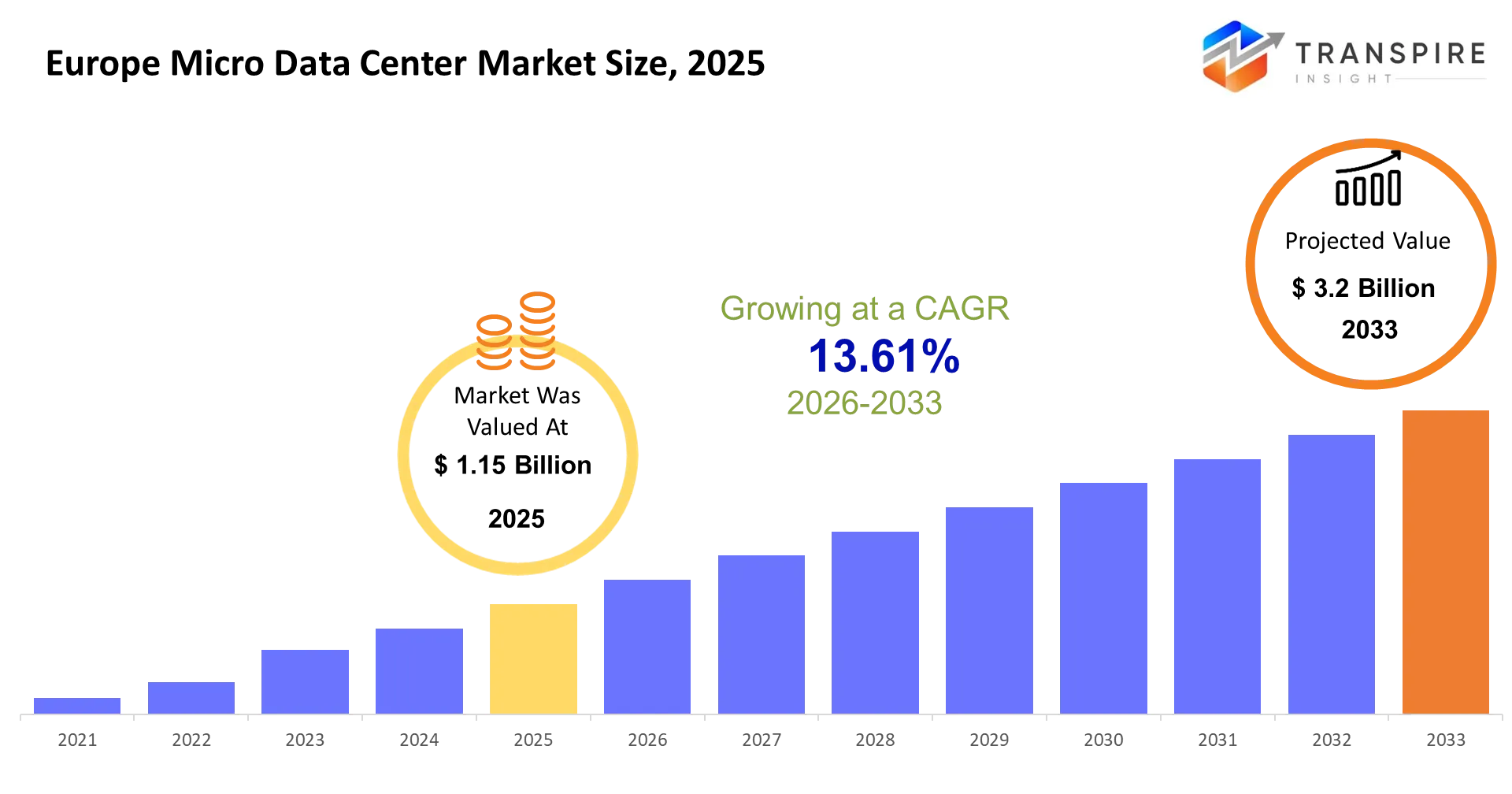
- Europe Micro Data Center Market Size 2025: USD 1.15 Billion
- Europe Micro Data Center Market Size 2033: USD 3.2 Billion
- Europe Micro Data Center Market CAGR: 13.61%
- Europe Micro Data Center Market Segments: By Type (Rack-based, Containerized, Modular, Edge Data Centers, Others); By Application (Edge Computing, Remote Offices, IoT Applications, Others); By End-User (IT & Telecom, BFSI, Healthcare, Retail, Others); By Component (Power Systems, Cooling Systems, Networking, Others)
To learn more about this report,  Download Free Sample Report
Europe Micro Data Center Market Summary
The Europe Micro Data Center Market was valued at USD 1.15 Billion in 2025. It is forecast to reach USD 3.2 Billion by 2033. That is a CAGR of 13.61% over the period.
European companies face critical infrastructure problems which micro data centers address by delivering computing and storage and cooling and networking systems to locations close to data generation and consumption areas. Compact systems enable telecom operators and manufacturers and hospitals and logistics providers to achieve better performance through lower latency and uninterrupted operations and real-time digital service delivery without full reliance on remote centralized facilities. The 5G network rollout together with industrial automation and AI-driven analytics created a new need for edge computing solutions which led to a 5 year market transition toward edge-based computing.
The European data sovereignty and sustainability regulations which became mandatory after 2021 forced companies to handle sensitive data within local jurisdictions while they worked to enhance their energy efficiency. Major hyperscale data center hubs faced supply chain problems and power shortages which demonstrated the dangers of relying on centralized infrastructure systems. The combination of these two elements led to increased investment in edge systems which use modular and prefabricated design to achieve rapid deployment and proximity to industrial and urban demand centers. Direct revenue generation for vendors now comes from their distributed computing systems through integrated cooling and intelligent power management and remote infrastructure monitoring services.
Key Market Insights
- The Europe Micro Data Center Market in 2025 saw Western Europe secure 42% of the market share according to its advanced telecom and cloud infrastructure.
- The market share of Germany France and United Kingdom increased from 2024 to 2026 through their investments in sustainability-based edge infrastructure development.
- Eastern Europe established itself as the fastest expanding market during the 2026 to 2033 prediction period because of industrial digitization and EU-supported connectivity initiatives.
- Poland and Romania expanded their investments in smart manufacturing and 5G infrastructure which generated new requirements for modular edge computing facilities.
- The market share of rack-based systems reached approximately 38% in 2025 because enterprises selected compact deployment models for their telecom and branch computing needs.
- The second largest segment of modular micro data centers emerged because enterprises reduced their deployment timelines from months to weeks through their use of prefabricated infrastructure.
- Between 2026 and 2033 edge data centers became the fastest expanding sector because of rising AI inferencing and real-time analytics workloads.
- Cooling systems experienced significant growth after 2024 because high-density AI and telecom edge deployments started using liquid cooling systems.
- The application demand for edge computing reached 41% in 2025 because telecom providers expanded their low-latency 5G enterprise services.
- The Europe Micro Data Center Market in 2025 generated its highest revenue from IoT IT and telecom companies which actively expanded their edge network operations.
What are the Key Drivers, Restraints, and Opportunities in the Europe Micro Data Center Market?
The European market expansion process experiences its primary push from the current fast development of edge computing infrastructure which 5G networks and AI systems and industrial automation technology bring. Telecom operators and enterprise networks increasingly require localized processing capacity to reduce latency and manage rising data traffic volumes generated by connected devices and real-time analytics platforms. The transition toward digital operations reached its peak after 2023 when manufacturers and logistics providers and healthcare systems started their digital operations which required a distributed system instead of a centralized cloud environment. The demand for small modular systems which can be installed near operational sites has increased because of this trend which leads to higher equipment sales and software integration revenue and permanent infrastructure maintenance agreements.
The most significant restraint remains the structural limitation of energy availability and grid capacity in major European data center hubs. Power allocation constraints and stricter environmental approval processes which delay distributed infrastructure project deployment in Germany and the Netherlands and Ireland continue to affect these regions. The challenge requires an extended period because grid modernization needs multiple years of public infrastructure development while renewable integration and permitting reforms need extended timeframes. The infrastructure vendors and colocation operators face revenue loss because their deployment approvals experience ongoing delays.
Secondary Eastern European industrial markets present a significant opportunity for companies that develop smart manufacturing technologies and EU-supported digital infrastructure projects which create a strong demand for edge computing solutions.Poland and Romania are developing their 5G networks and industrial automation systems which create opportunities for companies that provide modular edge computing solutions. The market will benefit from vendors who offer ready-to-use energy-saving systems that include artificial intelligence monitoring tools because these vendors will secure future enterprise modernization investments until 2033.
What Has the Impact of Artificial Intelligence Been on the Europe Micro Data Center Market?
The introduction of artificial intelligence together with advanced digital technologies has brought operational improvements to micro data centers throughout Europe through enhanced automation and better infrastructure management and improved remote monitoring functions. Operators increasingly use AI-driven DCIM platforms to manage automatic temperature control systems together with their distributed edge facilities power management and equipment distribution needs. The companies Schneider Electric and Vertiv have developed intelligent monitoring systems which track real-time thermal loads and rack usage and energy consumption to minimize the need for human monitoring in decentralized computing environments. Automated control systems enable both telecommunications and industrial operators to maintain operational availability while they handle 5G and artificial intelligence workloads which require real-time processing.
Machine learning models enhance predictive maintenance abilities by detecting temperature anomalies and component damage and power system faults which lead to equipment failures. Data center operators increasingly apply predictive analytics to optimize cooling efficiency which extends equipment lifespan and reduces unplanned downtime across edge installations. AI-enabled energy optimization platforms have helped some facilities lower cooling-related energy consumption by double-digit percentages while improving infrastructure utilization rates. Advanced analytics support emissions monitoring and sustainability compliance through energy efficiency measurement against European environmental standards.
The high integration costs together with fragmented legacy infrastructure systems create obstacles which prevent organizations from implementing AI technology across their entire operations. The majority of distributed facilities operate with different hardware systems which lack compatibility, thus creating difficulties for smaller operators who want to implementAI technology throughout their facilities.
Key Market Trends
- Telecom operators across Germany and France started increasing their edge deployments during 2023 to enable their low-latency 5G enterprise applications and localized AI processing operations.
- The adoption of liquid cooling systems experienced rapid growth during 2025 because AI inferencing workloads required operators to exceed traditional air-cooling limits in small infrastructure spaces.
- Schneider Electric and Vertiv redirected their product development efforts toward software-based modular systems that include predictive energy management and remote monitoring functionality.
- Manufacturing companies in Poland and Czech Republic started investing in smart factory technologies which created a need for industrial edge infrastructure within their local areas.
- European sustainability regulations required operators to use low-carbon cooling systems and renewable energy sources instead of standard energy-intensive operational methods.
- Enterprise buyers started shifting from centralized systems to distributed micro facilities which helped them maintain operational continuity during latency issues and regional power failures.
- Between 2024 and 2026, enterprises adopted prefabricated modular systems because they could deploy these systems within weeks instead of the traditional months required for standard systems.
- Healthcare and BFSI organizations developed new processing facilities in response to stricter regional data governance laws which made them more cautious about using cross-border cloud services.
- Secondary metropolitan markets received increased investment in infrastructure development because hyperscale congestion drove up land and power and cooling expenses at primary European data center locations.
Europe Micro Data Center Market Segmentation
By Type:
The market revenue of rack-based systems remains strong because businesses need small and standardized systems to operate their branch offices and telecom stations and their local computing facilities. The banking industry and retail businesses and telecom companies all need rack-integrated power and cooling and monitoring products which enable them to operate within their small available space. Organizations that need to expand their edge networks can use rack-based systems because these systems require less time to install and need less complex operations.
The manufacturing sector and logistics sector and energy sector are adopting containerized and modular systems because these systems support industrial automation and remote infrastructure deployment. The modular design of large enterprises newly preferred by enterprises enables businesses to create expandable systems which shorten construction time and decrease engineering work needed at the project site. The expansion of edge data centers occurs because 5G networks and AI inferencing and real-time analytics drive the need for processing that requires minimal delay through nearby data centers. The product development team will create higher-density cooling solutions and remote management software and prefabricated integration capabilities to enable the growth of distributed digital infrastructure throughout the upcoming forecast period.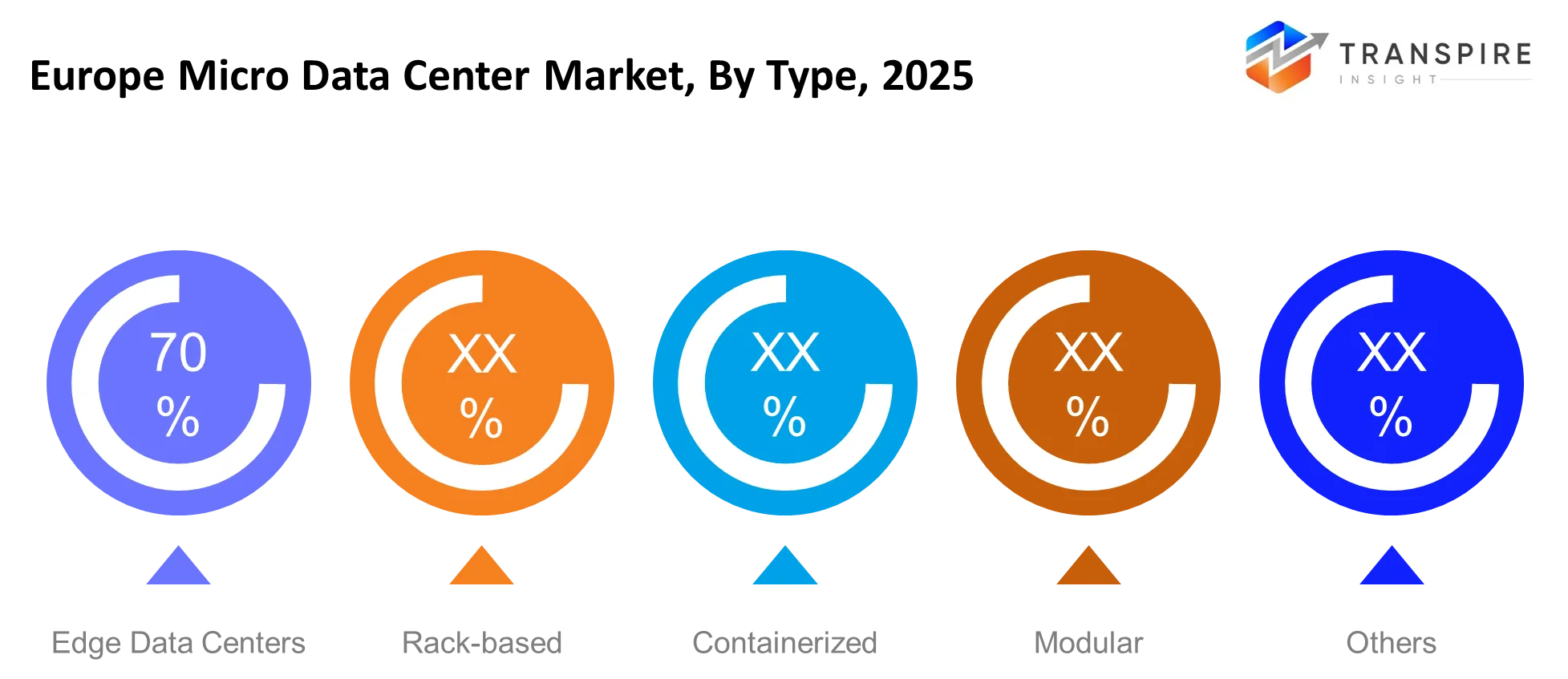
To learn more about this report, Download Free Sample Report
By Application:
The edge computing system serves as the main application area because telecom operators and cloud service providers and industrial enterprises need to perform localized data processing which helps them achieve better performance through reduced latency and decreased need for bandwidth. The combination of rapid 5G deployment and rising enterprise demand for AI-based analytics solutions has resulted in fast expansion of edge infrastructure throughout urban areas and industrial locations. Financial institutions, smart factories, and logistics networks depend on localized processing to support real-time operational visibility and secure data handling.
Healthcare and retail and public sector environments experience ongoing growth of remote office infrastructure and IoT-based deployments. Distributed enterprises increasingly deploy compact computing facilities within branch offices to improve application reliability and business continuity. IoT applications are creating additional demand as connected sensors and automation systems and predictive maintenance platforms generate large volumes of localized operational data. Future investment is expected to shift toward intelligent workload management and remote orchestration platforms and energy-efficient edge processing systems that autonomous operations.
By End-User:
The deployment activities of IT and telecom organizations reach their highest point because network densification and cloud expansion and 5G infrastructure development create a need for decentralized computing resources throughout urban and industrial areas. Telecom operators maintain their investment in small-scale edge facilities because these facilities enable them to provide low-latency applications and content delivery and enterprise connectivity services. The segment experiences continuous funding because of the high data traffic and the increasing need for distributed processing.
Healthcare and BFSI sectors are increasing adoption due to strict data security requirements and the growing need for uninterrupted digital operations. Hospitals and financial institutions need local infrastructure that enables them to conduct real-time analytics and electronic records management and transaction processing without dependency on centralized cloud systems. Retail operators use local computing systems to enable their AI-based inventory management systems and digital payment solutions and customer analytics platforms. The period of forecast shows that end-user demand will choose systems which provide high security and remote management and energy-efficient operation while meeting specific industry compliance standards.
By Component:
The current power systems produce the majority of component requirements because distributed computing environments need their operations to work continuously. Uninterruptible power supply systems and intelligent power distribution units and backup energy solutions remain essential to enterprises who want to reduce downtime in their healthcare, telecom and industrial operations. Organizations increase their investments in advanced power monitoring systems and energy optimization solutions because they need to support greater deployment density and AI-powered workloads.
High-density edge computing environments need cooling systems and networking infrastructure to support their active operations. AI deployments increasingly adopt liquid cooling systems and intelligent airflow systems because these solutions help manage thermal challenges of compact infrastructure which produces excessive heat. Organizations need faster data transfer and protected remote access to their distributed network operations which is driving the development of new networking technologies. The industry expects sustained growth to create new product development opportunities which will focus on energy-efficient solutions and software-defined infrastructure management systems and integrated monitoring technologies that simplify operational tasks while reducing equipment maintenance expenses.
What are the Key Use Cases Driving the Europe Micro Data Center Market?
The primary use case which drives micro data center demand throughout Europe focuses on telecom edge computing. Telecom operators install compact modular facilities in populated areas to provide 5G service and low-latency solutions and localized data processing for their business clients. The deployment of urban and industrial networks operates at an increasing speed because organizations need to manage their infrastructure from distant locations.
The demand for localized computing systems has grown within manufacturing and healthcare sectors because factories and hospitals need these systems to support automation and predictive maintenance and real-time monitoring systems. Industrial operators increasingly deploy edge infrastructure in their smart manufacturing operations to decrease latency times and enhance their system uptime. Retail chains are also adopting micro data centers to support AI-driven inventory systems and digital payment platforms.
The development of AI inferencing at remote industrial locations and edge infrastructure for electric vehicle charging systems represents new use cases. The implementation of smart city projects which integrate traffic analytics and public surveillance with energy optimization systems has gained traction as European municipalities expand their connected infrastructure budget.
|
Report Metrics |
Details |
|
Market size value in 2025 |
USD 1.15 Billion |
|
Market size value in 2026 |
USD 1.31 Billion |
|
Revenue forecast in 2033 |
USD 3.2 Billion |
|
Growth rate |
CAGR of 13.61% from 2026 to 2033 |
|
Base year |
2025 |
|
Historical data |
2021 - 2024 |
|
Forecast period |
2026 - 2033 |
|
Report coverage |
Revenue forecast, competitive landscape, growth factors, and trends |
|
Regional scope |
Europe (Germany, United Kingdom, France, Italy, Spain, Rest of Europe) |
|
Key company profiled |
Schneider Electric, Dell, Hewlett Packard Enterprise, IBM, Vertiv, Eaton, Cisco, Huawei, Rittal, Panduit, Lenovo, ABB, Hitachi, Fujitsu, Nokia |
|
Customization scope |
Free report customization (country, regional & segment scope). Avail customized purchase options to meet your exact research needs. |
|
Report Segmentation |
By Type (Rack-based, Containerized, Modular, Edge Data Centers, Others); By Application (Edge Computing, Remote Offices, IoT Applications, Others); By End-User (IT & Telecom, BFSI, Healthcare, Retail, Others); By Component (Power Systems, Cooling Systems, Networking, Others) |
Which Regions are Driving the Europe Micro Data Center Market Growth?
The Micro Data Center market in Europe shows Western Europe as its leading region because this area possesses established digital infrastructure. The area for edge computing investments from Germany, France, and the United Kingdom supports artificial intelligence workloads and smart manufacturing operations and financial services processing needs which require immediate data access. The region benefits from its extensive fiber network and operational data centers and legal frameworks which mandate data processing to occur within specific geographic boundaries. Western Europe maintains its position as a leader in distributed digital infrastructure development through the strong partnerships between telecom companies and industrial automation vendors and energy management solution providers.
Northern Europe markets itself through its dedication to energy efficient solutions and renewable energy systems and sustainable operational practices which extend beyond basic deployment measurements. Sweden and Norway and Finland provide investment opportunities through their systems which deliver low-carbon power and their climate conditions which enable cost reductions for edge computing facilities. The region's enterprise customers need robust infrastructure to support their public sector digital projects and telecom network expansion and industrial automation initiatives, which results in a consistent demand pattern that does not show explosive growth. Sustainable micro data center operational practices and long-term service contracts have created stable revenue streams for vendors who operate in Northern Europe.
Eastern Europe represents the fastest developing regional market because industrial digitization and EU-backed infrastructure investment programs have both started to grow at faster rates. Countries such as Poland, Romania, and Czech Republic are modernizing manufacturing facilities and expanding 5G connectivity, which creates demand for localized edge computing systems. The recent push toward regional data sovereignty and smart factory deployment has encouraged enterprises to adopt compact modular infrastructure closer to operational sites. The period from 2026 to 2033 will provide infrastructure providers and cooling technology firms and investors with appealing market entry opportunities in underserved industrial and secondary metropolitan markets.
Who are the Key Players in the Europe Micro Data Center Market and How Do They Compete?
The Micro Data Center market in Europe contains multiple companies which control the majority of its market operations. Global infrastructure providers handle large enterprise deployments while regional integrators and edge specialists compete for industrial and telecom projects. The current competition between companies has shifted from price-based competition to technology integration and energy efficiency and deployment speed as the main competitive factors. The vendors must develop small systems which can expand their capacity to handle AI operations and enable remote system monitoring and fulfill European sustainability requirements. The present market incumbents use software-based infrastructure management and prefabricated modular systems to protect their existing market positions, while new companies develop localized edge systems for manufacturing and healthcare and smart city deployments.
Schneider Electric provides its customers with a unique advantage through its complete power and cooling system and its DCIM software solution which enables organizations to control their distributed edge systems from one centralized system. The EcoStruxure architecture gives the company an advantage in energy optimization and regulatory compliance, particularly in Western Europe. The company pursues growth through partnerships focused on AI development and partnerships for sustainable infrastructure development. Vertiv competes through high-density cooling innovation and prefabricated modular systems tailored for AI and telecom edge deployments. The company advances its position in latency-sensitive sectors through its latest liquid cooling and modular expansion strategy.
Rittal specializes in developing industrial edge infrastructure solutions which serve manufacturing and Industry 4.0 applications throughout Germany and Central Europe.The system achieves its highest operational performance through its unified design which combines its enclosure system with its cooling system and its IT rack system for use in industrial environments. Cisco Systems uses its networking dominance to market micro data centers as secure edge computing extensions which telecom and smart infrastructure operators can use. Dell Technologies focuses on developing modular edge solutions which enable hybrid cloud operations by providing computing resources and storage capabilities and remote management functions for quick deployment at multiple enterprise locations.
Company List
- Schneider Electric
- Dell
- Hewlett Packard Enterprise
- IBM
- Vertiv
- Eaton
- Cisco
- Huawei
- Rittal
- Panduit
- Lenovo
- ABB
- Hitachi
- Fujitsu
- Nokia
Recent Development News
“In January 2026, Vertiv launched new configurations of its MegaMod HDX prefabricated data center module for AI and liquid-cooled computing clusters. The modular infrastructure platform supports high-density AI workloads and accelerated edge deployments, reinforcing the growing convergence between micro data centers and AI-ready infrastructure in Europe.Data Center Dynamics coverage (Data Center Dynamics).”
“In April 2026, Schneider Electric entered a strategic collaboration with Deloitte to accelerate AI-enabled digital transformation across industrial operations and data center infrastructure. The partnership is expected to expand integrated AI, automation, and energy-efficiency solutions for next-generation distributed data center environments across Europe.Schneider Electric release (Schneider Electric).”
What Strategic Insights Define the Future of the Europe Micro Data Center Market?
The European Micro Data Center market is transforming into distributed edge-centric infrastructure models because artificial intelligence needs processing power and industrial automation requires compliance with European Union data sovereignty rules. The demand in the next 5 to 7 years will move away from hyperscale centralized systems and toward local processing solutions which provide faster response times and meet specific industry regulations. The market faces an invisible danger because its increasing reliance on a limited number of suppliers for advanced cooling solutions and semiconductors and power management products will result in extended deployment delays and price instability during times of political or energy crisis. The secondary Eastern European markets are creating a new business opportunity because smart manufacturing programs and EU digital infrastructure funding are driving edge technology deployments which will be adopted by enterprises at a later stage. The modular software-defined system design with its ability to work with various power and cooling systems should become the main focus for market participants because it enables rapid system growth while minimizing risks from supply chain issues and changing rules.
Europe Micro Data Center Market Report Segmentation
By Type
- Rack-based
- Containerized
- Modular
- Edge Data Centers
- Others
By Application
- Edge Computing
- Remote Offices
- IoT Applications
- Others
By End-User
- IT & Telecom
- BFSI
- Healthcare
- Retail
- Others
By Component
- Power Systems
- Cooling Systems
- Networking
- Others
Frequently Asked Questions
Find quick answers to common questions.
The Europe Micro Data Center Market size is USD 3.2 Billion in 2033.
Key segments for the Europe Micro Data Center Market are By Type (Rack-based, Containerized, Modular, Edge Data Centers, Others); By Application (Edge Computing, Remote Offices, IoT Applications, Others); By End-User (IT & Telecom, BFSI, Healthcare, Retail, Others); By Component (Power Systems, Cooling Systems, Networking, Others).
Major Europe Micro Data Center Market Players are Schneider Electric, Dell, Hewlett Packard Enterprise, IBM, Vertiv, Eaton, Cisco, Huawei, Rittal, Panduit, Lenovo, ABB, Hitachi, Fujitsu, Nokia.
The Europe Micro Data Center Market size is USD 1.15 Billion in 2025.
he Europe Micro Data Center Market CAGR is 13.61% from 2026 to 2033.
- Schneider Electric
- Dell
- Hewlett Packard Enterprise
- IBM
- Vertiv
- Eaton
- Cisco
- Huawei
- Rittal
- Panduit
- Lenovo
- ABB
- Hitachi
- Fujitsu
- Nokia
Recently Published Reports
-
Apr 2026
3D Optical Profiler Market
3D Optical Profiler Market Size, Share & Analysis Report By Type (Desktop 3D Optical Profiler, and Portable 3D Optical Profiler), By Technology (Confocal Technology, and White Light Interference), By End-Use Industry (Manufacturing, Research Institutions, Automotive, Aerospace and Defense, Medical Devices, and Other), and Geography (North America, Europe, Asia-Pacific, Middle East and Africa, South and Central America), 2021 - 2031
-
Apr 2026
Depth Sensor Market
Depth Sensor Market Size, Share & Analysis Report By Type (Infrared Depth Sensors, Time-of-Flight (ToF) Sensors, Stereo Vision Sensors, Structured Light Sensors, Ultrasonic Depth Sensors), By Application (Automotive, Robotics, Gaming, Consumer Electronics, Industrial Automation, Healthcare, Security & Surveillance, Others), By End Users (Automotive Manufacturers, Consumer Electronics Companies, Healthcare Providers, Industrial Companies, Security Agencies, Gaming Companies, Robotics Companies, Others), and Geography (North America, Europe, Asia-Pacific, Middle East and Africa, South and Central America), 2021 – 2031
-
Apr 2026
Digital Manufacturing Market
Digital Manufacturing Market Size, Share & Analysis Report By Component (Hardware, Software, and Services), By Technology (Robotics, 3D Printing, Internet of Things (IoT), and Others), By Application (Automotive and Transportation, Aerospace and Defense, Consumer Electronics, Industrial Machinery, and Others), By Process Type (Computer-Based Designing, Computer-Based Simulation, Computer 3D Visualization, Analytics, and Others), and Geography (North America, Europe, Asia-Pacific, Middle East and Africa, South and Central America), 2021 – 2031
-
Apr 2026
Digital Visa Services Market
Digital Visa Services Market Size, Share & Analysis Report By Type (Individual Travelers, Group Travelers), By Application (Tourism, Business Travel, Others), and Geography (North America, Europe, Asia-Pacific, Middle East and Africa, South and Central America), 2021 – 2031