
Europe Green Data Center Market Size & Forecast:
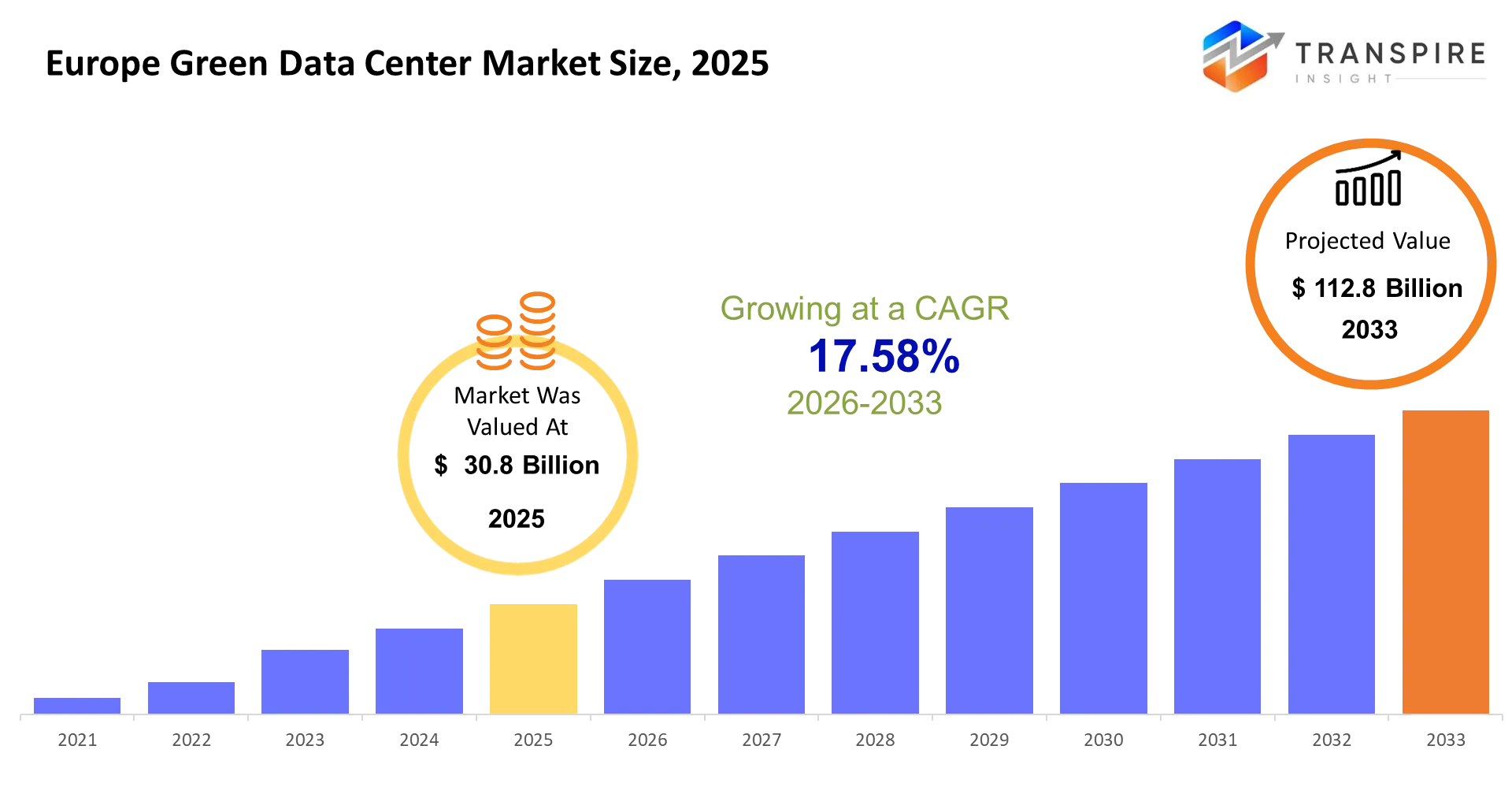
- Europe Green Data Center Market Size 2025: USD 30.8 Billion
- Europe Green Data Center Market Size 2033: USD 112.8 Billion
- Europe Green Data Center Market CAGR: 17.58%
- Europe Green Data Center Market Segments: By Type (Renewable Energy Data Centers, Energy-efficient Data Centers, Modular Green Data Centers, Others); By Application (Cloud Computing, Colocation, Enterprise IT, Others); By End-User (IT Companies, BFSI, Government, Others); By Component (Cooling Systems, Power Systems, Monitoring Systems, Others)
To learn more about this report,  Download Free Sample Report
Europe Green Data Center Market Summary
The Europe Green Data Center Market was valued at USD 30.8 Billion 2025. It is forecast to reach USD 112.8 Billion by 2033. That is a CAGR of 17.58% over the period.
Green data centers function as the digital infrastructure for Europe by handling three types of data which originate from enterprises and cloud services and artificial intelligence systems while they minimize power usage and greenhouse gas emissions. The facilities provide essential solutions which help hyperscale operators and financial institutions and governments and cloud providers to manage their operational expenses and meet their environmental targets. The combination of advanced cooling systems and renewable energy sourcing methods and smart power management systems now enables organizations to achieve operational uptime while controlling their operational expenses.
The market developed during the past five years from simple energy-efficient systems to complete digital campuses which use renewable energy and artificial intelligence for optimization. The European energy crisis which followed the Russia-Ukraine conflict created this transition because it revealed critical weaknesses that arose from unstable electricity costs and reliance on power grids. Operators in Germany the Netherlands and Ireland chose to invest in renewable energy procurement contracts and liquid cooling systems and modular infrastructure designs to control their operational expenses while maximizing their future profitability.
Key Market Insights
- Germany controlled approximately 24% of the European Green Data Center Market in 2025 because hyperscale construction projects and accessible renewable energy systems.
- The Nordic countries show the fastest regional market expansion until 2030 because Sweden and Finland provide affordable cooling solutions together with their extensive hydroelectric power resources.
- Data centers operating on renewable energy sources achieved more than 38% market share in 2025 as operators expanded their long-term solar and wind energy procurement contracts.
- Enterprises required modular green infrastructure which could grow their operations without incurring high deployment and operational expenses.
- The market for cloud computing applications reached around 46% in 2025 because more businesses adopted AI-powered cloud solutions.
- Edge computing applications experienced the highest growth forecast between 2026 and 2030 because 5G technology required sustainable infrastructure with minimal latency.
- The IT sector generated over 40% of market demand in 2025 because hyperscale companies increased their funding toward carbon-free computing systems.
- The BFSI sector experienced the fastest growth after 2024 because digital banking services expanded and companies needed to meet stricter ESG-based operational standards.
- The adoption of liquid cooling systems grew after 2023 because AI servers required more cooling than standard air cooling methods could handle.
- The green data center sector experienced increased waste heat recovery implementation throughout Germany and Denmark as cities connected their facilities to district heating networks.
What are the Key Drivers, Restraints, and Opportunities in the Europe Green Data Center Market?
The Europe Green Data Center Market experiences its main growth through two factors which include strict regional energy efficiency regulations and higher electricity costs which started after 2021. The European Union expanded sustainability disclosure requirements while it mandated operators to decrease their carbon emissions through its climate-related policies and energy reporting standards. Power costs in Germany, the United Kingdom, and the Netherlands experienced fluctuations which compelled hyperscale operators and colocation providers to develop infrastructure with low energy consumption. The shift occurred because operators needed to maintain their computing capacity for cloud and artificial intelligence workloads while protecting their operating margins which led to higher financial investments in liquid cooling systems and renewable energy and AI-driven power optimization technologies.
The primary obstacle for data center facilities in Dublin, Frankfurt, and Amsterdam data center hubs exists because these locations experience restricted access to electrical grids. The utility expansion projects at grid congested areas face an operational obstacle because they need to complete multiple years of regulatory procedures before they can start their transmission upgrades and renewable energy integration work. The delays in grid connections have resulted in multiple hyperscale expansion projects being delayed, which decreases the immediate infrastructure deployment for hyperscale facilities while it hampers potential colocation revenue growth in urban areas with high demand.
Nordic countries have developed a future possibility through waste heat recovery systems and modular edge infrastructure development. The renewable energy sources in Sweden and Finland, along with their cold climate, and their digital infrastructure policies, continue to attract investments to these two countries. Operators now implement heat reuse systems which transfer surplus thermal energy to district heating networks, which results in new economic benefits for their operations.
What Has the Impact of Artificial Intelligence Been on the Europe Green Data Center Market?
European sustainable data center operations receive transformations through artificial intelligence and advanced digital technologies which provide real-time automation and predictive analytics and intelligent energy management capabilities. Operators deploy AI building management systems to control cooling systems and airflow distribution and power management according to actual workload requirements. Google discovered through machine learning-based cooling optimization testing that energy consumption for cooling purposes dropped by almost 30% at particular sites which led to more hyperscale operators adopting the technology. Digital twins and sensor-based monitoring platforms enable operators to monitor equipment health and thermal performance and renewable power usage with greater accuracy.
Machine learning models now support predictive maintenance by identifying abnormal behavior in cooling units, backup generators, and power supply systems before system failures occur. The systems deliver uptime reliability improvements which decrease maintenance downtime while they maintain cost cuts through their condition-based servicing model instead of using fixed maintenance schedules. AI-powered forecasting tools also assist operators in balancing renewable energy availability with computing demand to improve power efficiency and regulatory compliance reporting.
The high integration costs which operators must pay present a significant obstacle that prevents many from using the advantages. The operational data from legacy facilities becomes separated into different systems which results in inaccurate predictions during the initial deployment period because those facilities do not possess compatible infrastructure.
Key Market Trends
- Between 2021 and 2025, hyperscale operators increased renewable electricity procurement because European data center operators established carbon reduction goals as their primary requirement for expansion.
- Liquid cooling systems became more widely used after 2023 because AI workloads created higher rack densities that traditional air cooling systems could not handle.
- Nordic countries experienced greater investments in green data centers since 2022 because their electricity costs decreased while they provided abundant hydropower resources and their natural climates stayed cool.
- European regulators established new energy efficiency regulations which required operators to lower Power Usage Effectiveness standards for their newly built facilities after 2021.
- Colocation providers adopted modular green infrastructure solutions between 2022 and 2025 because these systems enabled faster deployment and better energy management in shared spaces.
- The three companies Schneider Electric Siemens and Vertiv established more partnerships with renewable energy suppliers because enterprise customers wanted complete sustainability solutions that combined operational infrastructure.
- Enterprises decreased their use of traditional on-premise systems between 2021 and 2025 because they needed more energy-efficient hyperscale facilities which gained popularity through cloud adoption.
- Waste heat recovery systems became commercially viable after 2022 because German and Scandinavian municipalities urged data centers to provide heating support for district energy systems.
- Supply chain interruptions in 2022 and 2023 required manufacturers to shift their component procurement for cooling equipment backup systems and intelligent monitoring technologies toward domestic sources.
- Financial institutions and public sector organizations increased procurement of certified green colocation services since 2023 to align operations with ESG compliance commitments.
Europe Green Data Center Market Segmentation
By Type:
The renewable energy data centers maintain their market position because their corporate sustainability targets and decarbonization requirements force hyperscale operators to use this data center type. The energy-efficient data centers obtain a major market share because they enhance power usage effectiveness and decrease operational expenses. The modular green data centers maintain their market share because they provide their customers with quick installation capabilities in developing capacity markets. The other categories face market restrictions because they do not offer methods for sustainable growth through environmental practices.
The type segmentation demonstrates growth patterns because of two main factors which are energy price fluctuations and carbon emissions regulations. The renewable energy data centers achieve their growth through two main strategies which are their contracts for future electricity sales and their commitment to grid decarbonization. The energy-efficient data centers achieve market growth through their new cooling technologies and their artificial intelligence-based workload management systems. The modular green data centers need to implement their systems at a quick pace because they must support distributed computing operations. The future projection shows that organizations will invest more in infrastructure that produces low carbon emissions while their certification standards will determine their buying choices.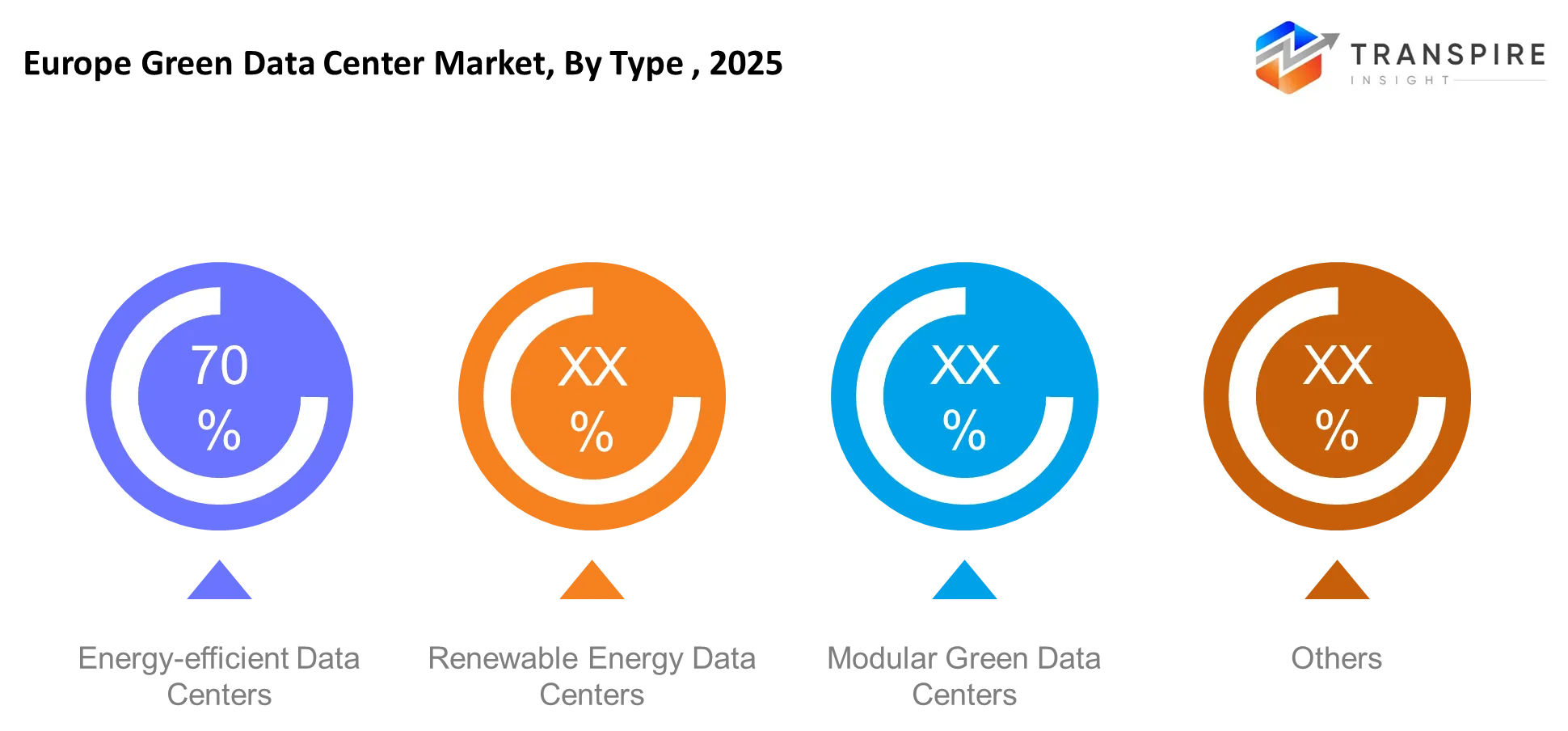
To learn more about this report, Download Free Sample Report
By Application:
Cloud computing holds dominant share within application segmentation due to hyperscale migration, workload centralization, and AI compute expansion. The colocation market remains strong because businesses use cost-sharing models to outsource infrastructure needs. The enterprise IT sector maintains its market position because companies still need to use their existing systems and hybrid solutions. The other applications face market boundaries because they lack strong demand and require less computational power.
The different applications of digital transformation generate distinct growth patterns that depend on their required digital transformation level and their particular scalability requirements. The growth of cloud computing accelerates because artificial intelligence applications generate increased worldwide data traffic. Colocation centers require capital efficiency which meets their operational needs and regulatory compliance requirements. The enterprise IT sector experiences consistent expansion through organizations which implement hybrid cloud solutions and execute their system modernization initiatives. The upcoming period will see cloud computing maintain its lead while organizations use colocation to create cost-effective infrastructure solutions.
By End-User:
IT companies represent the largest share within end-user segmentation due to high compute demand, software delivery scale, and continuous infrastructure expansion. The BFSI sector controls substantial market share because secure data processing and regulatory compliance requirements and digital banking transformation drive its growth. The government sector holds a moderate market share because digital public services and data localization requirements support its operations. The other end-user groups operate with restricted capacity because their infrastructure requirements remain below standard levels.
The different end-user categories experience unique growth patterns which depend on their digital adoption progress and applicable regulatory requirements. IT companies expand capacity through AI integration and global service scaling. The BFSI sector modernizes its operations through secure cloud adoption and deployment of real-time analytics systems. Government adoption increases through e-governance programs and sovereignty requirements. The upcoming period will see IT companies maintain strong market presence while BFSI becomes a major growth area for investments in secure infrastructure development.
By Component:
The component segmentation of cooling systems actually dominates the market because high-performance computing together with AI applications create increased heat generation. Power systems maintain strong position driven by uninterrupted energy demand and backup infrastructure requirements. The monitoring systems establish their increasing market share because automation and predictive maintenance together with operational efficiency requirements create increasing demand for their services. Other components remain limited because their integration needs fall below minimum requirements.
The various components of the system undergo growth because efficiency optimization needs to be fulfilled together with demands for reliable performance. Cooling systems advance through liquid cooling and immersion technologies which provide solutions to high thermal load challenges. Power systems expand through the integration of renewable energy sources together with advanced energy storage technologies. The monitoring systems increase their market presence because AI-powered analytics and real-time system monitoring provide advanced capabilities. The future development trends show that integrated infrastructure management systems will improve operational efficiency and system availability together with environmental sustainability for data center operations.
What are the Key Use Cases Driving the Europe Green Data Center Market?
European Green Data Center Market demand finds its main drivers in two primary use cases which include cloud computing and hyperscale colocation services. Large technology firms and enterprise clients require energy-efficient infrastructure to support rising data traffic while complying with European carbon reduction regulations. The combination of AI processing workloads together with high-density computing requirements leads to increased need for facilities which provide advanced cooling systems and operate on renewable energy sources.
Secondary applications are expanding across banking, healthcare, and manufacturing sectors that require secure storage of data with low latency through sovereign cloud infrastructure. Financial institutions increasingly adopt green colocation services to meet ESG reporting requirements, while healthcare providers use sustainable data centers to manage growing volumes of digital patient records and AI-assisted diagnostics.
Edge computing systems for autonomous mobility networks and green AI training clusters that operate on dedicated renewable energy systems represent emerging use cases. Modular low-carbon micro data centers serve as test systems for both governments and telecom operators who use them to establish smart city systems together with next-generation industrial automation during the forecast period.
|
Report Metrics |
Details |
|
Market size value in 2025 |
USD 30.8 Billion |
|
Market size value in 2026 |
USD 36.3 Billion |
|
Revenue forecast in 2033 |
USD 112.8 Billion |
|
Growth rate |
CAGR of 17.58% from 2026 to 2033 |
|
Base year |
2025 |
|
Historical data |
2021 - 2024 |
|
Forecast period |
2026 - 2033 |
|
Report coverage |
Revenue forecast, competitive landscape, growth factors, and trends |
|
Regional scope |
Europe (Germany, United Kingdom, France, Italy, Spain, Rest of Europe) |
|
Key company profiled |
Google, Amazon Web Services, Microsoft, IBM, Equinix, Digital Realty, Schneider Electric, Siemens, ABB, Cisco, Vertiv, Eaton, Huawei, NTT Communications, Fujitsu |
|
Customization scope |
Free report customization (country, regional & segment scope). Avail customized purchase options to meet your exact research needs. |
|
Report Segmentation |
By Type (Renewable Energy Data Centers, Energy-efficient Data Centers, Modular Green Data Centers, Others); By Application (Cloud Computing, Colocation, Enterprise IT, Others); By End-User (IT Companies, BFSI, Government, Others); By Component (Cooling Systems, Power Systems, Monitoring Systems, Others) |
Which Regions are Driving the Europe Green Data Center Market Growth?
Northern Europe currently leads the Europe Green Data Center Market because the region combines abundant renewable energy capacity with naturally cool climates that reduce cooling-related electricity consumption. Sweden, Norway, Denmark, and Finland established effective policy frameworks that support both carbon-neutral digital infrastructure development and long-term renewable energy power purchase agreements. The area benefits from established fiber connections and dependable power grid systems and active governmental assistance for hyperscale cloud development. Northern Europe maintains its leading position through a robust network of renewable energy suppliers and colocation providers and advanced cooling technology manufacturers.
Western Europe remains the second-largest regional contributor, but its strength comes from enterprise demand stability and regulatory consistency rather than low-cost energy advantages. The investment climate in Germany, the Netherlands, France, and the United Kingdom attracts multinational companies because they require secure and compliant infrastructure that provides low-latency access to major financial and industrial centers. The operators of these countries now prioritize energy-efficient system upgrades for their current buildings instead of creating new facilities from scratch. The organization implements a slow-paced modernization strategy, which establishes dependable income sources while enabling continued use of infrastructure through energy price increases.
Recent investments in renewable generation and grid modernization and AI-ready digital infrastructure have made Eastern and Southern Europe the fastest-growing regions. The countries Poland Spain and Portugal have increased their sustainable technology project incentives while developing solar and wind capacity to meet future hyperscale requirements. International operators are entering these markets to secure lower land costs and untapped power availability before competition intensifies. The period from 2026 to 2033 will create significant investment opportunities which will benefit cooling technology providers and renewable energy developers who establish their presence in rapidly growing markets.
Who are the Key Players in the Europe Green Data Center Market and How Do They Compete?
The Europe Green Data Center Market operates with moderate consolidation because global infrastructure providers compete against operators who focus on renewable energy within specific regions. Enterprises now compete through their ability to reduce energy consumption and provide renewable energy access and develop innovative cooling systems and maintain operational sites close to low-carbon power networks instead of using conventional pricing methods. Established players maintain their market position through major facility development and environmentally responsible project funding while emerging companies focus on creating AI-compatible systems and carbon-neutral data center operations. Northern European countries including Sweden and Norway and Finland have become a key competitive area because operators can achieve reduced cooling costs and better renewable energy systems.
Equinix establishes its unique market position through its high-density interconnection networks and its commitment to renewable energy development at its European sites. The company maintains its growth through its partnerships which create alternative energy systems and distributed power resilience to improve operational time while decreasing carbon emissions. Schneider Electric competes through energy management software, modular infrastructure, and sustainability certifications that help operators meet tightening EU environmental standards. The company establishes itself in the market through partnerships which focus on AI-compatible cooling systems and smart grid integration that extend beyond standard electrical infrastructure solutions.
Vertiv uses its liquid cooling and thermal optimization systems which meet AI processing requirements to establish a competitive edge in next-generation high-density facility implementations. The company uses acquisition-based growth approach to develop exclusive cooling technologies while building its European hyperscale customer network.
Company List
- Amazon Web Services
- Microsoft
- IBM
- Equinix
- Digital Realty
- Schneider Electric
- Siemens
- ABB
- Cisco
- Vertiv
- Eaton
- Huawei
- NTT Communications
- Fujitsu
Recent Development News
In May 2026,Schneider Electric entered a strategic partnership with GreenScale to develop AI-ready sustainable data center infrastructure across Europe. The collaboration focuses on advanced energy management and low-carbon operational architecture, strengthening Europe’s transition toward high-efficiency green data center campuses. (GreenScale)
In November 2025,Vertiv announced the acquisition of PurgeRite Intermediate for approximately $1 billion. The deal expands Vertiv’s liquid cooling and thermal management capabilities for AI-focused data centers, supporting the growing demand for energy-efficient high-density computing infrastructure. (Reuters)
What Strategic Insights Define the Future of the Europe Green Data Center Market?
The Europe Green Data Center Market is moving through a fundamental structural transition from sustainability-based assessments to its current state of research which examines energy-security requirements for infrastructure development. The demand for low-carbon grid-resilient facilities will increase because of hyperscale cloud growth and AI workload expansion during the upcoming five-to-seven-year period. Organizations will obtain competitive advantages through their ability to use renewable power purchase agreements and advanced cooling technologies and their location near stable transmission systems during the next five to seven years. European countries face a hidden danger because their manufacturers increasingly depend on a limited number of suppliers who provide essential components such as semiconductors and battery storage systems and rare-earth-intensive power equipment. Nordic and Eastern European regions have become an emerging opportunity because their surplus renewable capacity and their carbon regulation framework create interest for the development of modular AI-optimized green campuses. The energy sector should focus on developing vertically integrated partnerships together with establishing grid access solutions which will allow them to prepare for future power availability restrictions that will emerge as the primary market limitation.
Europe Green Data Center Market Report Segmentation
By Type
- Renewable Energy Data Centers
- Energy-efficient Data Centers
- Modular Green Data Centers
- Others
By Application
- Cloud Computing
- Colocation
- Enterprise IT
- Others
By End-User
- IT Companies
- BFSI
- Government
- Others
By Component
- Cooling Systems
- Power Systems
- Monitoring Systems
- Others
Frequently Asked Questions
Find quick answers to common questions.
The Europe Green Data Center Market size is USD 112.8 Billion in 2033.
Key Segments for the Europe Green Data Center Market are By Type (Renewable Energy Data Centers, Energy-efficient Data Centers, Modular Green Data Centers, Others); By Application (Cloud Computing, Colocation, Enterprise IT, Others); By End-User (IT Companies, BFSI, Government, Others); By Component (Cooling Systems, Power Systems, Monitoring Systems, Others).
Major Europe Green Data Center Market Players are Google, Amazon Web Services, Microsoft, IBM, Equinix, Digital Realty, Schneider Electric, Siemens, ABB, Cisco, Vertiv, Eaton, Huawei, NTT Communications, Fujitsu.
The Current Europe Green Data Center Market size is USD 30.8 Billion in 2025.
The Europe Green Data Center Market CAGR is 17.58% from 2026 to 2033.
- Amazon Web Services
- Microsoft
- IBM
- Equinix
- Digital Realty
- Schneider Electric
- Siemens
- ABB
- Cisco
- Vertiv
- Eaton
- Huawei
- NTT Communications
- Fujitsu
Recently Published Reports
-
Apr 2026
3D Optical Profiler Market
3D Optical Profiler Market Size, Share & Analysis Report By Type (Desktop 3D Optical Profiler, and Portable 3D Optical Profiler), By Technology (Confocal Technology, and White Light Interference), By End-Use Industry (Manufacturing, Research Institutions, Automotive, Aerospace and Defense, Medical Devices, and Other), and Geography (North America, Europe, Asia-Pacific, Middle East and Africa, South and Central America), 2021 - 2031
-
Apr 2026
Depth Sensor Market
Depth Sensor Market Size, Share & Analysis Report By Type (Infrared Depth Sensors, Time-of-Flight (ToF) Sensors, Stereo Vision Sensors, Structured Light Sensors, Ultrasonic Depth Sensors), By Application (Automotive, Robotics, Gaming, Consumer Electronics, Industrial Automation, Healthcare, Security & Surveillance, Others), By End Users (Automotive Manufacturers, Consumer Electronics Companies, Healthcare Providers, Industrial Companies, Security Agencies, Gaming Companies, Robotics Companies, Others), and Geography (North America, Europe, Asia-Pacific, Middle East and Africa, South and Central America), 2021 – 2031
-
Apr 2026
Digital Manufacturing Market
Digital Manufacturing Market Size, Share & Analysis Report By Component (Hardware, Software, and Services), By Technology (Robotics, 3D Printing, Internet of Things (IoT), and Others), By Application (Automotive and Transportation, Aerospace and Defense, Consumer Electronics, Industrial Machinery, and Others), By Process Type (Computer-Based Designing, Computer-Based Simulation, Computer 3D Visualization, Analytics, and Others), and Geography (North America, Europe, Asia-Pacific, Middle East and Africa, South and Central America), 2021 – 2031
-
Apr 2026
Digital Visa Services Market
Digital Visa Services Market Size, Share & Analysis Report By Type (Individual Travelers, Group Travelers), By Application (Tourism, Business Travel, Others), and Geography (North America, Europe, Asia-Pacific, Middle East and Africa, South and Central America), 2021 – 2031