

Europe Wind Energy Market Size & Forecast:
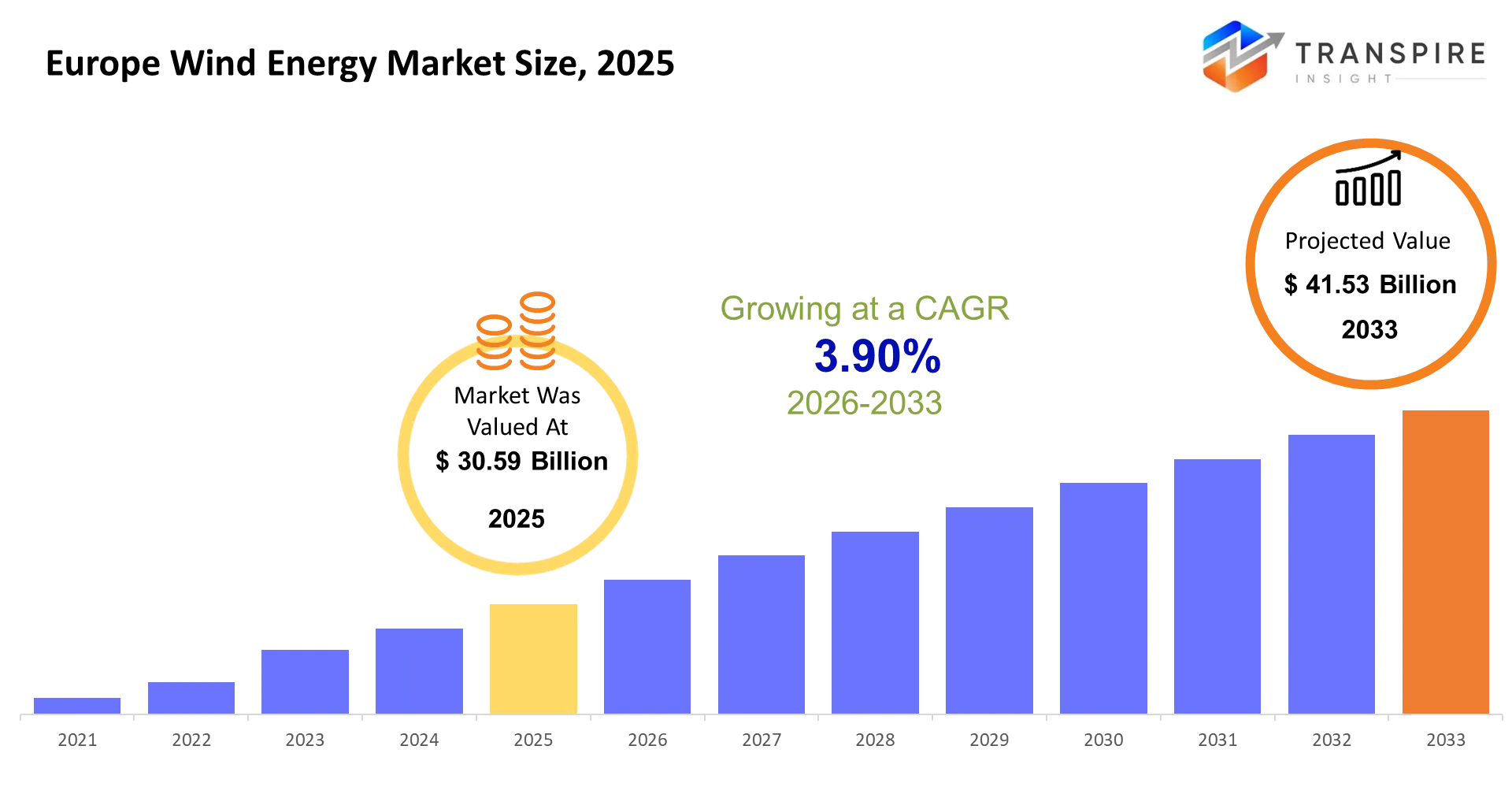
- Europe Wind Energy Market Size 2025: USD 30.59 Billion
- Europe Wind Energy Market Size 2033: USD 41.53 Billion
- Europe Wind Energy Market CAGR: 3.90%
- Europe Wind Energy Market Segments: By Type (Onshore Wind, Offshore Wind, Small Wind, Others), By Application (Power Generation, Distributed Energy, Others), By End-User (Utilities, Independent Power Producers, Government, Others), By Component (Turbines, Towers, Blades, Others).
To learn more about this report,  Download Free Sample Report
Europe Wind Energy Market Summary:
The Europe Wind Energy Market size is estimated at USD 30.59 Billion in 2025 and is anticipated to reach USD 41.53 Billion by 2033, growing at a CAGR of 3.90% from 2026 to 2033. The Europe Wind Energy Market functions as a fundamental force which transforms both the energy sector and industrial sectors of Europe by converting local wind resources into electrical power that enables the region to decrease its need for imported fossil fuels. Wind power generation now serves as a primary energy source which industrial facilities and utilities and manufacturers and ports use to implement their decarbonization strategies while achieving stable energy expenses.
The market has transformed during the past three to five years by moving from a system which relied on subsidies for deployment to a phase which supports large-scale commercial operations through offshore wind projects and corporate power purchase agreements and hybrid renewable energy systems. The energy crisis which resulted from the Russia-Ukraine conflict exposed Europe's gas supply vulnerabilities and price fluctuations which resulted in electricity pricing to increase.
The government system expedited both grid investment projects and permitting process changes while industrial customers established renewable energy agreements to protect themselves against electricity price fluctuations. The new revenue streams have emerged for utilities which now force steel manufacturers and chemical manufacturers and data center firms to develop their wind energy procurement plans.
Key Market Insights
- The Europe Wind Energy Market in 2025 saw Northern Europe emerge as the leading market region because it operated offshore projects throughout the North Sea which resulted in a market share exceeding 42 percent.
- Germany preserves its position as a main regional wind power producer because the country successfully conducts renewable energy auctions and establishes large-scale turbine operations.
- EU funding for clean energy projects and investments in grid development create conditions for Eastern Europe to become the fastest expanding regional market until 2032.
- The UK remains the primary developer of offshore wind power systems which enables European wind energy capacity to grow through its extensive seabed leasing initiatives.
- The Europe Wind Energy Market in 2025 derived its revenue through offshore wind turbines which generated 58 percent of total earnings because they produced more energy than other systems.
- Because of its affordable installation expenses and quick project execution schedule, onshore wind power continues to be the second most important industry sector.
- The floating offshore wind industry will expand at its fastest pace until 2030 because deep-water installation sites exist throughout Atlantic Ocean coastal regions.
- Wind farm operators began using digital management solutions to enhance their predictive maintenance systems and optimize turbine performance.
- The market for utility-scale electricity generation reached a share of 64 percent, with renewable energy procurement agreements serving as a foundation for the market in 2025.
- The industrial decarbonization strategy developed by Europe creates new growth opportunities for green hydrogen production which has become an essential application area.
- Data centers and manufacturing facilities and chemical processing plants increased their demand for wind energy through corporate renewable power purchase agreements.
- Governments have invested heavily in offshore-to-grid integration projects because they consider renewable electricity transmission infrastructure between national borders to be essential for their initiatives.
What are the Key Drivers, Restraints, and Opportunities in the Europe Wind Energy Market?
The energy security strategy developed by European countries after Russia attacked Ukraine and gas supplies were interrupted has led to increased wind energy development in Europe. The government implemented three specific actions which included speeding up renewable energy permitting changes and increasing offshore leasing programs and committing more funds to grid development. Power-intensive industrial sectors experienced extreme fluctuations in electricity costs which led manufacturers and data center operators to establish long-term renewable energy purchase contracts. Wind developers now receive better revenue forecasts which resulted in growing project financing for offshore and utility-scale wind power projects. The combination of decreasing turbine operating expenses and increasing capacity of offshore wind facilities has enabled power producers to achieve higher electricity generation levels from their installed systems.
The grid infrastructure limitations constitute the primary structural obstacle which hinders market development. European transmission networks were built to support centralized fossil-fuel power plants instead of handling scattered offshore wind energy production facilities. The process of upgrading subsea cables and cross-border interconnectors and national transmission systems requires multiple years to achieve regulatory approval while it demands an expenditure of billions of dollars. The approved wind projects face multiple delays in their grid connections which extend their commercialization periods while reducing their immediate revenue potential for developers and utilities.
Floating offshore wind represents the next major growth opportunity, particularly in deep-water regions such as the Atlantic coastlines of Portugal, Spain, and Norway. Floating platforms enable commercial deployment in areas with stronger and more consistent wind resources which is not possible with fixed-bottom systems.
What Has the Impact of Artificial Intelligence Been on the Europe Wind Energy Market?
The European Wind Energy Market is undergoing a transformation through the use of artificial intelligence and digital technologies which enhance turbine reliability and grid connection capabilities and offshore operational effectiveness. Wind farm operators now utilize AI-driven control systems to automate turbine positioning together with blade pitch adjustments and power output balancing functions which respond to wind speed fluctuations. Offshore operators increasingly use digital twins and real-time sensor networks to track vibration patterns and gearbox temperatures and rotor stress throughout their entire turbine fleet without using manual inspection cycles.
Machine learning models create new possibilities for developing predictive maintenance methods. Operators use weather data together with historical component failures and turbine performance metrics to detect faults before they lead to equipment failures. The approach has decreased unplanned maintenance incidents while boosting turbine availability rates in multiple offshore projects. Predictive analytics in large offshore installations enable operators to decrease maintenance expenses through decreased vessel dispatch needs and reduced operational downtime which results from rough ocean conditions. AI-assisted forecasting systems help transmission operators make more accurate predictions about wind generation output which leads to better grid stability and lower balancing expenses.
The process of adopting artificial intelligence technology currently encounters a major obstacle. The majority of aging wind farms operate through outdated wind farms which use nonstandard data systems that make it difficult to connect different systems together and which decrease machine learning model performance when applied to diverse turbine systems.
Key Market Trends
- European governments began to increase their offshore permitting reforms after gas supply issues showed their dependence on imported fossil fuels which started in 2022.
- The average offshore turbine capacity grew from 8 MW in 2019 to more than 15 MW by 2025 which created better financial results for project development.
- Between 2021 and 2025 industrial manufacturers established permanent renewable energy contracts to protect themselves against future electricity price increases.
- European turbine manufacturers moved their factories to locations near regional ports because pandemic-related shipping problems made it more expensive to transport goods and parts.
- The implementation of AI-based predictive maintenance systems created remote monitoring capabilities for gearbox and blade performance which led to a decrease in unplanned offshore turbine downtime.
- The development of floating offshore wind projects increased in Portugal, Norway, and Spain because developers began to explore high-wind areas further from shore.
- The emergence of grid congestion created operational challenges for wind projects after 2023 because multiple projects had already received approval but were unable to proceed due to ongoing auction processes.
- Siemens Gamesa Renewable Energy and Vestas Wind Systems started to invest more in recyclable turbine blade technology because they wanted to find solutions to their end-of-life waste problems.
- The expansion of cross-border electricity interconnector projects after 2021 occurred because regulators needed integrated renewable energy transmission systems for their Northern European operations.
- Offshore wind developers established partnerships with green hydrogen producers to sell their surplus renewable energy while creating more stable revenue streams for their projects.
Europe Wind Energy Market Segmentation
By Type
The type segment maintains its presence because onshore wind energy requires lower installation expenses and offers established grid connections and enables faster project development which allows for large-scale wind energy implementation throughout Germany and Spain and France. The past five years have seen offshore wind development grow rapidly because government authorities started leasing seabeds more frequently and they developed transmission networks throughout the North Sea and Baltic Sea areas. Utilities and institutional investors continue to show interest in projects because they generate more energy and operate at higher capacity factors but require substantial financial investments.
Small wind installations maintain a limited share because commercial viability depends heavily on local incentives and land availability. The decentralized renewable systems have gained traction among rural communities and industrial facilities because these systems provide reliable energy solutions for their specific areas. Current investment trends show that offshore expansion will continue because of increased deployment of larger turbine systems and floating wind technology. The manufacturing sector will focus on developing high-capacity systems while project developers will shift their attention to deep-water initiatives that promise better long-term financial results.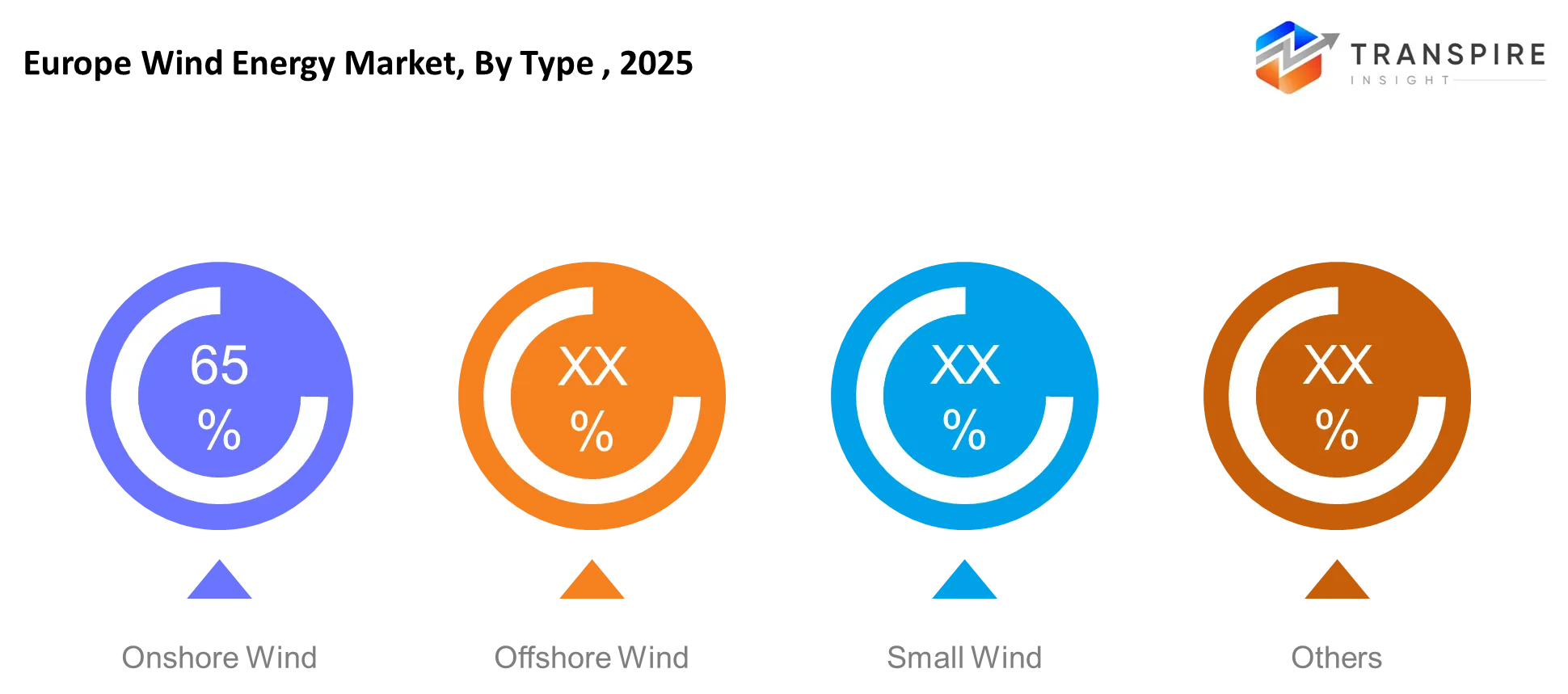
To learn more about this report, Download Free Sample Report
By Application
The primary application segment for power generation maintains its position as the top segment because national decarbonization initiatives and industrial electrification efforts create ongoing demand for renewable energy sources at utility scale. National transmission systems obtain electricity directly from large offshore and onshore wind farms which enable utilities and industrial operators to establish stable long-term procurement agreements. Commercial facilities and logistics hubs and manufacturing plants have increased their use of distributed energy applications to achieve partial energy independence from electricity market fluctuations. The increasing corporate demand for renewable energy sources has created greater need for medium-scale wind projects which operate through private energy networks.
Governments are expanding clean industrial infrastructure programs which are increasing visibility for other applications that include renewable-powered hydrogen production and hybrid storage integration. The future development of projects will depend on two main factors which are grid modernization and cross-border electricity transmission capacity. Project assessments now require investors to consider integration efficiency as an essential factor which leads to greater demand for both flexible energy management systems and digitally optimized renewable energy operations.
By End-User
The end-user segment exists because utilities operate as the largest segment through their need to build renewable power plants which require approval through existing electricity generation and transmission regulations. Offshore project development stays under the control of major energy companies because they possess both financial resources and the ability to handle complex grid integration needs. The market share of independent power producers increased through their participation in auction-based renewable contracts and their establishment of private corporate procurement agreements. Independent developers now obtain better funding opportunities because institutional investors direct their investments toward renewable infrastructure funds. Public funding for transmission upgrades and renewable capacity expansion projects backs government-supported initiatives which play a vital role in developing emerging regional markets.
Heavy industries and commercial enterprises who belong to other end-user groups are increasing their direct acquisition of renewable energy sources because it helps them manage their long-term operational costs while they work to achieve carbon reduction goals necessary for maintaining their export competitiveness. The future market direction indicates that utilities will work more closely with industrial buyers and private developers because they will adopt renewable procurement methods which use long-term contracts combined with energy management functions.
By Component
The main part of the system includes turbines because their energy production efficiency and project financial performance depend on turbine size and rotor size and digital control system design. Manufacturers have steadily increased turbine capacity ratings to improve electricity generation while reducing installation frequency per project site. The development of blades is an active area of growth because developers focus on creating lightweight composite materials and recyclable blade technologies to achieve better sustainability throughout their product lifespan. The critical role of towers in offshore operations arises from the fact that taller structures enable wind capture and generation consistency.
The operational reliability and predictive maintenance needs of operators drive the increasing significance of gearboxes transformers subsea cables and monitoring systems in their operations. The recent logistics disruptions that raised delivery expenses and caused project delays have made supply chain localization into a primary strategic goal for companies. The upcoming investment plan for the future will support advanced materials development and digital monitoring system development and regional manufacturing facility growth to build resilience in renewable energy infrastructure development.
What are the Key Use Cases Driving the Europe Wind Energy Market?
The main application for wind energy throughout Europe continues to be its use in generating electricity at utility-scale power plants. The national utilities and transmission operators use both offshore and onshore wind farms to eliminate their need for gas-fired power plants while they maintain steady electricity supply costs throughout the future.
The steel industry and chemical industry and data center operators all rapidly increase their adoption of industrial renewable procurement. Energy-intensive facilities now use corporate power purchase agreements to fund dedicated wind projects which help them control electricity price fluctuations while they comply with export-related carbon regulations.
Renewable hydrogen production and offshore energy hubs which connect to international power grids represent emerging applications in the field. North Sea projects currently test their integrated wind-to-hydrogen infrastructure systems to create future fuel supply chains for maritime operations and industrial decarbonization efforts.
|
Report Metrics |
Details |
|
Market size value in 2025 |
USD 30.59 Billion |
|
Market size value in 2026 |
USD 31.78 Billion |
|
Revenue forecast in 2033 |
USD 41.53 Billion |
|
Growth rate |
CAGR of 3.90% from 2026 to 2033 |
|
Base year |
2025 |
|
Historical data |
2021 - 2024 |
|
Forecast period |
2026 - 2033 |
|
Report coverage |
Revenue forecast, competitive landscape, growth factors, and trends |
|
Regional scope |
Europe (Germany, United Kingdom, France, Italy, Spain and Rest of Europe) |
|
Key company profiled |
Vestas, Siemens Gamesa, GE Renewable Energy, Nordex, Enercon, Suzlon, Goldwind, MingYang, Envision, ABB, Schneider Electric, Hitachi Energy, SKF, TUV SUD, DNV |
|
Customization scope |
Free report customization (country, regional & segment scope). Avail customized purchase options to meet your exact research needs. |
|
Report Segmentation |
By Type (Onshore Wind, Offshore Wind, Small Wind, Others), By Application (Power Generation, Distributed Energy, Others), By End-User (Utilities, Independent Power Producers, Government, Others), By Component (Turbines, Towers, Blades, Others) |
Which Regions are Driving the Europe Wind Energy Market Growth?
Northern Europe maintains its market leadership because offshore wind operations in the North Sea have achieved industrial capacity through development of its existing port facilities and its dependable renewable energy policies. The UK and Germany and Denmark and the Netherlands continue to develop their offshore leasing rounds while they spend substantial resources to build their underwater power transmission systems and interconnector facilities. The combined operation of large turbine assembly plants and specialized installation ships and skilled engineering contractors establishes a unified supply network which enables swift project completion. Regional power remains strong because institutional financing and long-term electricity purchase contracts help utilities and offshore developers reduce their investment hazards.
The second largest regional contributor to Western Europe shows different growth patterns from Northern Europe because its expansion depends more on upgrading existing systems and improving grid efficiency than on developing new offshore megaprojects. France and Spain and Belgium proceed to enhance renewable energy adoption through gradual changes to their permitting processes and implementation of long-term industrial decarbonization plans. The manufacturing sector maintains stable operations while utility companies sustain their investments which results in constant demand for turbine upgrades and repowering projects and hybrid renewable systems. The region uses its established renewable energy procurement systems to support continuous project development which remains active during supply chain disruptions and energy price fluctuations.
Eastern Europe maintains its fastest expansion rate because countries develop clean energy infrastructure and implement regional energy diversification plans which emerged from the Russia-Ukraine conflict.
Who are the Key Players in the Europe Wind Energy Market and How Do They Compete?
The Europe Wind Energy Market maintains a moderate level of consolidation because a small number of turbine manufacturers together with major renewable developers control most utility-scale and offshore projects. The market requires operators to compete by improving turbine efficiency together with their ability to install equipment in offshore locations and their digital monitoring systems and their long-term maintenance contracts. Existing manufacturers protect their market presence by developing turbines with capacities exceeding 15 megawatts and producing their components locally to decrease transportation uncertainties. At present new engineering companies together with floating wind technology experts establish their presence in specific areas where deep-water installation and power grid connection skills remain insufficient.
Vestas Wind Systems achieves market competition through its dependable operations and complete service solutions which include predictive maintenance systems and extensive service capabilities across Europe. The company uses its vast experience in onshore projects and its advanced turbine optimization software to create competitive advantages which enhance long-term energy production. Siemens Gamesa Renewable Energy develops offshore wind technology through its high-capacity turbine systems which meet the needs of North Sea operational conditions. The company establishes strategic alliances with utility providers while building manufacturing facilities close to major European ports to enhance its installation operations and protect its supply chain network.
Ørsted maintains a strong competitive position through deep offshore project execution expertise and integrated ownership across development, construction, and operations. The company benefits from its long-term seabed leasing experience and its initial development of offshore transmission infrastructure which lead to cost savings and project execution benefits on large-scale endeavors.
Company List
- Vestas
- Siemens Gamesa
- GE Renewable Energy
- Nordex
- Enercon
- Suzlon
- Goldwind
- MingYang
- Envision
- ABB
- Schneider Electric
- Hitachi Energy
- SKF
- TUV SUD
- DNV
Recent Development News
In May 2026, Orsted first-quarter core profit tops forecasts, maintains outlook: Danish wind giant Orsted reported a stronger-than-expected Q1 core profit driven by higher offshore wind output across Europe. The company maintained its full-year guidance, showing resilience despite regulatory and cost pressures. Growth was supported by improved generation from major European offshore assets.
Source: https://www.reuters.com
In May 2026, Wind energy producer EDPR's recurring profit rises 9%, beats expectations: EDP Renewables posted a 9% rise in recurring net profit, exceeding analyst expectations. Strong wind production in European and North American markets helped offset lower electricity prices, highlighting operational efficiency gains in its wind portfolio.
Source: https://www.reuters.com
What Strategic Insights Define the Future of the Europe Wind Energy Market?
The Europe Wind Energy Market will undergo a fundamental transformation during the next five to seven years to develop large-scale offshore wind projects which will operate together with international renewable energy sharing systems. Governments and utilities are focusing on developing stable renewable energy sources through domestic power plants and transmission networks because of their need to address energy security issues and industrial electrification requirements and long-term decarbonization goals. Offshore wind power will become a vital resource for industrial operations which will generate electricity through hydrogen production and energy storage systems throughout Northern and Eastern Europe.
One underrecognized risk involves critical material concentration within turbine and cable supply chains. The need for developers to obtain imported rare earth elements copper and specialized offshore components will result in cost increases and project delays if geopolitical trade restrictions become more severe. Floating offshore wind power has developed into a major long-term opportunity because Atlantic coastlines now have better deep-water deployment economic conditions. Market participants should establish manufacturing partnerships within their operational regions while developing grid integration systems because infrastructure access will determine future competitive advantage for their business.
Europe Wind Energy Market Report Segmentation
By Type
- Onshore Wind
- Offshore Wind
- Small Wind
- Others
By Application
- Power Generation
- Distributed Energy
- Others
By End-User
- Utilities
- Independent Power Producers
- Government
- Others
By Component
- Turbines
- Towers
- Blades
- Others
Frequently Asked Questions
Find quick answers to common questions.
The Approximate Europe Wind Energy Market size for the Market will be USD 41.53 Billion in 2033.
The key Segments of the Europe Wind Energy Market are By Type (Onshore Wind, Offshore Wind, Small Wind, Others), By Application (Power Generation, Distributed Energy, Others), By End-User (Utilities, Independent Power Producers, Government, Others), By Component (Turbines, Towers, Blades, Others).
Major Players in the Europe Wind Energy Market are Vestas, Siemens Gamesa, GE Renewable Energy, Nordex, Enercon, Suzlon, Goldwind, MingYang, Envision, ABB, Schneider Electric, Hitachi Energy, SKF, TUV SUD, DNV.
The Current Market size of the Europe Wind Energy Market is USD 30.59 Billion in 2025.
The Europe Wind Energy Market CAGR is 3.90%.
- Vestas
- Siemens Gamesa
- GE Renewable Energy
- Nordex
- Enercon
- Suzlon
- Goldwind
- MingYang
- Envision
- ABB
- Schneider Electric
- Hitachi Energy
- SKF
- TUV SUD
- DNV
Recently Published Reports
-
Apr 2026
Active Power Filter Market
Active Power Filter Market Size, Share & Analysis Report By Type (Shunt Active Power Filters, Series Active Power Filter, Hybrid Active Power Filter), By Application (Harmonics Mitigation, Reactive Power Compensation, Voltage Regulation, Power Factor Correction), By Phase (Single Phase, Three Phase), By End-User Industry (Manufacturing, Healthcare, Commercial, Automotive, Oil and Gas, Others), and Geography (North America, Europe, Asia-Pacific, Middle East and Africa, South and Central America), 2021 - 2031
-
Apr 2026
Electrical Transformer Market
Electrical Transformer Market Size, Share & Analysis Report By Core (Closed, Shell, and Berry), By Insulation (Gas, Oil, Solid, Air, and Other), By Phase (Single, and Three), By Rating (100 MVA to 500 MVA, 501 MVA to 800 MVA, and 801 MVA to 1200 MVA), and Geography (North America, Europe, Asia-Pacific, Middle East and Africa, South and Central America), 2021 – 2031
-
Apr 2026
Hydraulic Piston Pumps Market
Hydraulic Piston Pumps Market Size, Share & Analysis Report By Type (Axial Piston Pumps, Radial Piston Pumps), By Operating Pressure (Low Pressure, Medium Pressure, High Pressure), By Application (Construction, Mining, Agriculture, Automotive, Oil & Gas, Industrial Machinery, Others), By End-User (OEMs, Aftermarket), and Geography (North America, Europe, Asia-Pacific, Middle East and Africa, South and Central America), 2021 – 2031
-
Apr 2026
Laboratory Gas Generators Market
Laboratory Gas Generators Market Size, Share & Analysis Report By Product (Nitrogen Gas Generator, Hydrogen Gas Generator, Zero Air Gas Generator, Purge Gas Generator, TOC Gas Generators, Others), By Application (Gas Chromatography, Liquid Chromatography-mass Spectrometry (LC-MS), Gas Analyzers, Others), By End-user (Life Science, Chemical & Petrochemical, Food & Beverage, Others), and Geography (North America, Europe, Asia-Pacific, Middle East and Africa, South and Central America), 2021 – 2031