
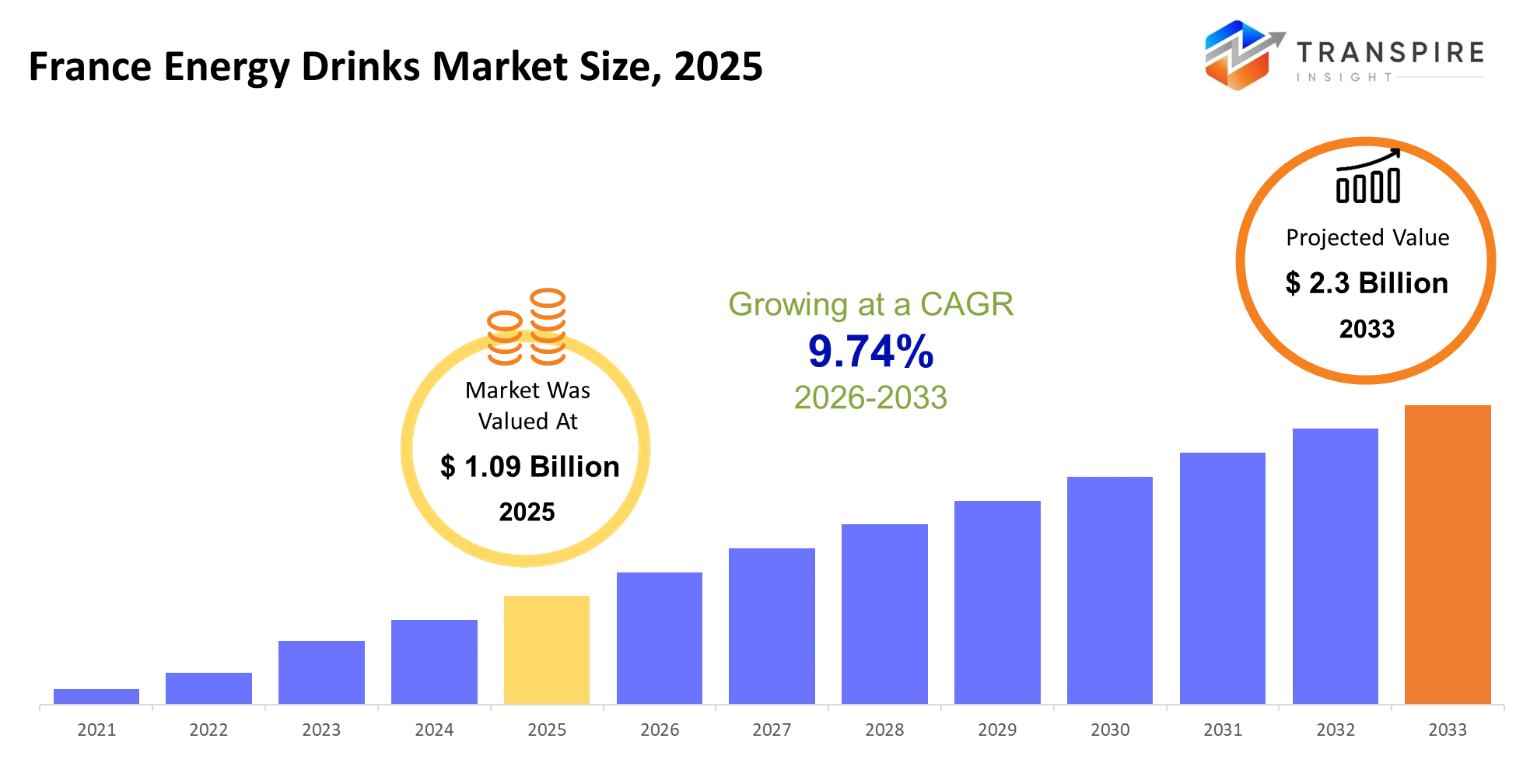
France Energy Drinks Market Size & Forecast:
- France Energy Drinks Market Size 2025: USD 1.09 Billion
- France Energy Drinks Market Size 2033: USD 2.3 Billion
- France Energy Drinks Market CAGR: 9.74%
- France Energy Drinks Market Segments: By Type (Sugar-based, Sugar-free, Organic, Others); By Application (Sports, Fitness, Daily Consumption, Gaming, Others); By End-User (Youth, Athletes, Professionals, Consumers, Others); By Distribution (Supermarkets, Convenience Stores, Online, Others).
To learn more about this report,  Download Free Sample Report
France Energy Drinks Market Summary
The France Energy Drinks Market was valued at USD 1.09 Billion in 2025. It is forecast to reach USD 2.3 Billion by 2033. That is a CAGR of 9.74% over the period.
The France energy drinks market serves as a vital support system for contemporary drinking habits which link to extended work hours and fitness practices and nighttime activities and gaming and active traveling. The market has expanded beyond its previous role of supplying energy drinks which served only as athletic performance enhancers for young consumers. Energy drinks have emerged as high-profit functional drinks which supermarkets and convenience stores and restaurants use to boost customer spending and product purchases in both city areas and transportation terminals. The past five years have witnessed a fundamental change in the market which now focuses on products that contain no sugar and use natural caffeine sources and include active components like guarana and vitamins and adaptogens.
France introduced stricter sugar intake guidelines and improved labeling standards which accelerated this process. The pandemic created supply chain challenges which made companies develop new distribution methods that combined e-commerce with direct retail sales. The introduction of premium and wellness products to store shelves enables manufacturers to increase their earnings per product sold while their products reach both young customers and working adults and fitness enthusiasts.
Key Market Insights
- The market consumption of northern regions together with urban areas including Paris and Île-de-France reached almost 38 percent in 2025 through their active retail and nightlife operations.
- Southern France will develop into the most rapidly expanding regional market until 2033 because of increasing beverage sales through tourism and the growth of its convenience retail stores.
- The market for sugar-free energy drinks reached its highest point in 2025 when they occupied almost 46% of total market share because consumers began preferring low-calorie functional drinks.
- Natural and organic energy drink formulations emerged as the fastest-growing category after 2022, supported by clean-label purchasing behavior among millennials.
- Canned beverages that are ready to drink maintained their market lead because supermarkets and petrol stations selected products which customers could easily carry and which displayed their products to customers from a distance.
- French online beverage sales experienced substantial double-digit growth during the period from 2023 to 2025 because subscription-based delivery platforms and direct-to-consumer purchasing became more common among urban buyers.
- The collaboration between beverage companies and wellness influencers enabled fitness centers and sports nutrition outlets to become popular consumption channels which expanded their customer base throughout the nation.
- The premium energy drink market in metropolitan areas saw its largest consumer group with young professionals who were 25 to 40 years old because they spent over 40 percent of their energy drink budget on premium products.
- French manufacturers increasingly adopted recyclable aluminum packaging and localized sourcing strategies to lower transportation expenses and strengthen sustainability performance.
What are the Key Drivers, Restraints, and Opportunities in the France Energy Drinks Market?
The energy drinks market in France experiences rapid growth because people increasingly adopt fitness practices which use digital technologies and consume functional beverages.French consumers increasingly seek products that deliver immediate mental focus, hydration support, and sustained energy during work, gaming, travel, and exercise. People stopped using conventional work schedules because they wanted to continue using their digital devices which became common after the pandemic. Beverage companies responded by launching sugar-free products which contain vitamins and use plant-based caffeine to create beverages that sell at higher prices while building stronger customer loyalty. Supermarkets and convenience stores now provide more shelf space for premium functional beverages which helps manufacturers to increase their sales while reaching additional customers.
France's strict public health regulations about sugar content and caffeine consumption and youth access to these substances represent the main obstacle to progress.The advertising rules and nutritional labeling regulations create operational barriers that prevent companies from pursuing aggressive market development. International brands face increased compliance expenses because of these requirements, which also decrease their advertising capabilities. Synthetic stimulants face consumer skepticism, which leads older customers to avoid using them; this limits market growth potential.
Functional wellness beverages that offer energy enhancement and immunity support together with hydration and cognitive functions represent major business potential. The market for premium products is developing through investments in botanical ingredients and nootropic blends and personalized nutrition formats. Brands that create AI-powered consumer analytics together with online retail strategies for particular audiences will succeed in capturing changing buying patterns throughout the health sector in France.
What Has the Impact of Artificial Intelligence Been on the France Energy Drinks Market?
The French energy drinks market undergoes transformation because artificial intelligence and advanced digital technologies enable demand forecasting and retail optimization and precision marketing implementation. AI-driven analytics now enable beverage manufacturers to monitor consumer purchasing behavior across various retail channels including supermarkets and e-commerce websites and gyms and convenience stores. The systems enable companies to improve their inventory management by preventing stockouts and optimizing their promotional activities during peak demand times which include summer events and sports tournaments.
Machine learning models use weather data and regional consumption patterns and social media activity and retail foot traffic information to create predictive sales forecasting models. The process enables producers to optimize their supply chain operations while reducing waste during their distribution activities. The automated production monitoring systems which large beverage companies use today can identify filling inconsistencies and packaging defects and equipment inefficiencies before these issues disrupt manufacturing operations. The technologies allow organizations to run their business operations while their production systems experience reduced operational interruptions.
AI-powered marketing platforms further strengthen customer engagement by personalizing advertising campaigns based on age groups and lifestyle interests and online behavior patterns. Brands that implement predictive recommendation engines achieve better digital conversion results while increasing their customer return rate through online shopping.
The high costs of integrating AI into different retail systems together with insufficient access to complete consumer data create barriers that prevent organizations from adopting AI technologies. Smaller beverage companies lack the necessary system components which hinders their ability to execute advanced analytics throughout the French functional beverage sector.
Key Market Trends
- French retailers have increased their product display area for zero-sugar energy drinks since 2022 because urban shoppers now prefer to buy health-oriented products.
- Beverage companies began to use guarana and green tea extract and adaptogens as replacements for synthetic additives because they wanted to create products that met clean-label standards.
- Convenience stores increased their single-serve can sales between 2023 and 2025 through strategic product displays which they positioned near checkout areas and transportation hubs.
- The number of fitness partnerships increased greatly after sports nutrition influencers started to advertise functional energy drinks through their TikTok and Instagram promotional campaigns.
- Red Bull and Monster Beverage launched premium flavor products to create distinct market offerings that would compete in crowded supermarket environments.
- Online beverage subscriptions gained traction after French consumers adopted home-delivery purchasing habits during post-pandemic retail normalization.
- Beverage producers increased their use of aluminum packaging after 2023 because retailers demanded better recyclable packaging that complied with European packaging regulations.
- Mid-sized brands shifted toward localized ingredient sourcing to reduce logistics volatility caused by international supply chain disruptions.
- Energy drink consumption among professionals aged above 30 expanded steadily as brands repositioned products around productivity and mental focus.
- Cross-category innovation accelerated with hybrid beverages combining caffeine hydration electrolytes vitamins and cognitive support ingredients entering French retail shelves.
France Energy Drinks Market Segmentation
By Type
Sugar-based products hold the dominant market position because traditional energy drink consumers continue favoring strong taste profiles and rapid stimulation effects linked to caffeine and glucose combinations. Retail chains together with convenience stores dedicate extensive shelf space to these products because young people and nighttime customers make unplanned purchases of these items. International brands use sports sponsorships together with entertainment partnerships to maintain market presence in France which helps their products reach high sales volumes.
Health-conscious consumers who want low-calorie drinks but still need performance advantages consider sugar-free beverages to be the most appealing beverage option. Companies keep spending on natural sweeteners and vitamin-based products and functional components because they want to attract professionals and fitness users and customers who use their products every day. Organic and plant-based variants maintain a smaller but expanding market position as clean-label purchasing behavior strengthens across urban retail channels. The "others" category which includes hybrid hydration-energy beverages together with nootropic formulations will experience growth during the forecast period because product developers design products for premium wellness-oriented consumption trends.
By Application
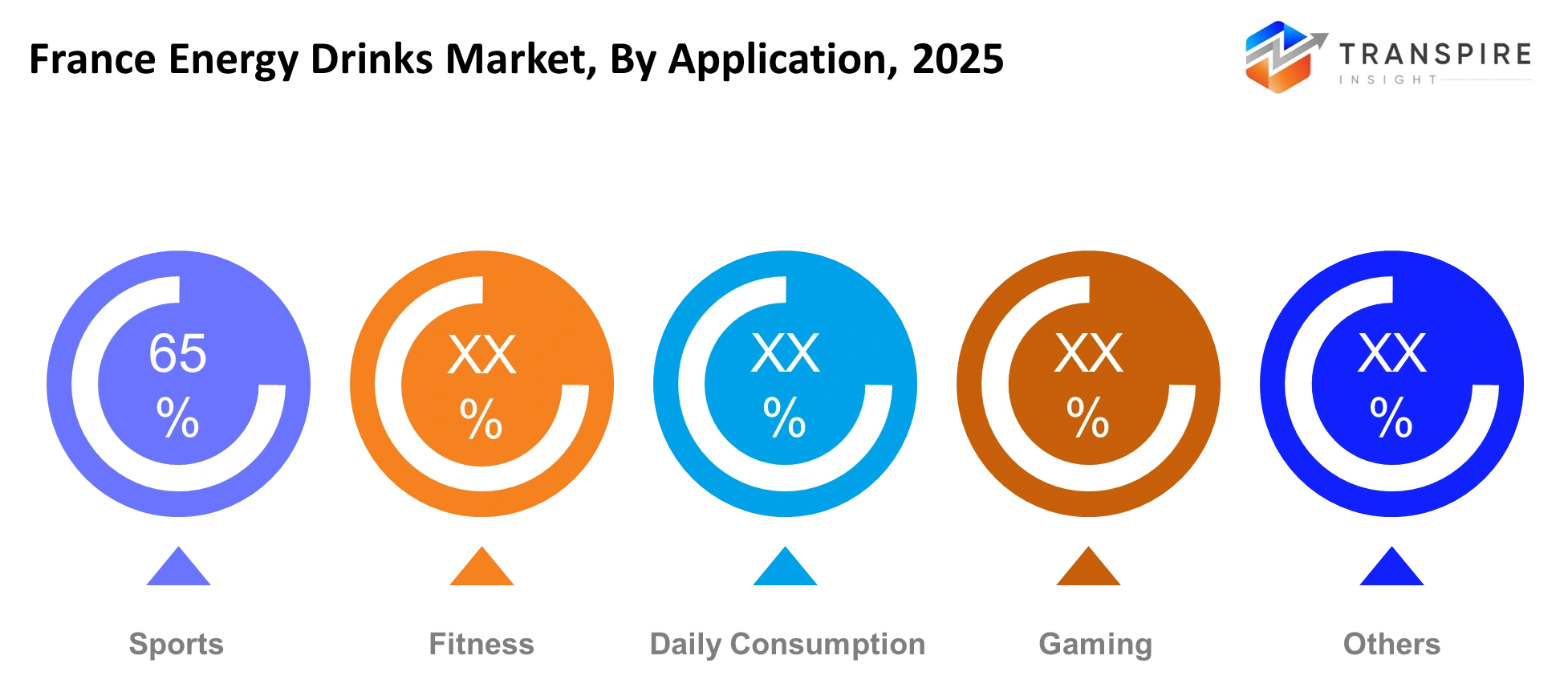
Sports and fitness applications maintain the leading market position because gyms, training centers, and active lifestyle consumers consistently drive high-frequency energy drink consumption. The demand for performance-focused beverages which people use before their workouts results in high sales of products containing both caffeine and electrolyte components. Beverage brands work with athletes and fitness influencers to create marketing partnerships which enhance their product visibility through digital channels and sports retail outlets.
Energy drinks now serve as productivity-support beverages which professionals and students and commuters consume during their work and travel activities throughout the day. The gaming applications are experiencing growth because esports participation increases and younger users spend extended time on screens to improve their focus and mental abilities. Nightlife and entertainment consumption through the others segment holds significant value for premium and flavored product categories which hospitality venues and music events distribute. Over the forecast period manufacturers will launch multifunctional beverages which provide cognitive performance benefits and hydration solutions and stress management support for various lifestyle needs.
To learn more about this report, Download Free Sample Report
By End-User
Youth consumers represent the dominant end-user segment because aggressive digital marketing, sports sponsorships, and social media engagement continue shaping purchasing behavior among younger age groups. Nightlife venues and gaming environments together with academic spaces create conditions which lead to constant product replacement in both supermarkets and convenience stores. Major beverage companies use limited-edition product releases and flavor testing to build brand loyalty which exists between their brands and younger consumers.
The market position of athletes remains strong because people desire performance-based products that contain electrolytes and amino acids together with low-sugar content. The hybrid working system and extended work hours have made professionals into the most rapidly expanding end-user group which drives demand for functional beverages that enhance focus and work efficiency. General consumers continue contributing stable revenue through casual and occasional purchases tied to travel, entertainment, and convenience retail environments. The "others" category which includes wellness-oriented older consumers will experience gradual growth because brands will launch products with cleaner ingredient profiles and lower-caffeine options which target a wider range of customers.
By Distribution
The distribution network of supermarkets operates as the primary retail channel because their vast store network enables customers to see products and access marketing materials and purchase goods in large quantities throughout France. Supermarket chains function as essential partners for major beverage companies to introduce new product flavors and develop their premium merchandise lines while achieving nationwide distribution through supermarket shelf space. The combination of high customer traffic and systematic product display methods establishes a reliable pattern of customer repeat purchases within this market category.
Energy drink sales maintain their current market share because energy drink consumers at transport hubs and petrol stations and urban commercial areas buy their drinks on impulse throughout the day. Young urban consumers are driving rapid growth in online distribution through their increasing use of digital grocery platforms and subscription-based beverage delivery services and direct-to-consumer sales channels. The "others" category which consists of gyms and vending machines and hospitality venues will experience continuous growth through its collaborations with events and its partnerships with fitness-centered retail outlets. The period of the forecast will show that companies which spend money on both omnichannel retail approaches and customer data analytics for their retail operations will gain advantages over their market competitors.
What are the Key Use Cases Driving the France Energy Drinks Market?
TheFrance energy drinksmarket shows its main usage pattern through daily functional drinking by urban professionals and students and gamers and fitness enthusiasts. The highest sales for ready-to-drink canned beverages occur because these products meet the convenience needs of people who use their products during their daily activities which include working at offices and going to the gym. Supermarkets and convenience stores and petrol stations experience increased sales through customers who make spontaneous purchases of their sugar-free products and performance-based products.
The nightlife market and sports nutrition market and foodservice industry now use secondary applications. Fitness centers and wellness retailers now offer premium energy beverages which contain vitamins and electrolytes and natural caffeine to their customers who are between 25 and 40 years old. Branded partnerships help hospitality operators and music event organizers to increase their beverage sales during festivals and concerts and sporting events.
The market now offers new social beverages which replace alcohol and development drinks that boost cognitive abilities for remote workers and esports viewers. Manufacturers are developing new nootropic products which include energy-boosting and focus-enhancing and hydration-building and mood-lifting functions to introduce new premium product categories which will drive economic growth in the market.
|
Report Metrics |
Details |
|
Market size value in 2025 |
USD 1.09 Billion |
|
Market size value in 2026 |
USD 1.2 Billion |
|
Revenue forecast in 2033 |
USD 2.3 Billion |
|
Growth rate |
CAGR of 9.74% from 2026 to 2033 |
|
Base year |
2025 |
|
Historical data |
2021 - 2024 |
|
Forecast period |
2026 - 2033 |
|
Report coverage |
Revenue forecast, competitive landscape, growth factors, and trends |
|
Regional scope |
France |
|
Key company profiled |
Red Bull, Monster Energy, Rockstar, PepsiCo, Coca-Cola, Lucozade, Bang Energy, Celsius, 5-hour Energy, Hell Energy, Tenzing, Aspire, Eboost, Guru, XS Energy. |
|
Customization scope |
Free report customization (country, regional & segment scope). Avail customized purchase options to meet your exact research needs. |
|
Report Segmentation |
By Type (Sugar-based, Sugar-free, Organic, Others); By Application (Sports, Fitness, Daily Consumption, Gaming, Others); By End-User (Youth, Athletes, Professionals, Consumers, Others); By Distribution (Supermarkets, Convenience Stores, Online, Others). |
Which Regions are Driving the France Energy Drinks Market Growth?
The energy drinks market in France maintains its highest market share through Île-de-France because of its urban population density and its extensive retail network and active nightlife economy. The Paris area experiences high beverage sales because its convenience stores and transport centers and gyms and entertainment locations enable customers to make frequent purchases. The region benefits from premium retail systems which enable international brands to swiftly launch their new product releases and limited-time offerings. The region achieves market leadership in premium and sugar-free goods because of its strong online sales and influencer marketing efforts.
The Auvergne-Rhône-Alpes region operates as a secondary growth area which displays market behavior based on fitness activities and tourist traffic and persistent consumer spending. The university population and outdoor sports activities and wellness retail growth in Lyon and Grenoble create ongoing customer demand for these cities. The region demonstrates higher repeat buying patterns which people associate with their daily activities and leisure time than Paris where people make impulse purchases. Multinational and emerging beverage companies generate consistent revenue through their established supermarket networks and regional distributor partnerships.
Provence-Alpes-Côte d'Azur has emerged as the fastest developing market which results from both the recovery of tourism and the expansion of hospitality services and the increase in seasonal beverage drinking. The coastal cities of Nice and Cannes and Marseille experienced elevated energy drink sales after their post-pandemic entertainment and travel and festival activities reached normal levels. The region's retailers now focus on premium functional beverages which meet the needs of international tourists visiting the area.
Who are the Key Players in the France Energy Drinks Market and How Do They Compete?
Multinational beverage companies maintain control over a significant portion of supermarket and convenience store distribution in the France energy drinks market, which maintains a state of moderate market consolidation. Brand competition centers on establishing brand identities and developing unique product components and gaining access to high-end retail distribution instead of using basic price-based competition methods. Established companies use marketing agreements and influencer endorsements and sports sponsorships to maintain product visibility in stores while new companies enter the market with sugar-free products and natural caffeine solutions and wellness-based marketing.
Red Bull uses a premium brand strategy that combines its sports sponsorships and its branding for nightlife and its extensive presence in hospitality and travel retail markets. The brand achieves product differentiation because customers recognize its brand name and purchase its special edition flavors which enable the company to maintain its premium pricing. Monster Beverage establishes its market position through its diverse flavor selection and its larger beverage container sizes and its strong partnerships with convenience stores which attract young customers and gamers. Coca-Cola uses its comprehensive network of bottling facilities and retail outlets to enhance market presence which enables its brands Monster and Burn to achieve national brand recognition.
Celsius established itself as a unique brand through its dedicated fitness market approach which includes zero-sugar products and marketing that emphasizes ingredients designed for active people. The company expanded its business operations throughout Europe by forming distribution partnerships and developing energy beverages with clean-label products. Tenzing appeals to niche market customers through its use of plant-based caffeine products and its commitment to sustainability which attracts health-conscious city dwellers. The companies use digital platforms and athlete collaborations to establish their competitive advantages over other companies.
Company List
- Red Bull
- Monster Energy
- Rockstar
- PepsiCo
- Coca-Cola
- Lucozade
- Bang Energy
- Celsius
- 5-hour Energy
- Hell Energy
- Tenzing
- Aspire
- Eboost
- Guru
- XS Energy
Recent Development News
In April 2026, Celsius expanded its France distribution footprint through Metro stores with support from Suntory Beverage & Food. The rollout introduced new kiwi-guava and strawberry-watermelon variants, increasing the brand’s penetration in France’s premium functional beverage segment.
Source: http://resto.zepros.fr
In January 2026, Monster Beverage partnered with Circle K to launch the exclusive Punk Punch flavor across convenience retail channels. The collaboration strengthened Monster’s visibility in impulse-driven retail environments and reinforced competition in zero-sugar flavor innovation.
Source: http://www.convenience.org
What Strategic Insights Define the Future of the France Energy Drinks Market?
The France energy drinks market is now evolving toward premium beverages that provide functional energy support together with wellness and hydration and cognitive support benefits. The shift is occurring because professionals and fitness-oriented consumers and young city residents now prefer drinks that do not contain traditional sugary soft drinks and alcohol-based social beverages. Brands that can develop energy products with health-related branding will achieve better profit growth through their retail and digital sales channels during the upcoming five to seven years.
European authorities now examine caffeine consumption and artificial sweetener use and marketing strategies that target underage consumers with stricter regulations. International beverage companies will face elevated expenses to meet compliance requirements because future labeling regulations and taxation measures will restrict their ability to market products.
AI-based consumer customization systems and functional nutrition platforms that create drinking recommendations based on user activity and health targets and dietary needs represent a significant new business opportunity. French companies need to focus on developing products that cater to local markets while creating low-sugar products and establishing partnerships with fitness and gaming and wellness companies to build long-lasting customer loyalty in the country’s changing functional beverage market.
France Energy Drinks Market Report Segmentation
By Type
- Sugar-based
- Sugar-free
- Organic
- Others
By Application
- Sports, Fitness
- Daily Consumption
- Gaming
- Others
By End-User
- Youth
- Athletes
- Professionals
- Consumers
- Others
By Distribution
- Supermarkets
- Convenience Stores
- Online
- Others
Frequently Asked Questions
Find quick answers to common questions.
The confirmed 2033 market size figure is USD 2.3 Billion.
Key segments for the France Energy Drinks Market are By Type (Sugar-based, Sugar-free, Organic, Others); By Application (Sports, Fitness, Daily Consumption, Gaming, Others); By End-User (Youth, Athletes, Professionals, Consumers, Others); By Distribution (Supermarkets, Convenience Stores, Online, Others).
Major France Energy Drinks Market players are Red Bull, Monster Energy, Rockstar, PepsiCo, Coca-Cola, Lucozade, Bang Energy, Celsius, 5-hour Energy, Hell Energy, Tenzing, Aspire, Eboost, Guru, XS Energy.
The France Energy Drinks Market size is USD 1.09 Billion in 2025.
The France Energy Drinks Market CAGR is 9.74% from 2026 to 2033.
- Red Bull
- Monster Energy
- Rockstar
- PepsiCo
- Coca-Cola
- Lucozade
- Bang Energy
- Celsius
- 5-hour Energy
- Hell Energy
- Tenzing
- Aspire
- Eboost
- Guru
- XS Energy
Recently Published Reports
-
Apr 2026
Baby Infant Formula Market
Baby Infant Formula Market Size, Share & Analysis Report By ype (Infant Milk, Follow On Milk, Specialty Baby Milk, Growing-Up Milk), By Ingredient (Carbohydrate, Fat, Protein, Minerals, Vitamins, and Others), By Product Form (Powder, Liquid, and Ready-to-feed), By Distribution Channels (Supermarket/Hypermarket, Specialty Store, Pharmacies, Online Retail, and Others), and Geography (North America, Europe, Asia-Pacific, Middle East and Africa, South and Central America), 2021 - 2031
-
Apr 2026
Edible Insects for Animal Feed Market
Edible Insects for Animal Feed Market Size, Share & Analysis Report By Type (Insect Powder, Insect Meal, Insect Bar, Insect Paste, Insect Oil, and Others), By Insect Type (Beetles, Cricket, Caterpillar, Hymenoptera, Orthoptera, Tree Bugs, and Others), By Application (Livestock, Pet Food, and Aquaculture), By Livestock Type (Poultry, Swine, and Others), and Geography (North America, Europe, Asia-Pacific, Middle East and Africa, South and Central America), 2021 - 2031
-
Apr 2026
Food Industry Disinfection and Bacterial Control Market
Food Industry Disinfection and Bacterial Control Market Size, Share & Analysis Report By Type (Chemical Disinfectants, Physical Disinfectants, and Biocides and Antimicrobials), By Application (Food Processing Equipment Surface Disinfection, Food Preparation Areas Surface Disinfection, Storage Areas Surface Disinfection, Anti-microbial Coatings Food Preservation, and Preservative Solutions Food Preservation), By End User (Meat and Poultry Processing, Dairy Processing, Seafood Processing, Bakery and Confectionery, Restaurants and Commercial Kitchens, and Food Service Providers), By Sales Channel (Online, Offline), and Geography (North America, Europe, Asia-Pacific, Middle East and Africa, South and Central America), 2021 - 2031
-
Apr 2026
Freeze Dried Food Market
Freeze Dried Food Market Size, Share & Analysis Report By Product Type (Fruits, Vegetables, Freeze-Dried Dairy Products, Freeze-Dried Meat and Seafood, Freeze-Dried Pet Food, and Prepared Meal), By Nature (Organic, and Conventional), By Form (Powdered, Granules, and Diced), By End Use (Breakfast Cereals, Dairy Products, Bakery & Confectionery, Nutritional Bars & Supplements, Powdered Beverages, Snacks, and Retail (Household)), and Geography (North America, Europe, Asia-Pacific, Middle East and Africa, South and Central America), 2021 - 2031