

Europe Power Management System Market Size & Forecast:
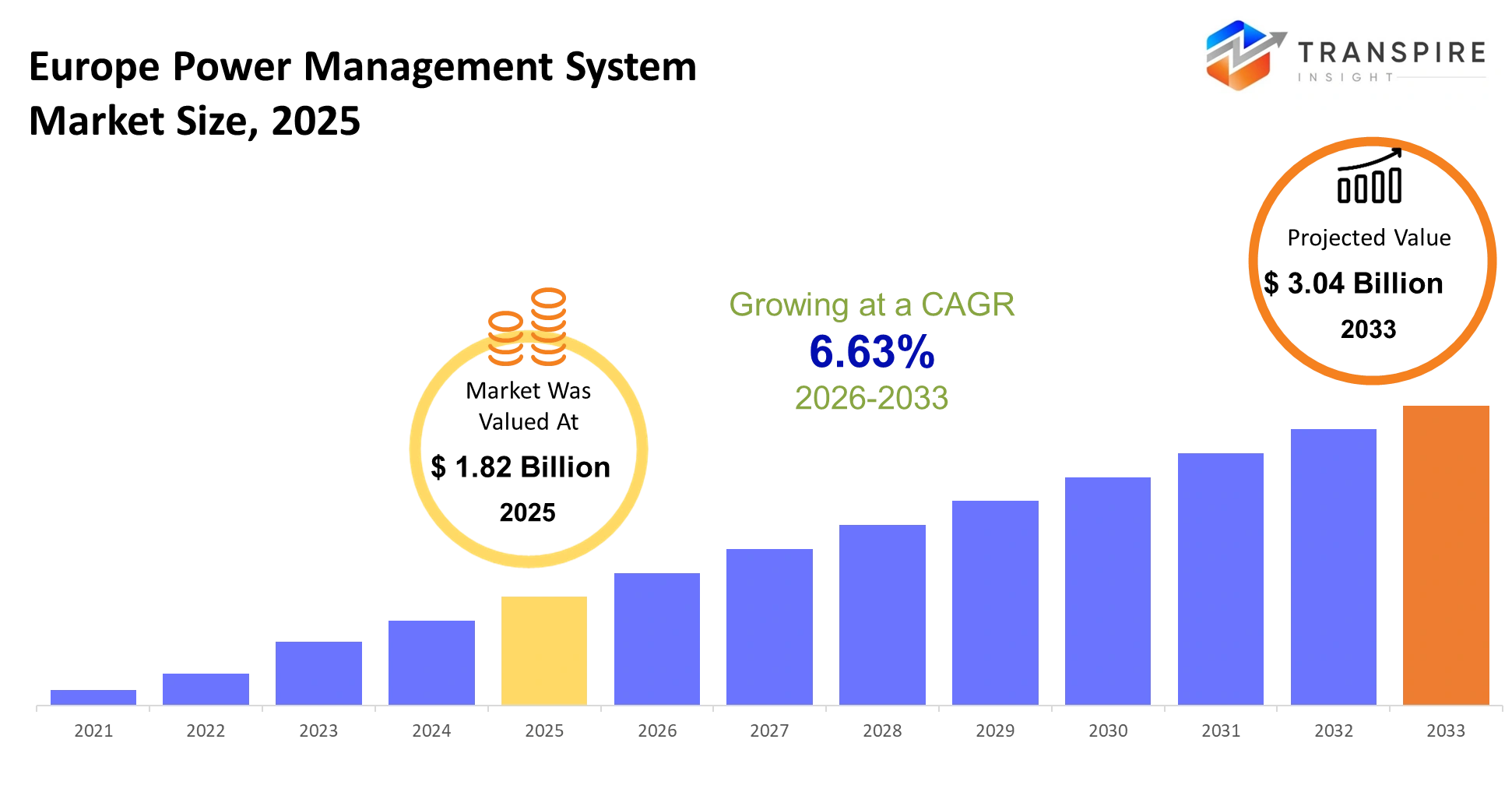
- Europe Power Management System Market Size 2025: USD 1.82 Billion
- Europe Power Management System Market Size 2033: USD 3.04 Billion
- Europe Power Management System Market CAGR: 6.63%
- Europe Power Management System Market Segments: By Type (Hardware, Software, Services, Monitoring Systems, Control Systems, Others); By Application (Energy Monitoring, Load Management, Demand Response, Power Optimization, Others); By End-User (Utilities, Industrial, Commercial, Residential, Others); By Deployment (Cloud, On-premise, Hybrid, Edge, Others)
To learn more about this report,  Download Free Sample Report
Europe Power Management System Market Summary
The Europe Power Management System Market was valued at USD 1.82 Billion in 2025. It is forecast to reach USD 3.04 Billion by 2033. That is a CAGR of 6.63% over the period.
The European market for power management systems serves as the essential link that connects industrial operations with electric grid stability. The system allows factories, utilities, transport networks, and marine operators to manage their energy demands while securing operational uptime and maintaining electrical system expenses during their shift toward greater electrification. The market has undergone a complete transformation during the past five years because it now uses software-based solutions that combine artificial intelligence with energy orchestration platforms to manage real-time renewable energy assets and battery storage systems and distributed resources. The European energy crisis which began after the Russia-Ukraine conflict revealed that power supply fluctuations and natural gas imports created both financial and operational risks to the energy market. Power management systems changed their function from regulatory requirements to essential business tools after electricity costs reached record highs. The current trend creates new software revenue streams which drive infrastructure upgrades and predictive energy optimization system deployment across manufacturing facilities and ports and commercial centers.
Key Market Insights
- The Europe Power Management System Market in 2025 saw Western Europe achieve more than 42% market share because of its advanced grid modernization investments.
- The industrial automation growth and renewable energy implementation at manufacturing sites enabled Germany to sustain its major market share.
- The Northern Europe market developed into the fastest expanding regional sector until 2032 because of smart grid implementation and energy storage technology development.
- The Europe Power Management System Market showed hardware solutions as its leading component which represented almost 48% of market size in 2025 through substation modernization projects.
- Industries used predictive monitoring and AI-based energy optimization systems which made software and analytics platforms the second biggest market segment.
- The segment of cloud-based energy management platforms will experience its highest growth rate between 2026 and 2032 because businesses increasingly adopt digitalization solutions.
- The industrial manufacturing sector used digital power systems which generated 35% of application demand because energy-intensive facilities needed to enhance operational efficiency and ensure system availability.
- The application segment for data centers showed the highest growth rate because of increasing hyperscale infrastructure investments and essential power continuity needs.
- Marine and port operations increasingly adopted intelligent power management technologies to support electrification and emission reduction targets.
- Transportation infrastructure operators expanded deployment of digital power systems to support electric mobility and rail network electrification projects.
What are the Key Drivers, Restraints, and Opportunities in the Europe Power Management System Market?
The Europe Power Management System Market experiences its most powerful growth through the development of decentralized renewable energy systems which industrial sectors and utility networks are currently building. The European Union forces utilities and manufacturers to upgrade their existing grid systems through its Fit for 55 program and new carbon reduction requirements which demand power systems to handle unpredictable solar and wind energy. The market witnessed a growth in spending for systems which include intelligent load balancing and predictive energy analytics and real-time monitoring platforms. After the Russia-Ukraine conflict energy prices started fluctuating companies needed to implement advanced power management systems which enabled them to monitor energy usage and decrease operational hazards while maintaining stable electricity expenses that boosted their recurring software and service income.
The market’s biggest structural barrier remains the integration challenge posed by Europe’s aging electrical infrastructure. Many industrial facilities still operate fragmented systems built over several decades which makes it difficult to connect modern digital platforms with their existing systems. Organizations face multiple challenges during retrofitting because they need longer shutdown times and expert engineers and they also need to implement cybersecurity measures which causes them to delay their procurement processes while their mid-sized operators face difficulties with system updates because they need to spend their modernization budgets.
The integration of grid-scale battery storage systems brings forth the potential for substantial expansion. Germany and the Netherlands are currently increasing their financial support for battery-backed smart substations which need advanced power orchestration software to manage renewable energy fluctuations in real time.
What Has the Impact of Artificial Intelligence Been on the Europe Power Management System Market?
The Europe Power Management System Market undergoes transformation through Artificial intelligence together with advanced digital platforms which enable operators to conduct energy management using predictive systems instead of their current practice of reactive monitoring. Industrial operators and utilities now deploy AI-enabled control systems which automatically balance electrical loads while optimizing power distribution and detecting abnormal consumption patterns in real time. Machine learning algorithms use historical equipment behavior data to predict transformer failures and switchgear degradation and voltage instability at large manufacturing facilities and smart substations. The predictive ability of this system reduces unplanned equipment downtime while extending equipment lifespan and decreasing maintenance expenses.
Advanced analytics platforms enable businesses to achieve better energy efficiency results while maintaining proper regulatory compliance. The AI-driven forecasting tools which utilities use help them manage wind and solar generation fluctuations which creates stable grid performance and decreases their balancing expenses. Digital twin technology together with IoT-connected sensors enables operators to create operational simulations which lead to better asset utilization while achieving energy savings and reduced maintenance needs. Multiple industrial sites achieve double-digit energy efficiency gains after they implement AI-based optimization software into their existing power systems.
The process of adoption continues to face a significant obstacle. The operation of many European facilities depends on fragmented legacy systems which contain inconsistent data quality and these factors create problems for AI integration that increase expenses and decrease accuracy during real-world operation in complex environments.
Key Market Trends
- The European utilities sector has been accelerating its investment in smart grid technology since 2021 because energy price fluctuations demonstrated the vulnerabilities of existing transmission and distribution systems.
- The industrial sector now uses cloud-based analytics solutions to monitor multiple facilities which deliver real-time electricity usage information instead of using separate monitoring systems.
- Between 2022 and 2025 Germany and the Netherlands expanded their battery-supported substations which increased their requirement for intelligent load balancing and storage orchestration software solutions.
- The integration of renewable energy sources resulted in organizations shifting their procurement focus from hardware-based systems toward software-based energy management solutions which can control intermittent power generation.
- The companies Schneider Electric and Siemens AG have increased their acquisition activities for digital energy analytics businesses to improve their artificial intelligence-powered grid management systems.
- Western European manufacturers have transitioned from using reactive maintenance systems to implementing predictive diagnostic methods which help them decrease unexpected electrical outages and work interruptions.
- Data center operators implemented advanced power optimization systems because hyperscale facilities needed to meet stricter energy efficiency standards while facing rising electricity procurement expenses.
- After the 2022 increase in operational technology threats which targeted connected grid infrastructure utilities began treating cybersecurity as their major purchasing requirement.
- Eastern European governments accelerated transmission capacity upgrades through EU recovery funding to decrease reliance on outdated electrical systems which date back to the Soviet Union.
- Marine and port operators implemented shore power management systems to meet new European emission reduction standards which took effect after 2023.
Europe Power Management System Market Segmentation
By Type:
The market position of hardware products continues to dominate because Western Europe experiences heavy investment in substations and switchgear upgrades and smart meter installation and industrial electrical system development. Utilities and heavy manufacturing facilities maintained their focus on physical grid reliability which developed after the 2022 energy supply crisis exposed aging transmission networks as weak points. Industrial operators needed to track dynamic changes in renewable power generation and load distribution which led to the widespread adoption of monitoring systems and control systems.
Over the past three years software and services experienced rapid growth because energy-intensive industries adopted predictive analytics and cloud-based monitoring systems and AI-enabled optimization platforms. The demand for intelligent orchestration systems which control decentralized power flows has risen due to the deployment of hybrid energy networks that combine solar and wind and battery storage systems. The future growth of software-led ecosystems will create new opportunities for service-based revenue models which will drive technology developers to enhance their cybersecurity solutions and interoperability capabilities and remote operational support systems.
By Application:
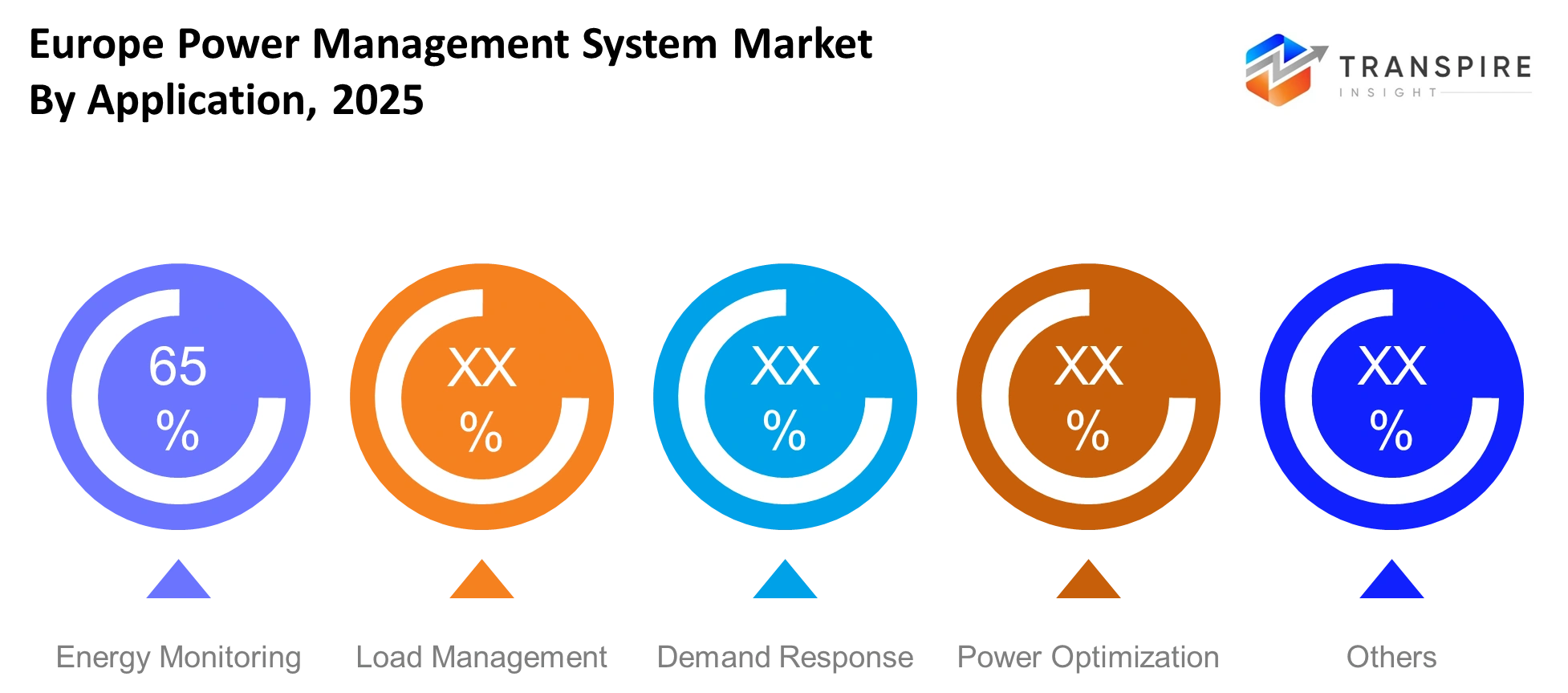
Energy monitoring proved to be the most important market segment because utilities and manufacturers and commercial facilities required ongoing electricity management to reduce costs and maintain operational efficiency. The industrial sector throughout Europe adopted real-time monitoring systems because unpredictable energy pricing made it necessary to establish new industrial procurement methods. The expansion of load management and power optimization applications occurred because renewable energy resources brought unpredictable changes to national power grids and industrial distribution networks.
The expansion of smart grid programs together with new dynamic electricity pricing systems which several European markets implemented created rapid growth for demand response as its main application segment. The grid operators established a system which provided rewards to industrial customers who successfully automated their electricity reduction during times of peak demand. Advanced optimization platforms which combine AI-based forecasting with battery management solutions will receive increased funding throughout the forecast period because energy-intensive industries and data center facilities will require these technologies.
To learn more about this report, Download Free Sample Report
By End-User:
The utility sector became the leading end-user market because national grid modernization projects needed advanced control systems which could manage distributed renewable energy sources. After European governments established stricter decarbonization targets and increased concerns about grid instability electricity transmission operators began to implement advanced monitoring and automation systems at a faster rate. Industrial facilities maintained a significant market share because electricity procurement expenses increased while their operations needed continuous power supply solutions.
The office complex, retail facility, airport, and data center sectors experienced higher adoption rates for energy efficiency technology which business operations depend on for both efficiency and resilience. The electrification process which transforms transportation networks together with the growth of hyperscale digital infrastructure has created a higher need for advanced load balancing solutions and backup power systems. The upcoming investment period will direct its focus towards commercial ecosystems which utilize digital connectivity to create operational systems that determine their carbon emissions and energy efficiency practices which impact their financial performance and compliance with regulations.
By Deployment:
The market maintained its most significant share through on-premise deployment because utilities and essential industrial facilities needed to control operations while securing their systems and connecting to their existing infrastructure. The power generation industry together with transmission operators and manufacturing facilities preferred to use localized deployment architectures for their essential applications which demanded continuous system operation. Organizations adopted hybrid deployment models to achieve their operational security needs while benefiting from cloud-based analytics systems which provided operational growth.
The most rapid growth in cloud deployment occurred because businesses began to implement remote asset monitoring and predictive maintenance software and centralized energy management systems across their multiple operational sites. Organizations used AI-based optimization systems and IoT-enabled infrastructure to transition their operations to cloud-based systems that could manage high levels of operational data in real-time processing. Industrial operators will find edge computing solutions more useful during the forecast period because they need to make quick decisions at their facilities which handle smart substations and renewable energy integration and automated grid management.
What are the Key Use Cases Driving the Europe Power Management System Market?
Industrial energy monitoring remains the primary use case driving adoption across Europe, particularly in manufacturing plants, chemical facilities, and automotive production sites with high electricity intensity. The operators use advanced control and monitoring systems to decrease equipment downtime and maintain consistent power quality and handle the unpredictable electricity expenses that stem from renewable energy-heavy power grids.
The operators of commercial buildings and data centers use real-time load optimization and backup power coordination to create new application areas. Utilities have increased their deployment of demand response systems to control peak electricity use while they protect grid stability through times of changing solar and wind energy production.
The new use cases start with AI-powered battery management systems which operate between smart substations and European port shore power systems. The government funding of decarbonization projects together with grid modernization efforts for transport and industrial systems creates long-term market potential for railway electrification projects and hydrogen production plants.
|
Report Metrics |
Details |
|
Market size value in 2025 |
USD 1.82 Billion |
|
Market size value in 2026 |
USD 1.94 Billion |
|
Revenue forecast in 2033 |
USD 3.04 Billion |
|
Growth rate |
CAGR of 6.63% from 2026 to 2033 |
|
Base year |
2025 |
|
Historical data |
2021 - 2024 |
|
Forecast period |
2026 - 2033 |
|
Report coverage |
Revenue forecast, competitive landscape, growth factors, and trends |
|
Regional scope |
Europe (Germany, United Kingdom, France, Italy, Spain, Rest of Europe) |
|
Key company profiled |
Siemens, Schneider Electric, ABB, Eaton, GE, Honeywell, Emerson, Mitsubishi Electric, Toshiba, Rockwell Automation, Hitachi, Cisco, IBM, Oracle, Delta Electronics |
|
Customization scope |
Free report customization (country, regional & segment scope). Avail customized purchase options to meet your exact research needs. |
|
Report Segmentation |
By Type (Hardware, Software, Services, Monitoring Systems, Control Systems, Others); By Application (Energy Monitoring, Load Management, Demand Response, Power Optimization, Others); By End-User (Utilities, Industrial, Commercial, Residential, Others); By Deployment (Cloud, On-premise, Hybrid, Edge, Others) |
Which Regions are Driving the Europe Power Management System Market Growth?
The market in Western Europe reaches its highest point because the region implements aggressive grid modernization policies and possesses advanced industrial infrastructure and Germany France and the Netherlands maintain their strong renewable energy integration targets. The energy crisis of 2022 revealed power system weaknesses which led utilities and manufacturing operators to make substantial investments in intelligent load balancing and predictive energy management systems. The implementation of artificial intelligence monitoring systems advanced because government agencies enforced carbon reduction regulations and energy efficiency requirements. The regional technology ecosystem which includes technology providers and engineering companies and software developers and transmission operators maintains its regional control while creating new opportunities for future development.
The northern European market achieves constant revenue growth because it implements structured energy transition plans which receive ongoing financial support from both public and private sectors to develop intelligent infrastructure solutions. The growth of Sweden Denmark and Finland as separate entities from Western Europe happens because these countries build their future on digital grid networks which connect to power generation facilities that use renewable energy sources. Nordic utilities adopted advanced grid systems which combine battery storage with decentralized energy management to handle their increasing wind energy production. Utility companies which have strong financial stability and follow fixed regulatory planning schedules drive the ongoing implementation of next-generation energy optimization technologies.
Eastern Europe represents the fastest-growing regional market as governments accelerate transmission upgrades and industrial electrification programs supported by European Union recovery funding. The three countries of Poland, Romania, and the Czech Republic increased their investments in digital substations and industrial energy resilience after geopolitical disruptions showed them the need to upgrade their old systems and reduce their reliance on imported energy. Manufacturing expansion and modernization of rail and transport electrification systems also created new demand for intelligent power management technologies. The period between 2026 and 2033 will show strong growth which will create major business opportunities for software vendors and infrastructure integrators and cloud-based energy analytics providers who want to expand their presence in markets that remain mostly untapped.
Who are the Key Players in the Europe Power Management System Market and How Do They Compete?
The Europe Power Management System Market exhibits moderate market consolidation because global industrial technology companies control major utility and infrastructure contracts while specialized software companies compete in analytics and grid optimization markets. The competition now focuses on digital capabilities because companies need more than hardware size to succeed in AI-based energy orchestration and predictive maintenance and cybersecurity integration. Existing suppliers maintain their market position through established utility relationships and their comprehensive service agreements, but energy software providers who operate in the cloud introduce subscription monitoring services that change traditional procurement methods. The ability to launch services from different locations and connect with old systems and handle real-time data analysis has become the main factor that determines business success today.
Schneider Electric uses its combined software ecosystems which merge building automation with energy analytics and industrial control systems into one platform to create its unique market position. Schneider Electric holds a competitive advantage in digital energy solutions because its products reach both commercial infrastructure and data centers. Siemens AG invests heavily in smart grid digitization and industrial automation because these technologies enable its utilities to establish better relationships through digital twin technology and AI-powered substations which cover Germany and Northern Europe. Siemens expands its regional operations through its transmission operator partnerships and infrastructure modernization initiatives.
ABB Ltd. uses its advanced electrification systems which enable renewable energy integration and industrial power stability to compete in the market.ABB achieved greater product differentiation through its cloud-based asset monitoring solutions and its acquisition of digital automation technology which enhances its predictive maintenance capabilities. The company provides essential backup power systems and energy management solutions to support commercial buildings and healthcare facilities and data processing centers. Hitachi Energy expanded its operations through development of grid-edge software and its work on high-voltage transmission projects which create renewable energy corridors throughout Eastern and Central Europe.
Company List
- Siemens
- Schneider Electric
- ABB
- Eaton
- GE
- Honeywell
- Emerson
- Mitsubishi Electric
- Toshiba
- Rockwell Automation
- Hitachi
- Cisco
- IBM
- Oracle
- Delta Electronics
Recent Development News
“In January 2026, Siemens AG expanded its partnership with NVIDIA and unveiled an Industrial AI Operating System at CES 2026. The collaboration introduced AI-enabled digital twin and industrial automation technologies designed to improve manufacturing efficiency, predictive operations, and energy optimization across industrial facilities.https://press.siemens.com
“In August 2025, Schneider Electric entered a long-term partnership with E.ON to deploy SF₆-free medium-voltage switchgear across European energy networks. The agreement supports compliance with upcoming EU F-Gas regulations and accelerates adoption of sustainable digital-ready grid infrastructure throughout Europe.https://www.se.com
What Strategic Insights Define the Future of the Europe Power Management System Market?
The Europe Power Management System Market is moving toward highly decentralized, software-defined energy ecosystems where AI-driven orchestration platforms manage distributed renewables, battery storage, electric transport infrastructure, and industrial microgrids in real time. The underlying force behind this transition is not only decarbonization policy, but also the growing economic cost of grid instability and energy price volatility across Europe’s industrial base. A less visible risk is the increasing concentration of digital grid infrastructure among a small group of software and automation providers, which could create interoperability bottlenecks, cybersecurity vulnerabilities, and pricing power imbalances over the next decade.
A significant emerging opportunity is developing in Eastern Europe, where transmission modernization programs and EU-backed electrification funding are creating demand for cloud-native grid optimization platforms and edge-based control systems. Market participants should prioritize open-architecture platforms capable of integrating legacy infrastructure with AI-enabled analytics, as buyers increasingly favor interoperable ecosystems over proprietary hardware-centric solutions.
Europe Power Management System Market Report Segmentation
By Type
- Hardware
- Software
- Services
- Monitoring Systems
- Control Systems
- Others
By Application
- Energy Monitoring
- Load Management
- Demand Response
- Power Optimization
- Others
By End-User
- Utilities
- Industrial
- Commercial
- Residential
- Others
By Deployment
- Cloud
- On-premise
- Hybrid
- Edge
- Others
Frequently Asked Questions
Find quick answers to common questions.
The Europe Power Management System Market size is USD 3.04 Billion in 2033.
Key segments for the Europe Power Management System Market are By Type (Hardware, Software, Services, Monitoring Systems, Control Systems, Others); By Application (Energy Monitoring, Load Management, Demand Response, Power Optimization, Others); By End-User (Utilities, Industrial, Commercial, Residential, Others); By Deployment (Cloud, On-premise, Hybrid, Edge, Others).
Major Europe Power Management System Market players are Siemens, Schneider Electric, ABB, Eaton, GE, Honeywell, Emerson, Mitsubishi Electric, Toshiba, Rockwell Automation, Hitachi, Cisco, IBM, Oracle, Delta Electronics.
The Europe Power Management System Market size is USD 1.82 Billion in 2025.
The Europe Power Management System Market CAGR is 6.63% from 2026 to 2033.
- Siemens
- Schneider Electric
- ABB
- Eaton
- GE
- Honeywell
- Emerson
- Mitsubishi Electric
- Toshiba
- Rockwell Automation
- Hitachi
- Cisco
- IBM
- Oracle
- Delta Electronics
Recently Published Reports
-
Apr 2026
Active Power Filter Market
Active Power Filter Market Size, Share & Analysis Report By Type (Shunt Active Power Filters, Series Active Power Filter, Hybrid Active Power Filter), By Application (Harmonics Mitigation, Reactive Power Compensation, Voltage Regulation, Power Factor Correction), By Phase (Single Phase, Three Phase), By End-User Industry (Manufacturing, Healthcare, Commercial, Automotive, Oil and Gas, Others), and Geography (North America, Europe, Asia-Pacific, Middle East and Africa, South and Central America), 2021 - 2031
-
Apr 2026
Electrical Transformer Market
Electrical Transformer Market Size, Share & Analysis Report By Core (Closed, Shell, and Berry), By Insulation (Gas, Oil, Solid, Air, and Other), By Phase (Single, and Three), By Rating (100 MVA to 500 MVA, 501 MVA to 800 MVA, and 801 MVA to 1200 MVA), and Geography (North America, Europe, Asia-Pacific, Middle East and Africa, South and Central America), 2021 – 2031
-
Apr 2026
Hydraulic Piston Pumps Market
Hydraulic Piston Pumps Market Size, Share & Analysis Report By Type (Axial Piston Pumps, Radial Piston Pumps), By Operating Pressure (Low Pressure, Medium Pressure, High Pressure), By Application (Construction, Mining, Agriculture, Automotive, Oil & Gas, Industrial Machinery, Others), By End-User (OEMs, Aftermarket), and Geography (North America, Europe, Asia-Pacific, Middle East and Africa, South and Central America), 2021 – 2031
-
Apr 2026
Laboratory Gas Generators Market
Laboratory Gas Generators Market Size, Share & Analysis Report By Product (Nitrogen Gas Generator, Hydrogen Gas Generator, Zero Air Gas Generator, Purge Gas Generator, TOC Gas Generators, Others), By Application (Gas Chromatography, Liquid Chromatography-mass Spectrometry (LC-MS), Gas Analyzers, Others), By End-user (Life Science, Chemical & Petrochemical, Food & Beverage, Others), and Geography (North America, Europe, Asia-Pacific, Middle East and Africa, South and Central America), 2021 – 2031