

Europe Remote Deposit Capture Market Size & Forecast:
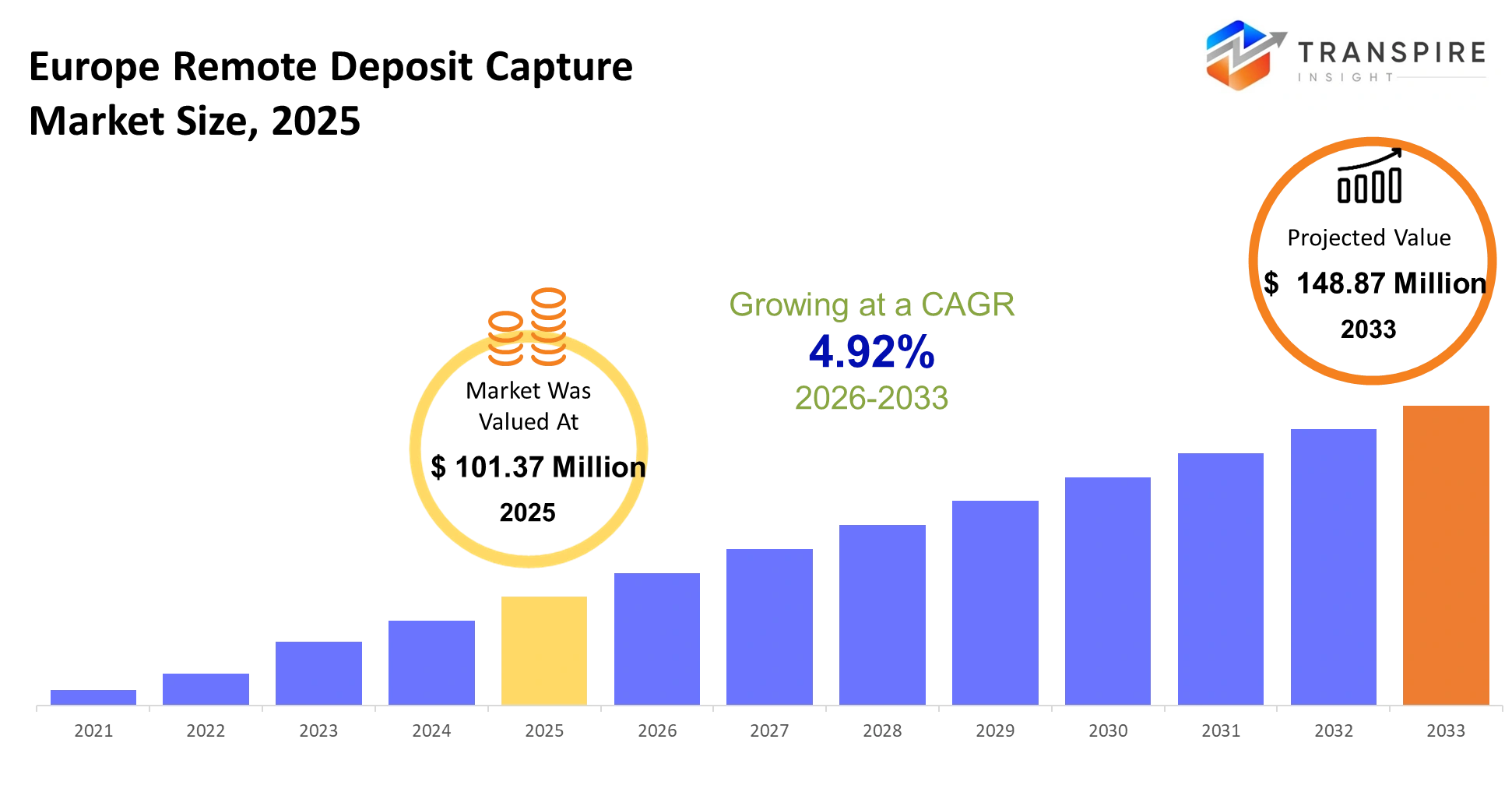
- Europe Remote Deposit Capture Market Size 2025: USD 101.37 Million
- Europe Remote Deposit Capture Market Size 2033: USD 148.87 Million
- Europe Remote Deposit Capture Market CAGR: 4.92%
- Europe Remote Deposit Capture Market Segments: By Type (Mobile RDC, Desktop RDC, ATM-based RDC, Others), By Application (Cheque Processing, Banking Automation, Fraud Detection, Others), By End-User (Banks, Enterprises, SMEs, Credit Unions, Others), By Deployment (Cloud, On-premise, Hybrid, Others).
To learn more about this report,  Download Free Sample Report
Europe Remote Deposit Capture Market Summary:
The Europe Remote Deposit Capture Market size is estimated at USD 101.37 Million in 2025 and is anticipated to reach USD 148.87 Million by 2033, growing at a CAGR of 4.92% from 2026 to 2033. The critical digital banking utility of remote deposit capture enables European businesses and retail customers to deposit checks through mobile devices and desktop scanners without needing to visit physical branch locations. The system helps banks overcome their expensive operational challenge because it enables customers to access their funds faster while they depend less on branch locations.
The market has transitioned during the past three to five years from basic image-based check submission to AI-enabled systems which verify identities and detect fraudulent activities through remote deposit workflows. The COVID-19 pandemic created a major change because it established new customer standards for branchless banking which required financial institutions to accelerate their digital onboarding and payment modernization efforts. The process creates a strong cause-and-effect relationship because banks spend money on digital channels for the purpose of reducing their servicing expenses which leads to higher remote deposit tool usage by customers, resulting in increased transaction activity and platform revenue generation and extended software revenue prospects throughout the European banking system.
Key Market Insights
- Western Europe held the leading position in the Europe Remote Deposit Capture Market during 2025 with a market share of 42% because advanced banking digitization progressed through Germany, France, and the UK.
- The Eastern European market will experience its fastest growth rate until 2030 because of developing fintech ecosystems together with increasing mobile banking adoption.
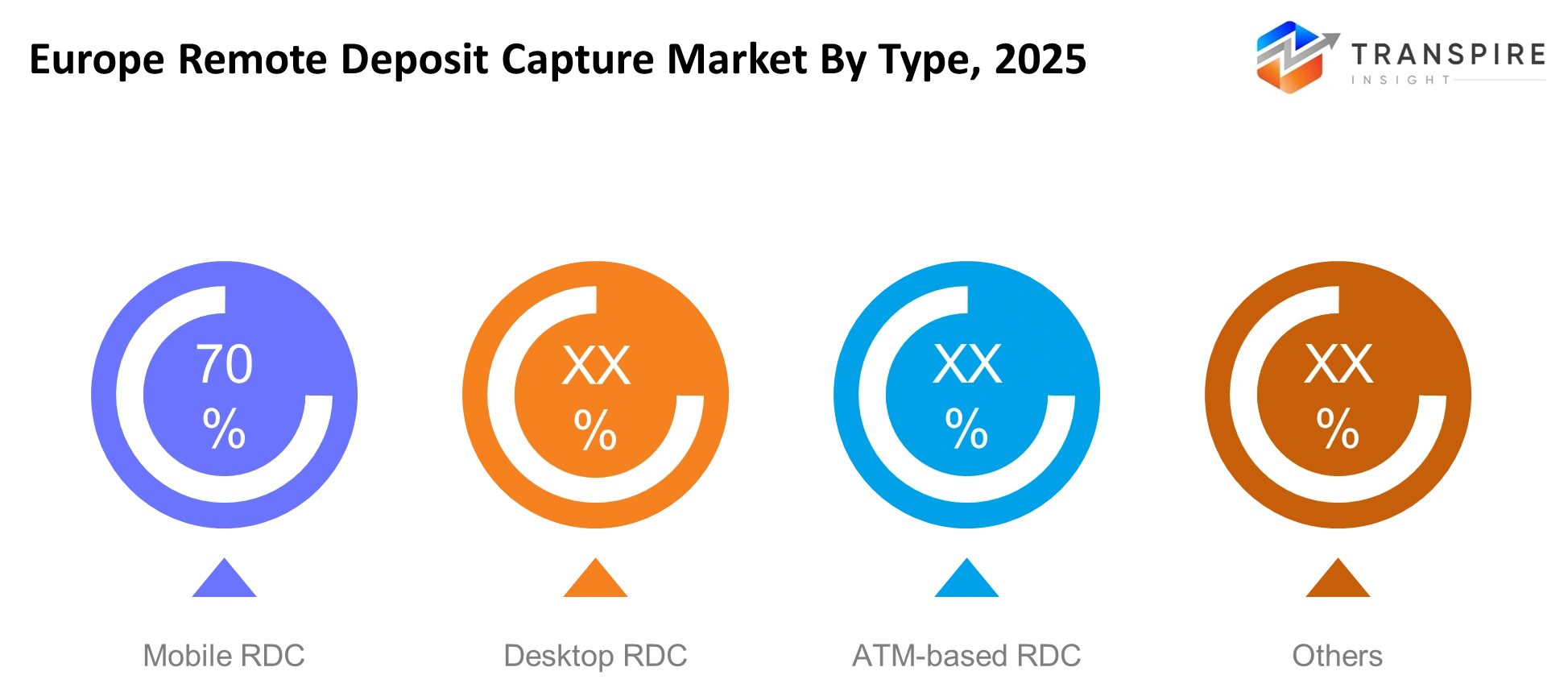
- European banks operated their remote deposit systems through mobile remote deposit capture solutions which generated about 48% of the Europe Remote Deposit Capture Market size in 2025 because banks prioritized smartphone-based transaction convenience.
- The desktop-based remote deposit capture system maintained its position as the second-largest segment because corporate banking operations and treasury management needs generated high usage of this system.
- AI-powered fraud detection platforms represent the fastest-growing technology segment between 2026 and 2030 because financial institutions develop their digital transaction security systems.
- Retail banking applications have achieved the highest revenue share of about 46% in 2025 because many customers now use contactless and branchless banking services.
- SME banking applications are developing quickly because smaller businesses require faster check-clearing systems and more affordable ways to handle their transactions.
- Large banking institutions maintained their dominant position as end users because traditional banks improved their digital systems and operational efficiency during 2025.
- The fastest growth rate during the forecast period will occur for fintech companies because they will establish strategic partnerships with local financial institutions.
- The Europe remote banking technology market observed higher investments in cloud-native deposit capture systems which enhanced their ability to handle compliance requirements and process transactions at greater speeds.
What are the Key Drivers, Restraints, and Opportunities in the Europe Remote Deposit Capture Market?
The banking industry exhibits its most intense operational drive which enables European Remote Deposit Capture Market growth through its current efforts to control branch expenses while implementing automatic digital transaction systems. European banks faced sustained pressure after the pandemic to reduce physical infrastructure expenses while maintaining customer service continuity. The banking industry made major investments in mobile banking platforms and artificial intelligence image recognition technology and cloud-based check processing systems. The integration of remote deposit capture technology into standard digital banking operations resulted in decreased transaction costs for banks and improved customer loyalty between the banks and their clients. The banking operations achieved better productivity through faster check processing and decreased need for manual verification which resulted in more customers using the system and the business generating ongoing software sales from both retail and commercial banking customers.
The market’s largest structural barrier remains Europe’s fragmented banking compliance environment. Remote deposit capture systems must comply with different national banking regulations, data privacy frameworks, and anti-fraud verification standards across multiple jurisdictions. The platform deployment process between countries becomes more difficult due to this system complexity which results in higher costs for financial institutions when they try to set up their systems across multiple European nations. Smaller banks and regional credit institutions often delay modernization because replacing legacy core banking infrastructure requires multi-year investment cycles. The market remains limited because customers adopt new technologies at different rates which creates obstacles for market growth and revenue development through the upcoming period.
The Europe Remote Deposit Capture Market has its most promising growth potential through AI-powered fraud detection systems. Financial institutions today dedicate resources to machine learning technologies that enable them to identify duplicate deposits and forged signatures and image alterations during actual operations. The Eastern European countries present themselves as suitable locations for business expansion because their mobile banking usage exceeds their development of physical banking branches. The environment supports cloud-based remote deposit solutions which can grow efficiently because they need minimal physical equipment to operate.
What Has the Impact of Artificial Intelligence Been on the Europe Remote Deposit Capture Market?
The European Remote Deposit Capture Market undergoes significant changes because artificial intelligence combined with advanced digital technologies improves transaction precision and stops fraudulent activities while it streamlines banking procedures. Financial institutions are increasingly deploying AI-powered image recognition systems to automate check verification, signature authentication, and duplicate detection during remote deposit processing. The systems enable banks to process more transactions by providing fast access to funds while reducing their requirement for manual assessment. The combination of cloud-native banking platforms with robotic process automation tools enables efficient compliance monitoring and audit reporting and exception handling throughout multi-branch banking operations.
Organizations now use machine learning models to detect fraudulent transaction behavior that occurs before they approve deposits. The behavioral analytics systems of multiple European banks work together with real-time anomaly detection engines to decrease false-positive fraud alerts while improving their compliance with regulatory requirements. The technologies have enabled banks to decrease processing times and achieve greater transaction uptime while cutting operating expenses related to manual deposit processing. The banking institutions report that AI implementation has resulted in verified decreases of manual verification tasks and expedited clearing processes.
The organization faces a primary challenge because high integration costs restrict its operations. The AI-powered remote deposit platforms that regional banks need to adopt modernization face implementation challenges because their existing core banking systems use outdated technology which lacks compatibility with these advanced systems.
Key Market Trends
- The European banking sector has implemented branch closure operations since 2021 which resulted in remote deposit services becoming essential elements of both retail and commercial banking services.
- The adoption of AI-based fraud detection systems experienced a substantial increase during banks after 2022 because of their growing digital transaction needs and the implementation of stricter anti-money laundering regulations.
- The use of mobile remote deposit grew at a faster rate in Eastern Europe between 2023 and 2025 because of increased smartphone banking adoption and the entry of new fintech competitors.
- Financial institutions have started to move away from traditional on-premise deposit processing systems towards modern cloud-native systems which provide better scalability options and enhanced cybersecurity features and improved ability to track international transactions.
- The implementation of automated image verification systems by banks enabled them to decrease their manual check review operations by almost 30 percent from 2022 to 2025 which resulted in better operational efficiency during processing.
- Fiserv and Mitek Systems advanced their AI-based product development initiatives to enhance their capabilities in fraud detection and biometric authentication systems.
- The year 2022 brought about stricter regulatory measures for digital identity verification which compelled banks to upgrade their outdated transaction authentication methods and compliance documentation systems.
- The adoption of SME programs across Germany and Poland gained momentum because businesses required quicker check-clearing processes while wanting to decrease their need for physical bank branch access.
- The number of partnerships between fintech companies and traditional banks increased after 2023 which enabled regional banks to implement remote deposit services without having to switch their fundamental banking software.
- The pandemic created a permanent transformation in customer banking practices which now prioritize mobile banking while decreasing in-branch visits and boosting investments in digital deposit processing technology.
Europe Remote Deposit Capture Market Segmentation
By Type
The type segment of mobile remote deposit capture operates as the primary method used by retail banking customers who prefer to perform transactions through their smartphones instead of visiting bank branches. The banks in Western European countries started to enhance their mobile banking services during 2020 which led to increased use of app-based check deposit systems. Desktop remote deposit capture maintains its position as the preferred method for corporate banking customers who need to handle large volumes of check processing through their treasury management functions.
Financial institutions decreased their growth of ATM-based remote deposit systems because they chose to invest in digital-first transaction systems. Special deposit channels maintain their usefulness within specific banking contexts while they only deliver minimal market share. The demand for mobile platforms increasingly favors AI-based image verification and biometric authentication and automated fraud detection systems. The upcoming market trend will develop integrated omnichannel deposit systems which enable banks to authenticate customers through their mobile devices and desktop systems and cloud-based verification methods.
To learn more about this report, Download Free Sample Report
By Application
Financial institutions still depend on digital check clearing methods to handle commercial transactions and insurance payments and enterprise banking operations, which keeps cheque processing applications as the leading application type. Banking automation applications gained strong momentum after European banks intensified operational cost reduction strategies and reduced branch dependency. Fraud detection emerged as the fastest-growing application category because regulators implemented stricter digital transaction monitoring rules for European financial systems. The transaction processing system uses machine learning algorithms to perform real-time image validation and duplicate deposit identification and behavioral risk analysis.
Banking modernization programs currently underway support the gradual expansion of audit management and digital recordkeeping as emerging application areas. Application development now focuses on designing automation solutions which achieve operational efficiency and compliance requirements instead of developing basic deposit functions. Financial institutions will see technology providers and investors shift their focus to AI-based transaction analytics and cloud compliance solutions, which help them scale operations and reduce fraud risks.
By End-User
The main user group of banks which includes all banks in the world depends on remote deposit technology because their extensive infrastructure and high transaction rates enable them to spend money on these systems. Most enterprises have adopted their systems which enables organizations to handle their distributed payment collection processes together with their high-volume receivables processing tasks. Remote deposit systems have become more common among small and medium-sized enterprises because these systems help businesses to decrease their payment processing time while decreasing their banking administrative work.
Credit unions and regional financial cooperatives continue their modernization efforts but face budget constraints and outdated systems which delay their progress. The pandemic created a major demand shift which made digital banking services essential for ongoing operations instead of being treated as optional customer service options. The future business expansion will depend on subscription-based platforms which enable smaller financial institutions and business users to implement their systems with less effort. The vendors who provide businesses with adaptable system integration together with AI-based fraud prevention and compliance reporting solutions will achieve better market success in the future.
By Deployment
Financial institutions now choose cloud deployment as their preferred method for deployment because they need systems that can handle their growing transaction volumes and their need to monitor compliance from a single location while keeping their infrastructure costs minimal. Banks use cloud-native platforms to handle deposits from different regions while they enhance their cybersecurity systems and improve their software update processes. Large organizations which operate essential banking systems and need to control their internal data access restrictions still find value in on-premise deployment. Banks use hybrid deployment models to modernize their systems gradually because they want to keep their current operational systems running.
The available deployment methods become usable only under specific institutional settings which demand particular security measures for their transactional systems. The market now favors adaptable system designs which enable businesses to use artificial intelligence and mobile banking services while conducting instant fraud detection without interruptions. The future deployment trends show that organizations will spend more money on hybrid-cloud systems which create a balance between their need for regulatory oversight and their desire for business flexibility. The next stage of banking infrastructure development will create advantages for technology companies which develop systems that enable different technologies to work together through encryption standards and cloud security compliance solutions.
What are the Key Use Cases Driving the Europe Remote Deposit Capture Market?
The main purpose of remote deposit capture technology drives its implementation across European retail banking systems. The number of mobile check deposits has reached its peak because consumers now demand immediate access to banking services which they can use without needing to visit physical bank locations in metropolitan areas throughout Germany and France and the United Kingdom.
Companies are implementing commercial banking systems and SME payment solutions because they need to handle customer payments more efficiently while decreasing their dependence on physical documents. Remote deposit systems enable insurance companies and regional credit institutions to process claims faster while they maintain compliance with strict digital verification requirements.
The development of new applications has introduced AI-based fraud detection and biometric authentication systems which now function as integrated components of cloud banking platforms. Financial institutions are conducting tests of remote deposit systems within open banking networks to enable customers to make payments across different platforms while verifying their identities instantly for digital banking services.
|
Report Metrics |
Details |
|
Market size value in 2025 |
USD 101.37 Million |
|
Market size value in 2026 |
USD 106.36 Million |
|
Revenue forecast in 2033 |
USD 148.87 Million |
|
Growth rate |
CAGR of 4.92% from 2026 to 2033 |
|
Base year |
2025 |
|
Historical data |
2021 - 2024 |
|
Forecast period |
2026 - 2033 |
|
Report coverage |
Revenue forecast, competitive landscape, growth factors, and trends |
|
Regional scope |
Europe (Germany, United Kingdom, France, Italy, Spain and Rest of Europe) |
|
Key company profiled |
Fiserv, NCR, Deluxe Corp, Mitek Systems, Jack Henry, FIS, Digital Check, Panini, Canon, Epson, ARCA, Cummins Allison, Burroughs, Parascript, ACI Worldwide |
|
Customization scope |
Free report customization (country, regional & segment scope). Avail customized purchase options to meet your exact research needs. |
|
Report Segmentation |
By Type (Mobile RDC, Desktop RDC, ATM-based RDC, Others), By Application (Cheque Processing, Banking Automation, Fraud Detection, Others), By End-User (Banks, Enterprises, SMEs, Credit Unions, Others), By Deployment (Cloud, On-premise, Hybrid, Others) |
Which Regions are Driving the Europe Remote Deposit Capture Market Growth?
The market is controlled by Western Europe because banks in the United Kingdom and Germany and France dedicated their resources to developing digital banking systems after the pandemic forced them to improve their branch operations. The swift implementation of artificial intelligence-powered remote deposit systems resulted from strict regulatory enforcement which required digital identity verification and anti-fraud compliance measures to be followed. The financial institutions in this area have developed advanced mobile banking systems which operate through their partnerships with cloud providers and fintech companies and their existing cybersecurity systems. Western Europe maintains its leading market status because people use mobile banking services and financial institutions continue to upgrade their banking operations through automation.
Northern Europe stands as the second largest regional contributor because its growth pattern differs from Western Europe through its base business activities and digital banking development which drive adoption instead of fast growth. The countries of Sweden Denmark and Finland now possess advanced digital financial systems which require less physical documentation for their banking operations. The financial institutions in these markets focus on incremental upgrades , fraud analytics integration , and secure transaction processing instead of large-scale infrastructure replacement. Northern Europe generates dependable software and platform revenue streams because its regulatory processes are stable and customers trust digital financial services.
Eastern Europe demonstrates its strongest growth potential because banks in Poland and Romania and the Czech Republic speed up their mobile banking modernization and fintech integration projects.
Who are the Key Players in the Europe Remote Deposit Capture Market and How Do They Compete?
The Remote Deposit Capture Market in Europe shows moderate consolidation among its competitors, who use AI technology for fraud prevention and cloud banking systems and mobile payment systems and do not rely solely on price for their business operations. Financial technology businesses maintain their market presence by establishing enduring partnerships with banks and providing built-in compliance solutions, whereas new companies in the fintech industry use cloud-based systems and mobile-first solutions to break away from established deployment methods. Banks now obtain a competitive edge through their ability to use real-time image analytics and biometric authentication systems that work with existing banking technology. Banks and enterprise customers increasingly prefer vendors who can reduce processing times while satisfying the new digital compliance requirements established by European authorities.
Fiserv establishes its market position through its unified payment processing system, which delivers remote deposit capture functions together with fraud detection and digital banking operations on a single platform. Fiserv can increase its software revenue streams through recurring contracts because its partnerships with major European financial organizations enable the company to develop infrastructure modernization solutions. Mitek Systems uses mobile-first technology together with AI-powered image authentication systems to establish its market position. Mitek establishes agreements with banks that require high security for their mobile transactions and efficient customer onboarding processes through its advanced biometric identification systems and machine learning fraud detection technologies.
NCR Voyix delivers omnichannel banking solutions that enable ATM networks to connect with mobile banking systems and branch automation technologies for seamless transaction processing.
Company List
- Fiserv
- NCR
- Deluxe Corp
- Mitek Systems
- Jack Henry
- FIS
- Digital Check
- Panini
- Canon
- Epson
- ARCA
- Cummins Allison
- Burroughs
- Parascript
- ACI Worldwide
Recent Development News
In April 2026, ClearBank Europe becomes the first Dutch bank with MiCA CASP status enabling digital deposit and asset services: ClearBank Europe received official regulatory confirmation from the Dutch Authority for the Financial Markets to operate as a crypto asset service provider under EU MiCA rules. This allows it to expand regulated digital deposit-like services and institutional settlement capabilities across Europe. The move strengthens its role in digital banking infrastructure supporting remote and instant value capture systems.
Source: https://www.fintechweekly.com
In April 2026, ClearBank Europe launches regulated digital deposit rails via stablecoin integration: Following its CASP approval, ClearBank Europe began rolling out infrastructure using Circle Mint to enable euro and dollar stablecoin settlement (EURC & USDC). This system supports real-time digital deposit conversion workflows across EU institutions, enhancing remote banking and deposit processing efficiency.
Source: https://coinlaw.io
What Strategic Insights Define the Future of the Europe Remote Deposit Capture Market?
The Europe Remote Deposit Capture Market is developing toward complete digital transaction systems which include AI-based fraud detection and biometric identity authentication and cloud banking systems as their core operational framework. The banking industry requires operational branch cost reductions to handle customer requirements because customer needs to access digital services have become more complex in multiple regions. Over the next five to seven years, competitive advantage will shift toward vendors capable of embedding predictive risk intelligence directly into payment workflows.
European economies are currently facing a hidden danger which involves the declining trend of check payment methods. Financial institutions are expected to decrease their long-term investments in remote deposit infrastructure as real-time account-to-account payments and open banking adoption increase.
Eastern Europe presents a major business opportunity because regional banks are upgrading their old systems and implementing cloud transaction processing faster than established Western markets. The market needs to focus on developing AI-enabled platforms which can work with current banking systems instead of creating separate deposit systems.
Europe Remote Deposit Capture Market Report Segmentation
By Type
- Mobile RDC
- Desktop RDC
- ATM-based RDC
- Others
By Application
- Cheque Processing
- Banking Automation
- Fraud Detection
- Others
By End-User
- Banks
- Enterprises
- SMEs
- Credit Unions
- Others
By Deployment
- Cloud
- On-premise
- Hybrid
- Others
Frequently Asked Questions
Find quick answers to common questions.
The approximate Europe Remote Deposit Capture Market size for the market will be USD 148.87 Million in 2033.
The key segments of the Europe Remote Deposit Capture Market are By Type (Mobile RDC, Desktop RDC, ATM-based RDC, Others), By Application (Cheque Processing, Banking Automation, Fraud Detection, Others), By End-User (Banks, Enterprises, SMEs, Credit Unions, Others), By Deployment (Cloud, On-premise, Hybrid, Others).
Major players in the Europe Remote Deposit Capture Market are Fiserv, NCR, Deluxe Corp, Mitek Systems, Jack Henry, FIS, Digital Check, Panini, Canon, Epson, ARCA, Cummins Allison, Burroughs, Parascript, ACI Worldwide.
The current market size of the Europe Remote Deposit Capture Market is USD 101.37 Million in 2025.
The Europe Remote Deposit Capture Market CAGR is 4.92%.
- Fiserv
- NCR
- Deluxe Corp
- Mitek Systems
- Jack Henry
- FIS
- Digital Check
- Panini
- Canon
- Epson
- ARCA
- Cummins Allison
- Burroughs
- Parascript
- ACI Worldwide
Recently Published Reports
-
Apr 2026
Bottled Water Market
Bottled Water Market Size, Share & Analysis Report By Product Type (Still Bottled Water, Carbonated Bottled Water, Functional Bottled Water, and Others), By Packaging (PET, Cans, and Others), By Sales Channel (Supermarkets/Hypermarkets, Convenience Stores/Drug Stores, Grocery Stores/Club Stores, Foodservice, and Others) and Geography (North America, Europe, Asia-Pacific, Middle East and Africa, South and Central America), 2021 - 2032
-
Apr 2026
Color Cosmetic Packaging Market
Color Cosmetic Packaging Market Size, Share & Analysis Report By Application (Mascara Packaging, Liquid Packaging, and Liquid Face), By Type (Tubes & Bottles, Pens & Markers, Compacts & Containers, and Droppers & Pumps), and Geography (North America, Europe, Asia-Pacific, Middle East and Africa, South and Central America), 2021 - 2031
-
Apr 2026
External Microphone For Camera Market
External Microphone For Camera Market Size, Share & Analysis Report By Type (Shotgun Microphone, Lavalier Microphone, and Others), By Application (Digital Camera, Professional Video Camera, and Others), and Geography (North America, Europe, Asia-Pacific, Middle East and Africa, South and Central America), 2021 - 2031
-
Apr 2026
Foot Orthotic Insoles Market
Foot Orthotic Insoles Market Size, Share & Analysis Report By Type (Pre-fabricated, and Custom-made), By Material (Thermoplastic, Composite Carbon Fiber, and Others), By Distribution Channel (Drug Stores, Hospitals & Clinics, and Others), and Geography (North America, Europe, Asia-Pacific, Middle East and Africa, South and Central America), 2021 - 2031