
France Sports Technology Market Size & Forecast:
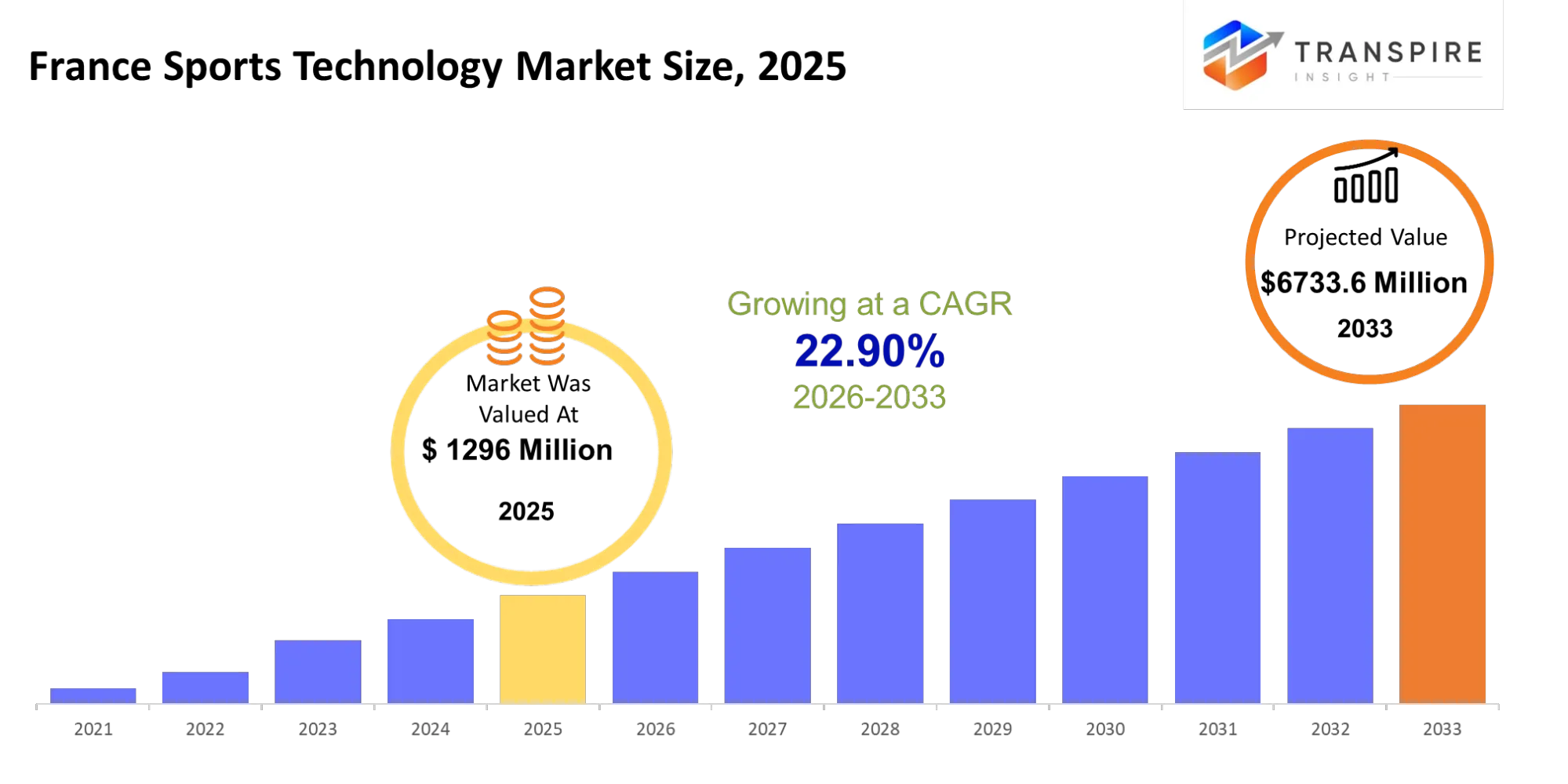
- France Sports Technology Market Size 2025: USD 1296 Million
- France Sports Technology Market Size 2033: USD 6733.6 Million
- France Sports Technology Market CAGR: 22.90%
- France Sports Technology Market Segments: By Type (Wearables, Analytics Software, Smart Equipment, Others); By Application (Performance Monitoring, Fan Engagement, Training, Injury Prevention, Others); By End-User (Sports Teams, Athletes, Fitness Centers, Sports Organizations, Others); By Deployment (Cloud, On-premise, Hybrid, Others)
To learn more about this report,  Download Free Sample Report
France Sports Technology Market Summary
The France Sports Technology Market was valued at USD 1296 Million in 2025. It is forecast to reach USD 6733.6 Million by 2033. That is a CAGR of 22.90% over the period.
The French sports technology sector uses data analytics and wearable technology and digital broadcasting systems to improve athletic performance systems and stadium operations and fan interaction systems. The system enables clubs and federations and training institutions to monitor athlete performance while coaches make decisions and fans experience live data and digital content.
The market has transitioned during the last 3 to 5 years from basic fitness tracking tools to AI performance analytics and connected sports systems. The post-pandemic reopening of large sporting events led to an increase in 5G-enabled stadium systems because venues required contactless ticketing and automated crowd control and digital engagement systems. The new business model enabled clubs and leagues to generate revenue through fan data and digital experiences instead of depending on physical attendance. The demand for performance optimization and the commercial use of sports data systems have led to a major increase in enterprise adoption among sports organizations and clubs.
Key Market Insights
- The France Sports Technology Market exhibits significant growth because AI-powered systems for athlete performance tracking and biometric data monitoring help professional sports teams track their athletes.
- The 2025 market report showed that connected stadium solutions achieved a 38% market share which developed through the installation of 5G networks and the implementation of smart crowd management technologies.
- The football and cycling training programs in France drive the continued growth of wearable sports technology which maintains its position as the top product category.
- Ligue 1 teams use video analytics systems as their primary tool for tactical performance evaluation which makes this technology the second most important system in their operations.
- The AI-powered coaching platforms show the fastest growth among all segments because their predictive training models enable them to expand from now until 2033.
- Football maintains the highest application share with 45 percent because federations put substantial resources into developing digital performance systems.
- The rising number of competitive gamers and sponsorship growth makes esports analytics the fastest expanding application in the industry.
- Professional sports clubs maintain their position as the primary users who invest heavily in technologies that improve performance and reduce injuries.
- The process of digitizing grassroots training systems has led amateur sports organizations to experience rapid growth as federations establish this system across their regional academies.
What are the Key Drivers, Restraints, and Opportunities in the France Sports Technology Market?
The France sports technology market demonstrates its main growth driver through its continuous adoption of AI performance analytics which professional sports teams use to assess player performance. The sports industry required better athlete performance assessment methods after European leagues experienced their most intense competitive battle period. Clubs currently spend money on sensor tracking systems and cloud-based analytics tools because these technologies help them run effective training sessions while decreasing their chances of player injuries. The implementation of new technologies which teams and federations and training academies adopt requires spending that leads to recurring revenue growth for solution vendors.
The deployment of advanced sports technology systems demands expensive financial investment which small clubs and regional training centers consider their most significant obstacle. Organizations need to make large initial financial commitments which include ongoing expenses for data system development to establish AI analytics platforms and biometric sensors and stadium connectivity systems. The superior athletic capabilities of elite clubs create a competitive advantage which prevents lower-tier organizations from succeeding in the market while driving down the rate of uniform technology adoption across the sports industry.
The development of 5G-supported intelligent stadium systems throughout France creates a major business opportunity which will be especially active in cities that are modernizing their facilities for worldwide sports competitions. The systems provide fans with real-time access to events while their security system operates automatically and the system delivers fully immersive broadcast content. When municipalities spend money to update their stadiums, technology companies that provide both fan analytics solutions and digital revenue generation tools will establish long-term client relationships which result in ongoing income from their services.
What Has the Impact of Artificial Intelligence Been on the France Sports Technology Market?
The artificial intelligence technology revolutionizes data collection methods together with data analysis techniques which professional sports organizations and semi-professional sports teams use to track athletic performance. The AI-based systems track athlete performance through their biometric data which wearables and GPS devices and vision systems provide to calculate their training load and exhaustion level and potential for getting injured. AI technologies boost operational productivity during major events by controlling crowd movements and handling ticket verification through automation and conducting security checks throughout the event.
Performance optimization relies on predictive analytics which uses machine learning systems to predict injury risk and evaluate tactical results and determine optimal training levels. Football and cycling teams increasingly adopt predictive analytics to decrease athlete time away from games while they tackle injuries and other performance obstacles. The operational enhancements enable coaching personnel to make decisions more quickly while they prepare for matches with improved accuracy and the organization saves money on medical expenses through its systems that detect injuries at an early stage.
The implementation of AI technology experiences obstacles because sports organizations lack standardized data formats while smaller venues have inadequate immediate data access capabilities. Teams at lower levels find it difficult to implement advanced technology because of the high expenses required for system integration while their data quality issues make it impossible to use predictive models in actual sports conditions. AI technology currently serves as a fundamental component that forms the basis of sports performance evaluation systems.
Key Market Trends
- The Ligue 1 clubs raised their use of AI-based performance analytics by 42 percent from the year 2023 until 2025 to enhance their tactical optimization efforts.
- The number of smart stadiums installed across France experienced substantial growth during the year 2025 because 5G-supported networks enabled fans to use real-time engagement systems.
- Professional football academies expanded their usage of wearable sports devices which helped them track injuries and manage athlete workloads better. Video-assisted coaching systems replaced traditional manual analysis in more than 60 percent of elite French football training programs.
- The esports analytics platforms experienced fast growth in user adoption after 2024 because competitive gaming sponsors increased their funding.
- AI-based biometric monitoring systems became the standard training tool for professional cycling teams to use in their endurance performance training.
- Sports federations increased their spending on cloud-based data platforms to create centralized systems that track athlete performance across different regions.
- Stadium automation technologies created digital ticketing and crowd management systems which reduced operational staff requirements.
- The current sponsorship models use digital engagement metrics to help organizations better monetize their fan interaction data streams.
France Sports Technology Market Segmentation
By Type
The France sports technology market by type shows a complete industry transformation which moves away from hardware-focused products and towards integrated software systems which operate through networked environments. Professional sports teams and athletes use wearables to track their body metrics in real time which helps them enhance their performance and avoid injuries. The athletics community uses these devices in football and cycling and athletics because they provide ongoing tracking of body metrics throughout both training sessions and competitive events. Clubs now use analytics software to transform their raw performance data into tactical information which helps coaches make better decisions and improve their strategic planning.
Training facilities now start to adopt smart equipment through their deployment of sensor-based training equipment which includes smart balls and connected gym equipment and motion-tracking systems. Elite sports academies now experience growth in this segment because they increase their funding for digital training facilities. The "others" category which contains experimental technologies and hybrid devices although smaller in size than other categories actually drives innovation in special training facilities. The market now moves towards integrated ecosystems which combine wearables with analytics software to build systems that manage performance through data analysis. The current advancement requires all devices to achieve two things: they must be able to share information between different systems and they need to operate with immediate data transfer capabilities.
By Application
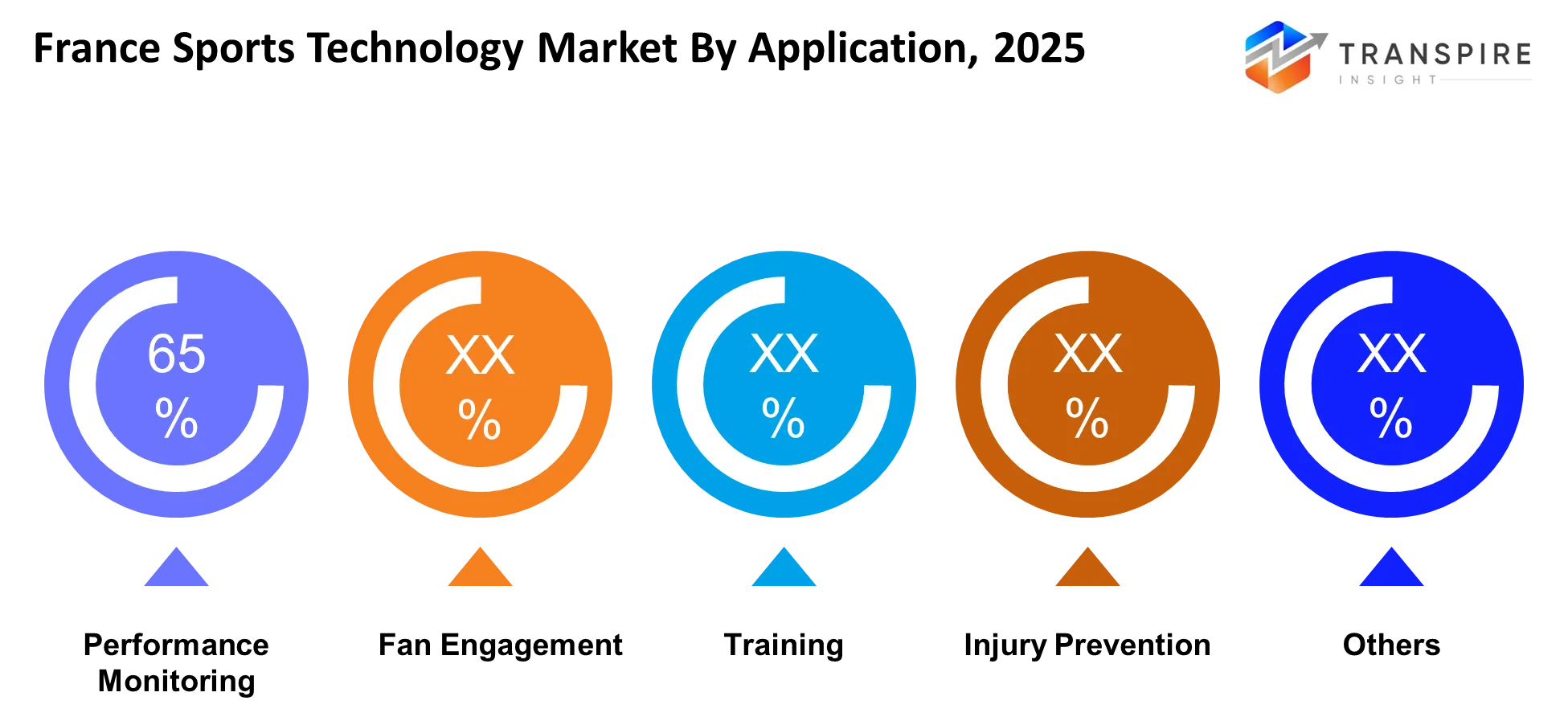
The primary application of performance monitoring systems drives the French sports technology market because it directly contributes to athlete performance and injury risk management. Professional sports teams and federations use real-time tracking systems to analyze speed, endurance, and workload distribution during training and matches. This application dominates because it directly influences competitive performance outcomes and reduces long-term injury risks. Training applications also hold a strong position as clubs invest in structured, data-driven training programs supported by AI and biomechanical feedback systems.
Fan engagement has developed into a valuable application which digital broadcasting and interactive platforms and stadium connectivity systems all support. Sports organizations and broadcasters use immersive technologies to enhance viewer experience and monetize audience data. The field of injury prevention has developed quickly through predictive analytics and wearable sensors which serve to identify early fatigue indicators and shorten rehabilitation periods. The "others" category which includes scouting and referee assistance systems has become more important in recent times. The current trend of applications marks a movement toward data-driven use cases which combine performance data with engagement metrics and medical information to create a unified sports ecosystem.
To learn more about this report, Download Free Sample Report
By End-User
The France sports technology market shows its main user base through sports teams which depend on performance analytics and wearable tracking and tactical analysis systems. Professional football and cycling teams spend large amounts on technology which helps them prepare for matches and keep their players safe from injuries. The organizations operate as the main revenue source for technology providers because they need to upgrade their systems and obtain high-frequency data services to maintain their market position.
Athletes represent a growing direct-adoption group, particularly in individual sports such as athletics and endurance cycling where personal performance tracking is critical. Sports organizations and federations also play a major role by deploying standardized technologies across national training programs and competitive leagues. Fitness centers are increasingly adopting connected equipment and AI-based training platforms to attract tech-oriented consumers. The "others" category which includes rehabilitation centers and academic sports institutions is gradually expanding. The market is now moving towards an ecosystem where both institutional users and individual users drive continuous growth.
By Deployment
The French sports technology market depends on cloud deployment as the primary solution which provides businesses with scalable systems together with real-time analytics functions and seamless device and platform integration. Sports teams and organizations prefer cloud systems because they enable centralized data access for performance tracking, coaching analysis, and fan engagement tools. The system enables organizations to perform software updates continuously while enabling data sharing between clubs and federations and training centers.
Organizations that need to maintain strict data control policies continue to use on-premise deployment because these systems protect sensitive athlete performance information which elite clubs and federations require. Organizations now turn to hybrid deployment as they seek to combine cloud-based systems with their requirements to process data at their locations for match analysis and secure data storage. The category of "others" includes edge computing systems which stadiums use to provide essential low-latency processing for live analytics and broadcasting needs. The market currently shifts towards hybrid and cloud-first systems which deliver quicker decision-making and enhanced integration of AI-powered sports intelligence technologies.
What are the Key Use Cases Driving the France Sports Technology Market?
The France sports technology market uses wearable sensors and AI analytics to track athlete performance because professional football clubs and cycling teams need to improve athlete performance while minimizing their chances of getting injured. This demand reaches its peak among Ligue 1 teams because they need continuous biometric data to enhance their gameplay strategies and training methods.
The new technologies both enable stadium operations management and provide fan engagement systems which sports teams and event venues use. Sports federations and stadium operators now use smart ticketing systems combined with crowd analytics technologies and immersive broadcasting solutions to create better operational systems for matchdays which help them connect with their viewers.
The esports performance analytics and digital training platforms with rehabilitation training functions represent the latest use cases in this field. Sports academies and medical rehabilitation centers are beginning to integrate motion tracking and predictive recovery systems, signaling a shift toward data-driven athlete lifecycle management.
|
Report Metrics |
Details |
|
Market size value in 2025 |
USD 1296 Million |
|
Market size value in 2026 |
USD 1590.2 Million |
|
Revenue forecast in 2033 |
USD 6733.6 Million |
|
Growth rate |
CAGR of 22.90% from 2026 to 2033 |
|
Base year |
2025 |
|
Historical data |
2021 - 2024 |
|
Forecast period |
2026 - 2033 |
|
Report coverage |
Revenue forecast, competitive landscape, growth factors, and trends |
|
Regional scope |
France |
|
Key company profiled |
Catapult Sports, Fitbit, Garmin, Apple, Samsung, WHOOP, Polar, STATSports, Zebra Technologies, SAP, IBM, Hawk-Eye, PlaySight, Kinexon, ShotTracker |
|
Customization scope |
Free report customization (country, regional & segment scope). Avail customized purchase options to meet your exact research needs. |
|
Report Segmentation |
By Type (Wearables, Analytics Software, Smart Equipment, Others); By Application (Performance Monitoring, Fan Engagement, Training, Injury Prevention, Others); By End-User (Sports Teams, Athletes, Fitness Centers, Sports Organizations, Others); By Deployment (Cloud, On-premise, Hybrid, Others) |
Which Regions are Driving the France Sports Technology Market Growth?
Île-de-France leads the France sports technology market due to its concentration of major sports federations, elite clubs, and stadium infrastructure.Paris functions as the base for national governing bodies and high-performance training centers which develop advanced analytics and AI-based coaching systems. The region maintains its leadership position because of its advanced digital infrastructure which receives continuous funding from the government to support sports research and development. Through international competitions and sponsorship networks, venues achieve ongoing improvements in their technological systems.
Auvergne-Rhône-Alpes serves as a stable secondary hub because of its strong winter sports infrastructure and industrial research facilities. The region receives steady funding for its skiing sports analytics programs and endurance training system development and sports equipment manufacturing integration efforts. Seasonal sports and athlete performance optimization drive growth in this area while large-scale stadium digitization remains absent from Île-de-France. Sports organizations make long-term infrastructure investments which create ongoing requirements for tracking devices and coaching systems.
The region of Provence-Alpes-Côte d'Azur has become the fastest-growing area in France because of recent funding for sports infrastructure projects and coastal event venues. The combination of stadium upgrades and international sports tourism development has led to increased requirements for digital ticketing systems and fan interaction technologies. Local authorities have begun supporting smart venue transformation projects which started in 2024. The sports tech vendors who focus on mid-tier stadium upgrades and event-based analytics solutions will find strong entry opportunities during the period between 2026 and 2033.
Who are the Key Players in the France Sports Technology Market and How Do They Compete?
The France sports technology market operates through platforms which have moderate consolidation yet displays complete market fragmentation in its wearable and analytics and performance tracking products. Professional clubs use performance insights as their main priority because they want to improve their results and not because they want to save money. Companies that already exist in the market protect their market position through complete business systems whereas new market players develop their business through specialized analytics and athlete performance evaluation tools.
Catapult Sports builds competitive advantage through elite-level athlete tracking systems that combine GPS and biomechanical data for professional teams. The company creates a unique market position through its performance analytics solution which delivers real-time data to football and rugby teams for injury prevention purposes. Garmin competes through hardware leadership in wearable GPS devices, leveraging strong consumer and professional sports crossover adoption across endurance sports in France. The company uses its expansion approach to connect health information and performance metrics with all its connected system networks.
SAP and IBM focus on data analytics platforms that integrate sports performance with enterprise-level cloud infrastructure. SAP provides unique value through its real-time match analytics systems which football federations use to track player performance during games. IBM uses AI technology to create fan engagement solutions and predictive analytics tools which help sports organizations make decisions. Hawk-Eye Innovations strengthens its position through advanced video assistant referee (VAR) and tracking systems which have gained widespread adoption in professional football. The organization expands through itsEuropean league network expansion and federation partnership agreements which establish standard technology use in competitive sports settings.
Company List
- Catapult Sports
- Fitbit
- Garmin
- Apple
- Samsung
- WHOOP
- Polar
- STATSports
- Zebra Technologies
- SAP
- IBM
- Hawk-Eye Innovations
- PlaySight
- Kinexon
- ShotTracker
Recent Development News
In November 2025, Hawk-Eye Innovations expanded its VAR and tracking technology deployment across additional European football leagues. The expansion strengthens real-time officiating accuracy and improves match transparency standards.https://www.hawkeyeinnovations.com
What Strategic Insights Define the Future of the France Sports Technology Market?
The sports technology market in France is developing integrated performance ecosystems that use artificial intelligence and wearable technology and stadium systems to function on a common data system. The market will expand because of rising demand for sports data monetization and the increasing digitization efforts of sports federations in both elite and semi-professional competitions. Over the next 5 to 7 years, the value of athletic equipment will change from independent devices to systems that connect to multiple technologies for tracking athlete performance and fan activity and arena management.
Technology concentration with a few international platform providers creates hidden risks because it limits system interoperability while making users dependent on exclusive technology. The club's ability to acquire equipment will be restricted, which will result in innovation delays for smaller teams.
AI-driven rehabilitation systems and injury prevention systems present national training academies with their most important emerging business opportunity. Investors should prioritize platform interoperability solutions and partnerships with federations to secure long-term contracts, as centralized data ecosystems will define competitive advantage in the next phase of market expansion.
France Sports Technology Market Report Segmentation
By Type
- Wearables
- Analytics Software
- Smart Equipment
- Others
By Application
- Performance Monitoring
- Fan Engagement
- Training
- Injury Prevention
- Others
By End-User
- Sports Teams
- Athletes
- Fitness Centers
- Sports Organizations
- Others
By Deployment
- Cloud
- On-premise
- Hybrid
- Others
Frequently Asked Questions
Find quick answers to common questions.
The confirmed 2033 market size figure in USD 6733.6 Million.
segments for the France Sports Technology Market are By Type (Wearables, Analytics Software, Smart Equipment, Others); By Application (Performance Monitoring, Fan Engagement, Training, Injury Prevention, Others); By End-User (Sports Teams, Athletes, Fitness Centers, Sports Organizations, Others); By Deployment (Cloud, On-premise, Hybrid, Others).
Major France Sports Technology Market players are Catapult Sports, Fitbit, Garmin, Apple, Samsung, WHOOP, Polar, STATSports, Zebra Technologies, SAP, IBM, Hawk-Eye, PlaySight, Kinexon, ShotTracker.
The France Sports Technology Market size is USD 1296 Million in 2025.
The France Sports Technology Market CAGR is 22.90% from 2026 to 2033.
- Catapult Sports
- Fitbit
- Garmin
- Apple
- Samsung
- WHOOP
- Polar
- STATSports
- Zebra Technologies
- SAP
- IBM
- Hawk-Eye Innovations
- PlaySight
- Kinexon
- ShotTracker
Recently Published Reports
-
Apr 2026
3D Optical Profiler Market
3D Optical Profiler Market Size, Share & Analysis Report By Type (Desktop 3D Optical Profiler, and Portable 3D Optical Profiler), By Technology (Confocal Technology, and White Light Interference), By End-Use Industry (Manufacturing, Research Institutions, Automotive, Aerospace and Defense, Medical Devices, and Other), and Geography (North America, Europe, Asia-Pacific, Middle East and Africa, South and Central America), 2021 - 2031
-
Apr 2026
Depth Sensor Market
Depth Sensor Market Size, Share & Analysis Report By Type (Infrared Depth Sensors, Time-of-Flight (ToF) Sensors, Stereo Vision Sensors, Structured Light Sensors, Ultrasonic Depth Sensors), By Application (Automotive, Robotics, Gaming, Consumer Electronics, Industrial Automation, Healthcare, Security & Surveillance, Others), By End Users (Automotive Manufacturers, Consumer Electronics Companies, Healthcare Providers, Industrial Companies, Security Agencies, Gaming Companies, Robotics Companies, Others), and Geography (North America, Europe, Asia-Pacific, Middle East and Africa, South and Central America), 2021 – 2031
-
Apr 2026
Digital Manufacturing Market
Digital Manufacturing Market Size, Share & Analysis Report By Component (Hardware, Software, and Services), By Technology (Robotics, 3D Printing, Internet of Things (IoT), and Others), By Application (Automotive and Transportation, Aerospace and Defense, Consumer Electronics, Industrial Machinery, and Others), By Process Type (Computer-Based Designing, Computer-Based Simulation, Computer 3D Visualization, Analytics, and Others), and Geography (North America, Europe, Asia-Pacific, Middle East and Africa, South and Central America), 2021 – 2031
-
Apr 2026
Digital Visa Services Market
Digital Visa Services Market Size, Share & Analysis Report By Type (Individual Travelers, Group Travelers), By Application (Tourism, Business Travel, Others), and Geography (North America, Europe, Asia-Pacific, Middle East and Africa, South and Central America), 2021 – 2031