
Europe Open Banking Market Size & Forecast:
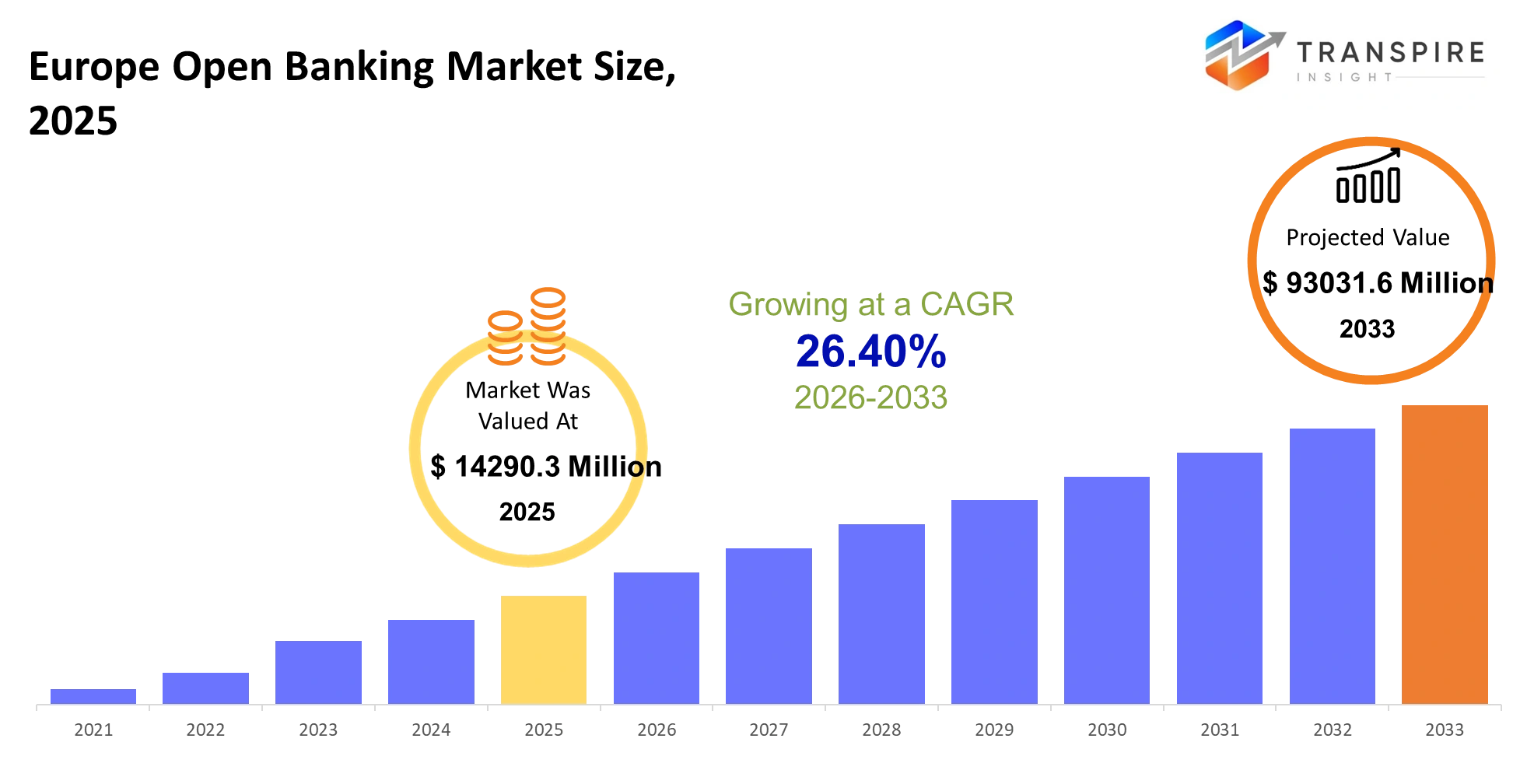
- Europe Open Banking Market Size 2025: USD 14290.3 Million
- Europe Open Banking Market Size 2033: USD 93031.6 Million
- Europe Open Banking Market CAGR: 26.40%
- Europe Open Banking Market Segments: By Type (API Platforms, Financial Services, Data Sharing Solutions, Payment Gateways, Others), By Application (Payments, Account Aggregation, Lending, Personal Finance Management, Wealth Management, Others), By End-User (Banks, Fintech Companies, Consumers, SMEs, Enterprises, Regulators, Others), By Deployment (Cloud, On-premise, Hybrid, Others).
To learn more about this report,  Download Free Sample Report
Europe Open Banking Market Summary:
The Europe Open Banking Market size is estimated at USD 14290.3 Million in 2025 and is anticipated to reach USD 93031.6 Million by 2033, growing at a CAGR of 26.40% from 2026 to 2033. The Open Banking market in Europe enables banking institutions and financial technology companies and external organizations to share customer financial information through application programming interfaces. This system allows users to control multiple bank accounts and make payments and receive personalized financial solutions through one digital platform.
The market has evolved from compliance-driven PSD2 API disclosure requirements which existed for three to five years into a banking ecosystem. The COVID-19 pandemic resulted in a significant increase of digital transactions which prompted organizations to fast track their API development and user interface work.
The two elements together produce new patterns of economic expansion. Banks now invest in premium APIs and partnerships to retain relevance, while fintechs build value-added services on top. Revenue streams have shifted towards transaction-based services and embedded finance solutions instead of conventional account-based systems used for bank account ownership.
Key Market Insights
- Financial institutions now direct their operational techniques towards two distinct goals, which require their current investments for premium API monetization to reach 65 percent by 2025 according to their current investment patterns.
- The increasing demand for embedded finance has led about 40 percent of fintech companies to implement open banking APIs which enable them to create integrated lending and payment systems.
- The period after 2020 witnessed digital payment volumes increase rapidly which led to greater overall adoption, while open banking-enabled transactions made up a major portion of account-to-account payment transactions that occurred throughout Europe.
- Financial institutions have adopted cloud-based API infrastructure solutions which enable them to achieve over 70 percent usage because these solutions enhance their ability to scale operations and protect data and share financial information in real time.
- The United Kingdom leads the European Open Banking Market because it established its regulatory framework early and developed a robust fintech industry, which enables it to control about 35 percent of the market in 2024.
- The growth rate of Germany and France will surpass 20 percent until 2030 because SMEs now adopt digital solutions through banking relationships.
- The API platforms hold more than 50 percent of the market share in 2024 because banks focus on developing secure data-sharing systems and developer platforms.
- The second-largest market segment operates through payment initiation services, which experience growth because of the increasing use of real-time banking solutions that provide affordable bank transfers.
- The sector of data analytics and value-added services shows the fastest growth rate, which will create substantial growth until 2030 because of its customized financial solution offerings.
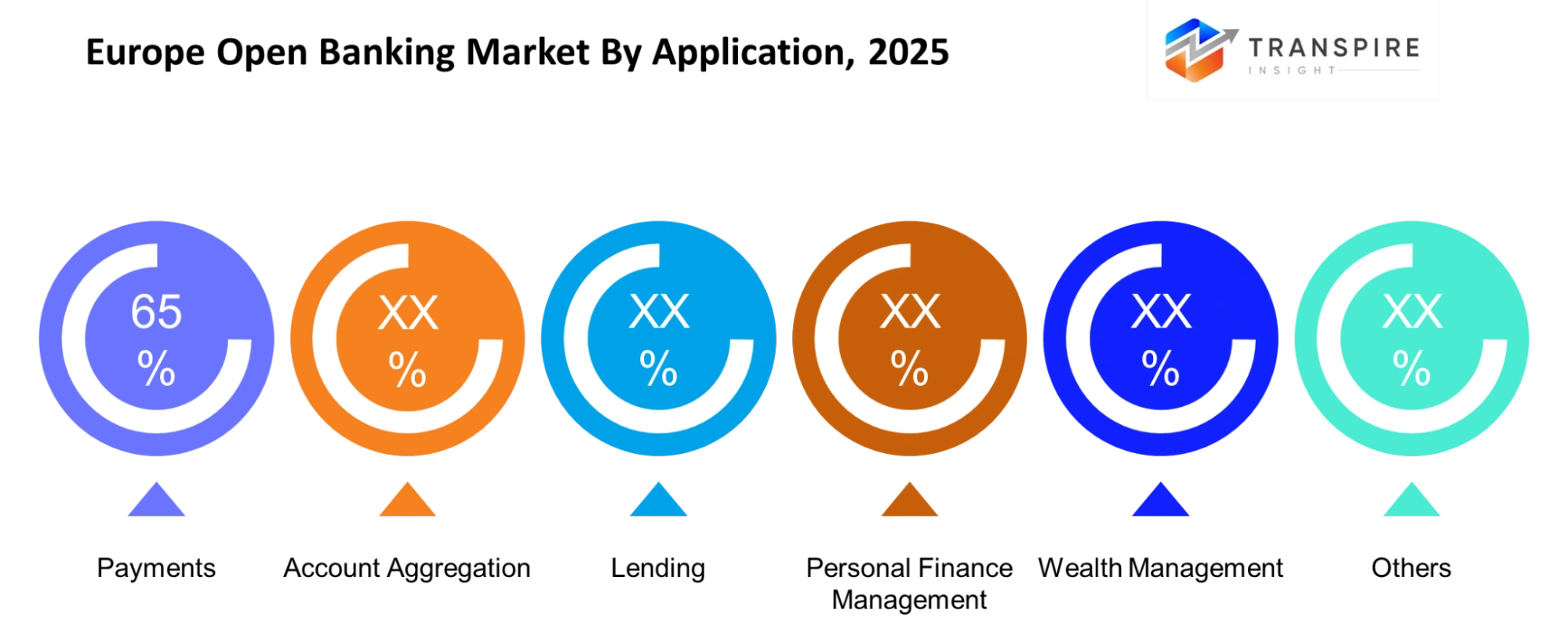
- The Europe Open Banking Market designates payments as its primary application, which generates approximately 45 percent of market share because customers prefer fast and affordable payment options.
- The use of real-time financial data has emerged as the most efficient method for companies to enhance their credit scoring methods because it enables them to establish better underwriting standards and minimize their risk of client defaults.
What are the Key Drivers, Restraints, and Opportunities in the Europe Open Banking Market?
The primary force accelerating the Europe Open Banking Market is regulatory standardization under PSD2 which mandated banks to open payment and account data through secure APIs. The policy shift established new financial system access points which enabled fintech companies to enter the market because it dismantled established data protection measures. Third-party providers created payment initiation and account aggregation services which operate outside traditional card networks to deliver their services. Merchants and digital platforms adopted the system because account-to-account payments created new revenue streams for banks and API providers.
European nations experience difficulties because API standards lack standardization and their implementation differs between countries. European Union Directive PSD2 established a unified structure which banks follow, but financial institutions have different levels of API service quality and system availability and data sharing capabilities. Financial technology companies must spend substantial resources to create integration systems and make compliance modifications across different regions. The added cost and complexity slow cross-border scalability and delay product launches which suppresses revenue potential and limits the pace of ecosystem expansion.
Embedded finance provides substantial growth potential because non-banking platforms now offer built-in financial services for their users. E-commerce and mobility platforms now adopt open banking APIs to provide their customers with instant payment options and real-time credit solutions during the checkout process. Financial institutions can provide personalized lending solutions and cash flow management tools through their cloud-based systems because AI-driven risk assessment models become more advanced.
What Has the Impact of Artificial Intelligence Been on the Europe Open Banking Market?
The Europe Open Banking Market experiences transformation through artificial intelligence which streamlines financial data processes and enhances API ecosystem operations. The AI orchestration tools which banks and fintech platforms use enable them to automate account aggregation and transaction categorization processes while fraud detection systems need only 40 percent of their previous manual work. Intelligent API management systems enable businesses to maintain system availability while controlling network traffic because they deliver stable performance during peak periods of payment processing.
Machine learning models use transaction data and user behavior to create enhanced predictive models. The systems use these models to perform real-time credit scoring and cash flow forecasting for small and medium-sized enterprises while achieving greater fraud detection accuracy. AI-based risk engines help organizations to detect financial distress signals which lead to reduced default rates and predictive analytics enhance lending accuracy and speed through their approval processes.
The technologies enable organizations to process transactions more rapidly while decreasing errors and enhancing their ability to monitor compliance with new European regulatory requirements. Organizations achieve financial savings and better customer loyalty because their services now provide individualized and dependable service.
The high cost of integration with various banking APIs presents a major obstacle together with the difficulties of creating standardized data formats across multiple systems. The imprecise data that exists between different organizations decreases model performance while hindering the implementation of AI solutions which depend on cross-border operations.
Key Market Trends
- The period after 2020 has seen banks change their PSD2 compliance approach by adopting advanced API solutions which enabled over 60% of banks to begin selling data and payment services by 2024.
- Fintech players have changed their operational methods because they now prefer to combine their services through platform aggregation instead of TrueLayer and Tink which allow them to connect with all European APIs instead of just particular countries.
- Post-2021 research shows that account-to-account payments became more popular as merchants started using less card networks which allowed them to achieve up to 50% cost reductions in certain digital commerce transactions.
- The period since 2022 has seen regulators create stricter API performance requirements which require banks to enhance their system uptime and data availability because these factors determine how well services operate and how quickly they can onboard partners.
- The adoption of cloud-native infrastructure technology increased after the COVID-19 pandemic because more than 70% of European banks planned to shift their API gateways into scalable cloud systems by 2025.
- Embedded finance showed strong development after 2021 when non-banking platforms started to provide integrated lending and payment services which led customers to use non-banking platforms instead of traditional banking services.
- Cross-border interoperability problems continue to exist because EU markets use different API standards which make it 25% more expensive for fintech companies to expand their operations across multiple regions.
- AI-based financial analytics became successful after 2022 because it enabled businesses to assess their credit risk in real time while detecting fraud which resulted in better approval results and lower business risk.
- Major banks such as HSBC and BNP Paribas formed partnerships with fintech companies because they wanted to increase their innovation speed through collaboration instead of engaging in direct competition.
Europe Open Banking Market Segmentation
By Type
The main industry segment of banks and fintech companies operates through API platforms because they require standard interfaces to establish protected data sharing and payment processing capabilities. The second largest market segment consists of financial services that use these APIs for lending and payment transactions, which providers use to generate revenue through access and transaction-based fees. The data sharing solutions and payment gateways establish interoperability capability, yet they encounter challenges because different countries maintain their own unique standards.
The company plans to evolve its operations from basic compliance API systems toward revenue generation through ecosystem development, which will help it attract partners through premium API and developer tool offerings. The upcoming developments will lead to API framework unification and organizations increasing their funding toward systems that can support global operations, which will create advantages for businesses that deliver dependable services with international operational ability.
By Application
The payment sector experiences growth because businesses adopt account-to-account transfer methods which decrease their need for card networks and result in lower transaction expenses. Consumers and businesses need to manage their financial assets across different banks which leads to the development of account aggregation services. The sectors of lending and personal finance management experience rapid expansion because real-time data enables better credit evaluation and budget management.
Wealth management remains a specialized service but it is growing through the introduction of data-based advisory services. The market expands because customers want effortless online experiences together with quicker methods to make financial choices. Financial services will become more integrated with non-banking platforms according to future trends which will help service providers who offer real-time data and smooth payment methods to achieve greater transaction volumes.
To learn more about this report, Download Free Sample Report
By End-User
Banks maintain their dominant position as primary data holders and infrastructure providers, while fintech companies represent the most rapidly expanding sector, because of their development of user-friendly applications. Open banking tools, which help with cash flow management and automated reconciliation, have become essential for small and medium enterprises, while large enterprises use APIs to enhance their treasury operations.
The demand for financial data control and convenience from consumers drives adoption, while regulators establish compliance standards and requirements. The growth logic shows that banks and fintech firms now work together in their competitive strategies instead of competing directly with each other. The future outlook will bring stronger ecosystem partnerships, which will shift value toward service providers that have power over customer interfaces and data analytics capabilities.
By Deployment
Financial institutions choose cloud-based models for deployment because they provide better scalability and quicker system integration and lower hardware operating expenses. Large banks use hybrid deployment systems because they need to meet regulatory obligations yet require operational flexibility while experiencing a decline in on-premise system use because of its expensive upkeep and restricted growth capabilities.
The rise in API traffic and the need for immediate processing in payment and analytics systems drive organizations to adopt cloud solutions. Organizations that operate in controlled environments use security and compliance requirements to determine their deployment methods. Multicloud systems will become more widespread while advanced security systems will enable service providers to process increased transaction volumes and protect customer data across multiple European territories.
What are the Key Use Cases Driving the Europe Open Banking Market?
The primary purpose of payments remains intact because e-commerce platforms and digital merchants use account-to-account transfers as their main payment method. Retailers and payment processors throughout Europe demonstrate high demand for this model because it decreases card expenses while providing faster payment processing.
The market for account aggregation services and financial management solutions for small and medium enterprises (SMEs) is experiencing rapid growth. Small businesses use aggregated banking data for cash flow tracking, automated reconciliation, and credit access. Fintech platforms use open banking data to enhance their lending processes which aim to support underserved small and medium enterprise (SME) segments.
The new use cases which developers create currently focus on embedded finance systems that mobile and subscription platforms use to provide payment and credit services through their user interface. Digital-first investors who want customized portfolio insights use wealth management tools that utilize real-time banking data.
|
Report Metrics |
Details |
|
Market size value in 2025 |
USD 14290.3 Million |
|
Market size value in 2026 |
USD 18049.3 Million |
|
Revenue forecast in 2033 |
USD 93031.6 Million |
|
Growth rate |
CAGR of 26.40% from 2026 to 2033 |
|
Base year |
2025 |
|
Historical data |
2021 - 2024 |
|
Forecast period |
2026 - 2033 |
|
Report coverage |
Revenue forecast, competitive landscape, growth factors, and trends |
|
Regional scope |
Europe (Germany, United Kingdom, France, Italy, Spain and Rest of Europe) |
|
Key company profiled |
Plaid, Tink, TrueLayer, Finastra, Fiserv, Mastercard, Visa, PayPal, Revolut, Stripe, Adyen, IBM, Oracle, SAP, Google |
|
Customization scope |
Free report customization (country, regional & segment scope). Avail customized purchase options to meet your exact research needs. |
|
Report Segmentation |
By Type (API Platforms, Financial Services, Data Sharing Solutions, Payment Gateways, Others), By Application (Payments, Account Aggregation, Lending, Personal Finance Management, Wealth Management, Others), By End-User (Banks, Fintech Companies, Consumers, SMEs, Enterprises, Regulators, Others), By Deployment (Cloud, On-premise, Hybrid, Others) |
Which Regions are Driving the Europe Open Banking Market Growth?
The United Kingdom operates as the top open banking authority in Europe because it established its regulations first and maintains a developed fintech system. The financial authorities implemented PSD2 standards through their effective monitoring which established a secure API system. Banks and fintech companies maintain their operations through a unified system that enables them to process multiple transactions while delivering uninterrupted services. The network of payment providers combined with digital banks and technology partners creates a dense network which establishes this leadership position while driving product development forward.
Germany and France function as stable market contributors yet their growth patterns show different trends compared to the United Kingdom. These markets depend on their industrial strength together with their banking systems that use conservative methods to protect customer accounts while they slowly implement digital changes. The regulatory rollout process maintains its steady progress which establishes permanent trust between enterprises and financial institutions. Banks make investments in API systems together with solutions for small to medium enterprises which creates continuous income streams that do not cause abrupt market changes.
The fastest expansion occurs in Southern and Eastern Europe because people increasingly adopt digital banking services and governments establish better regulatory systems. The recent digital infrastructure and fintech ecosystem investments have created broader access to financial services which use API technology. The regions experience advantages through their growing SME digital transformation and their governmental support for innovative initiatives. The sustained market growth between 2026 and 2033 will create business opportunities for new market players together with investors who want to access unserved market sections.
Who are the Key Players in the Europe Open Banking Market and How Do They Compete?
The Europe Open Banking market exhibits a moderate level of market division because traditional banks and fintech platforms and API specialists use technological capabilities and their ecosystem connections as their main approach to compete. Banks that operate in existing markets have moved beyond their previous practice of protecting their market share. To keep customer relationships banks have adopted platform models which allow them to work with outside developers. Fintech companies enter the market by providing systems that enable quick software integration and create APIs which developers find easy to use and establish international operational links. The main competitive factors show API performance security and data availability and the companies' capability to establish partnerships with different sectors.
Tink provides a special service because it operates a European-wide aggregation platform which establishes standard procedures for banks to connect with different European markets and thus simplifies integration work for its fintech customers. TrueLayer develops high-performance payment APIs which maintain high uptime levels to satisfy digital merchants who need dependable account-to-account transaction connections. Plaid establishes new business operations through its partnerships with global fintech applications while using a developer-first approach which streamlines product development.
HSBC develops its proprietary API systems to keep its enterprise customers while integrating banking services into their business operations. BNP Paribas uses partnerships with European fintech companies to extend its operations into new areas while developing banking services for small and medium-sized enterprises. The organization adopts partnership-based growth strategies which help them develop competitive advantages through their ability to create extensive networks and their rapid system integration and their capacity to provide stable international operations.
Company List
- Plaid
- Tink
- TrueLayer
- Finastra
- Fiserv
- Mastercard
- Visa
- PayPal
- Revolut
- Stripe
- Adyen
- IBM
- Oracle
- SAP
Recent Development News
In April 2026, TrueLayer expands its European pay-by-bank network via Zimpler integration: Open banking infrastructure provider TrueLayer expanded its European footprint after integrating Swedish payments firm Zimpler, strengthening its pay-by-bank network across 22 countries. The move significantly boosts coverage across Nordic markets and increases its user reach beyond 20 million. This reflects continued consolidation among API-based payment providers in Europe’s Open Banking ecosystem.
Source: https://paymentexpert.com
In January 2026, Open Banking pay-by-bank adoption accelerates through EV charging partnerships: European fintech and mobility platforms began integrating Open Banking payments into EV charging infrastructure, enabling real-time account-to-account payments. Companies such as Monta and Northe expanded deployments using AIS and payment initiation services. This marks a shift of Open Banking from financial services into physical infrastructure payment ecosystems.
Source: https://britepayments.com
What Strategic Insights Define the Future of the Europe Open Banking Market?
The Europe Open Banking Market is moving toward a platformized financial infrastructure which allows organizations to transform data access into revenue-generating assets instead of treating it as a regulatory requirement. The market will experience value transformation over the next 5 to 7 years when businesses shift their focus from fundamental API connectivity toward advanced orchestration systems that provide real-time integration of payment processing, identity verification, and risk assessment solutions. The embedded finance model drives this transformation because it allows non-banking platforms to manage customer relations while banks function as controlled service providers behind the scenes.
A less visible risk lies in market concentration at the API aggregation layer. The European market will face decreased pricing power for banks because of its dependence on only a few platforms which provide standardized connectivity and this dependency creates system risks that would emerge during outages or policy changes. An emerging opportunity exists because open banking and digital identity framework integration can now take place under new EU regulations, which will enable secure cross-border financial onboarding while reducing fraud risks.
Market participants should invest in interoperable API architectures and diversify partnerships to avoid over-reliance on single aggregators while positioning for identity-linked financial services.
Europe Open Banking Market Report Segmentation
By Type
- API Platforms
- Financial Services
- Data Sharing Solutions
- Payment Gateways
- Others
By Application
- Payments
- Account Aggregation
- Lending
- Personal Finance Management
- Wealth Management
- Others
By End-User
- Banks
- Fintech Companies
- Consumers
- SMEs
- Enterprises
- Regulators
- Others
By Deployment
- Cloud
- On-premise
- Hybrid
- Others
Frequently Asked Questions
Find quick answers to common questions.
The approximate Europe Open Banking Market size for the market will be USD 93031.6 Million in 2033.
The key segments of the Europe Open Banking Market are By Type (API Platforms, Financial Services, Data Sharing Solutions, Payment Gateways, Others), By Application (Payments, Account Aggregation, Lending, Personal Finance Management, Wealth Management, Others), By End-User (Banks, Fintech Companies, Consumers, SMEs, Enterprises, Regulators, Others), By Deployment (Cloud, On-premise, Hybrid, Others).
Major players in the Europe Open Banking Market are Plaid, Tink, TrueLayer, Finastra, Fiserv, Mastercard, Visa, PayPal, Revolut, Stripe, Adyen, IBM, Oracle, SAP, Google.
The current market size of the Europe Open Banking Market is USD 14290.3 Million in 2025.
The Europe Open Banking Market CAGR is 26.40%.
- Plaid
- Tink
- TrueLayer
- Finastra
- Fiserv
- Mastercard
- Visa
- PayPal
- Revolut
- Stripe
- Adyen
- IBM
- Oracle
- SAP
Recently Published Reports
-
Apr 2026
Bottled Water Market
Bottled Water Market Size, Share & Analysis Report By Product Type (Still Bottled Water, Carbonated Bottled Water, Functional Bottled Water, and Others), By Packaging (PET, Cans, and Others), By Sales Channel (Supermarkets/Hypermarkets, Convenience Stores/Drug Stores, Grocery Stores/Club Stores, Foodservice, and Others) and Geography (North America, Europe, Asia-Pacific, Middle East and Africa, South and Central America), 2021 - 2032
-
Apr 2026
Color Cosmetic Packaging Market
Color Cosmetic Packaging Market Size, Share & Analysis Report By Application (Mascara Packaging, Liquid Packaging, and Liquid Face), By Type (Tubes & Bottles, Pens & Markers, Compacts & Containers, and Droppers & Pumps), and Geography (North America, Europe, Asia-Pacific, Middle East and Africa, South and Central America), 2021 - 2031
-
Apr 2026
External Microphone For Camera Market
External Microphone For Camera Market Size, Share & Analysis Report By Type (Shotgun Microphone, Lavalier Microphone, and Others), By Application (Digital Camera, Professional Video Camera, and Others), and Geography (North America, Europe, Asia-Pacific, Middle East and Africa, South and Central America), 2021 - 2031
-
Apr 2026
Foot Orthotic Insoles Market
Foot Orthotic Insoles Market Size, Share & Analysis Report By Type (Pre-fabricated, and Custom-made), By Material (Thermoplastic, Composite Carbon Fiber, and Others), By Distribution Channel (Drug Stores, Hospitals & Clinics, and Others), and Geography (North America, Europe, Asia-Pacific, Middle East and Africa, South and Central America), 2021 - 2031