

North America Fintech Market Size & Forecast:
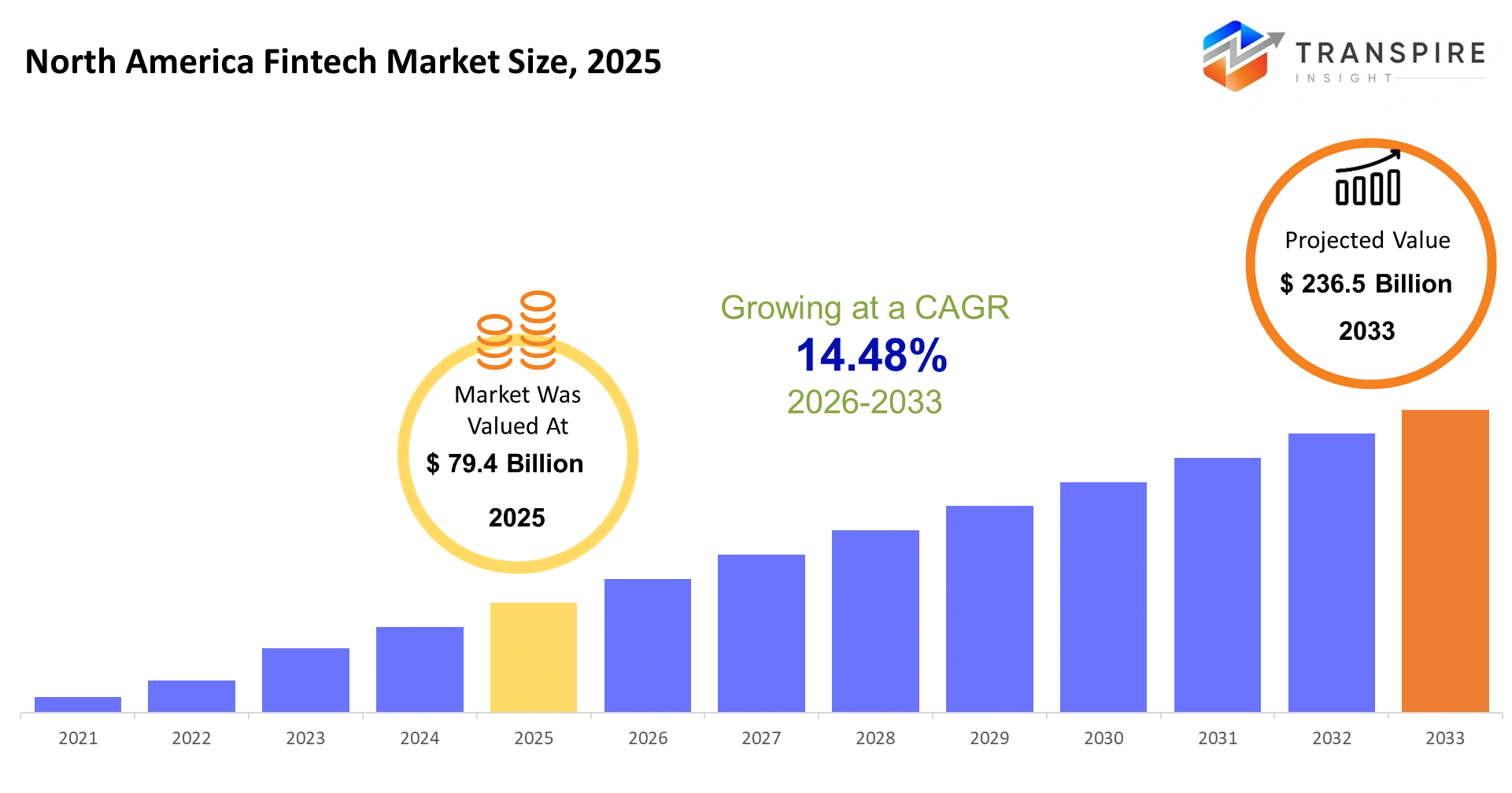
- North America Fintech Market Size 2025: USD 79.4 Billion
- North America Fintech Market Size 2033: USD 236.5 Billion
- North America Fintech Market CAGR: 14.48%
- North America Fintech Market Segments: By Service (Payments, Lending, Wealth Management, Others, Insurance Tech, Blockchain), By Technology (AI, Blockchain, Cloud, Others, Big Data, APIs), By Deployment (Cloud, On-premises, Hybrid, Others, SaaS, Digital Platforms), By End-User (BFSI, Retail, Enterprises, Others, SMEs, Consumers).
To learn more about this report,  Download Free Sample Report
North America Fintech Market Summary:
The North America Fintech Market size is estimated at USD 79.4 Billion in 2025 and is anticipated to reach USD 236.5 Billion by 2033, growing at a CAGR of 14.48% from 2026 to 2033. The North America Fintech Market is experiencing strong and steady growth because banking operations and payment systems and lending processes and investment services are undergoing rapid digital changes.
The growing use of mobile banking applications and contactless payment systems and AI-based financial solutions is changing how both consumers and businesses handle their financial matters. The North America Fintech Market is experiencing growth because its population possesses high technological skills and the region has strong digital systems which enable people to adopt modern cloud-based financial systems instead of traditional banking methods. Fintech companies develop new solutions because consumers require uninterrupted access to immediate financial services which enables them to conduct their financial transactions.
The North America Fintech Market experiences growth because traditional banks and fintech startups are forming stronger partnerships. Banks choose to work with technology-based companies because this partnership improves their customer service while decreasing security risks and operational expenses. The increase of blockchain technology and digital wallets and embedded finance creates new pathways for market development. Financial innovation receives regulatory backing while venture capital funding increases to create a stronger financial ecosystem. The North America Fintech Market will sustain its strong growth because companies keep developing new products and consumers keep changing their product needs.
What Has the Impact of Artificial Intelligence Been on the North America Fintech Market?
The North America Fintech Market undergoes rapid transformation through Artificial Intelligence which changes the development and delivery and optimization processes of financial services. AI in North America Fintech Market uses advanced data processing capabilities to analyze large datasets which enable businesses to detect customer patterns with improved precision.
Financial institutions in North America Fintech Market use artificial intelligence for better demand forecasting which enables them to predict market trends and identify future financial requirements while minimizing their risk exposure. Through smart automation and machine learning, companies are streamlining operations, improving decision-making speed, and strengthening overall efficiency in the north america fintech market.
The North America Fintech Market ecosystem experiences production efficiency improvements and cost reductions and supply chain optimization because of AI technologies. Predictive analytics allows fintech companies to create customized financial products which enhances customer retention and engagement. AI-driven chatbots and fraud detection systems and automated advisory tools work together to establish a more secure and responsive financial ecosystem.
The artificial intelligence development in North America Fintech Market creates new business opportunities which enable companies to establish competitive advantages. The north america fintech market currently moves toward intelligent financial systems which use data analysis and machine learning to drive their operations.
Key Market Trends & Insights:
- The United States controls 70% of the North America Fintech Market which it will maintain through 2025 because of its advanced digital banking system.
- The United States Fintech Market experiences its most rapid expansion through 2030 because of rising fintech startups and existing regulations that support their development.
- The north america fintech market benefits from high smartphone penetration and advanced payment processing systems which exist throughout its major urban areas.
- The Digital payments segment leads the North America Fintech Market because it commands about 35% market share which will exist in 2025.
- Lending technology solutions hold the second-largest market share according to their AI-based credit scoring systems.
- Blockchain-based financial services represent the fastest-growing segment which will expand rapidly through the 2024 to 2030 period.
- Mobile banking services account for almost 40% of North America fintech market applications because retail banking services dominate this sector.
- Wealth management platforms grow at the fastest rate because AI-driven investment advisory tools support their operations.
- The InsurTech market grows quickly because people now demand automated solutions for claims processing.
- Banking institutions continue to dominate as the primary customer group for North America Fintech Market because they control a large portion of industry income.
- Digital lending and payment solutions drive faster growth for SMEs which have become the newest customer group.
- The retail market drives increasing consumer demand for financial services which customers can access through application-based solutions that operate throughout the entire financial system.
North America Fintech Market Segmentation
By Service
The Payments segment maintains a significant market share in the North American fintech market because people increasingly use digital wallets and contactless payment methods and instant payment collection systems. The demand for lending services continues to grow because digital credit scoring enables faster loan approvals for both consumers and small and medium enterprises.
Wealth management platforms expand their services through automated advisory systems and data-based portfolio management solutions. Insurance technology experiences increased adoption because companies use digital claims management systems and risk assessment tools. Financial services that use blockchain technology provide secure transaction systems which enhance transparency across financial networks.
Niche financial service categories provide specialized solutions that include compliance monitoring tools and systems for detecting fraudulent activities. The North America Fintech Market experiences persistent growth because customers prefer financial services that provide them with quick and safe yet inexpensive solutions. Financial technology companies enhance their operational performance and customer satisfaction through service diversification which creates new competition in the market. The industry will achieve sustained growth during the upcoming years through its digital service expansion.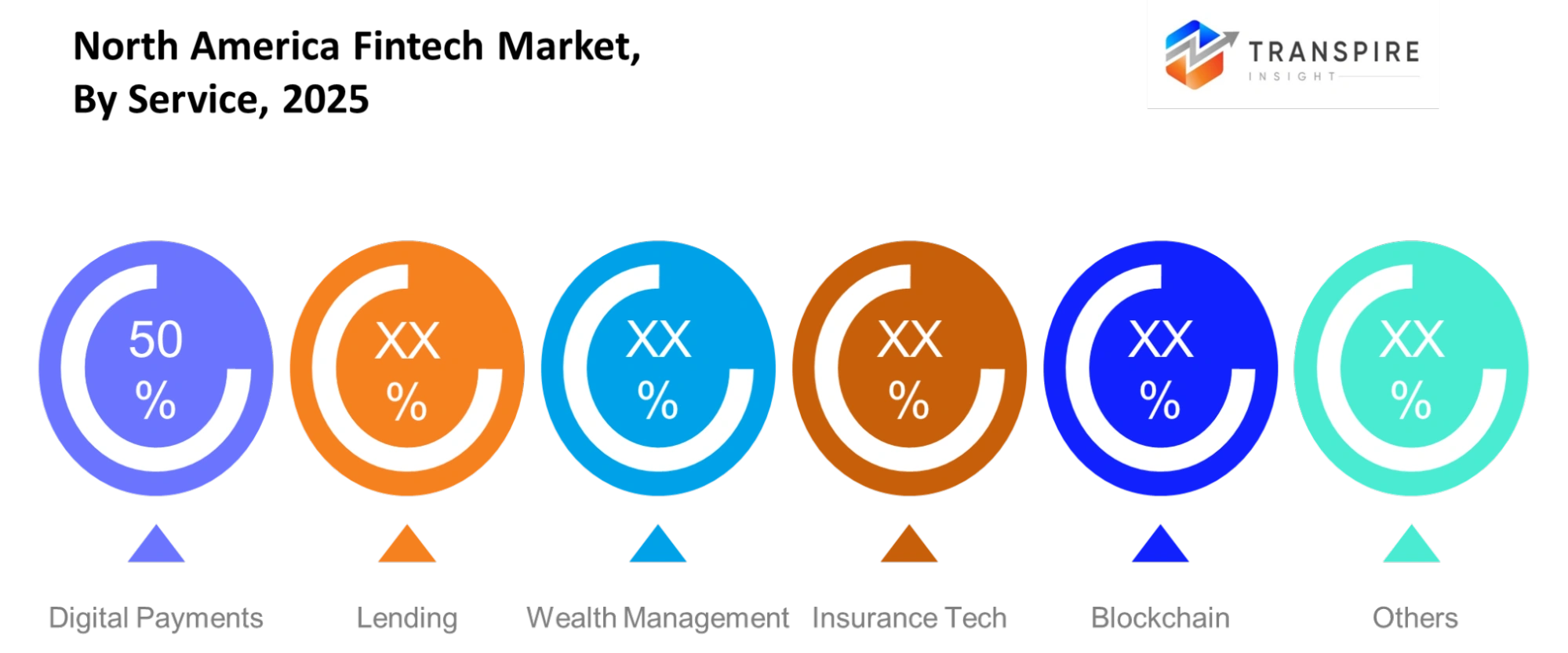
To learn more about this report, Download Free Sample Report
By Technology
Artificial intelligence functions as a core component for North American financial technology markets by enhancing fraud detection and credit scoring and customer behavior assessment. Blockchain technology enables secure transaction record maintenance while decreasing reliance on centralized system structures.
Cloud computing provides financial services with infrastructure capacity that can grow according to needs and delivers services instantly. Big data analytics enables organizations to forecast market developments while performing customer market segmentation analysis. API integration enables banking systems to establish better connections with third-party fintech software applications. Financial platforms use additional technologies to achieve automated processes and improved system performance.
Financial institutions demand better digital solutions because they want to achieve faster performance results with greater accuracy and stronger security measures. The adoption of new technologies drives innovation in financial service delivery because it enables organizations to compete better in their digital financial markets. Ongoing technological improvements will serve as the primary factor that drives both operational efficiency gains and market growth.
By Deployment
The digital financial infrastructure of North America Fintech Market currently relies on cloud deployment because it provides businesses with better scalability and more affordable costs while enabling them to deliver services to customers at increased speed. Organizations that need to maintain complete data control and meet compliance obligations still find value in using on-premises systems.
The hybrid model enables organizations to use cloud resources while maintaining protection of their internal systems. SaaS platforms provide financial tools through subscription services which also help organizations minimize their operational challenges. Digital platforms provide customers with uninterrupted access to services through both mobile and web platforms. The organization requires specialized deployment models which match its unique operational needs and compliance obligations.
The organization enhances system performance through flexible infrastructure while decreasing the possibility of downtime. Financial institutions continue their modernization programs to create more reliable systems which will improve user experience throughout their various service delivery methods. The ongoing development of deployment methods enables financial ecosystems to achieve their digital transformation goals.
By End-User
The BFSI sector serves as the main market for North America Fintech Market because digital banking and automated financial systems have received widespread market acceptance. The retail sector exhibits strong market growth through the adoption of mobile payments and the expansion of online financial services. Fintech solutions have become essential for SMEs to manage their credit needs and operational cash flow. Enterprise users concentrate on implementing automation solutions together with risk management systems. Financial application usage increases among consumers who prefer mobile-based financial solutions.
The end-user categories include government and institutional users who need safe financial systems. The need for services across all market segments drives ongoing development of new services. Financial technology adoption leads to better efficiency and lower costs while enhancing customer interaction within financial systems. The market will experience consistent growth as various user groups continue to embrace digital technology.
What are the Main Challenges for the North America Fintech Market Growth?
The North America Fintech Market faces ongoing technical and operational difficulties which hinder its growth as platforms expand their user base to millions. The system experiences risks of downtime which create operational pressure through two problems of integration with existing banking systems and cybersecurity threats. North American fintech companies in the fintech market struggle to maintain their operational efficiency when they need to process real-time transactions and handle large quantities of data.
The growth of digital financial services requires organizations to develop processing systems that maintain quick response times while establishing secure operational environments. The existence of technical obstacles creates problems for users who want to experience uninterrupted service. The North America Fintech Market faces operational challenges because manufacturing and commercialization processes encounter obstacles from operational costs and strict regulatory compliance requirements.
Financial institutions need to implement multiple compliance systems which include data protection requirements and financial reporting standards that create product development delays. The high expenses of development combined with the prolonged duration of approval processes result in delayed market entry for new fintech products. Commercialization in the north america fintech market requires companies to perform continuous system enhancements which create financial burdens that prevent smaller companies from expanding their operations.
The North America Fintech Market faces two main obstacles through its need for proper adoption methods and functioning infrastructure systems although digital services have experienced significant growth. The current situation of specific areas shows that they still need to build advanced financial systems while there exists a lack of trained experts who specialize in AI blockchain and cybersecurity fields.
The funding gaps which exist during the early stages of financial technology startups establish two main barriers which prevent companies from entering the market and developing new products. The North American fintech market experiences widespread growth delays because companies face difficulties in adopting digital technologies which results in uneven development across different industry segments. The North America Fintech Market experiences increasing pressure from market competition and future risks because traditional banks and new fintech companies fight for control of the financial industry.
Country Insights
The North America Fintech Market demonstrates high regional concentration because the United States maintains market dominance through its advanced digital banking systems and its widespread adoption of fintech and its active support from investors. Canada maintains its steady growth path through increasing startup activity and its favorable financial regulations. The North America Fintech Market operates through its robust infrastructure which enables digital payment and lending systems to function across all urban and semi-urban regions.
The North America Fintech Market finds its innovation and technology development focus through major financial centers which include New York and San Francisco and Toronto. These cities enable venture capital funding to thrive while providing access to skilled workers who can rapidly implement AI-based financial solutions. The development of digital financial services across banking and insurance platforms receives support from regulatory transparency which exists in important markets.
The North America Fintech Market will expand regionally because of digital infrastructure upgrades and financial partnerships between countries and the growth of financial services in developing urban areas. The adoption of mobile banking and digital lending and automated financial solutions will create new business prospects in smaller cities. The market will experience ongoing growth through the balanced distribution of innovation centers and developing secondary markets which create a foundation for market viability.
Recent Development News
In March 2026, Visa leads AI-driven payments innovation with over 300 AI models deployed: Visa strengthened its leadership in AI-powered fintech systems, expanding fraud detection and payment security tools across the U.S. market. This reinforces how artificial intelligence is becoming central to competitiveness in the North America fintech market.
Source: https://www.businessinsider.com
In February 2026, Stripe reaches a $159B valuation amid strong U.S. fintech rebound: The North America fintech market continues to show strong investor confidence as Stripe’s valuation surged significantly in early 2026. The company’s growth reflects rising demand for digital payments, AI-based financial automation, and enterprise payment infrastructure across the U.S. fintech ecosystem.
Source: https://www.reuters.com
|
Report Metrics |
Details |
|
Market size value in 2025 |
USD 79.4 Billion |
|
Market size value in 2026 |
USD 91.8 Billion |
|
Revenue forecast in 2033 |
USD 236.5 Billion |
|
Growth rate |
CAGR of 14.48% from 2026 to 2033 |
|
Base year |
2025 |
|
Historical data |
2021 – 2024 |
|
Forecast period |
2026 – 2033 |
|
Report coverage |
Revenue forecast, competitive landscape, growth factors, and trends |
|
Country scope |
North America (Canada, The United States, and Mexico) |
|
Key company profiled |
PayPal, Stripe, Square, Visa, Mastercard, Intuit, Adyen, Robinhood, SoFi, Coinbase, Block Inc., FIS, Fiserv, Plaid, Chime |
|
Customization scope |
Free report customization (country, regional & segment scope). Avail customized purchase options to meet your exact research needs. |
|
Report Segmentation |
By Service (Payments, Lending, Wealth Management, Others, Insurance Tech, Blockchain), By Technology (AI, Blockchain, Cloud, Others, Big Data, APIs), By Deployment (Cloud, On-premises, Hybrid, Others, SaaS, Digital Platforms), By End-User (BFSI, Retail, Enterprises, Others, SMEs, Consumers). |
How Can New Companies Establish a Strong Foothold in the North America Fintech Market?
The new companies which enter the North America Fintech Market should create a strong competitive position through their dedicated efforts to solve specific financial challenges instead of trying to compete with established industry leaders. The company should focus on specific market needs which include SME lending and cross-border payment solutions and healthcare billing solutions to create their first products which will attract customers. Startups in the north american fintech industry achieve rapid user acceptance through their implementation of AI-powered credit scoring and instant payment systems which address fundamental needs of hidden market segments.
The North America Fintech Market requires strategic partnerships because they help businesses establish their market presence. By partnering with banks and insurance companies and enterprise platforms new companies can tap into preexisting customer networks while benefiting from established regulatory systems. The emerging companies Plaid and Ramp demonstrate how financial access through API connections and expense management solutions can achieve rapid growth when they use integration-based systems. The north american fintech industry uses partnerships to decrease market entry obstacles while building trust with institutional customers.
Companies need to allocate resources for development of intelligent automation systems and blockchain verification systems and predictive analytics tools because technology differentiation represents a vital element for business success. Chime and Brex present digital-first banking solutions and corporate card products which enable them to compete against traditional banking methods through their faster customer onboarding and operational cost savings. North America Fintech Market companies achieve competitive advantage through their innovative products which provide users with excellent design experiences.
Key North America Fintech Market Company Insights
The North American Fintech Market experiences increasing competition because both existing banks and new startups pursue their digital transformation projects. The major companies in the industry which include PayPal Visa Mastercard and Stripe sustain their market dominance through their sophisticated payment solutions and extensive client base. The North America Fintech Market maintains constant market competition because digital payment systems and lending platforms and AI-driven financial solutions create new market opportunities.
Startups in the North America Fintech Market develop specialized products to challenge existing market leaders. Chime and Brex demonstrate that digital banking and corporate finance solutions can attract users through their fast account setup process and easy-to-use financial tracking system. The establishment of partnerships between banks and fintech startups creates new competition as these collaborations enable banks to implement technological solutions and extend their service offerings to different customer groups.
Companies in the North American Fintech Market differentiate themselves through their use of cutting-edge technology which includes AI and blockchain and automation system solutions. Companies that spend money on fraud detection systems and predictive analytics tools and smart automation technologies will achieve better market results. Businesses face increasing competitive pressure because they need to enhance customer satisfaction while minimizing costs for transactions and building their digital financial networks. The market will continue to experience competition because companies will keep developing new products and maintaining efficient service delivery standards.
Company List
- PayPal
- Stripe
- Square
- Visa
- Mastercard
- Intuit
- Adyen
- Robinhood
- SoFi
- Coinbase
- Block Inc.
- FIS
- Fiserv
- Plaid
- Chime
What are the Key Use-Cases Driving the Growth of the North America Fintech Market?
Digital payments serve as the primary driver for the North America Fintech Market because both businesses and consumers now prefer cashless payments with instant payment solutions. The retail and service sectors in North America make extensive use of mobile wallets and contactless cards and instant transfer platforms throughout the Fintech Market.
This use-case enables customers to complete their purchases more quickly while it decreases the time needed for transactions and it makes financial processes more understandable. The market keeps expanding because more people start using e-commerce together with subscription-based business models. The North America Fintech Market experiences another significant growth force through digital lending and credit access solutions which help small and medium-sized enterprises and unbanked borrowers.
The North America fintech market enables AI-based credit scoring models to deliver rapid loan approvals while assessing risk without requiring any standard documentation. Fintech lending platforms help healthcare providers and manufacturing companies to control their operational cash flow and secure funding for equipment purchases. The system enhances liquidity which enables businesses to operate more efficiently throughout different industries.
The North America Fintech Market experiences strong growth from wealth management and personal finance applications because users depend more on automated advisory tools and robo-advisors for their investment planning needs.
Users in the North America fintech market use predictive analytics to make financial choices that require less advisory assistance. The automation of insurance and healthcare billing processes creates new use-cases that enhance claim processing efficiency while decreasing operational workload. The applications help users stay connected with the platform while they build their digital usage habits for extended periods.
North America Fintech Market Report Segmentation
By Service
- Payments
- Lending
- Wealth Management
- Others
- Insurance Tech
- Blockchain
By Technology
- AI
- Blockchain
- Cloud
- Others
- Big Data
- APIs
By Deployment
- Cloud
- On-premises
- Hybrid
- Others
- SaaS
- Digital Platforms
By End-User
- BFSI
- Retail
- Enterprises
- Others
- SMEs
- Consumers
Frequently Asked Questions
Find quick answers to common questions.
The Approximate North America Fintech Market size for the Market will be USD 236.5 Billion in 2033.
The key Segments of the North America Fintech Market are By Service (Payments, Lending, Wealth Management, Others, Insurance Tech, Blockchain), By Technology (AI, Blockchain, Cloud, Others, Big Data, APIs), By Deployment (Cloud, On-premises, Hybrid, Others, SaaS, Digital Platforms), By End-User (BFSI, Retail, Enterprises, Others, SMEs, Consumers).
Major Players in the North America Fintech Market are PayPal, Stripe, Square, Visa, Mastercard, Intuit, Adyen, Robinhood, SoFi, Coinbase, Block Inc., FIS, Fiserv, Plaid, Chime.
The Current Market size of the North America Fintech Market is USD 79.4 Billion in 2025.
The North America Fintech Market CAGR is 14.48%.
- PayPal
- Stripe
- Square
- Visa
- Mastercard
- Intuit
- Adyen
- Robinhood
- SoFi
- Coinbase
- Block Inc.
- FIS
- Fiserv
- Plaid
- Chime
Recently Published Reports
-
Apr 2026
3D Optical Profiler Market
3D Optical Profiler Market Size, Share & Analysis Report By Type (Desktop 3D Optical Profiler, and Portable 3D Optical Profiler), By Technology (Confocal Technology, and White Light Interference), By End-Use Industry (Manufacturing, Research Institutions, Automotive, Aerospace and Defense, Medical Devices, and Other), and Geography (North America, Europe, Asia-Pacific, Middle East and Africa, South and Central America), 2021 - 2031
-
Apr 2026
Depth Sensor Market
Depth Sensor Market Size, Share & Analysis Report By Type (Infrared Depth Sensors, Time-of-Flight (ToF) Sensors, Stereo Vision Sensors, Structured Light Sensors, Ultrasonic Depth Sensors), By Application (Automotive, Robotics, Gaming, Consumer Electronics, Industrial Automation, Healthcare, Security & Surveillance, Others), By End Users (Automotive Manufacturers, Consumer Electronics Companies, Healthcare Providers, Industrial Companies, Security Agencies, Gaming Companies, Robotics Companies, Others), and Geography (North America, Europe, Asia-Pacific, Middle East and Africa, South and Central America), 2021 – 2031
-
Apr 2026
Digital Manufacturing Market
Digital Manufacturing Market Size, Share & Analysis Report By Component (Hardware, Software, and Services), By Technology (Robotics, 3D Printing, Internet of Things (IoT), and Others), By Application (Automotive and Transportation, Aerospace and Defense, Consumer Electronics, Industrial Machinery, and Others), By Process Type (Computer-Based Designing, Computer-Based Simulation, Computer 3D Visualization, Analytics, and Others), and Geography (North America, Europe, Asia-Pacific, Middle East and Africa, South and Central America), 2021 – 2031
-
Apr 2026
Digital Visa Services Market
Digital Visa Services Market Size, Share & Analysis Report By Type (Individual Travelers, Group Travelers), By Application (Tourism, Business Travel, Others), and Geography (North America, Europe, Asia-Pacific, Middle East and Africa, South and Central America), 2021 – 2031