

Europe AI in Computer Vision Market Size & Forecast:
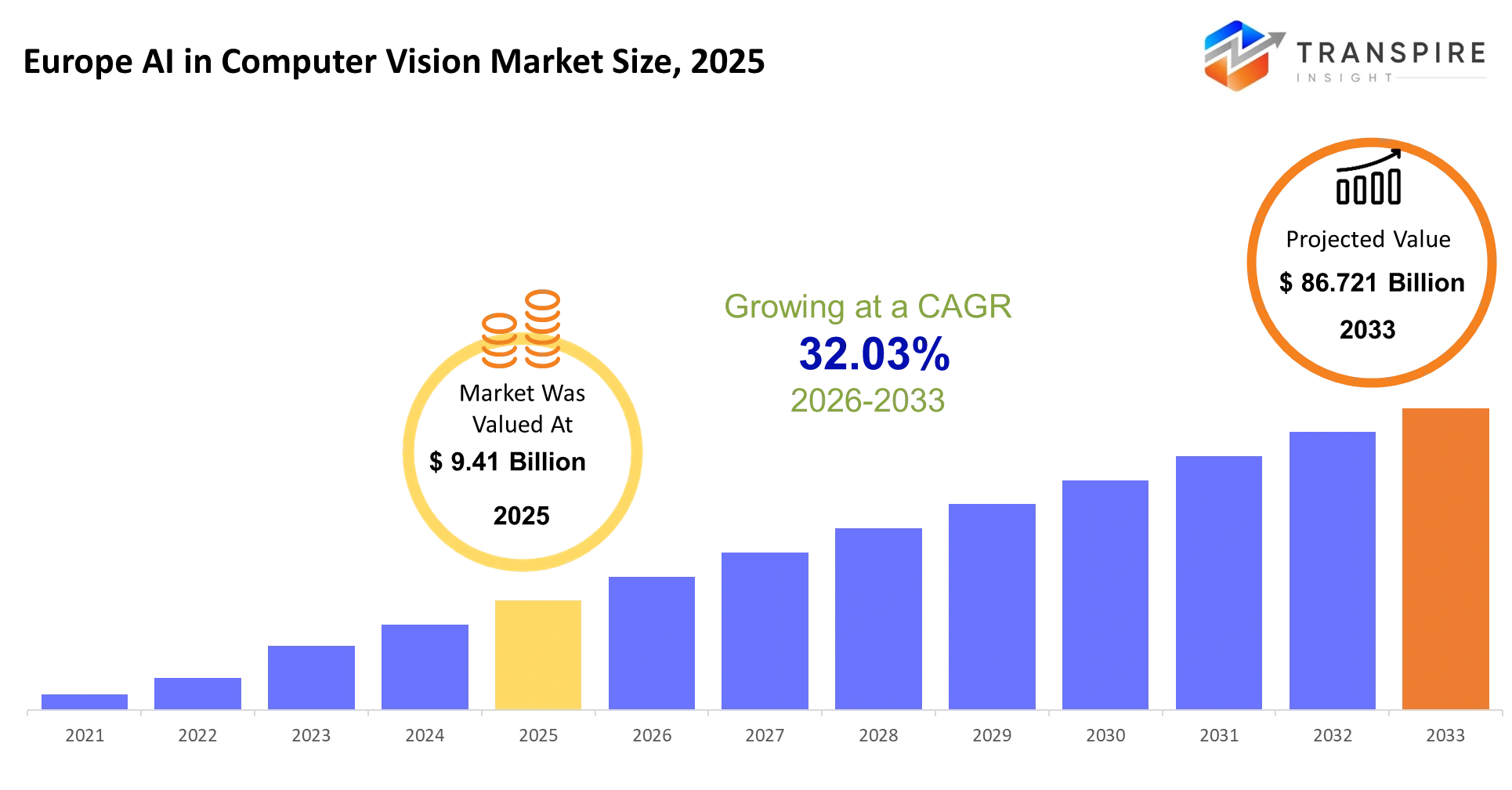
- Europe AI in Computer Vision Market Size 2025: USD 9.41 Billion
- Europe AI in Computer Vision Market Size 2033: USD 86.721 Billion
- Europe AI in Computer Vision Market CAGR: 32.03%
- Europe AI in Computer Vision Market Segments: By Type (Image Recognition, Video Analytics, Facial Recognition, Object Detection, OCR, Others); By Application (Security, Healthcare, Automotive, Retail, Manufacturing, Others); By End-User (Enterprises, Govt, Automotive, Healthcare, Retail, Others); By Deployment (Cloud, On-premises, Edge, Hybrid, AI Platforms, Others)
To learn more about this report,  Download Free Sample Report
Europe AI in Computer Vision Market Summary:
The Europe AI in Computer Vision Market size is estimated at USD 9.41 Billion in 2025 and is anticipated to reach USD 86.721 Billion by 2033, growing at a CAGR of 32.03% from 2026 to 2033. In Europe, the AI for computer vision market as part of the wider AI and machine vision ecosystem will demonstrate a clear tendency towards development of highly-contextual image intelligence based on rigorous data governance standards and high precision demanded by enterprises. The EU customer base will demand more and more transparent approaches to analyzing images in industries such as medical imaging, intelligent retail applications, and mobility-related solutions. With the development of GDPR and other regulatory policies, the way images are acquired and analyzed will keep being refined. Developments in edge computing and low latency processing capabilities will define future deployment scenarios.
What Has the Impact of Artificial Intelligence Been on the Europe AI in Computer Vision Market?
The process of data interpretation and its monetization will experience transformation through artificial intelligence, which has begun to establish its crucial impact on the European artificial intelligence computer vision sector. Through the integration of sophisticated machine learning technology into their visual systems, European artificial intelligence computer vision market companies can obtain more detailed analysis of their visual data. The market research process becomes more accurate through AI-driven analytics because it discovers patterns which traditional tools fail to identify, thus providing better segmentation and behavioral understanding. The implementation of this shift helps improve decision-making frameworks which now operate across multiple industries, including retail surveillance and medical imaging.
European ai in computer vision market environments now use artificial intelligence technology to improve their ability to forecast demand and track market trends. AI-powered predictive analytics enables organizations to forecast customer behavior, seasonal patterns, and operational hazards with improved accuracy. The system helps enterprises to develop better inventory control methods while enabling them to adjust their manufacturing processes according to current market conditions. The implementation of smart automation technology enhances the efficiency of production processes through its ability to decrease human involvement while it speeds up the inspection procedure and reduces mistakes in visual inspection systems.
AI technology in European artificial intelligence computer vision market ecosystems delivers operational advantages through its capacity to enhance supply chain operations and achieve cost reductions. This system uses visual automation together with advanced monitoring technologies to achieve better transparency in logistics operations while reducing operational waste. The advanced technologies enable businesses to improve their product development process which leads to personalized customer solutions their business will gain a competitive edge in the fast-changing world of advanced data analytics.
Key Market Trends & Insights:
- Western Europe accounts for over 42% of the europe computer vision market in 2025, led by Germany, France, and the United Kingdom.
- Eastern Europe is the highest growth region and expected to witness more than 20% CAGR until 2030 on account of digital transformation.
- Hardware-based solutions hold more than 45% market share, boosted by the use of sophisticated cameras, sensors, and edge computing systems.
- Software platforms account for the second-largest share, driven by artificial intelligence technologies and cloud deployment methods.
- Services hold the fastest-growing segment and are anticipated to grow rapidly until 2030 owing to growing needs for integration and customization.
- Healthcare imaging accounts for the largest market share, utilizing artificial intelligence for diagnostic and image processing applications.
- Autonomous mobility and smart surveillance are the fastest-growing applications on account of urbanization and investments made for enhanced safety.
- Manufacturing leads with almost 28% market share, utilizing artificial intelligence for inspection and manufacturing process optimization.
Europe AI in Computer Vision Market Segmentation
By Type
The identification of images will still be employed to categorize and label the visual input with higher precision. The analysis of videos will find application in real-time surveillance and assist organizations in handling the continuous data flow in an effective manner. The recognition of faces will attract interest because of the need to verify the identity of individuals; however, regulatory forces will guide the deployment trends in Europe.
The recognition of characters will facilitate digital document management and expedite the process of data extraction. The other types will consist of customized options meant for specific industries and provide high versatility and performance. The persistent optimization of the machine learning models will contribute to better precision and shorter processing time. The growing preference will lean towards the technologies that achieve optimal accuracy and speed without violating the regional data laws.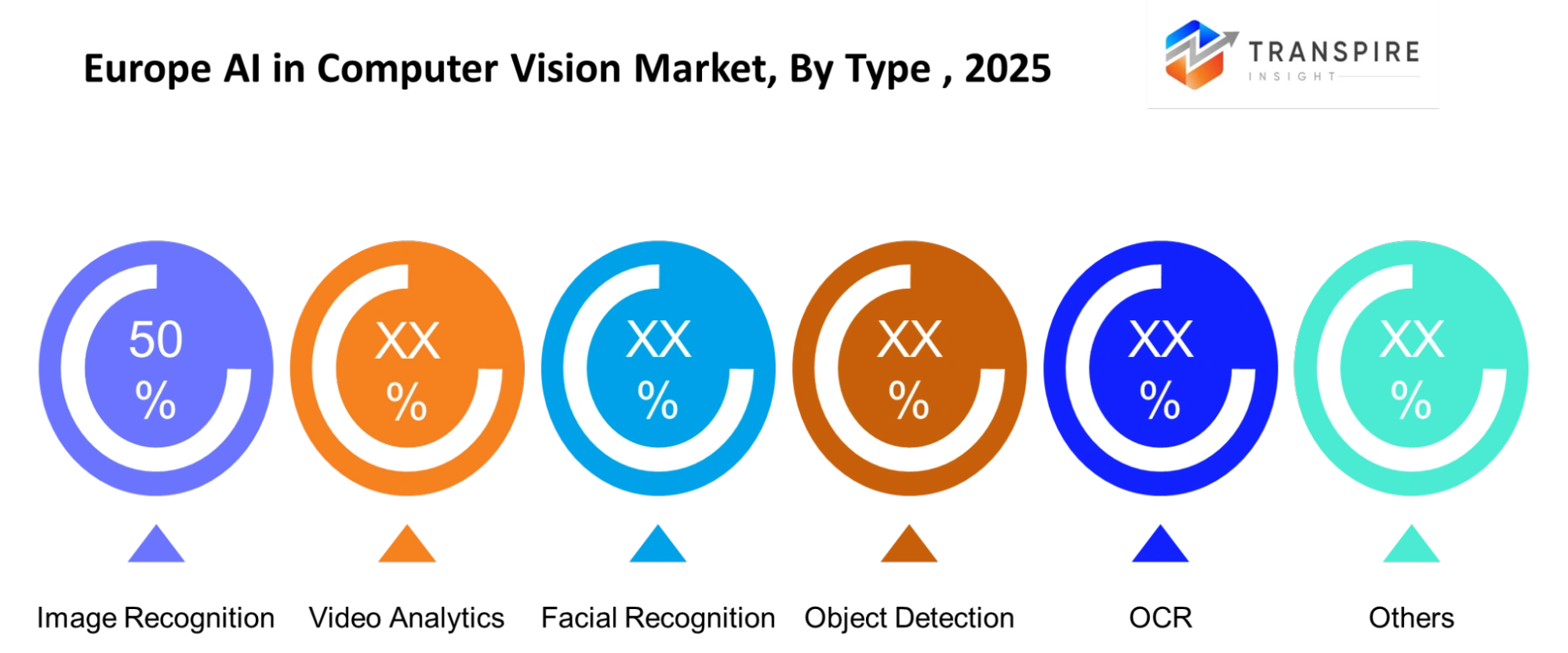
To learn more about this report, Download Free Sample Report
By Application
Use cases in security will be among the first to see adoption due to the benefits visual intelligence provides for surveillance and detection technology. The healthcare industry will find use for visual intelligence in diagnoses based on images and scans, where the AI will help with pattern recognition. In automotive, visual intelligence applications will aid in driver assistance and autonomous vehicle functions.
In manufacturing, visual intelligence technology will help companies improve their processes with better quality control. There will also be use cases in agriculture, education, and smart cities, as well as other areas. As companies invest more in automation technologies, they will look for visual intelligence that fits their particular business operations and needs.
By End-User
Businesses will continue to be major adopters since they would want to increase efficiency through automation and evidence-based decision-making. The government sector will deploy computer vision technology for its use in public safety and urban planning.Automotive firms will employ visual intelligence technologies in production operations as well as within their automobiles. Healthcare facilities will use these innovations for better diagnoses and patient management.
Other sectors, such as retail organizations and logistics services, will also deploy visual tools for specific applications that will benefit them. It will depend on budget considerations and the extent to which the infrastructure is already in place. The demand for visual intelligence solutions will gradually increase because more organizations would understand its benefits.
By Deployment
Cloud-based deployment is expected to deliver scalability and flexibility, which will be useful in facilitating large quantities of visual data processing away from the premises. Deployment based on on-premise infrastructure will still be suitable when data privacy and security concerns arise. Edge-based deployment will also become increasingly popular because it supports low-latency processing that makes timely decisions possible right at the source of data. Hybrid solutions may be chosen to combine the advantages of cloud and on-premise infrastructure deployments.
The deployment of AI software products will enable a unified platform for developing computer vision algorithms. Various other deployment alternatives will be based on custom-built infrastructure suited to unique demands. The evolution of technology will facilitate easy integration between systems, thus simplifying deployment processes.
What are the Main Challenges for the Europe AI in Computer Vision Market Growth?
Several technical and operational hurdles have been observed within the europe ai in computer vision market, making it difficult for companies to maintain consistent performance in various industry segments. Issues such as differences in image quality, data variations, and algorithmic bias are common among most AI applications. Moreover, real-time operations remain a challenge when deploying these technologies in autonomous and smart surveillance settings. Such constraints within the europe ai in computer vision market are also related to compatibility problems with existing legacy systems, resulting in slower deployment and higher operating expenses.
In addition to the technical and operational hurdles, manufacturing and commercialization challenges are present within the europe ai in computer vision market. The high cost of purchasing hardware parts, including sensors and GPU, remains another growth barrier in the europe ai in computer vision market.
The Europe AI in Computer Vision market is also facing some adoption difficulties as well as some limitations related to infrastructure and the availability of professionals. In most cases, the organizations do not have enough knowledge about how to utilize the technologies in the best way possible. Small businesses are also experiencing financial challenges that prevent them from investing in expensive AI systems.
Competition and risk factors are also influencing the growth potential of the Europe AI in Computer Vision market, as there are new technologies and AI systems emerging. The rapid evolution of technologies forces the companies to invest heavily into research and development. On top of that, the regulatory environment and ethical issues regarding surveillance may lead to additional risks.
Regional Insights
Western Europe is anticipated to be the most embracing region because of the advanced infrastructure and the introduction of AI in several industries such as manufacturing, health, and retailing. The need for AI will arise mostly from such countries as Germany, France, and the UK, owing to the fact that they have advanced research facilities and innovative culture, hence the investments in automation and digitization to preserve their competitive advantages.
Concerning Eastern Europe, gradual growth can be witnessed as a result of increased adoption of digital innovations in innovative industries. Poland and the Czech Republic might be seen adopting initiatives aimed at enhancing adoption of AI because they will be guided by effective cost-based strategies implemented by the governments.
Recent Development News
In April 2026, CP Group announced acquisition. CP Group acquired UK-based AI computer vision startup Recycleye to expand optical sorting solutions and strengthen AI-driven waste management systems across Europe.https://www.resultsense.com
|
Report Metrics |
Details |
|
Market size value in 2025 |
USD 9.41 Billion |
|
Market size value in 2026 |
USD 12.402 Billion |
|
Revenue forecast in 2033 |
USD 86.721 Billion |
|
Growth rate |
CAGR of 32.03% from 2026 to 2033 |
|
Base year |
2025 |
|
Historical data |
2021 - 2024 |
|
Forecast period |
2026 - 2033 |
|
Report coverage |
Revenue forecast, competitive landscape, growth factors, and trends |
|
Regional scope |
Europe (Germany, United Kingdom, France, Italy, Spain, Rest of Europe) |
|
Key company profiled |
NVIDIA, Intel, IBM, Microsoft, Google, Amazon, OpenCV, Qualcomm, Apple, Meta, SenseTime, Hikvision, Dahua, Basler, Cognex |
|
Customization scope |
Free report customization (country, regional & segment scope). Avail customized purchase options to meet your exact research needs. |
|
Report Segmentation |
By Type (Image Recognition, Video Analytics, Facial Recognition, Object Detection, OCR, Others); By Application (Security, Healthcare, Automotive, Retail, Manufacturing, Others); By End-User (Enterprises, Govt, Automotive, Healthcare, Retail, Others); By Deployment (Cloud, On-premises, Edge, Hybrid, AI Platforms, Others) |
How Can New Companies Establish a Strong Foothold in the Europe AI in Computer Vision Market?
The europe ai in computer vision market offers promising entry opportunities for startups if they concentrate their efforts on niche and impactful application domains instead of pursuing a broad strategy. In order to identify key pain points and focus on relevant demand drivers, new entrants may consider such use cases as diagnostic imaging in the healthcare industry and manufacturing defect detection, among others. Solving existing operational issues will give startups an upper hand in the europe ai in computer vision market since the market prefers solutions with practical benefits and tangible ROI, such as improvements in accuracy and efficiency.
Technology-focused innovation will be the key to success for new participants entering the europe ai in computer vision market. They must prioritize technology differentiation and design scalability. Specifically, emerging startups must concentrate their efforts on edge computing and fast data processing.
Some of these emerging firms are showing some effective strategies already. For instance, Tractable is using the computer vision technique to assess vehicle damages, whereas Anyline's core competence lies in capturing data in real time using the technology of optical recognition. These emerging firms emphasize that a focused strategy helps in resolving pain points and creating a competitive edge. Following industry trends, making a special investment, and establishing partnerships will enable these firms to become successful in Europe.
Key Europe AI in Computer Vision Market Company Insights
Big organizations will maintain their dominance because of their continued investment in R&D, complex algorithms, and complete solutions tailored according to industrial requirements. Cooperation between new and existing organizations will lead to an increase in market penetration rate. Product differentiation through accuracy and fast processing in addition to compliance with all data security regulations will ensure competitiveness.
Intrusion into the market by new organizations will result in competition for the existing organizations through offering specialized and low-cost solutions designed specifically for different applications such as medical imaging and intelligent retailing. Cooperation with tech companies and local sales channels will further promote adoption rates. Competitiveness will grow in intensity due to shorter innovation periods.
Company List
- NVIDIA
- Intel
- IBM
- Microsoft
- Amazon
- OpenCV
- Qualcomm
- Apple
- Meta
- SenseTime
- Hikvision
- Dahua
- Basler
- Cognex
What are the Key Use-Cases Driving the Growth of the Europe AI in Computer Vision Market?
The europe ai in computer vision market is getting a boost due to high impact use cases that bring about significant improvement in efficiency and effective decision making in different sectors. There is the case of the usage of imaging technology based on artificial intelligence which enables efficient and accurate diagnosis of diseases like cancer and heart ailments using scans. This application is helping in the growth of the market since this is a highly critical area. More investments are being made in medical imaging systems that utilize predictive analytics in the europe ai in computer vision market.
Computer vision is used in automotive applications for enhancing driving safety through advanced driver assistance systems and self-driving cars. Computer vision helps in the detection of any obstacles and recognition of traffic signals among others. This application is contributing significantly to the europe ai in computer vision market due to the increase in regulations in the industry aimed at improving road safety. Edge computing developments are assisting in making this application more scalable.
The manufacturing industry serves as an essential sector which contributes to the increasing demand for European AI technology used in computer vision applications. The visual inspection systems employed by the company utilize artificial intelligence technology to identify defects which result in decreased production errors. The retail and e-commerce sector uses computer vision technology to study consumer behavior and track product inventory and enhance customer shopping experiences.
Europe AI in Computer Vision Market Report Segmentation
By Type
- Image Recognition
- Video Analytics
- Facial Recognition
- Object Detection
- OCR
- Others
By Application
- Security
- Healthcare
- Automotive
- Retail
- Manufacturing
- Others
By End-User
- Enterprises
- Govt
- Automotive
- Healthcare
- Retail
- Others
By Deployment
- Cloud
- On-premises
- Edge
- Hybrid
- AI Platforms
- Others
Frequently Asked Questions
Find quick answers to common questions.
The Approximate Europe AI in Computer Vision Market size for the Market will be USD 86.721 Billion in 2033.
Key Segments for the Europe AI in Computer Vision Market are By Type (Image Recognition, Video Analytics, Facial Recognition, Object Detection, OCR, Others); By Application (Security, Healthcare, Automotive, Retail, Manufacturing, Others); By End-User (Enterprises, Govt, Automotive, Healthcare, Retail, Others); By Deployment (Cloud, On-premises, Edge, Hybrid, AI Platforms, Others).
Major Europe AI in Computer Vision Market Players are NVIDIA, Intel, IBM, Microsoft, Google, Amazon, OpenCV, Qualcomm, Apple, Meta, SenseTime, Hikvision, Dahua, Basler, Cognex.
The Current Europe AI in Computer Vision Market size is USD 9.41 Billion in 2025.
The Europe AI in Computer Vision Market CAGR is 32.03%.
- NVIDIA
- Intel
- IBM
- Microsoft
- Amazon
- OpenCV
- Qualcomm
- Apple
- Meta
- SenseTime
- Hikvision
- Dahua
- Basler
- Cognex
Recently Published Reports
-
Apr 2026
3D Optical Profiler Market
3D Optical Profiler Market Size, Share & Analysis Report By Type (Desktop 3D Optical Profiler, and Portable 3D Optical Profiler), By Technology (Confocal Technology, and White Light Interference), By End-Use Industry (Manufacturing, Research Institutions, Automotive, Aerospace and Defense, Medical Devices, and Other), and Geography (North America, Europe, Asia-Pacific, Middle East and Africa, South and Central America), 2021 - 2031
-
Apr 2026
Depth Sensor Market
Depth Sensor Market Size, Share & Analysis Report By Type (Infrared Depth Sensors, Time-of-Flight (ToF) Sensors, Stereo Vision Sensors, Structured Light Sensors, Ultrasonic Depth Sensors), By Application (Automotive, Robotics, Gaming, Consumer Electronics, Industrial Automation, Healthcare, Security & Surveillance, Others), By End Users (Automotive Manufacturers, Consumer Electronics Companies, Healthcare Providers, Industrial Companies, Security Agencies, Gaming Companies, Robotics Companies, Others), and Geography (North America, Europe, Asia-Pacific, Middle East and Africa, South and Central America), 2021 – 2031
-
Apr 2026
Digital Manufacturing Market
Digital Manufacturing Market Size, Share & Analysis Report By Component (Hardware, Software, and Services), By Technology (Robotics, 3D Printing, Internet of Things (IoT), and Others), By Application (Automotive and Transportation, Aerospace and Defense, Consumer Electronics, Industrial Machinery, and Others), By Process Type (Computer-Based Designing, Computer-Based Simulation, Computer 3D Visualization, Analytics, and Others), and Geography (North America, Europe, Asia-Pacific, Middle East and Africa, South and Central America), 2021 – 2031
-
Apr 2026
Digital Visa Services Market
Digital Visa Services Market Size, Share & Analysis Report By Type (Individual Travelers, Group Travelers), By Application (Tourism, Business Travel, Others), and Geography (North America, Europe, Asia-Pacific, Middle East and Africa, South and Central America), 2021 – 2031