
Europe Automotive Digital Instrument Cluster Market Size & Forecast:
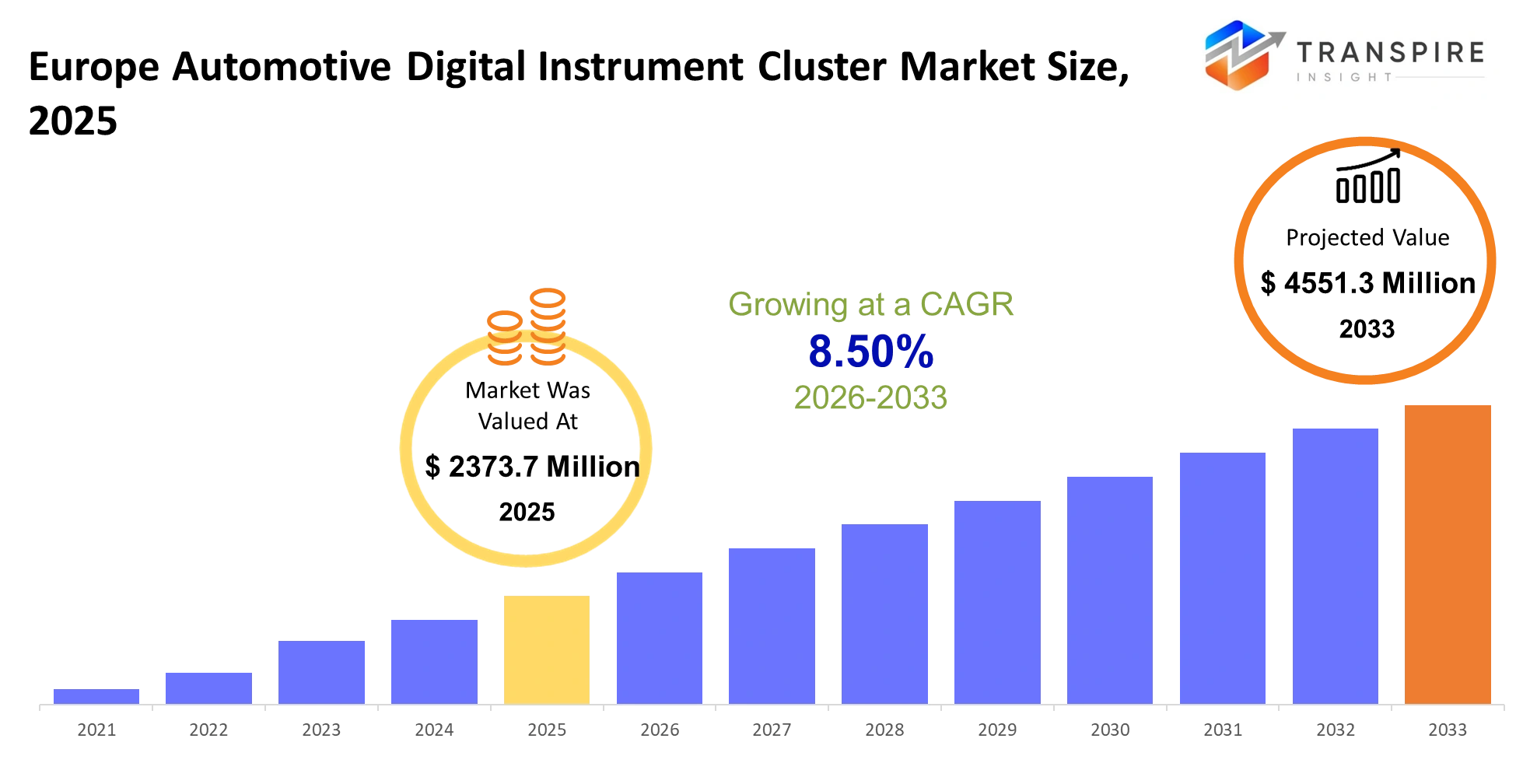
- Europe Automotive Digital Instrument Cluster Market Size 2025: USD 2373.7 Million
- Europe Automotive Digital Instrument Cluster Market Size 2033: USD 4551.3 Million
- Europe Automotive Digital Instrument Cluster Market CAGR: 8.50%
- Europe Automotive Digital Instrument Cluster Market Segments: By Type (Analog Clusters, Digital Clusters, Hybrid Clusters, LCD Clusters, TFT Displays, Others); By Application (Passenger Cars, Commercial Vehicles, EVs, Luxury Vehicles, SUVs, Others); By Component (Display, Software, Controllers, Sensors, Connectivity, Others); By End-User (OEMs, Aftermarket, Automotive Suppliers, EV Manufacturers, Fleet Operators, Others).
To learn more about this report,  Download Free Sample Report
Europe Automotive Digital Instrument Cluster Market Summary:
The Europe Automotive Digital Instrument Cluster Market size is estimated at USD 2373.7 Million in 2025 and is anticipated to reach USD 4551.3 Million by 2033, growing at a CAGR of 8.50% from 2026 to 2033. The Europe Automotive Digital Instrument Cluster Market, as part of the bigger Automotive Electronics Industry, is bound to continue transforming the experience of how drivers interface with data on their vehicles for years to come. It will evolve from its conventional gauge-oriented format to embrace more interactive and software-driven display formats influenced by changing preferences towards customization and connectivity. The desire by European motorists to have similar user interfaces as their smartphones will drive manufacturers to improve the graphic designs and responsiveness of the displays. Changes in the regulations concerning driver distraction will impact the layout and hierarchy of information displayed.
What Has the Impact of Artificial Intelligence Been on the Europe Automotive Digital Instrument Cluster Market?
AI technology is now playing a great role in the formation of the Europe automotive digital instrument cluster market and in directing changes from normal to smart or dynamic interfaces. Artificial intelligence adoption in Europe automotive digital instrument cluster market value chains will revolutionize how manufacturers will analyze data sets to conduct market researches.
Another area where AI is expected to make an impact on the Europe automotive digital instrument cluster market value chains is that of optimizing the manufacturing processes. Processes in the manufacturing sector are expected to be automated and AI-based demand sensing and supply chain optimization techniques will also be utilized in order to cut down production costs. The intention is to reduce costs without compromising on quality.
In addition to increasing efficiency, AI technology is expected to introduce further levels of innovation and customization to the European automotive digital instrument cluster market. Advanced AI-powered instruments would adjust the layout of information displayed on the screen according to user preference, external environment, and context of use. This trend is bound to increase the competitive advantage of manufacturers that utilize cutting-edge AI technologies.
Key Market Trends & Insights:
- Germany leads the European automotive digital instrument cluster market because it will hold 28% market share in 2025 due to its strong automotive production base and high-end vehicle manufacturing. Eastern Europe experiences its highest growth rate with a 9% CAGR until 2030 which results from rising vehicle manufacturing and financial advantages.
- The TFT-LCD clusters category leads the Europe automotive digital instrument cluster market share with over 55% in 2025 backed by cost-effectiveness and high penetration rate in mid-sized cars.
- The hybrid clusters occupy the second-largest share with about 25%, offering a blend of analog gauges and digital functionality.
- OLED-powered digital clusters witness the fastest growth with CAGR exceeding 10% through 2030 due to improved display quality.
- Passenger vehicles emerge dominant in the Europe automotive digital instrument cluster market with around 72% in 2025 backed by growing consumer preferences for advanced infotainment technology.
- The electric vehicles category exhibits the highest growth rate, registering over 11% CAGR through 2030 driven by digital-centric cabin design.
- OEMs are the dominant players occupying nearly 80% of Europe automotive digital instrument cluster market share in 2025, as automobile manufacturers incorporate digital clusters in their vehicle designs.
- Aftermarket installs exhibit significant growth driven by customization requirements and retrofitting applications.
Europe Automotive Digital Instrument Cluster Market Segmentation
By Type
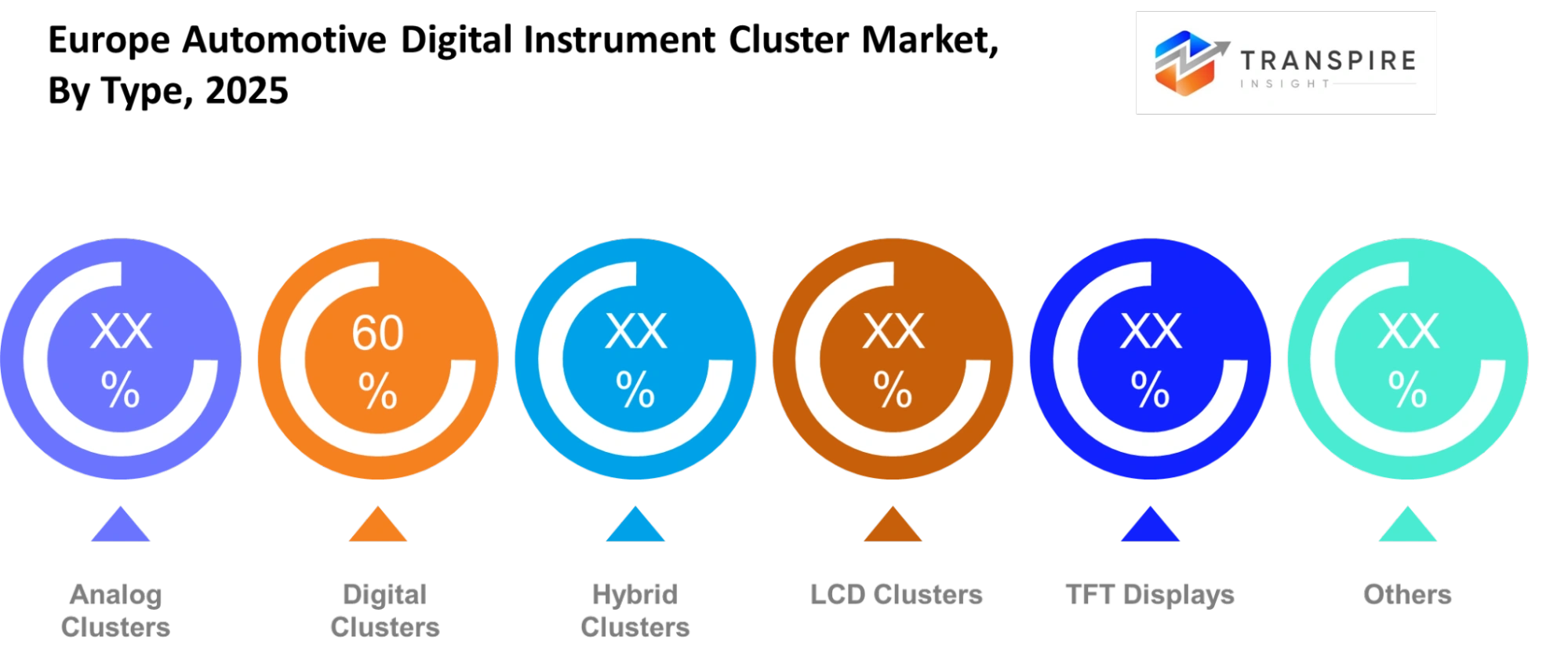
Analog clusters will still provide traditional designs with dials of fixed positions and low levels of adjustability, which are favored in basic vehicles to maintain price consistency. Digital clusters will provide totally adjustable screens showing speed readings, navigation information, and other warnings in flexible arrangements. Hybrid clusters will integrate gauges and electronic screens, providing a combination of traditional and advanced designs. LCD clusters and TFT screens will be used extensively in producing clear images and colors and in designing innovative screens.
The advancement in display technology will enhance visual performance and smooth screen changes. TFT screens will be popularly utilized because of high durability and cost-effectiveness, but the trend will change in the luxury segment where digital clusters will be favored. The demand for responsive and interactive clusters will urge manufacturers to improve their products' usability. This trend will be reflected in the Europe Automotive Digital Instrument Cluster Market.
To learn more about this report, Download Free Sample Report
By Application
Passenger cars will be in high demand because the need for state-of-the-art dashboards will increase among midsize and compact cars. Digital clusters will be incorporated into commercial vehicles slowly but surely, with an emphasis placed on efficiency, driver tracking, and routing information. EVs will be reliant on digital dashboards to convey battery capacity, distance, and energy flows. Luxurious vehicles will take the lead by incorporating advanced graphics, bigger screens, and cockpit designs.
Digital clusters will make their presence felt in SUVs because of the changing demands of consumers who prefer cars packed with advanced features. Diversity of applications will define the interface design that will differ based on the type of vehicle in question. Cluster design will have to adapt due to the increasing popularity of EVs to include energy information and routing capabilities.
By Component
The display units will function as the main visual elements, displaying the driving information by means of high-quality displays. The software will handle the control of interaction, customization of layouts, and connection with navigation and infotainment systems. The controllers will facilitate the processing tasks, guaranteeing seamless transitions and real-time updates. The sensors will be responsible for supplying the necessary input information, including speed, temperature, and vehicle diagnostic information for accurate display outputs.
Connectivity will be another key feature that will allow the digital instrument cluster to integrate with phones, cloud computing systems, and vehicular networking systems. The software will be continually updated, and hence there will be no need for hardware changes, which will increase the lifespan of the system. Additionally, the precision of the sensors and control systems will become very high, thus enabling advanced driving assistance systems.
By End-User
Adoption will take place through the OEMs who will integrate the digital cluster directly into the production process of the automobiles. As for the suppliers, they will contribute in the development process in that they will offer both hardware and software components. The manufacturers of electric vehicles will have a preference for the digital clusters which highlight energy efficiency. Also, fleet management requirements include the use of the digital clusters for performance and fuel efficiency purposes.
When it comes to the aftermarket side of things, we expect demand for the products to be increased because the consumers will search for improved digital clusters. In this respect, the suppliers will emphasize on scalability as to cater for different kinds of cars. Therefore, requirements of fleet management will ensure high levels of display as digital dashboards will form a part of cars.
What are the Main Challenges for the Europe Automotive Digital Instrument Cluster Market Growth?
Technical and operational issues characterize the Europe automotive digital instrument cluster industry, adversely impacting their efficiency and scalability. Advanced digital instrument clusters need considerable computational power, accurate calibration, and seamless integration of software, and problems could arise, leading to delays or display errors. In addition, problems can arise due to the need for regular software upgrades and compatibility issues. Another concern is the problems associated with supply chain management, particularly with semiconductors and display panels.
Production and marketing obstacles also pose a significant hindrance to the growth rate of the Europe automotive digital instrument cluster industry. The manufacturing process includes precision electronics, sophisticated displays, and compliance with automobile industry standards, resulting in higher expenses. Adherence to the regulations set by European authorities concerning driver safety and data presentation further complicates the process. Such considerations usually postpone the release of new products and reduce flexibility in operations.
Adoption issues continue to be the major challenge faced by the Europe automotive digital instrument cluster market in vehicle classes where costs are crucial and in some developing parts of Europe. Higher integration expenses and lack of awareness on the part of consumers lead to low adoption rates in affordable cars. Another problem is related to lack of experts capable of working with complicated electronic and software systems used in cars. Meanwhile, lack of infrastructure to support connectivity hinders effective use of digital clusters.
Market competition and risks associated with it continue to present challenges for the Europe automotive digital instrument cluster market development. Competition between established companies and startups makes profits smaller because prices drop. Another market trend to take into consideration is that alternative interface types like head-up display and speech recognition are increasingly popular. It means that their share can decrease in the future. Technological changes make future development risky.
Regional Insights
There will be tremendous variation in the Europe Automotive Digital Instrument Cluster market, dependent on the manufacturing sector, tastes, and legal requirements. Western Europe will lead the market due to advanced technology and manufacturing of luxury cars. Countries like Germany and France will be the leading adopters of digital instrument clusters due to their strong automotive manufacturing industries and high purchasing capacity.
Eastern Europe will show increasing adoption rates as more manufacturing hubs are formed in the region and the cost of manufacturing remains low. Growth in assembly centers and supplies of components will make it possible for manufacturers to slowly introduce digital instruments. Southern Europe will experience medium adoption rates.
Recent Development News
In April 2026, Robert Bosch GmbH announced partnership expansion. The company expanded collaboration with Qualcomm Technologies to advance cockpit and ADAS systems, strengthening digital instrument cluster integration capabilities in next-generation vehicles.
Source: https://www.qualcomm.com
|
Report Metrics |
Details |
|
Market size value in 2025 |
USD 2373.7 Million |
|
Market size value in 2026 |
USD 2570.8 Million |
|
Revenue forecast in 2033 |
USD 4551.3 Million |
|
Growth rate |
CAGR of 8.50% from 2026 to 2033 |
|
Base year |
2025 |
|
Historical data |
2021 - 2024 |
|
Forecast period |
2026 - 2033 |
|
Report coverage |
Revenue forecast, competitive landscape, growth factors, and trends |
|
Regional scope |
Europe (Germany, United Kingdom, France, Italy, Spain, Rest of Europe) |
|
Key company profiled |
Bosch, Continental, Denso, Visteon, Marelli, Nippon Seiki, Panasonic, Delphi Technologies, Aptiv, Harman, Valeo, Hyundai Mobis, Garmin, Pioneer, Yazaki. |
|
Customization scope |
Free report customization (country, regional & segment scope). Avail customized purchase options to meet your exact research needs. |
|
Report Segmentation |
By Type (Analog Clusters, Digital Clusters, Hybrid Clusters, LCD Clusters, TFT Displays, Others); By Application (Passenger Cars, Commercial Vehicles, EVs, Luxury Vehicles, SUVs, Others); By Component (Display, Software, Controllers, Sensors, Connectivity, Others); By End-User (OEMs, Aftermarket, Automotive Suppliers, EV Manufacturers, Fleet Operators, Others). |
How Can New Companies Establish a Strong Foothold in the Europe Automotive Digital Instrument Cluster Market?
New entrants can build a strong position in the Europe automotive digital instrument cluster market through their specific target of niche gaps which established players choose to ignore. The companies should direct their resources toward electric vehicles and compact urban cars and fleet-based solutions because those areas show increasing demand while customizations remain restricted. The emerging players will achieve better customer response through their dedicated focus on industry trends which include connected mobility and smart cockpit systems. The focused entry method will enable organizations to use their resources more effectively while they achieve faster validation of market presence.
The Europe automotive digital instrument cluster market will use innovation as its primary method for creating product differentiation. The startups that create lightweight software platforms and AI-powered display solutions and energy-efficient interfaces will solve major problems, which involve system slowness and excessive energy usage and restricted user options. The automotive OEMs and semiconductor manufacturers and software development companies will create strategic partnerships to speed up their product development process and establish market entry points. The collaboration process will lead to decreased entry obstacles while it establishes trustworthiness between organizations that must compete in an industry influenced by fast-moving technological advancements.
Rightware and Sono Motors demonstrate how emerging companies use innovation strategies to gain market visibility through their business model. Rightware makes user interface software of high quality for the digital clusters to utilize it for display purposes, whereas Sono Motors uses its technological innovations and green methods of transportation. Europe automotive digital instrument cluster market needs businesses that differentiate themselves through technology and application to stay relevant for years to come.
Key Europe Automotive Digital Instrument Cluster Market Company Insights
Europe Automotive Digital Instrument Cluster Market is anticipated to be highly competitive due to the presence of leading firms along with new entrants in the automotive electronics industry. Competition is anticipated to revolve around advanced display technology, advanced software capability, and reliability of the product. Constant updates in existing products along with innovation in the product development cycle will be key factors in positioning the products, whereas cost efficiency will be crucial in securing deals with automobile manufacturers.
Corporate partnership will play an essential role in improving the market position of the firms. Concentration on AI-based interface systems, connectivity technologies, and efficient energy systems will enable firms to distinguish themselves from their competitors. Competitive edge in the platform of electric cars and premium cars will be the main aspects of competition, since the demand for smart digital instrument clusters will only increase.
Company List
- Bosch
- Continental
- Denso
- Visteon
- Marelli
- Nippon Seiki
- Panasonic
- Delphi Technologies
- Aptiv
- Harman
- Valeo
- Hyundai Mobis
- Garmin
- Pioneer
- Yazaki
What are the Key Use-Cases Driving the Growth of the Europe Automotive Digital Instrument Cluster Market?
The automotive digital instrument cluster market in Europe is expanding because it uses its core technology to improve driver information systems that show real-time data. Modern vehicles are shifting from analog dashboards to fully digital displays that will present navigation, speed, and safety alerts in a clear and customizable format. The new system will enhance driving efficiency while minimizing driver distractions because it creates better decision-making conditions during urban traffic situations which require fast decisions.
The automotive digital instrument cluster market in Europe receives its second major driving force from advanced driver assistance system integration. Digital clusters will display lane guidance, collision warnings, and adaptive cruise data directly within the driver’s line of sight. The direct visualization method will enhance driving safety because it meets European safety standards. Automotive manufacturers will increasingly rely on these systems to meet regulatory expectations while improving user experience.
Electric vehicles are also creating strong demand within the Europe automotive digital instrument cluster market by requiring detailed energy monitoring and battery performance insights. Digital interfaces will show range, charging status, and energy flow in real time, helping drivers manage efficiency better. Connected vehicle ecosystems will enable clusters to connect with mobile applications and cloud-based systems which will enable both remote vehicle diagnostics and customized user settings. The practical applications of these technologies will enhance system scalability while promoting adoption in multiple vehicle categories.
Europe Automotive Digital Instrument Cluster Market Report Segmentation
By Type
- Analog Clusters
- Digital Clusters
- Hybrid Clusters
- LCD Clusters
- TFT Displays
- Others
By Application
- Passenger Cars
- Commercial Vehicles
- EVs
- Luxury Vehicles
- SUVs
- Others
By Component
- Display
- Software
- Controllers
- Sensors
- Connectivity
- Others
By End-User
- OEMs
- Aftermarket
- Automotive Suppliers
- EV Manufacturers
- Fleet Operators
- Other
Frequently Asked Questions
Find quick answers to common questions.
The approximate Europe Automotive Digital Instrument Cluster Market size for the market will be USD 4551.3 Million in 2033.
Key segments for the Europe Automotive Digital Instrument Cluster Market are By Type (Analog Clusters, Digital Clusters, Hybrid Clusters, LCD Clusters, TFT Displays, Others); By Application (Passenger Cars, Commercial Vehicles, EVs, Luxury Vehicles, SUVs, Others); By Component (Display, Software, Controllers, Sensors, Connectivity, Others); By End-User (OEMs, Aftermarket, Automotive Suppliers, EV Manufacturers, Fleet Operators, Others).
Major Europe Automotive Digital Instrument Cluster Market players are Bosch, Continental, Denso, Visteon, Marelli, Nippon Seiki, Panasonic, Delphi Technologies, Aptiv, Harman, Valeo, Hyundai Mobis, Garmin, Pioneer, Yazaki.
The Europe Automotive Digital Instrument Cluster Market size is USD 2373.7 Million in 2025.
The Europe Automotive Digital Instrument Cluster Market CAGR is 8.50%.
- Bosch
- Continental
- Denso
- Visteon
- Marelli
- Nippon Seiki
- Panasonic
- Delphi Technologies
- Aptiv
- Harman
- Valeo
- Hyundai Mobis
- Garmin
- Pioneer
- Yazaki
Recently Published Reports
-
Apr 2026
ATV & UTV Market
ATV & UTV Market Size, Share & Analysis Report By Type (ATV, and UTV), By Variants (Less Than 400 CC, 400 CC To 800 CC, and More Than 800 CC), and Geography (North America, Europe, Asia-Pacific, Middle East and Africa, South and Central America), 2021 - 2031
-
Apr 2026
Automotive Central Gateway Module Market
Automotive Central Gateway Module Market Size, Share & Analysis Report By Type (Ethernet Central Gateway Module, CAN Central Gateway Module, LIN Central Gateway Module, and FlexRay), By Application (Powertrain Control, Body Control, Infotainment System, Advanced Driver Assistance Systems (ADAS), and Others), By End User (Passenger Vehicles, and Commercial Vehicles), and Geography (North America, Europe, Asia-Pacific, Middle East and Africa, South and Central America), 2021 - 2031
-
Apr 2026
Automotive Engine Oil Filter Market
Automotive Engine Oil Filter Market Size, Share & Analysis Report By Filter Type (Fuel Filter, Engine Oil Filter, Hydraulic Oil Filter, and Others), By Filter Media (Cellulose, Synthetic, and Micro), By Sales Channel (OEMs, and Aftermarket), By Vehicle Type (Passenger Cars, Light Commercial Vehicles, Heavy Duty Trucks, Buses and Coaches, and Off-road Vehicles), and Geography (North America, Europe, Asia-Pacific, Middle East and Africa, South and Central America), 2021 - 2031
-
Apr 2026
Automotive Parts Aluminium Die Casting Market
Automotive Parts Aluminium Die Casting Market Size, Share & Analysis Report By Production Process (Pressure Die Casting, Vacuum Die Casting, Squeeze Die Casting, Gravity Die Casting), By Application (Body Parts, Engine Parts, Transmission Parts, Battery And Related Components, Other Application Types), and Geography (North America, Europe, Asia-Pacific, Middle East and Africa, South and Central America), 2021 - 2031
Our Clients