

North America Video Streaming Software Market Size & Forecast:
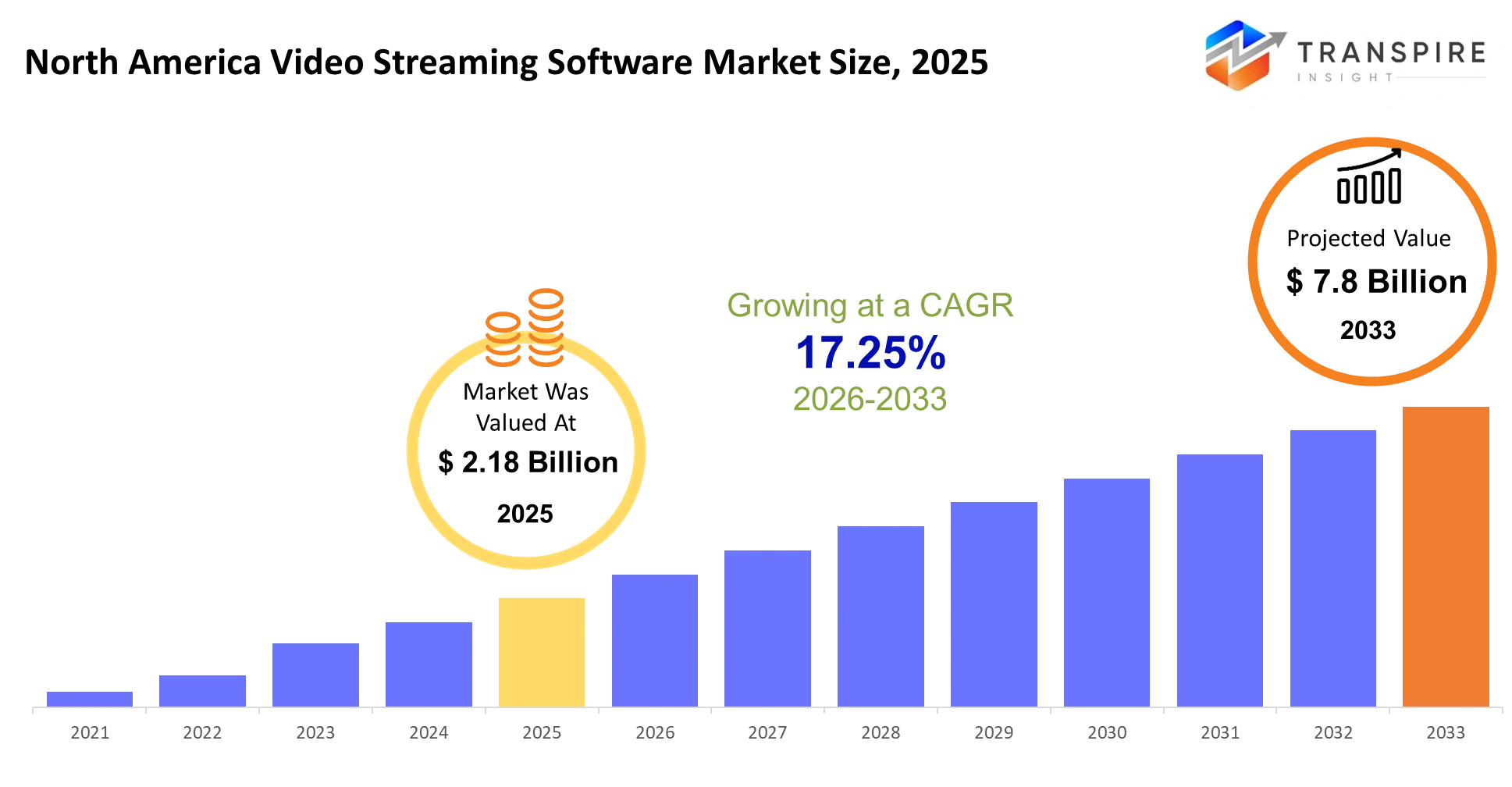
- North America Video Streaming Software Market Size 2025: USD 2.18 Billion
- North America Video Streaming Software Market Size 2033: USD 7.8 Billion
- North America Video Streaming Software Market CAGR: 17.25%
- North America Video Streaming Software Market Segments: By Type (Live Streaming, On-demand, OTT, Video Conferencing, Cloud Streaming, Hybrid, Interactive); By Deployment (Cloud, On-premise, Hybrid, SaaS, Edge, Multi-cloud, Private); By Application (Entertainment, Education, Corporate, Gaming, Sports, Social Media, Healthcare); By End-User (Consumers, Enterprises, Media, Education, Govt, Healthcare, Corporates); By Revenue (Subscription, Ads, Freemium, Pay-per-view, Licensing, Hybrid, Sponsorship)
To learn more about this report,  Download Free Sample Report
North America Video Streaming Software Market Summary:
The North America Video Streaming Software Market size is estimated at USD 2.18 Billion in 2025 and is anticipated to reach USD 7.8 Billion by 2033, growing at a CAGR of 17.25% from 2026 to 2033.
The North American video streaming software market experiences its current development because viewers now prefer to watch content whenever they want and choose their own viewing times. The platforms now provide support for multiple devices while they implement advertisement-based payment systems and protect user information according to new security requirements. Creators now need to change their production processes because digital platforms around the world demand higher quality content that needs to be delivered with faster speed.
The North American content distribution rules and transparency standards will undergo changes because regulatory shifts will drive platforms to establish more transparent licensing and reporting practices. The advancement of encoding technologies together with edge computing development and network optimization progress will enhance delivery quality for global viewers who will experience smoother content viewing in different bandwidth environments.
What Has the Impact of Artificial Intelligence Been on the North America Video Streaming Software Market?
The North American video streaming software market experiences its current development because viewers now prefer to watch content whenever they want and choose their own viewing times. The platforms now provide support for multiple devices while they implement advertisement-based payment systems and protect user information according to new security requirements. Creators now need to change their production processes because digital platforms around the world demand higher quality content that needs to be delivered with faster speed.
The North American content distribution rules and transparency standards will undergo changes because regulatory shifts will drive platforms to establish more transparent licensing and reporting practices. The advancement of encoding technologies together with edge computing development and network optimization progress will enhance delivery quality for global viewers who will experience smoother content viewing in different bandwidth environments.
AI technology increases operational efficiency for companies which also enables them to develop new products and deliver customized experiences to customers in the North American video streaming software industry. The advanced recommendation engines provide users with personalized content which boosts their research engagement while the system uses actual user behavior and network conditions to determine streaming quality. The company uses these capabilities to enhance customer satisfaction which gives them a competitive advantage because they can observe both existing market trends and emerging technological advancements.
Key Market Trends & Insights:
- The United States video streaming software market establishes its leadership position in North America through its 2025 market share, which reaches 75% because of its superior digital infrastructure.
- Canada shows the highest growth rate among all areas because its OTT market adoption drives the market to grow at more than 13% annual rate throughout the upcoming years.
- More than 35% of the market belongs to video hosting and content management solutions because enterprises need to build their streaming capabilities according to their business expansion needs.
- The second most significant market share belongs to video analytics and monitoring tools which receive support from increasing demand for real-time performance insights and predictive analytics.
- The market for AI-based recommendation engines shows its strongest growth as customer customization trends drive industry expansion until the year 2030.
- The north america video streaming software market shows OTT platforms as its leading force because they hold almost 45 percent market share which grows due to rising subscription-based content watching.
- The fastest expanding market segment belongs to live streaming applications which digital platforms use to meet their demand for esports events and real-time engagement.
- The media and entertainment sector controls more than 50 percent market share because it uses advanced streaming technology to deliver content and reach audiences.
- The education sector and e-learning platforms now experience their fastest growth as educational institutions adopt hybrid learning and digital transformation initiatives.
- The north america video streaming software market contains major companies such as Netflix and Amazon Web Services and Google and IBM and Microsoft.
North America Video Streaming Software Market Segmentation
By Type :
Live streaming enables audiences to receive real-time video streams which serve as their primary method for watching events and broadcasts. On-demand enables users to watch content whenever they choose to do so. OTT provides internet-based content delivery while video conferencing enables virtual meetings and communication for business and educational institutions and personal use.
Cloud streaming delivers video content through remote servers which decreases the processing requirements for devices. Hybrid systems use both live streaming and on-demand content delivery to provide users with flexible viewing options. Interactive streaming enables users to participate through chat functions and polling and reaction features which boost engagement and user participation across different platforms.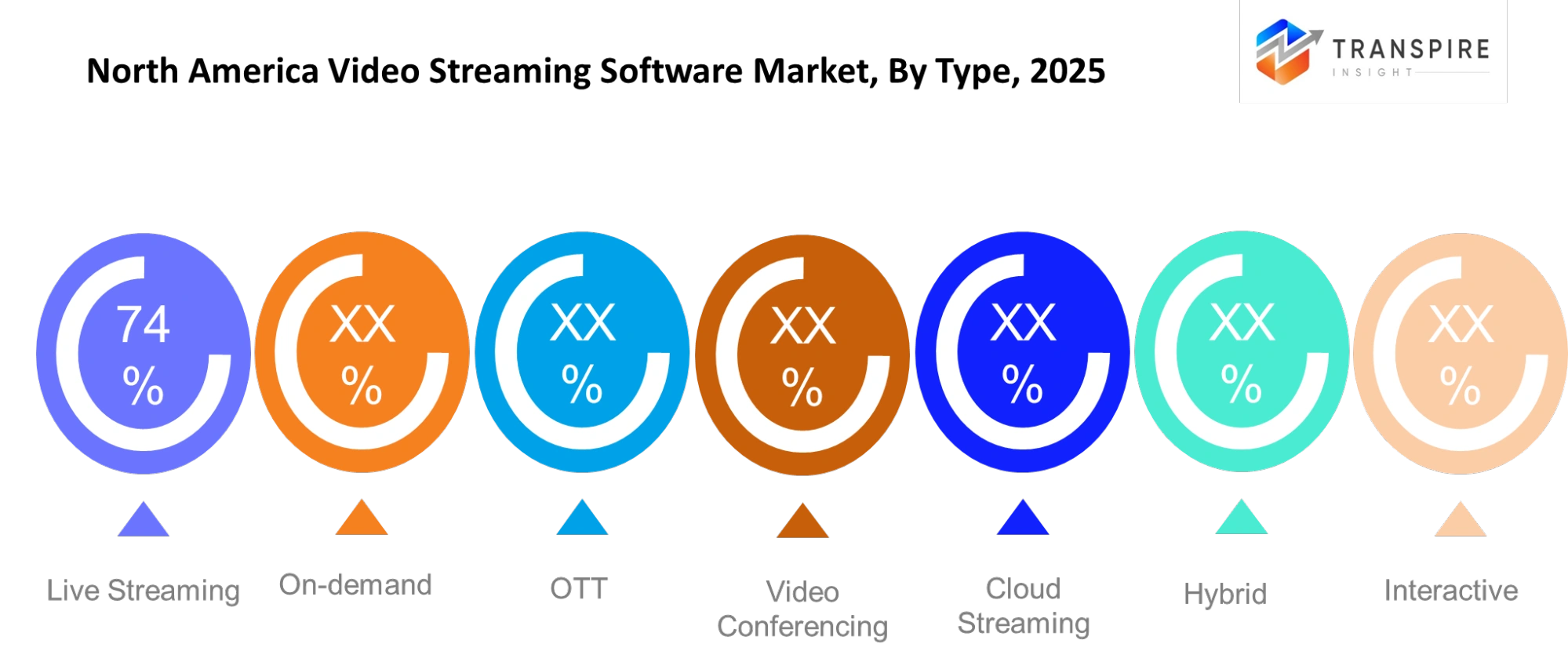
To learn more about this report, Download Free Sample Report
By Deployment :
The cloud deployment solution enables organizations to provide scalable video services which run on external servers and require minimal hardware requirements. The on-premise deployment system operates through a business's internal network, which gives organizations complete authority over their data and system operations. The hybrid deployment model uses both cloud services and on-premise systems to achieve equal operational capacity and system oversight.
The software-as-a-service model enables users to access software applications by paying subscription fees. Edge deployment enables organizations to decrease latency because it processes data at locations which are nearer to their user base. The multi-cloud deployment model utilizes multiple cloud service providers while the private deployment model provides organizations with dedicated infrastructure for their critical business operations.
By Application :
Streaming platforms provide entertainment which includes movies and shows and live events. Educational institutions use video software to conduct online learning and virtual classroom sessions.Corporations utilize meeting and training tools together with communication systems that enable remote and hybrid work.
Players can stream their gameplay through gaming streaming while their fans can interact with them. Sports platforms offer their audience the ability to view live sports programs and access match summaries. Social media platforms create interactive content through their use of short videos and live streaming. Healthcare organizations use video streaming technology to deliver telemedicine services and remote patient monitoring and medical consultations.
By End-User :
Consumers use video streaming to watch entertainment materials and to communicate with others and to study. Enterprises use it for internal communication purposes and for staff collaboration activities and for training programs which enhance workforce productivity across multiple locations.
Media organizations use streaming for content distribution and broadcasting. Education institutions support digital learning systems. Government bodies use video platforms to deliver public information and operational services. Healthcare providers use video tools to conduct patient consultations while corporate users depend on streaming to facilitate their business communication and operations.
By Revenue :
Subscription models create revenue through user payments which customers pay either monthly or yearly to access content. Users can access free content in advertising-based models which use advertisements to fund their services. Freemium models provide basic services free with paid premium features for advanced access and better viewing experience.
Users need to pay-per-view fees to watch each piece of content. Content rights distribution generates revenue through licensing agreements. Hybrid models use multiple revenue streams to provide their business needs. The organization generates its sponsorship revenue through brand partnerships which fund events and content and platform operations.
What are the Main Challenges for the North America Video Streaming Software Market Growth?
The video streaming software market in North America encounters multiple technical and operational difficulties which prevent it from achieving complete market expansion. The need for high-performance streaming services requires organizations to build strong infrastructure systems yet existing problems with latency and buffering and unstable video quality continue to occur during times of maximum user traffic. Platforms face significant challenges because they require systems to maintain operational status while more than one million users access the service at the same moment.
The process of implementing modern technologies which include AI and machine learning into existing systems creates higher system complexity while introducing problems that affect product stability and system compatibility, which creates major obstacles to business growth in the North American video streaming software market.The North American video streaming software market experiences growth obstacles from two factors: cost pressures and regulatory requirements which impact various elements of the business.
Streaming platforms need dedicated resources for cloud infrastructure and cybersecurity and content delivery networks because developing and maintaining their services demands special investment. Data protection regulations which include user privacy laws compel organizations to implement additional operational measures which result in increased expenditures. The North American video streaming software market faces adoption challenges because digital infrastructure and bandwidth limitations restrict access to various regions. Regions experience strong demand but face challenges in delivering efficient high-definition and real-time streaming services.
The innovation process gets hindered because there exists a shortage of professionals who possess expertise in AI-based streaming technology and data analytics. Small and mid-sized enterprises face adoption challenges because they lack funding and technical knowledge which creates continuous barriers that prevent their growth. The North American video streaming software market faces additional risks because of intense competition and technological advancements. Existing companies and new market entrants develop innovative solutions which create pricing pressure that decreases their profit margins.
Country Insights
Cloud computing and artificial intelligence along with data analytics development will create better system performance and personalized user experiences. Users will experience better viewing quality through adaptive bitrate streaming and low-latency delivery systems. Platforms will use recommendation engines to increase user retention while security features will protect against data breaches and content piracy.
The market maintains strong competition because established companies and emerging startups develop new products while changing their pricing models. The company will establish itself through strategic partnerships and acquisition deals and product introduction initiatives. Companies will focus on developing user-friendly interfaces together with flexible systems that enable them to win enterprise customers and achieve sustainable business growth.
The United States shows ongoing demand because of widespread digital technology use and the strong market presence of technology companies. The United States leads digital content delivery through its advanced streaming infrastructure which enables new streaming formats to enter the market first. Both consumer and enterprise sectors display stable demand patterns throughout the evaluation period.
The growth patterns show that users now prefer personalized content which includes interactive elements. Streaming tools become standard business instruments to enhance communication and outreach efforts across all sectors. Video streaming solutions maintain market stability because of ongoing technological progress and robust network infrastructure and established digital systems which promote long-term usage.
Recent Development News
In April 2026, Oku, Inc. reported surpassing 100 million active streaming households globally. This achievement demonstrates that users are increasingly utilizing their streaming platform together with their software ecosystem which confirms their dominant position in North America's connected TV and streaming operating system market.
Sourcehttps://www.theverge.com/
In April 2026, Paramount Global announced a major technology and content upgrade strategy for its streaming platforms Paramount+ and Pluto TV. The company is enhancing personalization, ad-targeting technology, and content pipelines to strengthen its competitive position in North America’s streaming software ecosystem. Source https://www.wsj.com/
|
Report Metrics |
Details |
|
Market size value in 2025 |
USD 2.18 Billion |
|
Market size value in 2026 |
USD 2.56 Billion |
|
Revenue forecast in 2033 |
USD 7.8 Billion |
|
Growth rate |
CAGR of 17.25% from 2026 to 2033 |
|
Base year |
2025 |
|
Historical data |
2021 - 2024 |
|
Forecast period |
2026 - 2033 |
|
Report coverage |
Revenue forecast, competitive landscape, growth factors, and trends |
|
Regional scope |
North America (Canada, The United States, and Mexico) |
|
Key company profiled |
Netflix, Amazon, Google, Microsoft, Disney, Apple, Hulu, IBM, Vimeo, Brightcove, Kaltura, JW Player, Wowza, Dacast, Twitch |
|
Customization scope |
Free report customization (country, regional & segment scope). Avail customized purchase options to meet your exact research needs. |
|
Report Segmentation |
By Type (Live Streaming, On-demand, OTT, Video Conferencing, Cloud Streaming, Hybrid, Interactive); By Deployment (Cloud, On-premise, Hybrid, SaaS, Edge, Multi-cloud, Private); By Application (Entertainment, Education, Corporate, Gaming, Sports, Social Media, Healthcare); By End-User (Consumers, Enterprises, Media, Education, Govt, Healthcare, Corporates); By Revenue (Subscription, Ads, Freemium, Pay-per-view, Licensing, Hybrid, Sponsorship) |
How Can New Companies Establish a Strong Foothold in the North America Video Streaming Software Market?
New entrants aiming to succeed in the north america video streaming software market must begin with clear niche targeting and differentiated value propositions. The emerging players need to concentrate on healthcare streaming for telemedicine and enterprise training and smart city surveillance systems which remain unserved by existing platforms.
The company needs to solve particular customer problems which include providing low-latency streaming for remote diagnostics and delivering secure video content to government customers in order to meet changing industry demands and gain initial market share. The approach enables companies to establish their market position in the north america video streaming software market while creating opportunities for sustainable market development.
The north america video streaming software market requires companies to develop innovation strategies which use AI and machine learning and intelligent automation technologies. New companies can use predictive analytics to create better content delivery systems which provide customized user experiences and optimize bandwidth use.
Startups can achieve cost savings through cloud-native architectures and edge computing which enable them to match the scalability of larger service providers. Companies in North America who want to enter the streaming video software market should establish partnerships with telecom operators and cloud service providers and content creators to create a distribution network which enhances their competitive edge.
Emerging players are already demonstrating how innovation drives success. Mux and JW Player have developed developer-friendly APIs together with advanced analytics tools to fulfill current streaming requirements which helped them gain market recognition. The companies demonstrate that businesses can create unique product offerings by developing their solutions through usability testing and performance evaluation and data analysis. New entrants into the north america video streaming software market can establish their presence through three strategies which include selecting specific market segments and using advanced technologies and building partnerships with other businesses.
Key North America Video Streaming Software Market Company Insights
The entertainment and education and corporate sectors will experience growth because there is increasing demand for on-demand content and live streaming services. The adoption of technology will increase because more people gain access to the internet and smart devices become widespread. The competitive market requires businesses to enhance user experience while they decrease buffering times and provide customized content to keep their subscribers active.
Market competition will determine how the industry develops because leading companies spend money on both technological advancements and unique content development. The small businesses will concentrate their efforts on reaching specific customer segments while they develop pricing strategies that can change based on customer needs. The market will become determined through strategic partnerships and mergers alongside ongoing advancements in streaming quality and platform functions.
Company List
- Netflix
- Amazon
- Microsoft
- Disney
- Apple
- Hulu
- IBM
- Vimeo
- Brightcove
- Kaltura
- JW Player
- Wowza
- Dacast
- Twitch
What are the Key Use-Cases Driving the Growth of North America Video Streaming Software Market?
The North American video streaming software market is experiencing rapid growth because different industries require multiple high-impact applications that particularly benefit the media and entertainment industry. The industry experiences primary growth through OTT platforms and on-demand content services which utilize advanced streaming solutions to provide users with customized viewing experiences that maintain high quality. AI-powered recommendation engines together with adaptive streaming technologies enhance user engagement which leads to higher retention rates that drive market expansion. The live streaming of sports, gaming, and virtual events creates an increasing need for real-time content delivery which has become an essential function of the North American video streaming software market.
The healthcare industry uses video streaming software to create new telemedicine systems and remote patient monitoring solutions. Hospitals and clinics increasingly depend on secure low-latency streaming platforms to conduct virtual consultations and surgical training and real-time diagnostics.The use of these applications enhances accessibility while simultaneously decreasing operational expenses, which leads to increased use of North American video streaming software across the entire market. Organizations in enterprise environments implement streaming solutions to conduct employee training and corporate communications and webinars, which enables them to share knowledge at scale while enhancing employee productivity.
The north america video streaming software market is also expanding its presence in educational institutions and manufacturing facilities and smart city projects. E-learning platforms need interactive video streaming to develop their hybrid educational programs while manufacturers use live video streams to monitor equipment from remote locations and conduct predictive maintenance tasks. Smart city initiatives use streaming technologies to monitor traffic and ensure public safety. The existing use cases demonstrate that companies have significant innovation potential which will be further enhanced through their ongoing development of new use cases.
North America Video Streaming Software Market Report Segmentation
By Type
- Live Streaming
- On-demand
- OTT
- Video Conferencing
- Cloud Streaming
- Hybrid, Interactive
By Deployment
- Cloud
- On-premise
- Hybrid
- SaaS
- Edge
- Multi-cloud
- Private
By Application
- Entertainment
- Education
- Corporate
- Gaming
- Sports
- Social Media
- Healthcare
By End-User
- Consumers
- Enterprises
- Media
- Education
- Govt
- Healthcare
- Corporates
By Revenue
- Subscription
- Ads
- Freemium
- Pay-per-view
- Licensing
- Hybrid
- Sponsorship
Frequently Asked Questions
Find quick answers to common questions.
The Approximate North America Video Streaming Software Market size for the Market will be USD 7.8 Billion in 2033.
Key Segments for the North America Video Streaming Software Market are By Type (Live Streaming, On-demand, OTT, Video Conferencing, Cloud Streaming, Hybrid, Interactive); By Deployment (Cloud, On-premise, Hybrid, SaaS, Edge, Multi-cloud, Private); By Application (Entertainment, Education, Corporate, Gaming, Sports, Social Media, Healthcare); By End-User (Consumers, Enterprises, Media, Education, Govt, Healthcare, Corporates); By Revenue (Subscription, Ads, Freemium, Pay-per-view, Licensing, Hybrid, Sponsorship).
Major North America Video Streaming Software Market Players are Netflix, Amazon, Google, Microsoft, Disney, Apple, Hulu, IBM, Vimeo, Brightcove, Kaltura, JW Player, Wowza, Dacast, Twitch.
The Current North America Video Streaming Software Market size is USD 2.18 Billion in 2025.
The North America Video Streaming Software Market CAGR is 17.25%.
- Netflix
- Amazon
- Microsoft
- Disney
- Apple
- Hulu
- IBM
- Vimeo
- Brightcove
- Kaltura
- JW Player
- Wowza
- Dacast
- Twitch
Recently Published Reports
-
Dec 2024
3D Optical Profiler Market
3D Optical Profiler Market Size, Share & Analysis Report By Type (Desktop 3D Optical Profiler, and Portable 3D Optical Profiler), By Technology (Confocal Technology, and White Light Interference), By End-Use Industry (Manufacturing, Research Institutions, Automotive, Aerospace and Defense, Medical Devices, and Other), and Geography (North America, Europe, Asia-Pacific, Middle East and Africa, South and Central America), 2021 - 2031
-
Feb 2025
Depth Sensor Market
Depth Sensor Market Size, Share & Analysis Report By Type (Infrared Depth Sensors, Time-of-Flight (ToF) Sensors, Stereo Vision Sensors, Structured Light Sensors, Ultrasonic Depth Sensors), By Application (Automotive, Robotics, Gaming, Consumer Electronics, Industrial Automation, Healthcare, Security & Surveillance, Others), By End Users (Automotive Manufacturers, Consumer Electronics Companies, Healthcare Providers, Industrial Companies, Security Agencies, Gaming Companies, Robotics Companies, Others), and Geography (North America, Europe, Asia-Pacific, Middle East and Africa, South and Central America), 2021 – 2031
-
Feb 2025
Digital Manufacturing Market
Digital Manufacturing Market Size, Share & Analysis Report By Component (Hardware, Software, and Services), By Technology (Robotics, 3D Printing, Internet of Things (IoT), and Others), By Application (Automotive and Transportation, Aerospace and Defense, Consumer Electronics, Industrial Machinery, and Others), By Process Type (Computer-Based Designing, Computer-Based Simulation, Computer 3D Visualization, Analytics, and Others), and Geography (North America, Europe, Asia-Pacific, Middle East and Africa, South and Central America), 2021 – 2031
-
Feb 2025
Digital Visa Services Market
Digital Visa Services Market Size, Share & Analysis Report By Type (Individual Travelers, Group Travelers), By Application (Tourism, Business Travel, Others), and Geography (North America, Europe, Asia-Pacific, Middle East and Africa, South and Central America), 2021 – 2031