

Europe Textured Vegetable Protein Market Size & Forecast:
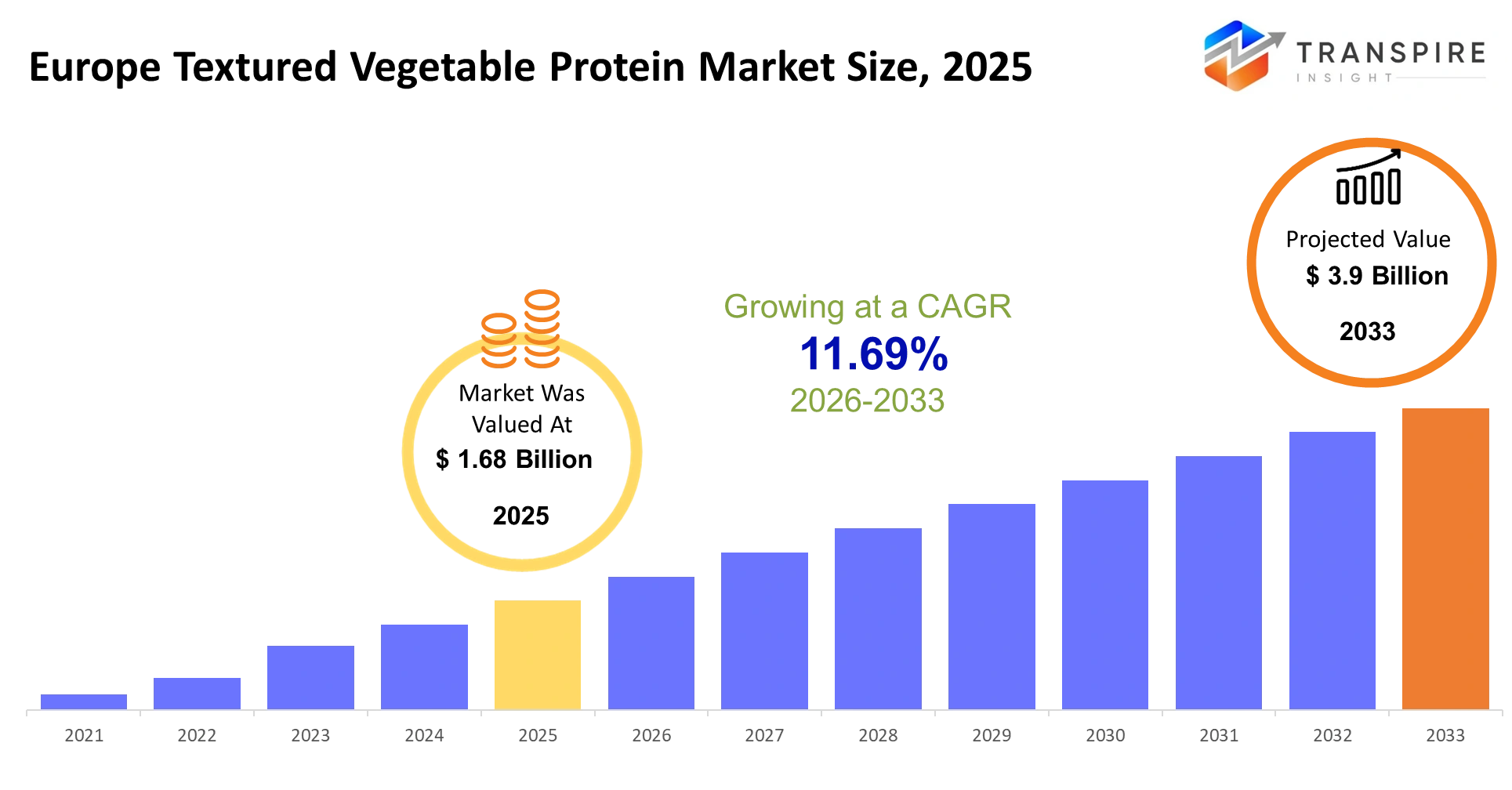
- Europe Textured Vegetable Protein Market Size 2025: USD 1.68 Billion
- Europe Textured Vegetable Protein Market Size 2033: USD 3.9 Billion
- Europe Textured Vegetable Protein Market CAGR: 11.69%
- Europe Textured Vegetable Protein Market Segments: By Source (Soy, Wheat, Pea), By Application (Meat Alternatives), By End-User (Food Industry)
To learn more about this report,  Download Free Sample Report
Europe Textured Vegetable Protein Market Summary:
Europe Textured Vegetable Protein Market size was estimated at USD 1.68 Billionin 2025 and is anticipated to reach USD 3.9 Billion by 2033, growing at a CAGR of 11.69% from 2026 to 2033.
The European textured vegetable protein market in the plant-based protein sector will serve as a response to changing dietary patterns that are developing throughout the region where consumers increasingly prefer nutritional yet cost-effective and environmentally-friendly food options.The manufacturing industry needs to change product development because younger urban groups have started to prefer different food textures and flavors that resemble traditional meat products. Retail shelves will gradually reflect this shift, with more private labels and localized flavors entering everyday consumption.
The product development process will receive new directions from product development advances that extrusion technology and ingredient processing advancements bring about because these innovations enable better management of product characteristics. European regulatory authorities will continue to establish ingredient sourcing and labeling requirements which will determine how brands choose to present their products to the market. The market for clean-label products will drive consumers to select products with fewer ingredients which show complete product origins because these features build consumer trust and create changes in product development methods.
Key Market Trends & Insights:
- The European market for textured vegetable protein will experience continuous demand growth because plant-based dining methods become more popular among residential customers and dining establishments. People will increasingly select soy, pea, and wheat protein substitutes for their daily meals because they recognize health benefits and environmental impact and ethical consumption practices.
- The European market for textured vegetable protein will experience growth because food processing technologies continue to develop methods which improve product texture and taste and nutritional content. Manufacturers will develop products which replicate meat texture to expand their use in ready-to-eat meals and snacks and frozen products while meeting customer satisfaction requirements.
- The European market for textured vegetable protein will increase through its distribution in grocery stores and its inclusion in private label products. Retail chains will increase their display areas for low-cost protein substitutes which will result in better product availability for customers. Retailers will establish price points which attract budget shoppers through their product distribution across multiple sales points.
- The European market for textured vegetable protein will experience growth because its carbon emissions remain lower than those of animal-based protein sources. Food producers will showcase their sustainability initiatives through their packaging and marketing materials.Their approach will create a market position which benefits local climate initiatives and attracts environmentally conscious customers who seek sustainable food products.
- The European market for textured vegetable protein will see increased demand because hybrid food products require plant-based protein to be mixed with meat. Food companies will use this method to decrease expenses while they create products that have balanced nutrition and maintain their current flavor profile which helps consumers move toward plant-based eating.
Europe Textured Vegetable Protein Market Segmentation
By Source :
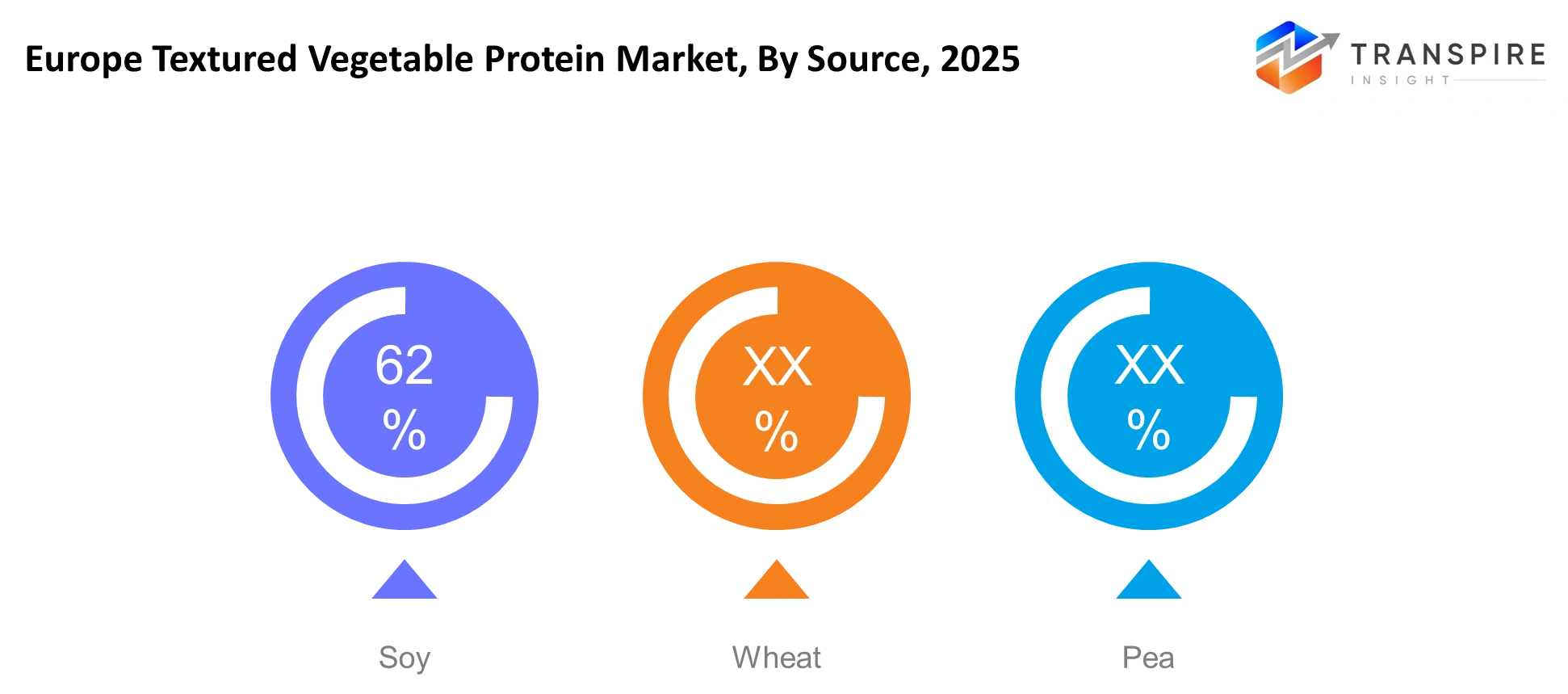
- Soy: The Europe Textured Vegetable Protein Market shows high demand for soy-based protein because it contains high protein content which is readily available. Soy remains the main raw material because existing processing methods allow for cost-effective production. Food manufacturers will keep using soy because it provides them with stable texture and taste absorption and it enables them to make products in large quantities for different food markets.
- Wheat: Wheat-based protein serves as a main segment in the Europe Textured Vegetable Protein Market because its fibrous structure enables it to create meat-like textures. Wheat protein functions as a binding agent which improves chewiness when used in mixed product formulations. The rising demand for different plant protein sources will result in sustained usage of the product although people with gluten allergies will face restrictions.
- Pea: The Europe Textured Vegetable Protein Market shows increasing popularity of pea protein because it does not cause allergic reactions and has a clean-label designation. Pea protein has a neutral flavor which allows it to be used in many different product formulations. The demand for pea protein in processed food products will increase because people want sustainable solutions that exclude soy.
To learn more about this report, Download Free Sample Report
By Application :
- Meat Alternatives: The Europe Textured Vegetable Protein Market depends on meat alternative market growth because textured protein serves as the main ingredient which recreates meat texture and structure. The increasing popularity of plant-based diets among consumers will drive product development for burgers and sausages and nuggets. The manufacturers will work on developing better flavor and mouthfeel elements which will enable their products to compete with traditional meat options.
By End-User :
- Food Industry: The Textured Vegetable Protein Market in Europe depends on the food industry because it serves as its main end-user market which drives both product development and market expansion. Food processors will integrate textured protein into ready meals, snacks, and frozen items. The industry will increase its use of plant-based convenience food because of rising consumer demand for these products.
Regional Insights
- The Europe Textured Vegetable Protein Market in Germany experiences strong demand because people want plant-based protein sources. Food manufacturers focus on clean-label and sustainable ingredients which results in sustained growth for meat alternatives. The processed food market will experience continuous growth because retail expansion and consumer health and environmental awareness increase. The Europe Textured Vegetable Protein Market in the United Kingdom sees growth because people choose vegan and flexitarian diets. Supermarkets and food chains expand their plant-based product display areas which leads to increased product usage. Changing dietary preferences and rising interest in protein-rich foods will drive demand for new ready meals and snacks.
- The French culinary tradition creates plant-based protein options to develop the Europe Textured Vegetable Protein Market. Food producers create new product combinations which deliver both taste and nutritious value to reach more customers. The government promotes sustainable food systems which encourages manufacturers to incorporate textured vegetable protein into their standard food products. The Europe Textured Vegetable Protein Market receives its influence from Italian traditional cuisine which now accepts alternative protein sources. Local producers focus on maintaining authentic flavors while introducing plant-based variations. Urban consumers and specialty food segments will gradually adopt healthful eating habits because they learn about health benefits.
- The increasing demand for sustainable and healthful food options drives growth of the Spain Europe Textured Vegetable Protein Market. The introduction of new plant-based products by foodservice restaurants and retail businesses creates both visibility and demand for these offerings. The rise in protein consumption among consumers will lead to ongoing market expansion which will particularly benefit young consumers who want easy access to healthy food options.
Recent Development News
March 2026 – Europe holds significant share in global TVP market
Recent data shows Europe accounts for approximately 27 percent of worldwide textured vegetable protein consumption which establishes Europe as one of the biggest regional markets. The UK and Germany continue to serve as vital centers for developing plant-based products.
March 2026 – Surge in plant-based meat demand fuels TVP usage
TVP demand keeps increasing throughout Europe because more people adopt flexitarian and vegan diets which lead to greater use of TVP in processed foods including burgers and sausages and ready meals. Food manufacturers are reformulating products to improve texture and taste.
|
Report Metrics |
Details |
|
Market size value in 2025 |
USD 1.68 Billion |
|
Market size value in 2026 |
USD 1.86 Billion |
|
Revenue forecast in 2033 |
USD 3.9 Billion |
|
Growth rate |
CAGR of 11.69% from 2026 to 2033 |
|
Base year |
2025 |
|
Historical data |
2021 - 2024 |
|
Forecast period |
2026 - 2033 |
|
Report coverage |
Revenue forecast, competitive landscape, growth factors, and trends |
|
Regional scope |
Europe (Germany, United Kingdom, France, Italy, Spain, Rest of Europe) |
|
Key company profiled |
ADM, Cargill, Roquette, Ingredion, Kerry, DuPont, DSM, Wilmar, CHS, Bunge, Fuji Oil, Axiom Foods, Sotexpro, Gushen, Shandong Yuxin |
|
Customization scope |
Free report customization (country, regional & segment scope). Avail customized purchase options to meet your exact research needs. |
|
Report Segmentation |
By Source (Soy, Wheat, Pea), By Application (Meat Alternatives), By End-User (Food Industry) |
Key Europe Textured Vegetable Protein Company Insights
- The Europe Textured Vegetable Protein Market shows a consistent transformation in food preferences which stems from health knowledge and sustainability values and the evolution of eating patterns. The demand for plant-based protein options shows continuous growth because consumers seek products which meet their nutritional needs while maintaining desirable taste and texture. The food industry has started to recognize textured vegetable protein as an essential ingredient because it can be used in numerous food products which include meat substitutes and ready meals and processed foods. The vegan and flexitarian populations of European countries drive market growth because they increase demand for plant-based products while existing regulatory frameworks create a supportive atmosphere for plant-based research. Food manufacturers continue to search for better processing methods which will improve product flavor and texture and nutritional value to create products that attract more customers. The market experienced growth because retailers expanded their operations and increased product distribution which enabled customers to discover new product options. The market expansion across the region has received additional support because people now understand how animal-based protein sources harm the environment which leads them to prefer plant-based alternatives.
- Leading companies in the Europe Textured Vegetable Protein Market focus on product development, strategic partnerships, and regional expansion to strengthen market position. The company works on product development to achieve better product quality through enhanced texture and taste characteristics while maintaining cost effectiveness. The company invests in research and development to produce new products which satisfy different consumer needs that include clean label and organic products. Companies are building their distribution networks to improve their market access through online platforms and physical retail outlets. Companies use competitive strategies which involve partnerships with food service companies and manufacturers to incorporate textured vegetable protein into various food items. The market players need to adapt their product offerings to changing consumer demands because this will help them maintain market relevance and product appeal against competing businesses.
Europe Textured Vegetable Protein Market Companies:
- ADM
- Cargill
- Roquette
- Ingredion
- Kerry
- DuPont
- DSM
- Wilmar
- CHS
- Bunge
- Fuji Oil
- Axiom Foods
- Sotexpro
- Gushen
- Shandong Yuxin
Europe Textured Vegetable Protein Market Segmentation
By Source
- Soy
- Wheat
- Pea
By Application
- Meat Alternatives
By End-User
- Food Industry
Frequently Asked Questions
Find quick answers to common questions.
The Approximate Europe Textured Vegetable Protein Market size for the Market will be USD 3.9 Billion in 2033.
Key Segments for the Europe Textured Vegetable Protein Market are By Source (Soy, Wheat, Pea), By Application (Meat Alternatives), By End-User (Food Industry).
Major Europe Textured Vegetable Protein Market Players are ADM, Cargill, Roquette, Ingredion, Kerry, DuPont, DSM, Wilmar, CHS, Bunge, Fuji Oil, Axiom Foods, Sotexpro, Gushen, Shandong Yuxin.
The Current Europe Textured Vegetable Protein Market size is USD 1.68 Billion in 2025.
The Europe Textured Vegetable Protein market CAGR is 11.69%.
- ADM
- Cargill
- Roquette
- Ingredion
- Kerry
- DuPont
- DSM
- Wilmar
- CHS
- Bunge
- Fuji Oil
- Axiom Foods
- Sotexpro
- Gushen
- Shandong Yuxin
Recently Published Reports
-
Apr 2026
Baby Infant Formula Market
Baby Infant Formula Market Size, Share & Analysis Report By ype (Infant Milk, Follow On Milk, Specialty Baby Milk, Growing-Up Milk), By Ingredient (Carbohydrate, Fat, Protein, Minerals, Vitamins, and Others), By Product Form (Powder, Liquid, and Ready-to-feed), By Distribution Channels (Supermarket/Hypermarket, Specialty Store, Pharmacies, Online Retail, and Others), and Geography (North America, Europe, Asia-Pacific, Middle East and Africa, South and Central America), 2021 - 2031
-
Apr 2026
Edible Insects for Animal Feed Market
Edible Insects for Animal Feed Market Size, Share & Analysis Report By Type (Insect Powder, Insect Meal, Insect Bar, Insect Paste, Insect Oil, and Others), By Insect Type (Beetles, Cricket, Caterpillar, Hymenoptera, Orthoptera, Tree Bugs, and Others), By Application (Livestock, Pet Food, and Aquaculture), By Livestock Type (Poultry, Swine, and Others), and Geography (North America, Europe, Asia-Pacific, Middle East and Africa, South and Central America), 2021 - 2031
-
Apr 2026
Food Industry Disinfection and Bacterial Control Market
Food Industry Disinfection and Bacterial Control Market Size, Share & Analysis Report By Type (Chemical Disinfectants, Physical Disinfectants, and Biocides and Antimicrobials), By Application (Food Processing Equipment Surface Disinfection, Food Preparation Areas Surface Disinfection, Storage Areas Surface Disinfection, Anti-microbial Coatings Food Preservation, and Preservative Solutions Food Preservation), By End User (Meat and Poultry Processing, Dairy Processing, Seafood Processing, Bakery and Confectionery, Restaurants and Commercial Kitchens, and Food Service Providers), By Sales Channel (Online, Offline), and Geography (North America, Europe, Asia-Pacific, Middle East and Africa, South and Central America), 2021 - 2031
-
May 2026
Freeze Dried Food Market
Freeze Dried Food Market Size, Share & Analysis Report By Product Type (Fruits, Vegetables, Freeze-Dried Dairy Products, Freeze-Dried Meat and Seafood, Freeze-Dried Pet Food, and Prepared Meal), By Nature (Organic, and Conventional), By Form (Powdered, Granules, and Diced), By End Use (Breakfast Cereals, Dairy Products, Bakery & Confectionery, Nutritional Bars & Supplements, Powdered Beverages, Snacks, and Retail (Household)), and Geography (North America, Europe, Asia-Pacific, Middle East and Africa, South and Central America), 2021 - 2031