

South Korea Insect Protein Market Size & Forecast:
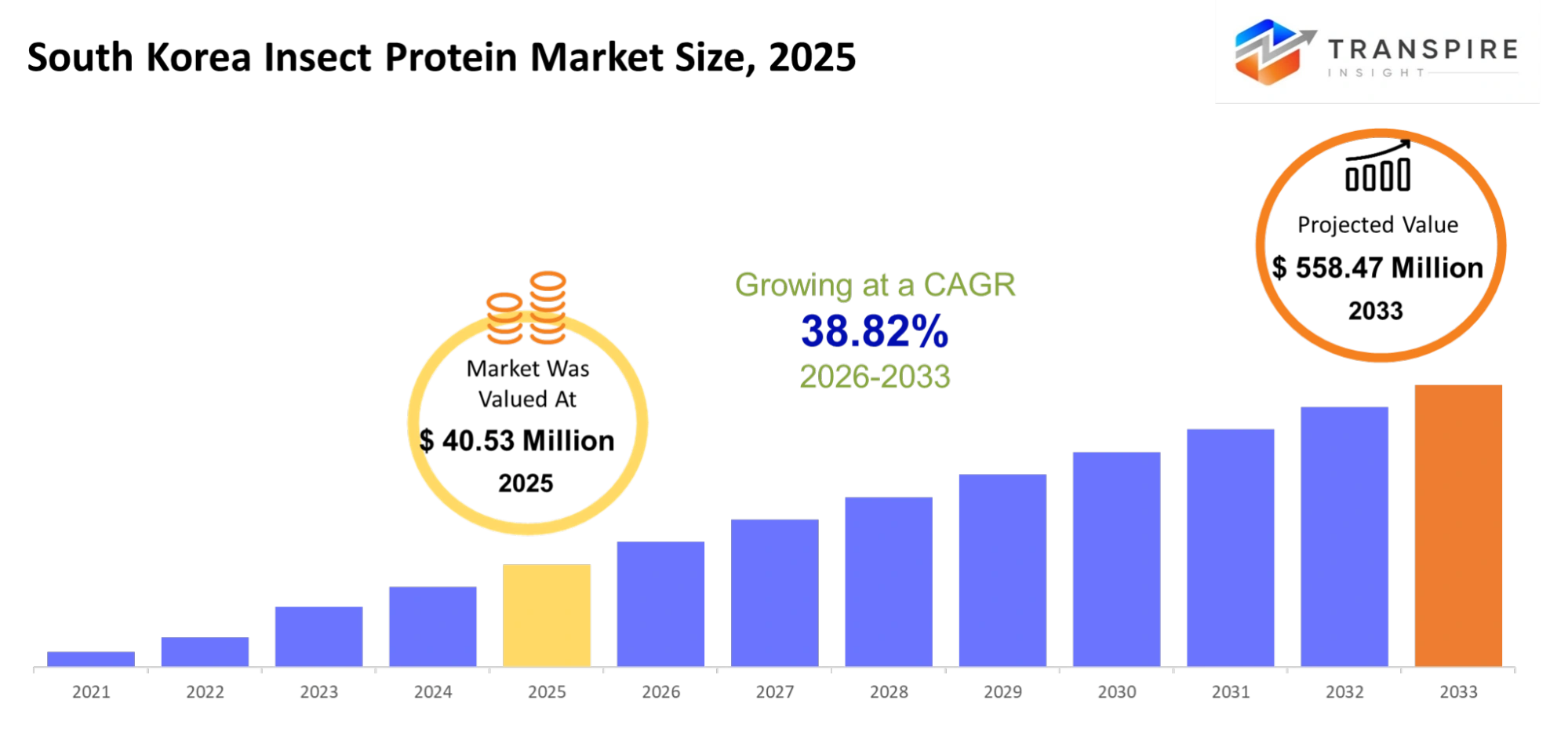
- South Korea Insect Protein Market Size 2025: USD 40.53 Million
- South Korea Insect Protein Market Size 2033: USD 558.47 Million
- South Korea Insect Protein Market CAGR: 38.82%
- South Korea Insect Protein Market Segments: By Type (Mealworms, Crickets, Black Soldier Fly, Others), By Application (Animal Feed, Food Products, Pet Food, Agriculture), By End-User (Feed Manufacturers, Food Companies, Farmers, Consumers)
To learn more about this report,  Download Free Sample Report
South Korea Insect Protein Market Summary:
The South Korea Insect Protein Market size is estimated at USD 40.53 Million in 2025 and is anticipated to reach USD 558.47 Million by 2033, growing at a CAGR of 38.82% from 2026 to 2033.
The South Korean insect protein market is developing alongside consumers' growing preference for sustainable food choices. The South Korean urban population is testing new dining habits by using cricket and mealworm products as their main ingredients. Food companies are changing their product development process because they now have better processing methods which make their products taste better and customers perceive their food as safer.
The development of automated farming systems together with advanced breeding technologies results in better production efficiency while new regulations establish approval requirements for insect-based food ingredients. The retail and foodservice industries in South Korea are developing new products because consumers now demand protein-rich foods and environmentally friendly dining options.
What Has the Impact of Artificial Intelligence Been on the South Korea Insect Protein Market?
Artificial intelligence systems are transforming the South Korean insect protein market by enabling companies to improve decision-making speed, enabling better production and distribution choices. The AI in south korea insect protein market uses advanced machine learning models to improve market research and data analysis by discovering new consumption trends and identifying factors that drive demand for alternative proteins.
The South Korean insect protein industry uses artificial intelligence to boost competitive intelligence which enables companies to track market pricing changes and customer purchasing patterns with greater precision. Smart automation systems in the South Korean insect protein market use technology to enhance operational productivity through efficient insect farming and processing and quality control procedures.
The supply chain system achieves its primary advantage through improved logistics network response times which decreased operational waste through predictive analytics. The machine learning system enables businesses to create personalized animal feed products and environmentally friendly food solutions which drive product development.
Key Market Trends & Insights:
- The South Korea insect protein market is experiencing rapid growth because the agricultural and food sectors need sustainable feed solutions and alternative protein sources.
- The South Korea insect protein market is growing because AI analytics and predictive modeling tools help businesses improve their production schedules and increase their insect farming operations.
- The South Korea insect protein market is undergoing transformation through smart automation systems which will enable the Seoul Capital Region to achieve a market share of approximately 45% by 2025 because of its advanced biotechnology facilities.
- The insect protein market in South Korea will reach its peak in 2025 when the Seoul-Gyeonggi region controls about 45% of the market because of its biotech clusters and agri-tech investments.
- The South Korean insect protein market will experience its highest growth during 2025 to 2030 because of supply collaborations that connect to Southeast Asia.
- The South Korean insect protein market receives its main support from feed-grade insect protein, which holds almost 60% market share because of high demand from aquaculture and livestock industries.
- The South Korean insect protein market for food-grade protein reaches its second largest segment because people increasingly seek sustainable nutrition solutions.
- The black soldier fly larvae protein segment experiences the fastest growth until 2030 because of its high conversion efficiency combined with its low production expenses.
- The South Korean insect protein market uses animal feed as its main application which represents more than 55 percent of both global and local market share.
- The South Korea insect protein market sees its most rapid market expansion through its aquaculture feed application because seafood consumption continues to grow.
- The South Korea insect protein market has key players which include Ÿnsect, Protix, InnovaFeed, Entobel, Nutrition Technologies, and Agronutris.
South Korea Insect Protein Market Segmentation
By Type :
Mealworms and crickets and black soldier fly larvae serve as essential insect protein sources which enable South Korea to maintain sustainable protein resources for its food and animal feed sectors. The demand for alternative protein sources has created consistent expansion throughout the agricultural and food processing sectors.
Mealworms offer high protein content and simple rearing conditions, crickets support quick growth cycles with efficient feed conversion, and black soldier fly larvae help convert organic waste into usable protein, supporting circular production systems across multiple industries.
By Application :
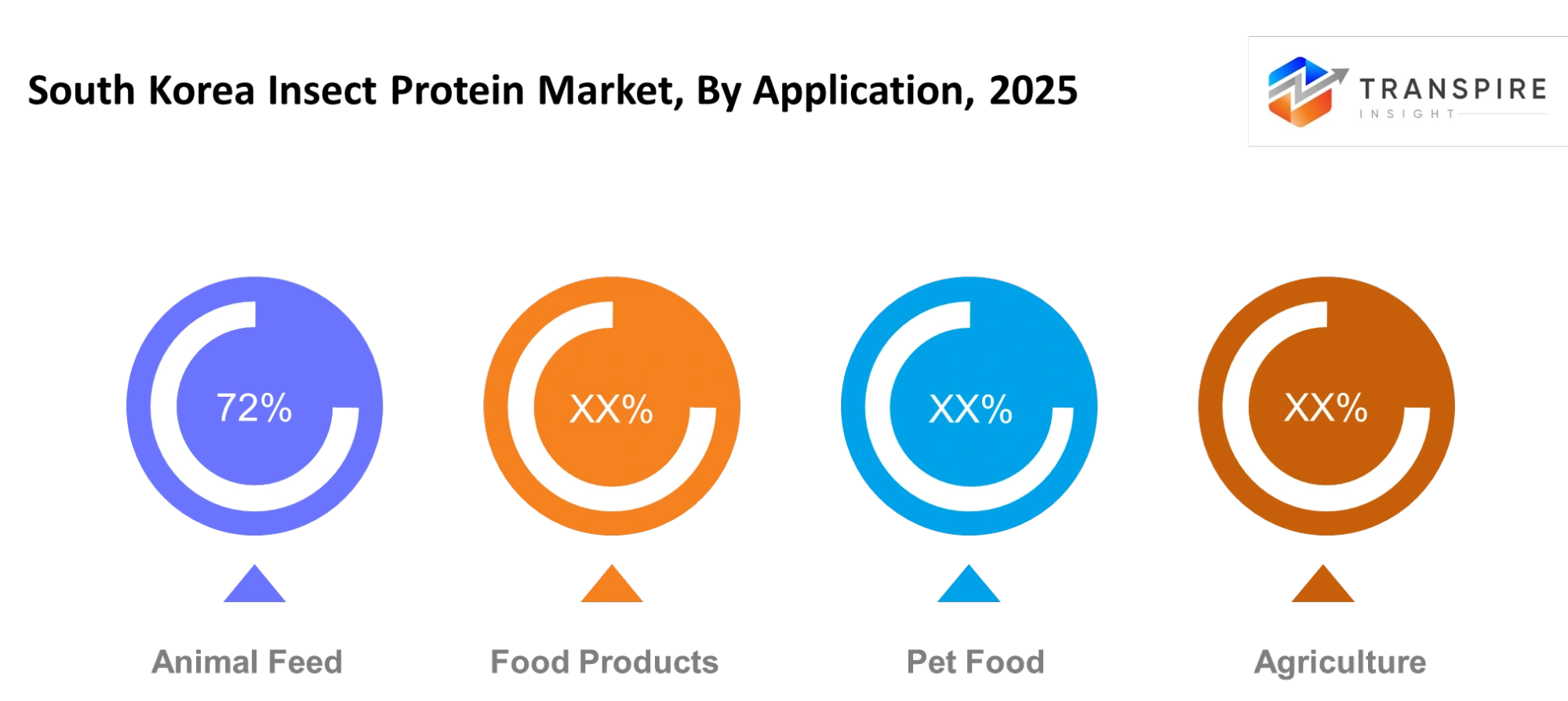
Animal feed remains the main application area, with insect protein used in poultry and aquaculture feed across South Korea livestock systems. Demand increases due to the need for efficient and sustainable protein alternatives.
Food products use insect protein as a nutrition-rich ingredient in processed items, pet food gains value from easy digestion and protein density, and agriculture uses insect-based outputs for soil improvement and organic input support in farming practices.
To learn more about this report, Download Free Sample Report
By End-User :
The Feed manufacturers utilize insect protein as a substitute for fish meal and soy-based ingredients which they use to feed livestock across South Korea. The new practice enables feed producers to achieve cost savings while ensuring continuous access to protein supplies needed for their operations.
Food companies create insect-based ingredients which they use to develop new product lines while farmers use insect solutions to create circular farming systems and consumers choose insect protein as a sustainable dietary option which helps maintain long-term food security and environmental balance.
What are the Main Challenges for the South Korea Insect Protein Market Growth?
The South korea insect protein market is facing notable technical and operational challenges that slow large-scale commercialization. One key issue is maintaining product stability and nutritional quality throughout different insect species and production cycles in the south korea insect protein market. The scalability process becomes more difficult because of three factors which include raw material input variability and environmental condition sensitivity and biological growth cycle complexity.
The South korea insect protein market faces manufacturing and commercialization challenges because production costs are too high and food safety standards and GMP compliance requirements create strict regulatory barriers that must be met. The South Korea insect protein market experiences delayed commercial development because there are no standard processing methods and current regulatory guidelines do not provide sufficient clarity which creates risk for investors while delaying project development.
The south korea insect protein market faces adoption challenges because there are not enough operational facilities and there is a lack of trained personnel who understand insect farming and bioconversion technologies. The funding gaps that affect mid-scale producers create obstacles which limit their ability to develop new products and grow their businesses. The limited knowledge base which end users possess about the product prevents acceptance of the product as a food and feed source.
The south korea insect protein market faces additional growth restrictions because plant-based proteins and synthetic alternatives create competitive threats. Price competitiveness remains a key concern because emerging technologies lead to cost reductions for competing protein sectors. The south korea insect protein market will experience market stabilization impacts from both regulatory changes and technological threats.
Country Insights
The South Korean insect protein market develops because people look for alternative protein sources which they can use in food and animal feed. People select insect-based ingredients because they seek sustainable nutritional solutions which produce reduced environmental impacts. Food manufacturers and animal feed producers prefer insect protein because it provides them with operational efficiency and dependable product supply.
The South Korean population shows increased interest in insect protein through its urban centers which serve as hubs for culinary research. The cities of Seoul and Busan show higher rates of sustainable food option adoption because residents understand current dietary patterns and eco-friendly food choices. Insect protein is being evaluated by local startups and food manufacturers through their experiments with snacks and supplements and animal feed solutions.
The rising demand for waste reduction and circular food systems creates a supportive environment for the market. The government together with research organizations supports the development of alternative protein sources which enables small businesses to increase their production capabilities.Rural areas contribute through insect farming activities that supply raw materials to processing units in major industrial zones.
Market expansion will keep proceeding because consumer acceptance and food service business acceptance of products will take time to reach their full potential. The growing availability of products through retail channels and their increasing product assortment will lead to sustained expansion throughout South Korea's various territories.
Recent Development News
In March 2026, Entomo Farms expanded its Asia-Pacific insect protein export program, strengthening supply chains for South Korea feed and food ingredient manufacturers. The company increased distribution of cricket-based protein ingredients to Korean alternative protein processors amid rising regional demand.
Source https://entomofarms.com/
In March 2026, CJ CheilJedang declared that it will expand its research development program for alternative proteins by developing insect-based protein research. The company built up its biotechnology research capabilities to create insect-based protein products which can be used in animal feed and blended food solutions that will be offered in South Korea.
Source https://www.cj.co.kr/
|
Report Metrics |
Details |
|
Market size value in 2025 |
USD 40.53 Million |
|
Market size value in 2026 |
USD 56.22 Million |
|
Revenue forecast in 2033 |
USD 558.47 Million |
|
Growth rate |
CAGR of 38.82% from 2026 to 2033 |
|
Base year |
2025 |
|
Historical data |
2021 - 2024 |
|
Forecast period |
2026 - 2033 |
|
Report coverage |
Revenue forecast, competitive landscape, growth factors, and trends |
|
Regional scope |
United States; Canada; Mexico; United Kingdom; Germany; France; Italy; Spain; Denmark; Sweden; Norway; China; Japan; India; Australia; South Korea; Thailand; Brazil; Argentina; South Africa; Saudi Arabia; United Arab Emirates |
|
Key company profiled |
Insect, Protix, InnovaFeed, Entomo Farms, Aspire Food Group, Beta Hatch, Hexafly, EnviroFlight, AgriProtein, Loopworm, Tebrio, Bugsolutely, Jimini’s, Kreca, MealFood Europe |
|
Customization scope |
Free report customization (country, regional & segment scope). Avail customized purchase options to meet your exact research needs. |
|
Report Segmentation |
By Type (Mealworms, Crickets, Black Soldier Fly, Others), By Application (Animal Feed, Food Products, Pet Food, Agriculture), By End-User (Feed Manufacturers, Food Companies, Farmers, Consumers) |
How Can New Companies Establish a Strong Foothold in the South Korea Insect Protein Market?
New companies can create successful businesses in the South Korean insect protein market by developing specialized products for aquaculture feed and pet nutrition and environmentally friendly food components. Companies in the South Korean insect protein market need to identify specific high-growth sub-segments that allow them to compete against major market players while meeting particular customer needs for protein alternatives. Startups can use innovative methods such as precision insect farming and AI-based bioconversion systems to enhance their production capabilities while decreasing their business expenses.
The South Korean insect protein market requires strategic partnerships for success which should include feed manufacturers and biotech companies and research organizations as essential partners. South Korean startups that want to develop black soldier fly farming operations should team up with aquaculture businesses to help them cope with increasing feed expenses in the South Korean insect protein market.
The South Korean insect protein market requires companies to use different technological solutions which include smart automation and machine learning-based quality control and production optimization through predictive analytics for their long-term market position. The combination of sustainability objectives and smart city projects will improve an organization's market entry success rate.
Key South Korea Insect Protein Market Company Insights
The South Korea insect protein market experiences continuous growth because people increasingly demand alternative protein sources for both human consumption and animal feed. The agricultural and aquaculture and food processing industries now incorporate insect-based ingredients because consumers prefer sustainable nutritional options that minimize environmental impact.
Market Drivers: The market experiences strong growth because three factors drive demand including rising feed protein costs and sustainability regulations and increasing circular economy interest. The use of insect protein in animal feed and specialty food products comes from two factors which include food security worries and high-protein ingredient demand. Farmers now achieve better production results because technological advancements enable them to raise insects more effectively and at lower costs.
The three factors, which include high production costs and insufficient large-scale farming facilities and uncertain regulatory environments prevent businesses from expanding their operations. People need more information about insect-based protein products because they do not understand these products which leads to lower acceptance of these products in traditional food markets. The two factors of supply chain challenges and hygiene requirements create extra difficulties which prevent businesses from achieving steady production and growth in different market sectors.
The competitive environment includes both new biotechnology companies and food technology firms which develop insect protein production systems that can be used at larger scales. The company uses three main methods for its operations which include forming strategic alliances and increasing production facilities and developing new products. The company invests in automated systems and breeding technologies which help reduce expenses while increasing protein production throughout its supply networks that serve the growing market demand.
Company List
- Insect
- Protix
- InnovaFeed
- Entomo Farms
- Aspire Food Group
- Beta Hatch
- Hexafly
- EnviroFlight
- AgriProtein
- Loopworm
- Tebrio
- Bugsolutely
- Jimini’s
- Kreca
- MealFood Europe
What are the Key Use-Cases Driving the Growth of South Korea Insect Protein Market?
The South Korea insect protein market receives strong vitality because multiple industries choose to use sustainable protein solutions which deliver high efficiency across their various operational needs. The rising demand for eco-friendly feed solutions together with circular economy practices drives the increased adoption of insect-based ingredients within aquaculture and livestock and pet nutrition markets. The South Korea insect protein market enables companies to use insect protein as a cost-efficient alternative to fishmeal and soy-based feed which leads to better nutritional results and better environmental protection.
The south korea insect protein market exhibits strong growth through its primary application in aquaculture feed production which uses insect protein to boost fish growth while decreasing the need for ocean fisheries. The livestock sector also represents a significant application area, as poultry and swine producers adopt insect-derived feed to improve protein intake and reduce feed cost volatility. The South Korea insect protein market now extends its reach into premium pet food products which depend on high digestibility and natural protein content as their main value elements.
The South Korea insect protein market gains new growth opportunities through food innovation and nutraceuticals which create new applications beyond agriculture. Companies explore insect protein powders and functional ingredients to develop health-focused consumer products because of rising interest in alternative proteins. Industrial-scale manufacturers utilize smart automation with machine learning technologies to improve their production processes which enables them to achieve better product quality and operational efficiency.
South Korea Insect Protein Market Report Segmentation
By Type
- Mealworms
- Crickets
- Black Soldier Fly
By Application
- Animal Feed
- Food Products
- Pet Food
- Agriculture
By End-User
- Feed Manufacturers
- Food Companies
- Farmers
- Consumers
Frequently Asked Questions
Find quick answers to common questions.
The approximate South Korea Insect Protein Market size for the market will be USD 558.47 Million in 2033.
Key segments for the South Korea Insect Protein Market are By Type (Mealworms, Crickets, Black Soldier Fly, Others), By Application (Animal Feed, Food Products, Pet Food, Agriculture), By End-User (Feed Manufacturers, Food Companies, Farmers, Consumers).
Major South Korea Insect Protein Market players are Insect, Protix, InnovaFeed, Entomo Farms, Aspire Food Group, Beta Hatch, Hexafly, EnviroFlight, AgriProtein, Loopworm, Tebrio, Bugsolutely, Jimini’s, Kreca, MealFood Europe.
The South Korea Insect Protein Market size is USD 40.53 Million in 2025.
The South Korea Insect Protein Market CAGR is 38.82%.
- Insect
- Protix
- InnovaFeed
- Entomo Farms
- Aspire Food Group
- Beta Hatch
- Hexafly
- EnviroFlight
- AgriProtein
- Loopworm
- Tebrio
- Bugsolutely
- Jimini’s
- Kreca
- MealFood Europe
Recently Published Reports
-
Apr 2026
Baby Infant Formula Market
Baby Infant Formula Market Size, Share & Analysis Report By ype (Infant Milk, Follow On Milk, Specialty Baby Milk, Growing-Up Milk), By Ingredient (Carbohydrate, Fat, Protein, Minerals, Vitamins, and Others), By Product Form (Powder, Liquid, and Ready-to-feed), By Distribution Channels (Supermarket/Hypermarket, Specialty Store, Pharmacies, Online Retail, and Others), and Geography (North America, Europe, Asia-Pacific, Middle East and Africa, South and Central America), 2021 - 2031
-
Apr 2026
Edible Insects for Animal Feed Market
Edible Insects for Animal Feed Market Size, Share & Analysis Report By Type (Insect Powder, Insect Meal, Insect Bar, Insect Paste, Insect Oil, and Others), By Insect Type (Beetles, Cricket, Caterpillar, Hymenoptera, Orthoptera, Tree Bugs, and Others), By Application (Livestock, Pet Food, and Aquaculture), By Livestock Type (Poultry, Swine, and Others), and Geography (North America, Europe, Asia-Pacific, Middle East and Africa, South and Central America), 2021 - 2031
-
Apr 2026
Food Industry Disinfection and Bacterial Control Market
Food Industry Disinfection and Bacterial Control Market Size, Share & Analysis Report By Type (Chemical Disinfectants, Physical Disinfectants, and Biocides and Antimicrobials), By Application (Food Processing Equipment Surface Disinfection, Food Preparation Areas Surface Disinfection, Storage Areas Surface Disinfection, Anti-microbial Coatings Food Preservation, and Preservative Solutions Food Preservation), By End User (Meat and Poultry Processing, Dairy Processing, Seafood Processing, Bakery and Confectionery, Restaurants and Commercial Kitchens, and Food Service Providers), By Sales Channel (Online, Offline), and Geography (North America, Europe, Asia-Pacific, Middle East and Africa, South and Central America), 2021 - 2031
-
May 2026
Freeze Dried Food Market
Freeze Dried Food Market Size, Share & Analysis Report By Product Type (Fruits, Vegetables, Freeze-Dried Dairy Products, Freeze-Dried Meat and Seafood, Freeze-Dried Pet Food, and Prepared Meal), By Nature (Organic, and Conventional), By Form (Powdered, Granules, and Diced), By End Use (Breakfast Cereals, Dairy Products, Bakery & Confectionery, Nutritional Bars & Supplements, Powdered Beverages, Snacks, and Retail (Household)), and Geography (North America, Europe, Asia-Pacific, Middle East and Africa, South and Central America), 2021 - 2031