

Middle East and Africa Animal Parasiticides Market Size & Forecast:
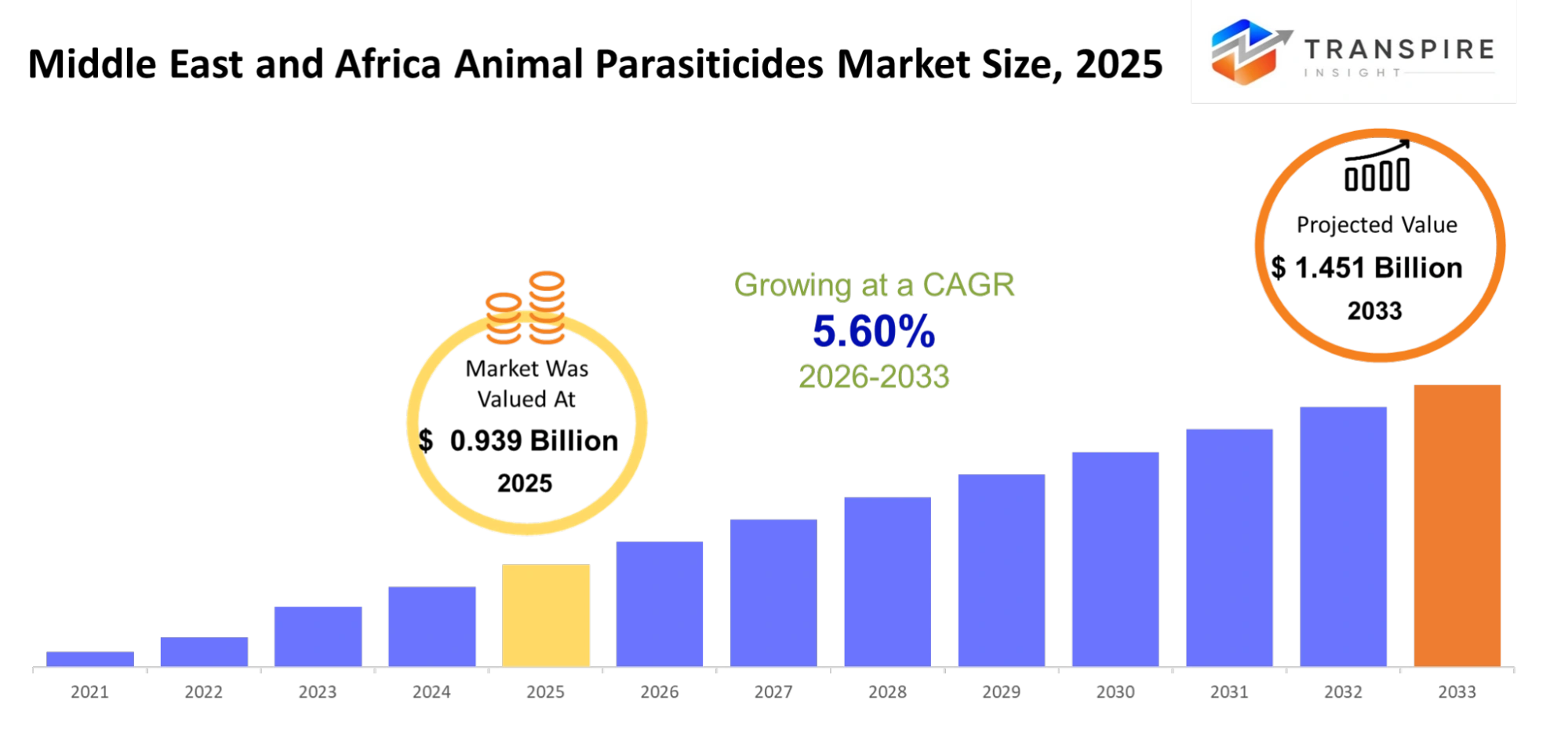
- Middle East and Africa Animal Parasiticides Market Size 2025: USD 0.939 Billion
- Middle East and Africa Animal Parasiticides Market Size 2033: USD 1.451 Billion
- Middle East and Africa Animal Parasiticides Market CAGR: 5.60%
- Middle East and Africa Animal Parasiticides Market Segments: By Product (Ectoparasiticides, Endoparasiticides, Endectocides), By Animal Type (Livestock, Companion, Aquaculture), By Mode (Topical, Oral, Injectable), By End-User (Veterinary Clinics, Farms, Pet Owners, Animal Hospitals)
To learn more about this report,  Download Free Sample Report
Middle East and Africa Animal Parasiticides Market Summary:
The Middle East and Africa Animal Parasiticides Market size is estimated at USD 0.939 Billion in 2025 and is anticipated to reach USD 1.451 Billion by 2033, growing at a CAGR of 5.60% from 2026 to 2033. The market for animal parasiticides in the Middle East and Africa which includes Saudi Arabia and the United Arab Emirates and South Africa and the Rest of Middle East and Africa will follow the changes in pet ownership and livestock management methods because it operates within the veterinary pharmaceuticals sector. The increasing demand from these regions will show a preference for preventive animal care instead of treating existing problems through veterinary services as commercial farming operations expand and urban pet populations increase. The new regulations which government agencies will establish about residue control and import processes will require manufacturers to develop products that maintain safer chemical profiles. The adoption of digital veterinary services together with precision dosing technologies will change how customers make purchases because these technologies will deliver more precise data-based treatment solutions that meet current animal health standards.
Key Market Trends & Insights:
The livestock economics transformation, which affects Saudi Arabia and the UAE and South Africa, will drive producers to implement structured parasite control systems. Scheduled treatments and monitoring systems will support large-scale farms in maintaining herd productivity, while smaller operators will start joining organized veterinary networks. The transition will require suppliers to create dosage formats that farmers can use across various farming environments, which includes developing heat-stable solutions that work in arid regions.
Pet ownership will continue rising in urban centers such as Dubai, Riyadh, and Johannesburg, which creates demand for products that provide both convenient and preventive pet health care. The increase of monthly treatment preferences will drive pet owners to select combination therapies, together with products that provide parasite protection and overall pet health benefits. Retail channels will expand beyond clinics, as online veterinary platforms and pet care marketplaces create new buying methods, which help brands establish differentiation through product safety and user-friendliness and effectiveness that customers can see.
Technological advancements will increasingly determine how products are developed and distributed throughout various markets. Manufacturers will invest in long-acting formulations and wearable monitoring tools and data-backed treatment protocols which veterinarians will use to monitor parasite exposure risks. The industry will see two developments when cold-chain systems improve and localized production partnerships establish local facilities that maintain consistent supply chains to remote areas. The new developments will lead to diminished reliance on imported stock while they enhance accessibility to underserved areas.
The regulatory focus will increase on monitoring chemical residues found in animal products and assessing environmental hazards. The regional authorities will implement more stringent approval processes and labeling rules which will motivate companies to develop products with reduced toxic substances and enhanced biodegradable properties. The market will show increased demand for plant-based products and biologically derived alternatives due to this transformation. Companies will establish their main focus on compliance through enhanced transparency while they allocate resources to conduct local trials which will help them achieve new safety regulations.
Middle East and Africa Animal Parasiticides Market Segmentation
By Product
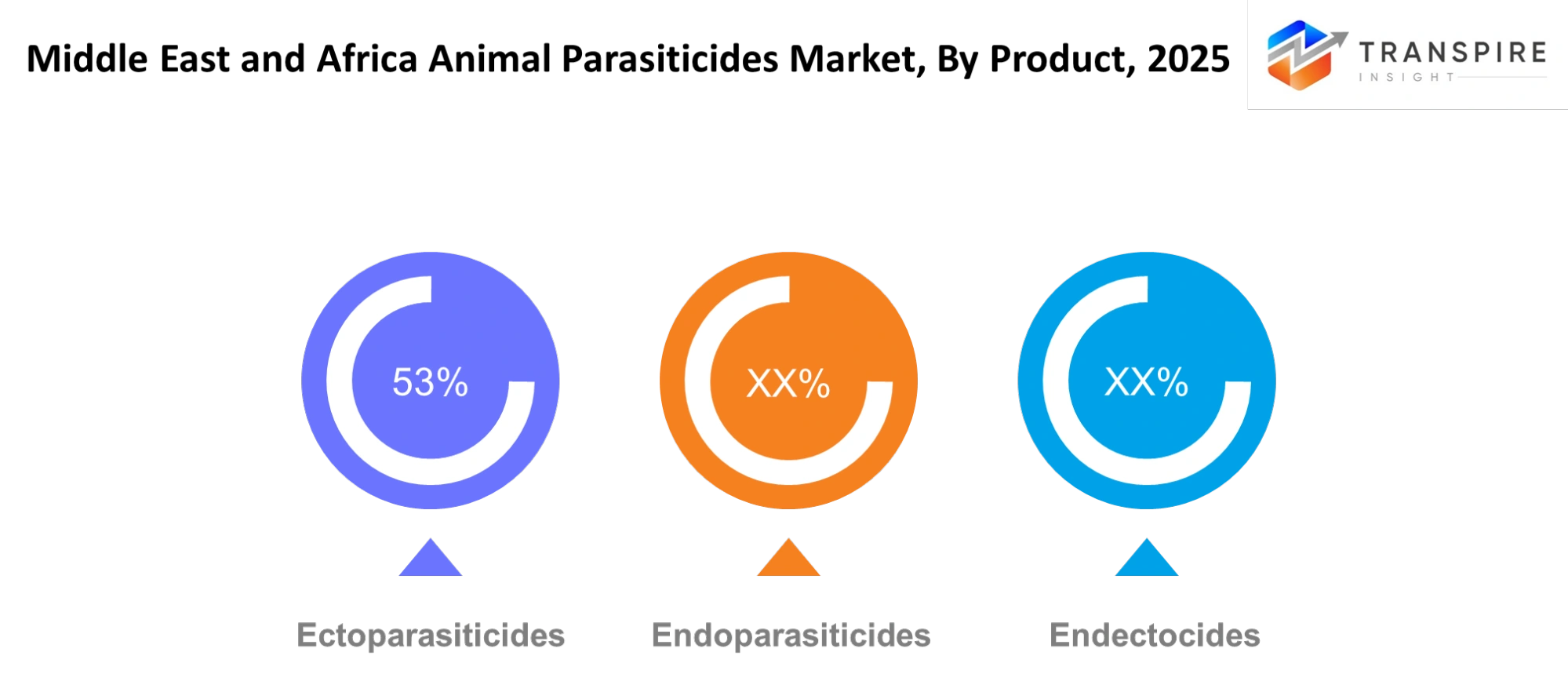
Ectoparasiticides- Ectoparasiticides will be used extensively to control external parasites which include ticks and fleas and mites that attack animal skin and their external health. The hot climate areas of Saudi Arabia and African regions will experience continuous presence of external parasites which will require multiple treatment cycles throughout the year. Manufacturers will create skin-safe products that protect skin from irritation while delivering effective results. The spray and spot-on and collar-based formats will become popular because they provide simple solutions which both livestock handlers and urban pet owners can use.
Endoparasiticides- Endoparasiticides will treat internal parasites which disrupt animal digestion and immunity and productivity. Livestock farmers will increasingly depend on these treatments to maintain feed efficiency and reduce disease-related losses. People will become more alert about the need to implement scheduled deworming processes in contrast to using deworming treatments at random times. Pharmaceutical companies will create targeted products which prevent resistance development while ensuring their products will stay effective through increased safety standards which regulators and food supply chains will require.
Endectocides- Endectocides will provide animal health management through a solution which controls both internal and external parasites. Their dual-action feature will attract large-scale farms which want to decrease their operational time while making their work easier. These products will develop into more advanced forms which provide longer protection times and need fewer uses. Farmers will start using the product because it provides an affordable way to control parasites while achieving dependable results in different weather conditions.
To learn more about this report, Download Free Sample Report
By Animal Type
Livestock- The primary focus of livestock research exists because this field directly supports both food production and economic stability throughout the region. The farmers will make parasite control their main concern because this process helps them achieve better weight gains and increases milk production while improving their entire herd performance. The expansion of intensive farming methods will create additional requirements for farmers to conduct their pesticide treatments on a regular basis. The agricultural industry will move towards preventive healthcare systems which will lead to farms treating parasites as part of their daily operations rather than waiting until outbreaks become apparent.
Urban areas- Cities will see an increase in demand for pet care as there will be an increase in pet adoption. The cost of pet services related to parasite control will rise due to the need for comfort and long-term health maintenance. The market will show a preference for products that are simple to use like chewable tablets and spot-on solutions. Pet owners will choose products based on their emotional attachment to pets while safety brand trust and veterinary recommendations will determine their buying choices.
Aquaculture- Parasite control for aquaculture needs special measures since this industry is done in water and relies on the presence of clean water. The fish farmers will resort to eco-friendly ways of treating their fish without causing any damage to the environment or water bodies around. This study will focus on finding effective dosage techniques and environmental-friendly solutions. The growing demand for fish farming in coastal and inland regions will require parasites management because it helps sustain fish health and meets export standards.
By Mode
Topical- The two-dimensional nature of topical therapies allows them to maintain their widespread appeal because they enable straightforward application onto the animal's skin. The industry will use sprays and dips and spot-on solutions as primary treatments for pets and smaller livestock. The treatments provide immediate parasite control which establishes them as standard solutions for everyday operations. The manufacturers will develop products that improve absorption rates while decreasing residue levels which results in better performance for animals during warm humid weather conditions.
Oral- Oral parasiticides will gain traction due to their convenience and precise dosing. The different product formats of tablets and powders and liquid forms will simplify administration for both pets and managed livestock. The products establish systemic defense mechanisms which enable them to attack internal and selected external parasites. The veterinary professionals will recommend oral solutions because they deliver effective results while minimizing application stress; these solutions work best in controlled environments which enable accurate dosage delivery.
Injectable- The medical field prefers to use injectable solutions because they provide both instant effects and extended protection. The agricultural industry and veterinary clinics depend on these treatments to control both severe parasite outbreaks and large-scale animal operations. The products deliver uniform absorption patterns which extend their protective effects thus decreasing the requirement for product reapplication. The products require only trained staff for administration which leads to their use in organized environments instead of informal pet treatment locations.
By End-User
Veterinary Clinics- Veterinary clinics will be at the forefront of making prescription and providing guidance on parasite control treatment. Owners of domestic animals will rely more on veterinary expertise when choosing the right products. Clinics will also serve as distribution points for high-quality formulations. Veterinarians will focus on preventive care programs which include regular check-ups and tailored treatment schedules for each specific animal requirement as public awareness about health issues increases.
Farms- Farms The farming industry will become the largest user group because of its extensive livestock farming operations. Farmers will include parasite control methods into their standard herd management procedures to protect their herd productivity. The buyers will select their products based on two factors which include their ability to buy in bulk and their ability to save money. The agricultural industry will move towards data-driven methods which use treatment schedules based on seasonal parasite patterns and environmental factors to achieve superior results.
Pet Owners- Pet Owners Urban pet owners will begin to assume responsibility for their pets' parasite prevention needs. The market will be dominated by products which pet owners can use to treat their pets without needing professional help. Consumers will learn about the need for consistent protection through two main channels which include awareness campaigns and digital platforms. The factors that will determine purchasing decisions include product accessibility, brand trustworthiness, and veterinarian or online community recommendations.Decision-making factors include the availability of products, trust in brands, and recommendations from veterinarians or online communities.
Animal Hospitals- Advanced Parasite Control Animal hospitals treating difficult cases will require advanced methods of parasite control. Animal Hospitals Advanced parasite control methods will become necessary for animal hospitals that treat complicated medical situations. The medical center will use diagnostic methods and focused therapies to treat patients with serious health problems. This environment will see an increase in the use of injectable medications and specialized medical treatments. The hospitals will participate in both clinical research activities and the establishment of standardized medical treatment protocols.
Regional Insights
The desert climate of Saudi Arabia together with its growing livestock industry will determine the country's methods for controlling parasites. Structured health management practices will enable camel, sheep, and poultry farming operations to maintain their production during extreme weather conditions. Veterinary authorities will establish enhanced monitoring systems which will promote the proper usage of veterinary products. Farmers will gradually adopt preventive routines, supported by improved access to veterinary services and better awareness around disease transmission linked to parasites.
People in the United Arab Emirates will show a preference for urban-based consumption patterns which will drive their need for companion animal services. Pet owners will select between treatment options, which include modern clinic treatments and digital platform treatments because they prefer solutions that provide both safety and convenience. The government will maintain strict regulatory control which ensures that imported products meet high-quality standards. The country's advanced retail infrastructure will support multiple distribution methods which enable professional and personal customer access to parasite control products.
South Africa sustains equal demand for livestock and companion animals because of its established veterinary system. Large commercial farms will protect their productivity through planned parasite control methods whereas smaller farms will proceed to implement organized farming methods. The veterinary organizations together with research institutions will develop better treatment protocols. The ongoing efforts will improve supply chains and outreach services although rural areas face accessibility challenges.
The Middle East and Africa region will show multiple regional differences which include different public understanding and different system development. Affordable and effective animal treatments will drive demand because livestock remains essential for survival in multiple African regions. The educational efforts about parasite control will receive backing from both government bodies and non-profit organizations. The development of distribution systems together with veterinary resources will make animal healthcare methods more accessible which will create opportunities for veterinarians to implement both standard and preventive healthcare methods.
Recent Development News
Expansion of Veterinary Partnerships in Saudi Arabia
Date: February 2026
Saudi Arabia developed closer ties between its veterinary government agencies and foreign animal health companies to enhance control of livestock parasites. The initiatives will establish improved surveillance systems and regulated drug distribution methods for operations that operate at extensive agricultural sites. The move will also encourage standardized treatment protocols, which will result in safer food production and better animal health. The partnerships will establish new product quality standards, which will result in more responsible parasiticide usage throughout the country.
Rise of Companion Animal Healthcare Platforms in UAE
Date: January 2026
The UAE has seen increased investment in digital veterinary platforms which provide home delivery of parasite treatments and online veterinary consultations. The urban population shift and rising pet ownership rates have caused this transformation. Consumers are choosing subscription-based preventive care plans that include regular parasite protection. The development will reshape distribution channels because it will create new pathways to advanced companion animal treatments which extend beyond traditional clinic services.
Research Advancements in Sub-Saharan Africa Parasite Control
Date: March 2026
New clinical trials across Sub-Saharan Africa are exploring improved dosing strategies for parasite infections in animals, aiming to enhance safety and treatment outcomes. Researchers are testing adaptive methods to identify optimal dosage levels more efficiently. These developments will support better disease control in livestock-dependent communities and may lead to more precise and cost-effective treatment options across the wider African region.
|
Report Metrics |
Details |
|
Market size value in 2025 |
USD 0.939 Billion |
|
Market size value in 2026 |
USD 0.991 Billion |
|
Revenue forecast in 2033 |
USD 1.451 Billion |
|
Growth rate |
CAGR of 5.60% from 2026 to 2033 |
|
Base year |
2025 |
|
Historical data |
2021 – 2024 |
|
Forecast period |
2026 – 2033 |
|
Report coverage |
Revenue forecast, competitive landscape, growth factors, and trends |
|
Country scope |
Middle East and Africa (Saudi Arabia, United Arab Emirates, South Africa, Rest of Middle East and Africa) |
|
Key company profiled |
Zoetis, Merck Animal Health, Elanco, Boehringer Ingelheim, Bayer, Virbac, Ceva Santé, Vetoquinol, Dechra, Norbrook, Phibro, Neogen, Kemin, HIPRA, Huvepharma |
|
Customization scope |
Free report customization (country, regional & segment scope). Avail customized purchase options to meet your exact research needs. |
|
Report Segmentation |
By Product (Ectoparasiticides, Endoparasiticides, Endectocides), By Animal Type (Livestock, Companion, Aquaculture), By Mode (Topical, Oral, Injectable), By End-User (Veterinary Clinics, Farms, Pet Owners, Animal Hospitals) |
Key Middle East and Africa Animal Parasiticides Market Company Insights
The Middle East and Africa animal parasiticides market which spans Saudi Arabia, United Arab Emirates, South Africa, and other Middle Eastern and African territories will be dominated by international veterinary pharmaceutical companies that include Zoetis, Elanco, Merck & Co., Boehringer Ingelheim, and Ceva Santé Animale and their respective regional distributors and local emerging manufacturers. The companies will expand their operations through establishing strategic partnerships and developing local supply networks and creating customized product lines. The research will develop new products which provide improved safety and extended effectiveness, while African countries with limited domestic production capabilities will depend on imports and joint manufacturing solutions to maintain steady product availability.
Company List
- Zoetis
- Merck Animal Health
- Elanco
- Boehringer Ingelheim
- Bayer
- Virbac
- Ceva Santé
- Vetoquinol
- Dechra
- Norbrook
- Phibro
- Neogen
- Kemin
- HIPRA
- Huvepharma
Middle East and Africa Animal Parasiticides Market Report Segmentation
By Product
- Ectoparasiticides
- Endoparasiticides
- Endectocides
By Animal Type
- Livestock
- Companion
- Aquaculture
By Mode
- Topical
- Oral
- Injectable
By End-User
- Veterinary Clinics
- Farms
- Pet Owners
- Animal Hospitals
Frequently Asked Questions
Find quick answers to common questions.
The approximate Middle East and Africa Animal Parasiticides Market size for the market will be USD 1.451 Billion in 2033.
Key segments for the Middle East and Africa Animal Parasiticides Market By Product (Ectoparasiticides, Endoparasiticides, Endectocides), By Animal Type (Livestock, Companion, Aquaculture), By Mode (Topical, Oral, Injectable), By End-User (Veterinary Clinics, Farms, Pet Owners, Animal Hospitals).
Major players in the Middle East and Africa Animal Parasiticides Market are Zoetis, Merck Animal Health, Elanco, Boehringer Ingelheim, Bayer, Virbac, Ceva Santé, Vetoquinol, Dechra, Norbrook, Phibro, Neogen, Kemin, HIPRA, Huvepharma.
The Middle East and Africa Animal Parasiticides Market size is USD 0.939 Billion in 2025.
The Middle East and Africa Animal Parasiticides Market CAGR is 5.60%.
- Zoetis
- Merck Animal Health
- Elanco
- Boehringer Ingelheim
- Bayer
- Virbac
- Ceva Santé
- Vetoquinol
- Dechra
- Norbrook
- Phibro
- Neogen
- Kemin
- HIPRA
- Huvepharma
Recently Published Reports
-
May 2026
Biosimilars Market
Biosimilars Market By Product Type (Monoclonal Antibodies, Recombinant Hormones, Erythropoietin, G-CSF, Others), By Indication (Oncology, Autoimmune Diseases, Blood Disorders, Diabetes, Others), By Manufacturing Type (In-House Manufacturing, Contract Manufacturing), By Distribution Channel (Hospital Pharmacies, Retail Pharmacies, Online Pharmacies), By Industry Analysis, Size, Share, Growth, Trends, and Forecasts 2021-2033
-
Apr 2026
Gastrointestinal Endoscopy Market
Gastrointestinal Endoscopy Market By Type (Rigid Gastrointestinal Endoscope, Flexible Gastrointestinal Endoscopes, Disposable Gastrointestinal Endoscope), By Procedure Type (Colonoscopy, Gastroscopy, Duodenoscopy, Enteroscopy, Flexible Sigmoidoscopy, Others), By Application (Diagnosis, Treatment), By End-Users (Hospitals, Ambulatory Surgical Centers, Specialty Clinics, Laboratories, Others), By Industry Analysis, Size, Share, Growth, Trends, and Forecasts 2021-2033
-
Apr 2026
Rare Inherited Metabolic Disorder Drug Market
Rare Inherited Metabolic Disorder Drug Market By Drug Class (Enzyme Replacement Drugs, Gene Therapy Drugs, Substrate Reduction Drugs, Small Module Drugs, Protein Drugs), By Route of Administration(Parenteral, Oral, Intrathecal), By Clinical Development (Marketed Drugs, Late Stage Clinical Phase III, Early Stage Clinical Phase I-II, Preclinical Candidates), By Indication (Lysosomal Storage Disorders, Urea Cycle Disorders, Amino Acid Metabolic Disorders, organic Acidemias, Peroximal Disorders), By Industry Analysis, Size, Share, Growth, Trends, and Forecasts 2021-2033
-
Jan 2026
Pharmaceutical Cleanroom Technology Market
Pharmaceutical Cleanroom Technology Market By Product (Equipment, Consumables, Services); By Cleanroom Type (Standard Cleanrooms, Modular Cleanrooms); By End Use (Pharmaceutical Companies, Biotechnology Companies), By Industry Analysis, Size, Share, Growth, Trends, and Forecasts 2021-2033