

North America Intra-Articular Injections Market Size & Forecast:
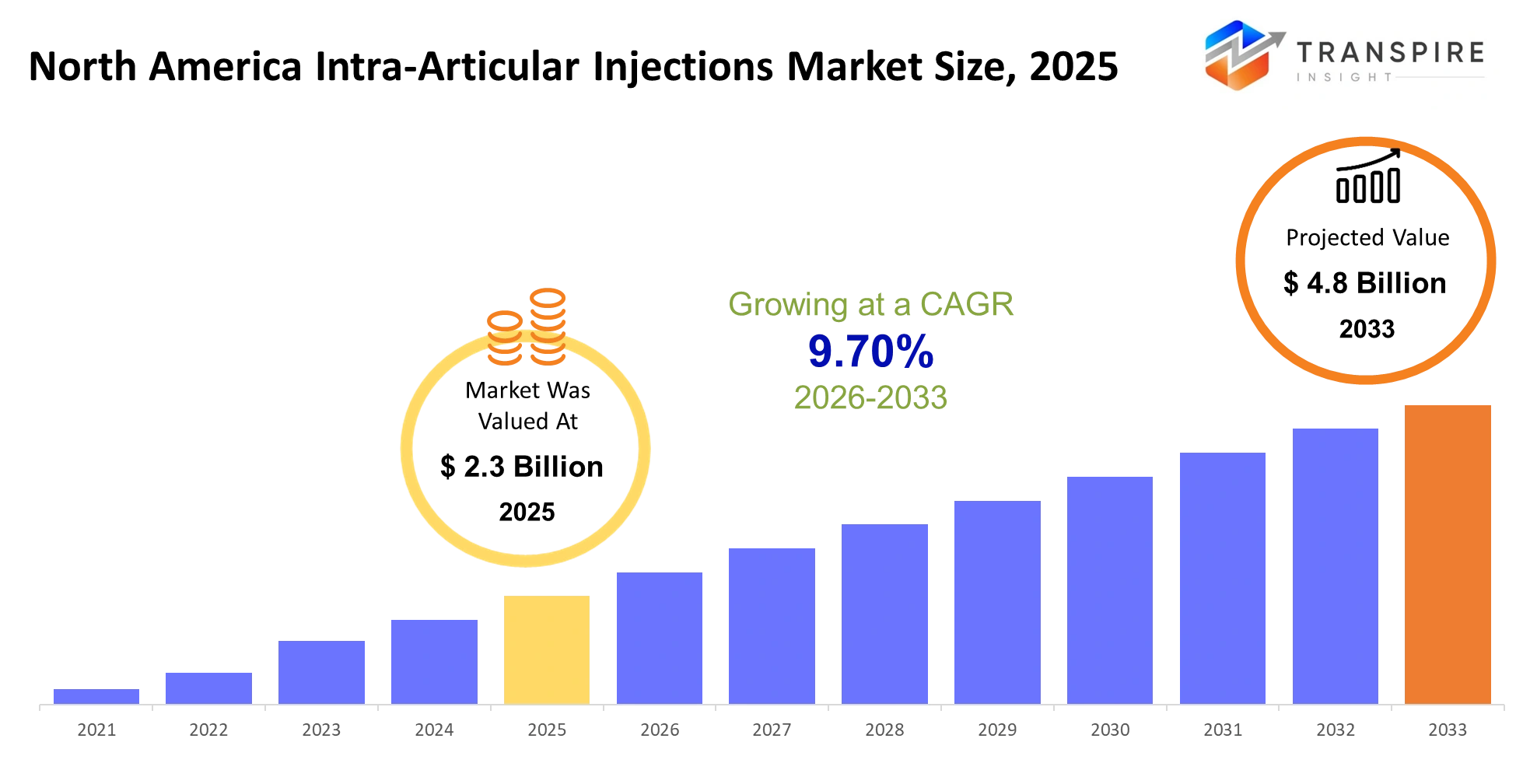
- North America Intra-Articular Injections Market Size 2025: USD 2.3 Billion
- North America Intra-Articular Injections Market Size 2033: USD 4.8 Billion
- North America Intra-Articular Injections Market CAGR: 9.70%
- North America Intra-Articular Injections Market Segments: By Product Type (Hyaluronic Acid Injections, Corticosteroid Injections, Platelet-rich Plasma Injections, Stem Cell Injections, Others); By Application (Osteoarthritis, Rheumatoid Arthritis, Sports Injuries, Joint Pain Management, Others); By End User (Hospitals, Orthopedic Clinics, Sports Medicine Centers, Others); By Joint Type (Knee Joint, Hip Joint, Shoulder Joint, Others).
To learn more about this report,  Download Free Sample Report
North America Intra-Articular Injections Market Summary
The North America Intra-Articular Injections Market was valued at USD 2.3 Billion in 2025. It is forecast to reach USD 4.8 Billion by 2033. That is a CAGR of 9.70% over the period.
The North America intra articular injections market basically backs up the direct delivery of therapies into joints to help manage osteoarthritis, inflammatory arthritis, and sports related injuries, so patients can postpone or sometimes even skip surgical steps while still regaining mobility and day to day function. Over the last few years, the market has been changing structurally, like routine corticosteroid, and hyaluronic acid use started to give way to more image guided procedures and biologic options, for example platelet-rich plasma, this is largely tied to precision medicine habits seen across outpatient orthopedic and pain clinics. One big trigger was the COVID 19 disruption of elective surgeries which left a treatment backlog in place, and it basically made many providers lean harder on injection based care, delivered in ambulatory settings. At the same time opioid sparing treatment policies helped speed up physician uptake of non surgical pain management, and that combination pushed clinic volumes upward while also improving how procedures are standardized. An aging population with degenerative joint disease is choosing these minimally invasive approaches more often, since they tend to mean quicker recovery and less strain on the broader system, and it all keeps compounding.
Key Market Insights
- The United States basically runs the North America Intra-Articular Injections Market , with something like nearly 78% share in 2025, and that’s mostly because of upgraded orthopedic infrastructure plus a lot of patient traffic.
- Canada still shows up as a smaller player but it’s pretty steady, fueled by solid adoption across public healthcare systems and sports medicine clinics, you know that kind of routine use.
- Mexico is kind of the quick mover though, the fastest-growing regional pocket from 2025 to 2030, supported by more access to private orthopedic care and a demand for cost-efficient treatment options, not always the most complicated stuff.
- Hyaluronic acid injections take the lead in the North America market, with roughly 42% share in 2025, mainly because osteoarthritis treatment usage is so widespread.
- Corticosteroid injections stay in the second place, these are commonly used for acute inflammation and pain relief plans that are shorter-term.
- Biologic injections, like PRP, look like the fastest-growing slice through 2030, and that’s tied to the broader move toward regenerative medicine solutions.
- Osteoarthritis treatment is the biggest application category, sitting at nearly 55% share in 2025, which lines up with aging demographics and the usual wear-and-tear patterns.
- Sports medicine is the fastest-growing application area, since ligament injuries keep rising and there’s growing interest in athlete focused regenerative therapies.
- Rheumatoid arthritis stays relatively constant, with demand that holds steady because long-term disease management is required over time.
- Hospitals and orthopedic clinics lead overall, holding about 48% of the end-user share in 2025, helped by procedural know-how and diagnostic integration, kinda like everything being handled in one workflow.
What are the Key Drivers, Restraints, and Opportunities in the North America Intra-Articular Injections Market?
Driver: The strongest growth driver is really the shift toward minimally invasive , outpatient orthopedic care supported by opioid- sparing treatment frameworks. As in the United States regulatory and clinical guidelines are increasingly discouraging long-term opioid use for chronic musculoskeletal pain, physicians have actually accelerated the adoption of intra-articular injections as a first-line approach. This change has been reinforced by ultrasound guided injection technology , which ups precision and clinical results, and it directly increases procedure volumes in orthopedic clinics and ambulatory surgical centers.
Restraint: One key structural constraint is the variability in clinical evidence for biologic therapies like platelet-rich plasma across standardized treatment protocols. Since reimbursement policies from both private insurers and public payers are still inconsistent, adoption gets uneven, and it is often tied to out-of-pocket patient spending. That ends up creating a fragmented access environment that slows down large-scale commercialization , and it also limits revenue predictability for manufacturers in the North America Intra-Articular Injections Market.
Opportunity: The next growth phase is starting to take shape through regenerative orthobiologics integrated into sports medicine networks , especially in high-performance rehabilitation centers across the United States. Clinics collaborating with professional sports franchises are investing more and more in next generation biologic injection platforms, which signals a route toward premium-priced treatments and broader clinical validation.
What Has the Impact of Artificial Intelligence Been on the North America Intra-Articular Injections Market?
AI is increasingly but kinda quietly reshaping the North America Intra-Articular Injections Market, mainly because it boosts clinical precision workflow efficiency, and patient-level treatment planning across orthopedic and sports medicine settings. In day to day use, the automation part shows up pretty clearly in AI-assisted imaging systems that back ultrasound-guided injections. There the algorithms help clinicians spot joint spaces, make the needle path more efficient, and keep procedural consistency more uniform across high volume clinics, so you get less operator variability and procedures can run faster. That, in turn, lets outpatient centers manage a higher patient throughput without just adding more staff.
Then there’s predictive analytics, which is also picking up speed via machine learning models embedded in electronic health record platforms. These tools look at patient history, imaging signals, and mobility scores to anticipate treatment response, plus they suggest injection type selection. This is especially noticeable in osteoarthritis management. Clinics running these kinds of systems tend to see smoother scheduling cycles and better resource allocation, especially with biologic therapies, where inventory control has to be tighter.
Operationally, AI driven demand forecasting and supply chain optimization have helped cut down stockouts of hyaluronic acid and corticosteroid products, while also improving cost efficiency across ambulatory surgical centers. Still, adoption is not fully smooth, because integration can be messy with legacy hospital IT systems, and the data quality can be inconsistent across imaging and clinical records. Because of that, model accuracy may dip in real world orthopedic environments, and it slows down broad rollout even when clinical interest is strong.
Key Market Trends
- Since 2022, adoption of ultrasound guided injections really took off, sort of abruptly, and in more than 60% of urban orthopedic clinics across the United States the older blind techniques got replaced.
- Hyaluronic acid dominance meanwhile has been slowly eroding, not all at once, as PRP and other biologics expanded, and regenerative therapies have seen double digit procedure growth since 2023.
- Also, outpatient surgical centers started pulling ahead of hospital settings in procedure volume growth after 2021, mostly because cost efficiency matters, plus patients move through faster, turnaround cycles feel quicker.
- Stryker and Zimmer Biomet expanded their digital imaging ecosystems to blend in navigation assisted injection platforms, aiming for improved orthopedic precision, like not just theoretical but practical.
- On the reimbursement side, tightening for biologics that lacked strong evidence since 2022 kinda forced clinics to improvise, shifting toward hybrid payment models, a mix of insurance plus patient self pay.
- Sports medicine demand jumped after 2021, and professional athlete rehabilitation programs increasingly lean on PRP based intra articular options for what they describe as faster recovery timelines.
- Viscosupplementation supply chains have stabilized after pandemic disruptions, though clinics still keep higher safety inventories, so procedure delays dont happen.
- Anika Therapeutics and Sanofi upped investments in next generation viscosupplement formulations, basically to defend market share against regenerative medicine entrants.
- Then in 2024, AI assisted treatment planning tools began shaping injection selection workflows, which improved patient specific therapy matching and also reduced repeat procedures in some clinics, in practice not only in charts.
North America Intra-Articular Injections Market Segmentation
By Product Type
Hyaluronic acid injections keep the strongest position in the North America Intra-Articular Injections Market, mostly because they’ve been adopted a lot in osteoarthritis care, and the reimbursement lanes are already set. Hospitals, plus orthopedic clinics usually like these viscosupplementation products, since they give sort of reliable pain relief, and there is long term clinical usage data behind them. Corticosteroid injections hold a pretty steady share too, as a quick acting option for acute inflammation, particularly in primary care and orthopedic settings where symptom control needs to happen fast. They stay in the mix but, their growth feels a bit limited because of worries around repeated long duration administration effects.
Platelet-rich plasma injections are picking up momentum while regenerative medicine adoption keeps speeding up, and sports medicine clinics ,and private orthopedic practices are backing this trend. Stem cell injections still sit in early adoption stages, largely due to regulatory scrutiny, and sometimes the clinical validation isn’t consistent enough which keeps uptake from spreading widely. Looking ahead, growth is expected to gather mostly around biologic therapies as patient preferences move toward tissue regenerative solutions. Companies that focus on standardized biologic formulations, and on clearer reimbursement frameworks, should end up with better positioning over the forecast period.
By Application
Osteoarthritis dominates the North America Intra-Articular Injections Market, because it is so common in aging populations, and clinicians lean heavily on non surgical joint preservation therapies. Treatment protocols are increasingly mixing injection-based approaches to delay joint replacement surgeries, especially for knee related cases.Rheumatoid arthritis is more like a smaller but steady, application base, pushed along by long-term disease management needs, and by combination therapy approaches that specialty clinics keep using. It feels less huge than some other areas, but it doesn’t really fade out.
Sports injuries are getting attention fast, because more people now do both competitive and recreational sports, so yeah the application segment keeps expanding. Joint pain care outside very specific diagnoses also adds fairly consistent procedural pull, especially within outpatient orthopedic settings. The next phase should lean on earlier intervention ideas for musculoskeletal conditions, and regenerative therapies are expected to shift how treatment happens, almost like a different roadmap. Developers that can promise faster recovery outcomes, plus minimally invasive protocols will probably see better clinical buy in, pretty steadily.
By End User
Hospitals hold a big share in the North America Intra-Articular Injections Market, mainly because they have the diagnostic infrastructure in place and smoother access to advanced imaging systems. Orthopedic clinics trail just behind, and they benefit from focused experience plus high procedure volumes in musculoskeletal care. Together these two settings basically keep anchoring most injection based treatments, since referral channels are established, and reimbursement alignment is already there.
Sports medicine centers are the fastest moving end user group, because demand keeps rising for performance recovery and injury rehabilitation solutions. Ambulatory surgical centers are also picking up speed, partly due to cost efficiency and shorter patient turnover times. In the future, growth should drift toward more decentralized care delivery, where outpatient facilities take on a larger portion of injection procedures. Investors and providers who focus on clinic-based expansion models may do well, as procedural migration away from traditional hospital settings keeps increasing.
By Joint Type
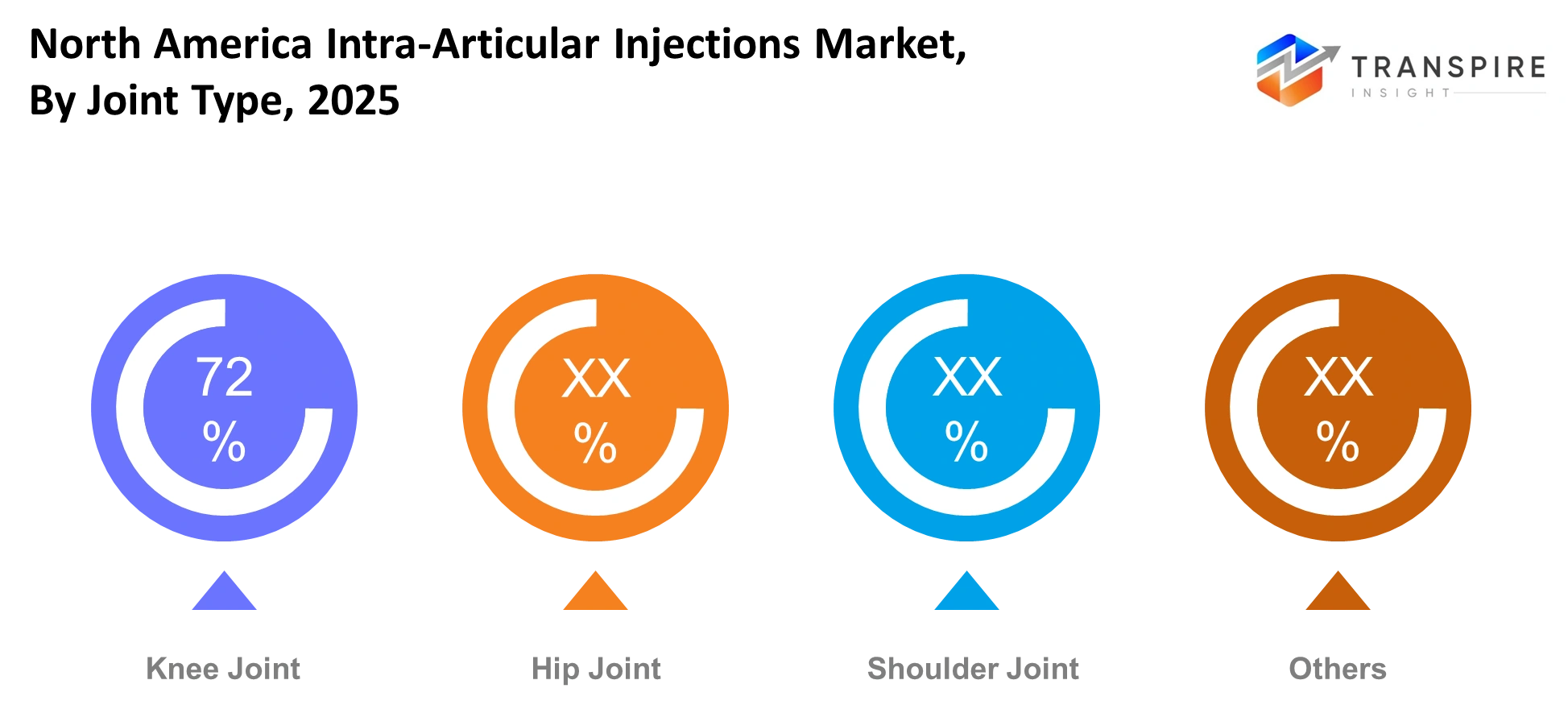
Knee joint treatments lead the North America Intra-Articular Injections Market, mostly because osteoarthritis is so common, also sports-related knee injuries show up a lot. In practice, many clinical protocols end up preferring injection-based options for keeping the knee functioning, before surgical replacement gets discussed. Hip joint applications hold a decent share, even so, the pace is somewhat held back by procedural complexity, though the aging population is helping.
Shoulder joint injections are growing at a steady clip. This is fueled by more rotator cuff injuries, along with repetitive strain conditions that build up over time. The other joints, including smaller articulations, usually sit in a narrower lane, but demand stays steady within specialized orthopedic care. Looking ahead, the main growth will likely cluster around knee and shoulder uses as diagnostic precision improves and early intervention becomes more common. Product teams that focus on joint-specific formulations, and on delivery accuracy in particular, should improve their competitive position across the shifting clinical pathways.
To learn more about this report, Download Free Sample Report
What are the Key Use Cases Driving the North America Intra-Articular Injections Market?
Knee joint osteoarthritis management is still the big dominant use case, mainly because populations are aging, and everyone is trying to push out the need for a surgical replacement. Orthopedic clinics, and hospitals tend to lean on intra-articular injections to help restore mobility, as well as to ease that persistent, chronic pain. So this becomes the main demand center across North America for intra-articular injections market adoption.
At the same time, sports injury rehabilitation and post-operative joint recovery are getting more traction too. This is especially noticeable in sports medicine centers, plus in ambulatory surgical facilities where patients want faster turnarounds. Athletes, as well as more active patients, are increasingly being offered hyaluronic acid and platelet-rich plasma injections, mainly to speed up tissue healing, and to cut down downtime after ligament or tendon injuries.
Beyond that, regenerative applications are starting to look like real contenders, particularly early-stage cartilage repair and more preventive joint preservation strategies. You can also see growing interest in experimental biologics for shoulder and hip joints, though it’s mostly in specialized orthopedic research centers. Overall, these directions suggest a slow but steady pivot toward disease-modifying interventions, not only symptom control, like before.
|
Report Metrics |
Details |
|
Market size value in 2025 |
USD 2.3 Billion |
|
Market size value in 2026 |
USD 2.51 Billion |
|
Revenue forecast in 2033 |
USD 4.8 Billion |
|
Growth rate |
CAGR of 9.70% from 2026 to 2033 |
|
Base year |
2025 |
|
Historical data |
2021 - 2024 |
|
Forecast period |
2026 - 2033 |
|
Report coverage |
Revenue forecast, competitive landscape, growth factors, and trends |
|
Regional scope |
North America (Canada, The United States, and Mexico) |
|
Key company profiled |
Sanofi, Anika Therapeutics, Zimmer Biomet, Seikagaku Corporation, Bioventus, Ferring Pharmaceuticals, Teva Pharmaceuticals, Johnson & Johnson, OrthogenRx, Pacira BioSciences, Chugai Pharmaceutical, LG Chem, Flexion Therapeutics, Regen Lab, Smith & Nephew. |
|
Customization scope |
Free report customization (country, regional & segment scope). Avail customized purchase options to meet your exact research needs. |
|
Report Segmentation |
By Product Type (Hyaluronic Acid Injections, Corticosteroid Injections, Platelet-rich Plasma Injections, Stem Cell Injections, Others); By Application (Osteoarthritis, Rheumatoid Arthritis, Sports Injuries, Joint Pain Management, Others); By End User (Hospitals, Orthopedic Clinics, Sports Medicine Centers, Others); By Joint Type (Knee Joint, Hip Joint, Shoulder Joint, Others). |
Which Regions are Driving the North America Intra-Articular Injections Market Growth?
North America is leading the global take-up of intra-articular injection approaches, and the United States really takes the big part of clinical procedures. The main reason is a mix of supportive reimbursement systems, more developed orthopedic infrastructure, and the high how-ever-common rate of osteoarthritis. Big hospital networks, plus specialized orthopedic clinics, keep the procedural pace steady. And that pace is also aided by broad access to ultrasound guided injection systems, you know, the ones clinicians rely on during routine work. Add in well-known pharmaceutical manufacturers and device innovators and the whole setup kinda snowballs, which helps clinical adoption move faster.
Canada comes in as the second most important regional contributor. It feels different, because its publicly funded healthcare system and more structured care pathways matter more than just raw procedural volume. There are steady regulatory approvals, plus standardized care protocols. That combination helps ensure viscosupplementation and corticosteroid therapies get used consistently across provinces. Compared with the United States, the growth angle is less about private clinic expansion and more about hospital driven orthopedic programs. So, adoption stays stable but also somewhat controlled, which in turn supports more predictable demand patterns for suppliers.
Mexico is showing up as the fastest-growing regional market. This is mostly tied to more private healthcare investment, and a growing orthopedic focus in urban areas. There have been recent improvements in diagnostic imaging setups and outpatient surgical facilities. Those upgrades make it easier for patients to access injection-based therapies. On top of that, medical tourism is rising, and procedural costs are lower, so middle-income patients are adopting faster too. This momentum points to strong entry possibilities for device manufacturers, and for biologic developers as well. Especially those aiming at cost sensitive, but rapidly expanding care networks, roughly through 2026–2033.
Who are the Key Players in the North America Intra-Articular Injections Market and How Do They Compete?
Competition in the North America intra-articular injections market is still moderately consolidated, with a mix of multinational pharmaceutical firms and specialized orthopedic device companies, which kind of shape pricing and innovation dynamics in a steady way. Incumbents keep their footing by leaning into product differentiation in viscosupplementation chemistry, biologic formulation quality, and also tighter integration with image-guided delivery systems. But competitive pressure has gotten louder, because regenerative medicine entrants are challenging the older corticosteroid and hyaluronic acid portfolios. Because of that, companies compete less on price alone, and more on clinical performance, procedural efficiency, and the whole physician adoption ecosystem, even when it sounds slightly indirect on the surface.
Sanofi keeps focusing on established viscosupplementation products , and it strengthens its position using lifecycle management strategies and expanded clinical evidence programs that support physician confidence in repeat osteoarthritis treatments. Zimmer Biomet differentiates via orthopedic ecosystem integration, combining injection therapies with surgical planning tools and imaging-assisted platforms, then it expands through hospital network partnerships across North America. Stryker moves the competition forward through digital-enabled orthopedic solutions, basically embedding navigation technologies that improve injection accuracy and help adoption in high-volume ambulatory surgical centers where throughput matters.
Anika Therapeutics builds niche strength in hyaluronic acid innovation, prioritizing differentiated formulations intended for extended joint residence time and better pain outcomes, while scaling through targeted orthopedic clinic distribution. Ferring Pharmaceuticals leans into regenerative and biologic adjacency strategies, investing in research collaborations and specialty care partnerships, to access the sports medicine networks. These varied strategies reflect a market where technological integration and clinical validation define competitive advantage more than traditional scale alone.
Company List
- Sanofi
- Anika Therapeutics
- Zimmer Biomet
- Seikagaku Corporation
- Bioventus
- Ferring Pharmaceuticals
- Teva Pharmaceuticals
- Johnson & Johnson
- OrthogenRx
- Pacira BioSciences
- Chugai Pharmaceutical
- LG Chem
- Flexion Therapeutics
- Regen Lab
- Smith & Nephew
Recent Development News
“In July 2025, Pacira BioSciences announced a strategic collaboration with Johnson & Johnson MedTech to expand co-promotion of ZILRETTA. The agreement broadens physician outreach across orthopedic, sports medicine, and rheumatology channels, strengthening intra-articular injection adoption in osteoarthritis care.
Source: https://investor.pacira.com
“In June 2025, Pacira BioSciences reported updated three-year clinical data for PCRX-201 gene therapy for knee osteoarthritis. The intra-articular injection demonstrated sustained pain and function improvements, reinforcing long-duration injectable innovation in disease-modifying joint therapies.
Source: https://investor.pacira.com
What Strategic Insights Define the Future of the North America Intra-Articular Injections Market?
The North America Intra-Articular Injections Market is shifting toward something more, biologics oriented , and precision-guided care that feels a bit more structured but not fully, pushed by aging demographics and the steady move of musculoskeletal care into outpatient orthopedic ecosystems. Over the next 5 to 7 years, value creation will mostly gather in therapies that pair regenerative promise with image-assisted delivery, while payers and providers start to lean on verifiable functional results , not just quick pain relief for the short term.
There is also a quieter risk, reimbursement fragmentation for regenerative injections, where inconsistent payer interpretations of clinical efficacy could slow uptake , even if procedural demand signals look strong. This may hit manufacturers that depend on PRP and next-generation biologics, especially in non-hospital environments where out of pocket sensitivity tends to be higher, and budgets are a little tighter.
A main, emerging chance is to blend AI-supported musculoskeletal diagnostics with injection planning platforms inside high volume sports medicine networks , notably across the United States. Firms that tie together biologic portfolios with properly validated digital guidance systems can enable distinct clinical processes. The most actionable approach is to invest in injection protocols that are proven by outcomes, linked directly to imaging and data platforms, so that payer acceptance improves and procedural scaling stays sustainable.
North America Intra-Articular Injections Market Report Segmentation
By Product Type
- Hyaluronic Acid Injections
- Corticosteroid Injections
- Platelet-rich Plasma Injections
- Stem Cell Injections
- Others
By Application
- Osteoarthritis
- Rheumatoid Arthritis
- Sports Injuries
- Joint Pain Management
- Others
By End User
- Hospitals
- Orthopedic Clinics
- Sports Medicine Centers
- Others
By Joint Type
- Knee Joint
- Hip Joint
- Shoulder Joint
- Others
Frequently Asked Questions
Find quick answers to common questions.
The expected North America Intra-Articular Injections Market size is USD 4.8 Billion in 2033.
Key segments for the North America Intra-Articular Injections Market are By Product Type (Hyaluronic Acid Injections, Corticosteroid Injections, Platelet-rich Plasma Injections, Stem Cell Injections, Others); By Application (Osteoarthritis, Rheumatoid Arthritis, Sports Injuries, Joint Pain Management, Others); By End User (Hospitals, Orthopedic Clinics, Sports Medicine Centers, Others); By Joint Type (Knee Joint, Hip Joint, Shoulder Joint, Others).
Major North America Intra-Articular Injections Market players are Sanofi, Anika Therapeutics, Zimmer Biomet, Seikagaku Corporation, Bioventus, Ferring Pharmaceuticals, Teva Pharmaceuticals, Johnson & Johnson, OrthogenRx, Pacira BioSciences, Chugai Pharmaceutical, LG Chem, Flexion Therapeutics, Regen Lab, Smith & Nephew.
The North America Intra-Articular Injections Market size is USD 2.3 Billion in 2025.
The North America Intra-Articular Injections Market CAGR is 9.70% from 2026 to 2033.
- Sanofi
- Anika Therapeutics
- Zimmer Biomet
- Seikagaku Corporation
- Bioventus
- Ferring Pharmaceuticals
- Teva Pharmaceuticals
- Johnson & Johnson
- OrthogenRx
- Pacira BioSciences
- Chugai Pharmaceutical
- LG Chem
- Flexion Therapeutics
- Regen Lab
- Smith & Nephew
About the Authors

Pankaj Ghogare Patil
I am Pankaj Ghogare Patil, a Senior Research Analyst at Transpire Insight, specializing in the Pharmaceutical, Chemicals & Materials, Healthcare IT, and Biotechnology industry. My expertise lies in conducting comprehensive market research, analyzing industry trends, evaluating competitive landscapes, and translating complex data into actionable insights. At Transpire Insight, I closely follow emerging technologies, regulatory developments, and market innovations to create accurate, well-researched, and informative content that helps businesses and professionals make informed decisions. I am committed to producing credible, evidence-based articles that reflect industry best practices while making technical topics accessible and valuable for a broad audience.

Chakradhar Khansole
Chakradhar serves as the Research Director at Transpire Insight, bringing over 8 years of experience in technology, innovation, and strategic market intelligence. He specializes in transforming complex market data into actionable business insights that enable organizations to make informed, growth-oriented decisions. Recognized for his strategic vision and analytical expertise, Chakradhar leads high-impact research initiatives, delivering comprehensive market assessments, competitive intelligence, and forward-looking industry analysis.
Recently Published Reports
-
Jul 2026
Alopecia Treatment Market
Alopecia Treatment Market Size, Share & Analysis Report By Disease Type (Alopecia Areata, Cicatricial Alopecia, Traction Alopecia, Alopecia Totalis, Androgenetic Alopecia, Alopecia Universalis, and Other Disease Types), By Treatment Type (Topical Treatments, Oral Medications, Injectable Therapies, and Hair Transplantation), By Gender (Male, and Female), By Distribution Channel (Hospitals and Clinics, Retail Pharmacies, and Online Retailers), and Geography (North America, Europe, Asia-Pacific, Middle East and Africa, South and Central America), 2021 - 2031
-
Jul 2026
Medical Ultrasound Probe Market
Medical Ultrasound Probe Market Size, Share & Analysis Report By Type (Linear Type, Convex Type, Endocavitary Probe, Phased Array/Cardiac Probe, Transesophageal (TEE) Probe, and Others), By Application (Ophthalmology, Cardiology, Musculoskeletal, Oncology, Obstetrics & Gynecology, General Imaging, and Others), By End User (Hospitals & Clinics, Diagnostic Centers, Ambulatory Surgical Centers, and Others), and Geography (North America, Europe, Asia-Pacific, Middle East and Africa, South and Central America), 2021 – 2031
-
May 2026
Biosimilars Market
Biosimilars Market By Product Type (Monoclonal Antibodies, Recombinant Hormones, Erythropoietin, G-CSF, Others), By Indication (Oncology, Autoimmune Diseases, Blood Disorders, Diabetes, Others), By Manufacturing Type (In-House Manufacturing, Contract Manufacturing), By Distribution Channel (Hospital Pharmacies, Retail Pharmacies, Online Pharmacies), By Industry Analysis, Size, Share, Growth, Trends, and Forecasts 2021-2033
-
Apr 2026
Gastrointestinal Endoscopy Market
Gastrointestinal Endoscopy Market By Type (Rigid Gastrointestinal Endoscope, Flexible Gastrointestinal Endoscopes, Disposable Gastrointestinal Endoscope), By Procedure Type (Colonoscopy, Gastroscopy, Duodenoscopy, Enteroscopy, Flexible Sigmoidoscopy, Others), By Application (Diagnosis, Treatment), By End-Users (Hospitals, Ambulatory Surgical Centers, Specialty Clinics, Laboratories, Others), By Industry Analysis, Size, Share, Growth, Trends, and Forecasts 2021-2033