Europe Hyaluronic Acid Market Size & Forecast:
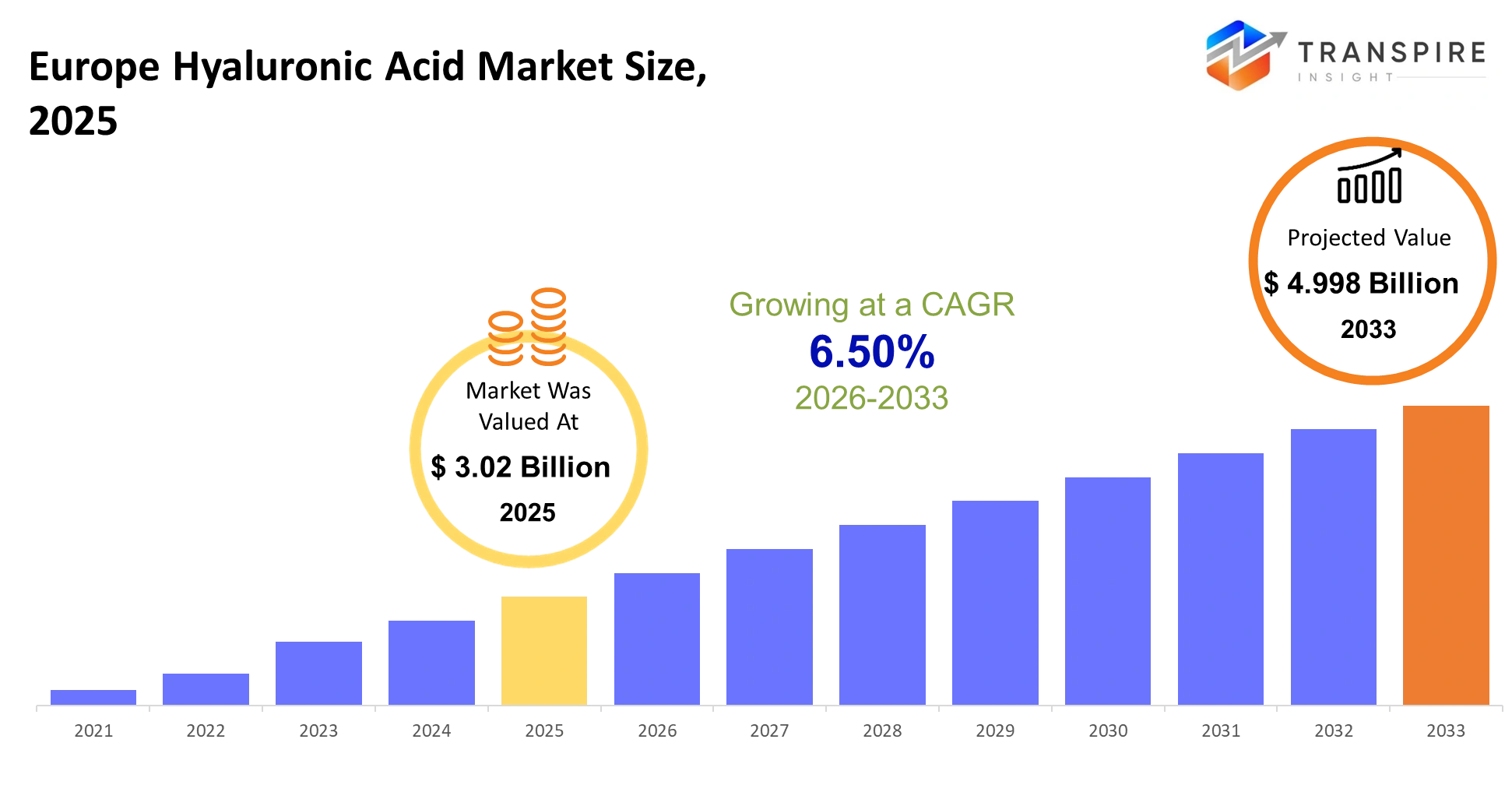
- Europe Hyaluronic Acid Market Size 2025: USD 3.02 Billion
- Europe Hyaluronic Acid Market Size 2033: USD 4.998 Billion
- Europe Hyaluronic Acid Market CAGR: 6.50%
- Europe Hyaluronic Acid Market Segments: By Type (Animal-based, Synthetic, Others), By Application (Dermal Fillers, Osteoarthritis Treatment, Cosmetics, Others), By End-User (Hospitals, Clinics, Cosmetic Centers, Others), By Form (Injectable, Topical, Others).
To learn more about this report,  Download Free Sample Report
Europe Hyaluronic Acid Market Summary:
The Europe Hyaluronic Acid Market size is estimated at USD 3.02 Billion in 2025 and is anticipated to reach USD 4.998 Billion by 2033, growing at a CAGR of 6.50% from 2026 to 2033. The Europe Hyaluronic Acid market supports clinical and aesthetic applications which need lubrication and hydration and tissue repair to function effectively. The material serves multiple purposes which include osteoarthritis treatment through viscosupplementation and ophthalmic surgery eye surface protection and dermatology clinics which use it for facial volume restoration and skin elasticity enhancement through dermal fillers.
The market has undergone a complete transformation during the past three to five years because customers now demand bio-fermentation processes that produce higher purity products compared to animal-derived extraction methods. The combination of Europe's increasing elderly demographic and the return of elective cosmetic treatments after COVID-19 created a primary force which drove clinics to adopt new technologies. The stricter EU safety and quality regulations required manufacturers to produce their products according to pharmaceutical-grade standards.
HA now serves as the primary option which hospitals and cosmetic clinics across the region use to treat patients who need non-surgical treatments.
Key Market Insights
- The European Hyaluronic Acid Market, which Western Europe powers through its advanced medical and beauty facilities, will reach 45% market share by 2025.
- The developing aesthetic clinics and increased medical tourist arrivals between 2024 and 2030 enable Eastern Europe to become the fastest expanding area.
- The strong dermatology networks in Germany, France, and Italy enable their citizens to receive more cosmetic treatments than other nations.
- The Europe Hyaluronic Acid Market shows dominance in its dermal fillers segment which holds almost 40% market share because people want non-surgical facial rejuvenation treatments.
- Pharmaceutical-grade sodium hyaluronate ranks second, as it serves multiple purposes in hospitals for treating osteoarthritis and performing eye surgeries.
- The demand for pure bio-fermented hyaluronic acid has increased because of European Union regulations which require specific purity standards to be met.
- Aesthetic dermatology leads applications with about 50% share, which increases because urban Europe shows rising interest in non-surgical beauty treatments.
- The European market for orthopedic viscosupplementation grows rapidly because of the increasing number of elderly people and the rising cases of joint disorders.
- Ophthalmology shows stable demand because cataract and dry-eye surgical procedures require continuous access to this medical treatment.
- The Europe Hyaluronic Acid Market shows high demand from dermatology clinics which control approximately 42% of the market in 2025.
- The second biggest segment of hospitals exists in the medical field, which uses their facilities for orthopedic and ophthalmic surgical procedures.
- The highest growth rate among end users belongs to ambulatory surgical centers, which provide patients with affordable outpatient cosmetic treatments.
What are the Key Drivers, Restraints, and Opportunities in the Europe Hyaluronic Acid Market?
The Europe Hyaluronic Acid Market through its medical and aesthetic use cases will develop through three interconnected elements which lead to market shifts.
The main driver of market growth occurs because dermatology and orthopedics continue to embrace minimally invasive procedures as their preferred treatment option. Cross-linked hyaluronic acid formulations now provide longer-lasting results while requiring shorter recovery times than surgical options which created this transition. The rise in outpatient treatments at clinics has increased revenue through additional injectable cycles which directly boosts market earnings throughout Western Europe.
Pharmaceutical companies face their main challenge when they need to secure EU regulatory approvals for all injectable-grade hyaluronic acid products which they plan to use in their operations. The company needs to spend more money on production while its research and development work will take longer because it has to establish new safety and traceability standards. The structural barrier to product introduction creates two problems which prevent small businesses from expanding their operations and result in fewer products that healthcare facilities need to implement fresh technologies.
The development of bio-fermentation technology presents a great chance to expand biomanufacturing operations which are currently growing in France and Germany. Fidia Farmaceutici and IBSA Institut Biochimique are expanding their production facilities to create non-animal derived hyaluronic acid products with high purity. The shift improves regulatory acceptance to European companies which want to enter premium aesthetic and therapeutic markets while establishing stronger export growth for the next development cycle.
What Has the Impact of Artificial Intelligence Been on the Europe Hyaluronic Acid Market?
The Europe Hyaluronic Acid Market experiences transformation through artificial intelligence and advanced digital technologies which enable manufacturers to enhance their biotechnological production operations while maintaining quality standards and their ability to predict customer demand for both medical and cosmetic products. AI-driven process control systems now serve as the primary technology for modern bio-fermentation facilities that use AI to advance their bioprocessing operations through real-time control of microbial strain performance by adjusting temperature and nutrient feed and pH levels to achieve optimal hyaluronic acid production while minimizing batch fluctuations. The production process has become more efficient because these changes resulted in two specific benefits which included increased output during each fermentation cycle and a decrease in rejected batches that occurred because of quality problems.
Predictive analytics models are being used to forecast bioreactor maintenance requirements which helps manufacturing plants schedule maintenance work and achieve higher operational availability during their production processes. Machine learning-based demand forecasting enables manufacturers to synchronize their production activities with changing needs from dermatology clinics and hospitals which results in decreased inventory expenses and reduced shortages of products that are highly demanded in European markets.
The AI-enabled spectroscopic analysis system develops better quality assurance processes because it detects molecular inconsistencies at a faster rate than traditional laboratory tests which helps organizations meet EU pharmaceutical regulations. The requirement for organizations to spend substantial financial resources while dealing with complicated procedures to implement AI systems in GMP-certified production settings serves as their main operational obstacle. The limited availability of high-quality datasets for rare batch failure events creates difficulties for manufacturers who need accurate models because it restricts their ability to implement new technologies throughout their operations.
Key Market Trends
- People started using bio-fermentation technology more frequently after 2021 because the European Union established strict rules for product purity and traceability which made it impossible to continue using animal-based extraction methods.
- The need for dermal fillers grew after 2022 when more people chose non-surgical aesthetic treatments instead of traditional cosmetic surgery procedures which were available in major European cities.
- Galderma expanded its production capabilities during 2023 to meet increasing clinic demands for cross-linked hyaluronic acid products which provide extended use.
- Hospitals began purchasing injectable-grade hyaluronic acid products after 2022 because these treatments offered more affordable options for managing osteoarthritis compared to surgical procedures.
- The European Union established stricter Good Manufacturing Practice requirements in 2021 which led to small-scale manufacturers needing to either merge with other companies or establish partnerships with bigger pharmaceutical entities.
- The industry adopted digital formulation tracking systems as standard practice by 2024 which helped large-scale fermentation plants achieve better batch consistency while decreasing their production failure rates.
- Merz Pharma expanded its clinical partnerships during 2023 to enhance its distribution capabilities throughout Western European dermatology clinics.
- The adoption of orthopedic viscosupplementation procedures increased after 2022 because the aging population became more common and people started using NSAID medications for shorter periods.
- European manufacturing facilities gained more production flexibility after 2021 when companies increased their use of local supply chains while decreasing their reliance on overseas biomaterials.
Europe Hyaluronic Acid Market Segmentation
By Type
The Europe Hyaluronic Acid Market) divides into two main segments which include pharmaceutical-grade sodium hyaluronate and cosmetic-grade formulations while cross-linked hyaluronic acid and native hyaluronic acid form smaller niche markets. The market for pharmaceutical-grade products maintains dominance because osteoarthritis injections and ophthalmic procedures require products with essential purity and molecular stability for their clinical purposes.
Cosmetic-grade products show steady adoption because dermatology clinics use them to provide dermal fillers and skin rejuvenation treatments. Cross-linked formulations grow at a faster rate because they deliver extended aesthetic benefits which decrease the need for subsequent treatments. The market will shift toward advanced bio-fermented products which empower manufacturers to produce reliable results while achieving EU compliance and sustaining their high-priced medical and cosmetic product distribution networks.
By Application
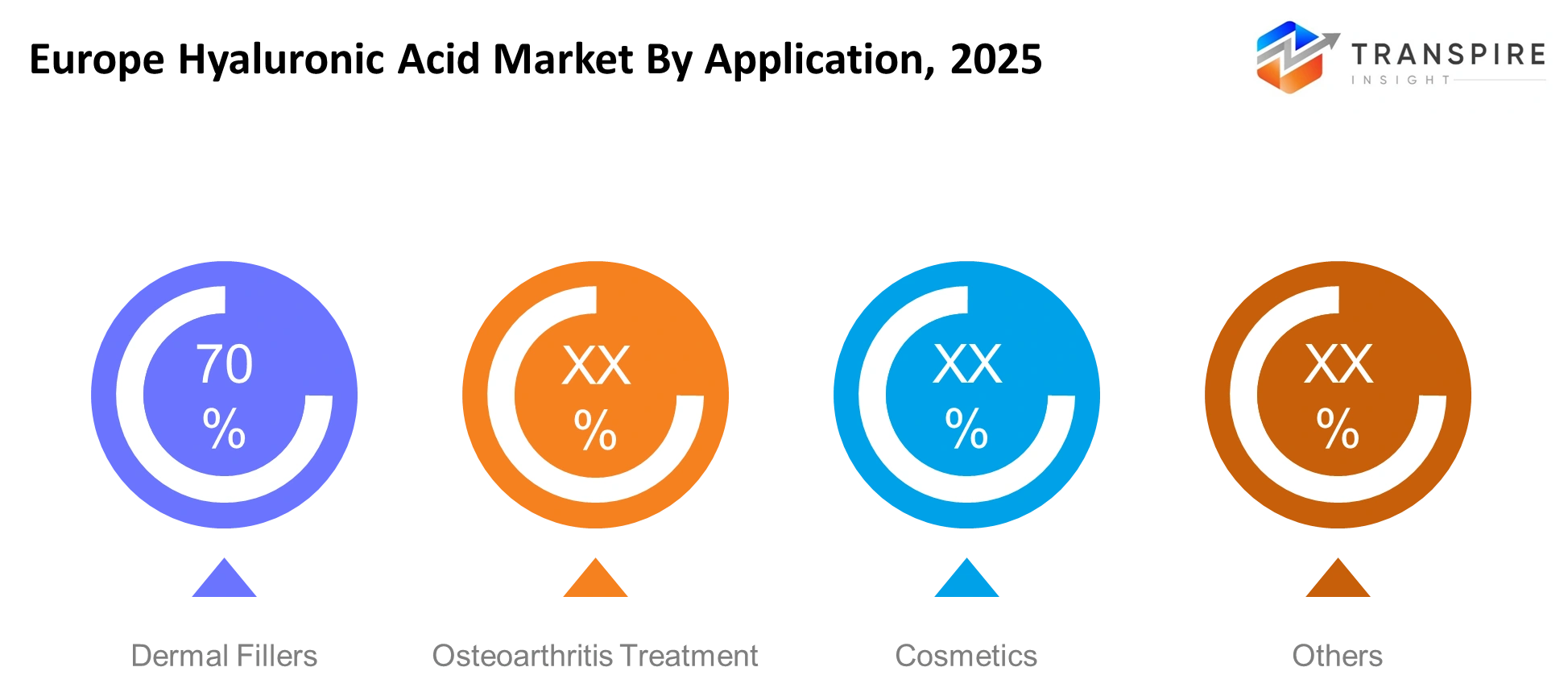
The two main applications of the market show dermal fillers and osteoarthritis treatment as the leading products because both aesthetic medicine and orthopedics have established widespread clinical use of these treatments. The demand for dermal fillers has increased because more people choose non-surgical cosmetic treatments while viscosupplementation for joint disorders remains a stable medical demand driver in aging populations.
The field of ophthalmology and the process of wound healing create smaller but steady business operational flows which particularly apply to surgical lubrication and post-operative recovery. The growth patterns of the business now rely more on patients choosing outpatient care and their decision to select minimally invasive treatments instead of surgical procedures. The market demand will shift toward high-frequency aesthetic applications because manufacturers develop long-lasting products which help decrease the need for injections while enhancing patient satisfaction in both private clinics and hospital settings.
To learn more about this report, Download Free Sample Report
By End-User
The Europe Hyaluronic Acid Market sees its highest consumption through dermatology clinics and hospitals which serve as the primary end-user group because they require aesthetic and orthopedic procedures. Clinics show more demand for cosmetic procedures because they treat many patients who need injectable treatments, while hospitals show consistent demand for surgical and joint-related operations.
The increasing need for cost-effective outpatient treatment and faster recovery times has established ambulatory surgical centers as a rapidly expanding end-user market. Pharmaceutical companies and research institutes play a supporting role through formulation development and clinical validation. The future demand will continue to move toward decentralized healthcare facilities which will result in increased clinic-based treatment delivery and enhanced distribution systems for injectable-grade products throughout Europe.
By Technology
The primary production methods for bio-based chemicals and biofuels depend on two technologies which include bio-fermentation and chemical synthesis. Bio-fermentation has become the dominant method because it meets higher purity requirements and complies with current regulatory standards. The testing laboratories employ LC-MS and MALDI-TOF technologies for quality control which helps them achieve consistent product testing results that meet EU pharmaceutical regulations.
GC-MS enables impurity detection in raw materials while its application in final product validation remains restricted. Manufacturers increasingly adopt bio-fermentation methods because they provide better traceability and scalability than traditional animal-based extraction methods. The manufacturing facilities that produce for the European Hyaluronic Acid Market will adopt automated analytical systems and real-time quality monitoring tools to achieve their production targets while minimizing waste and maintaining compliance with regulations.
What are the Key Use Cases Driving the Europe Hyaluronic Acid Market?
The Hyaluronic Acid Market in Europe depends on dermal filler procedures which serve as the primary market application because dermatology clinics need non-surgical methods for facial rejuvenation. The procedure volume reaches high levels because patients prefer treatments that enable them to recover quickly while they can achieve lasting aesthetic results through multiple injectable sessions. The advanced cosmetic infrastructure and established networks of practitioners enable clinics in Western Europe to achieve maximum operational capacity.
Osteoarthritis viscosupplementation and ophthalmic surgery represent expanding use cases, primarily within hospital settings and ambulatory surgical centers. Aging populations use injectable therapies to manage joint pain while hyaluronic acid remains essential for ophthalmology because it provides intraocular lubrication during cataract procedures which enhances surgical safety and improves patient outcomes.
Emerging applications include regenerative wound healing therapies and tissue engineering solutions in research institutes and biotech firms. Researchers now explore post-surgical recovery scaffolds and advanced drug delivery systems through experimental applications of bio-fermented material innovation which European clinical research developments facilitate.
|
Report Metrics |
Details |
|
Market size value in 2025 |
USD 3.02 Billion |
|
Market size value in 2026 |
USD 3.216 Billion |
|
Revenue forecast in 2033 |
USD 4.998 Billion |
|
Growth rate |
CAGR of 6.50% from 2026 to 2033 |
|
Base year |
2025 |
|
Historical data |
2021 - 2024 |
|
Forecast period |
2026 - 2033 |
|
Report coverage |
Revenue forecast, competitive landscape, growth factors, and trends |
|
Regional scope |
Europe (Germany, United Kingdom, France, Italy, Spain and Rest of Europe) |
|
Key company profiled |
Allergan, Galderma, Anika Therapeutics, Seikagaku, Zimmer Biomet, Sanofi, Bloomage Biotech, LG Chem, Fidia Pharma, Contipro, Merz Pharma, Teoxane, Sinclair Pharma, Lifecore Biomedical, Kewpie |
|
Customization scope |
Free report customization (country, regional & segment scope). Avail customized purchase options to meet your exact research needs. |
|
Report Segmentation |
By Type (Animal-based, Synthetic, Others), By Application (Dermal Fillers, Osteoarthritis Treatment, Cosmetics, Others), By End-User (Hospitals, Clinics, Cosmetic Centers, Others), By Form (Injectable, Topical, Others) |
Which Regions are Driving the Europe Hyaluronic Acid Market Growth?
The Europe Hyaluronic Acid Market operates under Western Europe because this region possesses superior medical facilities and multiple dermatology and orthopedic treatment centers. The strict EU medical regulations in Germany, France and Italy enable these countries to achieve high usage rates of pharmaceutical-grade formulations. The existing network of specialty clinics together with hospital procurement systems creates stable demand for injectable hyaluronic acid products. The strong reimbursement systems for osteoarthritis treatments create additional incentives for medical professionals to use these treatments in their practices. The presence of leading manufacturers together with research-focused dermatology centers enables both aesthetic and therapeutic product development to proceed at a faster pace.
Southern Europe exists as a stable and mature market because healthcare expenses remain stable while medical aesthetics practices continue their expansion. The private dermatology clinics of Spain and Italy create consistent demand for dermal fillers and skin rejuvenation treatments. Regulatory intensity creates less influence on growth in this region than consumer desire for aesthetic procedures and the gradual development of outpatient services. The hospital systems create dependable usage patterns for both ophthalmic and orthopedic treatments. The region generates reliable financial income because the healthcare system receives stable patient volumes who prefer established cosmetic procedures.
Eastern Europe sees rapid growth because private aesthetic clinics expand their services while healthcare facilities improve their medical services. The demand for dermal filler and orthopedic treatments in Poland and Hungary has risen because people now have more disposable income and medical tourists visit these countries.
Who are the Key Players in the Europe Hyaluronic Acid Market and How Do They Compete?
The Europe Hyaluronic Acid Market operates through a competitive environment which combines three global dermatology and pharmaceutical companies that control premium injectable products with regional manufacturers who provide specialized medical and aesthetic products. The competition between companies depends more on their ability to develop new products through technological advancements and their molecular stability and their success in obtaining EU pharmaceutical regulatory approvals than on their pricing strategies. Companies compete to extend product duration, improve cross-linked gel performance, and secure strong distribution access through dermatology clinics and hospitals. The requirements for strict GMP compliance together with the necessity for clinical validation present substantial obstacles that make entry into the market extremely difficult.
Galderma concentrates on developing advanced aesthetic injectables through its research on cross-linked hyaluronic acid formulations which enable longer lasting fillers that require less frequent treatments thus establishing its presence in high-end dermatology clinics. Allergan Aesthetics uses its extensive clinical network together with its physician training programs to sustain its market leadership in facial rejuvenation solutions through its popular injectable product range.
Merz Pharma uses hybrid aesthetic products like Belotero to create unique offerings that achieve accurate facial tissue matching through their natural integration with skin elements. Teoxane expands through RHA filler technology designed for dynamic facial movement, gaining traction in high-end cosmetic clinics across Europe. Fidia Farmaceutici develops joint-focused hyaluronic acid therapies to strengthen orthopedic applications while IBSA Institut Biochimique develops bio-fermented hybrid complexes through partnerships with European clinical networks to enhance their therapeutic and aesthetic market reach.
Company List
- Allergan
- Galderma
- Anika Therapeutics
- Seikagaku
- Zimmer Biomet
- Sanofi
- Bloomage Biotech
- LG Chem
- Fidia Pharma
- Contipro
- Merz Pharma
- Teoxane
- Sinclair Pharma
- Lifecore Biomedical
- Kewpie
Recent Development News
In April 2026, Croma-Pharma Reacquires Synocrom™ Hyaluronic Acid Portfolio: Austria-based Croma-Pharma re-entered the orthopaedics segment through the reacquisition of Synocrom™, a hyaluronic acid-based viscosupplementation brand used for osteoarthritis treatment. The move signals renewed European investment in HA therapeutics beyond aesthetics, especially in musculoskeletal applications.
Source: https://finance.yahoo.com
In March 2026, Allergan Aesthetics Expands JUVÉDERM® HA Injectable Strategy at AMWC Monaco: Allergan Aesthetics unveiled new positioning for its JUVÉDERM® hyaluronic acid injectable portfolio during AMWC Monaco, emphasizing “undetectable” aesthetic outcomes and personalized facial treatments. The announcement highlighted changing European consumer demand patterns and reinforced the company’s leadership in premium HA fillers.
Source: https://www.prnewswire.com
What Strategic Insights Define the Future of the Europe Hyaluronic Acid Market?
The European Hyaluronic Acid Market develops toward high-purity bio-fermented products which manufacturers create for their particular applications because aesthetic medicine expansion and EU pharmaceutical regulations develop stricter compliance requirements. The market will experience a shift towards products which deliver extended operational life and certified biocompatible performance through clinic-based treatment methods within the next five to seven years. The Western European population demonstrates an increase in elderly residents who choose to undergo less invasive medical treatments which has become their preferred option.
The major threat emerges from businesses which depend excessively on their few advanced fermentation suppliers because this creates a situation where supply distribution becomes riskier through regulatory changes and production interruptions. The situation will reduce access for smaller manufacturers while creating pricing fluctuations when demand remains steady in the market.
Scientific research clusters in Germany and France present emerging opportunities for scientists who can develop hyaluronic acid applications in regenerative medicine and drug delivery systems through bioengineering research funding. The application currently exists in the initial stages of clinical validation but it exhibits significant potential for future expansion. The market participants need to establish their partnerships with biotech companies while they develop hybrid product formulations to achieve their goals in regenerative medicine and therapeutic market development.
Europe Hyaluronic Acid Market Report Segmentation
By Type
- Animal-based
- Synthetic
- Others
By Application
- Dermal Fillers
- Osteoarthritis Treatment
- Cosmetics
- Others
By End-User
- Hospitals
- Clinics
- Cosmetic Centers
- Others
By Form
- Injectable
- Topical
- Others
Frequently Asked Questions
Find quick answers to common questions.
The approximate Europe Hyaluronic Acid Market size for the market will be USD 4.998 Billion in 2033.
The key segments of the Europe Hyaluronic Acid Market are By Type (Animal-based, Synthetic, Others), By Application (Dermal Fillers, Osteoarthritis Treatment, Cosmetics, Others), By End-User (Hospitals, Clinics, Cosmetic Centers, Others), By Form (Injectable, Topical, Others).
Major players in the Europe Hyaluronic Acid Market are Allergan, Galderma, Anika Therapeutics, Seikagaku, Zimmer Biomet, Sanofi, Bloomage Biotech, LG Chem, Fidia Pharma, Contipro, Merz Pharma, Teoxane, Sinclair Pharma, Lifecore Biomedical, Kewpie.
The current market size of the Europe Hyaluronic Acid Market is USD 3.02 Billion in 2025.
The Europe Hyaluronic Acid Market CAGR is 6.50%.
- Allergan
- Galderma
- Anika Therapeutics
- Seikagaku
- Zimmer Biomet
- Sanofi
- Bloomage Biotech
- LG Chem
- Fidia Pharma
- Contipro
- Merz Pharma
- Teoxane
- Sinclair Pharma
- Lifecore Biomedical
- Kewpie
Recently Published Reports
-
Apr 2026
AI in Diabetic Retinopathy Market
AI in Diabetic Retinopathy Market Size, Share & Analysis Report By Type (Screening AI Systems, Diagnostic AI Systems, and Predictive AI Models), By Application Segment (Hospitals, Ophthalmology Clinics, Diagnostic Centers, and Research and Development), and Geography (North America, Europe, Asia-Pacific, Middle East and Africa, South and Central America), 2021 - 2031
-
Apr 2026
Psychometric Tests Market
Psychometric Tests Market Size, Share & Analysis Report By Type (Personality Tests, Ability/Aptitude Tests, Skill/Knowledge Tests, and Others), By Application (Talent Acquisition and Talent Management), and Geography (North America, Europe, Asia-Pacific, Middle East and Africa, South and Central America), 2021 – 2031
-
Apr 2026
Rare Biological Sample Collection Market
Rare Biological Sample Collection Market Size, Share & Analysis Report By Type (Isolation Kits & Reagent, Blood Collection Tubes, and Others), By Application (Oncology, Transcriptomics, Pharmacogenomics, and Others), and Geography (North America, Europe, Asia-Pacific, Middle East and Africa, South and Central America), 2021 – 2031
-
Apr 2026
Patient Lift Pendant Market
Patient Lift Pendant Market By Product Type (Wired Pendants, Wireless, Programmable), By Operation Type(Manual, Electric), By End-Users (Healthcare Professionals, Patients), By Application (Hospitals, Homecare, Rehabilitation Centers, Others), By Industry Analysis, Size, Share, Growth, Trends, and Forecasts 2021-2033
Our Clients
.jpg)