
Europe Joint Replacement Market Size & Forecast:
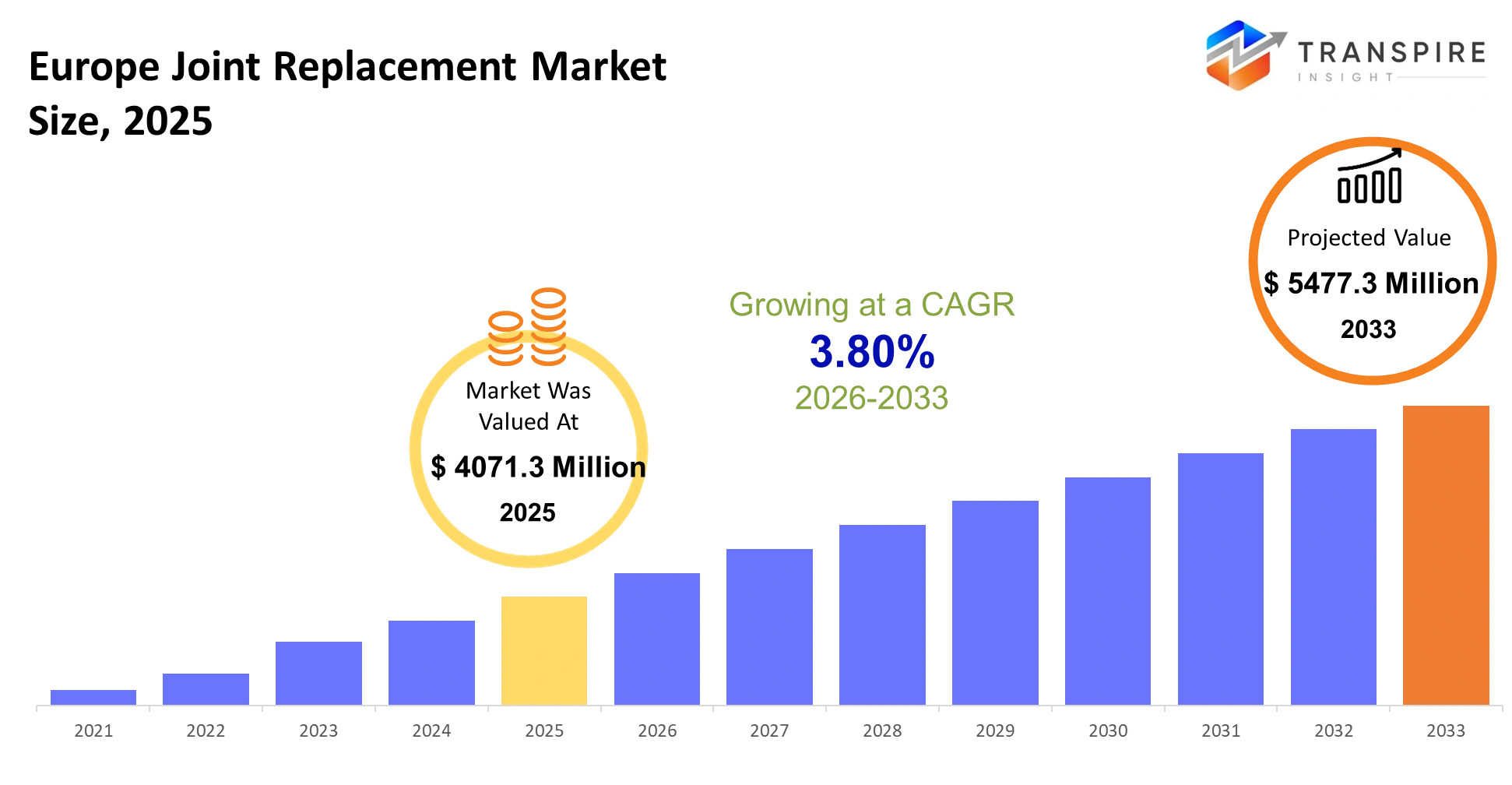
- Europe Joint Replacement Market Size 2025: USD 4071.3 Million
- Europe Joint Replacement Market Size 2033: USD 5477.3 Million
- Europe Joint Replacement Market CAGR: 3.80%
- Europe Joint Replacement Market Segments: By Type (Hip Replacement, Knee Replacement, Shoulder Replacement, Others); By Application (Osteoarthritis, Trauma, Rheumatoid Arthritis, Others); By End-User (Hospitals, Orthopedic Clinics, Others); By Material (Metal, Ceramic, Polymer, Others)
To learn more about this report,  Download Free Sample Report
Europe Joint Replacement Market Summary
The Europe Joint Replacement Market was valued at USD 4071.3 Million in 2025. It is forecast to reach USD 5477.3 Million by 2033. That is a CAGR of 3.80% over the period.
The European joint replacement market provides support to hospitals and orthopedic facilities which help patients with extensive hip knee and shoulder joint degeneration to attain mobility and become self-sufficient while experiencing less permanent impairment. The industry underwent structural changes during the last three to five years because it began using robotic surgical systems and creating customized implants through 3D printing technology which led to enhanced surgical results and shorter recovery durations. Hospitals needed to increase joint replacement procedures after their operating rooms reopened because COVID-19 caused a buildup of delayed elective surgeries which hospitals needed to address. Hospitals that removed their patient volume backlogs combined with their new rapid recovery methods increased their use of advanced implants because these devices reduced hospitalization time which helped hospitals operate more efficiently and increased manufacturer and service provider revenues. The combination of these elements strengthens public and private hospital adoption of these procedures.
Key Market Insights
- The Europe Joint Replacement Market distribution in 2025 shows Western Europe as the leading region which holds between 55 and 60 percent of the market because of its advanced hospital facilities and high rates of medical procedure usage.
- The reimbursement frameworks of Germany France and the UK create strong demand because their aging population base needs medical services.
- Eastern Europe experiences its most rapid development between 2025 and 2030 because of healthcare modernization efforts and the expansion of surgical facilities.
- The Europe Joint Replacement Market shows its largest market segment through knee replacement systems which account for approximately 45 percent of the market because of the high osteoarthritis incidence in the region.
- The hip replacement segment ranks as the second largest market segment because of the two main medical conditions which include trauma injuries and degenerative joint diseases.
- The shoulder and ankle implant market shows its most rapid growth because of the increase in sports injuries and the development of customized implant solutions.
- Osteoarthritis treatment dominates the Europe Joint Replacement Market because it accounts for more than 60 percent of the market which makes it the most important demand driver in the region.
- The trauma and sports injury segment experiences its most rapid growth because more people maintain active lifestyles and doctors adopt better surgical methods.
- Hospitals have become the top end-user segment because they control approximately 70 percent of the market through their high surgical volume and advanced orthopedic surgical facilities.
- The end-user category of ambulatory surgical centers experiences its fastest growth because these centers provide cost-effective services and enable patients to recover more quickly.
What are the Key Drivers, Restraints, and Opportunities in the Europe Joint Replacement Market?
The Europe Joint Replacement Market shows three dominant forces that control how quickly products are adopted and how much they cost and how many surgeries take place in different healthcare systems. Driver The European hospital system experiences its primary growth driver through the increasing adoption of robotic surgical systems and navigation systems for orthopedic surgery.
The post-pandemic surgical backlog together with hospital efficiency requirements that require speedy patient recovery and brief hospital stays created the need for this transition. Surgical procedures that utilize advanced joint systems now create greater value for manufacturers such as Stryker and Zimmer Biomet because hospitals can treat more patients. The increased use of implants in high-volume knee and hip replacement procedures has resulted from this development.
The joint replacement industry faces a fundamental structural limitation because of the high total expenses associated with joint replacement surgery in Western European countries which have developed reimbursement systems that focus on controlling costs. Public health organizations face financial challenges because premium implants and robotic systems and post-operative care solutions create expenses which force them to extend the replacement period for existing implant systems. The pricing system of the organization prevents small hospitals from expanding operations because they lack the resources needed to implement sophisticated surgical equipment. The organization experiences restricted revenue growth because of this situation.
The market opportunity for patient-specific 3D-printed implants that use decentralized manufacturing methods has emerged as a significant trend. Germany and the Netherlands have established localized additive manufacturing hubs to support faster customization processes which will lead to better surgical outcomes through decreased rates of surgical revision.The Europe Joint Replacement Market now requires personalized orthopedic solutions which create new business opportunities for Smith+Nephew and Johnson & Johnson through their advanced value delivery systems.
What Has the Impact of Artificial Intelligence Been on the Europe Joint Replacement Market?
The European Joint Replacement Market experiences continuous transformation through artificial intelligence which creates better methods for hospitals and specialty clinics to plan execute and monitor their orthopedic procedures. Surgeons can create accurate 3D surgical plans within minutes because AI-powered imaging systems in modern orthopedic implant systems automatically process CT and MRI data for surgical planning. Robotic-assisted surgical systems that use machine learning technology to control implant placement during knee and hip replacement procedures achieve better accuracy because they monitor surgical outcomes from their current state.
The Europe Joint Replacement Market uses predictive capabilities to enhance its performance optimization processes. Machine learning models analyze patient history, mobility patterns, and post-operative recovery data to predict revision risks, implant wear rates, and complication probabilities. Hospitals use these insights to optimize resource allocation, reduce readmission rates, and improve long-term implant success outcomes. Certain systems have shown operational improvements through simultaneous surgical time reductions of up to 20% and better alignment accuracy which leads to decreased revision surgery expenses.
The high costs for system integration together with the fragmented healthcare data systems that exist throughout Europe act as major barriers to new system implementation. Many hospitals continue to use outdated systems which prevent them from connecting with AI technologies. The EU medical device regulations and the absence of sufficient high-quality data for uncommon revision instances both hinder the process of developing models throughout the orthopedic field.
Key Market Trends
- Robotic-assisted surgeries expanded strongly after 2022 because hospitals adopted precision-guided knee and hip replacement operations across European medical facilities.
- AI-based preoperative planning tools replaced traditional imaging workflows which reduced surgical preparation time while improving implant alignment accuracy during recent hospital upgrades.
- Value-based healthcare models gained traction after 2021 which required manufacturers to connect reimbursement outcomes with long-term implant performance metrics.
- Advanced biomaterials which provide better implant durability than previous joint replacement systems led to decreased revision surgery rates at major EU hospitals.
- Manufacturing localization in regional areas increased during 2020-2022 because supply chain disruptions reduced the need for global orthopedic component imports.
- Stryker and Zimmer Biomet increased investment in robotic platforms, which transformed their competition from implants to complete surgical systems.
- Western European hospitals adopted bundled orthopedic solutions which became their primary purchasing method after they needed to acquire both implants and attached medical devices.
- EU MDR regulations which became stricter after 2021 required companies to develop new methods for conducting clinical validation and creating documentation for their products.
- Digital rehabilitation monitoring tools emerged as new tools which enable medical staff to track patient recovery progress after surgery while decreasing the need for inpatient rehabilitation.
- Healthcare modernization programs which expanded orthopedic infrastructure and surgical training capacity led to higher Eastern European adoption rates after 2023.
Europe Joint Replacement Market Segmentation
By Type:
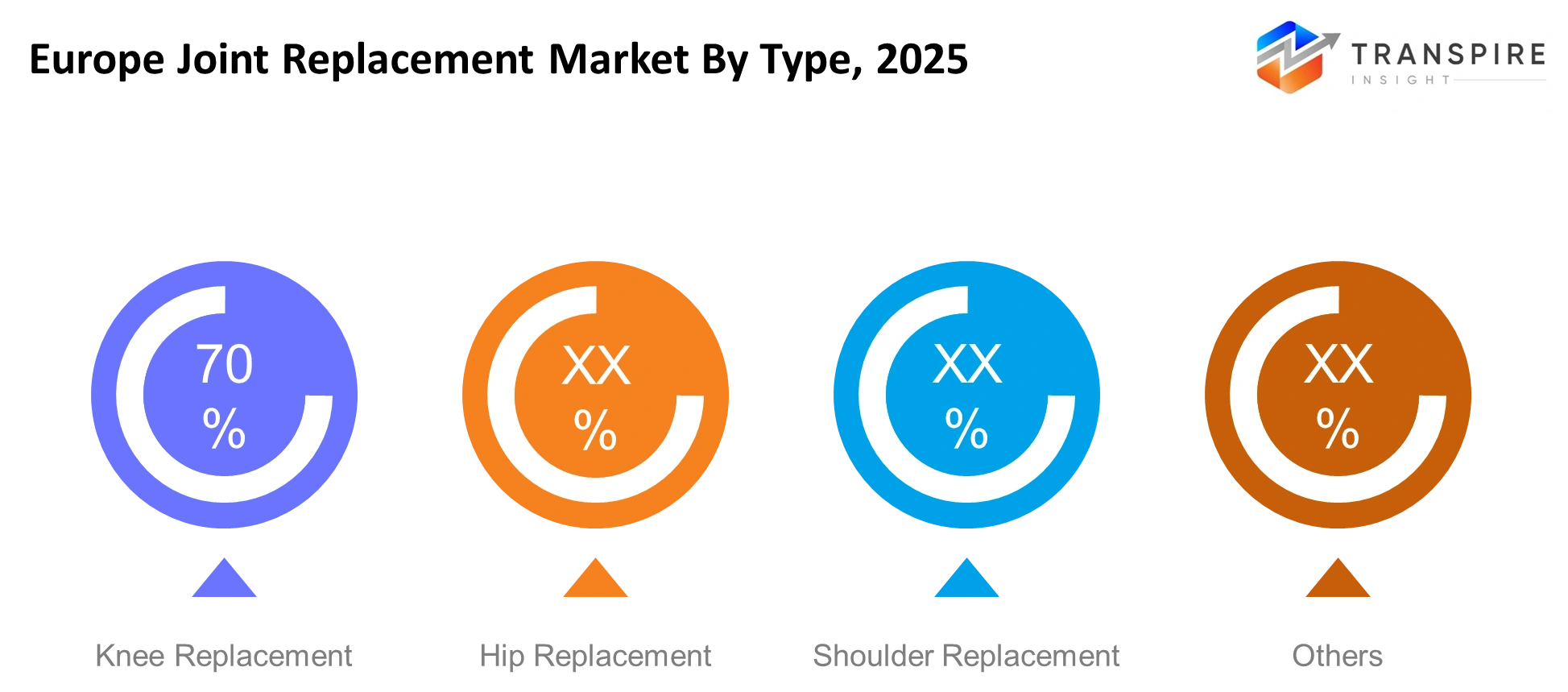
The knee replacement and hip replacement segments together create the highest number of medical procedures which operate throughout European countries. The predominant market section for knee systems exists because people developed osteoarthritis together with age-related joint degeneration. The Western European population needs hip replacements because their aging population suffers from trauma cases and femoral fractures and degenerative hip conditions.
Knee replacement demand originates from two main factors which include rising obesity rates and extended life spans because both factors increase joint stress while accelerating cartilage deterioration. The adoption of hip replacement procedures experiences positive growth because doctors now use more durable implants together with surgical techniques which reduce patient recovery time. The number of shoulder procedures in sports medicine facilities increased because doctors treat more active patients who experience injuries.
Knee systems will continue to dominate the market but the introduction of partial knee replacement innovations together with robotic-assisted procedure development will change the existing product combination. The market for hip implants will experience continuous premiumization as manufacturers adopt advanced materials while shoulder systems will achieve faster growth in specialized clinics. The primary focus for investors and manufacturers will shift towards creating distinct technologies which enable them to separate their products from the competition.
To learn more about this report, Download Free Sample Report
By Application:
All procedures for joint replacement in Europe serve as osteoarthritis treatment because the condition develops with aging and causes long-term joint destruction. The second largest application group includes trauma-related applications which occur because of fractures and joint damage from accidents.Rheumatoid arthritis and other inflammatory conditions represent a smaller but clinically significant share.
The combination of sedentary lifestyles together with increasing life expectancy creates continuous demand for osteoarthritis treatment because it leads to incremental joint degeneration. The occurrence of sports-related injuries among younger people in urban areas determines how trauma applications face their development needs. Rheumatoid arthritis cases show constant numbers but require advanced surgical planning which raises treatment costs throughout each case.
The procedure volumes for osteoarthritis will remain steady while the number of trauma cases will increase at a faster rate because more people will participate in sports activities. Advanced biologics and early intervention therapies may slightly delay surgery in some rheumatoid arthritis patients. High-volume osteoarthritis procedures will become valuable to manufacturers who develop long-lasting implants and quick recovery methods.
By End-User:
European hospitals maintain their position as the leading end-user segment because their surgical facilities operate at high capacity while their surgical systems have advanced technology and their reimbursement systems match the costs of complex joint replacement operations. The secondary market for orthopedic clinics is expanding because these facilities provide both elective and minimally invasive surgical procedures. Other facilities, including ambulatory centers, remain smaller but gradually expanding.
The hospital requires complete surgical teams and sophisticated imaging technology to conduct its complex hip and knee operations. The healthcare system supports orthopedic clinics because they provide better results through outpatient treatment, which decreases hospitalization expenses, and increases patient capacity. The expanding ambulatory centers operate within urban areas that need efficient medical services and quick patient recovery times.
Hospitals will maintain their dominant position while losing market share because patients choose to undergo surgical procedures at outpatient facilities. The growth of orthopedic clinics will occur at a faster rate because these facilities provide economical treatment options and patients prefer to spend less time in medical facilities. The surgical models and outpatient facilities, which decentralized healthcare systems, will drive device manufacturers and investors to develop greater strategic partnerships.
By Material:
Metal-based implants hold the largest share because they provide durable medical solutions with high mechanical strength that hospitals have used in hip and knee replacement procedures for many years. Ceramic materials have become vital for high-end implants because they demonstrate reduced wear and greater compatibility with human body tissues. The joint systems depend on polymer-based components, which provide both cushioning and articulation functions.
Metal maintains its market position because it offers cost advantages and demonstrates effective performance over extended periods in applications that require strong joint performance. Hospitals are increasingly adopting ceramic materials because they provide longer-lasting implants that require fewer replacement surgeries. The development of advanced polyethylene materials, which enhance both wear resistance and joint movement performance, drives ongoing growth of polymer materials in the market.
Western European healthcare systems will experience rapid growth in ceramic materials due to premiumization trends. Metal will stay as the main material but its usage will transition towards hybrid and coated material designs.Manufacturers will increasingly invest in material science research as this field enables them to create products that meet customer needs while maintaining durability and cost-effective performance.
What are the Key Use Cases Driving the Europe Joint Replacement Market?
The European Joint Replacement Market uses hip and knee replacements driven by osteoarthritis as its primary application because aging populations experience increased cartilage degeneration. The application generates maximum demand because it resolves permanent movement difficulties which hospital orthopedic departments achieve through their surgical treatments.
Secondary use cases are growing in orthopedic clinics and ambulatory surgical centers which perform numerous elective procedures to treat both trauma and sports injuries. Specialized hospital settings require advanced implant solutions and precise surgical planning to treat complex inflammatory joint conditions that affect rheumatoid arthritis patients.
The combination of minimal invasion and outpatient joint replacement procedures has emerged as a high-potential application because hospital cost-containment policies and rapid recovery methods support this trend. European healthcare systems are beginning to adopt robotic-assisted revision surgeries which will progress toward precise repeat-intervention techniques during the upcoming forecast period.
|
Report Metrics |
Details |
|
Market size value in 2025 |
USD 4071.3 Million |
|
Market size value in 2026 |
USD 4217.9 Million |
|
Revenue forecast in 2033 |
USD 5477.3 Million |
|
Growth rate |
CAGR of 3.80% from 2026 to 2033 |
|
Base year |
2025 |
|
Historical data |
2021 - 2024 |
|
Forecast period |
2026 - 2033 |
|
Report coverage |
Revenue forecast, competitive landscape, growth factors, and trends |
|
Regional scope |
Europe (Germany, United Kingdom, France, Italy, Spain, Rest of Europe) |
|
Key company profiled |
Zimmer Biomet, Stryker, Johnson & Johnson, Smith & Nephew, Medtronic, B Braun, Exactech, DJO Global, Conmed, Wright Medical, Arthrex, Integra LifeSciences, MicroPort, Aesculap, Corin |
|
Customization scope |
Free report customization (country, regional & segment scope). Avail customized purchase options to meet your exact research needs. |
|
Report Segmentation |
By Type (Hip Replacement, Knee Replacement, Shoulder Replacement, Others); By Application (Osteoarthritis, Trauma, Rheumatoid Arthritis, Others); By End-User (Hospitals, Orthopedic Clinics, Others); By Material (Metal, Ceramic, Polymer, Others) |
Which Regions are Driving the Europe Joint Replacement Market Growth?
The healthcare infrastructure of Western Europe together with its reimbursement systems and high surgical rates for older patients makes it the leading region in the European Joint Replacement Market. The orthopedic systems of Germany and France and the United Kingdom enable these countries to conduct numerous operations because they started using robotic surgery technology. The EU medical device regulations provide manufacturers of implants with a stable framework that delivers predictable product approval processes. The system creates ongoing requirement for high-quality implants and new surgical technologies.
Northern and Southern Europe maintain reliable secondary support because their distinct structural advantages create stable support functions for the region. The Nordic nations establish public healthcare systems with standard procedures which they fund through continuous financial resources to deliver predictable orthopedic treatment volumes throughout each year. The healthcare system in Southern Europe depends on public and private hospitals to deliver surgical services which remain stable despite financial limitations in Italy and Spain. The regions of Eastern Europe show lower technology adoption rates compared to Western Europe yet their healthcare systems remain robust because they receive regular patient arrivals and experience ongoing population growth.
Eastern Europe shows rapid growth because Poland and Romania have modernized their healthcare systems while increasing their orthopedic medical facilities. The European Union funding programs together with recent investments in hospital infrastructure have enabled better access to cutting-edge joint replacement operations. More orthopedic surgeons receive training because private healthcare organizations increase their involvement which creates higher adoption rates for new medical equipment. The upcoming decade provides device manufacturers with strong market entry prospects because of rising budget-conscious customers who create expanding demand for their products.
Who are the Key Players in the Europe Joint Replacement Market and How Do They Compete?
The Joint Replacement Market in Europe appears to have moderate competition because a few international orthopedic companies control its majority market share. The existing companies maintain their market positions through their robotic surgical systems and their durable implants and their complete operating room solutions. The current competition centers on artificial intelligence-based planning systems and navigation technologies and extended hospital service agreements. The market entry process faces two main obstacles which include strict regulatory standards and high financial requirements. The organization gains its main competitive edge through its ability to integrate various technological systems.
Stryker integrates Mako robotic-arm systems with their surgical implants to manage surgical procedures while creating stronger connections with hospitals. Zimmer Biomet uses ROSA robotics and custom-designed patient implants to enhance both knee alignment accuracy and surgical personalization. Johnson & Johnson through DePuy Synthes uses a complete trauma product line which works together with hybrid operating room systems that come from their recent business acquisitions.
Through its use of OXINIUM materials and its development of minimally invasive surgical tools Smith+Nephew offers unique advantages which help outpatient and sports medicine patients. Medtronic expands its operations by developing artificial intelligence-based navigation systems and imaging systems which operate with their orthopedic robotics partnerships to establish joint replacement processes in Europe.
Company List
- Zimmer Biomet
- Stryker
- Johnson & Johnson
- Smith & Nephew
- Medtronic
- B Braun
- Exactech
- DJO Global
- Conmed
- Wright Medical
- Arthrex
- Integra LifeSciences
- MicroPort
- Aesculap
- Corin
Recent Development News
In March 2026, Zimmer Biomet expanded its surgical robotics footprint by acquiring Monogram Technologies, a move that strengthens its autonomous knee replacement capabilities and enhances precision-driven orthopedic surgery across Europe. The acquisition improves robotic-assisted implant positioning and accelerates adoption of semi-autonomous systems in high-volume hospitals.https://www.reuters.com/
What Strategic Insights Define the Future of the Europe Joint Replacement Market?
European Joint Replacement Market develops toward digitalized outcome-oriented orthopedic treatment which uses precise surgical techniques together with durable implant performance as its main competitive factor. The current situation arises because three factors have merged together the increasing number of older people who need medical treatment, hospitals face problems with their operational effectiveness, and medical facilities start using advanced robotic systems together with artificial intelligence systems that create uniform treatment methods throughout their networks. Over the next 5–7 years, value creation will concentrate around ecosystems that combine implants, software, and perioperative analytics rather than standalone device sales.
The hidden danger of mounting regulatory restrictions under new EU medical device regulations creates two major problems because it increases both the time needed for product approvals and the expenses associated meeting regulatory standards. The process of developing new incremental innovations will experience delays which will negatively affect mid-sized companies that do not have extensive regulatory systems to support their operations. Hospitals face a market concentration problem because they depend too much on dominant robotic systems which restrict their ability to collaborate with different robotic system providers.
Eastern European countries with growing healthcare infrastructure development choose decentralized orthopedic manufacturing through 3D printing hubs which hospitals establish throughout their networks. This approach enables medical procedures to use customized implants which reduce time delays and enhance efficiency during surgeries. Market participants should prioritize partnerships with hospital systems to integrate digital design platforms and localized production capabilities, ensuring relevance in an increasingly personalized surgical ecosystem.
Europe Joint Replacement Market Report Segmentation
By Type
- Hip Replacement
- Knee Replacement
- Shoulder Replacement
- Others
By Application
- Osteoarthritis
- Trauma
- Rheumatoid Arthritis
- Others
By End-User
- Hospitals
- Orthopedic Clinics
- Others
By Material
- Metal
- Ceramic
- Polymer
- Others
Frequently Asked Questions
Find quick answers to common questions.
The Europe Joint Replacement Market size is USD 5477.3 Million in 2033.
Key segments for the Europe Joint Replacement Market are By Type (Hip Replacement, Knee Replacement, Shoulder Replacement, Others); By Application (Osteoarthritis, Trauma, Rheumatoid Arthritis, Others); By End-User (Hospitals, Orthopedic Clinics, Others); By Material (Metal, Ceramic, Polymer, Others).
Major Europe Joint Replacement Market players are Zimmer Biomet, Stryker, Johnson & Johnson, Smith & Nephew, Medtronic, B Braun, Exactech, DJO Global, Conmed, Wright Medical, Arthrex, Integra LifeSciences, MicroPort, Aesculap, Corin.
The Europe Joint Replacement Market size is USD 4071.3 Million in 2025.
The Europe Joint Replacement Market CAGR is 3.80% from 2026 to 2033.
- Zimmer Biomet
- Stryker
- Johnson & Johnson
- Smith & Nephew
- Medtronic
- B Braun
- Exactech
- DJO Global
- Conmed
- Wright Medical
- Arthrex
- Integra LifeSciences
- MicroPort
- Aesculap
- Corin
Recently Published Reports
-
Apr 2026
AI in Diabetic Retinopathy Market
AI in Diabetic Retinopathy Market Size, Share & Analysis Report By Type (Screening AI Systems, Diagnostic AI Systems, and Predictive AI Models), By Application Segment (Hospitals, Ophthalmology Clinics, Diagnostic Centers, and Research and Development), and Geography (North America, Europe, Asia-Pacific, Middle East and Africa, South and Central America), 2021 - 2031
-
Apr 2026
Psychometric Tests Market
Psychometric Tests Market Size, Share & Analysis Report By Type (Personality Tests, Ability/Aptitude Tests, Skill/Knowledge Tests, and Others), By Application (Talent Acquisition and Talent Management), and Geography (North America, Europe, Asia-Pacific, Middle East and Africa, South and Central America), 2021 – 2031
-
Apr 2026
Rare Biological Sample Collection Market
Rare Biological Sample Collection Market Size, Share & Analysis Report By Type (Isolation Kits & Reagent, Blood Collection Tubes, and Others), By Application (Oncology, Transcriptomics, Pharmacogenomics, and Others), and Geography (North America, Europe, Asia-Pacific, Middle East and Africa, South and Central America), 2021 – 2031
-
Apr 2026
Patient Lift Pendant Market
Patient Lift Pendant Market By Product Type (Wired Pendants, Wireless, Programmable), By Operation Type(Manual, Electric), By End-Users (Healthcare Professionals, Patients), By Application (Hospitals, Homecare, Rehabilitation Centers, Others), By Industry Analysis, Size, Share, Growth, Trends, and Forecasts 2021-2033
Our Clients
.jpg)