

Asia Pacific LTE Advanced Pro Market Size & Forecast:
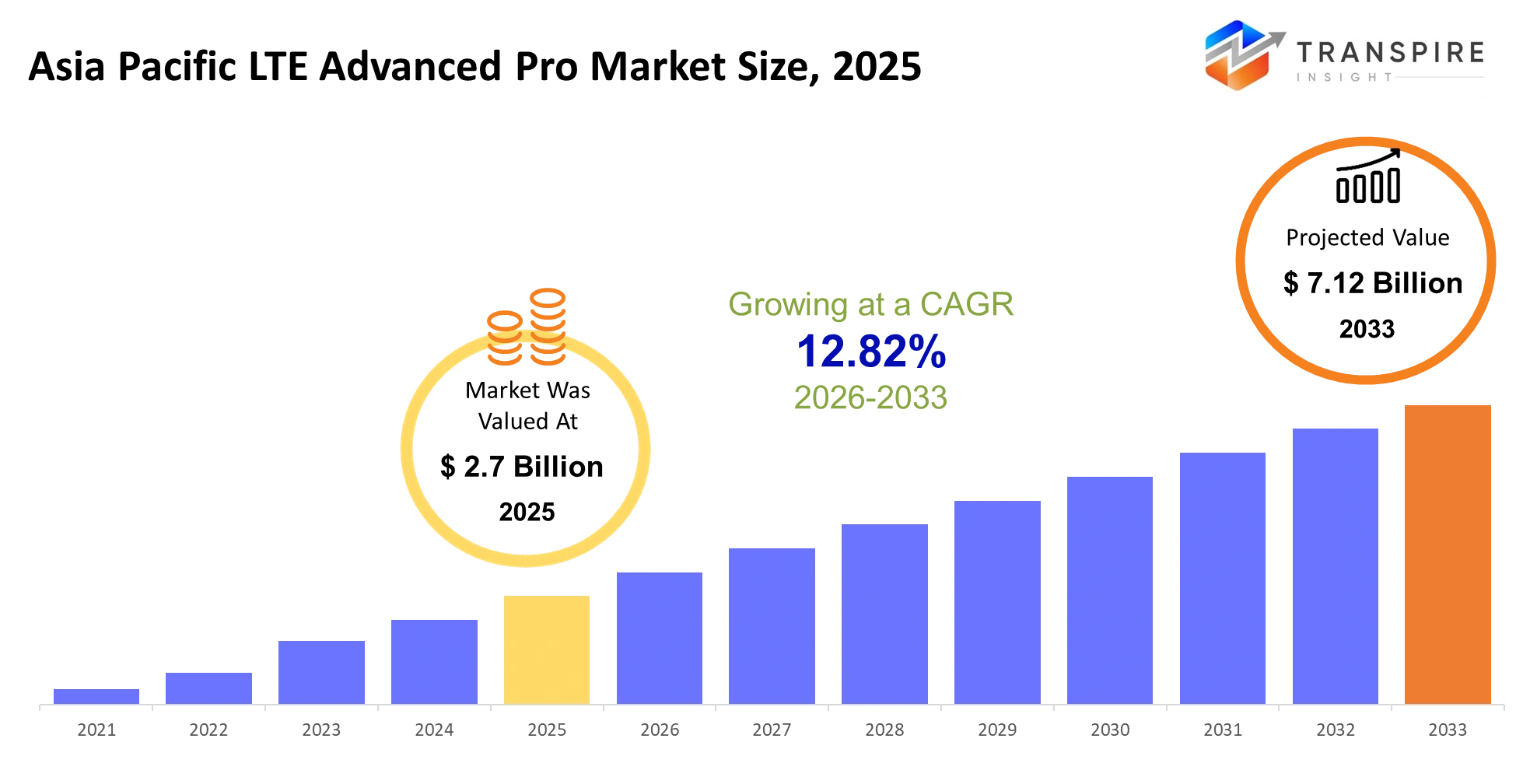
- Asia Pacific LTE Advanced Pro Market Size 2025: USD 2.7 Billion
- Asia Pacific LTE Advanced Pro Market Size 2033: USD 7.12 Billion
- Asia Pacific LTE Advanced Pro Market CAGR: 12.82%
- Asia Pacific LTE Advanced Pro Market Segments: By Type (Network Infrastructure, Devices, Software, Services, Others); By Application (Mobile Broadband, IoT Connectivity, Smart Cities, Industrial Automation, Public Safety, Others); By End-User (Telecom Operators, Enterprises, Government, Industrial Firms, Consumers, Others); By Deployment (Standalone, Non-standalone, Hybrid, Others).
To learn more about this report,  Download Free Sample Report
Asia Pacific LTE Advanced Pro Market Summary
The Asia Pacific LTE Advanced Pro Market was valued at USD 2.7 Billion in 2025. It is forecast to reach USD 7.12 Billion by 2033. That is a CAGR of 12.82% over the period.
The Asia Pacific LTE Advanced Pro market serves as an essential connection framework which enables industries to achieve fast data transfer with low latency across their extensive operational areas that include smart manufacturing plants and logistics centers and ports and energy facilities and interconnected transportation networks. The solution provides businesses with the capability to execute automated systems while tracking their assets through live monitoring and enabling machine-to-machine communication which exceeds the limitations of standard LTE networks. The market has changed from its previous status as a temporary solution which customers used to upgrade to 5G because it now operates as the primary infrastructure for companies needing private wireless systems.
The pandemic supply chain disruptions led to an accelerated transition when manufacturers and port operators dedicated significant resources to build digital systems that would enable them to operate their business functions with reduced staff presence. Spectrum liberalisation in markets such as China and Japan and South Korea created new opportunities for network operators to implement their services. The combination of operational risk mitigation and regulatory support has led to increased adoption because telecom vendors and enterprises view LTE Advanced Pro networks as the most effective method for achieving complete industrial digital transformation.
Key Market Insights
- China maintains market leadership in the Asia Pacific LTE Advanced Pro Market, which will exceed 38% of the total market share by 2025 because of industrial private network deployments.
- India experiences the highest market growth rate among all regions until 2030 because of spectrum reforms and increasing investments in smart manufacturing.
- Japan and South Korea pursue their strategic growth goals through the implementation of advanced factory automation systems and the deployment of high-density enterprise wireless networks.
- The market for Private LTE infrastructure solutions will reach 42% of industry share in 2025 because enterprises prefer secure, dedicated network connections.
- The second-largest market segment in network management software exists because users require both centralized orchestration systems and operational analytics tools.
- The period from 2026 to 2030 will show rapid growth of managed LTE Advanced Pro services because enterprises choose to outsource their deployment difficulties.
- Industrial automation functions as the primary driver of application usage which generates approximately 35 percent of total market revenues during the 2025 period.
- The manufacturing industry stands as the largest end-user segment which takes about 40 percent of market share during the 2025 period.
- The energy and utilities sector experiences rapid expansion because operators use LTE Advanced Pro to monitor their remote assets.
- Mining and heavy industrial activities create new market needs throughout Australia and Southeast Asia.
What are the Key Drivers, Restraints, and Opportunities in the Asia Pacific LTE Advanced Pro Market?
The Asia Pacific LTE Advanced Pro market experiences its strongest growth because enterprise private wireless networks expand quickly within manufacturing, logistics, and port infrastructure. The momentum began after countries like Japan, South Korea, and China implemented spectrum liberalization policies which allowed enterprises to access dedicated spectrum for industrial-grade connectivity. The decreasing costs of small-cell infrastructure deployment enabled mid-sized industrial operators to implement LTE Advanced Pro technology. The shift results in higher vendor revenues through contracts for infrastructure, managed network services, and long-term software licensing agreements.
The most significant barrier remains fragmented spectrum allocation frameworks and uneven digital infrastructure maturity across developing Asia Pacific economies. The telecommunications sector faces a structural challenge because its regulatory framework requires multiple years to achieve licensing reform and upgrade national infrastructure systems. Indonesia, Vietnam, and various South Asian markets experience rollout delays because they need to resolve two issues: regulatory uncertainty and insufficient fiber backhaul infrastructure. The result is slower enterprise adoption cycles and lost revenue opportunities for equipment vendors and service providers.
The integration of LTE Advanced Pro with edge computing for industrial automation creates its most significant growth opportunity. India exhibits a successful model because its investment in smart manufacturing zones and industrial corridor development creates suitable conditions for low-latency private networks. Enterprises can use LTE Advanced Pro as their basic connectivity system which enables them to implement real-time analytics together with machine control systems for scalable enterprise operations.
What Has the Impact of Artificial Intelligence Been on the Asia Pacific LTE Advanced Pro Market?
The deployment and management of LTE Advanced Pro networks throughout Asia Pacific industrial and maritime connectivity ecosystems receive transformation through artificial intelligence and advanced digital technologies. AI-driven orchestration platforms now serve as the main tool that network operators use to complete three tasks which include traffic management automation and dynamic bandwidth distribution and endpoint monitoring across multiple locations such as ports and factories and logistics corridors. The connected monitoring systems of maritime operations use real-time sensor data to monitor exhaust gas cleaning technology performance while they automate compliance reporting and notify operators about scrubber performance system breaches which exceed regulatory limits. The system enables more accurate fleet compliance tracking because it decreases the need for manual inspection work.
The predictive ability of machine learning models demonstrates improvement through their implementation. The operators use these systems to detect equipment deterioration that occurs in its early stages while they estimate maintenance requirements and determine optimal network operation during various environmental conditions. The implementation of predictive analytics in industrial settings enables organizations to achieve network downtime decreases between 20 percent and 30 percent through fault detection before service interruptions happen. The system enhances energy efficiency through two mechanisms which include data transmission load optimization and distributed infrastructure power consumption reduction.
The business achieves operational benefits through increased uptime and decreased operational expenses and enhanced ability to follow regulations. Data fragmentation across various systems presents a basic obstacle that hinders organizations from successfully implementing AI technology. The operational methods of many organizations depend on outdated systems which contain sensors that produce unreliable data, and this situation results in decreased model precision and increased costs for system integration. The achievement of real-time automated system maintenance requires continuous network access because the system needs to function without interruptions in remote maritime areas.
Key Market Trends
- Enterprise buyers started to move 30 percent of their private network investments from public LTE extensions to dedicated LTE Advanced Pro infrastructure in 2022.
- The 2023 industrial spectrum policy updates from China accelerated factory-grade private deployments which led regional operators to develop new enterprise connectivity solutions.
- Between 2021 and 2025 manufacturers from Japan and South Korea replaced their Wi-Fi-dependent industrial systems with low-latency LTE Advanced Pro networks.
- Major port operators including PSA-linked regional facilities advanced their private wireless networks to achieve better resilience than shared connectivity models after post-pandemic supply chain disruptions.
- The upcoming year 2024 will see Nokia and Ericsson expand their managed private network partnerships because enterprises require assistance with their deployment tasks.
- The network software procurement process experienced a total transformation after 2023 because AI-driven orchestration platforms now serve as essential requirements for industrial deployments that require large-scale operations.
- The expansion of India's manufacturing corridor system since 2022 has prompted regulators to expedite the development of enterprise spectrum access systems which enable companies to establish localized private network operations.
- Buyers increasingly prefer hybrid LTE Advanced Pro and edge computing systems because these technologies support their drive to achieve real-time automation in logistics operations.
- After 2023, regional vendors changed their competitive strategies because they started to focus on creating interoperability solutions and industrial application-specific products instead of providing standard telecom infrastructure products.
Asia Pacific LTE Advanced Pro Market Segmentation
By Type :
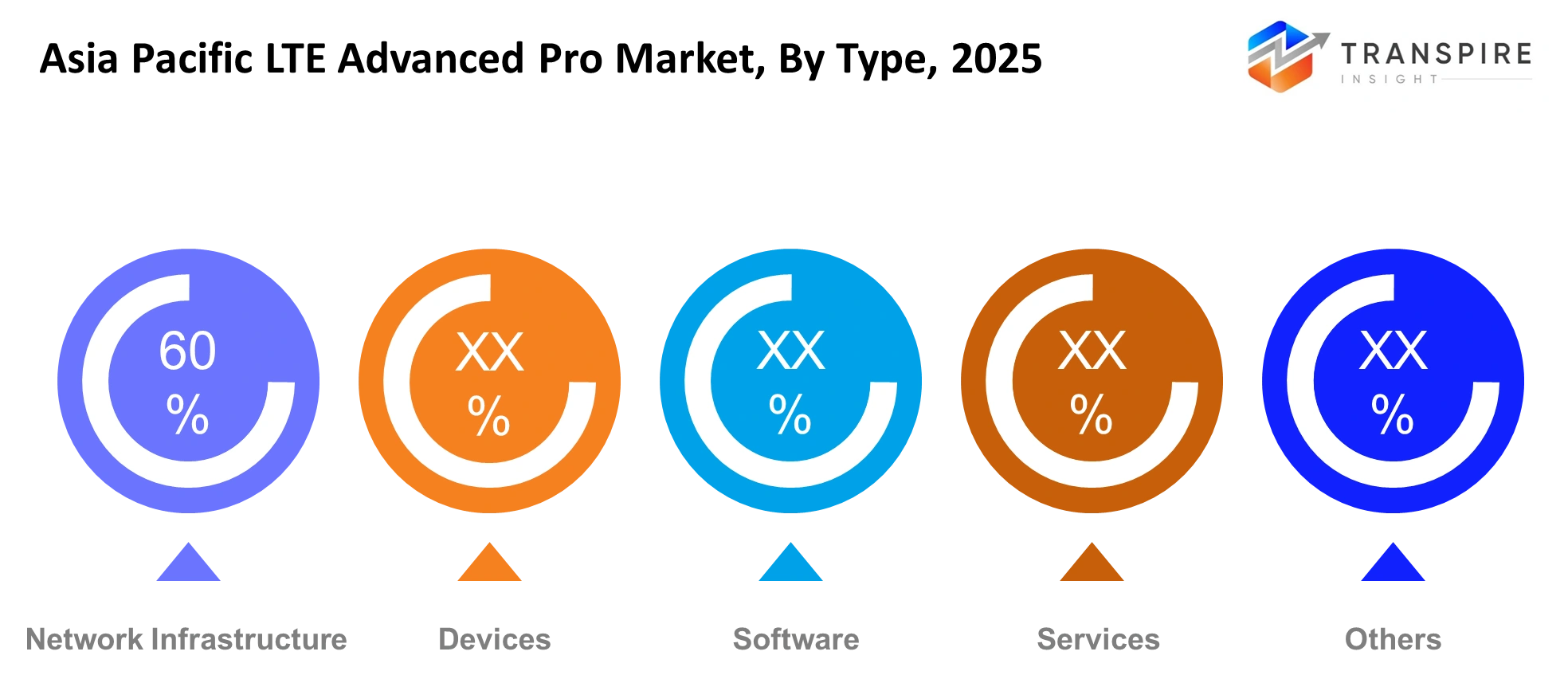
The Asia Pacific market for LTE Advanced Pro networks will depend on its network infrastructure because operators need to build high-capacity backbone systems that enable them to deliver faster data transmission services while achieving lower latency results. The implementation of macro cell, small cell, and core network system upgrades will enable broader coverage throughout both urban and rural areas.
The devices segment will comprise smartphones, routers, and connected modules that enable advanced LTE functionalities which provide users with high-speed internet access through continuous network connectivity. The software and services will deliver network optimization solutions together with traffic management tools and subscriber support systems which boost system efficiency. The other categories will include supporting hardware and emerging connectivity tools that assist deployment flexibility across regions.
To learn more about this report, Download Free Sample Report
By Application :
Mobile broadband will continue to be a primary application field because urban areas need fast internet access to support their increasing demand for online services. The implementation of LTE Advanced Pro technology will enhance streaming and video calls and online activities because it allows users to enjoy stable services while limiting network overload during busy hours.
Industries will expand their IoT connectivity through the implementation of smart sensors and connected devices which depend on stable low-latency networks. Smart cities will implement LTE Advanced Pro technology to manage their traffic systems and surveillance systems together with public utility operations. Machine-to-machine communication will drive industrial automation whereas public safety systems will rely on dependable networks to power their emergency response and coordination operations. The other applications will provide specialized connectivity solutions for different industry needs.
By End-User :
The primary users of LTE Advanced Pro systems will be telecom operators who implement this technology to enhance their network performance and coverage capabilities. The operators plan to enhance network performance by increasing their system capacity while decreasing congestion problems which occur during peak periods in all countries located within the Asia Pacific region.
Companies will implement LTE Advanced Pro because it provides better communication systems and increases their operational efficiency. Government entities will utilize the technology for their public service delivery systems and surveillance operations and smart governance projects. Industrial firms will use the system to track their production processes and supply chain activities through continuous monitoring. Customers will experience enhanced internet speeds which they can use for personal purposes while specialized service providers will need dependable wireless connections to operate their business activities.
By Deployment :
The deployment model will enable wireless operators to create complete LTE Advanced Pro networks which operate at peak performance without needing old system components. The new telecom networks which implement this approach will deliver higher data transmission rates and better network performance. The existing network infrastructure will continue operating under non-standalone deployment while network performance receives updates through LTE Advanced Pro system improvements.
The system will operate through a hybrid deployment method which uses both standalone and existing legacy systems to achieve better operational efficiency during system changes. The combined system will enable telecommunications companies to update their network systems at a gradual pace while providing uninterrupted service to their customers who operate in various locations and usage backgrounds.
What are the Key Use Cases Driving the Asia Pacific LTE Advanced Pro Market?
The main purpose of LTE Advanced Pro throughout the Asia Pacific region is to establish private industrial networks which operate in major manufacturing plants. Manufacturing facilities use this technology to achieve fast machine operations synchronization and to perform automated quality control tasks and to maintain continuous network access throughout their production areas which makes this solution the top choice for business network funding.
The adoption of this technology is growing in both port logistics operations and energy infrastructure systems. Major container terminals use LTE Advanced Pro to connect autonomous yard equipment, enable real-time cargo tracking, and coordinate fleet movement. These networks have become standard for utilities and power generation operators who need to monitor remote assets and automate their substation operations.
Connected mining operations and offshore energy platforms are developing new applications. Australian mining operators are testing LTE-based autonomous haulage systems while offshore facilities are testing private wireless networks for their predictive equipment monitoring needs. Smart rail corridor management represents a developing field with significant potential for long-term use.
|
Report Metrics |
Details |
|
Market size value in 2025 |
USD 2.7 Billion |
|
Market size value in 2026 |
USD 3.06 Billion |
|
Revenue forecast in 2033 |
USD 7.12 Billion |
|
Growth rate |
CAGR of 12.82% from 2026 to 2033 |
|
Base year |
2025 |
|
Historical data |
2021 - 2024 |
|
Forecast period |
2026 - 2033 |
|
Report coverage |
Revenue forecast, competitive landscape, growth factors, and trends |
|
Regional scope |
Asia Pacific ( China, India, Japan, South Korea, Australia, Rest of Asia Pacific) |
|
Key company profiled |
Huawei, Ericsson, Nokia, ZTE, Samsung, Qualcomm, Intel, Cisco, NEC, Fujitsu, MediaTek, Broadcom, Juniper Networks, AT&T, Verizon. |
|
Customization scope |
Free report customization (country, regional & segment scope). Avail customized purchase options to meet your exact research needs. |
|
Report Segmentation |
By Type (Network Infrastructure, Devices, Software, Services, Others); By Application (Mobile Broadband, IoT Connectivity, Smart Cities, Industrial Automation, Public Safety, Others); By End-User (Telecom Operators, Enterprises, Government, Industrial Firms, Consumers, Others); By Deployment (Standalone, Non-standalone, Hybrid, Others). |
Which Regions are Driving the Asia Pacific LTE Advanced Pro Market Growth?
East Asia leads the Asia Pacific LTE Advanced Pro market, with China, Japan, and South Korea driving the highest concentration of deployments. The region maintains its leadership position through dedicated spectrum allocation policies together with mature industrial automation systems and government-supported digital infrastructure development initiatives. The development of enterprise-grade LTE Advanced Pro technology occurs because China implements smart manufacturing solutions at scale while Japan develops its private 5G networks. The established vendor network which includes Huawei Technologies and Samsung Electronics maintains its power over the market through established vendor networks.
Southeast Asia stands as the second-largest region but its growth pattern differs from East Asia because Southeast Asia relies on business operations to create stability instead of using active governmental policies to drive development. Singapore, Thailand and Malaysia have strong export-based manufacturing industries which continuously develop their logistics networks through ongoing investment. The enterprise adoption process begins with commercial operations, which leads businesses to expand their use of services after they achieve dependable operation and measurable business results. The network vendors and service providers generate consistent income through their systematic approach to investment.
South Asia has become the fastest growing regional market because India has first established its industrial corridor network and second implemented digital manufacturing incentives during the past three years. The regulatory process which discusses enterprise spectrum access together with private wireless licensing has created new possibilities for industrial LTE deployment. The market now faces increased demand because semiconductor fabrication facilities and smart logistics parks and connected infrastructure receive substantial investment. The period until 2033 provides market entrants and investors with an excellent opportunity to build initial partnerships while they secure extended business contracts.
Who are the Key Players in the Asia Pacific LTE Advanced Pro Market and How Do They Compete?
The Asia Pacific LTE Advanced Pro market presents moderate market consolidation because only a few global telecom infrastructure vendors manage most large enterprise deployments while regional vendors offer specialized integration services. The competition between companies now focuses on their technical knowledge and their experience with industrial applications and their capability to create complete private wireless systems which extends beyond just equipment costs. The vendors establish dedicated enterprise contracts which include their network software products together with AI-powered orchestration tools and managed service offerings. Regional system integrators create dedicated solutions for manufacturing and logistics clients which enable them to customize their services while their competitors deploy solutions at a faster pace.
Huawei Technologies utilizes its vertical integration strategy to compete by creating integrated systems that combine radio access equipment with edge computing and their partnerships in industrial automated systems throughout China. Its advantage lies in tight interoperability across hardware and software layers, which reduces deployment complexity for large industrial operators. Nokia uses its modular private wireless systems, which enable businesses to expand their networks through gradual development, to create a competitive edge in Southeast Asia because that region commonly follows phased infrastructure development plans. Its expansion strategy relies heavily on partnerships with industrial automation providers.
Ericsson offers its software-defined network optimization and advanced spectrum efficiency solutions which suit high-density smart factory environments. Samsung Electronics uses its semiconductor and electronics manufacturing facilities to develop LTE Advanced Pro solutions which it tests in operational environments before launching commercial products. Cisco Systems enhances its market position through the combination of private wireless and enterprise security systems which attract operators who need safe industrial digital transformation solutions.
Company List
- Huawei
- Ericsson
- Nokia
- ZTE
- Samsung
- Qualcomm
- Intel
- Cisco
- NEC
- Fujitsu
- MediaTek
- Broadcom
- Juniper Networks
- AT&T
- Verizon
Recent Development News
In February 2025, Telstra entered a strategic partnership with Ericsson to deploy a 5G Advanced network upgrade in Australia. The collaboration involves upgrading Telstra’s radio access network with Ericsson’s next-generation Open RAN-ready hardware and 5G Advanced software, enhancing LTE Advanced Pro–adjacent infrastructure performance and enabling AI-driven network optimization across the Asia Pacific region.
Source: https://www.nasdaq.com/
In March 2026, AXIAN Telecom and AST SpaceMobile entered a strategic partnership to launch a direct-to-device space-based mobile broadband network across Africa and adjacent Asia-linked mobile coverage corridors. The collaboration aims to extend LTE/4G-class connectivity (including LTE Advanced Pro capability) directly to standard smartphones in remote and underserved regions, enhancing regional coverage continuity and operator service reach.
Source: https://www.axian-telecom.com/
What Strategic Insights Define the Future of the Asia Pacific LTE Advanced Pro Market?
The Asia Pacific LTE Advanced Pro market will develop for five to seven years until it becomes a dedicated industrial connectivity system which operates between existing enterprise LTE networks and complete private 5G systems. Organizations need this solution because they require affordable infrastructure which provides quick response times and supports automated processes without needing to invest in complete 5G systems. Enterprises now focus on establishing operational dates which match their business needs instead of implementing the latest network technologies.
Businesses face danger from technology advances which occur at faster rates than they can manage. The adoption cycle for LTE Advanced Pro will shorten in developed industrial markets if two conditions occur: private 5G equipment prices decrease faster than expected and governments expedite access to dedicated 5G spectrum. Vendors face market concentration risks when they depend too much on transitional network agreements for their business operations.
A strong emerging opportunity is taking shape in India’s industrial corridors and semiconductor manufacturing zones, where regulatory maturation is aligning with greenfield infrastructure development. Market participants should establish initial ecosystem partnerships with industrial automation companies and edge computing vendors instead of limiting their operations to connectivity offerings. Businesses which market LTE Advanced Pro as part of an all-inclusive industrial digitalization solution will obtain better chances to win multi-year enterprise contracts.
Asia Pacific LTE Advanced Pro Market Report Segmentation
By Type
- Network Infrastructure
- Devices
- Software
- Services
By Application
- Mobile Broadband
- IoT Connectivity
- Smart Cities
- Industrial Automation
- Public Safety
By End-User
- Telecom Operators
- Enterprises
- Government
- Industrial Firms
- Consumers
By Deployment
- Standalone
- Non-standalone
- Hybrid
Frequently Asked Questions
Find quick answers to common questions.
The Asia Pacific LTE Advanced Pro Market size is USD 7.12 Billion in 2033.
Key segments for the Asia Pacific LTE Advanced Pro Market are By Type (Network Infrastructure, Devices, Software, Services, Others); By Application (Mobile Broadband, IoT Connectivity, Smart Cities, Industrial Automation, Public Safety, Others); By End-User (Telecom Operators, Enterprises, Government, Industrial Firms, Consumers, Others); By Deployment (Standalone, Non-standalone, Hybrid, Others).
Major Asia Pacific LTE Advanced Pro Market players are Huawei, Ericsson, Nokia, ZTE, Samsung, Qualcomm, Intel, Cisco, NEC, Fujitsu, MediaTek, Broadcom, Juniper Networks, AT&T, Verizon.
The Asia Pacific LTE Advanced Pro Market size is USD 2.7 Billion in 2025.
The Asia Pacific LTE Advanced Pro Market CAGR is 12.82% from 2026 to 2033.
- Huawei
- Ericsson
- Nokia
- ZTE
- Samsung
- Qualcomm
- Intel
- Cisco
- NEC
- Fujitsu
- MediaTek
- Broadcom
- Juniper Networks
- AT&T
- Verizon
Recently Published Reports
-
Apr 2026
3D Optical Profiler Market
3D Optical Profiler Market Size, Share & Analysis Report By Type (Desktop 3D Optical Profiler, and Portable 3D Optical Profiler), By Technology (Confocal Technology, and White Light Interference), By End-Use Industry (Manufacturing, Research Institutions, Automotive, Aerospace and Defense, Medical Devices, and Other), and Geography (North America, Europe, Asia-Pacific, Middle East and Africa, South and Central America), 2021 - 2031
-
Apr 2026
Depth Sensor Market
Depth Sensor Market Size, Share & Analysis Report By Type (Infrared Depth Sensors, Time-of-Flight (ToF) Sensors, Stereo Vision Sensors, Structured Light Sensors, Ultrasonic Depth Sensors), By Application (Automotive, Robotics, Gaming, Consumer Electronics, Industrial Automation, Healthcare, Security & Surveillance, Others), By End Users (Automotive Manufacturers, Consumer Electronics Companies, Healthcare Providers, Industrial Companies, Security Agencies, Gaming Companies, Robotics Companies, Others), and Geography (North America, Europe, Asia-Pacific, Middle East and Africa, South and Central America), 2021 – 2031
-
Apr 2026
Digital Manufacturing Market
Digital Manufacturing Market Size, Share & Analysis Report By Component (Hardware, Software, and Services), By Technology (Robotics, 3D Printing, Internet of Things (IoT), and Others), By Application (Automotive and Transportation, Aerospace and Defense, Consumer Electronics, Industrial Machinery, and Others), By Process Type (Computer-Based Designing, Computer-Based Simulation, Computer 3D Visualization, Analytics, and Others), and Geography (North America, Europe, Asia-Pacific, Middle East and Africa, South and Central America), 2021 – 2031
-
Apr 2026
Digital Visa Services Market
Digital Visa Services Market Size, Share & Analysis Report By Type (Individual Travelers, Group Travelers), By Application (Tourism, Business Travel, Others), and Geography (North America, Europe, Asia-Pacific, Middle East and Africa, South and Central America), 2021 – 2031