
North America Mobile Broadband Market Size & Forecast:
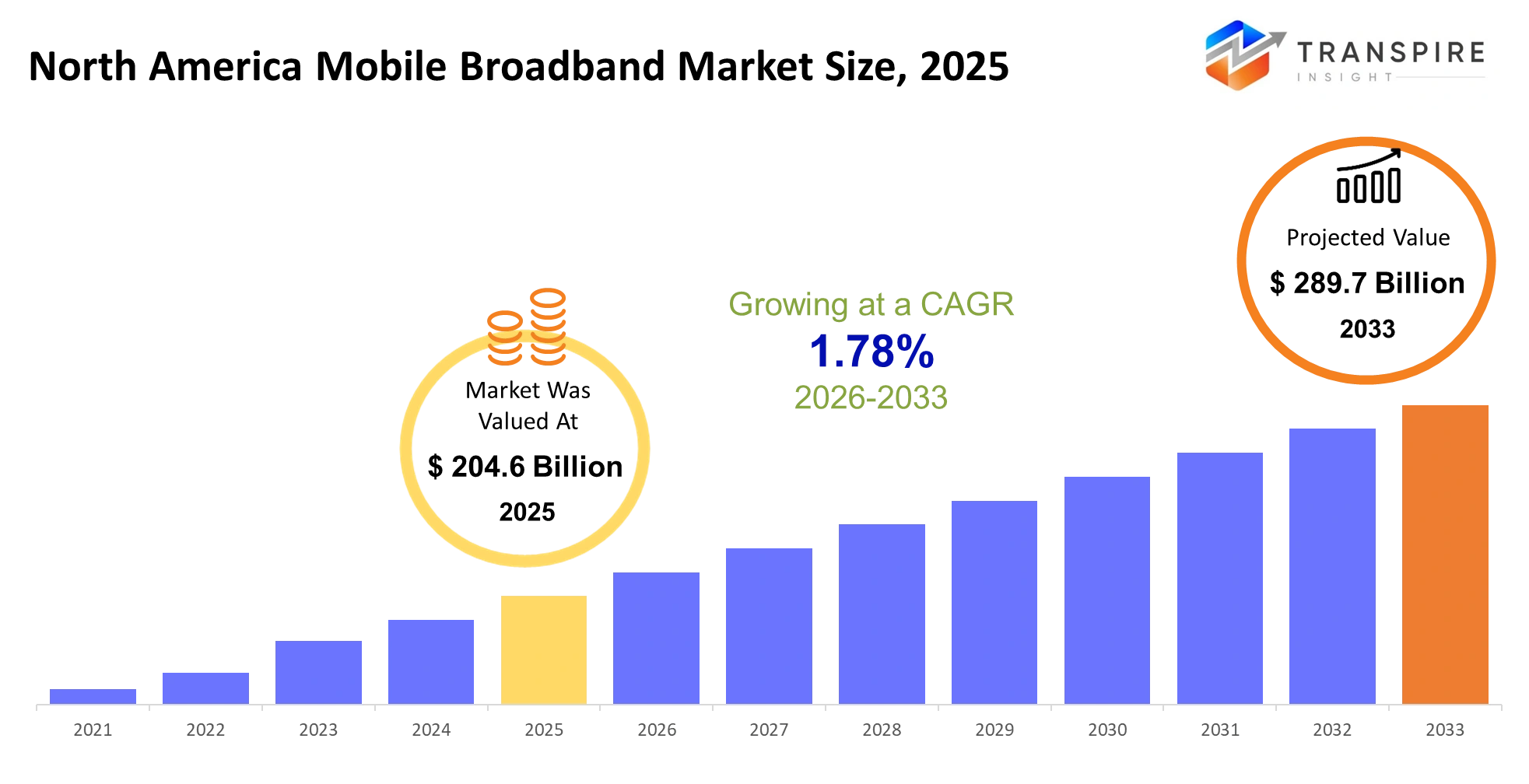
- North America Mobile Broadband Market Size 2025: USD 204.6 Billion
- North America Mobile Broadband Market Size 2033: USD 289.7 Billion
- North America Mobile Broadband Market CAGR: 1.78%
- North America Mobile Broadband Market Segments: By Technology (4G, 5G), By Device (Smartphone, Tablet), By End-User (Residential, Commercial).
To learn more about this report,  Download Free Sample Report
North America Mobile Broadband Market Summary:
The North America Mobile Broadband Market size is estimated at USD 204.6 Billion in 2025 and is anticipated to reach USD 289.7 Billion by 2033, growing at a CAGR of 1.78% from 2026 to 2033. The telecom industry in North America which includes Canada, the United States, and Mexico experiences its mobile broadband market through consumer behavior of data-heavy activities and their use of multiple platforms and their need for improved network systems. The demand for seamless streaming and cloud gaming and dependable remote work will drive operators to enhance their network capabilities and adjust their pricing structures. The switch to 5G standalone networks together with edge computing will enable providers to create more customized services. The regulatory frameworks established in the United States Canada and Mexico will promote efficient spectrum usage and improvements in rural internet access. The combination of digital services through competitive bundling will create new ways for customers to perceive value while the financial constraints will shape the development of prepaid services and equipment financing methods.
Key Market Trends & Insights:
The North American Mobile Broadband Market which serves Canada and the United States and Mexico will see customers adopting always-on connectivity while they expect continuous data access as their new standard. Users will demand faster speeds not only for entertainment but also for hybrid work and digital collaboration. The expectation requires providers to deliver network consistency as their primary focus while they provide multiple plans which adapt to changing usage patterns of urban and semi-urban users.
The evolution of technology will focus on establishing more extensive 5G networks because standalone systems deliver higher speed performance and better efficiency during peak usage times. Operators will gradually implement edge computing technology to enable real-time processing of immersive media content and connected devices. The ecosystem of devices will grow together with network systems as manufacturers develop hardware which uses less power and improves signal reception. Service providers will need to reevaluate their infrastructure investments while developing unique service packages that meet the needs of different customer groups.
The region will experience fundamental changes in pricing strategies because its competition levels will increase. Telecom companies will test bundled packages which combine streaming services with cloud storage and enterprise software to keep their customers. Prepaid payment systems will receive renewed interest because customers in budget-sensitive markets need to manage their expenses while having usage flexibility. The financing options for devices will become easier to access which will drive people to purchase premium smartphones and Internet-connected devices.
Canadian, American, and Mexican market activities will still be based on regulatory policies geared toward the issues of spectrum allocation and digital access, as well as competitive markets. Efforts to develop programs that will bridge gaps and expand connections in under-serviced regions will be encouraged by the government. This will create a situation where policy changes will impact not only collaborative efforts across borders but also the exchange of resources within operations, thus easing implementation of resource-saving methods.
North America Mobile Broadband Market Segmentation
By Technology
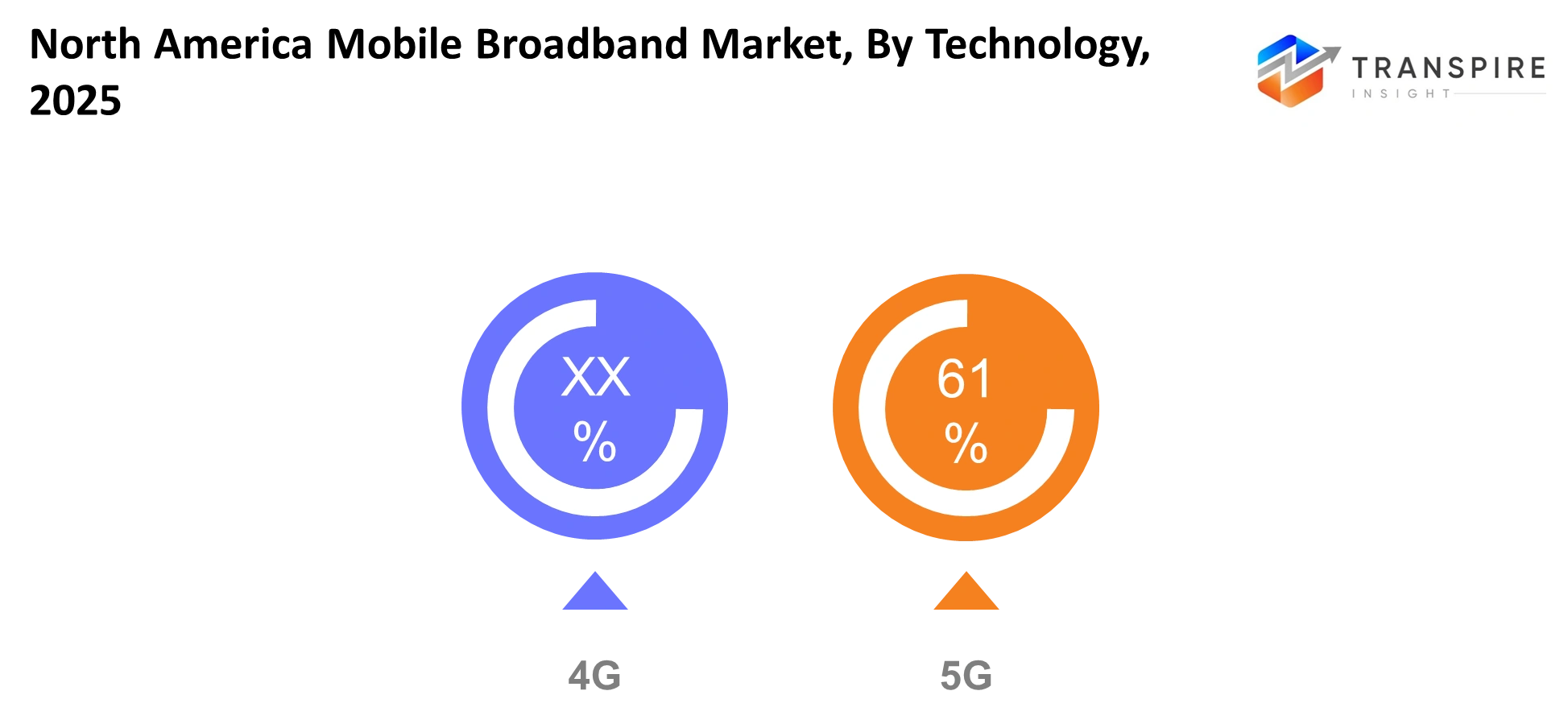
4G- The 4G networks will continue to function as a trustworthy foundation which provides service to regions that need to wait until complete 5G deployment. Users need it because they want to browse websites and stream videos and use applications without any interruptions. Telecom companies will use their resources to operate these networks which they will improve for better performance during regular usage periods to provide ongoing operational support. The system will remain useful because its costs are affordable and it exists in every location which offers value to users who need dependable service instead of modern technological advancements.
5G- The introduction of 5G technology will bring faster internet speeds combined with decreased latency times and better multiple device connectivity to users. The system will enable advanced applications which include cloud gaming and augmented reality experiences and virtual communication platforms. Service providers will dedicate financial resources to both network expansion efforts and systems improvements which will boost their operational capabilities. The adoption of 5G technology will increase as more devices become compatible which will lead to the development of new service offerings that target users with high data consumption needs.
To learn more about this report, Download Free Sample Report
By Device
Smartphone- People will use smartphones as their main device to access mobile broadband because smartphones offer multiple functions and manufacturers keep creating new features. Users will use these devices for their entertainment needs and their communication requirements and their financial activities and their work needs. The manufacturers will concentrate their efforts on developing better battery performance together with faster processing capabilities and enhanced network support. Users will expect more from smartphones which will lead to device manufacturers creating advanced features that result in higher data consumption while mobile service providers need to maintain their network performance across all conditions.
Tablet- Users who want to use larger screens for their work and their education and their media viewing needs will find tablets to be their ideal device. The gadgets will attract more interest in organizations where workers have to operate from different positions since there is a need for portability and functionality. Learning establishments and companies will use tablets to facilitate digital processes, thus making them more relevant. The gadgets will generate another source of data since they will be used for video streaming and teleconferencing and collaboration applications even though they are less popular than cell phones.
By End-User
Residential- Data usage in homes will increase because residential users depend on multiple connected devices. Users will need stable connections which deliver high-speed internet for streaming content and online gaming and remote work and smart home device operations, all at the same time. Households will expect their internet service to work without interruptions while they use multiple devices at once. Service providers will create custom plans which match different customer usage needs while delivering dependable service and cost-effective solutions to families and single users who need various online services.
Commercial- Mobile broadband will serve as the primary technology which commercial users need to operate their businesses and maintain communication with customers. Enterprises will use mobile networks to support their employees who work remotely and to access cloud-based software and to obtain immediate data updates. Mobile networks will become essential to daily operations for industries including retail and logistics and healthcare. Businesses will seek secure, scalable, and efficient connectivity solutions, which will lead service providers to create custom services that match their business needs and help them reach their productivity targets.
Regional Insights
The United States will lead regional momentum through dense network infrastructure and early adoption of advanced wireless technologies. Urban consumers will expect uninterrupted high-speed connectivity, while rural expansion will remain a policy priority. Operators will work to improve their systems through capacity upgrades which will decrease latency for digital service delivery. The competitive environment will drive companies to develop bundled services that combine connectivity with entertainment and productivity tools, which will change how users assess value during their daily mobile usage.
Canada will establish equal access to communication services through its urban coverage and its specific programs for rural areas. Terrain will influence the way network services are provided since there will be a need for robust and efficient networks. Reliability and service quality will matter most to consumers, particularly those who live in distant places. Regulations will favor infrastructure sharing while maintaining equality among competitors in the market. Digitization will increase in scope, which will prompt providers to improve pricing and service options to meet consumer demands in various locations.
The ongoing development of Mexico will proceed at a consistent pace because mobile broadband services will reach more people throughout the country. The operators will create prepaid and hybrid plans which provide customers with multiple payment options because price will continue to be the main element that determines which services customers will utilize. The network performance in underserved areas will improve through ongoing infrastructure development projects which will enhance system capabilities. The increase of smartphone ownership will lead to higher data consumption because businesses will depend more on mobile networks for their operational needs within a digitally advanced economy.
The North American continent will present distinct regional variations which create an interconnected geographical system. The future development of services will depend on cross-border partnerships and the alignment of technologies. The market will require providers to offer uninterrupted connectivity across all locations because customers expect this service standard. The regulatory system will establish rules that protect competitive markets while enabling businesses to grow their service offerings. The upcoming digital connectivity requirements will determine how mobile broadband networks will evolve based on the changing internet usage patterns of users.
Recent Development News
United States: Large-Scale Infrastructure Push and Spectrum Expansion
Recent developments in the United States highlight aggressive investment in network capacity and coverage. In 2026, AT&T announced a $250 billion plan to expand fiber, 5G, and satellite connectivity, aiming to meet rising demand from AI-driven applications and connected devices. At the same time, spectrum acquisitions and regulatory debates around C-band allocation will reshape how operators manage bandwidth and service quality across dense and underserved markets.
Canada: Long-Term Investment and Rural Connectivity Focus
Canada has witnessed a strong commitment toward strengthening domestic telecom infrastructure. TELUS revealed a multi-year investment exceeding $50 billion to enhance wireless coverage, build AI-enabled facilities, and improve connectivity in remote regions. This development signals a broader national effort to reduce digital gaps while supporting innovation. Providers will increasingly align network expansion with economic resilience and local technology ecosystems.
Mexico: Expanding Access and Industrial 5G Applications
In Mexico, recent momentum will center on improving accessibility and enabling industrial use cases. Broader North American initiatives, including expanded standalone 5G deployments, will extend into logistics corridors and manufacturing hubs, supporting real-time operations and smart infrastructure. As adoption increases, telecom operators will focus on cost-effective solutions, ensuring that mobile broadband becomes more accessible while supporting enterprise-driven digital transformation
|
Report Metrics |
Details |
|
Market size value in 2025 |
USD 204.6 Billion |
|
Market size value in 2026 |
USD 207.3 Billion |
|
Revenue forecast in 2033 |
USD 289.7 Billion |
|
Growth rate |
CAGR of 1.78% from 2026 to 2033 |
|
Base year |
2025 |
|
Historical data |
2021 – 2024 |
|
Forecast period |
2026 – 2033 |
|
Report coverage |
Revenue forecast, competitive landscape, growth factors, and trends |
|
Regional scope |
North America (Canada, The United States, and Mexico) |
|
Key company profiled |
Verizon, AT&T, T-Mobile, Rogers, Bell, Telus, Ericsson, Nokia, Huawei, Qualcomm, Cisco, Samsung, ZTE, Juniper, Vodafone. |
|
Customization scope |
Free report customization (country, regional & segment scope). Avail customized purchase options to meet your exact research needs. |
|
Report Segmentation |
By Technology (4G, 5G), By Device (Smartphone, Tablet), By End-User (Residential, Commercial). |
Key North America Mobile Broadband Market Company Insights
The Mobile Broadband Market in North America which includes Canada and the United States and Mexico will experience competition based on three factors which include network quality and pricing innovations and digital service integration. Verizon AT&T T-Mobile Rogers Bell Telus and América Móvil will work to develop their 5G networks while using bundled products to maintain existing customers. Service differentiation will transform as operators build strategic partnerships with content providers and cloud platform developers. Operators will invest in developing rural connectivity and improving the operational effectiveness of their infrastructure. The competitive landscape will force companies to enhance their prepaid and postpaid service models which provide affordable solutions that meet performance requirements for both individual customers and business clients.
Company List
- Verizon
- AT&T
- T-Mobile
- Rogers
- Bell
- Telus
- Ericsson
- Nokia
- Huawei
- Qualcomm
- Cisco
- Samsung
- ZTE
- Juniper
- Vodafone
North America Mobile Broadband Market Report Segmentation
By Technology
- 4G
- 5G
By Device
- Smartphone
- Tablet
By End-User
- Residential
- Commercial
Frequently Asked Questions
Find quick answers to common questions.
The approximate North America Mobile Broadband Market size for the market will be USD 289.7 Billion in 2033.
Key segments for the North America Mobile Broadband Market By Technology (4G, 5G), By Device (Smartphone, Tablet), By End-User (Residential, Commercial).
Major players in the North America Mobile Broadband Market are Verizon, AT&T, T-Mobile, Rogers, Bell, Telus, Ericsson, Nokia, Huawei, Qualcomm, Cisco, Samsung, ZTE, Juniper, Vodafone.
The North America Mobile Broadband Market size is USD 204.6 Billion in 2025.
The North America Mobile Broadband Market CAGR is 1.78%.
- Verizon
- AT&T
- T-Mobile
- Rogers
- Bell
- Telus
- Ericsson
- Nokia
- Huawei
- Qualcomm
- Cisco
- Samsung
- ZTE
- Juniper
- Vodafone
Recently Published Reports
-
Apr 2026
3D Optical Profiler Market
3D Optical Profiler Market Size, Share & Analysis Report By Type (Desktop 3D Optical Profiler, and Portable 3D Optical Profiler), By Technology (Confocal Technology, and White Light Interference), By End-Use Industry (Manufacturing, Research Institutions, Automotive, Aerospace and Defense, Medical Devices, and Other), and Geography (North America, Europe, Asia-Pacific, Middle East and Africa, South and Central America), 2021 - 2031
-
Apr 2026
Depth Sensor Market
Depth Sensor Market Size, Share & Analysis Report By Type (Infrared Depth Sensors, Time-of-Flight (ToF) Sensors, Stereo Vision Sensors, Structured Light Sensors, Ultrasonic Depth Sensors), By Application (Automotive, Robotics, Gaming, Consumer Electronics, Industrial Automation, Healthcare, Security & Surveillance, Others), By End Users (Automotive Manufacturers, Consumer Electronics Companies, Healthcare Providers, Industrial Companies, Security Agencies, Gaming Companies, Robotics Companies, Others), and Geography (North America, Europe, Asia-Pacific, Middle East and Africa, South and Central America), 2021 – 2031
-
Apr 2026
Digital Manufacturing Market
Digital Manufacturing Market Size, Share & Analysis Report By Component (Hardware, Software, and Services), By Technology (Robotics, 3D Printing, Internet of Things (IoT), and Others), By Application (Automotive and Transportation, Aerospace and Defense, Consumer Electronics, Industrial Machinery, and Others), By Process Type (Computer-Based Designing, Computer-Based Simulation, Computer 3D Visualization, Analytics, and Others), and Geography (North America, Europe, Asia-Pacific, Middle East and Africa, South and Central America), 2021 – 2031
-
Apr 2026
Digital Visa Services Market
Digital Visa Services Market Size, Share & Analysis Report By Type (Individual Travelers, Group Travelers), By Application (Tourism, Business Travel, Others), and Geography (North America, Europe, Asia-Pacific, Middle East and Africa, South and Central America), 2021 – 2031