

United States Commercial Greenhouse Market Size & Forecast:
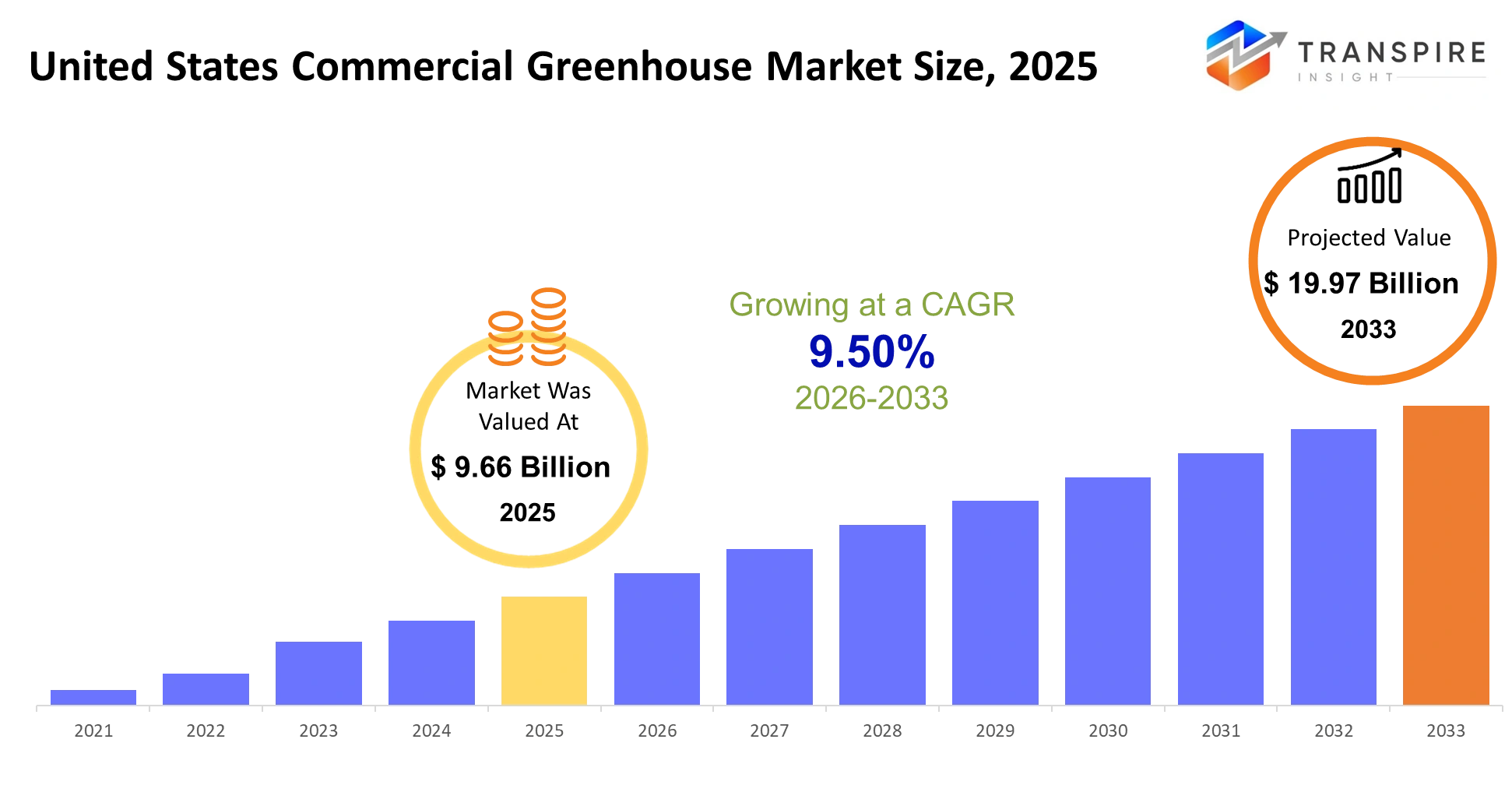
- United States Commercial Greenhouse Market Size 2025: USD 9.66 Billion
- United States Commercial Greenhouse Market Size 2033: USD 19.97 Billion
- United States Commercial Greenhouse Market CAGR: 9.50%
- United States Commercial Greenhouse Market Segments: By Type (Glass Greenhouses, Plastic Greenhouses), By Crop Type (Vegetables, Fruits, Flowers & Ornamentals), By Technology (Hydroponics, Aeroponics, Soil-Based Cultivation).
To learn more about this report,  Download Free Sample Report
United States Commercial Greenhouse Market Summary:
The United States Commercial Greenhouse Market size is estimated at USD 9.66 Billion in 2025 and is anticipated to reach USD 19.97 Billion by 2033, growing at a CAGR of 9.50% from 2026 to 2033. The United States commercial greenhouse market shows continuous expansion because people now want fresh local produce and sustainable farming practices. Growers can achieve maximum production by using advanced climate control systems together with automated systems and hydroponic technology. The increasing consumer demand for organic products and premium crops drives the growth of commercial greenhouses in modern agriculture. The market participants use technological development together with strategic business growth to fulfil changing industry requirements and environmental compliance standards.
Key Market Trends & Insights:
- Farmers have started using hydroponic and vertical farming methods within greenhouses because these techniques help them create more agricultural space while producing higher crop amounts. The methods which farmers use allow them to grow crops throughout the entire year while decreasing their need for traditional farming methods which depend on soil.
- The system uses advanced sensors together with IoT devices and climate control systems to gather data on temperature and humidity and nutrient content. The automation system enables better operational performance because it cuts down on waste while maintaining uniformity in crop production.
- Greenhouse operators have started using energy-saving lighting systems together with water conservation methods and renewable energy technologies. The implementation of environmentally sustainable practices as a primary business strategy enables companies to satisfy consumer demand for organic products.
- Consumers are driving greenhouse development because they prefer to buy fresh vegetables and fruits which do not have pesticides and come from local sources. Commercial growers use this market demand to provide restaurants and grocery stores and farmers' markets with their products.
- Greenhouses now grow herbs and berries and exotic crops in addition to their traditional vegetable production. Growers who expand their crop selections can better serve specialised markets while boosting their business earnings.
- Companies are allocating funds to research and development activities which will help them create more effective greenhouse systems and decrease business expenses while manufacturing crops that can resist diseases. Companies need to keep introducing new products to maintain their competitive edge.
United States Commercial Greenhouse Market Segmentation
By Type
- Glass Greenhouses: Farmers choose glass greenhouses because these structures can withstand time while providing complete solar illumination. The system provides exact climate management which suits the cultivation of valuable flowers and specialised vegetable crops. Commercial growers select this option because its initial costs exceed other choices, yet it delivers superior performance and higher production output across its lifespan.
- Plastic Greenhouses: Plastic greenhouses provide a combination of lightweight properties and affordable price points, which results in straightforward installation procedures. The structure uses polyethylene or polycarbonate sheets to create an environment which enables growers to control both temperature and humidity levels for their vegetable and fruit crops. The system enables small- and medium-scale growers to increase their production capacity without requiring extensive financial resources.
By CropType
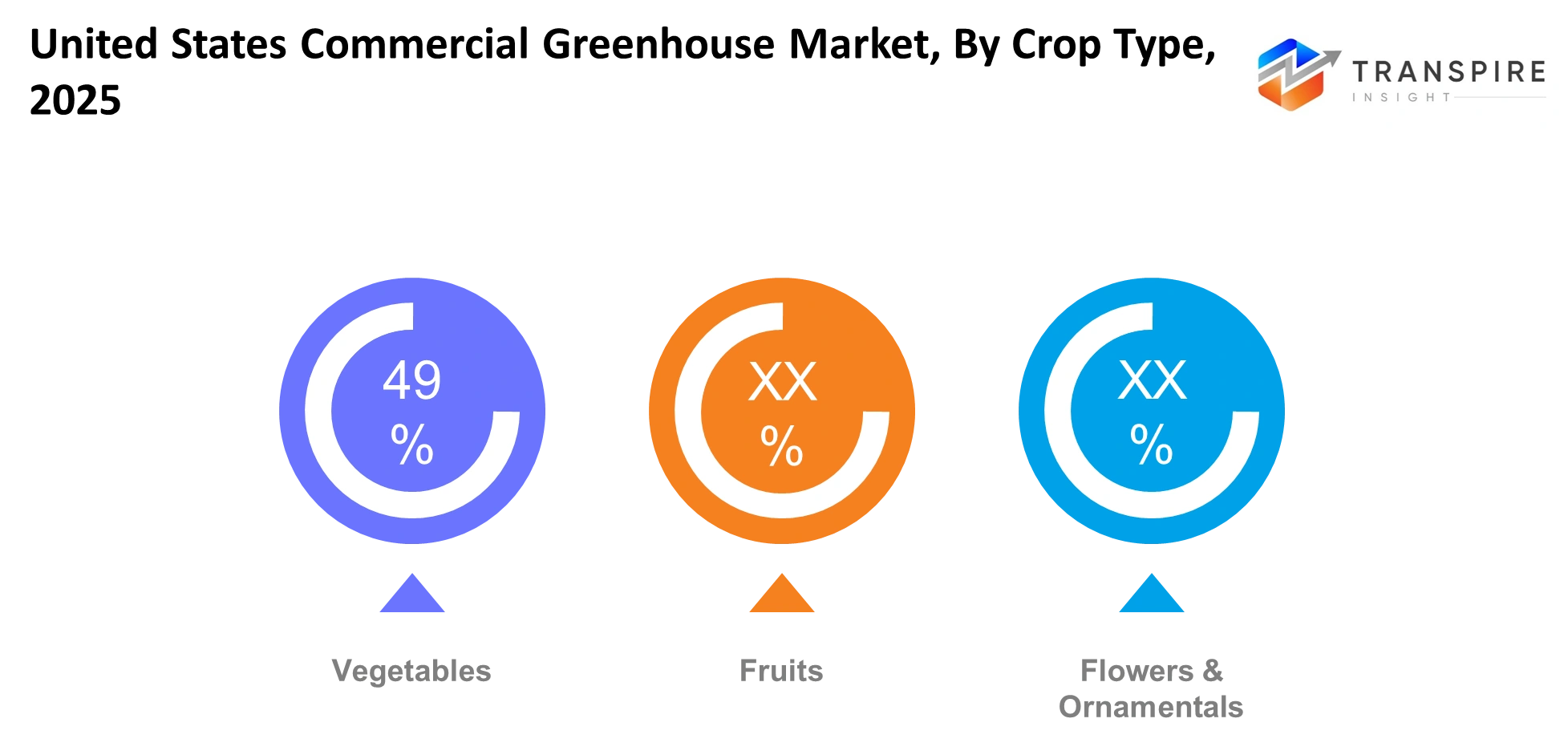
- Vegetables: The U.S. commercial greenhouses grow vegetables as their primary cultivated crop. The practice of controlled environments enables better growth results while producing higher quality products that last through extended harvesting periods. The greenhouse environment enables tomatoes and cucumbers and peppers to grow successfully because urban markets currently require fresh produce that people can eat without pesticides and which comes from local farms.
- Fruits: Greenhouses support fruit cultivation because they create protected areas which protect strawberries and blueberries from both pests and dangerous weather conditions. The method enables commercial growers to produce their products throughout the entire year while they can maintain their business results, which helps them enter premium markets and meet the rising demand for both regular and off-season fruit.
- Flowers & Ornamentals: Greenhouses provide essential advantages to flower and ornamental plant cultivation by creating conditions that control light and temperature and humidity levels. The horticultural industry raises roses and orchids and potted plants throughout the entire year to supply retail stores and landscaping services and international markets. The greenhouse environment helps floriculture businesses achieve high profits through its ability to maintain product quality and show vibrant colours and long-lasting flower displays.
To learn more about this report, Download Free Sample Report
By Technology
- Hydroponics: The hydroponic system allows plants to develop through its operation, which utilises nutrient water solutions for cultivation instead of using soil as a growing medium. The technology provides three benefits because it boosts operational efficiency while decreasing water consumption and enabling farmers to grow more crops in smaller areas. Commercial growers of the system have complete control over nutrient levels, which results in accelerated production cycles through environmentally sustainable methods for their vegetables and herbs and leafy greens.
- Aeroponics: Aeroponics enables plants to grow in environments which use air and mist while needing only minimal water for their development. The method enables rapid plant development while decreasing the chance of disease transmission, and it requires less space, which makes it suitable for growing valuable crops.US-based commercial greenhouses now use aeroponics as a new method that produces higher agricultural output while using fewer resources.
- Soil-Based Cultivation: Certain crops continue to thrive in traditional soil-based greenhouse cultivation, which provides them with natural growth conditions and cost-effective growing conditions. The method helps flowers and specific vegetable crops because they need natural soil nutrients. The system uses modern techniques to reach peak productivity while maintaining traditional practices.
Country Insights
The United States' commercial greenhouse market is experiencing strong expansion because consumers want fresh locally produced organic products. Greenhouse technology is most common in California, Florida and Texas because these states have suitable weather conditions and advanced technical resources and high consumer needs. Growers are making modern greenhouse facilities that include climate control systems and automatic irrigation systems and lighting systems to achieve maximum production and product quality. Urban areas with limited land space are starting to adopt hydroponics and vertical farming systems.
Greenhouse operations now utilise renewable energy sources together with water recycling systems and energy-efficient building materials because of the increased focus on sustainable resource management. Controlled-environment agriculture receives government support, which drives market expansion because consumers want fresh vegetables and fruits and flowers throughout the entire year. The U.S. greenhouse industry will achieve sustained expansion through ongoing technological advancements and planned business growth, which will enable the industry to fulfil domestic needs and international trade prospects.
Recent Development News
In March 2026, Taylor Farms Expands Controlled‑Environment Footprint: Taylor Farms has acquired Equinox Growers’ leafy greens greenhouse in Virginia, marking its largest investment in controlled‑environment agriculture to scale production and diversify supply chains.
In January 2026, U.S. Greenhouse Vegetable Growers Urge Stronger Trade Cooperation: Ontario growers called for enhanced cooperation between Canada and the U.S. to support greenhouse vegetable trade, signalling cross‑border market implications for U.S. greenhouse producers.
|
Report Metrics |
Details |
|
Market size value in 2025 |
USD 9.66 Billion |
|
Market size value in 2026 |
USD 10.58 Billion |
|
Revenue forecast in 2033 |
USD 19.97 Billion |
|
Growth rate |
CAGR of 9.50% from 2026 to 2033 |
|
Base year |
2025 |
|
Historical data |
2021 – 2024 |
|
Forecast period |
2026 – 2033 |
|
Report coverage |
Revenue forecast, competitive landscape, growth factors, and trends |
|
Country scope |
United States |
|
Key company profiled |
Richel Group SA, Certhon Build B.V., Rough Brothers Inc., Nexus Corporation, Netafim Ltd., Argus Control Systems Ltd., Hort Americas LLC, Signify Holding (Philips Lighting), Heliospectra AB, Lumigrow Inc., Logiqs B.V., Priva Holding BV, Greentech Agro LLC, GrowSpan Greenhouse Structures Inc., GGS Structures Inc. |
|
Customization scope |
Free report customization (country, regional & segment scope). Avail customized purchase options to meet your exact research needs. |
|
Report Segmentation |
By Type (Glass Greenhouses, Plastic Greenhouses), By Crop Type (Vegetables, Fruits, Flowers & Ornamentals), By Technology (Hydroponics, Aeroponics, Soil-Based Cultivation). |
Key United States Commercial Greenhouse Company Insights
The commercial greenhouse market in the United States results from its leading companies, which drive the industry through their commitment to innovation together with their technology adoption and their strategic business expansion efforts. Companies invest in climate-controlled facilities and hydroponic and aeroponic systems and automation technology to achieve better agricultural results. Organisations now prioritise their research partnerships together with their sustainable business practices, which include energy-efficient lighting systems and water recycling initiatives. The market leaders establish their market position while they develop controlled-environment agriculture in the United States through their distribution of fresh organic produce, which customers increasingly demand.
Company List
- Richel Group SA
- Certhon Build B.V.
- Rough Brothers Inc.
- Nexus Corporation
- Netafim Ltd.
- Argus Control Systems Ltd.
- Hort Americas LLC
- Signify Holding (Philips Lighting)
- Heliospectra AB
- Lumigrow Inc.
- Logiqs B.V.
- Priva Holding BV
- Greentech Agro LLC
- GrowSpan Greenhouse Structures Inc.
- GGS Structures Inc.
United States Commercial Greenhouse Market Report Segmentation
By Type
- Glass Greenhouses
- Plastic Greenhouses
By Crop Type
- Vegetables
- Fruits
- Flowers & Ornamentals
By Technology
- Hydroponics
- Aeroponics
- Soil-Based Cultivation
Frequently Asked Questions
Find quick answers to common questions.
The approximate United States Commercial Greenhouse Market size for the market will be USD 19.97 Billion in 2033.
The key segments of the United States Commercial Greenhouse Market are By Type (Glass Greenhouses, Plastic Greenhouses), By Crop Type (Vegetables, Fruits, Flowers & Ornamentals), By Technology (Hydroponics, Aeroponics, Soil-Based Cultivation).
Major players in the United States Commercial Greenhouse Market are Richel Group SA, Certhon Build B.V., Rough Brothers Inc., Nexus Corporation, Netafim Ltd., Argus Control Systems Ltd., Hort Americas LLC, Signify Holding (Philips Lighting), Heliospectra AB, Lumigrow Inc., Logiqs B.V., Priva Holding BV, Greentech Agro LLC, GrowSpan Greenhouse Structures Inc., GGS Structures Inc.
The current market size of the United States Commercial Greenhouse Market is USD 9.66 Billion in 2025.
The United States Commercial Greenhouse Market CAGR is 9.50%.
- Richel Group SA
- Certhon Build B.V.
- Rough Brothers Inc.
- Nexus Corporation
- Netafim Ltd.
- Argus Control Systems Ltd.
- Hort Americas LLC
- Signify Holding (Philips Lighting)
- Heliospectra AB
- Lumigrow Inc.
- Logiqs B.V.
- Priva Holding BV
- Greentech Agro LLC
- GrowSpan Greenhouse Structures Inc.
- GGS Structures Inc.
Recently Published Reports
-
Apr 2026
Handling and Lifting Equipment Market
Handling and Lifting Equipment Market Size, Share & Analysis Report By Product (Cranes and Hoists, Forklifts, Conveyor Systems, Aerial Work Platforms, Others), By Application (E-Commerce, Automotive and Railway, Food and Beverages, Aviation, Others), and Geography (North America, Europe, Asia-Pacific, Middle East and Africa, South and Central America), 2021 - 2031
-
Apr 2026
HVAC Equipment Market
HVAC Equipment Market Size, Share & Analysis Report By Heating Equipment Type (Boilers and Furnaces, Heat Pumps, and Unitary Heaters), By Ventilation Equipment (Air Handling Units, Humidifiers and Dehumidifiers, Air Filters, and Fan Coiling Units), By Air Conditioning Equipment (Unitary Air Conditioners, Room Air Conditioners, Packaged Terminal Air Conditioners, and Chillers), By End User (Commercial, Residential, Industrial, and others), and Geography (North America, Europe, Asia-Pacific, Middle East and Africa, South and Central America), 2021 – 2031
-
Apr 2026
Refrigeration Valves Market
Refrigeration Valves Market Size, Share & Analysis Report By Type (Solenoid Valves, Expansion Valves, Check Valves, Service Valves, Others), By Application (Commercial Refrigeration, Industrial Refrigeration, Transport Refrigeration, Residential Refrigeration, Air Conditioning Systems), By End User (Food and Beverage Industry, Pharmaceutical Industry, HVAC Industry, Chemical Industry, Others), and Geography (North America, Europe, Asia-Pacific, Middle East and Africa, South and Central America), 2021 – 2031
-
Apr 2026
E-Commerce Packaging Materials Market
E-Commerce Packaging Materials Market By Material Type (Corrugated Boxes, Paper & Paperboard, Foam & Cushioning Materials, Plastic Packaging, Flexible Packaging, Protective Packaging, Others), By Product(Primary Packaging, Secondary Packaging, Tertiary Packaging), By Packaging Function (Protective Packaging, Branding & Presentation Packaging, Transit & Logistic Packaging, Sustainable Packaging, Tamper Evidence Packaging), By End-User (Retail & Consumer Goods, Electronic Appliances, Food & Beverages, Healthcare & Pharmaceutical, Fashion & Apparel, Home & Furnishing, Others); By Industry Analysis, Size, Share, Growth, Trends, and Forecasts 2021-2033