

North America In Vitro Diagnostics Quality Controls Market Size & Forecast:
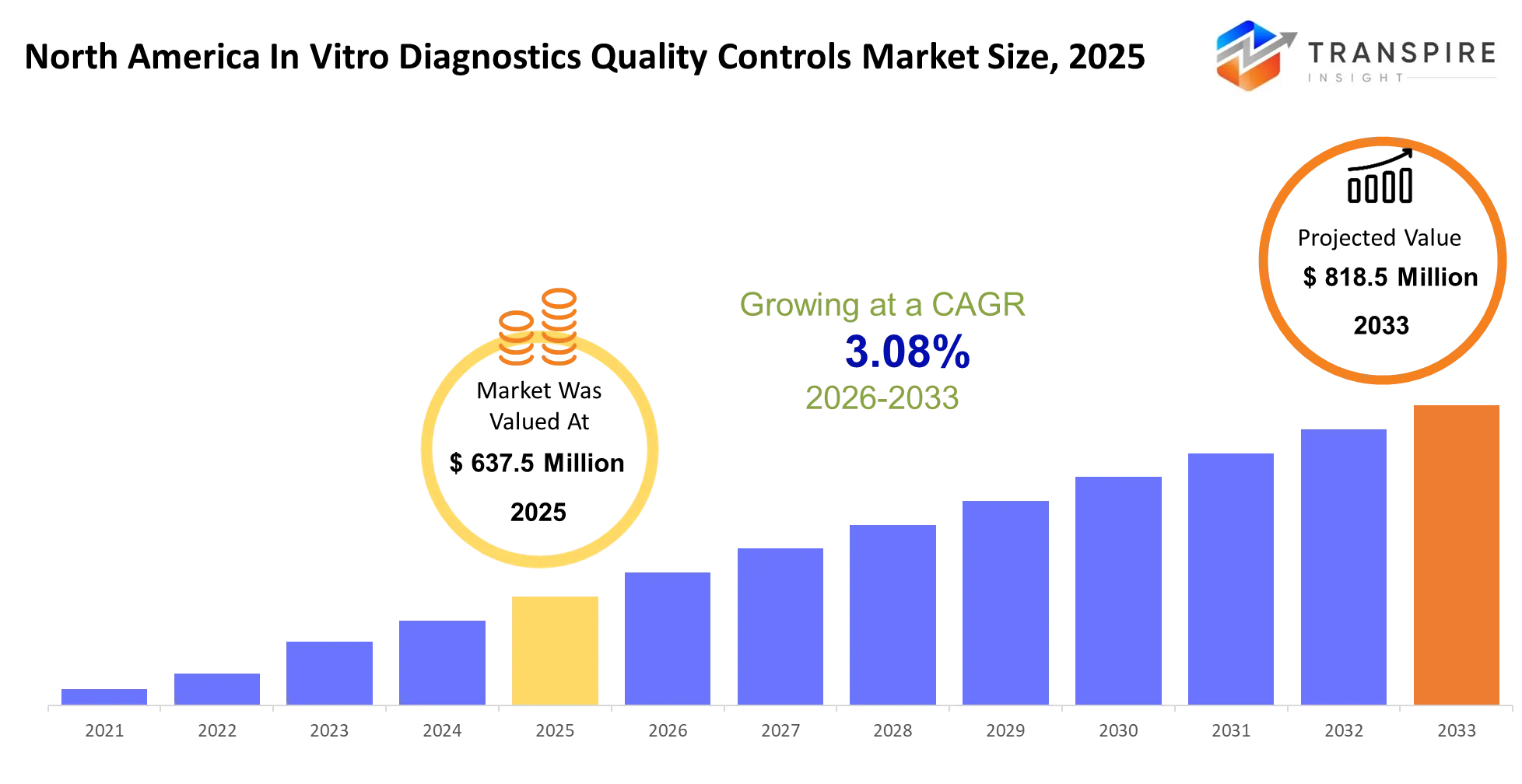
- North America In Vitro Diagnostics Quality Controls Market Size 2025: USD 637.5 Million
- North America In Vitro Diagnostics Quality Controls Market Size 2033: USD 818.5 Million
- North America In Vitro Diagnostics Quality Controls Market CAGR: 3.08%
- North America In Vitro Diagnostics Quality Controls Market Segments: By Product Type (Quality Control Sera, Molecular Quality Controls, Hematology Controls, Immunochemistry Controls, Others); By Application (Clinical Chemistry, Molecular Diagnostics, Immunoassays, Hematology Testing, Others); By End User (Hospitals, Diagnostic Laboratories, Research Institutes, Others); By Technology (Automated QC Systems, Cloud-based QC Platforms, AI-enabled QC Solutions, Others)
To learn more about this report,  Download Free Sample Report
North America In Vitro Diagnostics Quality Controls Market Summary
The North America In Vitro Diagnostics Quality Controls Market was valued at USD 637.5 Million in 2025. It is forecast to reach USD 818.5 Million by 2033. That is a CAGR of 3.08% over the period.
North America in vitro diagnostics quality controls market, basically makes sure that clinical laboratories can churn out accurate and reproducible test outcomes before anything gets sent to the patient record. In other words these controls help confirm how diagnostic instruments, reagents, and day to day workflows are actually performing in hospitals, reference labs, and even point of care testing settings. That way the chance of misleading results goes down, and those outcomes matter a lot since they can steer treatment decisions and also touch reimbursement compliance.
Over the last 3–5 years there’s been a kind of structural change, toward automation integrated and multi analyte quality control systems, and it has reshaped how labs move through their routine. Instead of leaning on manual validation, many sites now depend on more digital monitoring that is linked to laboratory information systems. The COVID-19 pandemic kind of acted as a real trigger here, it raised diagnostic testing volumes fast, and it also revealed variability issues in high throughput setups, so laboratories tightened their quality assurance routines.
When you put the higher testing intensity together with tougher regulatory attention, coming from organizations like CLIA and CAP, labs keep leaning into more advanced quality control materials. And so the priority has shifted toward continuous performance verification, which is helping quality control manufacturers see steadier recurring revenue, while also supporting long term procurement commitments across North American diagnostic networks.
Key Market Insights
- The United States dominates the North America In Vitro Diagnostics Quality Controls Market, holding close to 82% share in 2025, mainly due to high laboratory testing density. It’s kinda like everything funnels there, and yes, it still looks very strong going forward.
- Canada meanwhile shows pretty steady adoption, it’s helped by standardized public healthcare lab networks and a centralised quality assurance program sort of structure.
- Mexico is the one that’s moving the quickest between 2025 and 2032, pushed by expanding diagnostic infrastructure, plus more private laboratory investment , which matters a lot.
- In terms of product types, liquid quality controls take the lead, around 55% share, mostly because they play nicely with automated high-throughput analyzers.
- Then, third-party controls stay in the second position, since multi-platform laboratory validation is usually needed, and that doesn’t go away.
- Molecular quality controls are the fastest-growing slice all the way through 2032, supported by the growing rise of PCR testing and infectious disease screening volumes.
- For applications, clinical chemistry testing is the biggest player, nearly 40% share, since routine hospital diagnostics keep creating continuous demand.
- Molecular diagnostics is also the fastest-growing application, driven by infectious disease surveillance efforts and oncology testing expansion.
- Hematology applications, on the other hand, keep a stable adoption level across hospital laboratories as well as reference testing facilities.
- Hospital laboratories end up holding the biggest share, about 50%, largely due to high patient testing volumes and integrated diagnostic systems, they’re using, constantly.
What are the Key Drivers, Restraints, and Opportunities in the North America In Vitro Diagnostics Quality Controls Market?
In North America, the in vitro diagnostics quality controls market is mostly pushed by the rapid growth of high-throughput diagnostic testing in hospital labs and reference labs, kinda both at the same time. That momentum was really boosted by tighter regulatory enforcement from groups like CLIA and CAP, and they basically insist on ongoing performance verification for instruments and assays , all the time. After the COVID-19 period when testing volumes kept climbing, many laboratories started folding automated quality control systems into their day to day routines. So, purchases of multi-analyte control materials and third-party controls have gone up again and again which helps manufacturers in a pretty direct way. It also makes revenue feel more stable and it widens long-term procurement agreements across clinical networks.
There’s also a real restraint though, because the integration complexity is high, especially for advanced QC setups. A lot of smaller diagnostic facilities still rely on older or legacy laboratory information systems that do not really enable real time QC automation, or they don’t handle cloud monitoring well. This kind of setup slows down the move toward newer digital QC tools, and it limits the efficiency improvements that bigger hospital groups often manage to capture. Because of this, the revenue picture stays a bit uneven, with smaller labs buying less per unit even if overall demand is rising.
On the opportunity side, molecular diagnostics quality controls are showing up more strongly, especially for PCR based infectious disease and oncology testing. More decentralized testing networks across the United States are being funded, and that’s driving demand for standardized, interoperable QC solutions that keep results consistent across different platforms. Companies building AI-enabled QC tracking systems that plug into a laboratory information management platform can grab higher value contracts and speed up adoption, across those multi site diagnostic ecosystems. It’s kind of like better monitoring, more immediate insight and smoother workflows for different labs, all at once, without too much friction.
What Has the Impact of Artificial Intelligence Been on the North America In Vitro Diagnostics Quality Controls Market?
Artificial intelligence and advanced digital techs are kind of reshaping the North America in vitro diagnostics quality controls market, mostly by boosting lab automation, making result validation faster, and keeping continuous performance monitoring more consistent. AI-enabled laboratory information systems now automate the quality control rule application across high-throughput analyzers, so manual checking steps get reduced, and the whole workflow feels smoother in hospital labs as well as reference labs. Digital QC platforms also help centralize monitoring across multiple instruments, which lets labs spot assay drift plus calibration troubles in real time across chemistry, immunoassay and molecular testing systems.
In parallel, machine learning models are more and more used for flagging performance anomalies by looking at historical QC data patterns. This is then turned into predictive maintenance of diagnostic instruments, before failures show up. In practice, that capability has supported big laboratories reducing instrument downtime and raising testing uptime by double-digit percentages in high-volume environments, especially centralized reference labs that process thousands of samples every day. There are also automated alert systems, which improve regulatory alignment by continuously meeting CLIA and CAP quality thresholds, without as much extra human involvement.
Still, uptake isn’t fully smooth. It gets constrained by fragmented data standards across different diagnostic platforms, and by limited interoperability between instrument vendors. Many smaller laboratories don’t have a unified data infrastructure, and that limitation lowers model accuracy, plus it can delay the bigger rollouts of these predictive QC systems. So even with clear efficiency gains, this kind of integration snag continues to slow broader adoption across the North American diagnostics ecosystem.
Key Market Trends
- After 2021 the regulatory tightening, under CLIA and CAP, sort of raised the bar for continuous quality monitoring across hospital labs, which in turn caused QC materials to be used up faster and more often.
- Right after 2022, adoption of automated liquid quality controls really took off. Many sites went from manual validation steps to these high-throughput analyzer integration workflows, a kind of “plug in and run” method that felt more streamlined.
- Post-2020 molecular diagnostics quality control demand grew quickly too, mainly because PCR testing expanded in infectious disease surveillance, plus oncology screening programs. The QC need was basically pulled along with the testing volume.
- Bio-Rad Laboratories started expanding third-party QC offerings after 2023, partly to help with multi-platform compatibility across those fragmented analyzer ecosystems, where every unit seems different.
- From 2021 through 2025, independent reference laboratories increased their outsourcing contracts by more than 20%, which strengthened the recurring QC procurement cycle noticeably.
- Also after 2022, AI enabled laboratory monitoring tools got more traction. They made it easier to spot assay drift in real time, along with calibration inconsistencies that might otherwise slip through.
- Hospital laboratories reduced the manual QC procedures a lot after 2023, moving toward integrated digital laboratory information management systems. Less hand checking, more system-based oversight, in a way.
North America In Vitro Diagnostics Quality Controls Market Segmentation
By Product Type
Quality control sera seems to keep a dominant position, because they’re used a lot across routine clinical chemistry and immunoassay testing, in both hospital and reference labs. With high test volumes, and calibration protocols already set, they basically keep a strong foothold in standardized diagnostic routines. Immunochemistry controls still take a notable chunk as well, since they’re so vital for hormone work and infectious disease testing. Hematology controls stay pretty steady, while molecular quality controls grow a bit faster, mostly due to the rising pull of PCR based diagnosis needs.
Molecular quality controls are growing because infectious disease testing expands, and because oncology focused precision diagnostics keeps growing too. More laboratories go for these controls, to keep reliability in high sensitivity molecular assays, where the allowable error stays low. At the same time, traditional serum based controls don’t climb as quickly, which is tied to saturation in the more mature testing categories. Immunochemistry controls keep getting a boost from endocrine and immunology volumes, seen across North American healthcare systems.
Over the forecast period, molecular quality controls will gain even more share as next generation sequencing and PCR platforms keep expanding. Manufacturers will likely prioritize improved, high precision, multi analyte control development. Investors, meanwhile will lean toward molecular QC innovation, since it can bring better margin potential and it ties neatly into precision medicine routines
By Application
Clinical chemistry is the main application area, mainly because routine testing happens there a lot in hospital labs. Immunoassays sit in a strong secondary spot, driven by demand from hormone testing , infectious disease panels, and biomarker related studies.Hematology testing stays pretty stable, with similar utilization patterns across both inpatient and outpatient care settings, you know like it doesn’t really wobble much. Molecular diagnostics on the other hand, it represents the fastest-growing application mostly because genetic and infectious disease testing platforms are being adopted really quickly.
The rise in molecular diagnostics is fueled by growing use of PCR and sequencing technologies in oncology and pathogen detection. Clinical chemistry growth is steadier but kind of slower, mainly due to maturity and standardized workflows, it feels more “locked in.” Immunoassays keep expanding too, with chronic disease prevalence climbing, plus more screening programs are rolling out. Hematology testing maintains stable demand because it is still essential for routine patient monitoring.
As time goes on, molecular diagnostics should capture a higher share as precision medicine adoption broadens across North America. Laboratories will invest more in advanced QC systems that are tailored to high-complexity testing. Developers will focus on QC solutions that scale, and that support multi-application diagnostic environments without causing too many bottlenecks.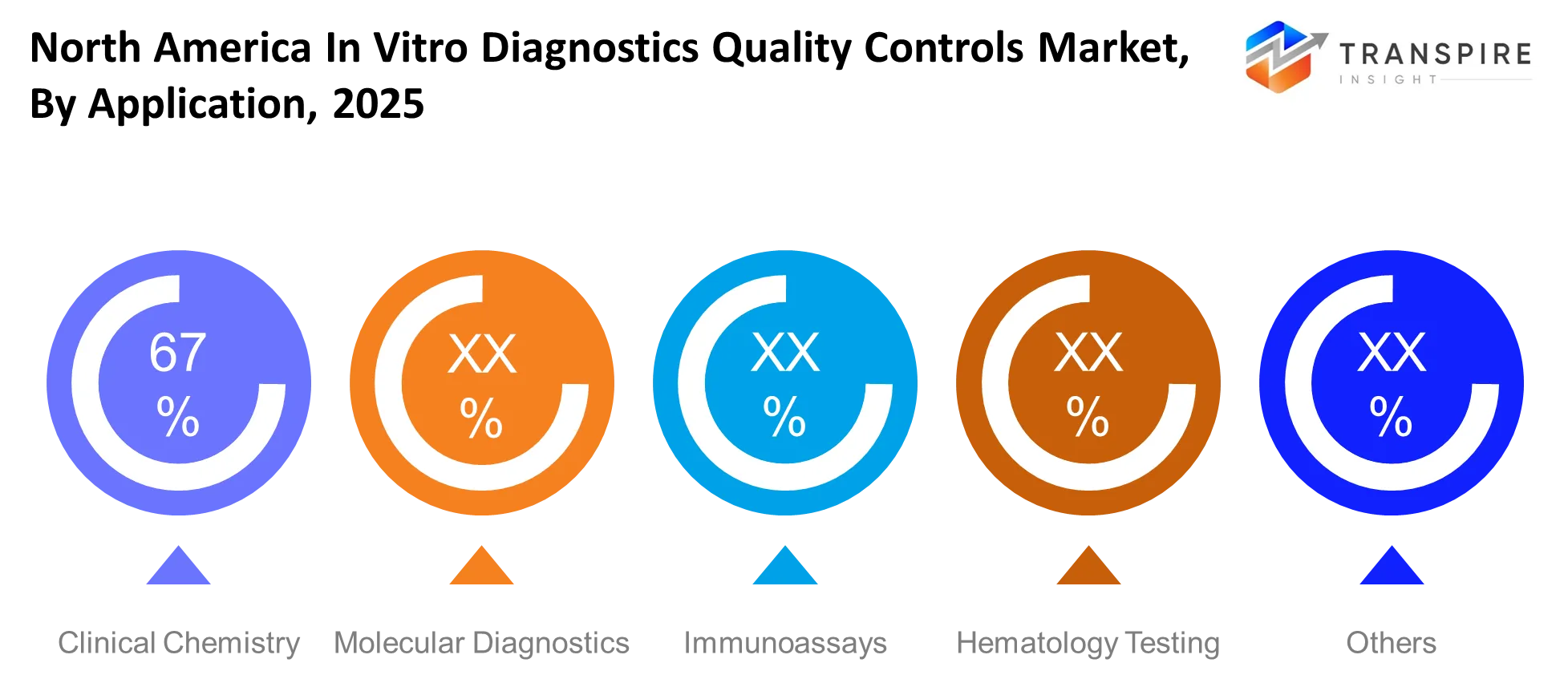
To learn more about this report, Download Free Sample Report
By End User
Hospitals hold the biggest share, since there is high patient inflow and integrated diagnostic testing systems that support real-time clinical decisions. Diagnostic laboratories are a strong second segment, largely driven by outsourcing trends, and the shift toward centralized high-throughput testing. Research institutes keep a smaller but fairly steady share, mostly tied to experimental and validation testing workflows. Other end users bring limited demand, typically across niche diagnostic environments, where specialized testing matters more than volume.
In diagnostic labs , growth is kinda pushed by more outsourcing of complicated testing from hospital systems, where they want cost efficiency and scalability . Meanwhile hospitals keep a solid baseline demand, because inpatient and emergency work never really stops. Research institutes also climb as funding ramps up for molecular diagnostics and translational medicine. And when outsourcing keeps getting stronger, it kinda helps independent laboratories expand even more, especially across North America.
Looking ahead, the future growth will lean harder toward diagnostic laboratories as test volumes keep moving away from “hospital only” approaches. Hospitals will still matter a lot for urgent and high acuity situations. Investors, I mean they’ll likely favor centralized lab networks, since those tend to be more efficient and they bring ongoing needs for recurring quality control.
By Technology
Automated QC systems are currently in the leading spot, mostly because they get integrated broadly with high throughput diagnostic analyzers in both hospital and reference settings. Cloud based QC platforms are taking up more space too , driven by the need for centralized data monitoring, plus multi site coordination across labs. AI enabled QC solutions are still smaller, but they’re growing the quickest, mainly due to predictive analytics being adopted more often. Other older QC methods continue to slide down in relative relevance.
Growth in AI-enabled QC systems is being pulled along by labs wanting something like real-time anomaly detection and predictive maintenance for diagnostic instruments. At the same time cloud platforms are growing, because more laboratories are trying to centralize quality monitoring, across distributed testing networks , not just locally. Automated systems still stay important though, mainly because they fit with the existing laboratory infrastructure, and they don’t require a full reinvention. Meanwhile, traditional QC approaches hit walls—mostly due to manual processes, and frankly limited scaling, even when teams are dedicated.
During the forecast period, AI-enabled QC solutions will see a steadier lift in adoption, as laboratories start prioritizing predictive accuracy plus compliance automation, with less hesitation. Cloud platforms should also get more traction around multi-lab connectivity across North America. And the developers will likely keep zeroing in on interoperable setups that blend AI, automation, and near real-time compliance monitoring, all in one flow, sort of.
What are the Key Use Cases Driving the North America In Vitro Diagnostics Quality Controls Market?
Clinical chemistry testing is really the core kind of use case that keeps pushing the North America in vitro diagnostics quality controls market forward, because hospitals lean on big, high-volume blood chemistry panels for routine diagnosis and for keeping an eye on treatment over time. These quality controls help make sure results stay accurate across automated analyzers, so it lowers the chances of diagnostic errors , and also keeps labs inside strict laboratory regulations.
Then you have molecular diagnostics plus immunoassay validation that are slowly widening the picture, especially in diagnostic laboratories and hospital reference networks. More PCR based infectious disease testing , along with hormone analysis, means labs are depending more and more on multi analyte control systems. Those systems basically verify assay precision across more complex workflows. On top of that, hematology monitoring keeps supporting consistent demand in inpatient units and emergency care, where turnaround matters.
More recently, people are starting to talk about emerging use cases like AI enabled predictive quality monitoring and cloud based QC harmonization across several labs in one network. This is picking up attention as healthcare systems move toward integrated diagnostic ecosystems, with real-time compliance tracking showing up as a priority.
|
Report Metrics |
Details |
|
Market size value in 2025 |
USD 637.5 Million |
|
Market size value in 2026 |
USD 662.1 Million |
|
Revenue forecast in 2033 |
USD 818.5 Million |
|
Growth rate |
CAGR of 3.08% from 2026 to 2033 |
|
Base year |
2025 |
|
Historical data |
2021 - 2024 |
|
Forecast period |
2026 - 2033 |
|
Report coverage |
Revenue forecast, competitive landscape, growth factors, and trends |
|
Regional scope |
North America (Canada, The United States, and Mexico) |
|
Key company profiled |
Bio-Rad Laboratories, Thermo Fisher Scientific, Roche Diagnostics, Abbott Laboratories, Siemens Healthineers, Randox Laboratories, Danaher Corporation, Sysmex Corporation, BioMérieux, Ortho Clinical Diagnostics, Agilent Technologies, Merck KGaA, QIAGEN, LGC Clinical Diagnostics, SeraCare |
|
Customization scope |
Free report customization (country, regional & segment scope). Avail customized purchase options to meet your exact research needs. |
|
Report Segmentation |
By Product Type (Quality Control Sera, Molecular Quality Controls, Hematology Controls, Immunochemistry Controls, Others); By Application (Clinical Chemistry, Molecular Diagnostics, Immunoassays, Hematology Testing, Others); By End User (Hospitals, Diagnostic Laboratories, Research Institutes, Others); By Technology (Automated QC Systems, Cloud-based QC Platforms, AI-enabled QC Solutions, Others) |
Which Regions are Driving the North America In Vitro Diagnostics Quality Controls Market Growth?
The United States leads the North America in vitro diagnostics quality controls market , sort of because its lab environment is pretty tightly regulated and there’s strong enforcement of CLIA and CAP compliance standards. Testing volumes remain high across hospital networks and reference laboratories , and that kind of constant throughput keeps quality control materials in demand. Also, the diagnostic ecosystem is already mature, with advanced automation plus integrated laboratory information systems, which helps multi-analyte and molecular QC products get adopted pretty consistently. And you have a strong presence of global diagnostics manufacturers too, which in turn supports supply reliability, and keeps the innovation pipeline moving.
Canada is the second major region. It’s driven by a publicly funded healthcare system that pushes standardized laboratory protocols across provincial networks. In contrast to the United States, the growth in Canada seems more shaped by structured procurement policies and centralized testing frameworks, not so much by fast-moving technology cycles. But investment in hospital laboratories and reference testing facilities stays steady , so uptake of clinical chemistry and immunoassay quality controls is still consistent. That steadiness makes Canada a dependable contributor to regional revenue, with out much sudden changes in adoption behavior.
Mexico looks like the fastest-growing region. This is largely tied to expanding private diagnostic laboratories, plus more healthcare infrastructure investment overall. In recent years, upgrades in urban hospital systems and diagnostic testing capacity have made access easier for molecular and clinical chemistry testing services. On top of that, more outsourcing of diagnostic services is happening, and automated laboratory systems are becoming more common, which further boosts quality control demand. For investors and new market entrants, this trend hints at solid expansion potential from 2026 to 2033, especially through localized partnerships and distribution networks.
Who are the Key Players in the North America In Vitro Diagnostics Quality Controls Market and How Do They Compete?
In North America in vitro diagnostics quality controls market, there is a moderately consolidated competitive structure, where a handful of worldwide diagnostics companies sort of dominate, and then a few specialized firms push forward with niche assay compatibility and also digital integration. The incumbents usually defend their share using wide-ranging product portfolios, basically spanning clinical chemistry, molecular diagnostics, and immunoassays. Meanwhile, newer entrants tend to zero in on AI-enabled quality monitoring plus multi-platform interoperability. What really steers the competition is more about technological compatibility with automated analyzers and laboratory information systems, rather than pricing, or at least that’s the main story. Also, regulatory compliance know-how, and multi-assay validation assistance, work as meaningful differentiators when hospitals and reference laboratories decide what to buy.
Bio-Rad Laboratories strengthens its standing via a kind of third-party quality control focus, providing multi-instrument compatibility that helps with fragmented diagnostic ecosystems across hospital networks, sort of smoothly. Thermo Fisher Scientific leans toward integrated laboratory workflows, pairing QC materials with informatics platforms so teams can do centralized observation and real-time compliance tracking. Roche builds on its clinical chemistry and molecular diagnostics presence, placing quality controls directly inside its proprietary analyzer environments, which helps ensure that closed-loop performance checks keep working as intended. Abbott Laboratories differentiates by delivering high-volume immunoassay testing solutions and pairing them with standardized QC procedures, so rapid hospital diagnostics can be supported without drama.
Siemens Healthineers is expanding by leaning into an automation-first play, where QC systems get folded into fully automated lab solutions that are then deployed across major hospital groups. Across all of them, competitiveness gets reinforced through collaborations with reference laboratories, expansion of digital QC analytics, and acquisitions that enhance assay compatibility across emerging molecular testing platforms.
Company List
- Bio-Rad Laboratories
- Thermo Fisher Scientific
- Roche Diagnostics
- Abbott Laboratories
- Siemens Healthineers
- Randox Laboratories
- Danaher Corporation
- Sysmex Corporation
- BioMérieux
- Ortho Clinical Diagnostics
- Agilent Technologies
- Merck KGaA
- QIAGEN
- LGC Clinical Diagnostics
- SeraCare
Recent Development News
“In September 2025, Roche Diagnostics announced achievement of first CLIA ‘Moderate Complexity’ categorization for its Ionify® 25-Hydroxy Vitamin D Total Test.” The milestone expanded access to automated mass spectrometry-based diagnostic testing in routine U.S. laboratories, improving standardization and reducing the need for highly specialized QC workflows.https://diagnostics.roche.com
“In July 2025, Thermo Fisher Scientific launched the AcroMetrix Oncology Hotspot Control.” The QC material provides a standardized, multi-platform control for detecting over 500 oncology mutations, improving inter-lab reproducibility and supporting more consistent quality control across next-generation sequencing workflows in clinical diagnostics.https://india.newsroom.thermofisher.com
What Strategic Insights Define the Future of the North America In Vitro Diagnostics Quality Controls Market?
North America in vitro diagnostics quality controls market is sort of slowly sliding, structurally speaking, toward more fully integrated and digitally governed lab ecosystems where quality verification stops being just periodic and becomes continuous. Um, this change is basically pulled by the rise in molecular testing volumes, tougher regulatory enforcement, and a stronger reliance on automated analyzers that really need real-time performance validation. Over the next 5 to 7 years, you’ll likely see demand clump around interoperable QC systems that are embedded inside laboratory information platforms, not standalone consumables. So procurement priorities across hospitals and reference laboratories will get reshuffled, a bit.
There’s also a less obvious risk sitting under all of that: increasing vendor concentration inside integrated diagnostic ecosystems. Analyzer makers may bundle proprietary quality controls, which can make third-party interoperability less flexible and it can also reduce competitive diversity. Another constraint is the uneven digital readiness of smaller laboratories, they tend to adopt advanced QC analytics more slowly even while testing complexity is rising.
A key emerging opportunity is AI-driven predictive quality control systems that can flag assay drift before it turns into an actual failure, especially across big reference laboratory networks in the United States. Players that connect QC development with cloud-based laboratory data platforms, and that secure earlier integration partnerships with hospital systems, are the ones more likely to lock in long-term contract stability. Strategic attention should mostly emphasize interoperability, real-time analytics capability, and compliance automation, to actually capture next-generation laboratory modernization spending.
North America In Vitro Diagnostics Quality Controls Market Report Segmentation
By Product Type
- Quality Control Sera
- Molecular Quality Controls
- Hematology Controls
- Immunochemistry Controls
- Others
By Application
- Clinical Chemistry
- Molecular Diagnostics
- Immunoassays
- Hematology Testing
- Others
By End User
- Hospitals
- Diagnostic Laboratories
- Research Institutes
- Others
By Technology
- Automated QC Systems
- Cloud-based QC Platforms
- AI-enabled QC Solutions
- Others
Frequently Asked Questions
Find quick answers to common questions.
The Expected North America In Vitro Diagnostics Quality Controls Market size is USD 818.5 Million in 2033.
Key Segments for the North America In Vitro Diagnostics Quality Controls Market are By Product Type (Quality Control Sera, Molecular Quality Controls, Hematology Controls, Immunochemistry Controls, Others); By Application (Clinical Chemistry, Molecular Diagnostics, Immunoassays, Hematology Testing, Others); By End User (Hospitals, Diagnostic Laboratories, Research Institutes, Others); By Technology (Automated QC Systems, Cloud-based QC Platforms, AI-enabled QC Solutions, Others).
Major North America In Vitro Diagnostics Quality Controls Market Players are Bio-Rad Laboratories, Thermo Fisher Scientific, Roche Diagnostics, Abbott Laboratories, Siemens Healthineers, Randox Laboratories, Danaher Corporation, Sysmex Corporation, BioMérieux, Ortho Clinical Diagnostics, Agilent Technologies, Merck KGaA, QIAGEN, LGC Clinical Diagnostics, SeraCare.
The Current North America In Vitro Diagnostics Quality Controls Market size is USD 637.5 Million in 2025.
The North America In Vitro Diagnostics Quality Controls Market CAGR is 3.08% from 2026 to 2033.
- Bio-Rad Laboratories
- Thermo Fisher Scientific
- Roche Diagnostics
- Abbott Laboratories
- Siemens Healthineers
- Randox Laboratories
- Danaher Corporation
- Sysmex Corporation
- BioMérieux
- Ortho Clinical Diagnostics
- Agilent Technologies
- Merck KGaA
- QIAGEN
- LGC Clinical Diagnostics
- SeraCare
About the Authors

Pankaj Ghogare Patil
I am Pankaj Ghogare Patil, a Senior Research Analyst at Transpire Insight, specializing in the Pharmaceutical, Chemicals & Materials, Healthcare IT, and Biotechnology industry. My expertise lies in conducting comprehensive market research, analyzing industry trends, evaluating competitive landscapes, and translating complex data into actionable insights. At Transpire Insight, I closely follow emerging technologies, regulatory developments, and market innovations to create accurate, well-researched, and informative content that helps businesses and professionals make informed decisions. I am committed to producing credible, evidence-based articles that reflect industry best practices while making technical topics accessible and valuable for a broad audience.

Chakradhar Khansole
Chakradhar serves as the Research Director at Transpire Insight, bringing over 8 years of experience in technology, innovation, and strategic market intelligence. He specializes in transforming complex market data into actionable business insights that enable organizations to make informed, growth-oriented decisions. Recognized for his strategic vision and analytical expertise, Chakradhar leads high-impact research initiatives, delivering comprehensive market assessments, competitive intelligence, and forward-looking industry analysis.
Recently Published Reports
-
Jul 2026
Alopecia Treatment Market
Alopecia Treatment Market Size, Share & Analysis Report By Disease Type (Alopecia Areata, Cicatricial Alopecia, Traction Alopecia, Alopecia Totalis, Androgenetic Alopecia, Alopecia Universalis, and Other Disease Types), By Treatment Type (Topical Treatments, Oral Medications, Injectable Therapies, and Hair Transplantation), By Gender (Male, and Female), By Distribution Channel (Hospitals and Clinics, Retail Pharmacies, and Online Retailers), and Geography (North America, Europe, Asia-Pacific, Middle East and Africa, South and Central America), 2021 - 2031
-
Jul 2026
Medical Ultrasound Probe Market
Medical Ultrasound Probe Market Size, Share & Analysis Report By Type (Linear Type, Convex Type, Endocavitary Probe, Phased Array/Cardiac Probe, Transesophageal (TEE) Probe, and Others), By Application (Ophthalmology, Cardiology, Musculoskeletal, Oncology, Obstetrics & Gynecology, General Imaging, and Others), By End User (Hospitals & Clinics, Diagnostic Centers, Ambulatory Surgical Centers, and Others), and Geography (North America, Europe, Asia-Pacific, Middle East and Africa, South and Central America), 2021 – 2031
-
May 2026
Biosimilars Market
Biosimilars Market By Product Type (Monoclonal Antibodies, Recombinant Hormones, Erythropoietin, G-CSF, Others), By Indication (Oncology, Autoimmune Diseases, Blood Disorders, Diabetes, Others), By Manufacturing Type (In-House Manufacturing, Contract Manufacturing), By Distribution Channel (Hospital Pharmacies, Retail Pharmacies, Online Pharmacies), By Industry Analysis, Size, Share, Growth, Trends, and Forecasts 2021-2033
-
Apr 2026
Gastrointestinal Endoscopy Market
Gastrointestinal Endoscopy Market By Type (Rigid Gastrointestinal Endoscope, Flexible Gastrointestinal Endoscopes, Disposable Gastrointestinal Endoscope), By Procedure Type (Colonoscopy, Gastroscopy, Duodenoscopy, Enteroscopy, Flexible Sigmoidoscopy, Others), By Application (Diagnosis, Treatment), By End-Users (Hospitals, Ambulatory Surgical Centers, Specialty Clinics, Laboratories, Others), By Industry Analysis, Size, Share, Growth, Trends, and Forecasts 2021-2033