

South Korea In-vitro Diagnostics Market Size & Forecast:
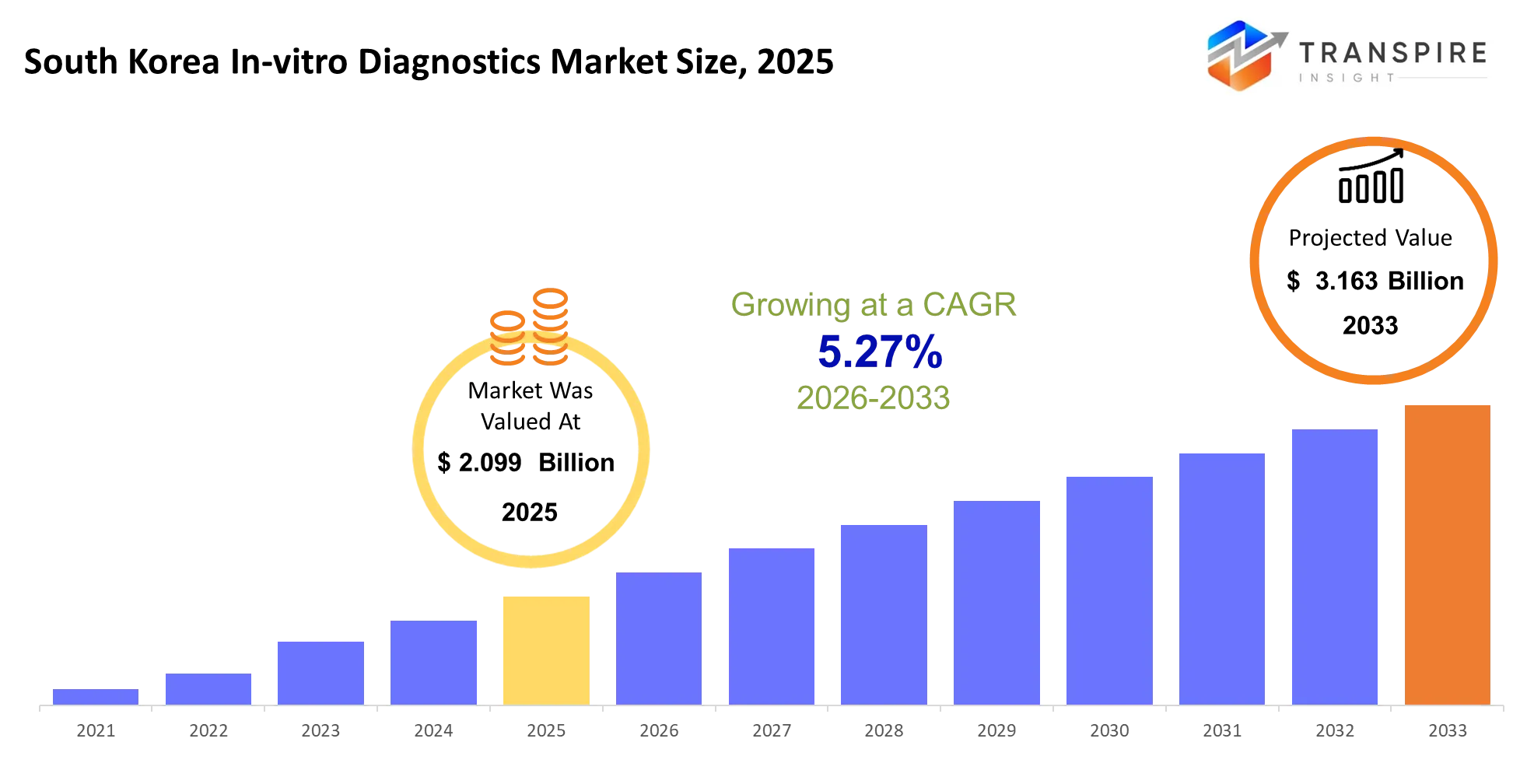
- South Korea In-vitro Diagnostics Market Size 2025: USD 2.099 Billion
- South Korea In-vitro Diagnostics Market Size 2033: USD 3.163 Billion
- South Korea In-vitro Diagnostics Market CAGR: 5.27%
- South Korea In-vitro Diagnostics Market Segments: By Product Type (Clinical Chemistry Diagnostics, Molecular Diagnostics, Immunodiagnostics, Hematology Diagnostics, Point-of-Care Diagnostics, Others); By Technology (PCR Technology, ELISA Technology, Next-generation Sequencing, Biosensors, AI-enabled Diagnostics, Others); By Application (Infectious Disease Testing, Cancer Diagnostics, Diabetes Testing, Cardiology Diagnostics, Genetic Testing, Others); By End User (Hospitals, Diagnostic Laboratories, Research Institutes, Home Care Settings, Others); By Sample Type (Blood Samples, Urine Samples, Tissue Samples, Saliva Samples, Others)
To learn more about this report,  Download Free Sample Report
South Korea In-vitro Diagnostics Market Summary
The South Korea In-vitro Diagnostics Market was valued at USD 2.099 Billion in 2025. It is forecast to reach USD 3.163 Billion by 2033. That is a CAGR of 5.27% over the period.
In South Korea, in-vitro diagnostics, or IVD systems, kind of act as the first layer for clinical decisions, where blood , tissue, and molecular samples get reviewed, so the disease shows up earlier before it turns into something too critical. Hospitals, diagnostic labs, and specialty clinics end up leaning on these tools so they can steer treatment choices for oncology, infectious diseases, and longer-term chronic condition management. So diagnostics becomes a key enabler, in a pretty practical way, it supports quicker turnaround in the clinic and also backs precision medicine.
In the last 3–5 years, the market started drifting away from older conventional immunoassays, toward high-throughput molecular testing, plus more automated platforms. This shift is mostly driven by hospital digitization, and also because lab data is getting folded into electronic health systems, you know. One of the more notable structural moves has been the movement toward PCR-based and next-generation sequencing workflows, mainly for faster pathogen detection and more granular cancer profiling. And then, the COVID-19 pandemic basically worked like a live trigger, it sped up the testing infrastructure across the country, and it also strengthened molecular diagnostic capacity in a more or less enduring manner. After that there was continued investment in automation, and in reagent-based revenue models, which then reshaped procurement behavior in both public and private healthcare spaces.
Key Market Insights
- Molecular diagnostics is kinda replacing the usual immunoassay workflows in tertiary hospitals , mostly because it’s quicker for disease detection and it really helps with precision medicine adoption too .
- These days automated lab systems are handling more than 45% of diagnostic workflows in big hospitals, which in practice improves speed and also operational accuracy, a lot.
- Seoul and Gyeonggi Province together make up nearly 55% of total diagnostic demand, that’s largely due to the dense hospital infrastructure, and lots of specialist centers nearby .
- Busan meanwhile is showing up as a fast growing diagnostic hub , backed by private laboratory networks expanding pretty quickly and regional healthcare investment.
- Revenue is mostly coming from reagents and consumables, they take about 50–55% of the share , and it basically mirrors the strong recurring demand across all those testing volumes .
- Molecular diagnostics is also the fastest-growing segment through 2033, supported by oncology screening programs and infectious disease surveillance initiatives.
- For applications, infectious disease testing accounts for around 40% share, helped by stronger post-pandemic monitoring systems and increased lab capacityexpansion .
- Oncology diagnostics is growing rapidly too, it’s driven by national early cancer screening efforts and more adoption of hospital based testing.
- Hospitals are still the main end users , with over 60% of the diagnostic testing activity across South Korea’s healthcare system.
- And diagnostic laboratories are moving the fastest in that end-user category, largely because outsourcing trends keep rising , and private lab networks keep widening.
What are the Key Drivers, Restraints, and Opportunities in the South Korea In-vitro Diagnostics Market?
The main driver of the South Korea In-vitro Diagnostics Market seems to be the rapid integration of precision medicine into everyday care, as if it’s just the new normal. With government supported cancer screening rolls and hospital digitization programs moving ahead, labs have been pushed to lean more on molecular diagnostics and automated analyzers. That change is basically boosting test volumes, and it also keeps revenue coming in through recurring sales of high-value reagents, especially in oncology as well as infectious disease monitoring. And as healthcare providers start looking at diagnostics through data, the need for quicker, more precise testing platforms keeps growing, which tends to lock in longer term procurement cycles.
Still, there’s a restraint that won’t really go away, and it’s the heavy capital requirement for advanced diagnostic setups. Fully automated systems and next generation sequencing tools tend to need a large upfront spend, plus specialized workforce training. Smaller clinics, and even some regional hospitals, often find it hard to absorb those costs. Because of that, adoption across non-metropolitan regions feels uneven, and it can create a kind of dependency on centralized diagnostic hubs. The result is slower, broader market penetration and fewer ways for manufacturers to diversify revenue.
On the other hand, an opportunity is starting to show up in decentralized and point of care molecular testing, where diagnostics can be nearer to patients. Portable PCR devices, along with cartridge based testing platforms, are getting more attention in emergency departments and in rural healthcare centers. For instance, compact molecular analyzers placed inside outpatient clinics can shrink turnaround times from several days down to under one hour. This movement is supported by growing government focus on healthcare accessibility, so decentralized diagnostics may become a real growth lever in the coming years.
What Has the Impact of Artificial Intelligence Been on the South Korea In-vitro Diagnostics Market?
Artificial intelligence is kind of reshaping the South Korea In-vitro Diagnostics Market, mostly by boosting diagnostic accuracy, speeding up workflow efficiency and giving more predictive health care abilities throughout laboratory ecosystems. AI powered image analysis tools are now pretty widely used in pathology and hematology, to automate cell counting, spot anomalies, and interpret slides. This is helping labs cut down on the manual workload, plus it lowers human error rates, especially in those high volume environments where throughput matters a lot.
On the other hand, machine learning models are being used more and more for predictive diagnostics. Here, patient data trends are reviewed to foresee how disease might progress, where infection outbreaks could appear, and what cancer risk profiles look like. In big hospital networks, AI integrated laboratory information systems also help manage sample routing and set testing priorities. That improves overall turnaround time and operational throughput, and it supports resource allocation too, so labs can reduce reagent wastage and minimize operational bottlenecks.
Operationally, AI adoption has improved diagnostic efficiency by allowing faster report generation, and it supports earlier-stage disease detection, especially in oncology screening programs. Still, adoption is constrained by high integration costs and fragmented health care data systems, in many places. A lot of hospitals run legacy infrastructure, which makes seamless AI deployment harder, and inconsistent data standardization can reduce model accuracy in real clinical conditions. Even with those obstacles, though, investment into AI enabled diagnostic platforms keeps expanding across major Korean hospital chains.
Key Market Trends
- After 2020 , molecular diagnostics adoption jumped up pretty sharply, and it now replaces more than 35% of those older immunoassay workflows, basically.
- AI enabled pathology platforms cut the diagnostic turnaround time by roughly 30% across several big Korean hospital networks, kind of fast.
- Today automated analyzers take care of over 45% of high volume testing inside tertiary care hospitals, with less hands-on work.
- Infectious disease testing capacity grew by more than 40% during the post pandemic build out, not just in one place.
- Nationwide oncology screening programs also widened, which pushed double digit growth in early cancer detection testing.
- Reagent based revenue models got stronger too , and they now account for over 50% of recurring income for the diagnostic industry .
- Private diagnostic laboratories expanded their portion to nearly 25% thanks to outsourcing by public hospitals, a lot of it.
- Point of care testing adoption rose a lot in emergency departments, mainly for quicker clinical choices.
- Roche Diagnostics and Siemens Healthineers rolled out more AI integrated systems across Korean hospitals, and the pace stayed high.
- Digital lab integration improved sample traceability and also lowered processing mistakes across around 60% of large hospitals, overall .
South Korea In-vitro Diagnostics Market Segmentation
By Product Type
Clinical Chemistry Diagnostics is kind of in the leading role, mainly because it is used a lot in routine metabolic profiling, liver function assessments , and hospital based screening programs. The high integration with automated analyzers in tertiary hospitals helps keep the recurring testing volumes up,so it feels like demand stays pretty stable across both public and private healthcare systems. Molecular Diagnostics are probably the fastest-growing group , mostly pushed by oncology profiling and infectious disease detection needs. Immunodiagnostics still hold a strong position, largely supported by chronic disease surveillance and hormone analysis. Hematology Diagnostics stay fairly steady because blood disorder evaluation is always required,while Point-of-Care Diagnostics keep expanding in emergency settings and outpatient places. The rest of the categories remain more limited, kind of locked into narrow niche specialty testing.
Looking ahead , growth should focus on Molecular Diagnostics and Point-of-Care Diagnostics, driven by the increasing decentralization of testing, plus the need for quick turnaround times. Clinical Chemistry Diagnostics will continue getting adopted but will face gradual value pressure from automation and bundled testing platforms. Immunodiagnostics and Hematology Diagnostics are expected to keep relatively consistent volumes, since hospitals still depend on routine screening. During the forecast period, product innovation will likely shift toward integrated multi panel analyzers, those that reduce testing time and improve diagnostic accuracy, especially inside high-throughput laboratory environments.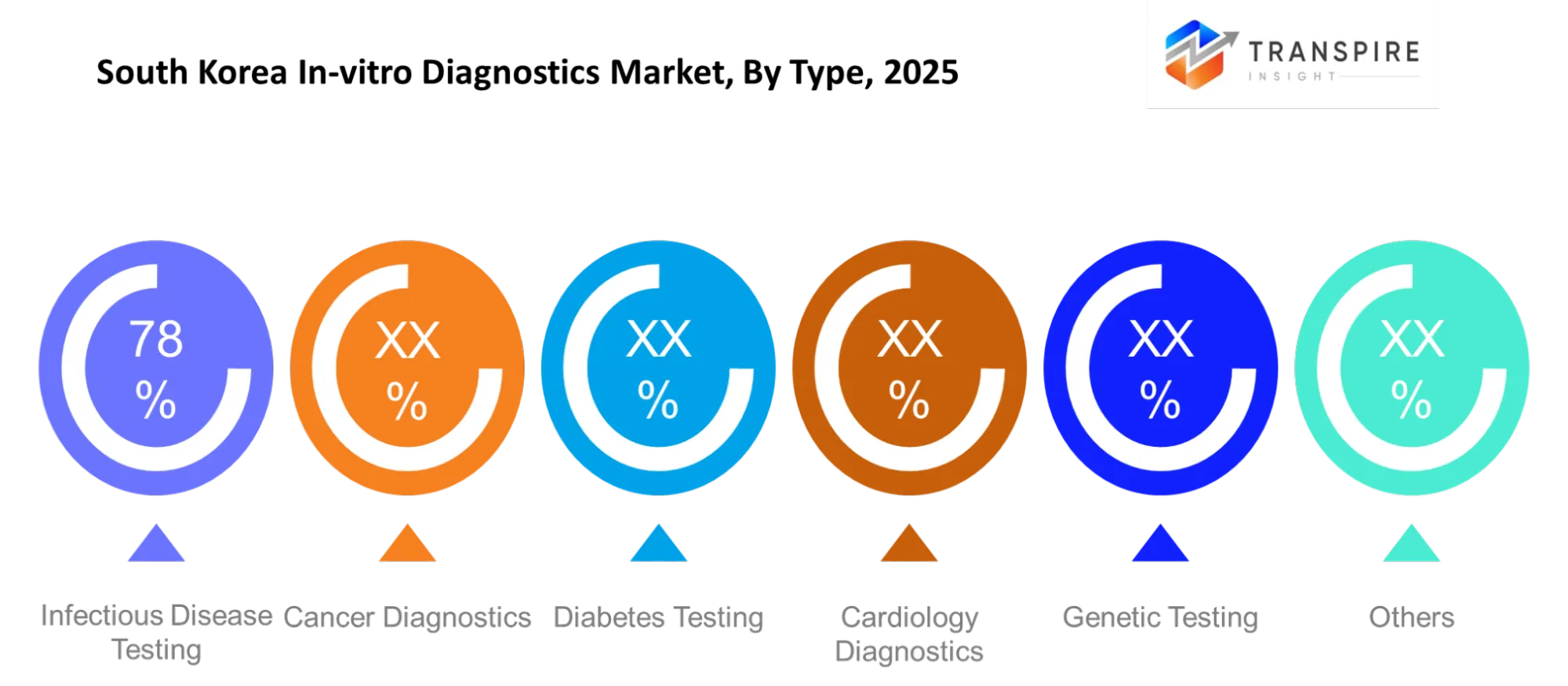
To learn more about this report, Download Free Sample Report
By Technology
PCR Technology kind of keeps the lead, mainly because it delivers high precision when you’re spotting pathogens and it’s already widely used for infectious disease testing in hospital labs. ELISA Technology stays fairly stable in immunological assays and it’s also used a lot for chronic disease follow up. Next-generation Sequencing is probably the fastest growing part, largely from the rising interest in oncology diagnostics, plus genetic disorder analysis, and yes that keeps pushing the segment forward. Biosensors are moving ahead slowly in point of care settings, while AI-enabled Diagnostics are getting more attention too, mostly because of workflow automation and image based interpretation systems. The “other” options remain pretty limited and often tied to older lab techniques.
Looking ahead, growth is going to lean hard on Next-generation Sequencing and AI-enabled Diagnostics, since healthcare systems keep steering toward precision medicine and clinical decisions that are data driven. PCR Technology will still be important, but it might get squeezed as more competitors enter, leading to commoditization and pricing pressure. ELISA Technology should keep a steady kind of demand in mid-tier diagnostic use cases. Biosensors will likely broaden in decentralized care places where rapid testing matters more. And over time, market evolution will be shaped by technology convergence—so sequencing, automation, and AI end up in one diagnostic platform, which helps cut down operational complexity and should raise clinical accuracy.
By Application
Infectious Disease Testing kinda holds the top spot, mainly because of big scale screening programs and good hospital readiness after the pandemic. that infrastructure expansion made everything easier, so testing capacity stays strong. Cancer Diagnostics is probably the fastest growing part, supported by national screening initiatives and more demand for catching problems early, like early-stage detection, you know. Diabetes Testing is more steady, driven by chronic disease prevalence and the usual monitoring routines, nothing too wild. Cardiology Diagnostics keeps moving upward at a gradual pace, tied to the aging population and cardiovascular risk assessment programs. Genetic Testing is getting momentum as precision medicine starts getting adopted more widely, while the Others category stays pretty specialized, low volume, and kinda niche.
Looking ahead, growth should lean more toward Cancer Diagnostics and Genetic Testing, since clinical attention is shifting to early identification and personalized treatment pathways. Infectious Disease Testing will still matter a lot, even so it should normalize once the post-pandemic capacity stabilizes a bit. Diabetes Testing should keep its consistent volume without any major acceleration. Cardiology Diagnostics may expand moderately, with incremental improvements in biomarker based testing. During the forecast period, application development is likely to favor multiplex testing platforms, basically combining several disease markers into one diagnostic workflow, this improves operational efficiency and also clinical decision speed, faster turnaround etc.
By End User
Hospitals kind of keep the dominant position because of centralized diagnostic infrastructure, big incoming patient flow, and a strong link to automated lab systems, like they’re just built for it. Diagnostic Laboratories are the fastest-growing end user group, mostly because of outsourcing happening more often, plus the expansion of private testing networks. Research Institutes still see steady demand tied to clinical studies and biotechnology development, not too much surprise there. Home Care Settings grow gradually, mostly as self testing becomes more common and remote monitoring solutions get picked up by more people. The “other” category stays pretty narrow and usually sits in very specialized healthcare facilities.
Looking ahead, future growth is likely to pile up in Diagnostic Laboratories as healthcare systems outsource testing more and more, aiming to cut down hospital workload and also boost efficiency. Hospitals will still produce the largest test volumes, but growth will be slower since a lot of urban centers are kind of already saturated. Research Institutes should maintain fairly stable expansion, backed by ongoing innovation in molecular and genetic testing. Home Care Settings should widen a lot faster later on, helped by portable diagnostic devices getting better and by digital health integration. Over the forecast period, the overall end-user mix should gradually tilt toward more distributed diagnostic ecosystems that blend hospital-based, laboratory-based, and home-based testing models, kind of like a mesh, rather than one single hub.
By Sample Type
Blood Samples keep the leading spot, mainly because they are used everywhere in chemistry, hematology, and molecular testing routines inside hospital labs. Urine Samples still show pretty steady use for metabolic checks and kidney function work. Tissue Samples seem to be the fastest growing group, mostly because oncology diagnostics need biopsy-based molecular testing all the time. Saliva samples are expanding more slowly, but the trend is clear, since non-invasive testing is getting adopted for both genetic and infectious disease screening. The other types stay kind of limited to specific diagnostic procedures
Going forward, growth should lean on Tissue Samples and Saliva Samples as diagnostic systems shift toward less invasive methods, and more “precision style” testing. Blood Samples will stay dominant, even if the market slowly diversifies since platforms built for multiple sample types are becoming more common. Urine Samples look set to hold steady, not really spiking or accelerating much. During the forecast period, the way samples are collected will line up more with automation and point-of-care setups, which helps labs move quicker, reduces basic handling mistakes, and supports better diagnostic accuracy across different lab networks
What are the Key Use Cases Driving the South Korea In-vitro Diagnostics Market?
The dominant use case in the South Korea In-vitro Diagnostics Market seems to be more hospital led disease diagnosis, where blood chemistry, molecular testing, and immunoassays somehow steer the clinical decisions for infectious diseases, oncology, and long term chronic conditions. In this scenario, large tertiary hospitals typically pull the most demand, mainly because there is a constant stream of patients and the case management gets pretty intricate, like day to day.
There is also a clear expansion toward outpatient diagnostic testing and private laboratory services, especially in urban centers where patients often prefer faster, outsourced testing. These options tend to connect closely with diagnostic laboratories, and also with specialized clinics that support preventive health screening initiatives.
On top of that, emerging use cases are getting noticed, for example decentralized point of care testing in emergency rooms and rural clinics, plus AI assisted predictive diagnostics for early detection. These tracks are picking up, because healthcare systems are trying to speed up diagnosis, lower the hospital load and improve access across regional health networks at the same time.
|
Report Metrics |
Details |
|
Market size value in 2025 |
USD 2.099 Billion |
|
Market size value in 2026 |
USD 2.208 Billion |
|
Revenue forecast in 2033 |
USD 3.163 Billion |
|
Growth rate |
CAGR of 5.27% from 2026 to 2033 |
|
Base year |
2025 |
|
Historical data |
2021 - 2024 |
|
Forecast period |
2026 - 2033 |
|
Report coverage |
Revenue forecast, competitive landscape, growth factors, and trends |
|
Regional scope |
South Korea |
|
Key company profiled |
Samsung Medison, Seegene, SD Biosensor, Roche Diagnostics, Abbott Laboratories, Siemens Healthineers, Thermo Fisher Scientific, Danaher Corporation, Bio-Rad Laboratories, Sysmex Corporation, bioMérieux, Qiagen, Hologic, Becton Dickinson, Fujirebio |
|
Customization scope |
Free report customization (country, regional & segment scope). Avail customized purchase options to meet your exact research needs. |
|
Report Segmentation |
By Product Type (Clinical Chemistry Diagnostics, Molecular Diagnostics, Immunodiagnostics, Hematology Diagnostics, Point-of-Care Diagnostics, Others); By Technology (PCR Technology, ELISA Technology, Next-generation Sequencing, Biosensors, AI-enabled Diagnostics, Others); By Application (Infectious Disease Testing, Cancer Diagnostics, Diabetes Testing, Cardiology Diagnostics, Genetic Testing, Others); By End User (Hospitals, Diagnostic Laboratories, Research Institutes, Home Care Settings, Others); By Sample Type (Blood Samples, Urine Samples, Tissue Samples, Saliva Samples, Others) |
Which Regions are Driving the South Korea In-vitro Diagnostics Market Growth?
Seoul along with the adjacent Gyeonggi Province seems to hold the biggest pull in the South Korea In-vitro Diagnostics Market, mainly because there’s this very dense cluster of tertiary hospitals, research universities, and national reference labs. On top of that the area tends to get strong government healthcare funding and it is usually early to adopt more advanced molecular diagnostic platforms inside large medical centers. Also a lot of patients travel in from different parts of the country, so testing demand becomes centralized, particularly when it comes to oncology checks and infectious disease screening . The big hospital networks plus these integrated digital health systems help keep procurement steady for high-throughput analyzers and reagent-based diagnostic routines, that’s basically what keeps the region at the top.
Meanwhile Busan and the southeastern corridor looks more like a stable second hub, pushed by industrial healthcare infrastructure and consistent hospital spending. It doesn’t operate the same way as Seoul’s very centralized diagnostic ecosystem. In Busan, growth is instead supported by a more even blend of public hospitals, private diagnostic laboratories , and even occupational health screening linked to the port region. Over the long run, shipbuilding and logistics workforce monitoring programs also add steady testing volumes. The region shows resilience, kind of through gradual regulatory rollout and steady capital investment into mid-sized laboratory facilities. So it becomes a dependable contributor, not some concentration-based winner.
Then there’s Honam, plus these inland cities that are starting to rise quicker than expected. They are often described as the fastest-growing areas, largely because of newer government-led decentralization policies in healthcare and more money for regional hospital systems. Fresh diagnostic laboratory sites and upgraded provincial hospitals have made molecular testing easier to access outside the metro zones, and that’s improving adoption in a fairly noticeable way.
Who are the Key Players in the South Korea In-vitro Diagnostics Market and How Do They Compete?
The South Korea In-vitro Diagnostics Market is kind of moderately consolidated, where global players go head to head with decent domestic and regional specialists. Overall competition seems mostly driven by tech progress in molecular diagnostics, automation systems and also by smooth integration with hospital information networks, even when budgets get tight. Established firms tend to keep a firm grip via long-term hospital agreements and bundled reagent supply approaches, while newer entrants lean toward quicker, point-of-care and more niche molecular testing types that cut turnaround time and make access easier in decentralized care setups.
Big names like Roche Diagnostics and Siemens Healthineers push their positions using higher-end molecular platforms plus large-scale lab automation. Roche leans into oncology and sequencing based diagnostics that slot into tertiary hospital environments, whereas Siemens Healthineers stresses end-to-end digital lab workflows, plus partnerships with hospital chains, to standardize day to day operations across many locations. With these moves, both companies stay deeply embedded in high volume hospital settings.
Then Abbott Laboratories, Sysmex Corporation, and bioMérieux compete by leaning on particular diagnostic lanes. Abbott leans into rapid diagnostics and distributed testing solutions for urgent care situations, Sysmex has a strong hold on hematology diagnostics using high precision analyzers and service contracts that run for a long time, and bioMérieux focuses on infectious disease and antimicrobial resistance testing via specialized laboratory collaborations. Overall, this mix is shaping a competitive scene that’s defined less by broad coverage and more by specialization, innovation pace, and how well products connect to changing clinical routines.
Company List
- Samsung Medison
• Seegene
• SD Biosensor
• Roche Diagnostics
• Abbott Laboratories
• Siemens Healthineers
• Thermo Fisher Scientific
• Danaher Corporation
• Bio-Rad Laboratories
• Sysmex Corporation
• bioMérieux
• Qiagen
• Hologic
• Becton Dickinson
• Fujirebio
Recent Development News
"In October 2025, Hitachi High-Tech Corporation commenced operation of its LABOSPECT TS Total Laboratory Automation system at Seegene Medical Foundation Seoul. The deployment enhances high-throughput molecular testing capacity and strengthens automation-driven diagnostic workflows in Korea’s expanding IVD ecosystem.http://www.hitachi-hightech.com
"In March 2026, the Ministry of Health and Welfare entered a memorandum of understanding with Roche to strengthen Korea’s biohealth and clinical trial ecosystem. The agreement supports expansion of advanced diagnostics-linked research infrastructure and accelerates integration of global R&D capabilities into domestic healthcare systems.https://www.asiae.co
What Strategic Insights Define the Future of the South Korea In-vitro Diagnostics Market?
South Korea In-vitro Diagnostics Market is kinda moving toward these fully integrated, data driven diagnostic ecosystems where automation, molecular testing, and AI based interpretation all end up in the same loop inside hospital networks. The growth will be more and more in high-throughput platforms that merge sequencing, near real-time analytics, and decentralized testing abilities, basically everything working faster together. But there is also a less visible risk that comes from depending on imported high end reagents and proprietary platforms, and that makes the supply chain more concentrated,plus it can squeeze pricing from big global vendors.
At the same time there’s an emerging opportunity in decentralized molecular diagnostics for outpatient care and emergency settings, supported by portable PCR and cartridge like systems, so the whole diagnosis cycle gets shorter, noticeably. In the next 5–7 years, the players who actually align with hospital digital transformation priorities and invest in localized reagent manufacturing and compact diagnostic platforms should end up with stronger structural position across both public and private healthcare segments.
South Korea In-vitro Diagnostics Market Report Segmentation
By Product Type
- Clinical Chemistry Diagnostics
- Molecular Diagnostics
- Immunodiagnostics
- Hematology Diagnostics
- Point-of-Care Diagnostics
- Others
By Technology
- PCR Technology
- ELISA Technology
- Next-generation Sequencing
- Biosensors
- AI-enabled Diagnostics
- Others
By Application
- Infectious Disease Testing
- Cancer Diagnostics
- Diabetes Testing
- Cardiology Diagnostics
- Genetic Testing
- Others
By End User
- Hospitals
- Diagnostic Laboratories
- Research Institutes
- Home Care Settings
- Others
By Sample Type
- Blood Samples
- Urine Samples
- Tissue Samples
- Saliva Samples
- Others
Frequently Asked Questions
Find quick answers to common questions.
The Expected South Korea In-vitro Diagnostics Market size for the Market will be USD 3.163 Billion in 2033.
Key Segments for the South Korea In-vitro Diagnostics Market are By Product Type (Clinical Chemistry Diagnostics, Molecular Diagnostics, Immunodiagnostics, Hematology Diagnostics, Point-of-Care Diagnostics, Others); By Technology (PCR Technology, ELISA Technology, Next-generation Sequencing, Biosensors, AI-enabled Diagnostics, Others); By Application (Infectious Disease Testing, Cancer Diagnostics, Diabetes Testing, Cardiology Diagnostics, Genetic Testing, Others); By End User (Hospitals, Diagnostic Laboratories, Research Institutes, Home Care Settings, Others); By Sample Type (Blood Samples, Urine Samples, Tissue Samples, Saliva Samples, Others).
Major South Korea In-vitro Diagnostics Market Players are Samsung Medison, Seegene, SD Biosensor, Roche Diagnostics, Abbott Laboratories, Siemens Healthineers, Thermo Fisher Scientific, Danaher Corporation, Bio-Rad Laboratories, Sysmex Corporation, bioMérieux, Qiagen, Hologic, Becton Dickinson, Fujirebio.
The Current South Korea In-vitro Diagnostics Market size is USD 2.099 Billion in 2025.
The South Korea In-vitro Diagnostics Market CAGR is 5.27% from 2026 to 2033.
- Samsung Medison
• Seegene
• SD Biosensor
• Roche Diagnostics
• Abbott Laboratories
• Siemens Healthineers
• Thermo Fisher Scientific
• Danaher Corporation
• Bio-Rad Laboratories
• Sysmex Corporation
• bioMérieux
• Qiagen
• Hologic
• Becton Dickinson
• Fujirebio
Recently Published Reports
-
May 2026
Biosimilars Market
Biosimilars Market By Product Type (Monoclonal Antibodies, Recombinant Hormones, Erythropoietin, G-CSF, Others), By Indication (Oncology, Autoimmune Diseases, Blood Disorders, Diabetes, Others), By Manufacturing Type (In-House Manufacturing, Contract Manufacturing), By Distribution Channel (Hospital Pharmacies, Retail Pharmacies, Online Pharmacies), By Industry Analysis, Size, Share, Growth, Trends, and Forecasts 2021-2033
-
Apr 2026
Gastrointestinal Endoscopy Market
Gastrointestinal Endoscopy Market By Type (Rigid Gastrointestinal Endoscope, Flexible Gastrointestinal Endoscopes, Disposable Gastrointestinal Endoscope), By Procedure Type (Colonoscopy, Gastroscopy, Duodenoscopy, Enteroscopy, Flexible Sigmoidoscopy, Others), By Application (Diagnosis, Treatment), By End-Users (Hospitals, Ambulatory Surgical Centers, Specialty Clinics, Laboratories, Others), By Industry Analysis, Size, Share, Growth, Trends, and Forecasts 2021-2033
-
Apr 2026
Rare Inherited Metabolic Disorder Drug Market
Rare Inherited Metabolic Disorder Drug Market By Drug Class (Enzyme Replacement Drugs, Gene Therapy Drugs, Substrate Reduction Drugs, Small Module Drugs, Protein Drugs), By Route of Administration(Parenteral, Oral, Intrathecal), By Clinical Development (Marketed Drugs, Late Stage Clinical Phase III, Early Stage Clinical Phase I-II, Preclinical Candidates), By Indication (Lysosomal Storage Disorders, Urea Cycle Disorders, Amino Acid Metabolic Disorders, organic Acidemias, Peroximal Disorders), By Industry Analysis, Size, Share, Growth, Trends, and Forecasts 2021-2033
-
Jan 2026
Pharmaceutical Cleanroom Technology Market
Pharmaceutical Cleanroom Technology Market By Product (Equipment, Consumables, Services); By Cleanroom Type (Standard Cleanrooms, Modular Cleanrooms); By End Use (Pharmaceutical Companies, Biotechnology Companies), By Industry Analysis, Size, Share, Growth, Trends, and Forecasts 2021-2033