

North America Contract Pharmaceutical Fermentation Services Market Size & Forecast:
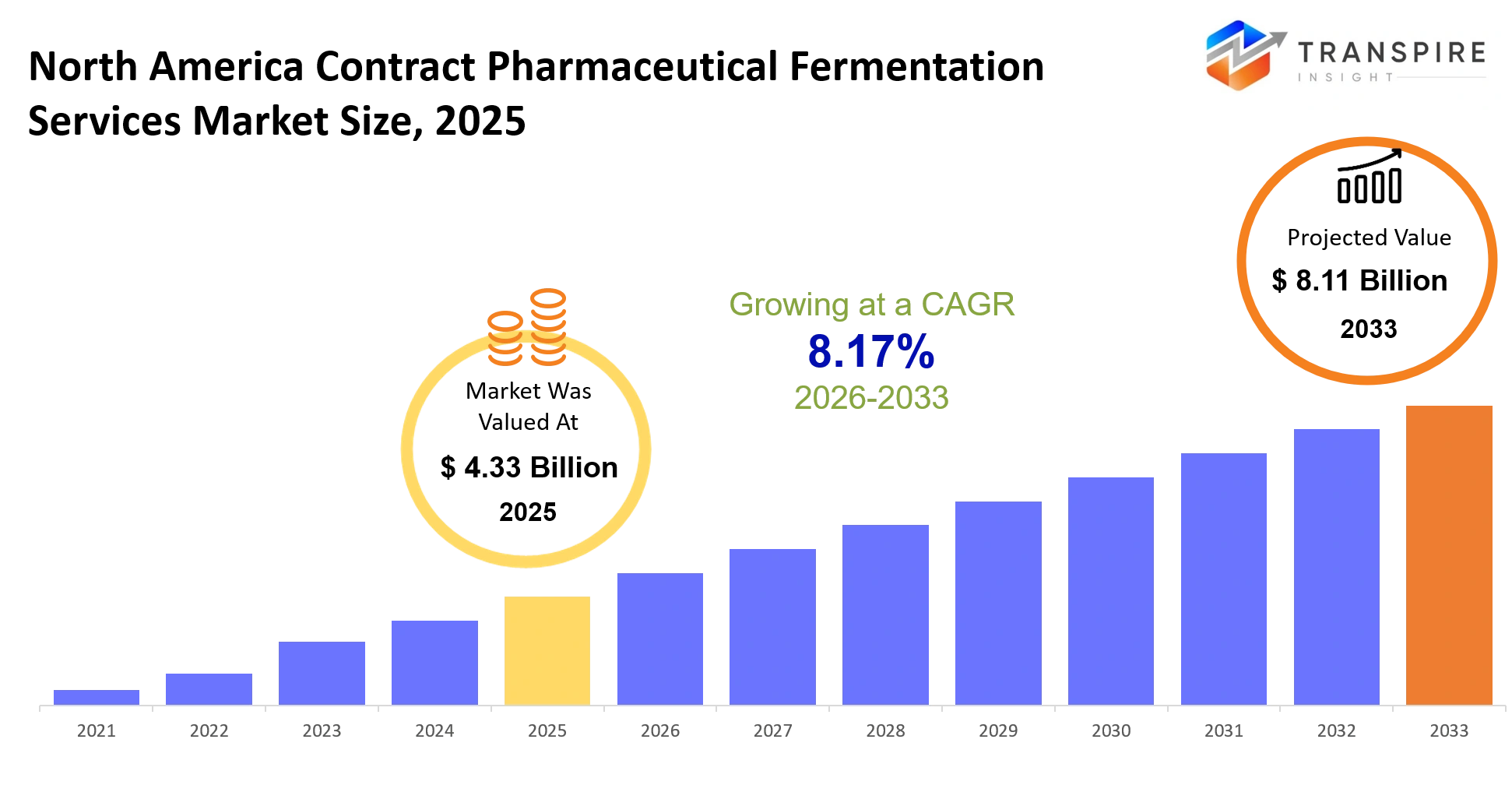
- North America Contract Pharmaceutical Fermentation Services Market Size 2025: USD 4.33 Billion
- North America Contract Pharmaceutical Fermentation Services Market Size 2033: USD 8.11 Billion
- North America Contract Pharmaceutical Fermentation Services Market CAGR: 8.17%
- North America Contract Pharmaceutical Fermentation Services Market Segments: By Service Type (Process Development, Strain Development, Fermentation Manufacturing, Scale-Up Services, Downstream Processing, Analytical Testing, Commercial Manufacturing, Others); By Product Type (Recombinant Proteins, Enzymes, Antibiotics, Vaccines, Probiotics, Biosimilars, Microbial APIs, Others); By Fermentation Type (Microbial Fermentation, Mammalian Cell Fermentation, Yeast Fermentation, Fungal Fermentation, Continuous Fermentation, Batch Fermentation, Fed-Batch Fermentation, Others); By End User (Pharmaceutical Companies, Biotechnology Companies, CDMOs, CROs, Academic Research Institutes, Government Research Organizations, Others); By Scale (Laboratory Scale, Pilot Scale, Clinical Scale, Commercial Scale, GMP Manufacturing, Continuous Manufacturing, Process Optimization, Others).
North America Contract Pharmaceutical Fermentation Services Market Summary
The North America Contract Pharmaceutical Fermentation Services Market was valued at USD 4.33 Billion in 2025. It is forecast to reach USD 8.11 Billion by 2033. That is a CAGR of 8.17% over the period.
The North America Contract Pharmaceutical Fermentation Services Market kinda lets biopharmaceutical companies hand off the hard microbial and cell based fermentation work that’s needed to make active pharmaceutical ingredients, biologics, vaccines, enzymes and other medical products, all with commercial quality at scale. So instead of building everything themselves, drug developers can speed up their work while also dodging the big upfront capital spent for specialized fermentation infrastructure. In recent years, the whole landscape has shifted in a more structural way, moving toward high capacity, adjustable manufacturing platforms that can cover both clinical scale and commercial scale biologic production. that change is mainly pushed by the growing pipeline of biologics and more advanced therapeutics. A pretty big trigger was the COVID-19 pandemic , it basically revealed weak spots in global pharma supply chains and it also made companies hurry up with plans to regionalize manufacturing capability. Because of that, buyers have been leaning more and more toward North American contract partners that can provide steadier production networks , faster technology transfer, and manufacturing that stays regulatory-compliant, so they can cut supply risk and improve how reliably deliveries show up.
Key Market Insights
- North America still kinda runs the show, holding around 82% market share in 2025, and this is backed by solid biologics manufacturing know-how infrastructure, plus regulatory knowledge that is already well established.
- Canada is showing the most rapid climb across 2025–2032, mostly because biomanufacturing investments keep coming in, with government funding, and also more contract development capability added step by step.
- On the services side, microbial fermentation services basically dominate, with an estimated 58% market share in 2025, and that happens because it gets used broadly for recombinant proteins, enzymes, and biosimilars.
- Mammalian cell fermentation services stay in second place, and they’re supported by the growing run of monoclonal antibody programs, and other complicated biologic manufacturing efforts.
- Continuous fermentation platforms are projected to be the fastest growing service segment from 2025 to 2032, because they help improve productivity, and also cut down production costs in a more direct way.
- When looking at applications, biologics manufacturing leads, with about 48% market share in 2025, which points to steady outsourcing across commercial manufacturing and late-stage clinical production.
- Vaccine manufacturing is expected to be the fastest growing application through 2032, supported by regional production capacity expansions and pandemic readiness initiatives.
- For end users, large pharmaceutical companies appear to lead with nearly 52% market share in 2025, using outsourcing to keep manufacturing flexible and to diversify their portfolios.
- Meanwhile emerging biotechnology companies are the fastest growing end-user group through 2032, and instead of building capital intensive facilities, they lean on outside fermentation expertise.
What are the Key Drivers, Restraints, and Opportunities in the North America Contract Pharmaceutical Fermentation Services Market?
The strongest growth driver is basically the movement toward biologics, biosimilars, and advanced therapeutic products that need specialized fermentation skills. Tight regulatory standards , and then escalating facility construction costs have pushed pharmaceutical companies to outsource manufacturing , rather than grow their own internal production assets. In practice this technology and cost shift tends to cut down commercialization timelines while also making manufacturing more adaptable. Contract service providers then end up capturing higher-value production programs, as clients look for scalable capacity across both clinical and commercial phases. So the end result is stronger contract values, better facility utilization, and more widespread adoption of long-term manufacturing agreements.
The main restraint is kind of a two part problem: limited large-scale fermentation capacity , plus lengthy facility qualification timelines. Creating regulatory compliant production infrastructure needs serious capital investment, and it can take several years before anything becomes commercially operational. On top of that, workforce shortages at the skilled level further narrow expansion. From the Transpire Insight review of regional procurement announcements and launch schedules, supply chain concentration is still the primary execution risk. Capacity bottlenecks can stall technology transfers, delay commercial launches , and reduce the possible revenue for both contract manufacturers and pharmaceutical sponsors.
A significant opportunity lies in continuous bioprocessing, digital biomanufacturing platforms, and next-generation precision fermentation technologies, in a way that feels almost like a chain reaction. If you invest in modular manufacturing facilities, you can run flexible production without that kind of proportional capital expansion, you know? North America seems to offer favorable conditions too, driven by public biomanufacturing initiatives, private investment, and the biotechnology clusters that keep growing and pulling in resources.
Service providers that bring together advanced automation, fast scale-up know how, and end-to-end development capabilities are positioned to land bigger multi-year outsourcing contracts. In other words, they can unlock the market’s next phase of expansion, and maybe a little more than just that.
What Has the Impact of Artificial Intelligence Been on the North America Contract Pharmaceutical Fermentation Services Market?
Artificial intelligence and digital manufacturing technologies are reshaping contract pharmaceutical fermentation services, kind of at the same time they improve process consistency, push production efficiency forward , and make regulatory compliance easier. AI enabled control systems constantly look at fermentation parameters like pH, dissolved oxygen, nutrient concentration, temperature , and microbial growth so the operators can tweak things right away, before process deviations end up touching product quality. On top of that, automated batch documentation helps a lot with compliance, especially when pharmaceutical manufacturing requirements are strict and have little margin for error.
Machine learning models now also back predictive maintenance for bioreactors filtration systems and downstream processing equipment, while at the same time they forecast production schedules using older utilization records and customer order patterns. Digital twins run simulations of fermentation conditions before commercial runs start, which lowers scale up uncertainty and tends to speed up technology transfer between development teams and manufacturing locations. With these tools in place, equipment uptime improves, batch failures go down, process yields get better, and operating costs can be reduced, which in turn supports more steady and dependable production planning.
Still, even with these benefits, broad AI rollout is slowed by high integration expenses and by fragmented manufacturing data trapped across older systems. A lot of fermentation facilities run equipment from multiple generations, and that makes standardized data collection a real challenge. Also, there are limited high quality datasets for specialized biologic processes, so prediction accuracy doesn’t always hold up , and it means humans still need to oversee outcomes. In many cases this is the reason AI driven suggestions can not be fully relied on yet in commercial pharmaceutical manufacturing.
Key Market Trends
- Since 2022, pharmaceutical companies kinda moved toward multi-year outsourcing agreements, to lock in fermentation capacity while those manufacturing constraints keep hanging around, pretty constant and hard to ignore .
- Continuous fermentation technologies have been more broadly used since 2023 , boosting production efficiency even while batch variability drops, and also cutting manufacturing downtime.
- Single-use bioreactor deployment has rolled out across clinical manufacturing facilities, which shortens facility changeover times, and adds a bit more operational flexibility.
- Digital bioprocess monitoring platforms are increasingly replacing manual process supervision, so they can spot deviations sooner, and it supports stronger regulatory compliance, not just faster reporting.
- After the pandemic-related disruptions, pharmaceutical companies diversified supplier networks, because concentrated manufacturing capacity turned out to be a real risk, and everyone noticed.
- Advanced microbial strain engineering is helping productivity rise faster, shortening development timelines for recombinant proteins and industrial biologics, in a way that feels pretty direct.
- Since 2022 , investment in domestic biologics manufacturing infrastructure has gone up, improving North American supply resilience, while reducing reliance on overseas outsourcing arrangements.
- Companies like Lonza, Thermo Fisher Scientific, and FUJIFILM Diosynth Biotechnologies have expanded fermentation capacity by leaning on strategic facility investments , rather than just incremental tweaks.
- Environmental sustainability initiatives are also pushing adoption of energy-efficient fermentation systems, plus media utilization has been optimized , so operating costs and emissions can both be lowered , at the same time.
North America Contract Pharmaceutical Fermentation Services Market Segmentation
By Service Type:
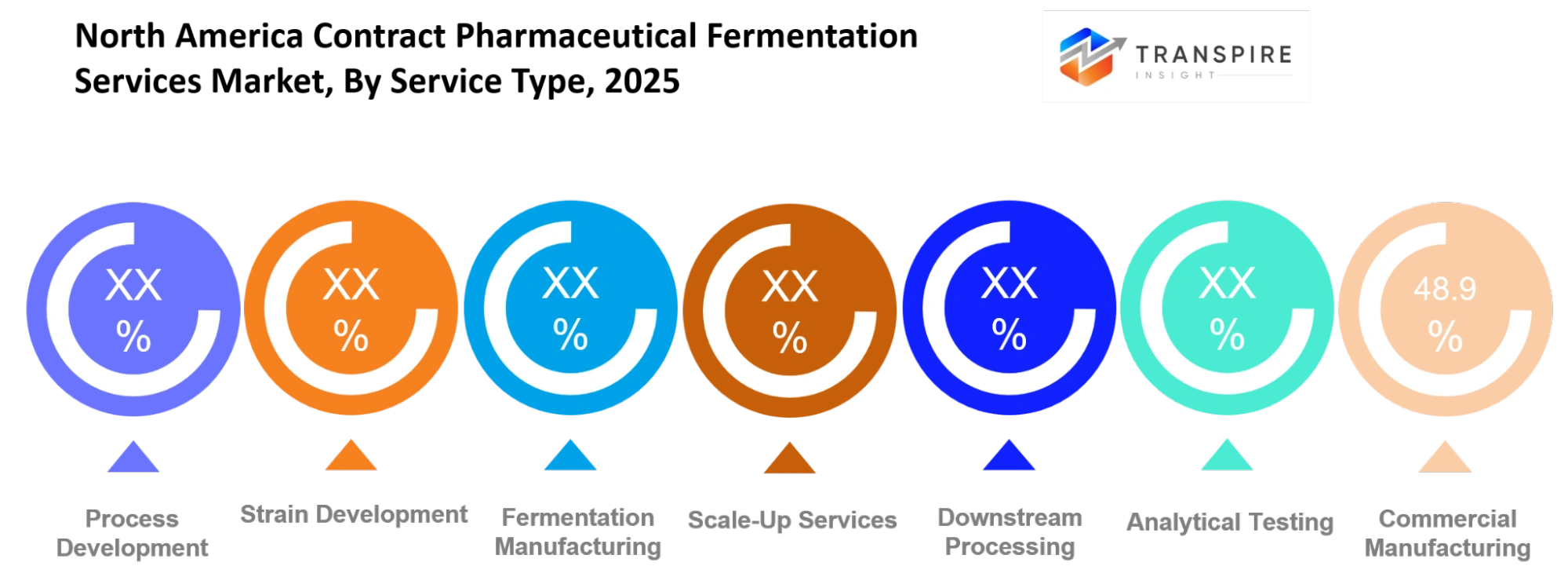
Process Development does the kind of groundwork that tends to help fermentation projects work out, because it sets up dependable production methods before big scale manufacturing even starts. In the early phase you do optimization, which helps tame process variability , and then you get better product consistency across the whole development journey. Strain Development, on the other hand, pushes higher productivity, by sharpening microbial performance and also improving yield, a bit like getting the organism to do more with less. Then Fermentation Manufacturing delivers controlled production for biologics enzymes and pharmaceutical ingredients while still staying inside strict quality expectations.
Scale-Up Services acts as a bridge between lab research and commercial production, through careful adjustments to fermentation parameters and equipment settings that actually matter. Downstream Processing covers purification, separation, and recovery of valuable biological materials, and it keeps product quality from drifting. Analytical Testing confirms the product identity, purity safety, and regulatory compliance, using detailed evaluation methods that are pretty much the checkpoints people trust. Commercial Manufacturing supports long term product supply with validated production systems, while Other services give specialized technical support for unusual development and manufacturing needs, you know those edge cases that still have to be handled properly.
By Product Type:
Recombinant Proteins seems like they are still in the lead since biologic therapies keep expanding across several treatment areas, you know. Enzymes stay widely used for pharmaceutical manufacturing, and also for specialized therapeutic programs that need a controlled biological activity not just “any” kind of activity. Antibiotics keep a steady role because fermentation stays an efficient way to produce a bunch of established drug classes, and it’s still practical. Vaccines continue to push market momentum by expanding manufacturing capacity, plus with better production technologies that help along the way.
Probiotics bring extra possibilities as fermentation methods get better at keeping products stable, and also at improving manufacturing efficiency. Biosimilars make contract manufacturing partnerships more attractive, mainly because developers want cost effective production without setting up dedicated facilities themselves. Microbial APIs support pharmaceutical production using dependable fermentation platforms that deliver consistent quality and scalable output over time. Other product categories cover specialized therapeutic initiatives that demand customized fermentation know how, and flexible manufacturing solutions too.
By Fermentation Type:
Microbial Fermentation keeps leading , because the already proven production setups back recombinant proteins, enzymes , antibiotics, and multiple pharmaceutical ingredients with dependable results. Mammalian Cell Fermentation is still a big deal for the more intricate biologic products where advanced expression systems are needed, plus strict production oversight. Yeast Fermentation works out well for selected therapeutic proteins and specialty biological products, it also tends to look favorable on the production cost side. Fungal Fermentation helps with enzyme production and other pharma uses , and in those cases the specific biological traits can give real manufacturing advantages.
Continuous Fermentation is getting more attention too, since the longer run times help with better equipment usage and fewer operational hiccups. Batch Fermentation stays common , mainly because the established manufacturing routines give flexibility across different product categories. Fed-Batch Fermentation kind of splits the difference, it aims for higher productivity while still keeping better process control by letting teams adjust nutrients during the run. Other fermentation approaches remain relevant for specialized manufacturing needs, especially when unique biological systems, or customized production strategies are required.
By End User:
Pharmaceutical Companies sit with the largest share because outsourced fermentation services cut down the capital investment, while at the same time stretching manufacturing flexibility a bit more than in house setups. Biotechnology Companies push stronger market momentum by expanding development pipelines that need specialized production know-how, and that “know-how” is not exactly plug and play. CDMOs keep widening their service suites too, by stitching together development, manufacturing, and regulatory support into one integrated operating model, so customers can move faster without too much handoff. CROs also matter, they pitch in during early stage process development and add technical support that basically helps products get ready for commercial manufacturing later.
Academic Research Institutes help by supporting innovation, they develop new fermentation methods and biological technologies, which then may later be fed into commercial production. Government Research Organizations help nudge manufacturing capability by providing research funding and running cooperative development programs aimed at strategic healthcare priorities. Other end users include niche organizations that are hunting for trustworthy fermentation partners for special therapeutic, industrial, or research use cases, sometimes very specific.
By Scale:
Laboratory Scale helps early research by checking how production methods hold up before any bigger manufacturing stuff even starts, so yeah it’s sort of a first look. Pilot Scale then confirms production performance in settings that are similar enough to commercial operations , while at the same time it points out process tweaks that could be better. Clinical Scale supplies material for regulatory work and clinical trials, and this is done with tightly controlled manufacturing standards. Commercial Scale is where high-volume manufacturing happens, meeting market supply needs while still keeping product quality consistent.
GMP Manufacturing stays important because pharmaceutical rules expect validated production systems and clearly recorded quality controls. Continuous Manufacturing boosts production efficiency by minimizing process interruptions and helping the plant stay in stable operating conditions. Process Optimization raises productivity using smarter resource use , better yields , and generally lower manufacturing costs. Also, other scale-related services cover specialized production needs, where a tailored development or manufacturing approach adds extra day to day operational value .
What are the Key Use Cases Driving the North America Contract Pharmaceutical Fermentation Services Market?
Contract pharmaceutical fermentation services get used a lot, maybe mostly, for biologic drug manufacturing where companies basically farm out recombinant protein and microbial active pharmaceutical ingredient work, just to cut down on upfront capital investment and also speed up commercial timelines. In practice this kind of use case grabs the biggest portion of contracts, because specialized fermentation facilities can provide validated production systems and they align with those very strict regulatory expectations.
Then there’s more. Additional use cases keep spreading into vaccine manufacturing, and also biosimilar development. Biotechnology companies increasingly lean on outside fermentation partners to scale clinical candidates, and contract development and manufacturing organizations help with more adaptable production, especially when products are transitioning from clinical trials to commercial supply, not always the easiest moment.
Also, newer opportunities are starting to show up around precision fermentation for novel therapeutic molecules, plus advanced microbial platforms for next generation biologics. Government backed biomanufacturing initiatives, along with academic research partnerships, keep generating fresh efforts that end up needing pilot scale fermentation skills before full commercial rollout, so adoption stays broader throughout the forecast period, and it kind of keeps moving forward.
|
Report Metrics |
Details |
|
Market size value in 2025 |
USD 4.33 Billion |
|
Market size value in 2026 |
USD 4.68 Billion |
|
Revenue forecast in 2033 |
USD 8.11 Billion |
|
Growth rate |
CAGR of 8.17% from 2026 to 2033 |
|
Base year |
2025 |
|
Historical data |
2021 - 2024 |
|
Forecast period |
2026 - 2033 |
|
Report coverage |
Revenue forecast, competitive landscape, growth factors, and trends |
|
Regional scope |
North America (Canada, The United States, and Mexico) |
|
Key company profiled |
Lonza, Thermo Fisher Scientific, WuXi AppTec, Catalent, Samsung Biologics, FUJIFILM Diosynth Biotechnologies, AGC Biologics, Recipharm, Cambrex, CordenPharma, Curia, Eurofins Scientific, Evonik, KBI Biopharma, BioVectra. |
|
Customization scope |
Free report customization (country, regional & segment scope). Avail customized purchase options to meet your exact research needs. |
|
Report Segmentation |
By Service Type (Process Development, Strain Development, Fermentation Manufacturing, Scale-Up Services, Downstream Processing, Analytical Testing, Commercial Manufacturing, Others); By Product Type (Recombinant Proteins, Enzymes, Antibiotics, Vaccines, Probiotics, Biosimilars, Microbial APIs, Others); By Fermentation Type (Microbial Fermentation, Mammalian Cell Fermentation, Yeast Fermentation, Fungal Fermentation, Continuous Fermentation, Batch Fermentation, Fed-Batch Fermentation, Others); By End User (Pharmaceutical Companies, Biotechnology Companies, CDMOs, CROs, Academic Research Institutes, Government Research Organizations, Others); By Scale (Laboratory Scale, Pilot Scale, Clinical Scale, Commercial Scale, GMP Manufacturing, Continuous Manufacturing, Process Optimization, Others). |
Which Regions are Driving the North America Contract Pharmaceutical Fermentation Services Market Growth?
The United States sort of represents the main regional market, making up about 84% of the total revenue . This happens because there is strong regulatory supervision, high end biopharmaceutical manufacturing standards and also a lot of biologics production capacity that basically keeps everything solid. There’s also a dense web of contract development and manufacturing organizations , along with biotechnology firms , pharmaceutical companies, and niche specialized suppliers, which helps the regional production ecosystem stay effective. Ongoing spending on advanced fermentation facilities, building a skilled workforce, and commercial biologics manufacturing should keep regional leadership in place during the forecast period.
Canada takes the second place share, mostly because the way market development happens leans toward smart biomanufacturing expansion rather than just raw production volume alone . The regulatory environment stays stable, public funding is relatively consistent, and long-term backing for life sciences supports more predictable investment choices across fermentation services. National research institutions , biotechnology clusters and commercial manufacturing collaborations create a steady stream of projects for contract service providers. Economic resilience plus coordinated industrial plans also helps maintain steady revenue growth and reduces the risk of short term market swings .
Canada is also kind of the fastest-growing regional market, because recent federal investments in local biomanufacturing infrastructure have expanded fermentation capacity and, honestly, made pharmaceutical supply resilience stronger. Along with new funding programs, facility modernization projects, and research collaborations, commercial readiness for advanced biologics manufacturing has moved along faster. As biotechnology activity keeps expanding, it creates extra outsourcing opportunities for specialized fermentation providers that support both clinical production and commercial production at the same time. And the growth expected across 2026–2033, should lead to real, attractive opportunities for fresh market entrants plus investors who are looking for capacity expansion , technology partnerships and specialized manufacturing services.
Who are the Key Players in the North America Contract Pharmaceutical Fermentation Services Market and How Do They Compete?
Competition is still kind of moderately consolidated, since only a smaller set of global contract manufacturers controls most of the big scale fermentation capacity. I mean the main “fight” is not really only about price, but more about things like technology skill, manufacturing quality, regulatory compliance, and also these integrated service offerings that kinda tie everything together. Even so, many long running providers keep pushing out additional production capacity and digital manufacturing capabilities. Meanwhile, specialized businesses tend to play a different game, focusing on niche biologics, more adaptable manufacturing setups, and quicker project execution, like less waiting time.
Thermo Fisher Scientific keeps strengthening its position by using integrated development along with commercial manufacturing services, so pharmaceutical programs can be supported from early research all the way to large scale production. They also keep investing in biologics facilities and digital manufacturing improvements, which helps keep production flexibility and shortens the delivery timelines. Lonza on the other hand differentiates in how they run things with advanced microbial and mammalian fermentation know-how, and it’s backed up by high levels of regulatory compliance. With capacity expansion plus technology investments, they can take bigger commercial contracts, and also tackle more complicated biologic manufacturing projects.
FUJIFILM Diosynth Biotechnologies concentrates on advanced biologics production, supported by strategic expansion of North American manufacturing sites and flexible development services. AGC Biologics competes through customized fermentation solutions, and they also do a close working relationship with biotechnology companies that are building innovative therapies. Catalent grows integrated biologics capabilities via manufacturing upgrades and more service breadth, so pharmaceutical clients can essentially manage development and commercial production within one connected operating network.
Company List
- Lonza
- Thermo Fisher Scientific
- WuXi AppTec
- Catalent
- Samsung Biologics
- FUJIFILM Diosynth Biotechnologies
- AGC Biologics
- Recipharm
- Cambrex
- CordenPharma
- Curia
- Eurofins Scientific
- Evonik
- KBI Biopharma
- BioVectra
Recent Development News
In April 2025, FUJIFILM Biotechnologies signed a 10-year U.S. manufacturing agreement valued at more than $3 billion with Regeneron Pharmaceuticals. The agreement expands large-scale biologics manufacturing at the Holly Springs, North Carolina facility and strengthens North American contract fermentation and biologics production capacity. Source URL:
Source: https://fujifilmbiotechnologies.fujifilm.com/
In September 2025, FUJIFILM Biotechnologies expanded its strategic partnership with argenx to include U.S. manufacturing operations. The expanded collaboration broadened commercial manufacturing support for biologic medicines while increasing utilization of North American biomanufacturing capacity and reinforcing long-term CDMO demand. Source URL:
Source: https://firstwordpharma.com/
What Strategic Insights Define the Future of the North America Contract Pharmaceutical Fermentation Services Market?
The North America Contract Pharmaceutical Fermentation Services Market is kind of moving toward a more specialized manufacturing model, where flexible fermentation capacity, advanced bioprocessing technologies, and these integrated development-to-commercial production services start becoming the key competitive edges . You can see this shift happening because biologics pipelines are expanding, product development cycles are getting shorter , and companies are leaning more on outside manufacturing rather than going all in on capital-intensive internal facilities.
A risk that’s a bit less visible, though, is the fact that large scale fermentation capacity may end up being concentrated with only a handful of providers, and that could bring pricing pressure, longer production queues, and then delayed product launches whenever demand is high and utilization hits its peak.
At the same time, there’s an opportunity that’s starting to look more real, in AI-enabled continuous bioprocessing, plus modular manufacturing platforms that could shrink the technology transfer timelines while also boosting day-to-day operational efficiency. Market players will likely benefit by putting money in early, in scalable digital manufacturing abilities, building regional production capacity, and forming long-term strategic partnerships with biotechnology innovators, so they can keep a sustainable competitive position over the next decade .
North America Contract Pharmaceutical Fermentation Services Market Report Segmentation
By Service Type
- Process Development
- Strain Development
- Fermentation Manufacturing
- Scale-Up Services
- Downstream Processing
- Analytical Testing
- Commercial Manufacturing
By Product Type
- Recombinant Proteins
- Enzymes
- Antibiotics
- Vaccines
- Probiotics
- Biosimilars
- Microbial APIs
By Fermentation Type
- Microbial Fermentation
- Mammalian Cell Fermentation
- Yeast Fermentation
- Fungal Fermentation
- Continuous Fermentation
- Batch Fermentation
- Fed-Batch Fermentation
By End User
- Pharmaceutical Companies
- Biotechnology Companies
- CDMOs
- CROs
- Academic Research Institutes
- Government Research Organizations
By Scale
- Laboratory Scale
- Pilot Scale
- Clinical Scale
- Commercial Scale
- GMP Manufacturing
- Continuous Manufacturing
- Process Optimization
Frequently Asked Questions
Find quick answers to common questions.
The expected North America Contract Pharmaceutical Fermentation Services Market size for the market will be USD 8.11 Billion in 2033.
Key segments for the North America Contract Pharmaceutical Fermentation Services Market are Type By Service Type (Process Development, Strain Development, Fermentation Manufacturing, Scale-Up Services, Downstream Processing, Analytical Testing, Commercial Manufacturing, Others); By Product Type (Recombinant Proteins, Enzymes, Antibiotics, Vaccines, Probiotics, Biosimilars, Microbial APIs, Others); By Fermentation Type (Microbial Fermentation, Mammalian Cell Fermentation, Yeast Fermentation, Fungal Fermentation, Continuous Fermentation, Batch Fermentation, Fed-Batch Fermentation, Others); By End User (Pharmaceutical Companies, Biotechnology Companies, CDMOs, CROs, Academic Research Institutes, Government Research Organizations, Others); By Scale (Laboratory Scale, Pilot Scale, Clinical Scale, Commercial Scale, GMP Manufacturing, Continuous Manufacturing, Process Optimization, Others).
Major North America Contract Pharmaceutical Fermentation Services Market players are Lonza, Thermo Fisher Scientific, WuXi AppTec, Catalent, Samsung Biologics, FUJIFILM Diosynth Biotechnologies, AGC Biologics, Recipharm, Cambrex, CordenPharma, Curia, Eurofins Scientific, Evonik, KBI Biopharma, BioVectra.
The North America Contract Pharmaceutical Fermentation Services Market size is USD 4.33 Billion in 2025.
The North America Contract Pharmaceutical Fermentation Services Market CAGR is 8.17% from 2026 to 2033.
- Lonza
- Thermo Fisher Scientific
- WuXi AppTec
- Catalent
- Samsung Biologics
- FUJIFILM Diosynth Biotechnologies
- AGC Biologics
- Recipharm
- Cambrex
- CordenPharma
- Curia
- Eurofins Scientific
- Evonik
- KBI Biopharma
- BioVectra
About the Authors

Pankaj Ghogare Patil
I am Pankaj Ghogare Patil, a Senior Research Analyst at Transpire Insight, specializing in the Pharmaceutical, Chemicals & Materials, Healthcare IT, and Biotechnology industry. My expertise lies in conducting comprehensive market research, analyzing industry trends, evaluating competitive landscapes, and translating complex data into actionable insights. At Transpire Insight, I closely follow emerging technologies, regulatory developments, and market innovations to create accurate, well-researched, and informative content that helps businesses and professionals make informed decisions. I am committed to producing credible, evidence-based articles that reflect industry best practices while making technical topics accessible and valuable for a broad audience.

Chakradhar Khansole
Chakradhar serves as the Research Director at Transpire Insight, bringing over 8 years of experience in technology, innovation, and strategic market intelligence. He specializes in transforming complex market data into actionable business insights that enable organizations to make informed, growth-oriented decisions. Recognized for his strategic vision and analytical expertise, Chakradhar leads high-impact research initiatives, delivering comprehensive market assessments, competitive intelligence, and forward-looking industry analysis.
Recently Published Reports
-
Jul 2026
Alopecia Treatment Market
Alopecia Treatment Market Size, Share & Analysis Report By Disease Type (Alopecia Areata, Cicatricial Alopecia, Traction Alopecia, Alopecia Totalis, Androgenetic Alopecia, Alopecia Universalis, and Other Disease Types), By Treatment Type (Topical Treatments, Oral Medications, Injectable Therapies, and Hair Transplantation), By Gender (Male, and Female), By Distribution Channel (Hospitals and Clinics, Retail Pharmacies, and Online Retailers), and Geography (North America, Europe, Asia-Pacific, Middle East and Africa, South and Central America), 2021 - 2031
-
Jul 2026
Medical Ultrasound Probe Market
Medical Ultrasound Probe Market Size, Share & Analysis Report By Type (Linear Type, Convex Type, Endocavitary Probe, Phased Array/Cardiac Probe, Transesophageal (TEE) Probe, and Others), By Application (Ophthalmology, Cardiology, Musculoskeletal, Oncology, Obstetrics & Gynecology, General Imaging, and Others), By End User (Hospitals & Clinics, Diagnostic Centers, Ambulatory Surgical Centers, and Others), and Geography (North America, Europe, Asia-Pacific, Middle East and Africa, South and Central America), 2021 – 2031
-
May 2026
Biosimilars Market
Biosimilars Market By Product Type (Monoclonal Antibodies, Recombinant Hormones, Erythropoietin, G-CSF, Others), By Indication (Oncology, Autoimmune Diseases, Blood Disorders, Diabetes, Others), By Manufacturing Type (In-House Manufacturing, Contract Manufacturing), By Distribution Channel (Hospital Pharmacies, Retail Pharmacies, Online Pharmacies), By Industry Analysis, Size, Share, Growth, Trends, and Forecasts 2021-2033
-
Apr 2026
Gastrointestinal Endoscopy Market
Gastrointestinal Endoscopy Market By Type (Rigid Gastrointestinal Endoscope, Flexible Gastrointestinal Endoscopes, Disposable Gastrointestinal Endoscope), By Procedure Type (Colonoscopy, Gastroscopy, Duodenoscopy, Enteroscopy, Flexible Sigmoidoscopy, Others), By Application (Diagnosis, Treatment), By End-Users (Hospitals, Ambulatory Surgical Centers, Specialty Clinics, Laboratories, Others), By Industry Analysis, Size, Share, Growth, Trends, and Forecasts 2021-2033