

Asia Pacific Clinical Trials Management System Market Size & Forecast:
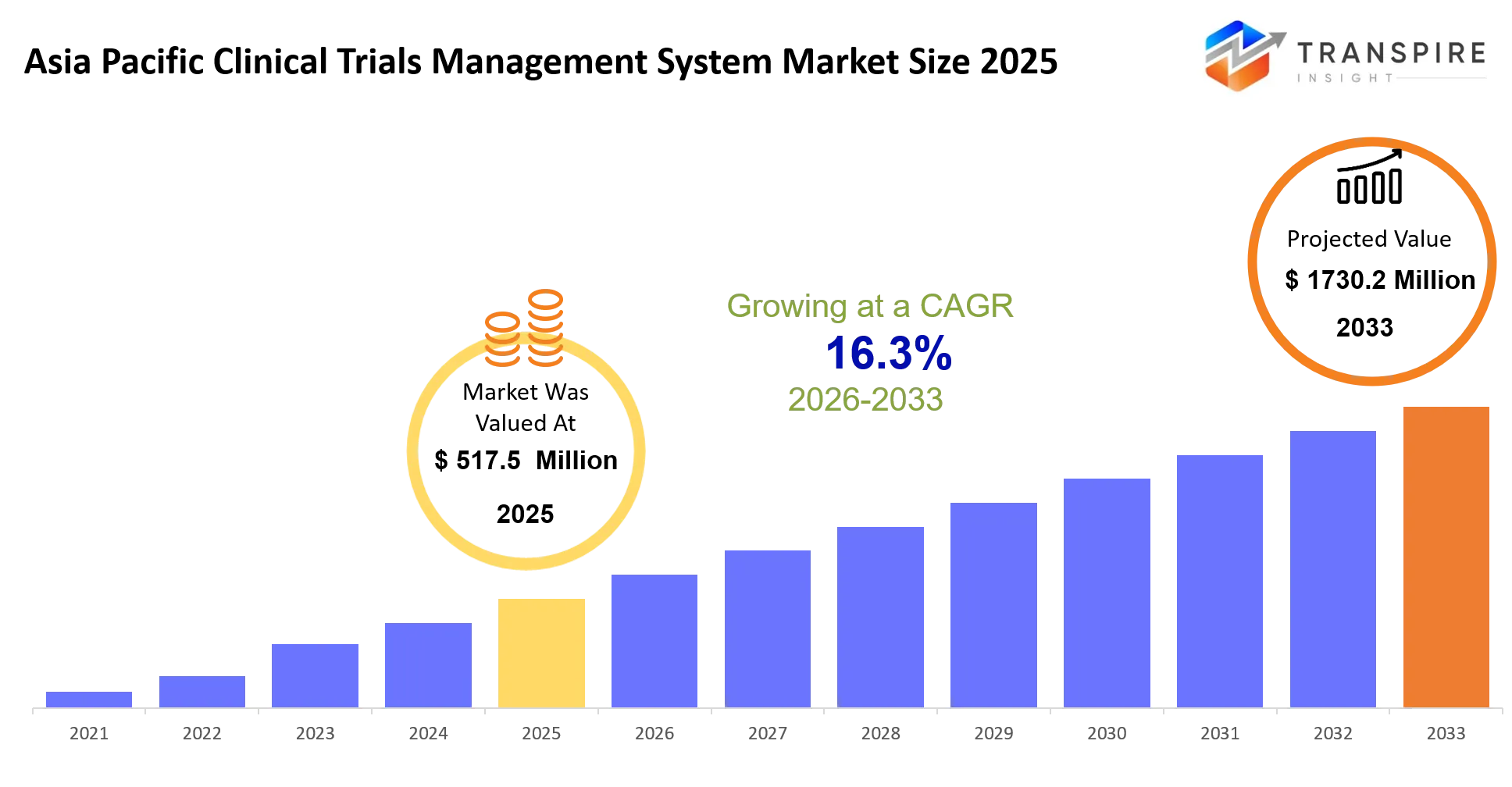
- Asia Pacific Clinical Trials Management System Market Size 2025: USD 517.5 Million
- Asia Pacific Clinical Trials Management System Market Size 2033: USD 1730.2 Million
- Asia Pacific Clinical Trials Management System Market CAGR: 16.3%
- Asia Pacific Clinical Trials Management System Market Segments: By Component (Software, Services, Consulting, Support Services, Integration Services, Analytics Services, Others); By Deployment (Cloud-Based, On-Premise, Hybrid, SaaS, Others); By End User (Pharmaceutical Companies, CROs, Research Institutes, Hospitals, Academic Institutes, Others); By Application (Trial Planning, Site Management, Patient Recruitment, Data Management, Compliance Management, Others)
Asia Pacific Clinical Trials Management System Market Summary
The Asia Pacific Clinical Trials Management System Market was valued at USD 517.5 Million in 2025. It is forecast to reach USD 1730.2 Million by 2033. That is a CAGR of 16.3% over the period.
The CTMS, or Clinical Trials Management Systems, market in Asia Pacific makes for an efficient clinical trial process. In this market, a company, research organization, or hospital can utilize the CTMS to manage trial planning, performance of trial sites, patient recruitment, regulatory document tracking, and financial management throughout numerous trial sites.
In the past five years, this market has changed quite a bit. Instead of using separate software installed on a company's own computers, people are now moving to cloud-based systems that work with other tools for collecting electronic data, involving patients, and analyzing information. The COVID-19 pandemic really sped this up because it made research groups start using remote monitoring and trials where patients didn't have to come into a central clinic. This showed that old, disconnected systems weren't good enough, so companies started putting more money into single, unified digital systems for trials.
Right now, this market is growing because more clinical studies are happening across several countries in Asia Pacific. Also, there are stricter rules from regulators, and everyone wants to get new treatments developed faster. As there are more trials and the data gets more complex, organizations are spending more on CTMS platforms that help them follow rules better, work more efficiently, and get studies done.
Key Market Insights
- China is the leader in the Asia Pacific Clinical Trials Management System Market. It has 32 percent of the market share by 2025. This is because there is a lot of research going on in China.
- India is growing fast in this market until 2030. This is happening because there are trials the cost of research is lower and the government is making it easier to do research.
- Japan has a share of the market. This is because Japan spends a lot of money on research and development. Japan also uses technology to manage trials well.
- Some countries in Southeast Asia are starting to do clinical trials. This is because big companies want to do trials in locations.
- Most of the market uses software solutions. This is 58 percent of the market in 2025. Companies want to manage trials from one place and automate work.
- Cloud-based systems are also popular. They are good because they can grow with the company people can work together in time and they are cheaper to set up
- The Clinical Trials Management System that uses analytics is growing fast from 2025 to 2030. This is because it helps companies make decisions and work efficiently.
- Clinical trial planning and management is a part of the market. It has 40 percent of the market share. This is because companies need to plan and manage studies well.
- People are also using technology to monitor how trial sites are performing. This is growing fast. Companies want to know how trials are going and how many people are enrolling.
- There is a need for systems that can report on trials and make sure everything is compliant. This is especially true for trials that happen in countries.
- The Clinical Trials Management System Market is very important for China and other countries in Asia. It helps companies do trials and get medicines to market. China, India and Japan are all players, in this market. Clinical Trials Management System is used to manage trials and make sure they are done correctly.
What are the Key Drivers, Restraints, and Opportunities in the Asia Pacific Clinical Trials Management System Market?
The main reasons the Asia Pacific market for Clinical Trials Management Systems is growing are two-fold: more clinical trials are happening across many countries, and research is moving towards more spread-out models. Drug companies are running bigger studies in more places like China, India, South Korea, and Southeast Asia. They do this to find all sorts of patients and to cut down on development costs. This change has made it clear that managing trials by hand or using scattered data systems just doesn't work anymore. As a result, the companies funding and running these trials are investing in combined CTMS platforms. These platforms help them better manage trial sites, track patients, follow rules, and handle finances. This directly leads to more money spent on software and more widespread use of cloud-based trial management solutions.
The biggest problem holding this market back is the disorganized digital setups in healthcare and research places across the region. Many hospitals, research sites, and smaller trial centers are still using old systems that don't easily work with modern CTMS platforms. This is a tough problem to fix because upgrading technology needs a lot of money, staff training, and changes to how things are done. Because of this, it takes longer to set up new systems, they don't connect well, and companies put off buying them, which slows down how much money the market could make.
A major chance for growth is to add artificial intelligence and predictive analysis to how trials are managed. CTMS platforms with AI can help predict problems with getting enough patients, find sites that aren't doing well, and use resources in the best way. Countries like Singapore and South Korea are spending more on digital health. This creates a good environment for advanced clinical research technologies, setting up the region for the next big step in CTMS development and use.
What Has the Impact of Artificial Intelligence Been on the Asia Pacific Clinical Trials Management System Market?
AI and new digital technologies are altering clinical trial management in the Asia Pacific by enabling a higher degree of automation of operating processes that traditionally required significant human monitoring. Current CTMS solutions utilize AI for the automation of processes such as site selection, patient enrollment procedures, protocol monitoring, document management, and regulatory compliance. These features mitigate administrative work and enable researchers to handle growing portfolios of studies.
Machine learning is also enabling enhanced predictive decision-making. A sponsor may now leverage predictive analytics to predict site patient enrollment rates, potential problematic sites that may underperform, and the probability of a protocol deviation before it may cause project impact. Organizations use predictive modeling (including analyzing historical trial data, investigator performance measures, and enrollment patterns) to efficiently distribute resources and avert time delays. As a result, trial planning tools that use AI have also decreased patient recruitment times, increased site productivity, and diminished operational expenses.
Advanced analytics platforms enhance real-time tracking of trial status, by combining data from electronic data capture systems, patient engagement tools, and regulatory data bases. The use of such integration facilitates increased compliance management and overall trial consistency throughout various countries.
A significant challenge in AI utilization remains. Many clinical research sites and health care organizations have dated, siloed systems that are both complex and costly to integrate. Poor data consistency throughout trial sites can diminish the accuracy of a predictive model, and ultimately the efficiency with which the model supports optimized clinical trial conduct.
Key Market Trends
- Since 2020 pharmaceutical companies have been moving their trial management systems from their own servers to the cloud. This change has helped them set up these systems faster and work better with people in countries.
- Decentralized clinical trial models became popular after the pandemic. This is when companies started using monitoring and patient engagement tools in their trials.
- The governments of China, India and South Korea have made rules for digital documents. Because of this companies are using tools that help them follow these rules and keep track of what they're doing.
- Between 2022 and 2025 companies that used intelligence to analyze data were able to predict problems with patient enrollment and make their clinical trial sites work better.
- Contract Research Organizations have invested more in technology to manage studies that take place in many countries. They are now buying trial management systems that can grow with their needs.
- More companies are asking for systems that can work together. They are moving away from using applications and are using systems that connect clinical trial management, data collection and other tools.
- Big companies, like Oracle, Medidata, Veeva Systems and IQVIA have partnered with companies to provide better support.
- The people who run trials want to be able to see what is happening in real time. They are using automated systems to track progress of spreadsheets.
- Research companies are trying to keep patients in their trials and make the process of recruiting patients more efficient. They are using technology that helps them plan their trials based on data.
- Companies are no longer just trying to make their products different by adding features. They are now trying to make their systems work with systems. They are investing in technology that allows different systems to communicate with each other.
Asia Pacific Clinical Trials Management System Market Segmentation
By Component:
Software is still the main thing we use for planning clinical trials, managing sites, tracking participants, handling regulatory documents, and keeping an eye on money. When trials get more complicated and happen in many countries, it's led to more investment in systems that bring everything together. These systems connect all the data, manage workflows, and handle reporting. Also, software running in the cloud has made it easier for the companies funding trials, research groups, and hospitals that manage many studies to get access to what they need.
Services are still a big part of making sure these systems work well when they're set up and keep working well over time. Things like consulting, setting up the system, connecting it to other tools, checking if it works right, and training people all help companies make sure the technology fits what they need to do day-to-day. People need more specialized help, especially as organizations update their old systems and start using newer digital tools. When you put new software ideas together with expert services, it makes things run smoother and helps trials get done better.
By Deployment:
A lot of research places are now choosing to run their systems in the cloud. They like it because it's flexible, can grow easily, and makes it simpler for everyone involved to work together. Being able to see trial info right away helps them make decisions quicker and gives a clearer picture to all the study sites, even if they're far apart. Cloud systems are also appealing because they need less hardware, which saves money for organizations looking for affordable tech.
But some places still use their own servers, especially those with strict rules about data and existing systems already set up. Being able to directly control where data is stored and how secure it is remains important for some drug companies and research centers. Hybrid systems are also getting noticed. These combine the easy access of the cloud with having control over some things locally. This way, organizations can follow all their rules while still being flexible in how they operate.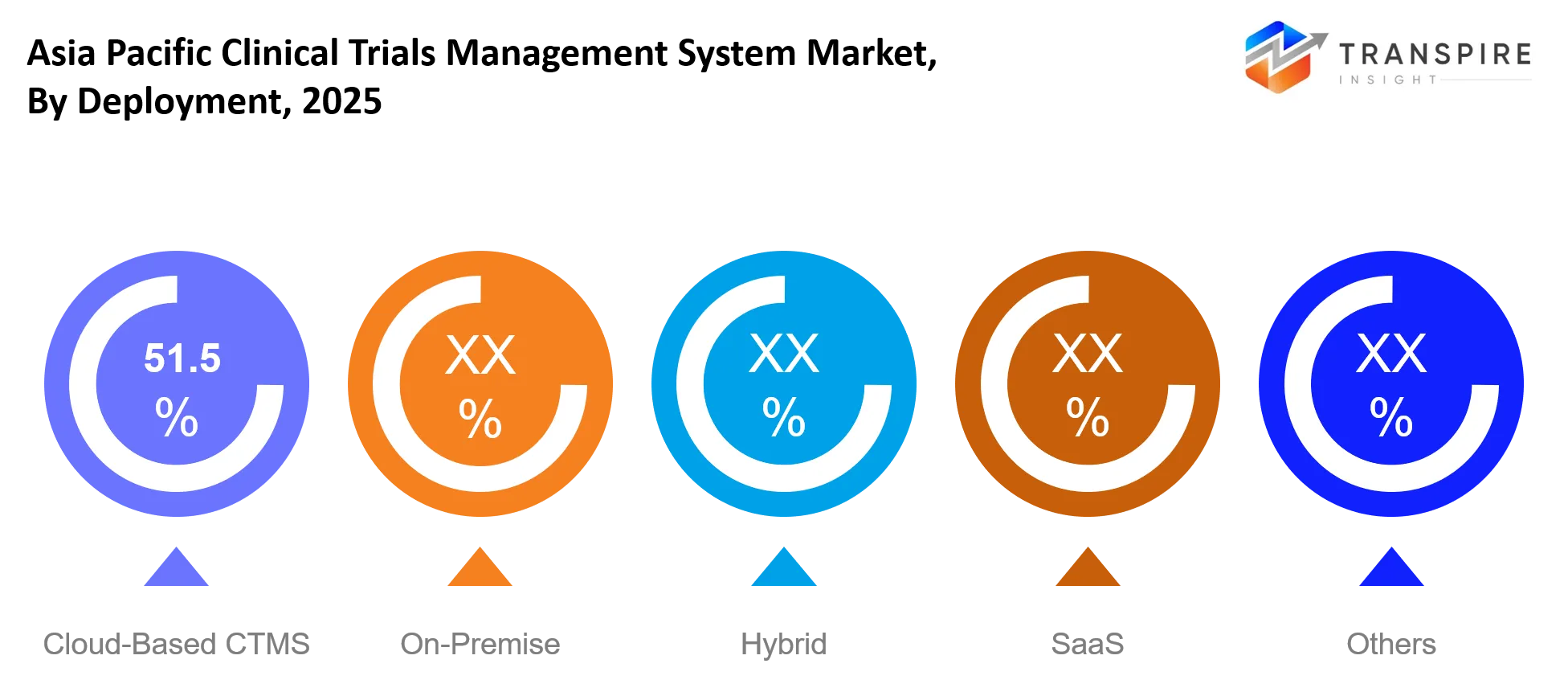
By End User:
Drug and biotech companies use these platforms a lot because they keep investing in developing new drugs and doing clinical trials. For them, it's really important to manage study schedules, government rules, and research budgets effectively. Better management systems help them organize trials across many countries and make everything clearer and easier to oversee.
CROs (Contract Research Organizations) are also using more of this technology. They need it to keep up with what their clients ask for and to handle more and bigger studies. Universities and other research centers are also bringing in digital tools. They use them to manage studies started by their own researchers and projects where they team up with others. Because everyone is focusing more on how efficiently they work and how good their data is, more and more different groups are starting to use these platforms. Investing in this technology helps them coordinate better, follow all the rules, and get more research done.
By Application:
Planning and managing clinical trials is a big deal because for a study to succeed, you need to precisely coordinate sites, participants, resources, and timelines. Digital management platforms make workflows smoother and cut down on administrative work during the whole research process. When you can see how the trial is going more clearly, it helps you spot problems quicker and fix them.
Monitoring how sites perform, managing regulatory compliance, tracking money, and reporting are all becoming more important as studies get more complicated. More and more, companies are using automatic tools to keep an eye on how enrollment is going, the quality of paperwork, and how well everything is running. Connecting these tools with other clinical systems makes sure all the data is consistent and helps people make better decisions. Because there's a strong focus on being efficient, following rules, and having good study quality, more and more of these applications are being used in clinical research.
What are the Key Use Cases Driving the Asia Pacific Clinical Trials Management System Market?
Clinical trial planning and operational management still become the main use case that supports adoption across the market, and honestly it keeps doing that most of the time. Pharmaceutical companies plus big research organizations depend on centralized platforms to line up study timelines, keep an eye on site activities, handle participant enrollment, and preserve regulatory documentation. This whole function drives the strongest demand , because even small delays or compliance hiccups can jump development costs, and it can also stretch product approval timelines longer than expected.
More adoption is starting to show up in site performance monitoring and financial management too. Contract Research Organizations are using these systems to track investigator productivity , budget utilization and key study milestones across different locations, like more or less everywhere. Healthcare institutions also tap digital platforms to sharpen coordination between research teams and sponsors, and it often feels smoother in practice.
Then the emerging applications get interesting, especially AI-assisted enrollment forecasting and risk-based trial oversight. Advanced analytics help sponsors surface recruitment constraints before they start harming the schedule. There’s also growing interest in decentralized clinical trials, and that’s creating new opportunities for remote monitoring and digital participant engagement capabilities across Asia Pacific research networks, where connectivity and access matter.
|
Report Metrics |
Details |
|
Market size value in 2025 |
USD 517.5 Million |
|
Market size value in 2026 |
USD 601.4 Million |
|
Revenue forecast in 2033 |
USD 1730.2 Million |
|
Growth rate |
CAGR of 16.3% from 2026 to 2033 |
|
Base year |
2025 |
|
Historical data |
2021 - 2024 |
|
Forecast period |
2026 - 2033 |
|
Report coverage |
Revenue forecast, competitive landscape, growth factors, and trends |
|
Regional scope |
Asia Pacific |
|
Key company profiled |
Oracle, Medidata, Veeva Systems, IQVIA, Parexel, IBM, Dassault Systemes, MasterControl, Bio-Optronics, Forte Research, Advarra, ArisGlobal, eClinical Solutions, Datatrak, OpenClinica |
|
Customization scope |
Free report customization (country, regional & segment scope). Avail customized purchase options to meet your exact research needs. |
|
Report Segmentation |
By Component (Software, Services, Consulting, Support Services, Integration Services, Analytics Services, Others); By Deployment (Cloud-Based, On-Premise, Hybrid, SaaS, Others); By End User (Pharmaceutical Companies, CROs, Research Institutes, Hospitals, Academic Institutes, Others); By Application (Trial Planning, Site Management, Patient Recruitment, Data Management, Compliance Management, Others) |
Which Regions are Driving the Asia Pacific Clinical Trials Management System Market Growth?
China kinda stays as the leading market in Asia Pacific, mostly because of the sheer level of clinical research activity and the ongoing, government backing for pharmaceutical innovation, not just talk. Over the last decade regulatory changes have made trial approvals feel less slow , and they also push more involvement from overseas sponsors. On top of that there’s this broad web of research hospitals, academic organizations, and biotechnology companies, which gives a solid groundwork for study delivery. So basically this established setup lets sponsors handle big patient enrollments and run those complicated multicenter trials without too much friction.
Japan sits in the number two slot, though its market power is more about steadiness than pure size. There’s a strong healthcare infrastructure, regulatory procedures that are fairly predictable, and continuing spending on pharmaceutical research, which all help maintain consistent adoption of new technologies. Research groups there tend to put extra weight on data integrity, compliance, and operational dependability, so demand for advanced trial management platforms stays fairly regular. Compared with China, expansion is slower, but the longer term investment habits mean Japan still shows up as a dependable revenue source.
India is showing the strongest growth momentum across the region, with clinical trial activity going up and digital health initiatives getting real traction. In the recent stretch, regulatory improvements—plus a more concerted push to pull in global research programs, well, that has increased the number of studies being run across the country. At the same time, more capital is flowing into hospital research capability, and also into technology infrastructure, which has meaningfully sped up the uptake of modern trial management systems. All of this, kind of creates attractive opportunities for software providers, service partners, and investors looking for exposure to clinical research expansion during 2026 and 2033.
Who are the Key Players in the Asia Pacific Clinical Trials Management System Market and How Do They Compete?
Competition in the Asia Pacific Clinical Trials Management System Market is moderately consolidated, with a group of global technology providers accounting for a substantial share of enterprise deployments. The primary basis of competition has shifted from basic trial management functionality to platform integration, analytics capabilities, cloud architecture, and regulatory compliance support. Established vendors continue to defend market share by expanding digital ecosystems that connect trial management, data capture, patient engagement, and reporting functions. At the same time, specialized providers are targeting niche requirements such as decentralized trials, advanced analytics, and site performance optimization.
Oracle focuses on technology integration and enterprise scalability through its clinical research platform portfolio. A key differentiator is the ability to connect clinical operations, data management, and analytics within a unified environment, reducing operational silos for large sponsors. Medidata emphasizes cloud-native innovation and decentralized trial capabilities, helping organizations manage remote monitoring and digital patient engagement more effectively. Continued investment in AI-enabled analytics strengthens decision-making and improves study oversight.
Veeva Systems has a connected clinical ecosystem connecting trial management, quality management and regulatory documents-this connects all aspects of development activities and compliance functions with sponsors-IQVIA offers integrated services in research and software services in combination, clients will be able to receive technological and operational services from one provider-Parexel, will boost competitiveness by adopting partnerships and local support models in Asia Pacific to achieve higher levels of study delivery, especially when running studies on multiple countries and on region-specific regulatory needs.
Company List
- Oracle
- Medidata
- Veeva Systems
- IQVIA
- Parexel
- IBM
- Dassault Systèmes
- MasterControl
- Bio-Optronics
- Forte Research
- Advarra
- ArisGlobal
- eClinical Solutions
- Datatrak
- OpenClinica
Recent Development News
In January 2026, Oracle announced the launch of the Oracle Life Sciences AI Data Platform. The platform combines clinical trial, real-world, and enterprise data with agentic AI capabilities to accelerate research insights and improve clinical development decision-making across life sciences organizations.https://www.oracle.com
In August 2025, Oracle enhanced its Clinical One electronic data capture solution with AI-enabled interoperability, expanded data collection capabilities, and integrated safety features. The upgrade strengthened digital clinical trial workflows and improved operational efficiency for sponsors and research organizations managing complex studies.https://www.oracle.com
In July 2025, Hcor adopted Oracle Clinical One Data Collection to support immunology clinical studies. The implementation enabled independent study development, reduced operational complexity, and lowered clinical trial management costs, reinforcing the adoption of cloud-based clinical research technologies.https://www.oracle.com
What Strategic Insights Define the Future of the Asia Pacific Clinical Trials Management System Market?
The next five to seven years should also see the market shift from simple workflow digitization to intelligent clinical operations platforms integrating trial management, analytics, patient engagement and regulatory compliance into a unified platform. At the core of this transition will be the increasingly common, multicountry trial, where coordination, real-time visibility and data-driven decision-making across distributed networks will be essential. The transition will drive increased emphasis on platform interoperation, which sponsors will find as important as native function when trying to shorten development timelines.
A more subtle threat could be market consolidation. As sponsors become ever more tied to specific technology ecosystems, reliance on platform functionality could lead to high switching costs that compromise flexibility and could dampen innovation with diminished competition among providers. As an array of AI capabilities becomes "plugged-in" to operations platforms, this overdependence risk could magnify.
A potential opportunity arises with AI-driven, predictive orchestration of trials in high-growth regions like India and Southeast Asia. Market vendors should focus on providing open, interoperation-focused platforms that connect with numerous clinical technologies enabling quick response to fluctuating regulations, study designs and data management requirements.
Asia Pacific Clinical Trials Management System Market Report Segmentation
By Component
- Software
- Services
- Consulting
- Support Services
- Integration Services
- Analytics Services
- Others
By Deployment
- Cloud-Based
- On-Premise
- Hybrid
- SaaS
- Others
By End User
- Pharmaceutical Companies
- CROs (Contract Research Organizations)
- Research Institutes
- Hospitals
- Academic Institutes
- Others
By Application
- Trial Planning
- Site Management
- Patient Recruitment
- Data Management
- Compliance Management
- Others
Frequently Asked Questions
Find quick answers to common questions.
The Expected Asia Pacific Clinical Trials Management System Market size for the Market will be USD 1730.2 Million in 2033.
Key Segments for the Asia Pacific Clinical Trials Management System Market are By Component (Software, Services, Consulting, Support Services, Integration Services, Analytics Services, Others); By Deployment (Cloud-Based, On-Premise, Hybrid, SaaS, Others); By End User (Pharmaceutical Companies, CROs, Research Institutes, Hospitals, Academic Institutes, Others); By Application (Trial Planning, Site Management, Patient Recruitment, Data Management, Compliance Management, Others).
Major Asia Pacific Clinical Trials Management System Market Players are Oracle, Medidata, Veeva Systems, IQVIA, Parexel, IBM, Dassault Systemes, MasterControl, Bio-Optronics, Forte Research, Advarra, ArisGlobal, eClinical Solutions, Datatrak, OpenClinica.
The Current Asia Pacific Clinical Trials Management System Market size is USD 517.5 Million in 2025.
The Asia Pacific Clinical Trials Management System Market CAGR is 16.3% from 2026 to 2033.
- Oracle
- Medidata
- Veeva Systems
- IQVIA
- Parexel
- IBM
- Dassault Systèmes
- MasterControl
- Bio-Optronics
- Forte Research
- Advarra
- ArisGlobal
- eClinical Solutions
- Datatrak
- OpenClinica
About the Authors

Mayur Shinde
I am Mayur Shinde, a Senior Research Analyst at Transpire Insight, specializing in the Automotive & Transportation and Information & Communication Technology (ICT) Industry. My work focuses on analyzing emerging market trends, technological advancements, competitive landscapes, and industry developments to deliver accurate, data-driven insights. I am passionate about transforming complex market information into clear, actionable content that helps businesses, professionals, and decision-makers stay informed and make confident strategic decisions.

Chakradhar Khansole
Chakradhar serves as the Research Director at Transpire Insight, bringing over 8 years of experience in technology, innovation, and strategic market intelligence. He specializes in transforming complex market data into actionable business insights that enable organizations to make informed, growth-oriented decisions. Recognized for his strategic vision and analytical expertise, Chakradhar leads high-impact research initiatives, delivering comprehensive market assessments, competitive intelligence, and forward-looking industry analysis.
Recently Published Reports
-
Apr 2026
3D Optical Profiler Market
3D Optical Profiler Market Size, Share & Analysis Report By Type (Desktop 3D Optical Profiler, and Portable 3D Optical Profiler), By Technology (Confocal Technology, and White Light Interference), By End-Use Industry (Manufacturing, Research Institutions, Automotive, Aerospace and Defense, Medical Devices, and Other), and Geography (North America, Europe, Asia-Pacific, Middle East and Africa, South and Central America), 2021 - 2031
-
Apr 2026
Depth Sensor Market
Depth Sensor Market Size, Share & Analysis Report By Type (Infrared Depth Sensors, Time-of-Flight (ToF) Sensors, Stereo Vision Sensors, Structured Light Sensors, Ultrasonic Depth Sensors), By Application (Automotive, Robotics, Gaming, Consumer Electronics, Industrial Automation, Healthcare, Security & Surveillance, Others), By End Users (Automotive Manufacturers, Consumer Electronics Companies, Healthcare Providers, Industrial Companies, Security Agencies, Gaming Companies, Robotics Companies, Others), and Geography (North America, Europe, Asia-Pacific, Middle East and Africa, South and Central America), 2021 – 2031
-
Apr 2026
Digital Manufacturing Market
Digital Manufacturing Market Size, Share & Analysis Report By Component (Hardware, Software, and Services), By Technology (Robotics, 3D Printing, Internet of Things (IoT), and Others), By Application (Automotive and Transportation, Aerospace and Defense, Consumer Electronics, Industrial Machinery, and Others), By Process Type (Computer-Based Designing, Computer-Based Simulation, Computer 3D Visualization, Analytics, and Others), and Geography (North America, Europe, Asia-Pacific, Middle East and Africa, South and Central America), 2021 – 2031
-
Apr 2026
Digital Visa Services Market
Digital Visa Services Market Size, Share & Analysis Report By Type (Individual Travelers, Group Travelers), By Application (Tourism, Business Travel, Others), and Geography (North America, Europe, Asia-Pacific, Middle East and Africa, South and Central America), 2021 – 2031