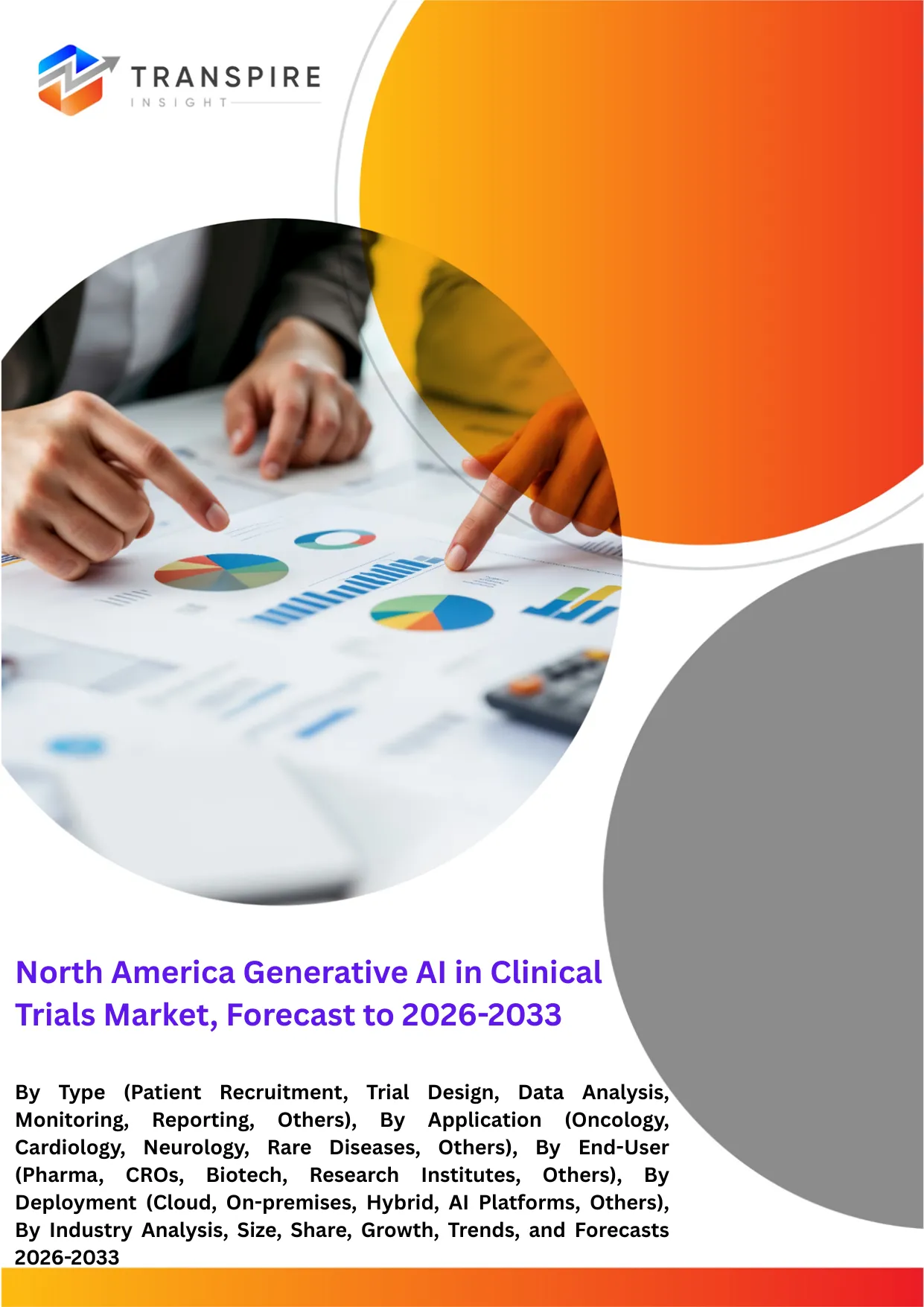
North America Generative AI in Clinical Trials Market Size & Forecast:
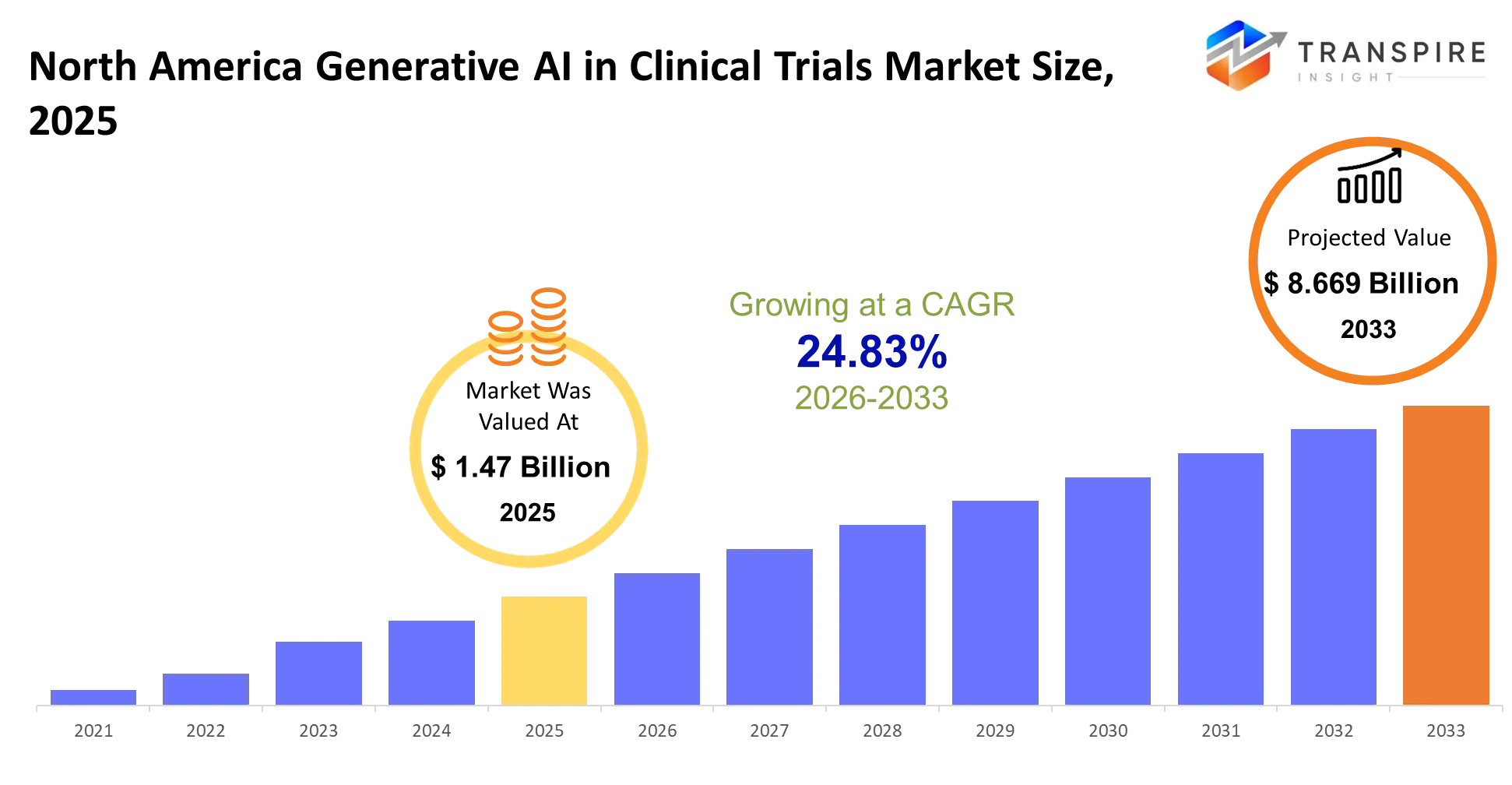
- North America Generative AI in Clinical Trials Market Size 2025: USD 1.47 Billion
- North America Generative AI in Clinical Trials Market Size 2033: USD 8.669 Billion
- North America Generative AI in Clinical Trials Market CAGR: 24.83%
- North America Generative AI in Clinical Trials Market Segments: By Type (Patient Recruitment, Trial Design, Data Analysis, Monitoring, Reporting, Others), By Application (Oncology, Cardiology, Neurology, Rare Diseases, Others), By End-User (Pharma, CROs, Biotech, Research Institutes, Others), By Deployment (Cloud, On-premises, Hybrid, AI Platforms, Others).
To learn more about this report,  Download Free Sample Report
North America Generative AI in Clinical Trials Market Summary:
The North America Generative AI in Clinical Trials Market size is estimated at USD 1.47 Billion in 2025 and is anticipated to reach USD 8.669 Billion by 2033, growing at a CAGR of 24.83% from 2026 to 2033.The North America Generative AI in Clinical Trials Market is kinda reshaping the way pharmaceutical companies , contract research organizations, and biotech firms design , run, and understand clinical studies. In real life these platform-ish tools cut down the time and cost needed to pull patients into trials , create trial protocols , track adverse events , and then parse all those tangled datasets that used to stall drug development for what feels like forever. Over the last five years the market has moved in a noticeable direction , going from manual site-centric routines toward AI assisted decentralized trial models that are tied in with electronic health records and real world evidence platforms.
A big catalyst was the COVID-19 pandemic, and honestly it made the operational fragility of older trial infrastructure pretty obvious. Sponsors had to lean into remote monitoring, digital recruitment, and automated interpretation of data, not as a side project but at scale. That upheaval pushed faster investment into generative AI systems that can simulate patient cohorts, flag enrollment bottlenecks before they become a problem, and help draft regulatory documentation. When trial timelines get tighter and development expenses keep climbing, drug developers are using generative AI for more than just speed. They are also aiming to raise the likelihood of regulatory success, so there’s basically a direct tie between adopting AI and commercial return on R&D spending.
Key Market Insights
- The United States is basically running the North America Generative AI in Clinical Trials Market, grabbing well over 78% market share in 2025, mostly because of a strong biotech backbone and lots of infrastructure that just keeps scaling.
- Canada is likely to be the fastest moving regional market through 2032, supported by government backed AI healthcare initiatives, and also by more clinical research funding that keeps broadening year after year.
- North America still has a large industry size because big pharmaceutical firms keep folding generative AI into drug discovery cycles and regulatory workflows, kind of end to end.
- When strategic expansion happens with cloud based clinical trial platforms it further lifts the regional growth rate across decentralized trial , and also hybrid trial ecosystems, where sites and patients are not always in one place.
- Software platforms lead the North America Generative AI in Clinical Trials Market, taking nearly 61% share in 2025, largely due to the rising need for automation and workflow streamlining that teams can’t really ignore.
- AI driven patient recruitment and protocol optimization solutions hold the second largest market share within clinical operations technology segments, and they’re getting adopted pretty steadily.
- For segmentation growth, predictive analytics and synthetic patient data tools are the fastest growing segment across the 2025–2032 forecast period, since teams want more foresight without compromising trial readiness.
- Key demand drivers show up as reduced clinical trial timelines, lower operating costs, and better patient retention rates across Phase II and Phase III studies.
- In terms of applications, clinical trial design and protocol generation dominates, with roughly 34% revenue share, mainly as oncology research gets more data heavy and harder to manage.
- Drug safety monitoring and adverse event prediction are showing the fastest growing adoption trend across AI enabled pharmacovigilance applications, which makes sense given compliance pressure and the need for earlier detection.
- Finally, generative AI models are increasingly improving enrollment forecasting accuracy , and that helps sponsors avoid expensive trial pauses plus site inefficiencies, even when timelines get tight.
What are the Key Drivers, Restraints, and Opportunities in the North America Generative AI in Clinical Trials Market?
The most powerful push accelerating the North America Generative AI in Clinical Trials Market is really the pressure to cut down drug development timelines and reduce the financial cost when trials go sideways.Drug makers now throw huge sums into late-stage programs that can end up failing anyway, most often because patient selection is shaky, protocols get overly tangled, or there are real gaps in how the results get interpreted. After the COVID-19 pandemic everything kind of shifted, toward decentralized trials, and more data-hungry designs. As a result, sponsors started picking up generative AI tools too, they can automate protocol drafting, sift qualifying patient cohorts from electronic health records, and even map out enrollment bottlenecks ahead of time. And yes, this helps a lot with trial throughput, it also shortens development cycles, so sponsors can push therapies into regulatory submission sooner, and start seeing earlier commercial returns.
That said, the largest structural obstacle stays the same, data is fragmented across hospitals, research locations, and regulatory environments.Clinical records are often kept in formats that just don’t line up, and there are strict privacy limits connected to HIPAA and other healthcare rules. Generative AI really needs huge amounts of standardized, high quality datasets to produce dependable answers, yet a lot of orgs still operate on isolated infrastructure, kind of, like separate rooms. So the fix is not a quick patch it really requires long term interoperability funding, closer regulatory alignment, and also some serious confidence building within the institutions, even when teams are busy and a bit stressed.Unfortunately all of that takes time , so enterprise-scale adoption moves slower, and AI platform vendors tend to feel that delay before revenue really shows up.
There’s a major growth window in multimodal AI platforms, the ones that sorta bring genomic signals together with imaging, and also layer in real world evidence so it becomes one unified clinical understanding system. Big pushes, from biotechnology firms and cloud providers, are speeding up this shift, especially in oncology studies where biomarker centered treatments need really bespoke patient pairing, matched in a near continuous way.
What Has the Impact of Artificial Intelligence Been on the North America Generative AI in Clinical Trials Market?
Artificial intelligence plus advanced digital tech are, kinda, reshaping the North America Generative AI in Clinical Trials Market by pushing automation into time-heavy research and day-to-day operational workflows that used to need big clinical teams. Now, generative AI platforms are automating protocol drafting, patient screening, medical coding, and regulatory paperwork, basically through natural language processing and large language models trained on clinical datasets. Sponsors and contract research organizations are also more often connecting these systems with electronic health records and decentralized trial platforms, in order to cut down administrative load and speed up the study launch window.
At the same time, machine learning models are making predictive decisions better throughout clinical development. AI algorithms look at past enrollment figures, shifting demographic patterns, and real world evidence to estimate where patient recruitment might slip, or where delays can appear. They also help spot high-performing trial sites ahead of time, before operational bottlenecks show up. Predictive analytics applications then tune adverse event monitoring as well, by flagging possible safety concerns earlier in the trial cycle, so sponsors can avoid expensive protocol amendments and minimize trial disruptions.
Overall, these tools are showing real operational wins. Some pharmaceutical companies are stating decreases, up to 30% in protocol development time, plus noticeable gains in patient retention and overall trial efficiency. Even so, uptake still meets a big restriction, because fragmented healthcare data systems and uneven data quality lower model accuracy. This then makes large scale AI integration harder across multi-site clinical settings, where the environment is rarely consistent.
Key Market Trends
- Since 2021, pharmaceutical sponsors kind of moved away from pilot AI efforts and, started going into full scale rollout across Phase II and Phase III clinical trial operations. Not exactly quick, but steadily.
- COVID-19 really sped up the whole decentralized trial movement, and it pushed companies like IQVIA and Medidata Solutions to expand remote monitoring options—like, much more broadly than before, for sure.
- Between 2022 and 2025, generative AI adoption for protocol drafting went up a lot. Sponsors were basically trying to blunt amendment related slowdowns and lower the compliance costs that tend to pile up. That pattern shows up across multiple programs.
- Also, large language models have been taking over manual medical coding workflows more and more, and that cut documentation turnaround time by nearly 30% in some enterprise clinical programs. The numbers vary, but the direction seems consistent.
- Contract Research Organizations then shifted their spending, towards AI enabled patient recruitment platforms. That change came after enrollment bottlenecks delayed several oncology and rare disease studies in 2023, so everyone noticed.
- Regulatory agencies started to encourage AI transparency frameworks too, and that basically forced vendors to improve explainability, validation approaches and audit ready clinical decision documentation. In practice it meant more evidence, more traceability, less guessing.
- Cloud partnerships between biotechnology firms and Oracle or Microsoft also expanded. That helped with secure real world evidence integration, especially after 2022, when the demand got louder.
- Sponsors increasingly began using synthetic patient data generation tools, not just for novelty, but because privacy restrictions plus fragmented healthcare datasets were limiting machine learning performance. Sometimes the data was there in theory, but not usable in practice.
- Since 2024, oncology trials have become the front line adopters of multimodal AI systems. These combine genomic data imaging, and electronic health records to support biomarker targeting with fewer blind spots. It’s been growing fast.
- Meanwhile venture capital funding increasingly leaned toward AI native clinical technology startups instead of traditional trial management software providers, and that reshaped competitive dynamics across the North American research ecosystems. Like, the map shifted, even if the players stayed the same-ish.
North America Generative AI in Clinical Trials Market Segmentation
By Type
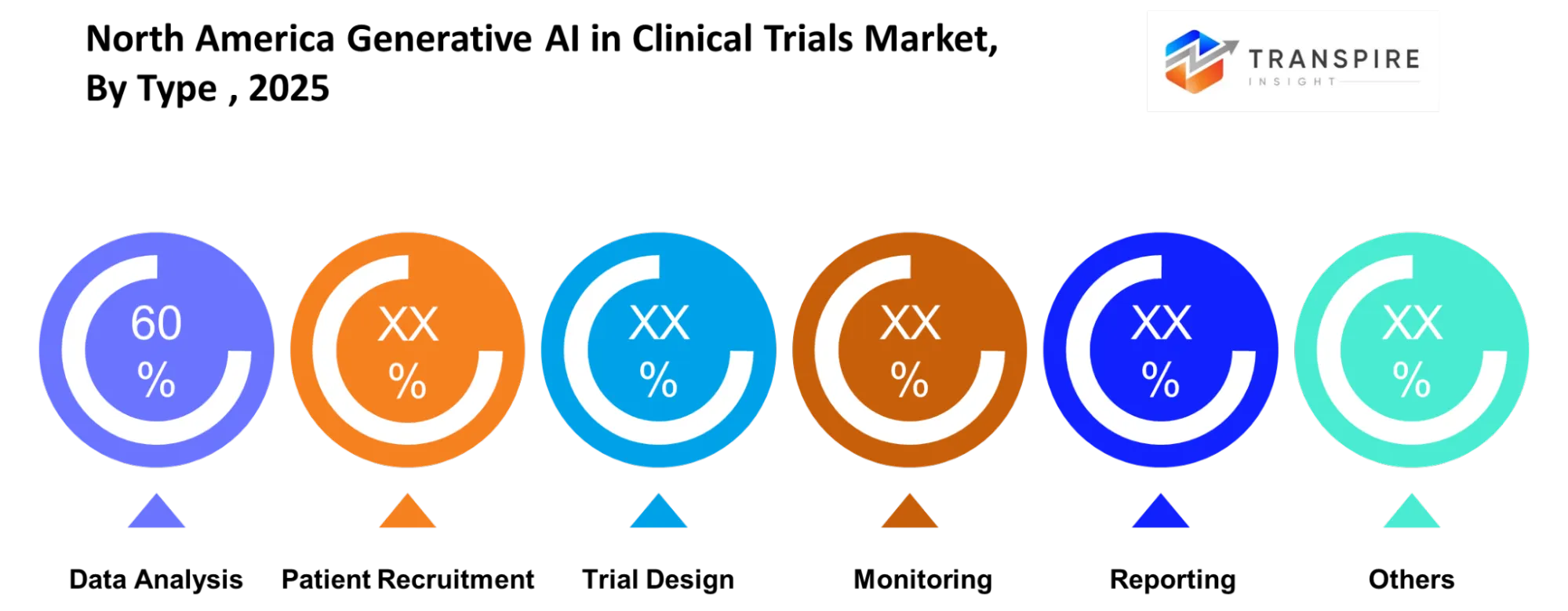
The type segment shows patient recruitment and trial design as the dominant categories, mainly because pharmaceutical sponsors keep dealing with rising enrollment costs and protocol complexity more or less. Generative AI tools that support patient matching, eligibility screening, and protocol generation gained solid commercial traction after decentralized clinical trials expanded across North America. Data analysis and monitoring solutions also stay in a strong market position because clinical programs now produce huge volumes of structured and unstructured information, coming from imaging, genomics, and electronic health records. Reporting applications keep growing too, since regulatory agencies are asking for faster and more transparent documentation workflows. The monitoring and analytics parts benefit from wider adoption of predictive algorithms that can spot enrollment risks and adverse event patterns before operational disruptions pop up. In the future growth will probably drift toward more integrated platforms, combining recruitment analytics and automated reporting, inside one unified clinical ecosystem kind of deal. Tech vendors and investors are more and more putting emphasis on scalable AI architectures that shrink trial cycle times while raising regulatory compliance, and improving the day to day operational efficiency too.
To learn more about this report, Download Free Sample Report
By Application
The application segment stays kind of heavily concentrated in oncology, because cancer trials need biomarker analysis, genomic interpretation, and those adaptive trial structures that fit pretty tightly with generative AI, like in a very natural way. Oncology studies, on the whole, throw off huge datasets and require complicated patient stratification modeling, so AI driven analytics ends up being really commercialy valuable for sponsors who want to reduce late stage trial failures. Rare disease uses are one of the fastest growing areas too, since patient groups are small and often spread out geographically, which creates a strong pull for predictive enrollment tools and synthetic patient data creation. Neurology and cardiology programs are also leaning in more, mostly due to the expanded use of imaging analysis and longitudinal patient monitoring instruments. Other therapeutic segments still bring AI in, but more slow, especially when the regulatory routes stay less standardized or unclear. Looking ahead, the market seems to move toward disease specific AI models trained on specialized datasets rather than generalized platforms. Because of that, software developers and clinical research organizations are ramping up investment into precision medicine features, and also multimodal data integration systems.
By End-User
The end user segment kinda gets led by pharmaceutical companies, because big drug manufacturers basically keep the financial resources , the clinical datasets, and the overall infrastructure needed for enterprise-scale AI integration . In the last stretch, major pharma firms are deploying generative AI more and more to cut down on trial delays, to automate regulatory paperwork, and to boost patient recruitment effectiveness across those global development pipelines. Contract research organizations still look like the second-largest slice, mostly due to rising outsourcing activity from sponsors, who want operational flexibility and also lower trial management costs. Biotechnology firms are showing the fastest expansion pace too, since smaller developers lean on AI platforms to speed up early-stage drug development without having to build big internal research operations. Academic research institutes plus healthcare organizations are also continuing to adopt AI-assisted analytics tools for translational medicine and genomics oriented studies. For the long run, growth will probably hinge on interoperability between sponsors, CROs, and healthcare systems. Vendors who can provide secure, collaborative, compliance-ready platforms are expected to strengthen their competitive position as multi partner clinical ecosystems become more common.
By Component
The deployment segment is kind of dominated by cloud-based platforms because clinical trial sponsors keep asking for scalable computing muscle, remote access, and real-time teamwork across research sites that are scattered geographically. Cloud deployment really started to pick up steam after decentralized clinical trials grew faster, which boosted the need for centralized data stewardship and AI-enabled analytics environments. Hybrid deployment models are still getting wider use among big pharmaceutical companies, they’re trying to balance operational flexibility with strict regulatory rules and cybersecurity guardrails, sort of all at once. On-premises systems are still not going anywhere in very sensitive clinical surroundings where organizations care a lot about direct oversight over proprietary datasets and patient information and so on. AI platform-based deployment models are also gaining traction , mostly because tightly integrated ecosystems make workflow automation easier, support predictive analytics, and enable multimodal data handling. Future deployment strategies will probably lean hard toward interoperability, federated learning, and privacy-preserving AI infrastructure, not just one of these. Technology providers that invest in secure cloud architecture and advanced compliance capabilities are set up to capture stronger enterprise adoption as clinical research operations become more and more data-heavy and globally connected.
What are the Key Use Cases Driving the North America Generative AI in Clinical Trials Market?
Patient recruitment and protocol generation stay as the primary use cases, partly because pharmaceutical firms are getting hit with increasing pressure to shorten clinical development timelines , like yesterday. Generative AI platforms go through electronic health records, genomic datasets and eligibility rules to find matching participants faster, so enrollment delays shrink and the whole process becomes less expensive, especially in oncology and rare disease studies.
Other applications are also creeping in across contract research organizations and biotechnology companies, more and more, notably for adverse event monitoring and automated regulatory paperwork. In practice, AI-assisted pharmacovigilance systems help clinical teams spot safety signals earlier and more consistently, while large language models speed up the building of FDA submission materials and the usual clinical study reports.
Newer use cases include synthetic patient data generation, plus multimodal trial intelligence platforms that mix imaging, genomics, and wearable device signals. These are still kind of early in rollout , but they look promising for decentralized trials and precision medicine programs, the ones that depend on highly personalized patient stratification models and fine-grained risk grouping.
|
Report Metrics |
Details |
|
Market size value in 2025 |
USD 1.47 Billion |
|
Market size value in 2026 |
USD 1.835 Billion |
|
Revenue forecast in 2033 |
USD 8.669 Billion |
|
Growth rate |
CAGR of 24.83% from 2026 to 2033 |
|
Base year |
2025 |
|
Historical data |
2021 - 2024 |
|
Forecast period |
2026 - 2033 |
|
Report coverage |
Revenue forecast, competitive landscape, growth factors, and trends |
|
Country scope |
North America (Canada, The United States, and Mexico) |
|
Key company profiled |
IBM, Microsoft, Google, Amazon, Oracle, SAP, IQVIA, Medidata, Veeva Systems, Parexel, ICON, Cognizant, Accenture, SAS Institute, NVIDIA |
|
Customization scope |
Free report customization (country, regional & segment scope). Avail customized purchase options to meet your exact research needs. |
|
Report Segmentation |
By Type (Patient Recruitment, Trial Design, Data Analysis, Monitoring, Reporting, Others), By Application (Oncology, Cardiology, Neurology, Rare Diseases, Others), By End-User (Pharma, CROs, Biotech, Research Institutes, Others), By Deployment (Cloud, On-premises, Hybrid, AI Platforms, Others) |
Which Regions are Driving the North America Generative AI in Clinical Trials Market Growth?
The United States kind a leads the North America Generative AI in Clinical Trials Market, not just because it has strong pharmaceutical R and D spending, but also because there’s a mature digital health infrastructure and, well, an early, enterprise wide uptake of artificial intelligence platforms. The regulator side, like FDA agencies, seems pretty open and that has encouraged sponsors to fold AI into protocol creation, patient sourcing and safety surveillance workflows. Big pharma, biotech firms cloud providers, and contract research organizations all operate in this tightly linked clinical research ecosystem, so it becomes easier to scale at really large deployment levels. Add strong access to electronic health records, genomic databases, plus venture capital backing and you get more reinforcement for that national leadership in AI led clinical development.
Canada sits in the second spot regionally, though the growth rhythm is not the same as the U.S. since expansion leans more on coordinated public research efforts and academic collaboration networks. With government backed investments in healthcare AI investigations and national digital health programs in place, clinical technology providers get longer term operational steadiness. Also, Canadian healthcare settings offer fairly standardized patient data environments, which helps teams train models more consistently and fold in real world evidence without too much friction. Because the policy direction and funding logic stay stable, Canada ends up being a dependable revenue source for companies that want lower risk expansion inside North American clinical research markets.
Mexico is kinda coming up as the fastest-growing regional market, because more and more clinical trial outsourcing, plus healthcare infrastructure modernization, is happening. A lot of international pharmaceutical sponsors have recently expanded their trial activity in Mexico so they can reach diverse patient populations, and also to trim operational costs vs those traditional research hubs. Meanwhile, investments in digital hospital systems, and electronic patient record infrastructure are steadily getting better, which is improving readiness for AI assisted recruitment and for decentralized trial management platforms, more or less. The growth expected across Mexico from 2026 through 2033 should create solid opportunities for software vendors , CROs, and cloud based analytics providers that are looking to get positioned early in underpenetrated clinical research environments.
Who are the Key Players in the North America Generative AI in Clinical Trials Market and How Do They Compete?
The competitive landscape of the North America Generative AI in Clinical Trials Market still looks moderately fragmented, with big healthcare technology firms rubbing shoulders with specialized AI startups, and also contract research organizations, kind of side by side. Lately, the tug of war is less about pricing ,and more about actual technology capability, since pharmaceutical sponsors seem to care more about data integration, predictive performance, and regulatory alignment than about simply getting something cheap to deploy. More established clinical software providers are trying to hold market share by stitching generative AI into their current trial management ecosystems, while newer players tend to aim at a narrower lane, for example synthetic patient data generation, and multimodal analytics. Strategic partnerships—whether with cloud providers , healthcare systems, or biotechnology companies—have turned into a go-to competitive lever because deeper access to large clinical datasets tends to lift model performance, and in turn improves commercial worth.
IQVIA separates itself via connected clinical data networks plus AI powered patient recruitment systems that tie into substantial real world evidence databases. The firm keeps rolling forward by forming partnerships with pharmaceutical sponsors who want enrollment to happen faster, and who also want decentralized trial management in practice. Medidata Solutions leans into embedding generative AI inside cloud based clinical operations platforms, so sponsors get one place for trial monitoring, data analytics, and regulatory workflows. Their strong adoption in oncology, plus global multi site studies, gives Medidata an edge in high complexity research settings, where everything is more interdependent than usual.
Oracle is big on scalable cloud infrastructure, and the interoperability pieces that sorta connect those scattered clinical datasets across different hospitals and research orgs, even when everything is kinda fragmented. Their expansion is now leaning harder toward AI-assisted automation for regulatory reporting, plus more decentralized clinical trial operations too.
Tempus meanwhile focuses on genomic and molecular data analytics for precision oncology trials, and it’s aiming to stand out with biomarker-driven patient matching models that make the whole trial process feel more targeted. Then there’s NVIDIA, which improves its competitive spot by providing high-performance computing architecture tuned for large language models and multimodal clinical AI training. That helps pharmaceutical companies build enterprise-scale generative AI platforms, without needing to reinvent every component.
Company List
- IBM
- Microsoft
- Amazon
- Oracle
- SAP
- IQVIA
- Medidata
- Veeva Systems
- Parexel
- ICON
- Cognizant
- Accenture
- SAS Institute
- NVIDIA
Recent Development News
In April 2026, Bristol Myers Squibb Expands Anthropic’s Claude AI Across Clinical Development Operations: Bristol Myers Squibb announced a large-scale rollout of Anthropic’s Claude AI platform to more than 30,000 employees, including teams involved in research and clinical development. The initiative is aimed at accelerating regulatory documentation, trial analytics, and operational workflows tied to drug development and clinical trials in North America.
Source: https://www.wsj.com
In April 2026, FDA Launched AI Pilot Program to Accelerate Clinical Trial Data Processing: The U.S. Food and Drug Administration initiated a pilot program using generative AI and large language models to automate extraction of clinical trial data from electronic health records. Companies including AstraZeneca and Amgen are participating in the North American initiative, which aims to reduce delays in regulatory submissions and improve trial efficiency.
Source: https://www.wsj.com
What Strategic Insights Define the Future of the North America Generative AI in Clinical Trials Market?
The North America Generative AI in Clinical Trials Market is kind of moving toward fully integrated, AI-orchestrated clinical development ecosystems where protocol design, patient recruitment, safety monitoring, and regulatory reporting run through connected predictive platforms not just separate software tools. The main push behind this shift is the growing economic pressure on pharmaceutical companies to cut down late-stage trial failures, while also speeding up precision medicine commercialization. In the next five to seven years, competitive edge will probably hinge more on proprietary clinical datasets and interoperability abilities rather than on stand alone AI algorithms.
A less noticed risk is that the market can become concentrated around a small group of cloud and data infrastructure providers. When sponsors lean more into these integrated AI ecosystems, they may end up depending on limited data networks. That can tilt pricing power, create operational fragility, and make things worse during regulatory hiccups or cybersecurity disruptions…
There’s also a newer opportunity showing up with federated learning models. These tools let organizations train AI systems across decentralized healthcare datasets without moving sensitive patient information elsewhere. Some companies, start early with privacy preserving AI infrastructure, regulatory grade validation frameworks and cross institution collaborations will likely end up with more solid, long term positioning, as compliance expectations tighten across North American clinical research markets.
North America Generative AI in Clinical Trials Market Report Segmentation
By Type
- Patient Recruitment
- Trial Design
- Data Analysis
- Monitoring
- Reporting
- Others
By Application
- Oncology
- Cardiology
- Neurology
- Rare Diseases
- Others
By End-User
- Pharma
- CROs
- Biotech
- Research Institutes
- Others
By Deployment
- Cloud
- On-premises
- Hybrid
- AI Platforms
- Others
Frequently Asked Questions
Find quick answers to common questions.
The approximate North America Generative AI in Clinical Trials Market size for the market will be USD 8.669 Billion in 2033.
The key segments of the North America Generative AI in Clinical Trials Market are By Type (Patient Recruitment, Trial Design, Data Analysis, Monitoring, Reporting, Others), By Application (Oncology, Cardiology, Neurology, Rare Diseases, Others), By End-User (Pharma, CROs, Biotech, Research Institutes, Others), By Deployment (Cloud, On-premises, Hybrid, AI Platforms, Others).
Major players in the North America Generative AI in Clinical Trials Market are IBM, Microsoft, Google, Amazon, Oracle, SAP, IQVIA, Medidata, Veeva Systems, Parexel, ICON, Cognizant, Accenture, SAS Institute, NVIDIA.
The current market size of the North America Generative AI in Clinical Trials Market is USD 1.47 Billion in 2025.
The North America Generative AI in Clinical Trials Market CAGR is 24.83%.
- IBM
- Microsoft
- Amazon
- Oracle
- SAP
- IQVIA
- Medidata
- Veeva Systems
- Parexel
- ICON
- Cognizant
- Accenture
- SAS Institute
- NVIDIA
Recently Published Reports
-
Apr 2026
AI in Diabetic Retinopathy Market
AI in Diabetic Retinopathy Market Size, Share & Analysis Report By Type (Screening AI Systems, Diagnostic AI Systems, and Predictive AI Models), By Application Segment (Hospitals, Ophthalmology Clinics, Diagnostic Centers, and Research and Development), and Geography (North America, Europe, Asia-Pacific, Middle East and Africa, South and Central America), 2021 - 2031
-
Apr 2026
Psychometric Tests Market
Psychometric Tests Market Size, Share & Analysis Report By Type (Personality Tests, Ability/Aptitude Tests, Skill/Knowledge Tests, and Others), By Application (Talent Acquisition and Talent Management), and Geography (North America, Europe, Asia-Pacific, Middle East and Africa, South and Central America), 2021 – 2031
-
Apr 2026
Rare Biological Sample Collection Market
Rare Biological Sample Collection Market Size, Share & Analysis Report By Type (Isolation Kits & Reagent, Blood Collection Tubes, and Others), By Application (Oncology, Transcriptomics, Pharmacogenomics, and Others), and Geography (North America, Europe, Asia-Pacific, Middle East and Africa, South and Central America), 2021 – 2031
-
May 2026
Patient Lift Pendant Market
Patient Lift Pendant Market By Product Type (Wired Pendants, Wireless, Programmable), By Operation Type(Manual, Electric), By End-Users (Healthcare Professionals, Patients), By Application (Hospitals, Homecare, Rehabilitation Centers, Others), By Industry Analysis, Size, Share, Growth, Trends, and Forecasts 2021-2033
Our Clients
.jpg)