
Middle East and Africa Healthcare Cold Chain Packaging Market Size & Forecast:
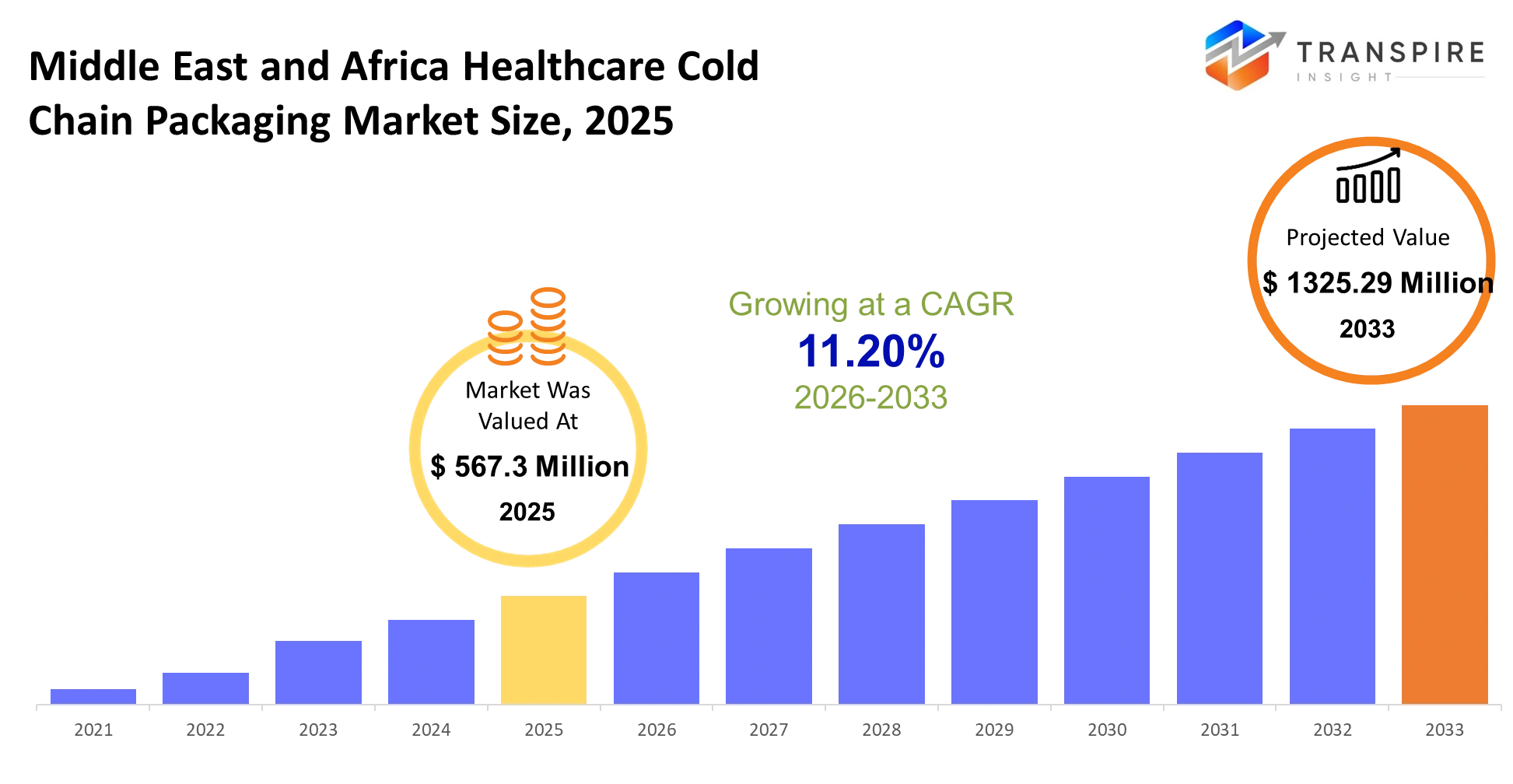
- Middle East and Africa Healthcare Cold Chain Packaging Market Size 2025: USD 567.3 Million
- Middle East and Africa Healthcare Cold Chain Packaging Market Size 2033: USD 1325.29 Million
- Middle East and Africa Healthcare Cold Chain Packaging Market CAGR: 11.20%
- Middle East and Africa Healthcare Cold Chain Packaging Market Segments: By Product Type (Insulated Containers, Refrigerants, Pallet Shippers, Temperature Monitoring Devices, Others); By Material (EPS, PUR, PCM, Vacuum Insulated Panels, Others); By Application (Vaccines, Biologics, Clinical Trials, Blood Products, Others); By End User (Pharmaceutical Companies, Hospitals, Logistics Providers, Others)
To learn more about this report,  Download Free Sample Report
Middle East and Africa Healthcare Cold Chain Packaging Market Summary
The Middle East and Africa Healthcare Cold Chain Packaging Market was valued at USD 567.3 Million in 2025. It is forecast to reach USD 1325.29 Million by 2033. That is a CAGR of 11.20% over the period.
The Middle East and Africa Healthcare Cold Chain Packaging Market plays a critical role in guarding temperature-sensitive medicines, vaccines, biologics, blood products and also clinical trial materials during storage as well as transportation. In practice, healthcare providers, pharmaceutical manufacturers, and logistics operators depend on insulated packing systems, along with temperature-control solutions that keep product integrity intact across long routes, rough climates, and even infrastructure gaps that show up in several areas of the region.
Over the last five years, this market has gone through a kind of structural change, moving from passive packing options toward more advanced temperature-controlled systems that include real-time monitoring and data logging. The vaccine distribution programs that came after the COVID-19 pandemic helped speed up investment in healthcare logistics networks and in doing so, reinforced how essential dependable cold chain infrastructure really is. Meanwhile, while pharma companies keep expanding their biologics portfolios and governments start pushing stronger immunization programs, the rules around temperature compliance are getting tighter , not looser. This kind of progression is kind of nudging more widespread adoption of premium packaging technologies , and yeah, it opens up fresh revenue angles for packaging manufacturers and logistics providers alike. At the same time it boosts product safety, reduces spoilage risk, and makes it easier to reach advanced therapies across the region.
Key Market Insights
- Saudi Arabia, UAE ,and South Africa in total brought in over 45% of regional revenue in 2025, kinda backed by advanced healthcare logistics networks.
- Meanwhile the Gulf Cooperation Council countries really dominate regional demand, with an estimated 38%-42% market share, pushed by pharmaceutical imports and healthcare modernization.
- East Africa looks like the fastest moving regional cluster through 2033, largely supported by vaccine distribution programs and healthcare infrastructure expansion.
- Insulated Containers held nearly 34% of market share in 2025 so, yeah, they were the top product segment for pharmaceutical transport.
- Refrigerants came in as the second-largest segment at about 25% market share, mainly because long-duration temperature control is a must.
- Temperature Monitoring Devices are expected to grow the quickest through 2033, especially as compliance tracking becomes mandatory across pharmaceutical supply chains.
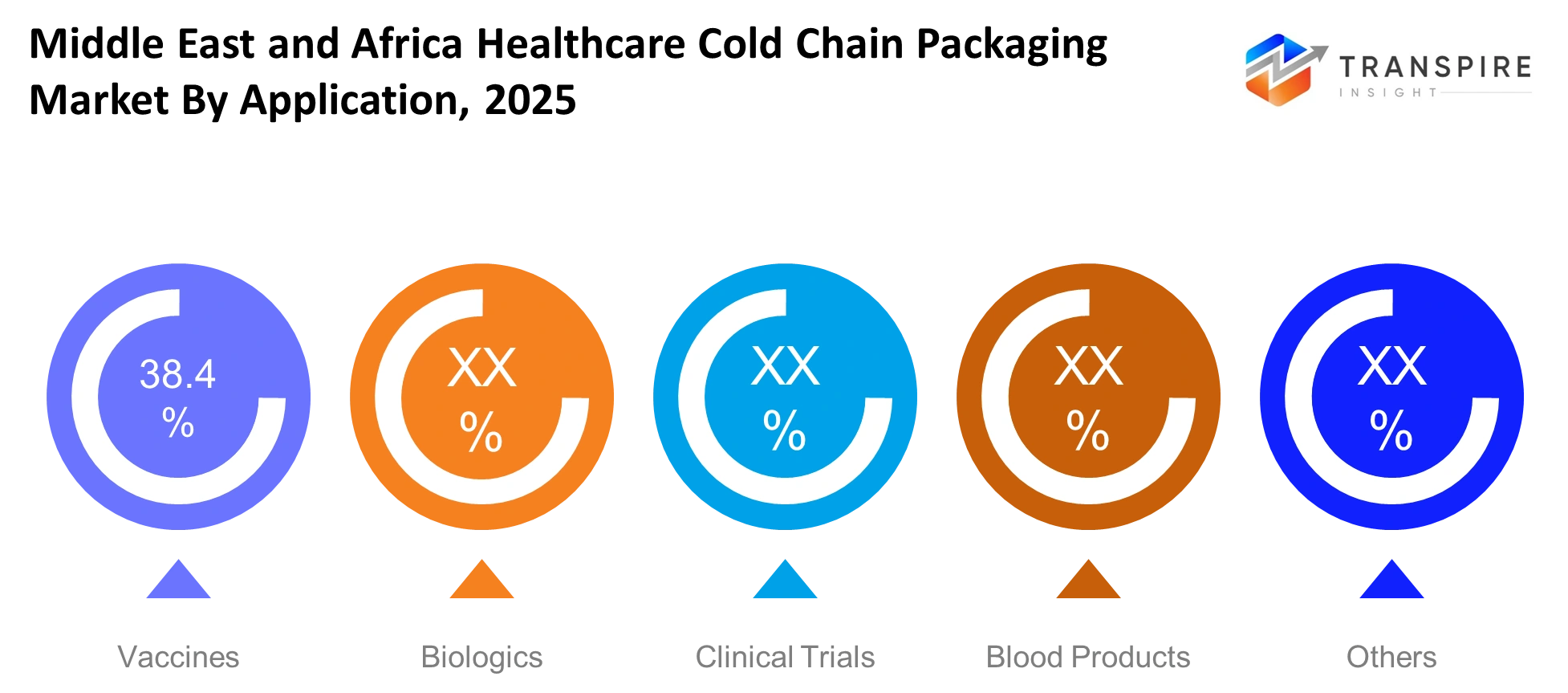
- Vaccines made up more than 30% of application demand in 2025, with national immunization programs and public health initiatives doing most of the heavy lifting.
- Pharmaceutical companies accounted for roughly 40% of end user revenue, so they’re the main customer group inside the regional market.
- Companies like Sonoco ThermoSafe, CSafe, Envirotainer, DHL, FedEx, and Cold Chain Technologies keep leaning into strategic expansion, using technology upgrades and regional partnerships.
- And across the healthcare logistics ecosystem, digital temperature monitoring, reusable packaging platforms, and validated shipping systems are turning into big competitive differentiators, like for real.
What are the Key Drivers, Restraints, and Opportunities in the Middle East and Africa Healthcare Cold Chain Packaging Market?
The strongest growth driver seems to come from the fast, kinda relentless expansion of biologics, specialty medicines, and vaccine distribution networks. Biologic therapies need strict thermal control during transport, usually within pretty narrow temperature bands. Regulatory agencies and pharmaceutical manufacturers have also tightened compliance expectations after disruptions they saw during the earlier global vaccine distribution efforts. So this has pushed more spending into certified, validated insulated containers, temperature-monitoring systems, and improved refrigerant technologies. As pharmaceutical output and imports keep expanding across Gulf countries, plus some parts of Africa, packaging suppliers tend to see better quality contracts and repeat orders for temperature-controlled shipping solutions.
The biggest restraint though is the uneven cold chain infrastructure across several African markets. Temperature-managed warehouses, specialized transport fleets, and continuous monitoring arrangements need a lot of upfront capital. Because the gaps in infrastructure come from deeper issues, they can’t be fixed quickly, it’s tied to long-term investments in logistics capacity, power reliability, transportation corridors, and regulatory enforcement. These realities raise the risk of product spoilage, slow down uptake of newer pharmaceutical offerings, and overall reduce the revenue chances for packaging suppliers.
A major future opportunity is smart cold chain ecosystems that blend IoT sensing, cloud based monitoring platforms, and predictive analytics tools. Nations putting serious money into healthcare modernization, especially Saudi Arabia, the UAE, Kenya, and South Africa, are building conditions that favor digital logistics solutions.
What Has the Impact of Artificial Intelligence Been on the Middle East and Africa Healthcare Cold Chain Packaging Market?
Artificial intelligence and advanced digital technologies are getting used more and more to shift healthcare cold chain operations across the Middle East and Africa, like, in a pretty steady way. AI-enabled monitoring systems are looking at temperature, humidity, route conditions and shipment status signals in real time so logistics teams can catch temperature excursions early before product quality gets affected. Automated control platforms then can push corrective actions, crank out compliance documents, and improve what people often call end-to-end visibility across multi-country pharmaceutical distribution routes.
Machine learning models are also helping with predictive maintenance for refrigeration units, insulated transport containers ,and monitoring devices. The idea is that, by spotting performance anomalies before a breakdown actually happens, these tools cut down on downtime and boost operational dependability. On top of that, AI-driven route optimization tools are assisting delivery efficiency, choosing transportation paths that reduce transit delays and lower environmental exposure risks along the way. A lot of logistics providers say they see better shipment integrity, fewer product losses, and better regulatory compliance once digital monitoring is put in place.
Even so, adoption is still kind of held back by integration expenses and infrastructure constraints. Lots of healthcare supply chains in emerging African markets still run on fragmented data systems, plus connectivity is often inconsistent. If high-quality operational data isn’t available, model accuracy can drop, and that makes big AI deployments harder to pull off. So, more investment in digital infrastructure and standardized data collection will be needed to actually release the full potential of AI-powered cold chain management solutions.
Key Market Trends
- Real-time temperature monitoring adoption went up more than 30% since 2021, which helped with shipment visibility and also regulatory compliance , like noticeably.
- Deployments of reusable insulated packaging expanded a lot from 2022 to 2025, assisting with lowering logistics costs along high-volume pharmaceutical lanes.
- More pharmaceutical companies now want an end-to-end shipment validation, not just leaning on packaging certification criteria.
- The need for biologics-compatible packaging solutions started accelerating after specialty drug distribution programs grew across the Gulf countries.
- Smart sensor integration picked up fast, and by 2025 connected monitoring devices became kind of standard across premium pharmaceutical shipments.
- DHL, UPS Healthcare , and FedEx also broadened healthcare logistics capabilities, so regional temperature-controlled transportation networks could be strengthened.
- Packaging providers shifted their funding toward longer-duration thermal protection systems, able to handle international pharmaceutical trade more reliably.
- Healthcare modernization initiatives from governments increased procurement of advanced cold chain technologies throughout Saudi Arabia and the UAE.
- After 2023, strategic partnerships between packaging manufacturers and logistics operators showed up more frequently, mainly to tighten service integration.
- Clinical trial work in selected African markets generated fresh demand for validated packaging systems with improved traceability features .
Middle East and Africa Healthcare Cold Chain Packaging Market Segmentation
By Product Type
Insulated Containers kinda cover a big chunk of temperature-controlled healthcare logistics, since steady thermal protection is still the key point for vaccines, biologics and specialty medicines. More advanced layouts help with longer road or air transit times, and they also lower the chance of temperature swings from the outside. Refrigerants play along with the whole setup by keeping the needed temperature range during both transportation and storage. Gel packs, phase change materials, and dry ice based solutions keep showing up too, because different distribution needs want different approaches.
Pallet Shippers handle high volume pharmaceutical shipments across regional, and also international supply chains. Temperature Monitoring Devices have become a bigger deal lately, because pharma firms are pushing stronger compliance rules and they want real time shipment awareness. The Others slot is where you usually find the more niche add-ons, like thermal liners, protective wrapping solutions, plus bundled shipment support systems. More emphasis on shipment validation keeps growing, and that’s pushing adoption across nearly every product category.
By Material
EPS materials are still widely used, mostly due to cost efficiency, light weight construction, an d pretty solid insulation results for pharmaceutical shipping. PUR materials, by comparison, offer better thermal stability and help with longer duration transport, so the product stays in range. Together these materials keep showing up in large scale healthcare logistics operations across the region. In practice the choice of material usually depends on how sensitive the product is, the shipping distance, and which regulatory rules apply.
PCM solutions are getting more acceptance too, since controlled temperature release helps protect the cargo during longer transit windows, you know. Vacuum Insulated Panels actually deliver top notch thermal performance and they fit premium healthcare use cases that need strict temperature consistency. The Others category is a mix of advanced composites and newer insulation technologies, aimed at improving packaging efficiency. And overall, ongoing innovation continues to raise durability, sustainability, and thermal performance across all these material categories, even when requirements vary.
By Application
Vaccines generate a lot of packaging demand , because temperature stability really still matters a ton from manufacturing facilities all the way to healthcare centers. Big immunization programs across the region means dependable transportation systems that can keep product effectiveness intact . Biologics are also another big application, since strict handling is a requirement and the product value is high too. Advanced packaging technologies help shield these therapies through all those complicated distribution routes.
Clinical trials need shipping systems that are validated, so the samples stay genuine and also meet regulatory compliance. Blood products depend on very accurate temperature control, to preserve safety as well as effectiveness during transit and storage. The “others” category covers specialty pharmaceuticals , diagnostic materials , lab specimens , and newer therapeutic products. As advanced healthcare services keep expanding, the application possibilities broaden as well .
To learn more about this report, Download Free Sample Report
By End User
Pharmaceutical companies take up a big portion of the packaging market, mainly because manufacturing, dispatch, and export tasks need strict temperature control. Keeping product quality intact is still a major day-to-day operational goal across the entire supply chain. Ongoing investments in more advanced cold chain tools keep showing up, especially as the biologics and specialty drug portfolios keep growing. On top of that regulatory compliance needs keep pushing uptake of validated packaging systems, which is kind of a constant pressure.
Hospitals rely on temperature-controlled packs for vaccine storage, specialty medicine handling, and the transportation of blood products. Logistics providers in turn back up regional distribution routes by using tailored transportation methods and warehousing services. The Others group covers research organizations, diagnostic laboratories, government healthcare agencies, and humanitarian medical programs. Meanwhile broader healthcare modernization drives overall demand, and it helps across every end-user group, not just one segment.
What are the Key Use Cases Driving the Middle East and Africa Healthcare Cold Chain Packaging Market?
The biggest use case is kind of about vaccine transportation and delivery across national immunization programs. There are strict temperature rules , and really wide distribution networks, so it’s basically consistent demand for pre-validated packaging systems that can keep product efficacy intact during transit and storage.
Biologics distribution and clinical trial logistics are also a big part, maybe a secondary but still important. Pharmaceutical manufacturers and contract research organizations then need tightly controlled packaging approaches to ship temperature-sensitive treatments, lab samples, and investigational products across several countries, all while still satisfying regulatory expectations.
Some new or emerging applications are cell and gene therapies, personalized medicines, and those advanced biologic treatments. These aren’t just “cold chains” in a general way, they need narrower temperature tolerances and improved shipment tracking. And as healthcare systems broaden access to advanced therapies, specialized cold chain packaging solutions are expected to become more commercially meaningful throughout the forecast period.
|
Report Metrics |
Details |
|
Market size value in 2025 |
USD 567.3 Million |
|
Market size value in 2026 |
USD 630.26 Million |
|
Revenue forecast in 2033 |
USD 1325.29 Million |
|
Growth rate |
CAGR of 11.20% from 2026 to 2033 |
|
Base year |
2025 |
|
Historical data |
2021 - 2024 |
|
Forecast period |
2026 - 2033 |
|
Report coverage |
Revenue forecast, competitive landscape, growth factors, and trends |
|
Regional scope |
Middle East and Africa (Saudi Arabia, United Arab Emirates, South Africa, Rest of Middle East and Africa) |
|
Key company profiled |
Sonoco ThermoSafe, Cold Chain Technologies, CSafe, DHL, FedEx, UPS Healthcare, Envirotainer, Cryopak, Softbox, va-Q-tec, Pelican BioThermal, Tempack, Intelsius, AmerisourceBergen, Cardinal Health |
|
Customization scope |
Free report customization (country, regional & segment scope). Avail customized purchase options to meet your exact research needs. |
|
Report Segmentation |
By Product Type (Insulated Containers, Refrigerants, Pallet Shippers, Temperature Monitoring Devices, Others); By Material (EPS, PUR, PCM, Vacuum Insulated Panels, Others); By Application (Vaccines, Biologics, Clinical Trials, Blood Products, Others); By End User (Pharmaceutical Companies, Hospitals, Logistics Providers, Others) |
Which Regions are Driving the Middle East and Africa Healthcare Cold Chain Packaging Market Growth?
In the Gulf region, market revenue generation is leading more or less , driven by heavy healthcare spending, pharmaceutical imports, improved logistics infrastructure, and these government programs aimed at modernizing healthcare , kind of overall. Saudi Arabia and the UAE are still putting serious investment into healthcare distribution networks and pharmaceutical storage facilities. Newer airports, logistics hubs, and updated regulatory frameworks keep things working smoothly with temperature-controlled transportation. In the end, a well-developed healthcare ecosystem really backs up the regional leadership.
South Africa steps in as the second-largest contributor, but it is a bit different from the Gulf markets, mainly because it already has a solid pharmaceutical manufacturing base and an established healthcare distribution network. Regulatory oversight stays steady, and consistent healthcare spending helps the market mature over the long term. Good logistics capabilities also make it easier to move pharmaceuticals within the country and across the region. Together, this setup becomes a reliable stream of market revenue.
East Africa shows the fastest growth momentum, no doubt. Healthcare infrastructure spending, vaccine distribution initiatives, and supply chain modernization for pharmaceuticals have sped up expansion in places like Kenya and Tanzania. Also, international healthcare funding initiatives are reinforcing cold chain capability build-out. With that, the region is creating good , almost compelling opportunities for packaging suppliers, technology providers, and logistics operators during 2026 to 2033.
Who are the Key Players in the Middle East and Africa Healthcare Cold Chain Packaging Market and How Do They Compete?
Competition stays moderately consolidated across global healthcare packaging specialists, logistics providers, and temperature-control technology companies. Honestly the competitive edge is shifting more toward thermal performance , validation know-how, digital monitoring integration, and regional service reach than it is about price by itself. A lot of firms are putting money into reusable packaging systems, analytics-based monitoring platforms, and healthcare tailored logistics infrastructure, mainly to keep customers more secure.
Sonoco ThermoSafe kind of stands out with validated temperature-controlled packaging systems made for pharmaceutical and biologics transit. CSafe leans into high-performance active and passive temperature-controlled solutions, supporting longer duration pharmaceutical shipments with a steadier approach. Envirotainer meanwhile zeroes in on air cargo temperature-control systems, and it benefits from airline partnerships that help smooth global healthcare logistics operations, even when routes are complicated.
Cold Chain Technologies keeps pushing forward via product innovation that centers on thermal protection , plus compliance performance. DHL also bundles packaging, transportation, warehousing, and monitoring services into one healthcare logistics model, and that arrangement tends to create operational efficiencies for pharmaceutical clients. UPS Healthcare tries to stay strong by using healthcare-specific distribution facilities, expanding cold storage investments, and sharpening specialized pharmaceutical transportation capabilities. Strategic alliances, digital monitoring platforms, and geographic expansion are still the main pieces for how companies position themselves competitively across the whole industry.
Company List
- Sonoco ThermoSafe
- Cold Chain Technologies
- CSafe
- DHL
- FedEx
- UPS Healthcare
- Envirotainer
- Cryopak
- Softbox
- va-Q-tec
- Pelican BioThermal
- Tempack
- Intelsius
- AmerisourceBergen
- Cardinal Health
Recent Development News
In April 2026, Envirotainer entered a Memorandum of Understanding (MoU) with Jeena & Company. The partnership expanded access to compliant temperature-controlled air cargo solutions and strengthened pharmaceutical cold chain logistics across global trade routes. http://www.envirotainer.com
In September 2025, Sonoco Products Company signed a definitive agreement to sell ThermoSafe to Arsenal Capital Partners for up to USD 725 million. The transaction strengthened ThermoSafe's growth prospects in temperature-controlled pharmaceutical packaging and healthcare logistics solutions.http://www.arsenalcapital.com
What Strategic Insights Define the Future of the Middle East and Africa Healthcare Cold Chain Packaging Market?
The market is slowly moving toward more integrated cold chain ecosystems, where advanced thermal packaging gets tied together with digital monitoring , predictive analytics, and regulatory compliance management, kind of in one overall logistics framework. Expansion in biologics, specialty pharmaceuticals and precision medicine programs will still be the main structural driver behind investment choices through the next decade. Value creation is likely to drift away from just selling packaging products , and instead toward data enabled service models that give visibility traceability, and risk management
There’s also a less obvious risk that doesn’t get talked about much. It can come from concentration within premium temperature-control technologies and very specialized logistics infrastructure. If the industry leans on a small set of suppliers, then cost pressures can show up and operational vulnerabilities may get worse, especially when supply chains get disrupted. Even so, there’s an opportunity in the same area: smart packaging systems with IoT sensors, plus cloud based monitoring, are emerging and they still look like they have real long-term upside
Market participants should probably focus on partnerships that bring packaging know how together with digital logistics capabilities. Putting money in connected cold chain solutions early on will probably lead to better differentiation, stronger customer stickiness, and easier access to higher value premium pharmaceutical transportation contracts
Middle East and Africa Healthcare Cold Chain Packaging Market Report Segmentation
By Product Type
- Insulated Containers
- Refrigerants
- Pallet Shippers
- Temperature Monitoring Devices
- Others
By Material
- EPS
- PUR
- PCM
- Vacuum Insulated Panels
- Others
By Application
- Vaccines
- Biologics
- Clinical Trials
- Blood Products
- Others
By End User
- Pharmaceutical Companies
- Hospitals
- Logistics Providers
- Others
Frequently Asked Questions
Find quick answers to common questions.
The expected Middle East and Africa Healthcare Cold Chain Packaging Market size for the market will be USD 1325.29 Million in 2033.
Key segments for the Middle East and Africa Healthcare Cold Chain Packaging Market are By Product Type (Insulated Containers, Refrigerants, Pallet Shippers, Temperature Monitoring Devices, Others); By Material (EPS, PUR, PCM, Vacuum Insulated Panels, Others); By Application (Vaccines, Biologics, Clinical Trials, Blood Products, Others); By End User (Pharmaceutical Companies, Hospitals, Logistics Providers, Others)
Major Middle East and Africa Healthcare Cold Chain Packaging Market players are Sonoco ThermoSafe, Cold Chain Technologies, CSafe, DHL, FedEx, UPS Healthcare, Envirotainer, Cryopak, Softbox, va-Q-tec, Pelican BioThermal, Tempack, Intelsius, AmerisourceBergen, Cardinal Health
The Middle East and Africa Healthcare Cold Chain Packaging Market size is USD 567.3 Million in 2025.
The Middle East and Africa Healthcare Cold Chain Packaging Market CAGR is 11.20% from 2026 to 2033.
- Sonoco ThermoSafe
- Cold Chain Technologies
- CSafe
- DHL
- FedEx
- UPS Healthcare
- Envirotainer
- Cryopak
- Softbox
- va-Q-tec
- Pelican BioThermal
- Tempack
- Intelsius
- AmerisourceBergen
- Cardinal Health
About the Authors

Kartik bhong
I am Kartik Bhong, a Senior Research Analyst at Transpire Insight, specializing in the Packaging, Manufacturing, and Construction industry. My work focuses on analyzing market trends, emerging technologies, industry regulations, and competitive landscapes to deliver accurate, data-driven insights. I am passionate about transforming complex industry information into clear, practical content that helps businesses, professionals, and decision-makers stay informed and make confident strategic decisions. Through continuous research and a strong commitment to accuracy, I strive to create reliable, well-researched content that reflects the latest developments across these dynamic industries and supports the vision of Transpire Insight in delivering valuable market intelligence.

Chakradhar Khansole
Chakradhar serves as the Research Director at Transpire Insight, bringing over 8 years of experience in technology, innovation, and strategic market intelligence. He specializes in transforming complex market data into actionable business insights that enable organizations to make informed, growth-oriented decisions. Recognized for his strategic vision and analytical expertise, Chakradhar leads high-impact research initiatives, delivering comprehensive market assessments, competitive intelligence, and forward-looking industry analysis.
Recently Published Reports
-
Apr 2026
Pharmaceutical Cold Chain Packaging Market
Pharmaceutical Cold Chain Packaging Market By Material (Plastic,(Polyethylene (PE), Polypropylene (PP), Polyethylene Terephthalate (PET), Expanded Polystyrene (EPS), Polyurethane (PU),Others), Paper, Metal, Others), By Product (Small Boxes, Pallets, Large Sized Pallet Containers, Others), By End Use (Biopharmaceutical Companies, Clinical Research Organizations, Hospitals, Research Institutes, Logistics and Distribution Companies, Others)”, By Industry Analysis, Size, Share, Growth, Trends, and Forecasts 2026-2033
-
Apr 2026
Active & Intelligent Packaging Market
Active & Intelligent Packaging Market By Type (Active Packaging, Smart Packaging), By Material (Polymer-Based, Paper & Board-Based, Metal-Based, Glass-Based), By Technology (Time-Temperature Indicators, Freshness Indicators, RFID, Antimicrobial Packaging, Modified Atmosphere Packaging), By Application (Food & Beverages, Pharmaceutical, Cosmetics & Personal Care, Electronics & Consumer Goods, Others), By Industry Analysis, Size, Share, Growth, Trends, and Forecasts 2026-2033
-
Apr 2026
Biodegradable Cut Flower Packaging Market
Biodegradable Cut Flower Packaging Market By Material Type (Paper & Paperboard, Biodegradable Plastics, Natural Fibers, Molded Pulp, Others), By Product Type (Sleeves, Wraps, Boxes & Cartons, Bags & Pouches, Inserts & Holders), By Application (Roses, Carnations, Tulips, Chrysanthemums, Mixed Flowers, Others) and By Distribution Channel (Direct Sales, Distributors & Wholesalers, Online Channels), By Industry Analysis, Size, Share, Growth, Trends, and Forecasts 2026-2033
-
May 2026
Pharmaceutical Packaging Market
Pharmaceutical Packaging Market By Material Type (Plastic, Glass, Metal, Paper & Paperboard, Others), By Packaging Type (Bottles, Blister Packs, Vials, Ampoules, Pouches & Sachets, Others) and By End User (Hospitals & Clinics, Retail Pharmacies, Online Pharmacies, Pharmaceutical Manufacturers), By Industry Analysis, Size, Share, Growth, Trends, and Forecasts 2026-2033