
France Cold Chain Market Size & Forecast:
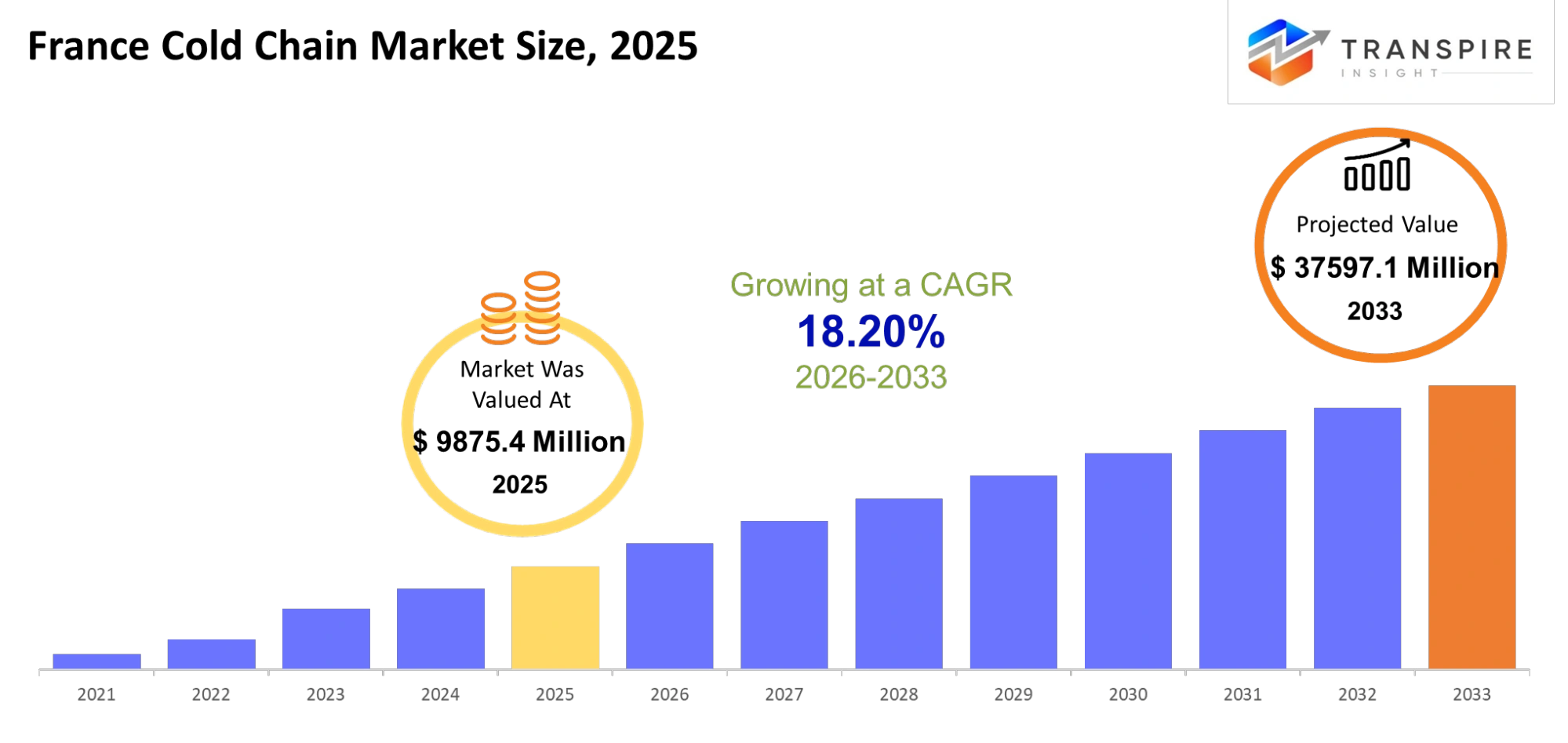
- France Cold Chain Market Size 2025: USD 9875.4 Million
- France Cold Chain Market Size 2033: USD 37597.1 Million
- France Cold Chain Market CAGR:18.20%
- France Cold Chain Market Segments: By Type (Cold Storage, Refrigerated Transport, Monitoring Systems, Others); By Application (Food & Beverages, Pharmaceuticals, Chemicals, Agriculture, Others); By End-User (Food Industry, Pharma Companies, Logistics Providers, Retailers, Others); By Technology (IoT Monitoring, Refrigeration Systems, Automation, Others)
To learn more about this report,  Download Free Sample Report
France Cold Chain Market Summary
The France Cold Chain Market was valued at USD 9875.4 Million in 2025. It is forecast to reach USD 37597.1 Million by 2033. That is a CAGR of 18.20% over the period.
The France Cold Chain Market provides temperature-controlled storage and transportation services that maintain the safe storage of pharmaceuticals and vaccines and seafood and dairy products and processed food from their production stage until their final usage stage. The system prevents spoilage while it maintains drug effectiveness and enables the transportation of delicate items through the healthcare and retail and export systems of France.
The market has changed during the past three years because companies now prefer to use digital systems for their logistics operations instead of relying on traditional refrigeration methods which require physical equipment. Distribution nodes now use IoT-enabled tracking together with real-time temperature analytics and automated warehousing systems instead of manual supervision. Biologics and vaccine distribution requirements have caused pharmaceutical logistics operations to become more tightly integrated with cold chain systems which represents a major structural transformation. The COVID-19 vaccine rollout exposed capacity gaps and forced rapid infrastructure expansion, while post-pandemic pharmaceutical demand sustained that momentum. The EU F-gas regulations have created two effects which include new spending requirements for equipment upgrades and operational maintenance costs which together transform how businesses in the industry allocate their financial resources.
Key Market Insights
- Île-de-France dominates the France Cold Chain Market because it has strong pharmaceutical hubs and hospitals and centralized logistics infrastructure.
- The southern regions of France which include Occitanie experience the fastest growth because of their agro-food exports and their expanding refrigerated warehousing capacity.
- Industrial clusters which develop around major ports like Marseille enable the cold chain expansion which supports import-export activities and seafood logistics operations.
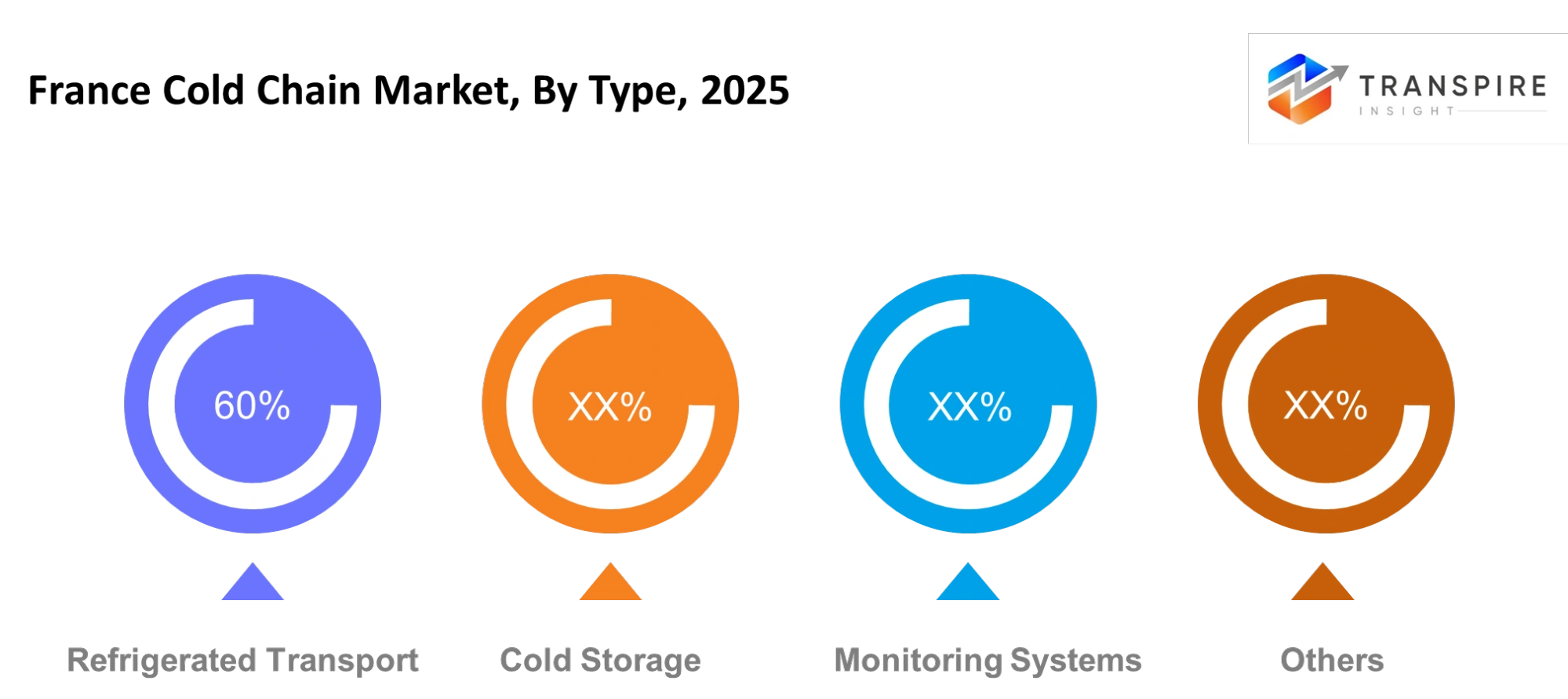
- The France Cold Chain Market sees its highest market share through refrigerated transportation because food and pharmaceuticals require high-volume distribution.
- The fastest-growing segment of pharmaceutical cold chain services operates through the delivery of biologics and vaccines and advanced drug formulations.
- The France Cold Chain Market sees its primary market share through food and beverage applications which require strict EU food safety compliance to meet export demands.
- Pharmaceutical distribution becomes the fastest-growing application because its operations require biologics and temperature-sensitive vaccine logistics.
- Seafood and dairy logistics operations experience continuous growth because import-export trade and frozen product consumption trends show an upward movement.
- Food processors and retailers lead end-user demand which allows them to maintain the largest share of cold chain operations throughout France.
- The hospitality and food service sectors show steady adoption because they require consistent access to preserved and imported perishables.
- Pharmaceutical companies use strategic partnerships to develop cold chain capacity which supports the distribution of biologics and vaccines.
- Companies are developing refrigerated fleets and automated warehouses to achieve increased efficiency while decreasing their risks of spoilage.
- French companies gain competitive advantages through sustainability-focused innovations which include low-emission refrigeration systems.
What are the Key Drivers, Restraints, and Opportunities in the France Cold Chain Market?
The main reason for the growth in France's cold chain market occurs because temperature-sensitive pharmaceutical products which include biologics and vaccines and specialty drugs experience substantial market growth. The COVID-19 vaccination program established requirements for ultra-low temperature logistics and resilient distribution networks which resulted in this operational shift. The pharmaceutical industry and logistics companies expanded their investment to develop refrigerated systems and monitoring systems that use IoT technology and automated systems for cold storage. The business enhancements led to increased revenue from contract logistics services while creating sustained demand for integrated cold chain solutions in the healthcare and food industries.
The requirement to operate cold chain systems that meet regulatory standards creates a critical constraint because it requires substantial capital and operational expenditures. The combination of energy-intensive refrigeration systems and European Union regulations on F-gas emissions and their monitoring needs creates exceptionally high operational costs for businesses. The financing limitations which affect mid-tier operators cause operational delays while they work through their modernization plans which creates difficulties for smaller logistics businesses that need to expand. The system establishes a structural bottleneck which prevents network growth and restricts adoption in rural areas throughout France thus hindering short-term revenue expansion.
Companies can achieve better performance by combining AI-based predictive logistics systems with environmentally friendly refrigeration solutions. Businesses that implement low-emission refrigeration solutions and predictive temperature analytics systems experience reduced product waste and energy expenses while achieving better compliance outcomes. The development of new logistics routes near Marseille and Lyon serves as testing sites for intelligent cold chain systems which receive financial backing from the European Union and private companies who invest in digital supply chain modernization.
What Has the Impact of Artificial Intelligence Been on the France Cold Chain Market?
Artificial intelligence transforms the France Cold Chain Market through its ability to enhance temperature monitoring and product transportation and maintenance workflows within intricate logistics systems. The AI control systems present in warehouses and refrigerated transport operations function through automated temperature control and humidity management and energy usage optimization based on actual cargo conditions. The system enables both automatic equipment operation and complete adherence to all pharmaceutical and food safety regulations which require ongoing monitoring. Fleet operators use AI tracking systems to find the best routes for their refrigerated trucks which helps them save fuel and deliver goods more efficiently.
Predictive analytics has become a major application area which helps organizations predict equipment failures while creating effective maintenance schedules for their refrigeration systems. Machine learning models use vibration data and compressor performance information and temperature deviation records to predict equipment failures which helps companies maintain their operations while reducing product waste. Operators report improved efficiency to handle maintenance planning cycles while achieving better asset utilization across their cold storage facilities which serve high-demand pharmaceutical distribution routes.
The process of adoption encounters a structural challenge because of two factors which are system integration difficulties and data management problems which result in system fragmentation. The logistics industry uses existing refrigeration systems which do not provide standardized digital connections which leads to high costs and delays for AI implementation. The France Cold Chain Market faces limitations in automation because operational data from multi-temperature environments presents accuracy problems which affect certain market segments.
Key Market Trends
- The pharmaceutical industry experienced a major increase in its cold chain requirements after 2020 because vaccine distribution and the growing use of biologics in France demanded more cold chain facilities.
- The adoption of Internet of Things temperature monitoring systems started to replace traditional manual temperature assessments for essential pharmaceutical products and high-value food products in the logistics sector after 2022.
- The European Union implemented F-gas regulations in 2023, which prompted businesses to upgrade their outdated high-pollution refrigeration systems with new energy-saving equipment that produces lower global warming potential emissions.
- The automated cold storage market experienced strong growth during 2024 because logistics companies wanted to decrease their workforce needs while enhancing their inventory management capabilities at urban distribution centers.
- The refrigerated transport industry underwent fast modernization after supply chain problems which resulted in companies implementing advanced tracking systems and route management software.
- Digital twins together with predictive maintenance systems reached widespread adoption during 2025 which resulted in higher equipment availability and decreased product spoilage costs for warehouse operations.
- Since 2023 retailers have started to use centralized cold chain distribution systems which help them decrease fragmented storage and maintain product freshness during delivery to customers.
- French industrial companies adopted solar-powered cold storage systems and green warehouse certification programs because sustainability requirements mandated that logistics providers implement these technologies.
- The expansion of automated cold chain services by DHL and Kuehne + Nagel in France created a more competitive market environment for all international logistics companies operating in the country.
France Cold Chain Market Segmentation
By Type
- The French Cold Chain Market depends mainly on refrigerated transport because it provides essential services for transporting temperature-sensitive products between different production and consumption locations. The system maintains high operational use throughout all domestic and international logistics routes because of its need to handle perishable food products and pharmaceutical distribution networks. E-commerce grocery delivery services continue to expand their delivery operations which boosts the company's operational importance.
- The segment experiences growth because customers need real-time tracking capabilities together with route optimization solutions and compliance with EU temperature control regulations. The logistics industry has turned to mobile cold chain systems because recent disruptions have made it difficult to use permanent storage facilities. The system becomes more popular because GPS-based monitoring systems and energy-saving refrigerated transportation fleets work together to provide monitoring solutions.
To learn more about this report, Download Free Sample Report
By Application
- The France Cold Chain Market shows increasing application requirements because frozen foods and dairy products and imported perishables constitute the majority of food and beverage consumption. The industry maintains its dominant position because of strong retail distribution networks and strict food safety regulations. Consumer habits have shifted toward convenience foods while supermarket cold chain requirements keep expanding which drives market growth. The need for temperature-controlled logistics services grows because seafood and meat products move through export-import trade routes.
- The application will maintain its current performance level, but efficiency will become the primary focus because retailers will develop systems for delivering goods and restocking inventory through automated processes. The pharmaceuticals market shows its fastest growth because of increasing demand for biologics and vaccine distribution and specialty drug needs. The cold chain system now depends more on its existing infrastructure after the pandemic drove its development.
By End-User
- The France Cold Chain Market experiences its highest application demand through food and beverages because people in France consume frozen foods and dairy products and imported perishables at high rates. The industry maintains its dominant market position because of its effective retail distribution systems and its compliance with strict food safety regulations. The market expands because customers prefer convenient foods and supermarkets increase their cold chain operation needs. The seafood and meat export-import business creates a higher need for logistics that maintain specific temperature ranges.
- The application will maintain its current level of performance throughout its existence while retailers focus their investments on two areas which are rapid product delivery times and automatic stock restocking systems.The application segment of pharmaceuticals develops at the fastest rate because of increasing needs for biologics production and vaccine distribution and specialty drug requirements. The pandemic period led to major infrastructure developments which have resulted in an upsurge of cold chain operations.
By Technology
- Food industry participants hold the largest share in the France Cold Chain Market because they heavily depend on refrigerated logistics to support their production and processing and distribution operations. The food manufacturing and retail sectors together create the highest demand within this market. The market expansion results from both centralized supply chain systems and rising consumer interest in fresh and frozen packaged products. The food safety regulations create additional requirements which businesses must meet to maintain their cold chain operations.
- This segment will develop toward automated systems which synchronize inventory management in real time to achieve waste reduction and distribution efficiency improvements. The pharmaceutical industry uses validated logistics systems as its primary essential element.
What are the Key Use Cases Driving the France Cold Chain Market?
Food and beverage logistics remain the dominant use case in the France Cold Chain Market, driven by strict EU food safety regulations and high consumption of frozen dairy and fresh imported products. National distribution networks depend on large retail chains and food processors to maintain their product quality through continuous temperature regulation which prevents spoilage.
Pharmaceutical distribution is experiencing rapid growth as its secondary use case, which receives backing from hospitals, biotech firms, and clinical research organizations. The demand for vaccine logistics and biologics handling and specialty drug transportation has increased because these processes require strict temperature control to maintain product integrity. The retail pharmacy networks enable ongoing technology adoption across urban areas.
The two emerging use cases include chemical temperature-sensitive transport and precision agriculture logistics. Industrial chemical firms require controlled conditions for reagents and specialty compounds while agricultural exporters are beginning to adopt cold chain systems for high-value produce. The applications currently under development demonstrate potential for future growth because digital monitoring and compliance systems have become more affordable and accessible to users.
|
Report Metrics |
Details |
|
Market size value in 2025 |
USD 9875.4 Million |
|
Market size value in 2026 |
USD 11662.9 Million |
|
Revenue forecast in 2033 |
USD 37597.1 Million |
|
Growth rate |
CAGR of 18.20% from 2026 to 2033 |
|
Base year |
2025 |
|
Historical data |
2021 - 2024 |
|
Forecast period |
2026 - 2033 |
|
Report coverage |
Revenue forecast, competitive landscape, growth factors, and trends |
|
Regional scope |
France |
|
Key company profiled |
DHL, FedEx, UPS, Maersk, Kuehne+Nagel, DB Schenker, Americold, Lineage Logistics, XPO Logistics, CEVA Logistics, Nippon Express, Yusen Logistics, Agility, VersaCold, Burris Logistics |
|
Customization scope |
Free report customization (country, regional & segment scope). Avail customized purchase options to meet your exact research needs. |
|
Report Segmentation |
By Type (Cold Storage, Refrigerated Transport, Monitoring Systems, Others); By Application (Food & Beverages, Pharmaceuticals, Chemicals, Agriculture, Others); By End-User (Food Industry, Pharma Companies, Logistics Providers, Retailers, Others); By Technology (IoT Monitoring, Refrigeration Systems, Automation, Others) |
Which Regions are Driving the France Cold Chain Market Growth?
The Cold Chain Market of France operates through Île-de-France because its pharma headquarters and advanced healthcare facilities and high population density areas make it the main distribution point. The need for temperature-controlled systems that meet strict compliance standards exists because food safety regulations and pharmaceutical logistics requirements are enforced with strong regulatory oversight. The area gains advantages from distribution hubs that provide connections between national road systems and air freight services operating from Paris airports. The region maintains its leading market position through its established network of logistics companies and cold storage facilities and biotech research centers.
The Auvergne-Rhône-Alpes region serves as a secondary industrial base with strong industrial development which enables its access to European trade routes. The region operates multiple manufacturing facilities that produce food products and chemicals and healthcare materials while Île-de-France depends on its centralized capital system. The logistics network infrastructure around Lyon receives continuous funding which supports dependable cold chain operations. The system generates steady revenue because of its stable regulatory framework and strong industrial capacity which makes it a reliable source of income.
The France Cold Chain Market experiences its fastest growth through Occitanie which develops its agro-food sector and upgrades its ports and cold storage systems. The region has improved its logistics network through recent upgrades while it supports temperature-controlled system adoption by providing incentives for agri-tech research and development. The increase in seafood and fresh produce exports supports market expansion. The existing momentum shows that logistics companies and investors will create opportunities to expand decentralized cold chain operations from 2026 to 2033.
Who are the Key Players in the France Cold Chain Market and How Do They Compete?
It shows that the France Cold Chain Market operates with a competitive structure which has moderate consolidation where global logistics integrators control high-value pharmaceutical and food-grade transport while specialized cold storage operators target their resource-intensive business operations. The market competition operates through three main factors which include technology adoption and service reliability and regulatory compliance requirements. The large companies develop their power to manage all aspects of temperature-controlled delivery systems while mid-sized companies face difficulties with funding their necessary equipment updates which include automation technology and systems for environmentally friendly refrigeration.
DHL Supply Chain and Kuehne+Nagel compete strongly through integrated pharmaceutical logistics platforms, with both focusing on GDP-compliant transport and real-time IoT tracking across European corridors. The DHL company creates a unique market position through its comprehensive life sciences logistics network and its development of digital control towers which enhance shipment tracking abilities. Kuehne+Nagel strengthens its position through air freight-linked cold chain solutions and strategic partnerships with pharmaceutical manufacturers for vaccine and biologics distribution. DB Schenker focuses on operational efficiency, expanding its temperature-controlled road freight network across France to serve industrial and retail clients.
Americold and Lineage Logistics lead in temperature-controlled warehousing, using large-scale automation and energy-efficient cold storage facilities as their key advantage. Americold expands through acquisitions of regional storage operators, increasing its footprint in European food distribution hubs. Lineage Logistics uses its advanced robotics warehouses and energy-efficient certified facilities as its unique market differentiators. CEVA Logistics strengthens its presence
Company List
- DHL
- FedEx
- UPS
- Maersk
- Kuehne+Nagel
- DB Schenker
- Americold
- Lineage Logistics
- XPO Logistics
- CEVA Logistics
- Nippon Express
- Yusen Logistics
- Agility
- VersaCold
- Burris Logistics
Recent Development News
In February 2026, DHL Group announced expansion of its Airfreight Cold Chain Network to strengthen global life sciences logistics. The initiative increased dedicated temperature-controlled capacity for vaccines, biologics, and cell and gene therapies, improving end-to-end visibility and transport reliability across international healthcare supply chains.https://group.dhl.com
In February 2026, DHL Supply Chain entered a strategic partnership with Sanofi to manage its Val-de-Reuil vaccine distribution center in France. The collaboration expanded GDP-compliant warehousing, inventory management, and order fulfillment capabilities, reinforcing pharmaceutical cold chain resilience and improving distribution efficiency for global vaccine delivery.https://www.dhl.com
What Strategic Insights Define the Future of the France Cold Chain Market?
The France Cold Chain Market is undergoing structural changes that will result in logistics systems which use digital technology and operate with reduced emissions and centralized control. The next 5-7 years will experience growth through the development of dual compliance needs for pharmaceutical-grade standards and food supply chain digital transformation which EU sustainability requirements and biologics distribution growth will accelerate.
Cold chain infrastructure will increasingly function as a data-driven ecosystem rather than a physical logistics service, with real-time monitoring and predictive optimization becoming standard requirements.
Global logistics integrators face an increasing market concentration which creates hidden dangers because it limits regional operators' operational flexibility while making them dependent on a few service providers. The system becomes vulnerable to operational bottlenecks because major networks will experience interruptions and regulatory investigations.
The development of regional decentralized cold storage hubs which operate renewable-powered microgrids represents an emerging opportunity for southern France. These facilities can reduce last-mile inefficiencies and support agro-export expansion while meeting decarbonization targets.
Market participants should prioritize investment in interoperable digital infrastructure and modular energy-efficient cold storage systems to maintain competitiveness during rising compliance expenses and heightened customer demands.
France Cold Chain Market Report Segmentation
By Type
- Cold Storage
- Refrigerated Transport
- Monitoring Systems
- Others
By Application
- Food & Beverages
- Pharmaceuticals
- Chemicals
- Agriculture
- Others
By End-User
- Food Industry
- Pharma Companies
- Logistics Providers
- Retailers
- Others
By Technology
- IoT Monitoring
- Refrigeration Systems
- Automation
- Others
Frequently Asked Questions
Find quick answers to common questions.
The confirmed 2033 market size figure is USD 37597.1 Million.
Key segments for the France Cold Chain Market are By Type (Cold Storage, Refrigerated Transport, Monitoring Systems, Others); By Application (Food & Beverages, Pharmaceuticals, Chemicals, Agriculture, Others); By End-User (Food Industry, Pharma Companies, Logistics Providers, Retailers, Others); By Technology (IoT Monitoring, Refrigeration Systems, Automation, Others).
Major France Cold Chain Market players are DHL, FedEx, UPS, Maersk, Kuehne+Nagel, DB Schenker, Americold, Lineage Logistics, XPO Logistics, CEVA Logistics, Nippon Express, Yusen Logistics, Agility, VersaCold, Burris Logistics .
The France Cold Chain Market size is USD 9875.4 Million in 2025.
The France Cold Chain Market CAGR is 18.20% from 2026 to 2033.
- DHL
- FedEx
- UPS
- Maersk
- Kuehne+Nagel
- DB Schenker
- Americold
- Lineage Logistics
- XPO Logistics
- CEVA Logistics
- Nippon Express
- Yusen Logistics
- Agility
- VersaCold
- Burris Logistics
Recently Published Reports
-
Apr 2026
ATV & UTV Market
ATV & UTV Market Size, Share & Analysis Report By Type (ATV, and UTV), By Variants (Less Than 400 CC, 400 CC To 800 CC, and More Than 800 CC), and Geography (North America, Europe, Asia-Pacific, Middle East and Africa, South and Central America), 2021 - 2031
-
Apr 2026
Automotive Central Gateway Module Market
Automotive Central Gateway Module Market Size, Share & Analysis Report By Type (Ethernet Central Gateway Module, CAN Central Gateway Module, LIN Central Gateway Module, and FlexRay), By Application (Powertrain Control, Body Control, Infotainment System, Advanced Driver Assistance Systems (ADAS), and Others), By End User (Passenger Vehicles, and Commercial Vehicles), and Geography (North America, Europe, Asia-Pacific, Middle East and Africa, South and Central America), 2021 - 2031
-
Apr 2026
Automotive Engine Oil Filter Market
Automotive Engine Oil Filter Market Size, Share & Analysis Report By Filter Type (Fuel Filter, Engine Oil Filter, Hydraulic Oil Filter, and Others), By Filter Media (Cellulose, Synthetic, and Micro), By Sales Channel (OEMs, and Aftermarket), By Vehicle Type (Passenger Cars, Light Commercial Vehicles, Heavy Duty Trucks, Buses and Coaches, and Off-road Vehicles), and Geography (North America, Europe, Asia-Pacific, Middle East and Africa, South and Central America), 2021 - 2031
-
Apr 2026
Automotive Parts Aluminium Die Casting Market
Automotive Parts Aluminium Die Casting Market Size, Share & Analysis Report By Production Process (Pressure Die Casting, Vacuum Die Casting, Squeeze Die Casting, Gravity Die Casting), By Application (Body Parts, Engine Parts, Transmission Parts, Battery And Related Components, Other Application Types), and Geography (North America, Europe, Asia-Pacific, Middle East and Africa, South and Central America), 2021 - 2031
Our Clients