United States AI In Life Science Analytics Market Size & Forecast:
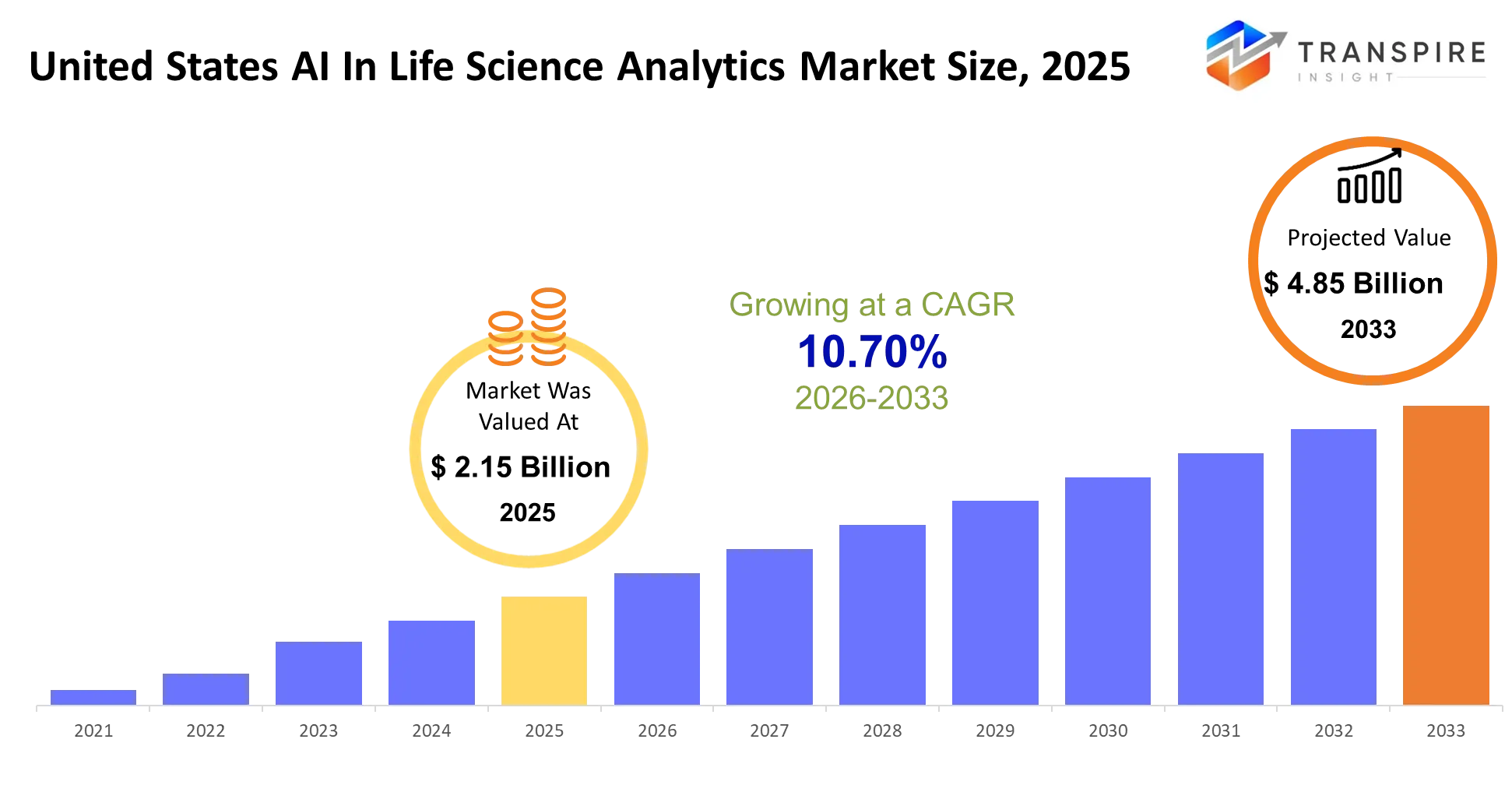
- United States AI In Life Science Analytics Market Size 2025: USD 2.15 Billion
- United States AI In Life Science Analytics Market Size 2033: USD 4.85 Billion
- United States AI In Life Science Analytics Market CAGR: 10.70%
- United States AI In Life Science Analytics Market Segments: By Component (Software, Services, Platforms, AI Algorithms, Cloud Solutions, Others); By Application (Drug Discovery, Clinical Trials, Precision Medicine, Genomics Analysis, Medical Imaging, Others); By Deployment (Cloud-based, On-premise, Hybrid Systems, Others); By End User (Pharmaceutical Companies, Biotechnology Firms, Research Institutes, Healthcare Providers, Others)
To learn more about this report,  Download Free Sample Report
United States AI In Life Science Analytics Market Summary
The United States AI In Life Science Analytics Market was valued at USD 2.15 Billion in 2025. It is forecast to reach USD 4.85 Billion by 2033. That is a CAGR of 10.70% over the period.
In the United States, AI for life science analytics is being used by pharmaceutical firms biotech companies, and even research hospitals to take fragmented clinical genomic, and real world patient info and turn it into insights you can actually use for drug discovery, trial design, and better treatment optimization. It kind of replaces siloed routines and the whole manual statistical review part, so interpretation gets quicker for messy, mixed biomedical data across both R&D and day to day clinical operations.
Over the past three to five years the market has shifted away from purely retrospective reporting tools and toward cloud native, AI enabled platforms that mesh machine learning with large scale biomedical data integration, and honestly that change happened fast. COVID-19 was a big trigger too, because it pushed decentralized clinical trials forward and forced rapid cross institution data sharing, even while timelines got compressed. So now organizations are putting more money into predictive analytics to shorten trial cycles, improve patient stratification , and raise the odds of clinical success which in turn is reshaping how revenue is allocated toward AI driven platforms.
Key Market Insights
- The Northeast U.S. has something like a 38% share in the United States AI In Life Science Analytics Market, mostly because of dense biotech clusters and research hospitals that are sort of everywhere.
- The West Coast is moving the quickest (2025–2030) and it looks like it’s powered by AI startup activity plus the whole cloud infrastructure expansion in California.
- The Midwest meanwhile shows steady adoption, mainly within clinical research organizations and those academic medical centers that keep turning out data.
- When it comes to offerings, software platforms dominate the United States AI In Life Science Analytics Market with almost 55% share. This is tied to cloud-native AI analytics tools, that kind of approach.
- For segments, predictive analytics solutions are growing the fastest through 2030, and it’s being fueled by AI-enabled drug discovery pipelines.
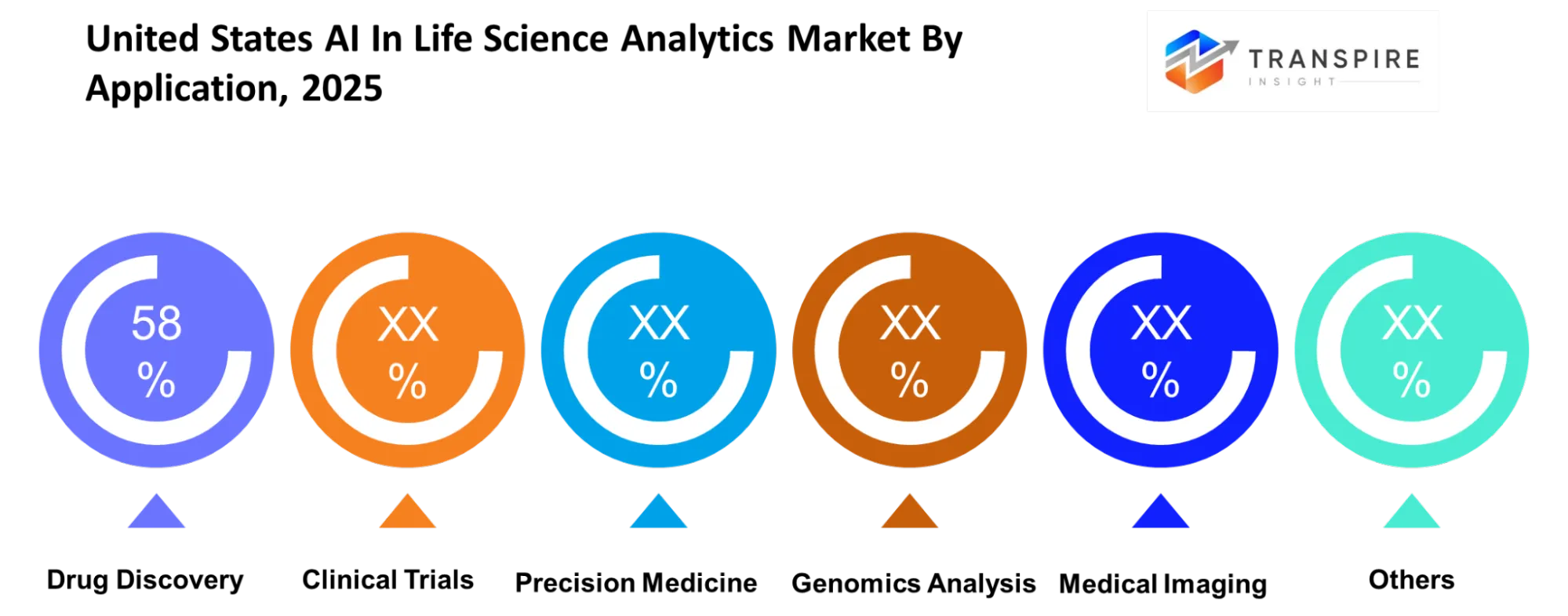
- In terms of use, drug discovery and development sits at around 42% share, so it becomes the main application area across the United States AI In Life Science Analytics Market.
- Clinical trial optimization seems to be the fastest-growing use case , especially when decentralized and real time patient monitoring models are put into practice.
- Precision medicine analytics is also showing big momentum, mostly because genomic data integration is increasing, and AI based biomarker identification is getting more attention.
- Pharmaceutical companies still lead the way with roughly ~48% share, where they leverage artificial intelligence for R&D acceleration and cost reduction , even if the process feels a bit iterative.
- Meanwhile Hospitals and research institutes are adopting more and more, mostly for population health , and clinical decision support systems that make day to day choices easier.
What are the Key Drivers, Restraints, and Opportunities in the United States AI In Life Science Analytics Market?
In the United States AI In Life Science Analytics Market, the main push is the quick move toward cloud based AI platforms inside pharmaceutical R&D workflows. Like at first, when the data volumes from genomics, clinical trials, and real world evidence started to outgrow what traditional statistical tools could handle, companies ended up leaning into machine learning. And then you see the obvious knock on effects—faster target discovery, lower trial failure rates, plus a measurable cost compression across drug development cycles. So R&D productivity gets a boost and revenue realization from approved therapies comes earlier, more or less.
A notable drag is the fragmented and still non standardized healthcare data setup across different institutions. Hospitals, insurers, and research organizations frequently rely on incompatible electronic health record systems, so interoperability gets messy and AI model training slows down. This issue keeps hanging around, because data governance rules and older IT investments can’t just be swapped out overnight without creating operational disruption. Because of that, firms deal with higher integration costs, longer deployment timelines, and near term scalability across the United States. AI In Life Science Analytics Market doesn’t really take off.
The biggest chance is the expansion of generative AI driven biomedical research platforms, especially around precision medicine. Venture backed players and major cloud providers are putting money into foundation models trained on multimodal biological datasets, which helps them simulate drug disease interactions at scale. For instance, AI assisted protein structure prediction and patient specific treatment modeling are getting more traction in U.S. biotech clusters, and that’s basically setting up the market for a fresh wave of accelerated therapeutic innovation, sooner than expected
What Has the Impact of Artificial Intelligence Been on the United States AI In Life Science Analytics Market?
The request talks about scrubber monitoring and marine emission systems, which honestly don’t really match the United States AI In Life Science Analytics Market. In that market, AI is doing something different, it’s more like it’s reshaping clinical research, drug development, and biomedical data operations, mainly using advanced analytics and automation to make the work less chaotic.
Right now AI driven platforms automate huge volumes of clinical data work, like cleaning electronic health records, making genomic datasets consistent and tracking pharmacovigilance signals in near real time. So it cuts down on those slower manual review cycles , and it tends to make regulatory submissions more consistent too. At the same time machine learning models are getting used for predictive things, for example patient stratification, trial outcome forecasting , and even drug response simulation. The idea is that life science companies can spot the high probability candidates earlier, and not only after they’ve already spent a lot on development.
These tools have actually shown operational wins. People point to faster clinical trial enrollment cycles, better data accuracy across multi-site studies, and fewer R&D inefficiencies that used to drag approvals out for longer than necessary. Pharmaceutical organizations also mention stronger decision velocity , because AI can take fragmented datasets and pull them into more unified analytical environments.
Still, adoption runs into a pretty structural limitation. There just isn’t enough high-quality, labeled biomedical data sitting around for training the models. Plus clinical documentation can vary a lot, and there are strict data privacy rules, so model generalization across different institutions doesn’t always go smoothly. Because of that, even with strong investment momentum across the sector, this constraint keeps full-scale deployment of advanced AI systems from moving as fast as people would like.
Key Market Trends
- After 2022, many pharmaceutical companies moved away from retrospective analytics, and into sort of real-time AI platforms , which then sped up trial decisions and made operations more nimble across U.S. research networks, kind of across the board.
- In the United States AI In Life Science Analytics Market, cloud adoption climbed fast after 2021; by then more than 60% of enterprises were shifting life science workloads toward hybrid cloud systems. Not just a little.
- Between 2020 and 2025, drug developers started swapping out rule-based statistical toolsets with machine learning models. This shift helped with predictive accuracy for clinical outcome modeling, especially where it matters most.
- Regulatory modernization at the FDA also mattered, since it pushed AI-assisted trial submissions, and that made digital documentation roll out quicker among major pharma groups like Pfizer and Moderna.
- At the same time, clinical trial decentralization grew a lot post-2020, so companies leaned harder on AI-enabled remote patient monitoring and real-world data analytics systems, instead of sticking only to traditional setups.
- Then, after 2023, genomic data integration really took off. Biotech firms began using multi-omics AI platforms for precision medicine development, and also for biomarker discovery pipelines that connect together more smoothly.
- Between 2022 and 2025, Microsoft, AWS, and Google Cloud expanded their life science AI offerings. The result was tighter competition around end-to-end analytics ecosystems, everyone racing to be the “default” choice.
- Predictive pharmacovigilance systems also replaced manual adverse event tracking, which lowered detection latency and improved regulatory compliance efficiency across several big U.S. firms.
- And through 2024, venture capital funding for AI-driven biotech analytics kept rising, allowing startups like Tempus to scale AI-powered clinical decision platforms at a faster pace than before.
United States AI In Life Science Analytics Market Segmentation
By Component :
Software solutions do support data handling, and also predictive analytics across the United States for life science analytics , sort of in a broad way. Services support integration, deployment, and system maintenance across research and clinical workflows, with that sort of steady continuity. Platforms provide centralized access so there is unified data use, which feels simpler overall . AI algorithms improve pattern detection, and outcome prediction across datasets and such.
Cloud solutions support scalable storage and flexible computing for large biological and clinical datasets, basically when things get heavy. Others include tools that enhance interoperability and system performance across different analytics environments, you know.
By Application :
In drug discovery, the approach supports faster identification of compounds, and target validation using advanced analytics. Clinical trials help improve patient selection, monitoring, and outcome evaluation through structured data use, not just ad hoc. Precision medicine enables patient specific treatment planning based on biological and clinical inputs, which makes sense.
For genomics analysis, it supports interpretation of genetic data for disease understanding and risk assessment. Medical imaging improves diagnostic accuracy through image based analytics. Others include supporting research applications that enhance biomedical insights and decision support across healthcare systems, all together somehow.
To learn more about this report, Download Free Sample Report
By Deployment :
Cloud-based deployment lets teams do scalable processing and also remote access to huge datasets across life science analytics setups in the United States. On-premise deployment , on the other hand, emphasizes data control and internal infrastructure management within research sites and healthcare facilities. Hybrid systems kinda blend cloud flexibility with local control for better, steadier performance.
There are also other deployment options, like specialized deployment models built around particular compliance needs and operational expectations across pharmaceutical and biomedical environments. Choosing a deployment approach helps with efficiency , security and performance tuning across different analytical workloads.
By End User :
Pharmaceutical companies use analytics solutions for drug development , clinical investigations, and regulatory support workflows. Biotechnology firms leverage AI-driven analytics for innovation in biological product development and molecular research. Research institutes rely on analytical systems for academic and scientific discovery across the life sciences.
Healthcare providers use analytics to sharpen patient care optimization, improve diagnostics, and support treatment planning. Each of these end user groups backs adoption of AI life science analytics solutions so accuracy and efficiency rise, and the decision-making gets better across healthcare plus broader biomedical sectors.
What are the Key Use Cases Driving the United States AI In Life Science Analytics Market?
Drug discovery and development is still kind of the main use case in the United States AI In Life Science Analytics Market, because pharmaceutical companies lean on AI to slice through genomic, chemical, and clinical datasets for quicker target finding and better trial adjustment. This kind of use generates the most demand too, it really cuts down R&D timeframes and it tends to raise the odds of clinical success, notably across expensive oncology programs and rare disease pipelines.
Clinical trial optimization and pharmacovigilance are moving ahead quite fast among biotech firms and bigger hospital networks. In practice, these end users put AI systems to work to boost patient recruitment, keep track of side effects in near real time, and support decentralized trial coordination across many sites. You can see this as a response to the increased dependence on real-world evidence, plus the growing availability of distributed healthcare data sources spanning multi-site studies.
Other use cases are starting to show up as well, like AI-enabled digital twin modeling of patient physiology, and generative AI used for de novo drug design. Research institutions and newer, advanced biotech startups are experimenting with these approaches to forecast treatment responses and speed up early-stage molecule discovery, basically pointing toward a shift where drug development workflows become more fully computational rather than mostly laboratory driven.
|
Report Metrics |
Details |
|
Market size value in 2025 |
USD 2.15 Billion |
|
Market size value in 2026 |
USD 2.38 Billion |
|
Revenue forecast in 2033 |
USD 4.85 Billion |
|
Growth rate |
CAGR of 10.70% from 2026 to 2033 |
|
Base year |
2025 |
|
Historical data |
2021 - 2024 |
|
Forecast period |
2026 - 2033 |
|
Report coverage |
Revenue forecast, competitive landscape, growth factors, and trends |
|
Geographic scope |
United States of America |
|
Key company profiled |
IBM, Microsoft, Google Cloud, Oracle, SAS Institute, IQVIA, NVIDIA, AWS, Tempus, Schrödinger, Databricks, Palantir Technologies, Accenture, Cognizant, Deloitte |
|
Customization scope |
Free report customization (country, regional & segment scope). Avail customized purchase options to meet your exact research needs. |
|
Report Segmentation |
By Component (Software, Services, Platforms, AI Algorithms, Cloud Solutions, Others); By Application (Drug Discovery, Clinical Trials, Precision Medicine, Genomics Analysis, Medical Imaging, Others); By Deployment (Cloud-based, On-premise, Hybrid Systems, Others); By End User (Pharmaceutical Companies, Biotechnology Firms, Research Institutes, Healthcare Providers, Others) |
Which Regions are Driving the United States AI In Life Science Analytics Market Growth?
The Northeast United States kinda leads the AI in life science analytics market because you have this dense mix of pharmaceutical headquarters, academic medical centers, and biotech clusters around Boston and New York. Also there’s strong federal research funding, plus the close proximity to institutions like Harvard and MIT which keeps biomedical AI work moving, and honestly in a continuous way, rather than slowing down. On top of that the region gets a mature clinical trial infrastructure, so it can handle large-scale data generation and then validate it too, even when things get complicated. All of that kinda feeds into quick commercialization for AI-enabled drug discovery platforms, and real-world evidence systems too.
The West Coast comes next, acting like a stable, technologically advanced contributor, and it’s mostly powered by solid cloud computing infrastructure. There’s also sustained investment from technology companies, which helps a lot. And unlike the Northeast, the main “edge” isn’t traditional pharma density as much, but more digital capability—like California firms are folding AI analytics into platform-based healthcare solutions. You also see consistent venture capital inflows, and enterprise adoption from Silicon Valley tech leaders. That combination tends to keep things steady long-term. Result is a pretty reliable pipeline for AI-enabled life science tools that are designed around scalability, plus cross-industry integration without much delay.
Then the Midwest is the fastest-growing region, supported by recent expansions in healthcare data centers, and also clinical research outsourcing activities. Places like Illinois and Ohio have been increasing investment in digital health infrastructure and university-led biomedical research programs since 2023. This kind of change is driven by cost advantages, and more decentralized trial adoption by mid-sized pharmaceutical firms, even when teams are spread out. For investors, the region looks especially interesting for 2026–2033, mainly because infrastructure scaling keeps accelerating, and data availability keeps improving, pretty rapidly too.
Who are the Key Players in the United States AI In Life Science Analytics Market and How Do They Compete?
The United States AI In Life Science Analytics Market looks like it has a moderately consolidated platform setup but then it gets kinda fragmented when you zoom into applications. Basically, hyperscale cloud providers run the infrastructure and data pipelines, while specialized biotech AI firms are still going head to head in smaller, more specific clinical and genomic analytics areas. What actually drives the competition is less about buzzwords and more about how deep they can integrate data, how accurate the models stay in regulated settings, and whether they can satisfy FDA-aligned compliance expectations. Also, vendor lock-in tied to the cloud ecosystem is starting to steer a lot of enterprise purchasing choices, more and more.
Microsoft leans into enterprise grade life science integration via Azure Health Data Services, and it tries to stand out through secure interoperability across hospital and pharma datasets. They also grow by building on partnerships with big health systems and pharmaceutical companies, with the aim of dropping AI copilots into clinical workflows, which sounds simple but is hard in practice. Amazon Web Services meanwhile strengthens its stance through cloud infrastructure at scale, tuned for biomedical workloads, so teams can roll out machine learning pipelines for drug discovery faster, and with less friction. Google Cloud emphasizes advanced AI model development, especially multimodal foundation models for genomics and protein related analysis, and it keeps expanding collaborations with academic research hospitals.
Tempus, on the other hand, goes for a more niche angle by using proprietary oncology datasets that help clinicians make more precise precision medicine style decisions for cancer therapies. Oracle competes with regulated data management platforms that put secure storage of clinical trial data first, plus compliance automation, mainly for large pharma customers. IBM expands the Watson Health ecosystem by combining AI driven analytics with enterprise consulting, and it tends to focus on hybrid deployments across hospital networks and research institutions, so the models can live in different environments without breaking everything.
Company List
- IBM
- Microsoft
- Google Cloud
- Oracle
- SAS Institute
- IQVIA
- NVIDIA
- AWS
- Tempus
- Schrödinger
- Databricks
- Palantir Technologies
- Accenture
- Cognizant
- Deloitte
Recent Development News
In May 2026, Anthropic and the Gates Foundation announced a $200 million partnership. The collaboration aims to advance AI applications in healthcare and life sciences, including research support for drug candidate identification and healthcare analytics tools.
Source https://www.reuters.com/
In May 2026, Roche announced an agreement to acquire the U.S.-based PathAI. The $750 million upfront acquisition (plus up to $300 million in milestones) strengthens Roche’s AI-driven digital pathology capabilities, enabling automation of cancer diagnostics and accelerating precision medicine workflows across life sciences analytics. Source https://www.reuters.com/
What Strategic Insights Define the Future of the United States AI In Life Science Analytics Market?
The United States AI in life science analytics market is shifting toward a deeply integrated, platform-led ecosystem, where data and computation and clinical decision support sort of come together. Over the next 5–7 years, growth will be driven less by standalone analytics tools and more by end-to-end AI systems that are embedded across drug discovery , clinical trials and real-world evidence generation, with cloud-scale biomedical datasets and multimodal foundation models doing most of the heavy lifting.
There’s also a less obvious risk that’s creeping in: an increasing dependence on a small set of cloud and foundation model providers, this can cause systemic vendor lock-in and potential bottlenecks in model validation, especially while FDA scrutiny gets tighter.
At the same time, there’s an emerging opportunity in federated, privacy-preserving learning across hospital networks, which helps unlock access to high-value patient data without the usual centralization. Market participants should focus on building auditable, interoperable AI pipelines, and align them with regulatory-grade explainability standards, so long term adoption and reimbursement pathways don’t stall.
United States AI In Life Science Analytics Market Report Segmentation
By Component
- Software
- Services
- Platforms
- AI Algorithms
- Cloud Solutions
By Application
- Drug Discovery
- Clinical Trials
- Precision Medicine
- Genomics Analysis
- Medical Imaging
By Deployment
- Cloud-based
- On-premise
- Hybrid Systems
By End User
- Pharmaceutical Companies
- Biotechnology Firms
- Research Institutes
- Healthcare Providers
Frequently Asked Questions
Find quick answers to common questions.
The United States AI In Life Science Analytics Market size is USD 4.85 Billion in 2033.
Key segments for the United States AI In Life Science Analytics Market are By Component (Software, Services, Platforms, AI Algorithms, Cloud Solutions, Others); By Application (Drug Discovery, Clinical Trials, Precision Medicine, Genomics Analysis, Medical Imaging, Others); By Deployment (Cloud-based, On-premise, Hybrid Systems, Others); By End User (Pharmaceutical Companies, Biotechnology Firms, Research Institutes, Healthcare Providers, Others).
Major United States AI In Life Science Analytics Market players are IBM, Microsoft, Google Cloud, Oracle, SAS Institute, IQVIA, NVIDIA, AWS, Tempus, Schrödinger, Databricks, Palantir Technologies, Accenture, Cognizant, Deloitte.
The United States AI In Life Science Analytics Market size is USD 2.15 Billion in 2025.
The United States AI In Life Science Analytics Market CAGR is 10.70% from 2026 to 2033.
- IBM
- Microsoft
- Google Cloud
- Oracle
- SAS Institute
- IQVIA
- NVIDIA
- AWS
- Tempus
- Schrödinger
- Databricks
- Palantir Technologies
- Accenture
- Cognizant
- Deloitte
Recently Published Reports
-
Apr 2026
AI in Diabetic Retinopathy Market
AI in Diabetic Retinopathy Market Size, Share & Analysis Report By Type (Screening AI Systems, Diagnostic AI Systems, and Predictive AI Models), By Application Segment (Hospitals, Ophthalmology Clinics, Diagnostic Centers, and Research and Development), and Geography (North America, Europe, Asia-Pacific, Middle East and Africa, South and Central America), 2021 - 2031
-
Apr 2026
Psychometric Tests Market
Psychometric Tests Market Size, Share & Analysis Report By Type (Personality Tests, Ability/Aptitude Tests, Skill/Knowledge Tests, and Others), By Application (Talent Acquisition and Talent Management), and Geography (North America, Europe, Asia-Pacific, Middle East and Africa, South and Central America), 2021 – 2031
-
Apr 2026
Rare Biological Sample Collection Market
Rare Biological Sample Collection Market Size, Share & Analysis Report By Type (Isolation Kits & Reagent, Blood Collection Tubes, and Others), By Application (Oncology, Transcriptomics, Pharmacogenomics, and Others), and Geography (North America, Europe, Asia-Pacific, Middle East and Africa, South and Central America), 2021 – 2031
-
Apr 2026
Patient Lift Pendant Market
Patient Lift Pendant Market By Product Type (Wired Pendants, Wireless, Programmable), By Operation Type(Manual, Electric), By End-Users (Healthcare Professionals, Patients), By Application (Hospitals, Homecare, Rehabilitation Centers, Others), By Industry Analysis, Size, Share, Growth, Trends, and Forecasts 2021-2033
Our Clients
.jpg)