

Middle East and Africa Investigator Payment Management Solutions Market Size & Forecast:
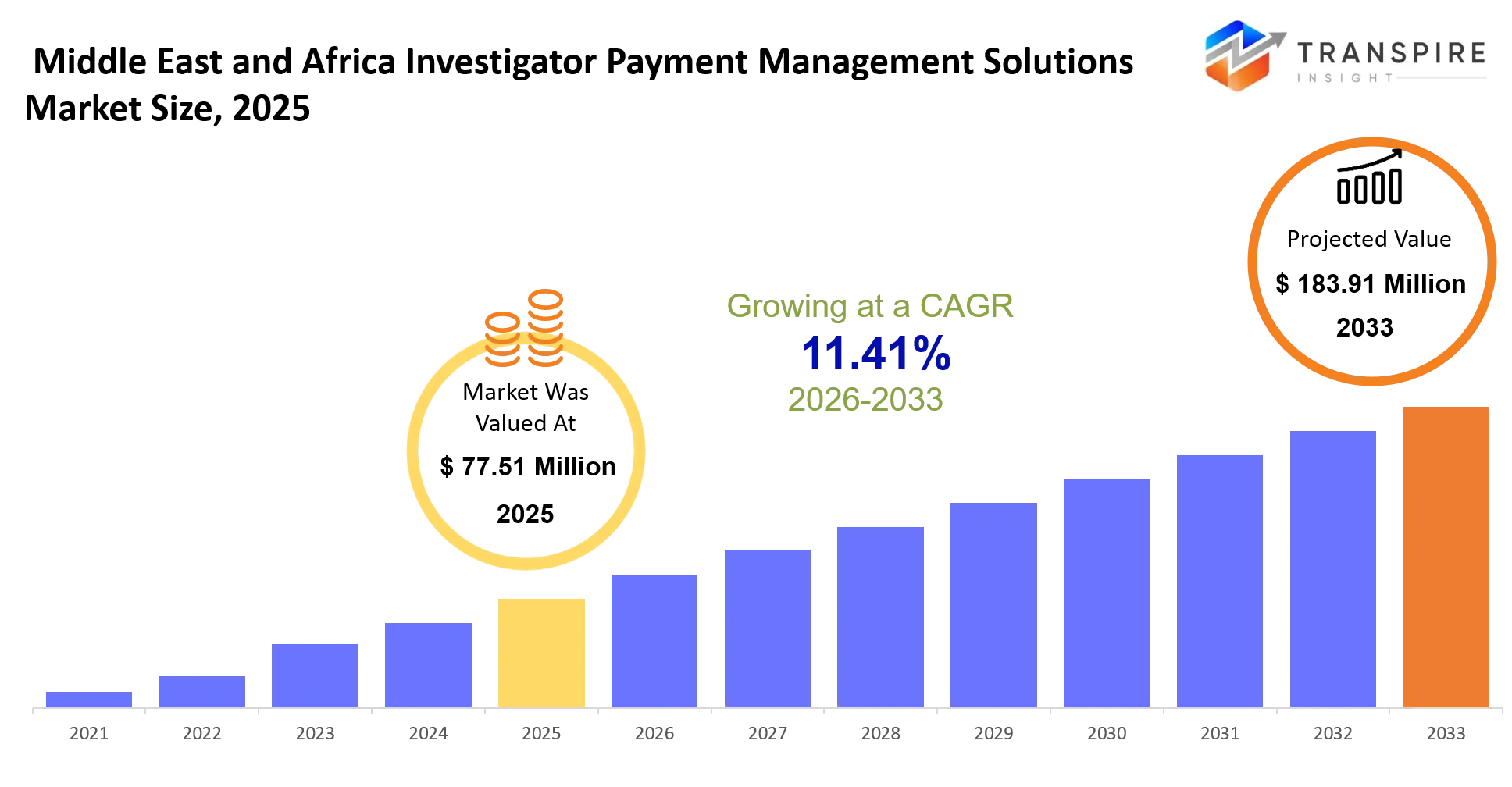
- Middle East and Africa Investigator Payment Management Solutions Market Size 2025: USD 77.51 Million
- Middle East and Africa Investigator Payment Management Solutions Market Size 2033: USD 183.91 Million
- Middle East and Africa Investigator Payment Management Solutions Market CAGR: 11.41%
- Middle East and Africa Investigator Payment Management Solutions Market Segments: By Component (Software, Services, Others); By Deployment (Cloud-based, On-premise, Hybrid, Others); By Application (Clinical Trials, Site Payments, Grant Management, Others); By End User (Pharmaceutical Companies, CROs, Research Institutes, Others)
Middle East and Africa Investigator Payment Management Solutions Market Summary
The Middle East and Africa Investigator Payment Management Solutions Market was valued at USD 77.51 Million in 2025. It is forecast to reach USD 183.91 Million by 2033. That is a CAGR of 11.41% over the period.
Investigator payment management solutions, help pharmaceutical sponsors, contract research organizations, and research sites deal with complex clinical trial payments with more speed, better accuracy, and stronger regulatory compliance. In practice, these platforms automate investigator reimbursements, milestone driven payments, tax paperwork, and multi currency transactions, which means fewer admin headaches that usually slow down trial start and execution. Over the last five years, the market kind of moved away from spreadsheet based payment tracking, and toward cloud platforms that are integrated with clinical trial management systems and electronic data capture environments. One big reason for the change was the fast spread of decentralized and hybrid clinical trials, after the COVID-19 period, and that pushed even more complexity into how payments get handled across several countries and research sites.
Now, as clinical studies become more widely spread, across the Middle East and Africa, sponsors are asking for centralized payment visibility, plus audit ready records, not just local reporting. This broader shift tends to support site satisfaction too, it boosts investigator engagement, and it also helps shorten the payment cycles. Those improvements show up as real operational efficiencies, which then makes platform adoption feel more “worth it,” and supports recurring software revenue growth, even when trial timelines vary.
Key Market Insights
- Saudi Arabia and the UAE, kind of together, racked up close to 42% of the regional revenue in 2025, helped by the way clinical research infrastructure kept expanding.
- The Gulf Cooperation Council countries look like the fastest growing regional cluster, mainly because healthcare digitization programs are rolling through until 2033, you know, not stopping anytime soon.
- In 2025, software solutions were the main piece with about 61% market share, which lines up with the demand for automated investigator compensation management.
- Services took the second position, mostly because sponsors are increasingly outsourcing payment administration and compliance monitoring functions… like, quietly switching a lot of those tasks out.
- Cloud-based deployment grabbed more than 58% of installations in 2025, and it benefited from lower implementation costs, plus scalability that’s easier to handle.
- For applications, clinical trials stayed in front with nearly 48% share, supported by growth from multinational studies.
- Site payment management became the quickest rising application category, since sponsors are pushing investigator retention and stronger payment transparency, seems like a major priority.
- Pharmaceutical companies generated over 46% of market revenue in 2025, reflecting large trial portfolios and payment requirements that are pretty complex.
- Contract research organizations keep picking up share, through expanded management of global as well as regional clinical programs.
- And yeah, companies like IQVIA, Medidata, Veeva Systems, Oracle, Greenphire, and ICON are strengthening their standing using platform integration, AI-enabled workflow automation, and regional partnerships.
What are the Key Drivers, Restraints, and Opportunities in the Middle East and Africa Investigator Payment Management Solutions Market?
The most potent growth lever really comes from how multinational clinical trials are spreading across newer healthcare markets in the Middle East and Africa. Sponsors now end up running studies with like dozens of research sites, each one under its own tax setup, different currencies, and a slightly different set of regulatory expectations. In many places the older manual payment routines still dominate, and that leads to all the usual problems—late transfers, reconciliation mistakes, and compliance exposures. Cloud based payment platforms basically automate the payment math plus the supporting paperwork, so sponsors can lower overhead expenses while also strengthening the day to day relationship with sites. When payment cycles get quicker, investigators tend to stay engaged, and that then affects enrollment pace, which in turn improves the operational flow of the whole study.
Still, data localization rules plus fragmented regulation frameworks are the biggest structural obstacle. A lot of countries keep distinct policies for where financial data must live, how tax reporting should be handled, and what’s allowed for cross border transactions. Because of that, technology vendors have to tailor their platforms for multiple jurisdictions and it tends to push implementation spend upward and makes deployment take longer. Those regulatory gaps do not get “fixed” rapidly either, since they’re tied to national healthcare strategies and financial policy choices. For those reasons, smaller research groups often delay adoption of new tooling, which reduces market reach, and pushes back both penetration and later revenue capture.
A strong coming opportunity sits with AI enabled payment intelligence platforms. With more advanced analytics, these systems can forecast payment bottlenecks, flag compliance oddities, and adjust investigator compensation cadences before troubles show up. Meanwhile, increased funding for clinical research hubs across Saudi Arabia, the UAE, and South Africa is creating a helpful environment for next generation payment solutions.
What Has the Impact of Artificial Intelligence Been on the Middle East and Africa Investigator Payment Management Solutions Market?
Artificial intelligence is reshaping investigator payment management, mainly by automating the money side workflows that usually needed a lot of manual oversight,and yes that’s still how many teams do it today. With AI-enabled platforms, teams can automatically check site invoices, line up payments with study milestones,and spot discrepancies before any money gets released. In practical terms this cuts down on administrative fuss and makes payments more correct across multi-country clinical programs, where everything tends to get complicated fast.
Machine learning models are also getting used for predictive financial management. They look at past payment behavior, participant enrollment patterns, and protocol milestones, then they can forecast what payments may be needed and also flag potential delays earlier than expected . Sponsors then use these signals to tighten up budgeting accuracy and keep more stable, kind relationships with investigators and research sites. On top of that, advanced analytics tools help organizations notice compliance risks sooner, keep an eye on tax obligations, and maintain records that are audit ready, which is really the point.
Operationally, the benefits often show up as faster payment processing cycles, lower reconciliation costs, better financial transparency, and more consistent regulatory compliance. A lot of organizations say they save a meaningful chunk of time on manual processing after switching to automated payment workflows. Still, AI adoption isn’t fully smooth sailing. Connecting AI systems to older clinical trial infrastructure can be expensive, and inconsistent data quality across several countries can mess with prediction accuracy. Plus, the limited availability of standardized clinical financial datasets makes some machine learning applications less effective, especially in emerging research markets where the data is thinner and harder to compare.
Key Market Trends
- Since 2021, cloud based payment platforms have kinda expanded from small pilot deployments into full enterprise wide implementations across major pharmaceutical sponsors, and it shows in the day to day rollout.
- Between 2022 and 2025, cross border clinical trials rose by more than 30%, so the need for multi currency payment automation just got stronger and stronger.
- Investigator payment cycle times also dropped by nearly 25% as automated workflow engines replace the old manual reconciliation processes, mostly without the extra back and forth.
- During 2024–2025, AI powered payment validation tools saw wider adoption, which has helped organizations cut down on financial processing errors that used to slip through gaps.
- In Saudi Arabia and UAE, research investments picked up pace too, and that momentum accelerated platform adoption as national healthcare programs pushed more clinical research activity forward.
- Sponsors are leaning more and more toward integrated payment ecosystems that connect directly with CTMS and EDC platforms, not so much standalone tools sitting alone.
- In 2025, strategic collaborations between technology vendors and CROs increased as well, aiming to improve payment visibility across the whole study network.
- Real time compliance monitoring features became normal requirements, as regulatory scrutiny of clinical financial transactions has intensified lately.
- Large global providers such as IQVIA, Medidata, and Veeva expanded their platform capabilities through broader workflow integration initiatives.
- And research sites are increasingly stressing payment transparency, which is basically pushing sponsors toward automated investigator compensation management solutions, rather than spreadsheets and delays.
Middle East and Africa Investigator Payment Management Solutions Market Segmentation
By Component
Software is basically the bedrock of investigator payment management, and it works by automating calculations, following milestones, organizing tax paperwork, and producing financial reporting. More sophisticated platforms then link in with clinical trial management systems, and with electronic data capture environments too, which should help make payments more accurate, and in a way that stays transparent. Also the growing reliance on cloud technology has really nudged software adoption upward among sponsors and research organizations, mostly because they want that centralized financial view, more or less.
On top of the platform, there are services for implementation support, system integration, compliance consulting, user training, plus ongoing platform management as well. Specialized providers assist teams in adapting payment workflows to regional regulatory requirements and the everyday operational realities. The category called the Others tends to cover complementary tools, customized modules, and extra support functions, all of which together can improve the overall efficiency of payment administration across clinical research programs.
By Deployment
Cloud-based deployment has a strong spot since it gives scalability, a sort of centralized reach, and fewer infrastructure worries. Research groups often like having real-time payment insight across different locations, and at the same time trimming the costs tied to information technology upkeep. Also, constant software improvements and remote accessibility makes adoption easier, and honestly it just keeps working for teams who need it.
On-premise deployment still matters for organizations that want direct control over sensitive financial, and research related data. Hybrid deployment is a middle path, using local infrastructure alongside cloud capabilities, so institutions can stay flexible even when they face varied regulatory frameworks. The Others category covers customized deployment setups, built for particular organizational needs and compliance demands, sort of tailored and not one-size-fits-all.
By Application
Clinical trials are kind of the biggest application area, because payment coordination is… essential for study execution, keeping investigator interest, and meeting regulatory compliance. Automated payment systems let sponsors oversee milestone based compensation and keep financial records correct during the whole study life cycle. Especially big multinational trials tend to get a lot from centralized payment management.
Also site payments have been gaining importance, since sponsors are trying to strengthen ties with research centers and cut down on delays. Grant management solutions help organizations monitor research funding allocations and the required expenditures. The Others group basically covers specialized payment applications that support niche research programs as well as certain administrative financial activities.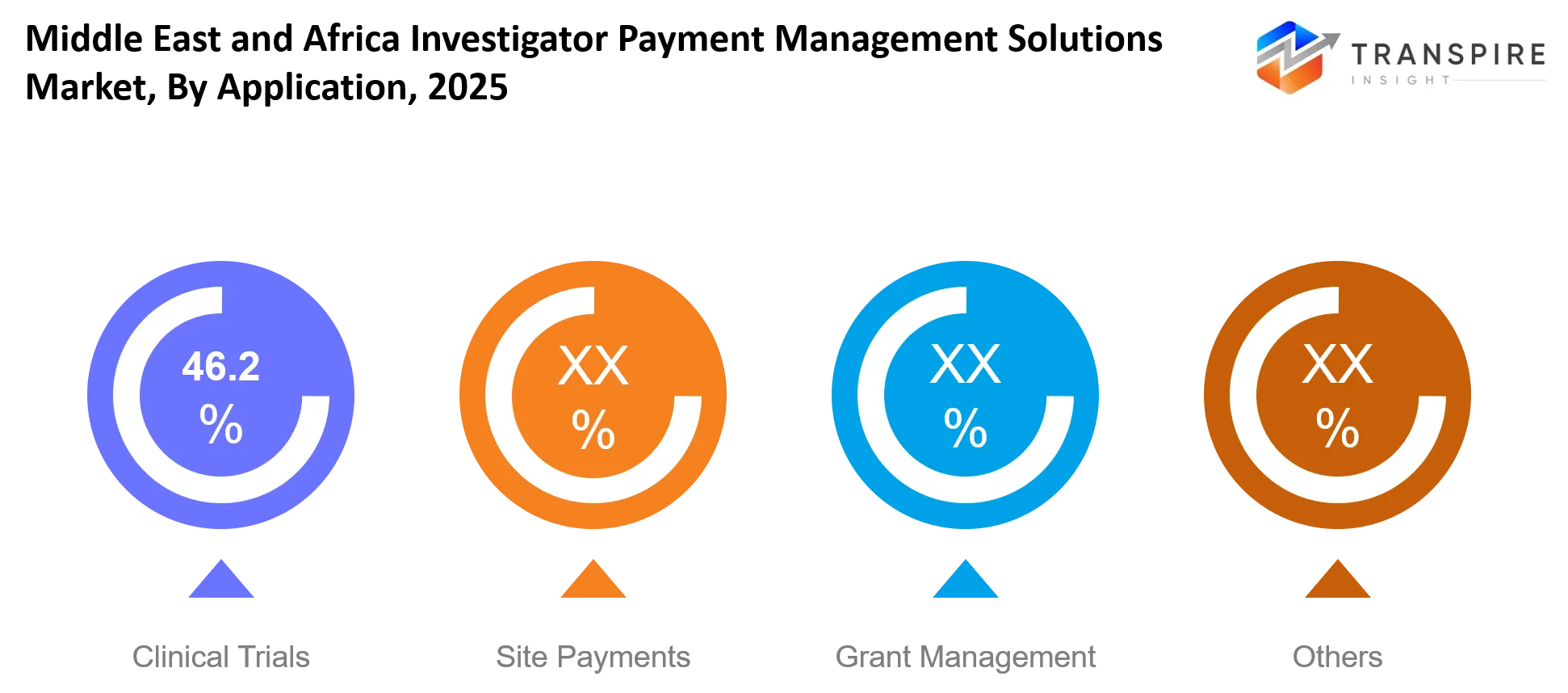
By End User
Pharmaceutical companies account for a decent share of platform adoption, mostly because they have big clinical trial portfolios and fairly complex investigator payment requirements, you know the kind that show up across regions. Payment automation helps keep global research programs organized while also boosting compliance, and operational efficiency, sometimes it feels a bit like it just smooths the friction out. When these platforms integrate with broader clinical development systems, utilization tends to strengthen even more.
Contract research organizations depend on payment management platforms to coordinate financial activities across several sponsor projects and different research sites . Research institutes use these systems for investigator compensation, plus grant-related financial workflows, all tied together in one place. The Others slice covers biotechnology firms, academic organizations, and healthcare institutions that take part in clinical research.
What are the Key Use Cases Driving the Middle East and Africa Investigator Payment Management Solutions Market?
The main thing, use case kinda is about handling investigator compensation when clinical trials are running. Sponsors and research organizations lean on automated payment platforms to keep tabs on study milestones, work out payments, handle reimbursements, and also keep the required regulatory paperwork in order. This part ends up taking the biggest share of demand, because payment accuracy kind of sits right on top of investigator participation and how fast study timelines move forward.
Other use cases show up too, like site payment administration, and grant funding management. Contract research organizations, more and more, use these platforms to coordinate financial activities across several sponsor programs at once, while research institutions often use them to watch grant allocations and how funding actually gets used. In general these systems support better financial visibility and stronger operational control, which sounds simple but matters.
What’s newer, is emerging use cases such as predictive payment analytics and AI assisted compliance monitoring. Some organizations are starting to lean on advanced algorithms to forecast payment needs, flag likely bottlenecks, and lower financial risk. There is also the broader shift toward decentralized clinical trials, which should open up more room for automated payment management technologies during the forecast period.
|
Report Metrics |
Details |
|
Market size value in 2025 |
USD 77.51 Million |
|
Market size value in 2026 |
USD 86.35 Million |
|
Revenue forecast in 2033 |
USD 183.91 Million |
|
Growth rate |
CAGR of 11.41% from 2026 to 2033 |
|
Base year |
2025 |
|
Historical data |
2021 - 2024 |
|
Forecast period |
2026 - 2033 |
|
Report coverage |
Revenue forecast, competitive landscape, growth factors, and trends |
|
Regional scope |
Middle East and Africa (Saudi Arabia, United Arab Emirates, South Africa, Rest of Middle East and Africa) |
|
Key company profiled |
IQVIA, Medidata, Veeva Systems, Oracle, Parexel, ICON, Labcorp Drug Development, Syneos Health, ClinChoice, Advarra, Greenphire, TrialScope, Fortrea, WCG, Signant Health |
|
Customization scope |
Free report customization (country, regional & segment scope). Avail customized purchase options to meet your exact research needs. |
|
Report Segmentation |
By Component (Software, Services, Others); By Deployment (Cloud-based, On-premise, Hybrid, Others); By Application (Clinical Trials, Site Payments, Grant Management, Others); By End User (Pharmaceutical Companies, CROs, Research Institutes, Others) |
Which Regions are Driving the Middle East and Africa Investigator Payment Management Solutions Market Growth?
The Gulf region kind of leads overall market activity, with Saudi Arabia and the United Arab Emirates acting as the main growth hubs. There is solid public backing for healthcare innovation, plus clinical research spending is getting wider, and digital transformation programs are pushing payment management platform adoption in a more natural way. On top of that, modern healthcare infrastructure keeps improving, and multinational clinical studies are involving more participants which still helps the region stay ahead. Then there’s also this maturing network of research institutions, sponsors, and technology providers that sort of reinforces demand, even when things move slowly.
South Africa sits as the second-largest contributor, but it feels different from the Gulf region since it already has a long clinical research track record and a relatively mature investigator network. Steady involvement in global trials ends up giving a reliable base for technology uptake. Research organizations keep putting money into operational efficiency and regulatory compliance skills too. That kind of steadiness really supports ongoing, repeatable demand for payment automation solutions.
Looking beyond that, the wider African market is expected to show the strongest growth momentum up to 2033. Healthcare investment is rising, clinical research activity is expanding, and international drug development programs are pulling in more attention. Several countries have also tightened their research frameworks and managed to attract more sponsor interest. Together these changes create pretty appealing circumstances for technology vendors and investors who are aiming for longer-term market expansion.
Who are the Key Players in the Middle East and Africa Investigator Payment Management Solutions Market and How Do They Compete?
Competition is still kind of moderately concentrated, mostly among long standing clinical technology players, more specialized payment management vendors, and bigger contract research organizations. In practice, the main competitive stuff comes down to technology integration, regulatory compliance know how, and workflow automation. Vendors are now, more often than not, trying to win with platform connectivity, stronger analytics functionality, and wider geographic coverage instead of relying on pricing alone.
IQVIA seems to stand out because it has a lot of clinical research data assets, plus integrated technology ecosystems that essentially link payment management with wider trial operations. Medidata leans into unified clinical development platforms, bringing financial workflows together with patient and study management capabilities. Veeva Systems uses connected clinical platforms and cloud based architectures, aiming to cover end to end research operations.
Oracle goes after enterprise scale infrastructure and integration capabilities, which is helpful for large global studies. Greenphire zeroes in on investigator and participant payment automation, with a more focused depth in financial workflow management. ICON and Parexel improve their positions by blending operational research services with technology enabled financial administration, and generally it looks like that mix helps them compete.
Company List
- IQVIA
- Medidata
- Veeva Systems
- Oracle
- Parexel
- ICON
- Labcorp Drug Development
- Syneos Health
- ClinChoice
- Advarra
- Greenphire
- TrialScope
- Fortrea
- WCG
- Signant Health
Recent Development News
In August 2025, IQVIA and Veeva Systems announced long-term global clinical and commercial partnerships and resolved all pending legal disputes. The collaboration improves interoperability between software, data, and service offerings used across clinical research operations.https://www.veeva.com
What Strategic Insights Define the Future of the Middle East and Africa Investigator Payment Management Solutions Market?
Over the next five to seven years, the market is expected to drift toward fully integrated clinical financial management ecosystems where payment administration, compliance monitoring, budgeting and performance analytics kind of live together inside one digital environment. This shift is being powered by the growing complexity of multinational clinical trials, plus the need for more financial transparency across research networks that are split up geographically.
There’s also a quieter risk that people often overlook, market concentration around a small set of technology platforms. If most organizations end up leaning heavily on a limited group of providers, switching costs can get worse and sponsors may face extra integration friction when they want more flexibility. In parallel, there’s an opportunity that’s starting to show up, AI enabled predictive payment intelligence, even though it’s still underdeveloped today. Still, it could deliver real upside for operational efficiency, and in practice that means smoother optimization.
Market participants should focus on interoperable platforms, the kind that can connect payment management systems with wider clinical technology environments. Companies that invest early in analytics driven automation, regional compliance depth, and scalable cloud architectures will likely be in a stronger position to capture durable value as research activity grows across the Middle East and Africa.
Middle East and Africa Investigator Payment Management Solutions Market Report Segmentation
-
By Component
Software
Services
Others -
By Deployment
Cloud-based
On-premise
Hybrid
Others -
By Application
Clinical Trials
Site Payments
Grant Management
Others -
By End User
Pharmaceutical Companies
CROs
Research Institutes
Others
Frequently Asked Questions
Find quick answers to common questions.
The expected Middle East and Africa Investigator Payment Management Solutions Market size for the market will be USD 183.91 Million in 2033.
Key segments for the Middle East and Africa Investigator Payment Management Solutions Market are By Component (Software, Services, Others); By Deployment (Cloud-based, On-premise, Hybrid, Others); By Application (Clinical Trials, Site Payments, Grant Management, Others); By End User (Pharmaceutical Companies, CROs, Research Institutes, Others).
Major Middle East and Africa Investigator Payment Management Solutions Market players are IQVIA, Medidata, Veeva Systems, Oracle, Parexel, ICON, Labcorp Drug Development, Syneos Health, ClinChoice, Advarra, Greenphire, TrialScope, Fortrea, WCG, Signant Health.
The current Middle East and Africa Investigator Payment Management Solutions Market size is USD 77.51 Million in 2025.
The Middle East and Africa Investigator Payment Management Solutions Market CAGR is 11.41% from 2026 to 2033.
- IQVIA
- Medidata
- Veeva Systems
- Oracle
- Parexel
- ICON
- Labcorp Drug Development
- Syneos Health
- ClinChoice
- Advarra
- Greenphire
- TrialScope
- Fortrea
- WCG
- Signant Health
About the Authors

Mayur Shinde
I am Mayur Shinde, a Senior Research Analyst at Transpire Insight, specializing in the Automotive & Transportation and Information & Communication Technology (ICT) Industry. My work focuses on analyzing emerging market trends, technological advancements, competitive landscapes, and industry developments to deliver accurate, data-driven insights. I am passionate about transforming complex market information into clear, actionable content that helps businesses, professionals, and decision-makers stay informed and make confident strategic decisions.

Chakradhar Khansole
Chakradhar serves as the Research Director at Transpire Insight, bringing over 8 years of experience in technology, innovation, and strategic market intelligence. He specializes in transforming complex market data into actionable business insights that enable organizations to make informed, growth-oriented decisions. Recognized for his strategic vision and analytical expertise, Chakradhar leads high-impact research initiatives, delivering comprehensive market assessments, competitive intelligence, and forward-looking industry analysis.
Recently Published Reports
-
Apr 2026
3D Optical Profiler Market
3D Optical Profiler Market Size, Share & Analysis Report By Type (Desktop 3D Optical Profiler, and Portable 3D Optical Profiler), By Technology (Confocal Technology, and White Light Interference), By End-Use Industry (Manufacturing, Research Institutions, Automotive, Aerospace and Defense, Medical Devices, and Other), and Geography (North America, Europe, Asia-Pacific, Middle East and Africa, South and Central America), 2021 - 2031
-
Apr 2026
Depth Sensor Market
Depth Sensor Market Size, Share & Analysis Report By Type (Infrared Depth Sensors, Time-of-Flight (ToF) Sensors, Stereo Vision Sensors, Structured Light Sensors, Ultrasonic Depth Sensors), By Application (Automotive, Robotics, Gaming, Consumer Electronics, Industrial Automation, Healthcare, Security & Surveillance, Others), By End Users (Automotive Manufacturers, Consumer Electronics Companies, Healthcare Providers, Industrial Companies, Security Agencies, Gaming Companies, Robotics Companies, Others), and Geography (North America, Europe, Asia-Pacific, Middle East and Africa, South and Central America), 2021 – 2031
-
Apr 2026
Digital Manufacturing Market
Digital Manufacturing Market Size, Share & Analysis Report By Component (Hardware, Software, and Services), By Technology (Robotics, 3D Printing, Internet of Things (IoT), and Others), By Application (Automotive and Transportation, Aerospace and Defense, Consumer Electronics, Industrial Machinery, and Others), By Process Type (Computer-Based Designing, Computer-Based Simulation, Computer 3D Visualization, Analytics, and Others), and Geography (North America, Europe, Asia-Pacific, Middle East and Africa, South and Central America), 2021 – 2031
-
Apr 2026
Digital Visa Services Market
Digital Visa Services Market Size, Share & Analysis Report By Type (Individual Travelers, Group Travelers), By Application (Tourism, Business Travel, Others), and Geography (North America, Europe, Asia-Pacific, Middle East and Africa, South and Central America), 2021 – 2031