
Asia Pacific Payment Gateway Market Size & Forecast:
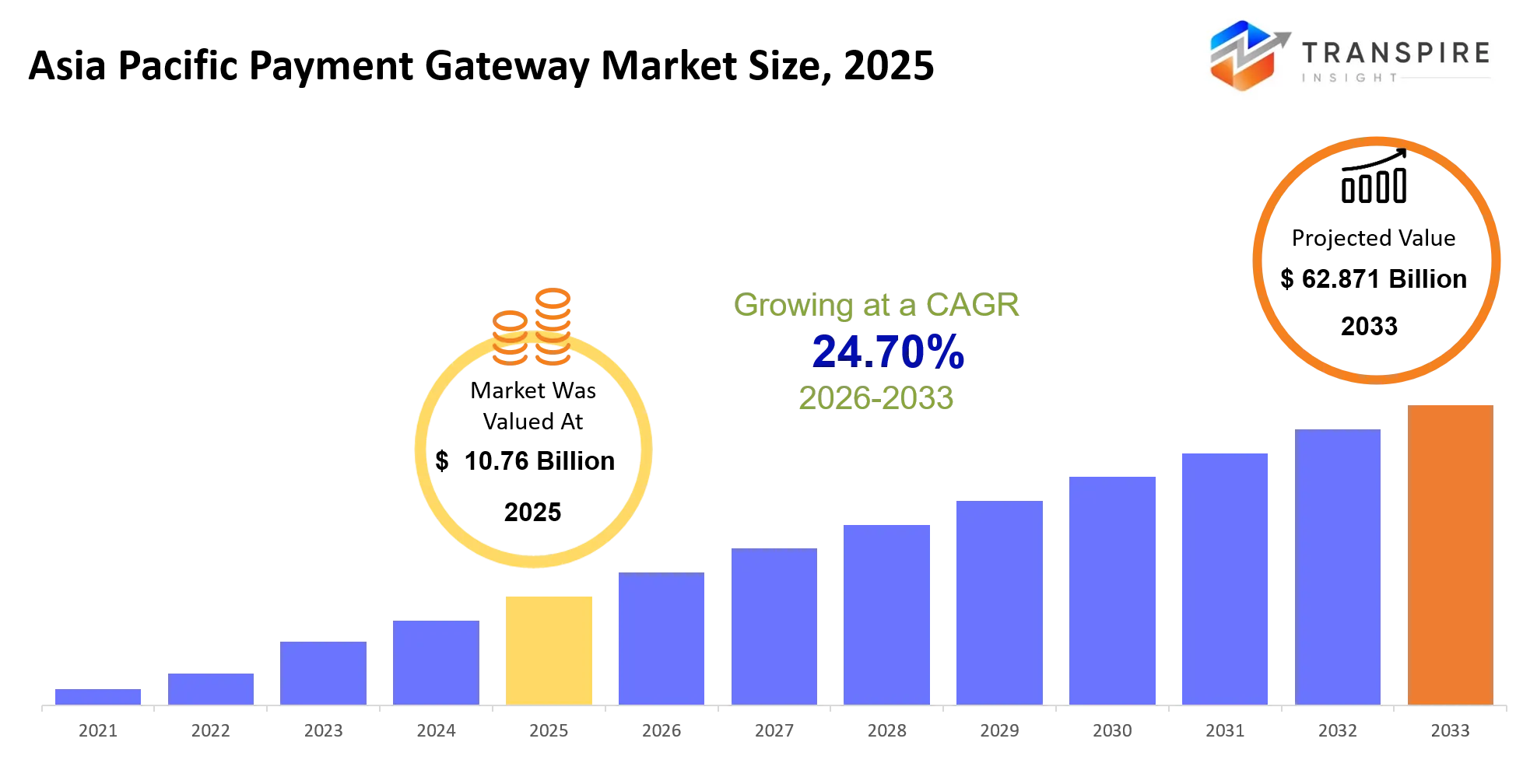
- Asia Pacific Payment Gateway Market Size 2025: USD 10.76 Billion
- Asia Pacific Payment Gateway Market Size 2033: USD 62.871 Billion
- Asia Pacific Payment Gateway Market CAGR: 24.70%
- Asia Pacific Payment Gateway Market Segments: By Type (Hosted Payment Gateway, Non-Hosted Payment Gateway, Bank Integrated Gateway, API-Based Gateway, Mobile Payment Gateway, Cryptocurrency Gateway, Smart Payment Gateway, Others); By Enterprise Size (Large Enterprises, Medium Enterprises, Small Enterprises, Startups, Government Organizations, Others); By End User (E-commerce, BFSI, Retail, Travel & Hospitality, Healthcare, Education, Utilities, Others); By Payment Method (Credit Cards, Debit Cards, UPI, Digital Wallets, Net Banking, Buy Now Pay Later, Cryptocurrency Payments, Others)
To learn more about this report,  Download Free Sample Report
Asia Pacific Payment Gateway Market Summary
The Asia Pacific Payment Gateway Market was valued at USD 10.76 Billion in 2025. It is forecast to reach USD 62.871 Billion by 2033. That is a 24.70% CAGR over the period.
The Asia Pacific payment gateway market somehow underpins the regions digital commerce ecosystem by helping businesses, banks, logistics providers, and online platforms run secure real-time transactions. It does this across cards, UPI systems, wallets, and cross border payment networks which, in practice reduces payment friction for merchants, lifts transaction success rates, and keeps the expansion moving for digital retail, travel bookings, subscription services, and app based economies. Over the last five years, the market has shifted from basic transaction processing to more embedded, API-driven payment infrastructure. This new direction folds in fraud detection, analytics, recurring billing, and multi currency settlement into one platform. Also the rapid expansion of UPI in India together with Southeast Asia’s QR code payment standardization initiatives, really changed consumer payment behavior and it even shifted merchant onboarding economics in a noticeable way.
The COVID 19 pandemic, acted as a big trigger that pushed digital payment adoption, across both urban and semi urban markets. Businesses went online faster and consumers reduced cash usage, so adoption climbed. Because of that shift, merchants, financial institutions, and governments had to modernize payment acceptance infrastructure at scale, not just “a little”. As transaction volumes increased, payment gateways started looking less like a backend utility and more like strategic revenue enablers. So demand grew for scalable cloud native systems, real time fraud monitoring, and localized payment acceptance capabilities across Asia Pacific.
Key Market Insights
- India kind of dominated the Asia Pacific Payment Gateway Market with more than 32% share in 2025, mainly because UPI transaction scale and some fintech innovation kept pushing forward.
- Meanwhile Southeast Asia looked like the fastest-growing regional market during 2026–2032, fueled by digital wallets getting wider adoption and smartphone-led commerce taking over, honestly it’s pretty clear.
- China still held a big industry size slice, supported by mature QR-based payment ecosystems and the high-volume mobile transaction penetration that doesn’t really slow down.
- Japan and South Korea also ramped up payment gateway modernization, using AI-enabled fraud prevention along with embedded finance adoption, which helps reduce risk and speed things up.
- Hosted payment gateways were close to 38% revenue share in 2025, because enterprises leaned toward secure and compliant payment processing solutions.
- On top of that, mobile payment gateways gained serious traction as merchants tried to optimize transaction experiences for app-based, smartphone-first consumers.
- In terms of applications, e-commerce stayed the dominant segment with over 41% market share in 2025, driven by regional online retail expansion and more shoppers moving to digital storefronts.
- BFSI institutions also increased gateway investments, so they could support instant settlements, stronger fraud management, and real-time digital banking transactions.
- Large enterprises broadly led the Asia Pacific Payment Gateway Market, with around 46% share in 2025, due to higher transaction volumes and wider operational footprints.
- Some major companies shaping the Asia Pacific Payment Gateway Market include PayPal, Stripe, Razorpay, Adyen, Paytm, and 2C2P.
What are the Key Drivers, Restraints, and Opportunities in the Asia Pacific Payment Gateway Market?
The strongest growth driver in the Asia Pacific Payment Gateway Market is probably the rapid institutionalization of real-time digital payment infrastructure across big economies like India, China, and parts of Southeast Asia. In practice, government-backed frameworks such as India’s UPI and Singapore’s PayNow basically cut down transaction costs for merchants, while also speeding up settlement and making it easier for banks, fintech platforms, and retailers to work together. This tech change kicked off broad merchant onboarding, especially for SMEs that had been avoiding digital payments, due to setup charges that felt too high and settlements that took too long, well at least in their experience. When transaction volumes shifted online, payment gateways also changed. They moved beyond being only processing tools, and became revenue-enabling platforms that handle subscriptions, cross-border commerce, fraud detection, and embedded financial services.
Still, the market’s biggest structural restraint is fragmented regulatory compliance across Asia Pacific. Each country keeps different rules for data localization cybersecurity, transaction authentication, and even how foreign payment participation is treated. So providers end up building separate compliance blueprints, local alliances, and licensing approaches, per jurisdiction. That operational complexity then raises expansion spend, slows down product rollouts and it quietly mutes revenue chances for mid-sized fintech firms trying to scale regionally.
A big future opportunity sits in cross-border real time payment connectivity across Southeast Asia. Regional programs that tie together QR payment systems between countries like Thailand, Singapore, Malaysia, and Indonesia are building this ground for smoother multi currency digital deals. As tourism, regional commerce, and internet shopping pick back up, payment gateway providers who can deliver a joined cross-border settlement and also localized payment acceptance, will be the ones that catch the next phase of market growth .
What Has the Impact of Artificial Intelligence Been on the Asia Pacific Payment Gateway Market?
Artificial intelligence and advanced digital technologies are really reshaping the Asia Pacific payment processing ecosystem, in a sort of noticeable way, by boosting transaction security, operational efficiency, and that real time decision thing. Payment gateway providers are more often rolling out AI driven fraud detection engines, that look at transaction behavior, device signatures, geolocation patterns, and spending irregularities within mere milliseconds. They basically automate risk scoring, and they manage to cut down on wrong or unnecessary payment declines. That lets merchants raise authorization rates, while also keeping chargeback losses smaller. At the same time, machine learning models are used for predictive transaction routing too, so gateways can direct payments through the best, most appropriate banking channel, based on past success rates, network latency, and local regional processing conditions.
Then there’s cloud native infrastructure, plus API based payment orchestration platforms, which are optimizing settlement activities and merchant onboarding routines across big, high-volume digital commerce markets, like India, Singapore, and Indonesia. A lot of providers claim they see tangible drops in transaction failure rates and operational processing expenses after adopting AI enabled payment monitoring systems. And the real time analytics platforms also help financial institutions anticipate transaction surges during seasonal sales events, which improves uptime stability and helps reduce those infrastructure bottlenecks, before they become a problem.
However, AI adoption still has a major limitation in the region, because financial rules feel fragmented and data standardization is not even across multiple countries. Payment providers often find it difficult to train robust machine learning models, as transaction datasets keep changing between banking systems , merchant categories, and local compliance frameworks. Sometimes it’s like each place speaks a slightly different language, so the models don’t generalize as cleanly as they should.
Key Market Trends
- Since 2021, India’s UPI ecosystem kinda changed the whole merchant onboarding economics by cutting transaction costs , and also making settlement cycles way faster for SMEs.
- From 2022 through 2025, Southeast Asian retailers started leaning more and more into QR based cross border payment systems, mainly to back regional tourism and to help digital commerce recovery move along again.
- Payment providers like Stripe and Adyen then redirected investment toward AI driven fraud detection , because online transaction fraud rates kept climbing across multiple regional marketplaces.
- Starting around 2023, API based payment gateways sort of replaced older hosted systems at large enterprises, where teams wanted a more adjustable checkout feel and better omnichannel transaction visibility , not just one fixed flow.
- Meanwhile banks in Singapore Thailand and Malaysia went faster on real time payment interoperability projects, to reduce how much they depended on those traditional card processing networks.
- Mobile wallet transaction volumes also expanded a lot after consumers in Indonesia and Vietnam went more smartphone first, and gradually moved everyday retail payments away from cash channels, bit by bit.
- From 2022 onward, cloud native payment infrastructure adoption picked up as merchants demanded scalable setups that could manage seasonal transaction spikes without hitting downtime.
- Fintech firms more and more began partnering with e-commerce platforms and digital banks, to plug in lending, subscription billing, and installment payment capabilities straight into the gateway layer.
- Regulatory scrutiny got tougher after 2023 too, as governments rolled out stricter cybersecurity rules, data localization policies, and digital authentication requirements that payment processors had to follow.
- And in the same region, payment gateway providers started shifting toward multi currency settlement platforms, because cross border sellers asked for more localized payment acceptance across Asia Pacific markets.
Asia Pacific Payment Gateway Market Segmentation
By Type
Hosted payment gateway solutions keep getting a lot of adoption from online retail platforms, mostly because secure handling of transactions and a kind of easier compliance management makes less operational stress on merchants. On the other side non-hosted payment gateway systems are drawing interest from bigger digital businesses that want full control over the customer checkout flow, and also the ability to tweak each transaction more exactly. Then there are bank integrated gateway services, those stay pretty steady in demand across traditional financial institutions, mainly due to trusted settlement mechanisms and direct banking connections, so it feels more reliable overall. API based gateway platforms also keep moving fast, they help with quick integration for digital marketplaces subscription models and mobile commerce apps across many Asia Pacific countries.
Mobile payment gateway platforms look like they are expanding strongly too, since smartphone payments and QR code based transactions are gradually replacing cash purchases in urban and semi urban locations. Cryptocurrency gateway services are still sort of early stage, because regulatory uncertainty keeps things from moving forward for broader commercial deployment in several regional economies. Smart payment gateway systems are getting better at transaction routing, fraud handling, and analytics capabilities thanks to artificial intelligence plus cloud based monitoring tools. Other gateway formats continue to show up for niche business needs, like sector specific billing systems, and regional payment acceptance models that don’t fit the standard pattern.
By Enterprise Size
Big enterprises take up a large chunk of the budget for digital payment infrastructure, mostly because huge transaction volumes force organizations to use stronger anti-fraud defenses, handle multi-currency settlement properly, and run systems that scale without breaking. Medium-sized companies keep moving to cloud payment platforms, as those can reduce the infrastructure load, while also making the customer payment experience feel smoother. Smaller businesses are now leaning on lower-cost gateway subscriptions, since expanding a digital storefront and building online service models means they still need solid secure payment acceptance, not just basic checkout. Newer startup companies are going a step further and roll out API-driven payment tools, so they can manage subscription billing flexibly, handle marketplace transactions, and keep mobile commerce operations running.
Government organizations also keep folding digital payment systems into tax collection, transport ticketing, and public utility services, aiming for better transaction transparency and faster administration. Public sector digitalization efforts across India, Singapore, and parts of Southeast Asia, push for broader adoption of electronic payment processing. Other kinds of groups, like universities and nonprofit organizations, likewise use payment gateways for recurring payments, online registrations, and digital service delivery. Overall, demand for customizable payment processing platforms will continue climbing, as digital business activity grows across regional economies and everyone starts expecting more tailored options.
By End User
E-commerce platforms are basically the main end-user group , since online retail activity just keeps growing across mobile-first consumer markets. For BFSI institutions, there is a big push to invest in advanced gateway technologies so they can enable instant fund transfers, do fraud analytics more reliably, and run secure digital banking in the day to day. Retail businesses also keep strengthening their payment infrastructure, not only for contactless payments but also to plug in loyalty integration, and to improve omnichannel customer engagement efforts. Meanwhile travel and hospitality companies increasingly use multi-currency payment processing systems, so it’s easier to handle international bookings and all those tourism related transactions.
Healthcare providers go for digital payment gateways too, for appointment scheduling, insurance claim settlements, and contactless billing systems that move faster. Educational institutions continue adding online payment platforms for tuition collection, examination fees, and remote learning services, kind of as a default now. Utility service providers modernize their billing work via automated payment systems, which boosts collection efficiency and cuts down on manual processing workload. And in other industries, the payment gateway adoption keeps moving forward, because digital transaction expectations are rising, and online customer interaction channels are expanding.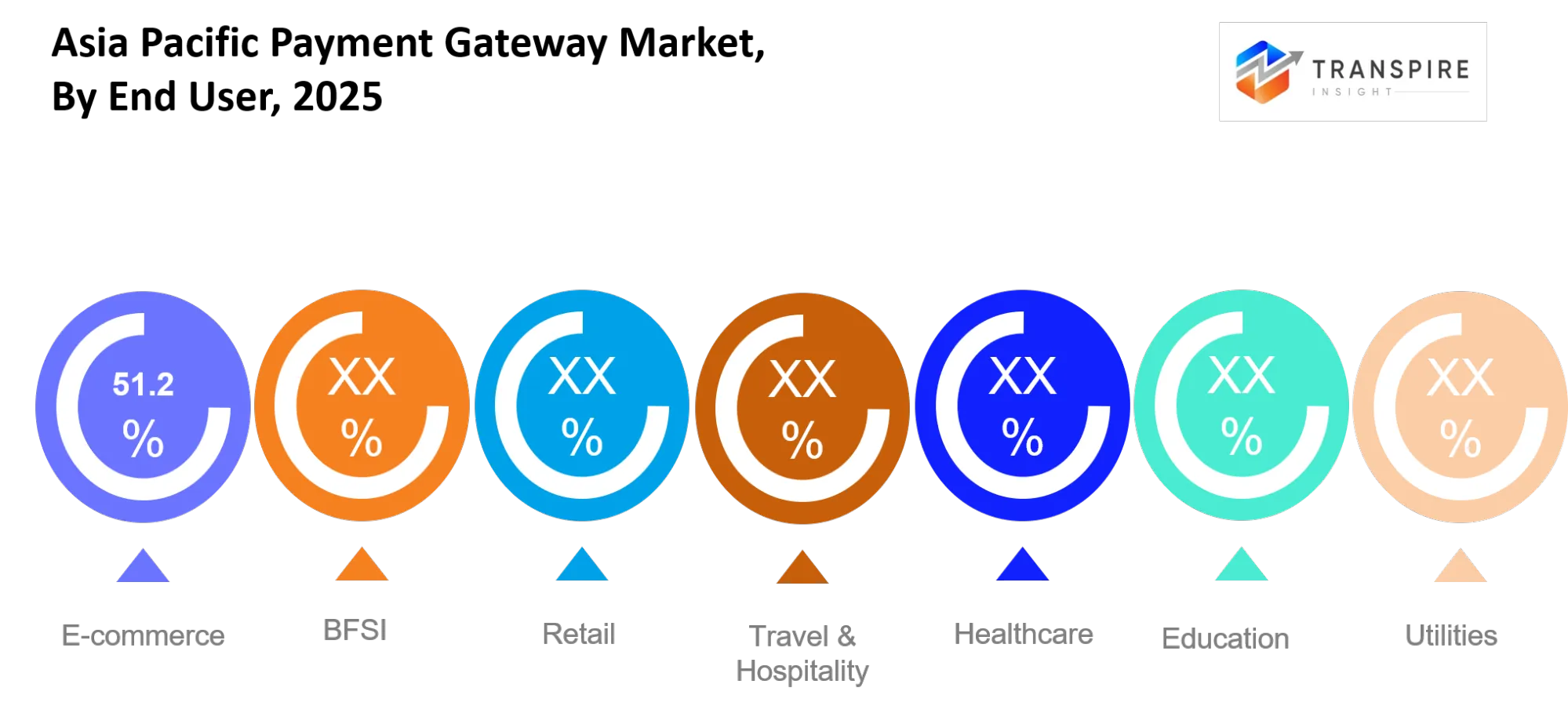
To learn more about this report, Download Free Sample Report
By Payment Method
Credit card payment methods keep a pretty steady pace for transaction volumes in those high-value online purchases, travel bookings, and the wider international commerce kind of stuff. Debit cards are still widely used too, mostly because banking penetration is climbing in several developing economies across Asia Pacific. UPI based activity is also seeing notable expansion , mainly thanks to real time settlement features, low processing costs, and that well supported government run digital payment infrastructure in India. Digital wallet services get a strong consumer pull because mobile first payment habits help with quicker checkout experiences and that QR code style convenience for payments.
Net banking keeps doing its role for enterprise level payments, and big value financial transfers that move across different banking networks. Buy Now Pay Later options are drawing in younger consumers who want installment based purchasing flexibility for retail and lifestyle products. Cryptocurrency payment methods are still kind of limited in adoption, but they keep getting attention from tech oriented merchants and cross border digital businesses. Other payment formats , like prepaid systems and regional payment applications, also continue backing localized transaction preferences across various consumer groups.
What are the Key Use Cases Driving the Asia Pacific Payment Gateway Market?
Online retail transactions are still the main reason payment gateways get adopted across Asia Pacific, though it really comes down to e-commerce platforms needing secure fast, and kinda scalable payment processing. A lot of the big digital marketplaces, plus direct-to-consumer brands rely on instant transaction sign-off , fraud surveillance, and support for multiple currencies, so they can cope with those growing order volumes without slowing down.
Healthcare and education keeps pushing payment gateway rollouts too, mostly for digital invoicing, online consultation charges, tuition fee collection, and learning systems that run on subscriptions. In parallel, travel and hospitality operators are tightening their gateway integrations as well, to handle international reservations, contactless payments, and mobile wallet purchases from travelers across the region.
Newer stuff is showing up, like embedded finance services woven into social commerce platforms, and real time cross border QR payments spreading across Southeast Asia. There’s also merchant payment options that are tied to crypto, plus AI based smart checkout tools, and these look like they could matter for the long term, especially as digital banking infrastructure gets stronger and regional interoperability rules keep getting more consistent.
|
Report Metrics |
Details |
|
Market size value in 2025 |
USD 10.76 Billion |
|
Market size value in 2026 |
USD 13.407 Billion |
|
Revenue forecast in 2033 |
USD 62.871 Billion |
|
Growth rate |
CAGR of 24.70% from 2026 to 2033 |
|
Base year |
2025 |
|
Historical data |
2021 - 2024 |
|
Forecast period |
2026 - 2033 |
|
Report coverage |
Revenue forecast, competitive landscape, growth factors, and trends |
|
Regional scope |
Asia Pacific (India, China, Japan, Australia, South Korea, Rest of Asia Pacific) |
|
Key company profiled |
PayPal, Stripe, Razorpay, PayU, Adyen, Worldpay, Square, Amazon Pay, Alipay, WeChat Pay, PhonePe, Cashfree, BillDesk, Fiserv, Checkout.com |
|
Customization scope |
Free report customization (country, regional & segment scope). Avail customized purchase options to meet your exact research needs. |
|
Report Segmentation |
By Type (Hosted Payment Gateway, Non-Hosted Payment Gateway, Bank Integrated Gateway, API-Based Gateway, Mobile Payment Gateway, Cryptocurrency Gateway, Smart Payment Gateway, Others); By Enterprise Size (Large Enterprises, Medium Enterprises, Small Enterprises, Startups, Government Organizations, Others); By End User (E-commerce, BFSI, Retail, Travel & Hospitality, Healthcare, Education, Utilities, Others); By Payment Method (Credit Cards, Debit Cards, UPI, Digital Wallets, Net Banking, Buy Now Pay Later, Cryptocurrency Payments, Others) |
Which Regions are Driving the Asia Pacific Payment Gateway Market Growth?
East Asia kind of leads the Asia Pacific payment gateway industry, because China, Japan and South Korea keep up super mature digital payment ecosystems, backed by solid banking infrastructure and a lot of mobile commerce adoption. China still seems to dominate the regional transaction volume, mainly due to QR-code payment systems that are deeply integrated, plus consumers who basically lean on digital wallets for everyday buys. Meanwhile Japan and South Korea push ahead with advanced cybersecurity rules, faster modernization of real-time payments, and serious enterprise spending on cloud based transaction processing setups. There’s also this dense fintech web, steady internet penetration, and already established e-commerce platforms, all of which keep sustaining revenue generation across East Asia.
South Asia sits in the second spot for regional contribution, largely because India’s UPI infrastructure is expanding quickly, along with government driven financial digitization programs. But unlike East Asia, South Asia leans more on low cost transaction models, which helps bring in lots of merchants, especially small businesses and semi urban economies. Strong fintech rivalry, public digital infrastructure, and rising smartphone penetration keep supporting stable transaction growth across retail, utility billing, and online service payments. Plus, consistent policy support from regulators and banks adds extra reliability over the long term across the region.
Southeast Asia currently shows the fastest growth momentum, as regional governments and financial institutions kind of pushed cross-border digital payment connectivity after the pandemic period. In places like Singapore, Thailand, Indonesia, and Malaysia, they keep putting money into QR payment interoperability, digital banking licenses, and real-time settlement systems. At the same time, rapid tourism bounce back and the wider regional e-commerce trade, opened fresh chances for multi currency payment handling and mobile wallet integration across local merchants. So, this overall growth path should end up bringing major expansion potential for fintech businesses, payment infrastructure suppliers, and also outside investors between 2026 and 2033.
Who are the Key Players in the Asia Pacific Payment Gateway Market and How Do They Compete?
Competition across the Asia Pacific payment gateway industry is still pretty moderately fragmented, not really stable because the big global payment firms, they end up going head to head with regional fintech companies as well as bank-backed digital platforms. Most large international providers put their focus on things like deeper technology integration, cross-border settlement strengths, and fraud prevention that feels enterprise-level, while regional operators tend to push harder on localized payment methods plus slightly lower merchant onboarding costs, which matters to smaller merchants. The competitive pressure, it has jumped a lot more after the rapid digital commerce expansion seen across India and Southeast Asia, because that created real openings for mobile-first payment infrastructure providers. These days, technology differentiation, higher transaction success rates, cybersecurity depth, and the shape of regional payment acceptance networks are what more strongly defines positioning than pricing alone.
Stripe keeps expanding via API-led payment infrastructure that is built for developers subscription platforms, and multinational digital business models. Its strong customization features along with a cloud-native setup let Stripe manage scalable cross-border commerce operations across Southeast Asia and Australia without too much friction. Adyen, on the other hand, differentiates with one unified commerce system, combining online, in-store, and mobile payments into a single platform. Plus, its strong enterprise relationships with well-known international retail and hospitality brands really reinforce Adyen’s standing in high-volume transaction environments.
Razorpay plays a big part by doing deep integration with India’s UPI ecosystem and using low cost tools for getting merchants on board, mostly aimed at small and medium enterprises. When it starts adding payroll management, embedded finance, and lending products, it can boost how much other digital companies lean on its platform. PayPal leans on cross border digital payments and better international merchant connectivity, especially for exporters and people running online services. Paytm builds its competitive edge through wide QR code acceptance infrastructure plus financial service integration across retail flows and utility payment networks.
Company List
- PayPal
- Stripe
- Razorpay
- PayU
- Adyen
- Worldpay
- Square
- Amazon Pay
- Alipay
- WeChat Pay
- PhonePe
- Cashfree
- BillDesk
- Fiserv
- Checkout.com
Recent Development News
"In April 2026, RateGain entered a partnership with Razorpay as a Platinum Partner for RG Pay. The collaboration integrated Razorpay’s payment gateway infrastructure into RateGain’s travel commerce platform to improve booking completion rates and support localized payment methods across global travel markets.https://rategain.com
"In April 2025, Razorpay launched the Turbo UPI Plugin on BHIM Vega through a partnership with NPCI BHIM Services Limited and Axis Bank. The launch enabled seamless in-app UPI transactions without third-party redirection, improving transaction success rates and reducing checkout friction for digital merchants across India.https://razorpay.com
What Strategic Insights Define the Future of the Asia Pacific Payment Gateway Market?
In the Asia Pacific payments gateway space things are starting to lean more and more toward really merged financial infrastructure, so payment processing, lending, fraud handling, and digital identity checks end up running in one kind of platform. In the next five to seven years, the biggest growth is likely to come less from simple online transaction activity and more from embedded finance being used widely, plus real time cross border payment links. Government backed instant payment rails, API led banking frameworks, and regional digital trade agreements will keep reshaping how transactions work across Southeast Asia and India, kind of quietly but steadily.
There is also a less obvious risk, it s more like the market could bunch up around a few big payment paths and a small set of cloud infrastructure providers. If everyone depends on the same limited digital base, then during cybersecurity events, or service outages, or even regulatory arguments tied to cross border data movements, the whole system could become more fragile, at least that s the worry. Still, cross border QR payments interoperability across ASEAN countries feels like a big new chance. It s there, but it s not really being tapped enough, even though policy support has been strong.
What market players should do is focus on local collaborations with banks, telecom firms, and digital commerce platforms, rather than trying to copy one standardized regional rollout playbook. By 2033, having a flexible compliance setup and multi currency settlement abilities will turn into non negotiable competitive needs.
Asia Pacific Payment Gateway Market Report Segmentation
-
By Type
- Hosted Payment Gateway
- Non-Hosted Payment Gateway
- Bank Integrated Gateway
- API-Based Gateway
- Mobile Payment Gateway
- Cryptocurrency Gateway
- Smart Payment Gateway
- Others
-
By Enterprise Size
- Large Enterprises
- Medium Enterprises
- Small Enterprises
- Startups
- Government Organizations
- Others
-
By End User
- E-commerce
- BFSI
- Retail
- Travel & Hospitality
- Healthcare
- Education
- Utilities
- Others
-
By Payment Method
- Credit Cards
- Debit Cards
- UPI
- Digital Wallets
- Net Banking
- Buy Now Pay Later
- Cryptocurrency Payments
- Others
Frequently Asked Questions
Find quick answers to common questions.
The Expected Asia Pacific Payment Gateway Market size will be USD 62.871 Billion in 2033.
By Type (Hosted Payment Gateway, Non-Hosted Payment Gateway, Bank Integrated Gateway, API-Based Gateway, Mobile Payment Gateway, Cryptocurrency Gateway, Smart Payment Gateway, Others); By Enterprise Size (Large Enterprises, Medium Enterprises, Small Enterprises, Startups, Government Organizations, Others); By End User (E-commerce, BFSI, Retail, Travel & Hospitality, Healthcare, Education, Utilities, Others); By Payment Method (Credit Cards, Debit Cards, UPI, Digital Wallets, Net Banking, Buy Now Pay Later, Cryptocurrency Payments, Others).
Major Asia Pacific Payment Gateway Market Players are PayPal, Stripe, Razorpay, PayU, Adyen, Worldpay, Square, Amazon Pay, Alipay, WeChat Pay, PhonePe, Cashfree, BillDesk, Fiserv, Checkout.com.
The Current Asia Pacific Payment Gateway Market size is USD 10.76 Billion in 2025.
The Asia Pacific Payment Gateway Market CAGR is 24.70% from 2026 to 2033.
- PayPal
- Stripe
- Razorpay
- PayU
- Adyen
- Worldpay
- Square
- Amazon Pay
- Alipay
- WeChat Pay
- PhonePe
- Cashfree
- BillDesk
- Fiserv
- Checkout.com
About the Authors

Mayur Shinde
I am Mayur Shinde, a Senior Research Analyst at Transpire Insight, specializing in the Automotive & Transportation and Information & Communication Technology (ICT) Industry. My work focuses on analyzing emerging market trends, technological advancements, competitive landscapes, and industry developments to deliver accurate, data-driven insights. I am passionate about transforming complex market information into clear, actionable content that helps businesses, professionals, and decision-makers stay informed and make confident strategic decisions.

Chakradhar Khansole
Chakradhar serves as the Research Director at Transpire Insight, bringing over 8 years of experience in technology, innovation, and strategic market intelligence. He specializes in transforming complex market data into actionable business insights that enable organizations to make informed, growth-oriented decisions. Recognized for his strategic vision and analytical expertise, Chakradhar leads high-impact research initiatives, delivering comprehensive market assessments, competitive intelligence, and forward-looking industry analysis.
Recently Published Reports
-
Apr 2026
3D Optical Profiler Market
3D Optical Profiler Market Size, Share & Analysis Report By Type (Desktop 3D Optical Profiler, and Portable 3D Optical Profiler), By Technology (Confocal Technology, and White Light Interference), By End-Use Industry (Manufacturing, Research Institutions, Automotive, Aerospace and Defense, Medical Devices, and Other), and Geography (North America, Europe, Asia-Pacific, Middle East and Africa, South and Central America), 2021 - 2031
-
Apr 2026
Depth Sensor Market
Depth Sensor Market Size, Share & Analysis Report By Type (Infrared Depth Sensors, Time-of-Flight (ToF) Sensors, Stereo Vision Sensors, Structured Light Sensors, Ultrasonic Depth Sensors), By Application (Automotive, Robotics, Gaming, Consumer Electronics, Industrial Automation, Healthcare, Security & Surveillance, Others), By End Users (Automotive Manufacturers, Consumer Electronics Companies, Healthcare Providers, Industrial Companies, Security Agencies, Gaming Companies, Robotics Companies, Others), and Geography (North America, Europe, Asia-Pacific, Middle East and Africa, South and Central America), 2021 – 2031
-
Apr 2026
Digital Manufacturing Market
Digital Manufacturing Market Size, Share & Analysis Report By Component (Hardware, Software, and Services), By Technology (Robotics, 3D Printing, Internet of Things (IoT), and Others), By Application (Automotive and Transportation, Aerospace and Defense, Consumer Electronics, Industrial Machinery, and Others), By Process Type (Computer-Based Designing, Computer-Based Simulation, Computer 3D Visualization, Analytics, and Others), and Geography (North America, Europe, Asia-Pacific, Middle East and Africa, South and Central America), 2021 – 2031
-
Apr 2026
Digital Visa Services Market
Digital Visa Services Market Size, Share & Analysis Report By Type (Individual Travelers, Group Travelers), By Application (Tourism, Business Travel, Others), and Geography (North America, Europe, Asia-Pacific, Middle East and Africa, South and Central America), 2021 – 2031