
Europe Payment Processing Solutions Market Size & Forecast:
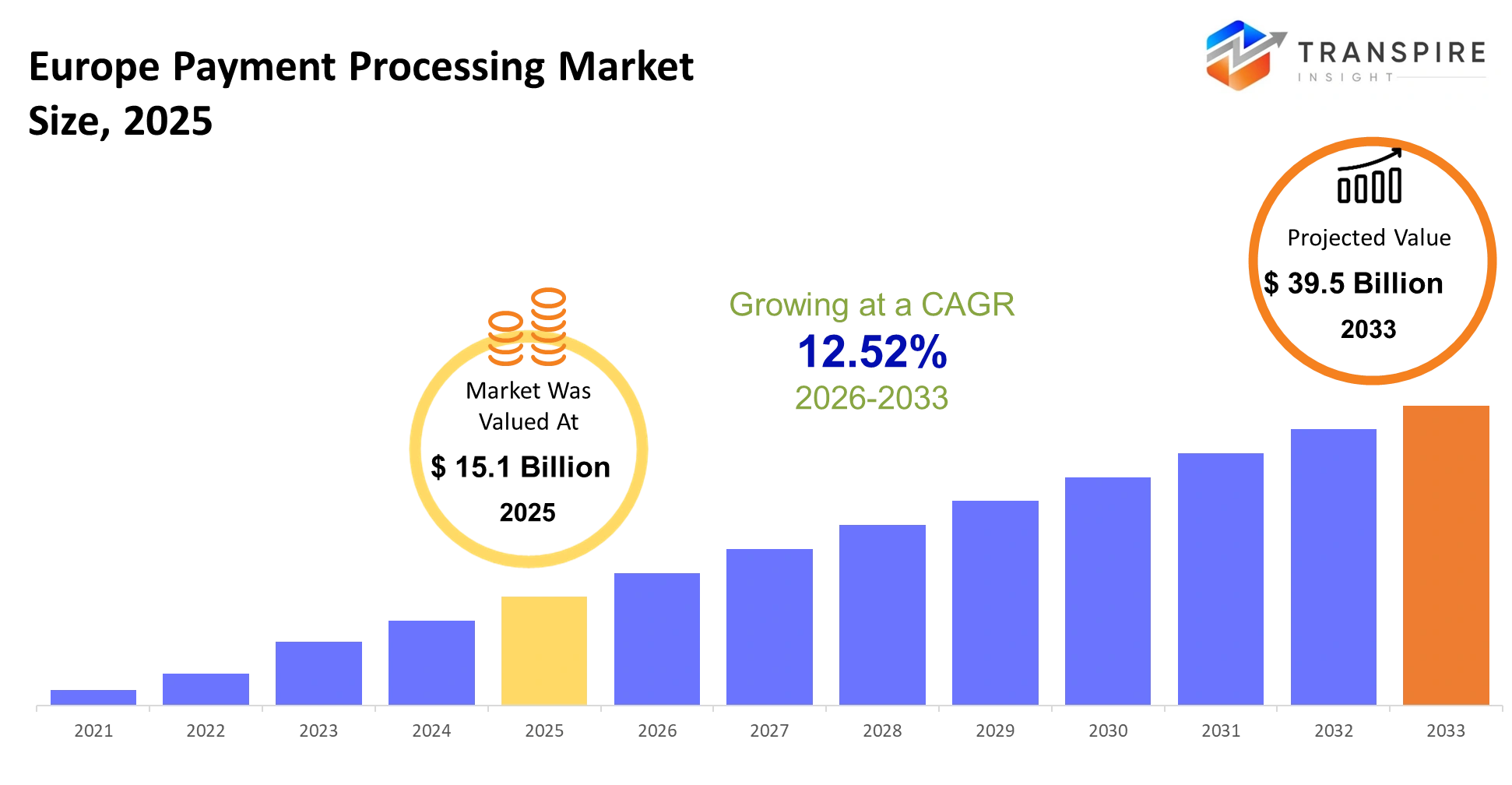
- Europe Payment Processing Solutions Market Size 2025: USD 15.1 Billion
- Europe Payment Processing Solutions Market Size 2033: USD 39.5 Billion
- Europe Payment Processing Solutions Market CAGR: 12.52%
- Europe Payment Processing Solutions Market Segments: By Type (Payment Gateways, Payment Processors, POS Systems, Mobile Payments, Others), By Application (E-commerce, Retail, BFSI, Hospitality, Travel, Others), By End-User (Enterprises, SMEs, Retailers, Financial Institutions, Consumers, Others), By Deployment (Cloud, On-premise, Hybrid, Others).
To learn more about this report,  Download Free Sample Report
Europe Payment Processing Solutions Market Summary:
The Europe Payment Processing Solutions Market size is estimated at USD 15.1 Billion in 2025 and is anticipated to reach USD 39.5 Billion by 2033, growing at a CAGR of 12.52% from 2026 to 2033. The European payment processing services operate the systems which transfer funds instantly between customers, businesses, financial institutions, and online platforms. The system provides a solution for businesses to process transactions through card and wallet and bank transfer and embedded payment methods while maintaining security and meeting regulatory and fraud control standards.
The past three to five years have seen a major change in market trends which now favor account-to-account payment methods and open banking systems instead of traditional card payment methods. The implementation of PSD2 and the fast growth of API-based financial services created the conditions which enabled this transition to gain momentum. The COVID-19 pandemic served as a major catalyst which caused consumers to adopt digital commerce at an accelerated speed while businesses had to modernize their payment systems.
The current growth pattern shows a straightforward relationship between two events because faster checkout systems which offer better integration lead to higher conversion rates which result in increased merchant spending on orchestration and fraud protectio and international operations which boost provider income.
Key Market Insights
- The Europe Payment Processing Solutions Market sees Western Europe as its leading region which controls more than 60% of the market share in 2025 because of its established digital banking systems.
- Northern Europe emerges as the fastest-growing region through 2030, supported by high fintech adoption and real-time payment penetration exceeding 75%
- In 2025 payment gateways will capture almost 35 of the market because their systems work with e-commerce platforms and their retail operations which operate through multiple channels.
- Merchants want Payment processing services because they need tools for handling their transactions and protecting against fraud threats.
- Open banking systems will make Account-to-account (A2A) payment solutions the fastest-growing sector in the industry which will continue to see significant development until 2030.
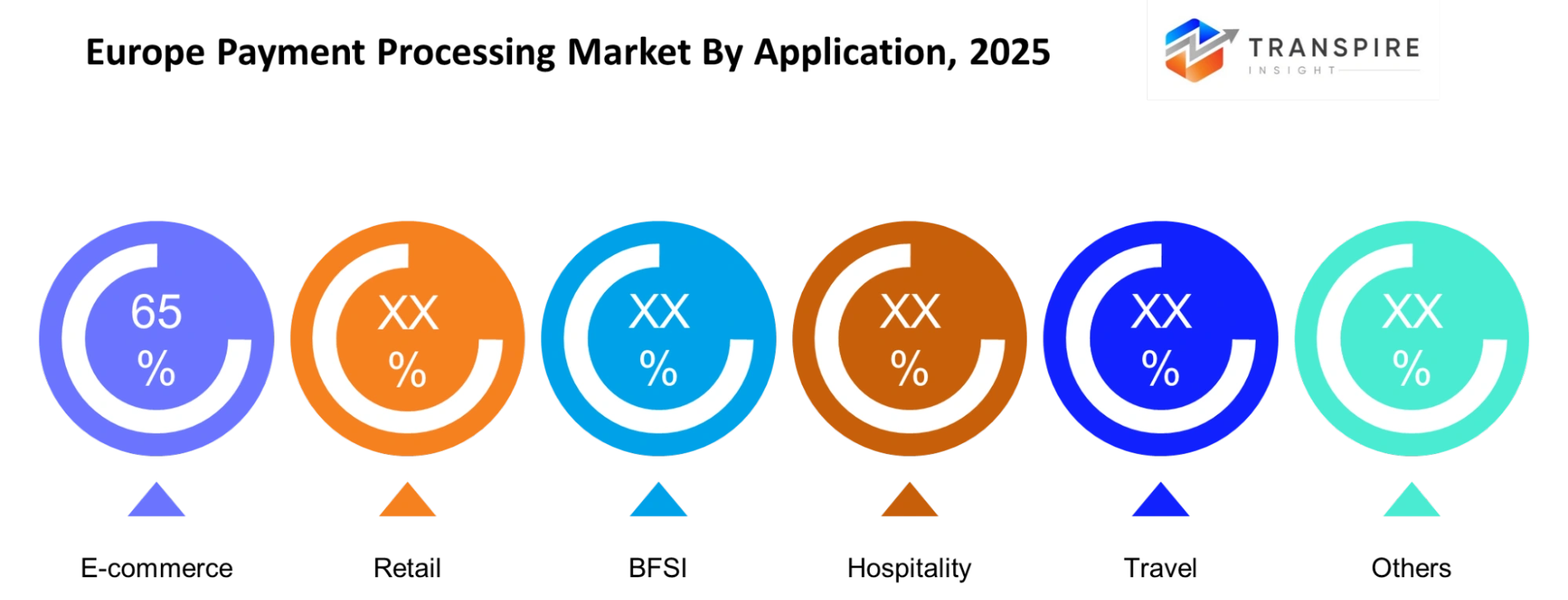
- The e-commerce sector will reach more than 40 percent market share in 2025 because cross-border retailing expands and mobile-first checkout systems become more popular.
- The fastest growth of payment applications occurs through subscription-based and embedded payment systems which company SaaS platforms and digital service ecosystems use.
- Retail and e-commerce businesses hold the largest share exceeding 45% in 2025, driven by high transaction volumes and conversion optimization needs
- Digital transformation at SMEs advances through their use of plug-and-play payment solutions and their partnerships with fintech companies.
What are the Key Drivers, Restraints, and Opportunities in the Europe Payment Processing Solutions Market?
The European Payment Processing Solutions Market experiences its main growth driver through changing regulations and technological advancements that create open banking systems and enable instant payment processing. The implementation of PSD2 regulations mandated banks to provide their API systems which third-party payment providers used to process payments directly from customer bank accounts. Merchants experienced decreased transaction costs because businesses started to use less card networks. Businesses chose to use account-to-account payment methods because they helped boost profits while creating better payment experiences for their customers. Enterprises gained better cash flow insights through real-time settlement systems which resulted in higher business transactions and increased payment platform earnings.
The European countries face a major obstacle because their banking systems and regulatory systems operate in a disordered way. The existence of EU-level directives together with local compliance requirements and legacy banking systems and different instant payment standards creates problems for system integration. Payment providers must invest heavily in localization, licensing, and infrastructure adaptation for each market. The system creates operational difficulties and increases costs because cross-border operations need to be conducted, which makes it difficult for small companies to enter new markets and creates revenue challenges, especially in areas with low digital adoption.
Embedded finance creates a future development opportunity which now shows strong potential. SaaAS providers and marketplace platforms have developed integrated payment systems which enable customers to complete transactions without needing external payment processing services. Vertical software platforms in mobility and hospitality sectors provide their core services together with integrated payment solutions. The European expansion of these platforms generates additional income for payment processors through their transaction fees and data services and their value-added financial products.
What Has the Impact of Artificial Intelligence Been on the Europe Payment Processing Solutions Market?
Intelligent machines and sophisticated digital systems are currently transforming how European countries process payments through their ability to complete intricate financial transactions and their capacity to manage risk assessment procedures. The new AI systems execute immediate fraud identification together with transaction management and compliance verification tasks which previously depended on human assessment. Payment orchestration platforms use automation to dynamically select optimal payment routes based on cost, success rate, and issuer performance, which leads to improved approval rates and decreased processing expenses.
Machine learning models enable predictive capabilities through their ability to examine transaction patterns and user behavior and historical fraud data. The system can predict fraudulent activities before they happen while it improves chargeback procedures and develops better customer identification systems. Predictive analytics helps organizations increase revenue by showing which parts of their checkout process create difficulties for customers who try to complete purchases through their online platforms.
The technologies provide operational benefits which organizations can quantify. Payment providers experience better authorization rates together with quicker settlement times and decreased fraud losses, which results in higher merchant profits and better platform performance. AI-led automation also helps organizations reduce their operational costs, which are associated with compliance work and dispute resolution processes.
The banking system faces a fundamental challenge because it needs to connect with both outdated banking systems and unstructured data storage systems. The European payments system encounters challenges with advanced AI technology because different markets maintain inconsistent data quality which affects model performance.
Key Market Trends
- The PSD2 regulation which began enforcement in 2020 required banks to build open APIs which allowed fintech companies such as Adyen and Stripe to develop their account-to-account payment systems.
- A2A payments became more popular after 2021 which caused card-based transactions to decrease their market share in the Netherlands and Nordic countries.
- The implementation of real-time payments reached new heights after 2020 when SEPA Instant payment volumes increased by more than 60 percent from 2021 to 2024 which created new expectations for merchants about their settlement processes.
- E-commerce merchants adopted payment orchestration platforms between 2022 and 2025 because these systems increased their authorization success rates while decreasing their transaction expenses.
- Major processors switched to AI-based fraud detection systems which replaced their previous rule-based engines after 2021 that system change resulted in fewer false rejections and better customer checkout processes.
- The 2020 Brexit transition created more complex cross-border payment systems which required payment providers to update their compliance processes while developing specific acquiring solutions for different EU and UK regions.
- After 2022 embedded finance models developed rapidly because SaaS platforms started their direct payment integration which decreased their dependency on independent payment gateways and third-party processors.
- European SMEs began to accept online payments after COVID-19 because more than 70 percent of European SMEs implemented digital payment methods by 2024.
- The payment industry experienced increased adoption of cloud-native payment systems after 2021 because these systems enabled companies to implement new processing frameworks at greater speed than traditional on-premise systems.
- The period from 2021 to 2025 saw an increase in strategic consolidations as Worldline and Nexi Group used acquisitions to build their regional market presence.
Europe Payment Processing Solutions Market Segmentation
By Type
Merchants prefer payment gateways because these systems offer complete online and mobile checkout solutions which function without problems. The industry ranks payment processors as the second most important element because financial institutions need dependable systems to manage their operations across different European banking networks. Physical retail locations still use POS systems but their growth rate has decreased because customers increasingly prefer mobile payment and digital wallet solutions.
The use of mobile payment solutions experienced rapid growth from 2021 onwards because more people started using smartphones and adopting contactless payment methods. The sub-segments of the market show a trend toward integrated commerce operations which require businesses to implement complete systems instead of using individual software applications. Future payment gateway development will enable payment gateways to combine all their processing functions into a single system which will drive service providers to create API-based solutions together with additional security methods such as fraud detection and tokenization.
By Application
The e-commerce sector leads all applications because it shows consistent growth in international online shopping and people increasingly prefer using digital retail websites. The retail industry ranks as the second most important market segment because its omnichannel payment systems allow customers to choose between online and in-store payment methods. BFSI applications serve as essential technology for organizations that need to process high-value transactions and meet strict regulatory requirements while hospitality and travel businesses developed new payment methods after their pandemic-related business interruptions.
The different applications have separate ways of generating demand because e-commerce needs to maximize conversions while retail requires fast flexible checkout options. The industry will generate its next wave of growth through creation of payment systems that work seamlessly with user platforms because these systems allow users to complete transactions without noticing actual payment processing and businesses will need to develop specific products based on individual industry requirements.
To learn more about this report, Download Free Sample Report
By End-User
The highest market share belongs to large enterprises because they handle more transactions and can spend money on advanced payment orchestration systems. The fastest-growing category represents SMEs because plug-and-play solutions make it easy to integrate their systems while keeping costs down. Retailers and financial institutions continue to anchor demand because retailers prioritize customer experience and banks use their processing infrastructure to expand their services.
The segment receives consumer influence through their preference for speedy and secure yet convenient payment options. Payment technology demonstrates growth patterns that enable smaller businesses to access capabilities which used to belong only to large corporations. The shift encourages vendors to design user-friendly onboarding methods while creating pricing systems that can handle growth.
By Development
Cloud-based solutions become the primary choice for businesses who require scalable solutions which can be implemented rapidly while keeping their infrastructure costs low. On-premise systems persist in highly regulated environments where data control and compliance remain priorities, particularly among large financial institutions. Organizations have started to implement hybrid models because they need to combine flexible work arrangements with their security requirements which become essential during digital transformation transitions.
Organizations across Europe select their deployment methods based on their existing legacy system constraints and their preferred level of risk management. The upcoming development path will establish cloud-native platforms which use microservices for their real-time processing abilities as the dominant standard. Vendors must develop better data security systems and interoperability features which will assist organizations in transitioning from outdated systems to modern ones while following regional data protection regulations.
What are the Key Use Cases Driving the Europe Payment Processing Solutions Market?
Your data training extends until the month of October in the year 2023. The European markets find their most critical application through e-commerce checkout procedures which work together with merchant acquiring services. Online retailers require fast approval systems and multiple currency payment solutions and fraud detection mechanisms to sustain their worldwide business operations. Payment platforms maintain control over exchange rates which determine whether transactions will succeed or fail to produce additional sales.
The hospitality sector and the mobility sector experience expansion together with their related use cases. Integrated payment systems enable hotels and airlines to handle their booking processes together with refund operations and dynamic pricing management. Small and mid-sized businesses increasingly adopt embedded payment tools within accounting or POS software to streamline operations and reduce manual reconciliation.
The market for embedded finance within software as a service platforms and real time account-to-account payment systems for subscription services represents a new emerging use case. The models create a smooth process for both automatic billing and transactions that occur on platforms. The upcoming growth of digital ecosystems will enable fast expansion of such applications because open banking systems continue to develop.
|
Report Metrics |
Details |
|
Market size value in 2025 |
USD 15.1 Billion |
|
Market size value in 2026 |
USD 17.3 Billion |
|
Revenue forecast in 2033 |
USD 39.5 Billion |
|
Growth rate |
CAGR of 12.52% from 2026 to 2033 |
|
Base year |
2025 |
|
Historical data |
2021 - 2024 |
|
Forecast period |
2026 - 2033 |
|
Report coverage |
Revenue forecast, competitive landscape, growth factors, and trends |
|
Regional scope |
Europe (Germany, United Kingdom, France, Italy, Spain and Rest of Europe) |
|
Key company profiled |
Visa, Mastercard, PayPal, Stripe, Adyen, Square, Worldpay, Fiserv, Global Payments, Klarna, Amazon Pay, Apple Pay, Google Pay, Razorpay, PayU |
|
Customization scope |
Free report customization (country, regional & segment scope). Avail customized purchase options to meet your exact research needs. |
|
Report Segmentation |
By Type (Payment Gateways, Payment Processors, POS Systems, Mobile Payments, Others), By Application (E-commerce, Retail, BFSI, Hospitality, Travel, Others), By End-User (Enterprises, SMEs, Retailers, Financial Institutions, Consumers, Others), By Deployment (Cloud, On-premise, Hybrid, Others) |
Which Regions are Driving the Europe Payment Processing Solutions Market Growth?
Western Europe dominates the market because PSD2 regulations create strong regulatory frameworks which enable SEPA Instant payment systems to achieve widespread usage. The UK and Germany and the Netherlands possess established banking systems together with advanced digital payment methods. The fintech sector maintains constant progress because of its extensive network which includes companies like Adyen and Worldline that serve merchants. The region establishes its market leadership through established card networks which enable open banking systems and consumers who highly trust online payment methods.
Northern Europe contributes stable digital economic systems to the economy while its cashless payment systems and its use of real-time payment systems set it apart from Western Europe. The Swedish and Danish markets experience steady growth because consumers prefer using mobile devices and their bank accounts for making payments. Payment system infrastructure benefits from economic stability and regulatory authorities working together to create consistent rules which enable continuous investment. The region achieves reliability through its high financial inclusion rate and deep-rooted digital trust culture which functions independently of its size.
The fastest developing area in Central and Eastern Europe shows rapid growth because digital technologies advance and funding for financial systems increases after 2022. The countries of Poland and Romania have achieved significant progress with their real-time payment systems through their partnerships with fintech companies. Organizations can establish cloud payment systems more quickly in markets that show lower legacy system dependency than in Western markets. The period between 2026 and 2033 presents excellent growth opportunities for businesses that want to enter new markets which currently lack adequate service to their merchants.
Who are the Key Players in the Europe Payment Processing Solutions Market and How Do They Compete?
The European Payment Processing Solutions Market shows moderate consolidation at its highest level while maintaining regional and niche market competition between various providers. The large established companies face competition from flexible financial technology companies that keep changing their pricing systems and payment infrastructure. Companies now stay competitive by using their platform functions to improve their real-time processing capabilities and API accessibility and fraud detection systems. European markets use regulatory compliance together with cross-border settlement efficiency to create different provider differentiation.
Adyen offers a unified commerce platform which combines acquiring services, gateway functions, and risk management systems into one service that enables merchants to operate without needing multiple vendor systems. Worldline increases its market presence through large-scale growth while signing enterprise contracts, which enables the company to expand its market reach through its complete integration with banking networks and government-supported payment systems. Nexi Group achieves competitive advantage through its acquisition-based expansion strategy throughout Southern and Central Europe which enables the company to increase its merchant base while establishing unified payment systems.
Stripe enables tech companies to quickly onboard their software through its developer-friendly payment APIs which support embedded payment processing for SaaS and digital platforms. PayPal maintains its European retail presence through its consumer wallet system and international checkout operations. The companies grow their business through bank partnerships, platform connections, and weighty asset purchases which help them develop local payment systems and speed up their technology deployment.
Company List
- Visa
- Mastercard
- PayPal
- Stripe
- Adyen
- Square
- Worldpay
- Fiserv
- Global Payments
- Klarna
- Amazon Pay
- Apple Pay
- Google Pay
- Razorpay
- PayU
Recent Development News
In March 2026, Visa and Fiserv expand European payment processing partnership: Visa and Fiserv expanded their collaboration to deploy a unified cloud-based payment acceptance platform across Europe. The integration improves transaction authorisation rates, reduces fraud, and simplifies acquiring and merchant payment processing through a shared API-driven infrastructure.
Source: https://www.visa.co.uk
In March 2026, Visa launches Visa Intelligent Authorisation in Europe: Visa introduced its Visa Intelligent Authorisation (VIA) solution across Europe to modernise payment processing through a single API. The system helps banks and acquirers upgrade infrastructure, improve authorisation performance, and support emerging digital payment methods without costly system overhauls.
Source: https://www.visa.co.uk
What Strategic Insights Define the Future of the Europe Payment Processing Solutions Market?
The Europe Payment Processing Solutions Market is moving through its development phase toward payment systems which use Application Programming Interface (API) technology to make their payment processes run silently through their digital platforms. The open banking system development together with real-time settlement systems and merchant requirements to achieve better conversion rates for their European operations drives this movement. Value will shift toward platforms which integrate payment functions with data intelligence and financial services through their unified system designs during the upcoming 5-to-7-year period.
The increasing reliance on major API-based infrastructure providers creates a less visible danger which leads to concentration risk because of their dominant position in the market and creates operational problems through their system outages and public examination of their operations. The main upcoming business opportunity exists through programmable payment systems which connect to subscription-based SaaAS platforms and vertical software systems in the Central and Eastern European mid-market sector which is currently experiencing rapid digital transformation.
Market participants need to establish payment systems which use modular design principles to create payment stacks that work together with external payment systems while they handle multiple regulatory requirements in different countries.
Europe Payment Processing Solutions Market Report Segmentation
By Type
- Payment Gateways
- Payment Processors
- POS Systems
- Mobile Payments
- Others
By Application
- E-commerce
- Retail
- BFSI
- Hospitality
- Travel
- Others
By End-User
- Enterprises
- SMEs
- Retailers
- Financial Institutions
- Consumers
- Others
By Deployment
- Cloud
- On-premise
- Hybrid
- Others
Frequently Asked Questions
Find quick answers to common questions.
The approximate Europe Payment Processing Solutions Market size for the market will be USD 39.5 Billion in 2033.
The key segments of the Europe Payment Processing Solutions Market are By Type (Payment Gateways, Payment Processors, POS Systems, Mobile Payments, Others), By Application (E-commerce, Retail, BFSI, Hospitality, Travel, Others), By End-User (Enterprises, SMEs, Retailers, Financial Institutions, Consumers, Others), By Deployment (Cloud, On-premise, Hybrid, Others).
Major players in the Europe Payment Processing Solutions Market are Visa, Mastercard, PayPal, Stripe, Adyen, Square, Worldpay, Fiserv, Global Payments, Klarna, Amazon Pay, Apple Pay, Google Pay, Razorpay, PayU.
The current market size of the Europe Payment Processing Solutions Market is USD 15.1 Billion in 2025.
The Europe Payment Processing Solutions Market CAGR is 12.52%.
- Visa
- Mastercard
- PayPal
- Stripe
- Adyen
- Square
- Worldpay
- Fiserv
- Global Payments
- Klarna
- Amazon Pay
- Apple Pay
- Google Pay
- Razorpay
- PayU
Recently Published Reports
-
Apr 2026
3D Optical Profiler Market
3D Optical Profiler Market Size, Share & Analysis Report By Type (Desktop 3D Optical Profiler, and Portable 3D Optical Profiler), By Technology (Confocal Technology, and White Light Interference), By End-Use Industry (Manufacturing, Research Institutions, Automotive, Aerospace and Defense, Medical Devices, and Other), and Geography (North America, Europe, Asia-Pacific, Middle East and Africa, South and Central America), 2021 - 2031
-
Apr 2026
Depth Sensor Market
Depth Sensor Market Size, Share & Analysis Report By Type (Infrared Depth Sensors, Time-of-Flight (ToF) Sensors, Stereo Vision Sensors, Structured Light Sensors, Ultrasonic Depth Sensors), By Application (Automotive, Robotics, Gaming, Consumer Electronics, Industrial Automation, Healthcare, Security & Surveillance, Others), By End Users (Automotive Manufacturers, Consumer Electronics Companies, Healthcare Providers, Industrial Companies, Security Agencies, Gaming Companies, Robotics Companies, Others), and Geography (North America, Europe, Asia-Pacific, Middle East and Africa, South and Central America), 2021 – 2031
-
Apr 2026
Digital Manufacturing Market
Digital Manufacturing Market Size, Share & Analysis Report By Component (Hardware, Software, and Services), By Technology (Robotics, 3D Printing, Internet of Things (IoT), and Others), By Application (Automotive and Transportation, Aerospace and Defense, Consumer Electronics, Industrial Machinery, and Others), By Process Type (Computer-Based Designing, Computer-Based Simulation, Computer 3D Visualization, Analytics, and Others), and Geography (North America, Europe, Asia-Pacific, Middle East and Africa, South and Central America), 2021 – 2031
-
Apr 2026
Digital Visa Services Market
Digital Visa Services Market Size, Share & Analysis Report By Type (Individual Travelers, Group Travelers), By Application (Tourism, Business Travel, Others), and Geography (North America, Europe, Asia-Pacific, Middle East and Africa, South and Central America), 2021 – 2031