
Global Payment Security Market Size & Forecast:
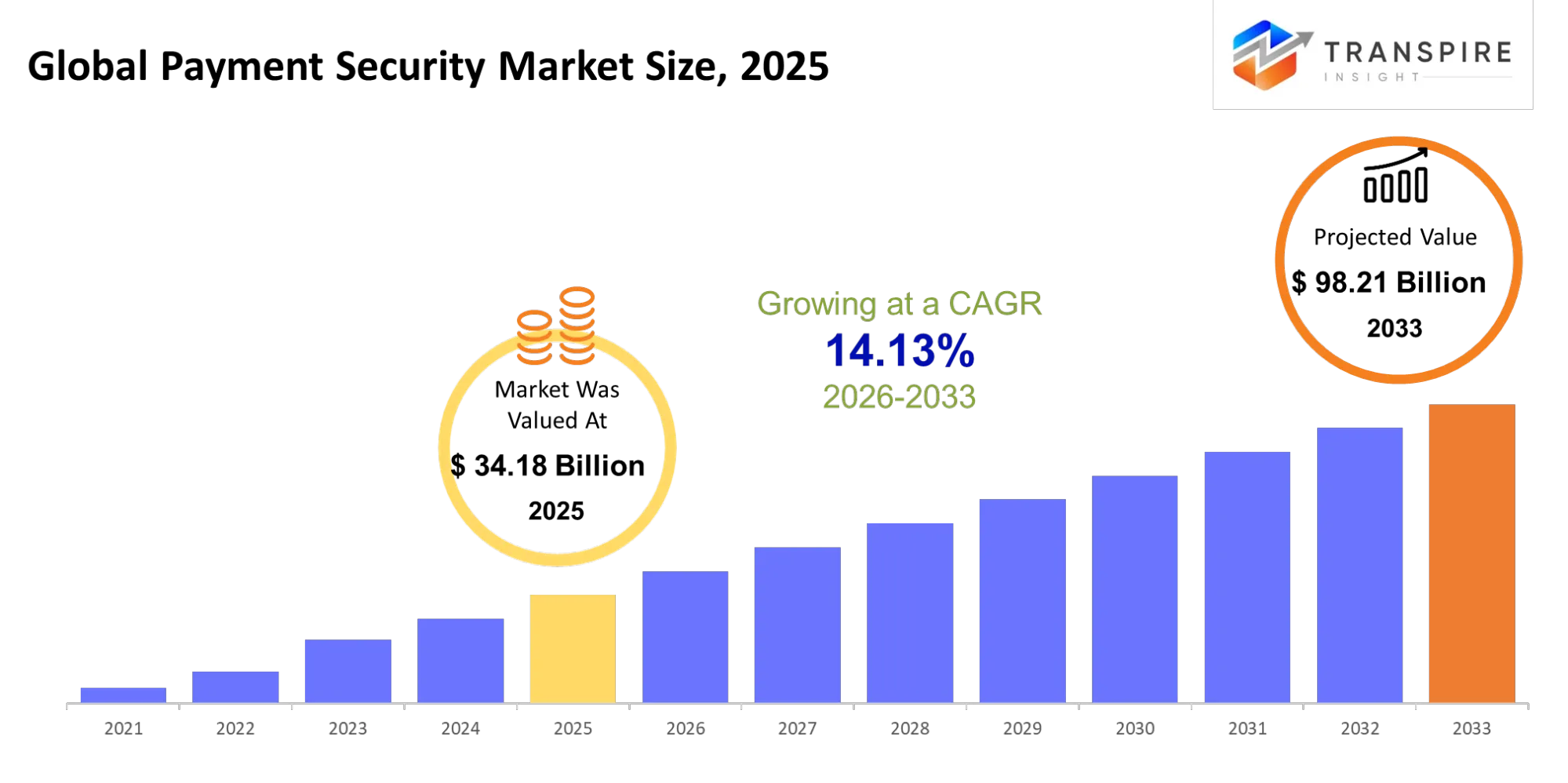
- Global Payment Security Market Size 2025: USD 34.18 Billion
- Global Payment Security Market Size 2033: USD 98.21 Billion
- Global Payment Security Market CAGR: 14.13%
- Global Payment Security Market Segments: By Type (Encryption Solutions, Tokenization Solutions, Fraud Detection Systems, Secure Payment Gateways, Biometric Authentication Systems, Multi-factor Authentication Platforms, Others); By Application (E-commerce Payments, Mobile Payments, Banking Transactions, Retail Payments, Healthcare Payments, Others); By End-User (Banks, Retailers, Payment Service Providers, E-commerce Platforms, Others); By Deployment (Cloud-based Security, On-premise Security, Hybrid Security Systems, AI-driven Security Platforms, Others)
To learn more about this report,  Download Free Sample Report
Global Payment Security Market Summary:
The Global Payment Security Market size is estimated at USD 34.18 Billion in 2025 and is anticipated to reach USD 98.21 Billion by 2033, growing at a CAGR of 14.13% from 2026 to 2033. Market growth can be attributed to the need for enhanced digital payment security infrastructure among organizations due to security threats associated with the online, mobile, and contact-less methods of payments. The payment security industry has seen a shift in approach towards ensuring safe digital transactions in the last 3-5 years in favor of utilizing Artificial Intelligence (AI), Tokenization technology, biometric security measures, and cloud-native security frameworks to prevent any fraud in financial transactions. Real-time and embedded payment security has become an important part of payment infrastructure, necessitating constant security checks. The fast growth in e-commerce and cross-border transactions acts as one of the key triggers for market growth.
Global Payment Security Market Insights:
- Global Payment Security Markets will move away from being merely transaction protection-focused towards becoming intelligent fraud prevention platforms. Increasing trends will include those related to the evolution of e-commerce transactions, use of artificial intelligence in security solutions, and government requirements for advanced payment authentication.
- Over 55% of all payment security budgets are related to cloud services, as more enterprises are adopting payment infrastructures that leverage scalability and application programming interfaces.
- Credit card payment security comprises almost 40% of total transaction protection spending. At the same time, enterprises are investing more into their tokenization capacities in order to minimize payment credentials exposures.
- Artificial intelligence fraud detection solutions are gaining popularity at over 30% growth rates on an annual basis.
- Mobile payments make up more than 45% of digital transactions' growth, thus prompting payment providers to enhance their capabilities in biometrics authentication and device authentication solutions.
- Big companies account for roughly 60% of the overall market demand due to larger transaction volumes and increased vulnerability to financial frauds.
- Contactless payments will keep growing fast, which is why more firms are spending on improving their capabilities in encryption technology and transaction authentication.
- Cross-border digital transactions also play an important role in fostering payment security solutions because the need for multifaceted fraud protection increases.
- Over 65% of all financial organizations are focusing on embedded security frameworks, indicating an evolution towards the integration of security directly into the payment processing process rather than using separate systems.
- With real-time payments growing at an unprecedented pace, many firms are relying on behavioral analytics, machine learning, and monitoring techniques to avoid transaction risks and payment fraud.
What are the Key Drivers, Restraints, and Opportunities in the Global Payment Security Market?
Driver:
The main catalyst behind Global Payment Security Market growth is the fast proliferation of the digital payments ecosystem via e-commerce portals, mobile banking channels, subscription models, and real-time payments systems. The catalyst here has been the fast-growing number of online transactions, usage of digital wallets, and cyber-attacks on the infrastructure for payments. With more payments being processed, organizations incur more risk of losing money due to fraudulent behavior and chargebacks. Therefore, companies have to invest heavily in tokenization, AI-powered fraud detection solutions, and encryption services.
Restraint:
Another important constraint is the technical difficulty involved in upgrading existing payment system infrastructures with state-of-the-art payment security solutions. Financial organizations and merchant establishments continue to use outdated payment systems architecture that makes it hard to upgrade the system due to cost implications and logistical challenges associated with the same. The reason for this problem is because implementing the change requires heavy financial outlay.
Opportunity:
An important opportunity would be in securing payments through integration into native cloud-based payment systems and real-time transaction ecosystems. The increased development of digital banking capabilities within emerging economies, in addition to the use of behavior analysis and biometrics via artificial intelligence technologies, presents new growth opportunities. Increased investment in instant payment systems and international digital commerce will also help in this regard.
What Has the Impact of Artificial Intelligence Been on the Global Payment Security Market?
The Global Payment Security Market has undergone significant changes due to Artificial Intelligence since it has revolutionized the market in terms of fraud prevention in real time, transaction monitoring, and automatic risk management. AI technology is applied to detect abnormal payment patterns, prevent suspicious transactions from occurring, and protect the market from financial fraud.
AI has improved operational efficiency in terms of automation and predictions in payment transactions. For example, AI fraud engines allow for the automatic processing of thousands of transactions without the need for manual checks, while predictive capabilities enable machine learning algorithms to predict risks of fraudulent payments and evolve the security model according to changing cyberattacks.
Furthermore, operational benefits include reduced false positives, fast authentication, customer satisfaction, and scalability for payment solutions.
In March 2024, payment organizations had enhanced investments in their AI-driven systems used to detect and prevent fraud. Likewise, by October 2023, banks had ramped up adoption of AI-based behavioral analysis tools to enhance real-time security of payments due to rising use of instant payments.
Global Payment Security Market Trends:
- There is a fundamental change occurring in the Global Payment Security Market as payment ecosystems progress from a reactive approach to security to a proactive and intelligent approach based on embedded real-time security architecture.
- Payment security practices have evolved from relying on conventional perimeters of security to using continuous monitoring practices as the transaction volume continues to increase within digital platforms.
- There have been significant developments in fraud management, where there has been a shift away from relying on rule-based methods to an approach using artificial intelligence technology.
- With time, authentication methods have also evolved, with the gradual replacement of password and one-time authentication practices with biometric verification in digital payment ecosystems.
- Cloud-based payment architecture is overtaking traditional security frameworks because businesses value scalability, interoperability with APIs, and accelerated deployment.
- There is a growing trend of embedding security solutions into the payment process, thereby reducing the latency caused by external security layers.
- Consumer tendencies towards non-touchable, mobile-based, and digital wallets are compelling payment companies to rethink their security solutions in light of new consumer preferences.
- Tokenization technology has emerged as a major trend in the field as companies shift from maintaining customer payment details in databases.
- Digital cross-border transactions are leading the way towards adaptive fraud prevention systems that can analyze different types of transaction data across different geographies.
- Real-time payments are fueling investment in behavioral analytics and continuous authentication technology solutions because real-time decisions about the risks associated with a transaction are needed.
Global Payment Security Market Segmentation:
By Type
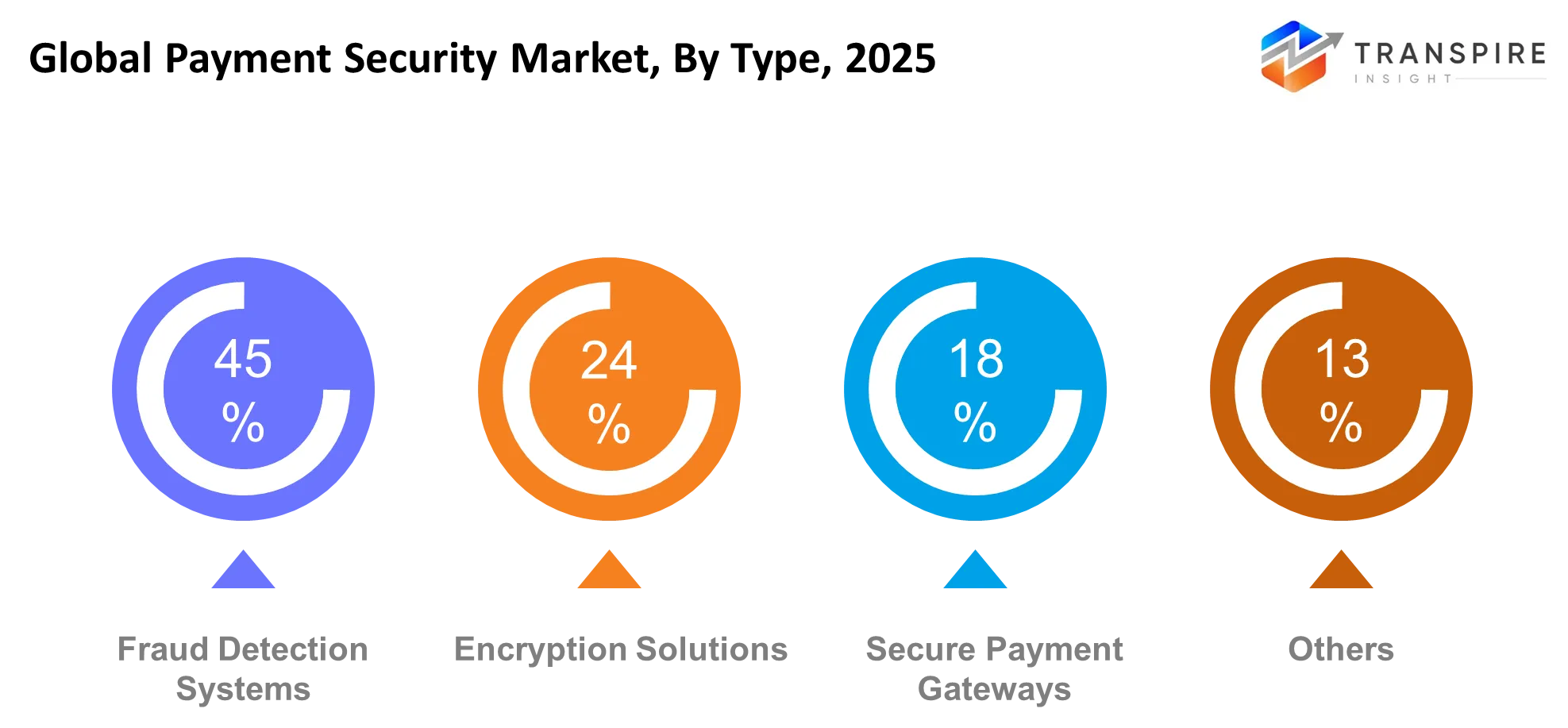
In the Global Payment Security Market, fraud detection and secure payment gateway segments retain high market shares because they directly address risk management for payments. Encryption and tokenization segments continue to grow because businesses are becoming more inclined towards securing their payments through credential protection without adding any friction for the end-user. Biometric authentication and multi-factor authentication segments are expected to grow further owing to increased focus on identity-based security systems in the payment ecosystem as opposed to password-based security.
To learn more about this report, Download Free Sample Report
By Application
In terms of application, e-commerce payments constitute the highest adoption category since increased online transactions increase vulnerability to fraudulent attacks and compromised accounts. Mobile payments keep growing at an impressive rate because of growing contactless payments and digital wallets around the world. Payments through banking are still very critical due to the regulatory requirements and adoption of fast payments, and payments in the health sector are becoming increasingly essential due to increased sensitive financial data associated with the health of patients.
By End-User
Banks will continue to be the primary end-users because of the transactional activity, regulatory requirements, and risk of fraud, whereas retailers and eCommerce firms have begun to spend on security infrastructure as well as to ensure customer experience without any interruption and minimize payment abandonment. Payment service providers will enhance their security capabilities to enable an environment for growing digital transactions. In the future, investments in security will be spread among several entities.
By Deployment
Cloud security takes the lead in driving transformational deployment as enterprises find it convenient to deploy their payment security infrastructures in a scalable manner from remote locations. In-house solutions continue to have their place in cases where organizations face stringent regulatory guidelines, while hybrid solutions are also on an upward trend as organizations look for ways of balancing convenience and control. The most rapidly evolving deployment solution is the use of AI-powered security solutions to meet the need for advanced threat detection.
What are the Key Use Cases Driving the Global Payment Security Market?
Transaction security in the e-commerce and banking sectors is among the major application scenarios fueling the Global Payment Security Market since transaction volumes and increased levels of fraud demand consistent processes of authentication, encryption, tokenization, and real-time detection of potential payment frauds.
Use cases of Payment Security are becoming more widespread due to increasing use of mobile payments, transactions performed by retailers, and payment service platforms due to the rising adoption rates of contactless payment options, digital wallets, and instant payment solutions.
Emerging use cases are being created in areas such as payment security powered by artificial intelligence, embedded finance services, and instant cross-border payments. In addition, healthcare payments and subscription-based online services as well as decentralized finance systems can drive the demand for adaptive payment security solutions that can monitor transaction activity.
|
Report Metrics |
Details |
|
Market size value in 2025 |
USD 34.18 Billion |
|
Market size value in 2026 |
USD 38.93 Billion |
|
Revenue forecast in 2033 |
USD 98.21 Billion |
|
Growth rate |
CAGR of 14.13% from 2026 to 2033 |
|
Base year |
2025 |
|
Historical data |
2021 - 2024 |
|
Forecast period |
2026 - 2033 |
|
Report coverage |
Market size estimation, growth drivers, restraints, opportunities, AI impact analysis, pricing trends, technological developments, competitive landscape, regional analysis, and future strategic outlook. |
|
Regional scope |
North America, Europe, Asia-Pacific, Latin America, Middle East & Africa |
|
Key company profiled |
Visa, Mastercard, PayPal, Stripe, Adyen, Fiserv, Ingenico, Verifone, Broadcom, IBM Security, Thales Group, Entrust, Fortinet, RSA Security, Okta |
|
Customization scope |
Customized segmentation, regional expansion, company profiling, competitive benchmarking, and country-level analysis available. |
|
Report Segmentation |
By Type (Encryption Solutions, Tokenization Solutions, Fraud Detection Systems, Secure Payment Gateways, Biometric Authentication Systems, Multi-factor Authentication Platforms, Others); By Application (E-commerce Payments, Mobile Payments, Banking Transactions, Retail Payments, Healthcare Payments, Others); By End-User (Banks, Retailers, Payment Service Providers, E-commerce Platforms, Others); By Deployment (Cloud-based Security, On-premise Security, Hybrid Security Systems, AI-driven Security Platforms, Others) |
Which Regions are Driving the Global Payment Security Market Growth?
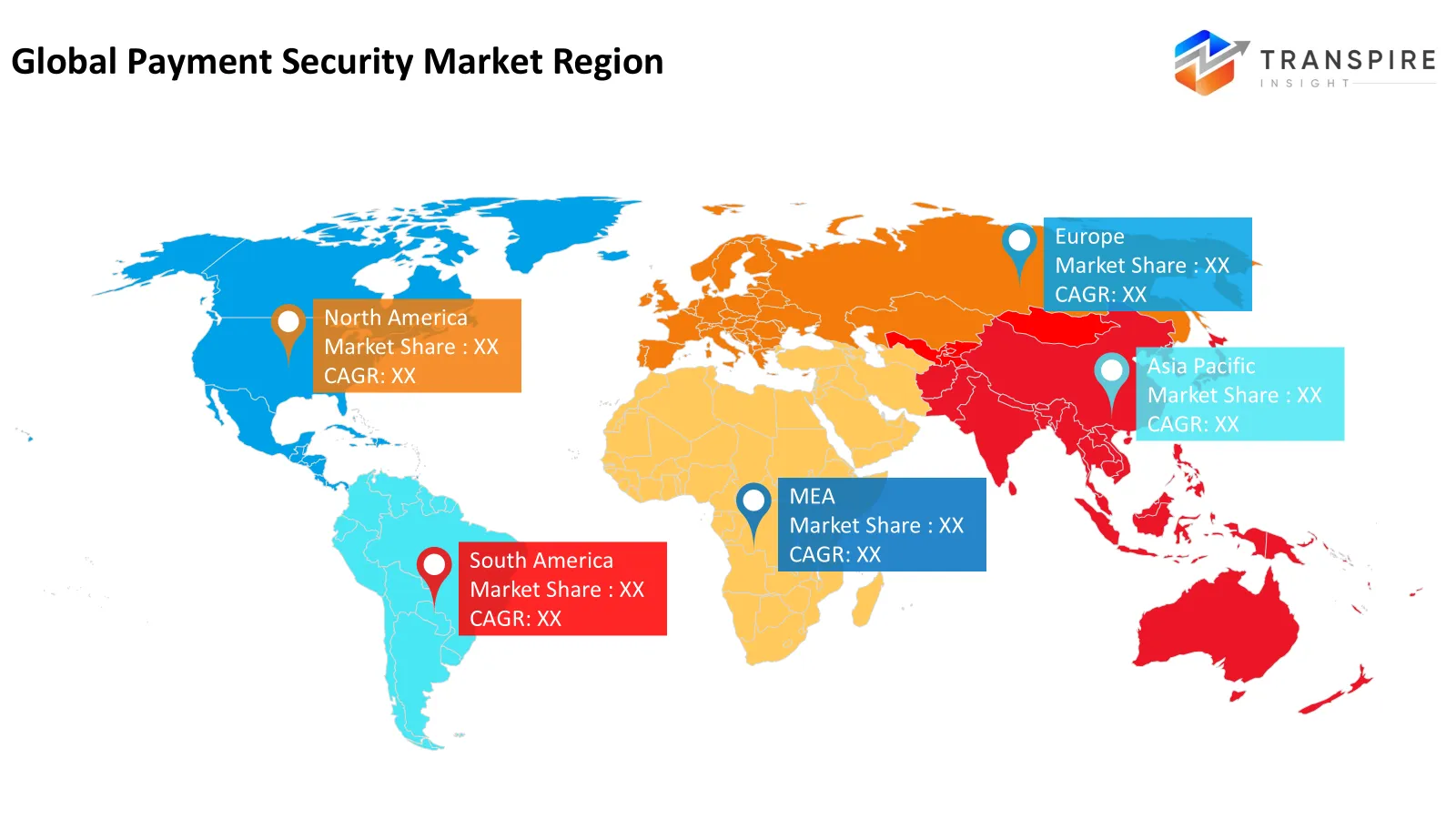
The Global Payment Security Market leader is North America owing to its sophisticated payment ecosystem, substantial cybersecurity investment, and extensive use of digital transactions across the region. Dominance in this region is achieved due to the robust regulatory environment, intensive usage of digital commerce processes, and the rapid development of real-time payment platforms. In July 2023, the introduction of FedNow real-time payment system led to a surge in demand for advanced fraud detection solutions, secure payment authentication tools, and transaction protection services. The increased use of cloud payment solutions, digital wallets, and artificial intelligence-powered fraud detection services drives regional dominance in the market.
Second in the list is Europe that experiences different market growth compared to other regions as the adoption is highly driven by regulatory needs and standardization of financial infrastructures. In contrast to North America, the role of regulations is more critical in Europe when it comes to security and adoption of new technologies and practices. In September 2019, the revised European payment regulations stimulated the introduction of multi-factor authentication technology and secure transaction process leading to long-term market stability.
Asia-Pacific is proving to be the fastest-growing region due to the fast-paced growth of mobile payment, fintech development, and digital financial inclusion. Things have been changing rapidly within the past few years in Asia-Pacific, owing to the pace at which governments are advancing in terms of the creation of digital payment eco-systems and real-time transaction systems. In January 2020, the quick pace at which payment ecosystems and mobile transactions are expanding raised the demands for advanced fraud detection and payment authentication technologies.
To learn more about this report, Download Free Sample Report
Who are the Key Players in the Global Payment Security Market and how do they Compete?
Competitions in the Global Payment Security Market come from technological differentiation, fraud prevention, authentication capabilities, and flexible integrations. Competitive activities for companies include the use of AI-enabled fraud analytics, cloud-native payment security solutions, embedded payments, and strategic collaborations with banks and merchant organizations. Market participants are now going beyond transaction security to offer comprehensive protection of the entire payment ecosystem.
Firms like Visa and Mastercard have differentiated themselves using transaction network insights and fraud surveillance technologies. These firms leverage huge transaction networks that provide sophisticated risk analysis and behavioral monitoring capabilities. On the other hand, PayPal competes in the space through integrated payment ecosystems in which fraud management and authentication processes happen together with payments.
Security technology providers such as Thales Group, Fiserv, and IBM differentiate themselves through innovations in encryption, tokenization services, cloud security infrastructure, and threat detection algorithms. Acquisition activities, embedded security solutions, cloud partnerships, and digital banking ecosystems have become the new methods used by security firms to expand their reach into payments transactions.
Global Payment Security Market Companies
- Visa
- Mastercard
- PayPal
- Stripe
- Adyen
- Fiserv
- Ingenico
- Verifone
- Broadcom
- IBM Security
- Thales Group
- Entrust
- Fortinet
- RSA Security
- Okta
Recent Development News
- In January 2026, FIS acquired Global Payments' Issuer Solutions division, with a valuation of roughly USD 13.5 billion. With the acquisition, FIS enhanced its payment processing offerings, as well as AI-driven payment fraud protection services for financial institutions.
- In February 2026, “Bluefin teamed up with Accrue for the introduction of secure payment platforms that use branded wallets to enhance security aspects during transactions. This collaboration improved secure digital payment platforms along with embedded payment services.
- In March 2026, "IBM launched its new Agentic AI-based anti-fraud technology in its payment security solution. These features enhanced their ability to detect real-time fraud, conduct automatic threat assessment, and monitor payments. Source: IBM."
What Strategic Insights Define the Future of the Global Payment Security Market?
For the Global Payment Security Market, the future seems to be heading towards embedded and intelligent real-time security ecosystems where security is incorporated right into the payment process rather than being an external layer. The market direction indicates that there is going to be increased integration among AI, behavioral analysis, cloud-native solutions, and continuous authentication amid fast-paced transaction environments.
There is one hidden threat for which companies need to prepare; the increased complexity in payment ecosystems. With the adoption of multi-channel payments, APIs, digital wallets, instant payments, and other third-party integrations, it can lead to fragmentation of security efforts amidst increased security investments by businesses.
The upcoming trend in AI involves creating adaptive security platforms that can learn behavior in transactions and provide security services for embedded finance ecosystems. Growth of real-time payments and international e-commerce only adds to this trend's potential.
As far as strategy goes, it would be ideal to concentrate on interoperable and cloud-native security architectures since future competitiveness will hinge on the ability to automate transactions.
Global Payment Security Market Segmentation
By Type
- Encryption Solutions
- Tokenization Solutions
- Fraud Detection Systems
- Secure Payment Gateways
- Biometric Authentication Systems
- Multi-factor Authentication Platforms
- Others
By Application
- E-commerce Payments
- Mobile Payments
- Banking Transactions
- Retail Payments
- Healthcare Payments
- Others
By End-User
- Banks
- Retailers
- Payment Service Providers
- E-commerce Platforms
- Others
By Deployment
- Cloud-based Security
- On-premise Security
- Hybrid Security Systems
- AI-driven Security Platforms
- Others
Regional Outlook
North America
- United States
- Canada
- Mexico
Europe
- Germany
- United Kingdom
- France
- Spain
- Italy
- Rest of Europe
Asia Pacific
- Japan
- China
- Australia & New Zealand
- South Korea
- India
- Rest of Asia Pacific
South America
- Brazil
- Argentina
- Rest of South America
Middle East & Africa
- Saudi Arabia
- United Arab Emirates
- South Africa
- Rest of the Middle East & Africa
Frequently Asked Questions
Find quick answers to common questions.
The global Global Payment Security Market size was valued at USD 34.18 Billion in 2025 and is poised to reach USD 98.21 Billion by 2033, expanding at a 14.13% CAGR 2026-2033.
Key segments for the Global Payment Security Market are By Type (Encryption Solutions, Tokenization Solutions, Fraud Detection Systems, Secure Payment Gateways, Biometric Authentication Systems, Multi-factor Authentication Platforms, Others); By Application (E-commerce Payments, Mobile Payments, Banking Transactions, Retail Payments, Healthcare Payments, Others); By End-User (Banks, Retailers, Payment Service Providers, E-commerce Platforms, Others); By Deployment (Cloud-based Security, On-premise Security, Hybrid Security Systems, AI-driven Security Platforms, Others).
Growth is primarily driven by increasing adoption of digital payments, explosive growth in e-commerce transactions, increased use of mobile and contactless payments, increase in cases of payment fraud, greater regulatory demands on the security of transactions, greater deployment of AI systems to detect payment fraud, growth in real-time payments, increasing use of digital wallets, increased cross-border transactions, and enterprise spending on encryption and authentication technologies.
The global market is led by major manufacturers including Visa, Mastercard, PayPal, Stripe, Adyen, Fiserv, Ingenico, Verifone, Broadcom, IBM Security, Thales Group, Entrust, Fortinet, RSA Security, Okta.
The Asia Pacific region, which grows at a rate of 14.3%, commands about 25% of the market share and affects the growth of the worldwide Global Payment Security Market owing to increased mobile payments, e-commerce transactions, use of digital wallets, investment in fraud prevention tools, and payment authentication.
Opportunities in the industry involve the application of AI in detecting fraud, increased use of digital wallets and real-time payments, increased need for cloud payment security solutions, increase in cross-border payments, use of biometric authentication, and rapid digital banking adoption in emerging economies.
- Visa
- Mastercard
- PayPal
- Stripe
- Adyen
- Fiserv
- Ingenico
- Verifone
- Broadcom
- IBM Security
- Thales Group
- Entrust
- Fortinet
- RSA Security
- Okta
About the Authors

Mayur Shinde
I am Mayur Shinde, a Senior Research Analyst at Transpire Insight, specializing in the Automotive & Transportation and Information & Communication Technology (ICT) Industry. My work focuses on analyzing emerging market trends, technological advancements, competitive landscapes, and industry developments to deliver accurate, data-driven insights. I am passionate about transforming complex market information into clear, actionable content that helps businesses, professionals, and decision-makers stay informed and make confident strategic decisions.

Chakradhar Khansole
Chakradhar serves as the Research Director at Transpire Insight, bringing over 8 years of experience in technology, innovation, and strategic market intelligence. He specializes in transforming complex market data into actionable business insights that enable organizations to make informed, growth-oriented decisions. Recognized for his strategic vision and analytical expertise, Chakradhar leads high-impact research initiatives, delivering comprehensive market assessments, competitive intelligence, and forward-looking industry analysis.
Recently Published Reports
-
Apr 2026
3D Optical Profiler Market
3D Optical Profiler Market Size, Share & Analysis Report By Type (Desktop 3D Optical Profiler, and Portable 3D Optical Profiler), By Technology (Confocal Technology, and White Light Interference), By End-Use Industry (Manufacturing, Research Institutions, Automotive, Aerospace and Defense, Medical Devices, and Other), and Geography (North America, Europe, Asia-Pacific, Middle East and Africa, South and Central America), 2021 - 2031
-
Apr 2026
Depth Sensor Market
Depth Sensor Market Size, Share & Analysis Report By Type (Infrared Depth Sensors, Time-of-Flight (ToF) Sensors, Stereo Vision Sensors, Structured Light Sensors, Ultrasonic Depth Sensors), By Application (Automotive, Robotics, Gaming, Consumer Electronics, Industrial Automation, Healthcare, Security & Surveillance, Others), By End Users (Automotive Manufacturers, Consumer Electronics Companies, Healthcare Providers, Industrial Companies, Security Agencies, Gaming Companies, Robotics Companies, Others), and Geography (North America, Europe, Asia-Pacific, Middle East and Africa, South and Central America), 2021 – 2031
-
Apr 2026
Digital Manufacturing Market
Digital Manufacturing Market Size, Share & Analysis Report By Component (Hardware, Software, and Services), By Technology (Robotics, 3D Printing, Internet of Things (IoT), and Others), By Application (Automotive and Transportation, Aerospace and Defense, Consumer Electronics, Industrial Machinery, and Others), By Process Type (Computer-Based Designing, Computer-Based Simulation, Computer 3D Visualization, Analytics, and Others), and Geography (North America, Europe, Asia-Pacific, Middle East and Africa, South and Central America), 2021 – 2031
-
Apr 2026
Digital Visa Services Market
Digital Visa Services Market Size, Share & Analysis Report By Type (Individual Travelers, Group Travelers), By Application (Tourism, Business Travel, Others), and Geography (North America, Europe, Asia-Pacific, Middle East and Africa, South and Central America), 2021 – 2031