
Europe Vein Recognition Biometrics in BFSI Market Size & Forecast:
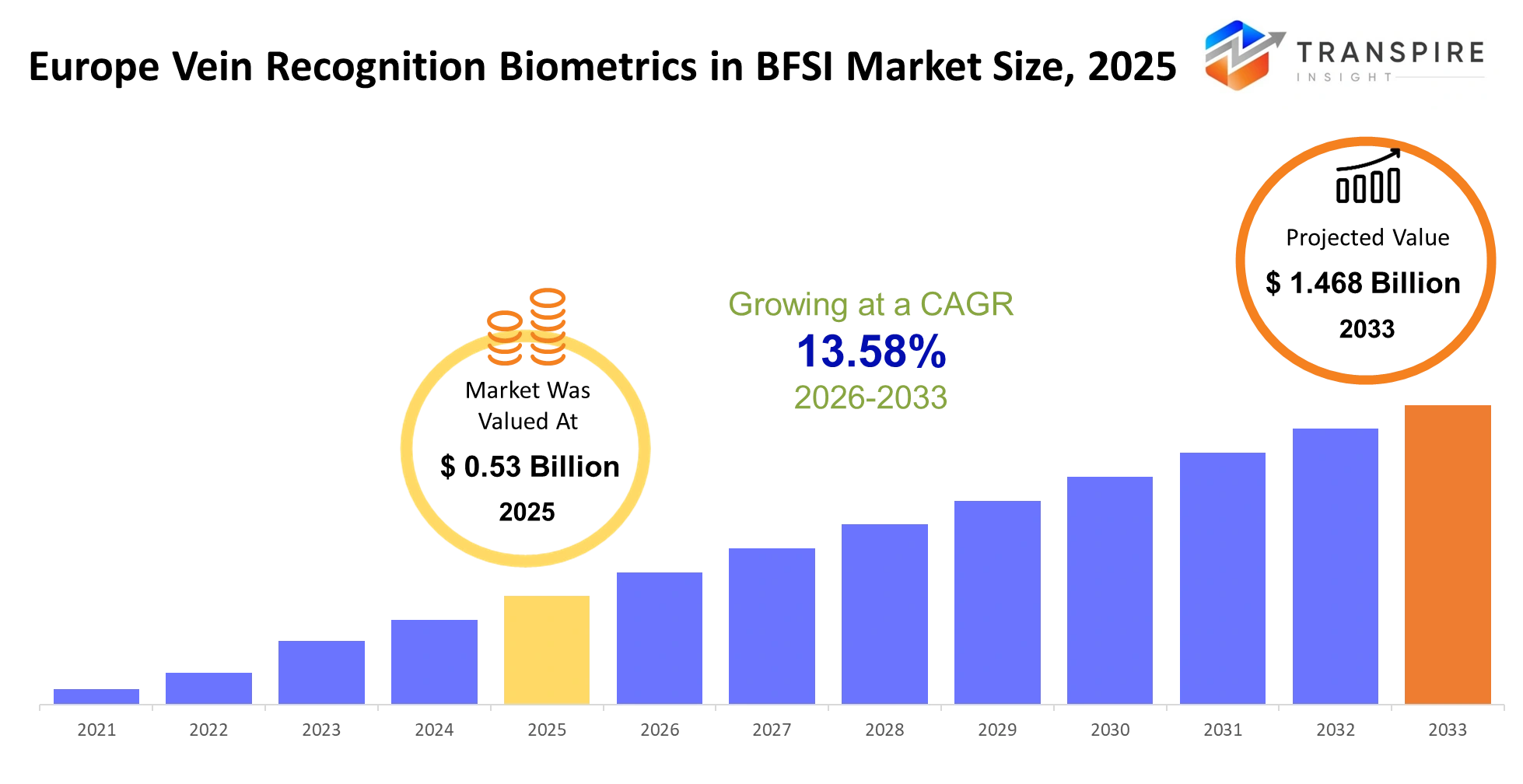
- Europe Vein Recognition Biometrics in BFSI Market Size 2025: USD 0.53 Billion
- Europe Vein Recognition Biometrics in BFSI Market Size 2033: USD 1.468 Billion
- Europe Vein Recognition Biometrics in BFSI Market CAGR: 13.58%
- Europe Vein Recognition Biometrics in BFSI Market Segments: By Type (Finger Vein, Palm Vein, Multi-vein Systems, Others), By Application (Authentication, Access Control, Payment Security, ATM Security, Others), By End-User (Banks, Financial Institutions, Fintech Firms, Others), By Deployment (Cloud, On-premise, Hybrid, Others).
To learn more about this report,  Download Free Sample Report
Europe Vein Recognition Biometrics in BFSI Market Summary:
The Europe Vein Recognition Biometrics in BFSI Market size is estimated at USD 0.53 Billion in 2025 and is anticipated to reach USD 1.468 Billion by 2033, growing at a CAGR of 13.58% from 2026 to 2033. The Europe Vein Recognition Biometrics in BFSI Market is changing the methods that banks and insurers and payment providers use to confirm identity during high-risk transactions. Financial institutions use vein recognition systems at their ATMs and branch kiosks and mobile banking checkpoints and secure vault access points because these systems help them to prevent fraud while delivering quick customer authentication without using passwords or PINs or fingerprints which can be copied or spoofed. The technology provides a solution to an increasing operational challenge which European banks face because their digital transaction volume has grown beyond the capacity of existing identity security systems.
The market has progressed during the past three to five years from testing biometric systems at pilot sites to implementing AI-powered security systems which use multi-factor authentication together with cloud-based banking solutions. Financial institutions needed to enhance their identity verification processes for online services because PSD2 implementation together with new customer authentication rules required them to enforce stronger verification methods. The increase in remote banking during COVID-19 showed system vulnerabilities which led banks to adopt contactless biometric authentication instead of using password systems. This shift results in increased investments dedicated to secure onboarding systems and ATM upgrades and fraud prevention systems which produce ongoing revenue sources for biometric solution companies.
Key Market Insights
- The 2025 Europe Vein Recognition Biometrics market in BFSI sector showed Germany as its leading country which obtained 28% of the total market due to its superior banking digitalization technologies.
- The Nordic region became the fastest developing market because of its quick adoption of fintech and its substantial funding for cybersecurity solutions used in banking authentication systems.
- Palm vein recognition technology achieved more than 46% industry share in 2025 because it provided banking applications with better accuracy and fewer false-acceptance errors.
- Finger vein recognition continued to be the second-largest market segment because European financial institutions increased their use of secure employee authentication systems and branch access control systems.
- Through 2031 banks will require multimodal biometric systems which use AI technology to develop their fraud detection systems that protect digital banking services.
- ATM authentication applications generated approximately 39% of total revenue because people increasingly adopted cardless cash withdrawal and contactless banking transaction methods.
- Mobile banking authentication functions as the fastest growing application area because European BFSI networks now use remote account onboarding and digital payment verification as standard procedures.
- European Vein Recognition Biometrics in BFSI Market shows large commercial banks as its main end-user group because these banks handle high-value transactions together with security risks.
- The fastest expanding end-user segment in the market consists of digital-only banks and fintech companies which grow through their use of cloud banking systems and instant customer verification needs.
- The Europe Vein Recognition Biometrics in BFSI Market shows strong market growth because anti-money laundering compliance requirements and new customer authentication regulations are becoming more demanding.
What are the Key Drivers, Restraints, and Opportunities in the Europe Vein Recognition Biometrics in BFSI Market?
The Europe Vein Recognition Biometrics market in BFSI sector experiences its most powerful growth because European Union countries implement stricter digital banking security requirements. After the post-pandemic digital banking surge led to rising online fraud and account takeover incidents, PSD2 and Strong Customer Authentication requirements forced banks to adopt authentication methods that exceeded traditional password and SMS verification methods. The system of vein recognition received increased acceptance because it provides precise authentication results, which are difficult to duplicate through fingerprint and facial recognition methods. The combination of regulatory requirements and security measures led to increased investments in biometric ATMs and digital onboarding systems and branch authentication systems, which generated ongoing software and support revenue for biometric technology companies.
The market faces its highest structural constraint from the challenges involved in implementing vein recognition technology within existing banking systems used by European banks. Many financial institutions still operate on decades-old core banking platforms that were not designed for real-time biometric authentication. The process of replacing or upgrading these systems demands an extensive political system of financial resources that leads to multiple-year investment cycles and security certification and essential government approval requirements. The delay in major system launch requires banks to spend money for system updates which mid-sized banks cannot afford because they lack resources for system upgrades.
The development of AI-based multimodal biometric banking platforms presents a significant opportunity that will shape future banking systems. The financial technology hubs situated in Germany and Nordic countries of Europe are now integrating vein pattern recognition technology with behavioral analysis and cloud-based identity verification methods.
What Has the Impact of Artificial Intelligence Been on the Europe Vein Recognition Biometrics in BFSI Market?
Artificial intelligence and advanced digital technologies are transforming the Europe Vein Recognition Biometrics in BFSI Market through their capability to enhance authentication speed and improve fraud detection accuracy while boosting operational efficiency in banking networks. Financial institutions increasingly adopt AI-based biometric systems which enable automatic customer identification during ATM transactions and online account creation and mobile banking authentication. The systems execute real-time analysis of vein patterns and transaction activities and device fingerprints and login irregularities which results in decreased manual verification requirements and improvements in customer authentication speed.
Machine learning models enhance predictive fraud prevention systems through their capacity to identify suspicious activities. Banks employ behavioral analytics together with adaptive AI algorithms to detect fraudulent activities because these methods are effective in monitoring remote banking sessions and high-value cross-border payments. Multimodal biometric systems combined with cloud-based fraud analytics platforms resulted in European banks achieving decreased false acceptance rates and improved transaction processing efficiency. Automated audit trail generation by AI-based authentication systems helps financial institutions meet PSD2 requirements and Strong Customer Authentication standards which reduces their regulatory risk and operational expenses.
The process of adopting AI technology faces a critical barrier because banks struggle with connecting new biometric intelligence systems to their existing banking systems. European financial institutions face operational challenges because their core systems operate as disconnected systems which prevent them from achieving real-time data sharing capabilities while raising their deployment expenses and extending their time to implement large-scale projects.
Key Market Trends
- The European banking sector decreased its use of OTP authentication methods while increasing its implementation of palm vein authentication for secure digital banking operations starting from 2021.
- Germany and Nordic countries launched biometric ATM modernization initiatives which grew during the period from 2022 to 2023 because of increasing card skimming activities that affected their banking systems.
- Financial institutions transitioned from using single-factor authentication methods to multimodal biometric systems which combined vein recognition technology with behavioral analytics and artificial intelligence-based fraud detection systems.
- Hitachi and Fujitsu established more relationships with European fintech companies to enhance their cloud-based identity verification systems since 2023.
- The banking sector started to use contactless authentication solutions more frequently because of increased customer demand for touch-free verification methods which emerged after the pandemic.
- From 2022 to 2025, digital-only banks implemented mobile banking authentication systems at a faster rate than branch-based systems because they expanded their capability to onboard customers through remote methods.
- The enforcement of PSD2 Strong Customer Authentication rules by regulators after 2021 prompted mid-sized European banks to boost their biometric security spending.
- BFSI organizations in Europe started to replace their outdated fingerprint systems with vein recognition technology which provided better security through lower false acceptance rates in high-security financial environments.
- AI-powered biometric fraud detection systems enhanced their ability to identify unusual patterns in real time, which enabled banks to decrease their manual compliance auditing needs and operational interruptions.
- Vendors of API-enabled biometric systems have started to focus on achieving effortless integration of their products into banking and payment systems that operate on cloud-native platforms.
Europe Vein Recognition Biometrics in BFSI Market Segmentation
By Type
Palm vein recognition systems hold the leading position within the type segment because major European banks prioritize high authentication accuracy and low spoofing risk for customer-facing financial transactions. The pandemic period brought increased hygiene issues which led to greater use of contactless verification through palm vein scanners. Finger vein systems maintain strong market presence because their deployment costs remain lower while they provide simple integration into existing access control infrastructure.
The multi-vein systems category shows the fastest growth because financial institutions now use multiple biometric systems to secure high-value transactions and detect fraudulent activities. The demand for multimodal solutions is increasing because banks need to meet stronger PSD2 and Strong Customer Authentication requirements. Technology vendors are therefore investing in AI-enabled recognition engines miniaturized sensors and mobile-compatible verification platforms. The upcoming competition within this segment will focus on three main areas which include authentication speed and cloud compatibility and digital banking ecosystem integration flexibility.
By Application
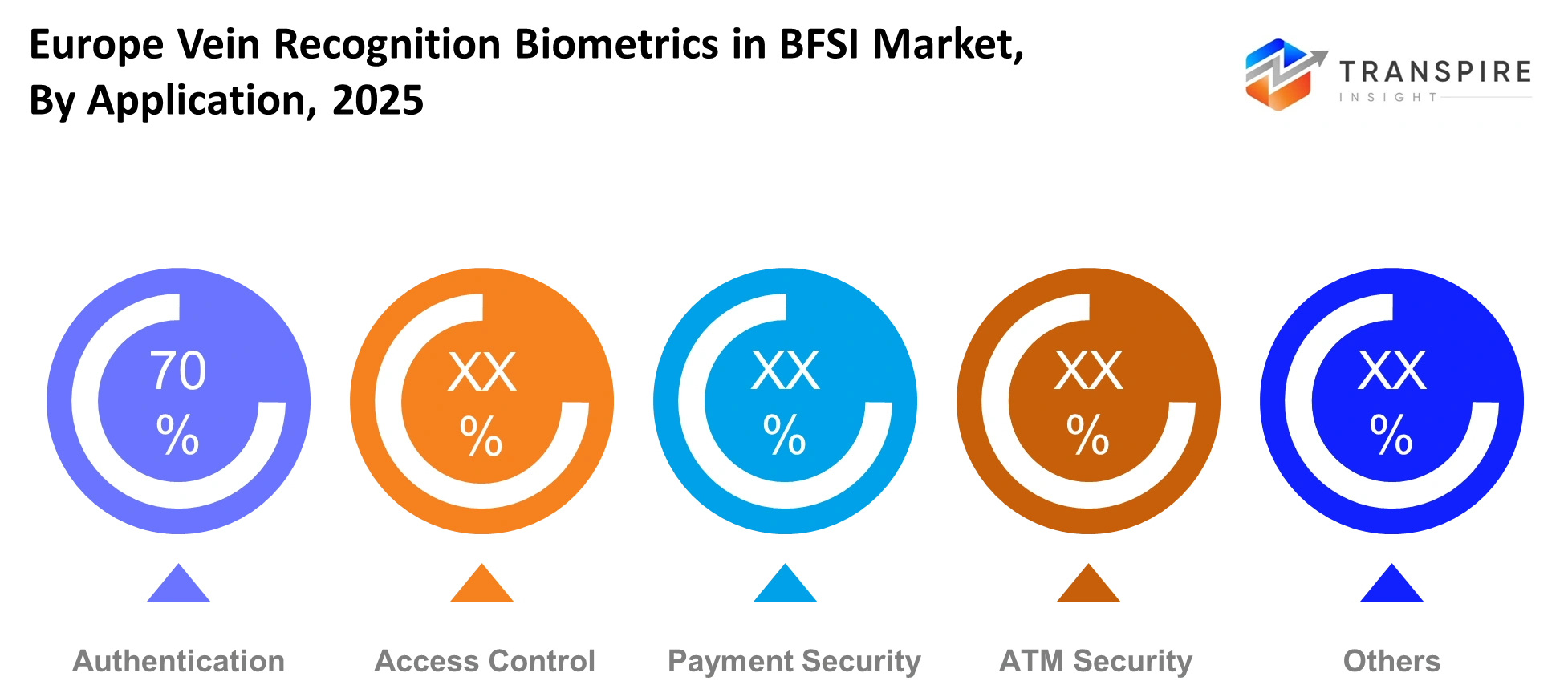
The application market is mainly occupied by authentication applications because financial institutions need biometric identity verification to protect their online banking and remote onboarding and account recovery operations. Banks invest in modernizing their self-service banking systems because ATM security generates substantial revenue through decreased card skimming and unauthorized withdrawal incidents. Financial institutions now use access control systems to secure their back-office operations and data centers because they need better systems to verify employee identities. Digital wallet and real-time transaction platform adoption across Europe has led to increasing demand for payment security applications.
Biometric verification systems help financial institutions decrease fraud risks while providing customers easier access, which explains their preference for vein recognition systems over traditional passwords. People will demand unified authentication systems that use artificial intelligence for fraud detection and biometric verification of transactions in the future. Software developers, cloud platform providers, and biometric hardware manufacturers who build digital banking systems will find permanent business opportunities through this transition.
To learn more about this report, Download Free Sample Report
By End-User
The banking sector functions as the primary user group because commercial banks operate their extensive network of ATMs and branch locations and their secure systems for high-value transactions which require advanced authentication methods. The financial sector which includes insurance companies and investment firms has gained significant market share because companies need to protect their assets from rising cybersecurity threats associated with online banking services. Fintech companies now operate as the fastest expanding user group since digital-first banking platforms need both seamless identity verification methods and immediate fraud detection solutions. Smaller fintech companies show a growing tendency to use cloud-based biometric technology instead of spending money on building their own authentication systems.
The need to compete against digital-only banks has driven financial institutions to accelerate their development of systems that use passwordless verification methods for customer authentication. The European regulatory framework continues to shape purchasing patterns within this market segment. The market will develop future growth trends which will benefit vendors that provide API-based biometric systems which work seamlessly with mobile banking software and AI-based fraud detection tools and open banking systems. The banking sector operates as the primary user group because banking networks maintain their complete ATM systems and branch facilities and secure systems for high-value transactions which require advanced authentication methods. The financial sector which includes insurance companies and investment firms has gained significant market share because companies need to protect their assets from rising cybersecurity threats associated with online banking services. Fintech companies now operate as the fastest expanding user group since digital-first banking platforms need both seamless identity verification methods and immediate fraud detection solutions.
By Deployment
Major European banks currently prefer on-premise deployment because they need complete control over their sensitive biometric data and their cybersecurity systems and their infrastructure which meets regulatory standards. The demand for localized deployment models continues because many financial organizations operate banking systems which were developed before the cloud technology became available. Fintech companies and mid-sized financial institutions choose cloud-based deployment because it provides them with lower infrastructure expenses and quicker system expansion and easier software upkeep.
Financial institutions are increasingly adopting hybrid deployment models because they need to control their data sovereignty requirements while using cloud-native banking systems. Hybrid architectures emerge as the preferred solution according to demand patterns which enable real-time authentication across digital channels while keeping essential data in secure private spaces. Technology providers are creating encrypted cloud systems together with edge computing technologies and AI-based authentication monitoring solutions. European biometric platforms will establish secure interoperability links with digital banking systems through the upcoming investment focus of industry players.
What are the Key Use Cases Driving the Europe Vein Recognition Biometrics in BFSI Market?
European banking networks use ATM and digital banking authentication systems as their main authentication method for customer identification. Large commercial banks increasingly deploy palm vein recognition systems to prevent card fraud, account takeover incidents, and unauthorized cash withdrawals while improving customer verification speed.
Secondary applications are expanding across employee access control and remote customer onboarding platforms. Financial institutions and fintech firms increasingly integrate vein recognition into mobile banking applications and secure data center access systems to strengthen compliance with PSD2 authentication requirements.
Biometric payment authorization for contactless retail banking transactions and AI-driven identity verification for cross-border digital lending platforms represent new use cases that have emerged. Several Nordic fintech providers are also testing multimodal biometric wallets that combine vein recognition with behavioral analytics for high-risk financial transactions.
|
Report Metrics |
Details |
|
Market size value in 2025 |
USD 0.53 Billion |
|
Market size value in 2026 |
USD 0.602 Billion |
|
Revenue forecast in 2033 |
USD 1.468 Billion |
|
Growth rate |
CAGR of 13.58% from 2026 to 2033 |
|
Base year |
2025 |
|
Historical data |
2021 - 2024 |
|
Forecast period |
2026 - 2033 |
|
Report coverage |
Revenue forecast, competitive landscape, growth factors, and trends |
|
Regional scope |
Europe (Germany, United Kingdom, France, Italy, Spain and Rest of Europe) |
|
Key company profiled |
Hitachi, Fujitsu, NEC, M2SYS, BioSec Group, IDEMIA, Suprema, Thales, Crossmatch, Aware Inc, HID Global, Safran, ZKTeco, Dermalog, SecuGen. |
|
Customization scope |
Free report customization (country, regional & segment scope). Avail customized purchase options to meet your exact research needs. |
|
Report Segmentation |
By Type (Finger Vein, Palm Vein, Multi-vein Systems, Others), By Application (Authentication, Access Control, Payment Security, ATM Security, Others), By End-User (Banks, Financial Institutions, Fintech Firms, Others), By Deployment (Cloud, On-premise, Hybrid, Others). |
Which Regions are Driving the Europe Vein Recognition Biometrics in BFSI Market Growth?
The biometric banking market in Western Europe shows Germany, the United Kingdom, and France as its top three markets which adopt biometric banking systems. Financial institutions accelerated their investments in vein recognition authentication systems because of strong PSD2 enforcement combined with existing digital banking systems. The region's major commercial banks maintain multiple ATMs and branch locations which require them to use advanced methods for preventing fraudulent activities. The ecosystem which exists between fintech companies and cybersecurity firms and biometric technology providers enables businesses to implement new systems while upgrading their existing systems.
The Nordic countries represent the second most important area in terms of market share although its growth pattern differs from that of Western Europe. Nordic countries focus less on large physical banking infrastructure and more on highly digitized financial ecosystems supported by cashless payment adoption. Biometric authentication technologies receive continuous investment because digital identity systems have achieved strong consumer acceptance and regulatory frameworks maintain stable conditions. Northern European banks and fintech companies invest in secure mobile banking solutions and cloud-native verification systems which makes this region a dependable source for ongoing technology investments.
The banking sector in Eastern Europe has become the fastest-growing market because banks are modernizing their operations and making bigger investments in cybersecurity measures. Various financial organizations in Poland and Romania and the Czech Republic have accelerated their digital transformation efforts because online fraud incidents and remote banking usage have risen since 2021. The government together with regional banking regulators established stronger cybersecurity compliance standards to drive investment in advanced biometric authentication systems.
Who are the Key Players in the Europe Vein Recognition Biometrics in BFSI Market and How Do They Compete?
The market displays a moderate degree consolidation because a few biometric technology companies and major digital identity providers together dominate most valuable BFSI projects throughout Europe. Businesses now compete through their ability to authenticate users, their capacity to integrate with cloud systems, their AI-powered fraud detection systems and their readiness to meet PSD2 and Strong Customer Authentication compliance standards. Established biometric firms maintain their market position by using their unique vein-matching technology and their enduring relationships with banks, while fintech companies enter the market through their adaptable API deployment systems. The vendors use speed of integration as their competitive advantage because most banking institutions depend on traditional banking systems that need specialized implementation assistance.
Hitachi maintains a strong competitive position through palm vein authentication technology with high recognition accuracy and low false acceptance rates in ATM and branch banking environments. The company focuses heavily on technology-driven differentiation rather than price competition, particularly in contactless authentication systems integrated with digital banking platforms. The company established strategic partnerships with European financial institutions and system integrators to expand its deployment capabilities across remote onboarding and self-service banking applications. Fujitsu competes through multimodal biometric platforms that combine vein recognition with AI-based behavioral analytics for fraud monitoring. The integration capability enables Fujitsu to provide banks with a unified authentication system that banks prefer over independent biometric hardware solutions.
Company List
- Hitachi
- Fujitsu
- NEC
- M2SYS
- BioSec Group
- IDEMIA
- Suprema
- Thales
- Crossmatch
- Aware Inc
- HID Global
- Safran
- ZKTeco
- Dermalog
- SecuGen
Recent Development News
In March 2026, IDEX Biometrics expands its biometric ID card deployment framework with an exclusive tech partnership: IDEX announced a strategic expansion agreement involving exclusive biometric sensor deployment across identity card systems. The collaboration focuses on secure financial identity verification systems, a key BFSI use case where vascular/vein-based biometric integration is increasingly deployed in high-security banking authentication.
Source: https://live.euronext.com
In March 2026, IDEX Biometrics signs a commercial agreement with ID Centric: European biometrics company IDEX Biometrics has finalised a commercial agreement with ID Centric for the deployment of its biometric sensor technology in identity and payment solutions. The deal strengthens biometric authentication use in financial identity systems, including high-security card-based access used in BFSI environments.
Source: https://live.euronext.com
What Strategic Insights Define the Future of the Europe Vein Recognition Biometrics in BFSI Market?
The Europe Vein Recognition Biometrics in BFSI Market is structurally moving toward passwordless and AI-orchestrated banking ecosystems over the next five to seven years. Financial institutions will implement biometric authentication systems through digital identity systems which will authenticate users across their mobile banking services and payment systems and lending processes and international financial transactions. Organizations need to improve their operational efficiency through digital customer experiences because they face escalating fraud threats and more stringent cybersecurity regulations.
The hidden danger emerges from the pressure to replace current systems with behavioral biometrics and decentralized digital identity solutions which will decrease the need for hardware-dependent vein recognition systems in specific banking functions. The biometric market becomes insecure because only a few specialized biometric vendors possess essential authentication methods and system integration capabilities.
The Eastern European market presents a significant opportunity for mid-sized banks which are upgrading their outdated systems by implementing cloud-based authentication solutions. Market participants should prioritize interoperable biometric ecosystems with API-based deployment models because banks increasingly favor scalable platforms that integrate seamlessly with AI fraud analytics and open banking architecture.
Europe Vein Recognition Biometrics in BFSI Market Report Segmentation
By Type
- Finger Vein
- Palm Vein
- Multi-vein Systems
- Others
By Application
- Authentication
- Access Control
- Payment Security
- ATM Security
- Others
By End-User
- Banks
- Financial Institutions
- Fintech Firms
- Others
By Deployment
- Cloud
- On-premise
- Hybrid
- Others
Frequently Asked Questions
Find quick answers to common questions.
The approximate Europe Vein Recognition Biometrics in BFSI Market size for the market will be USD 1.468 Billion in 2033.
The key segments of the Europe Vein Recognition Biometrics in BFSI Market are By Type (Finger Vein, Palm Vein, Multi-vein Systems, Others), By Application (Authentication, Access Control, Payment Security, ATM Security, Others), By End-User (Banks, Financial Institutions, Fintech Firms, Others), By Deployment (Cloud, On-premise, Hybrid, Others).
Major players in the Europe Vein Recognition Biometrics in BFSI Market are Hitachi, Fujitsu, NEC, M2SYS, BioSec Group, IDEMIA, Suprema, Thales, Crossmatch, Aware Inc, HID Global, Safran, ZKTeco, Dermalog, SecuGen.
The current market size of the Europe Vein Recognition Biometrics in BFSI Market is USD 0.53 Billion in 2025.
The Europe Vein Recognition Biometrics in BFSI Market CAGR is 13.58%.
- Hitachi
- Fujitsu
- NEC
- M2SYS
- BioSec Group
- IDEMIA
- Suprema
- Thales
- Crossmatch
- Aware Inc
- HID Global
- Safran
- ZKTeco
- Dermalog
- SecuGen
Recently Published Reports
-
Apr 2026
3D Optical Profiler Market
3D Optical Profiler Market Size, Share & Analysis Report By Type (Desktop 3D Optical Profiler, and Portable 3D Optical Profiler), By Technology (Confocal Technology, and White Light Interference), By End-Use Industry (Manufacturing, Research Institutions, Automotive, Aerospace and Defense, Medical Devices, and Other), and Geography (North America, Europe, Asia-Pacific, Middle East and Africa, South and Central America), 2021 - 2031
-
Apr 2026
Depth Sensor Market
Depth Sensor Market Size, Share & Analysis Report By Type (Infrared Depth Sensors, Time-of-Flight (ToF) Sensors, Stereo Vision Sensors, Structured Light Sensors, Ultrasonic Depth Sensors), By Application (Automotive, Robotics, Gaming, Consumer Electronics, Industrial Automation, Healthcare, Security & Surveillance, Others), By End Users (Automotive Manufacturers, Consumer Electronics Companies, Healthcare Providers, Industrial Companies, Security Agencies, Gaming Companies, Robotics Companies, Others), and Geography (North America, Europe, Asia-Pacific, Middle East and Africa, South and Central America), 2021 – 2031
-
Apr 2026
Digital Manufacturing Market
Digital Manufacturing Market Size, Share & Analysis Report By Component (Hardware, Software, and Services), By Technology (Robotics, 3D Printing, Internet of Things (IoT), and Others), By Application (Automotive and Transportation, Aerospace and Defense, Consumer Electronics, Industrial Machinery, and Others), By Process Type (Computer-Based Designing, Computer-Based Simulation, Computer 3D Visualization, Analytics, and Others), and Geography (North America, Europe, Asia-Pacific, Middle East and Africa, South and Central America), 2021 – 2031
-
Apr 2026
Digital Visa Services Market
Digital Visa Services Market Size, Share & Analysis Report By Type (Individual Travelers, Group Travelers), By Application (Tourism, Business Travel, Others), and Geography (North America, Europe, Asia-Pacific, Middle East and Africa, South and Central America), 2021 – 2031