

United Kingdom Liquidity Management Solutions Market Size & Forecast:
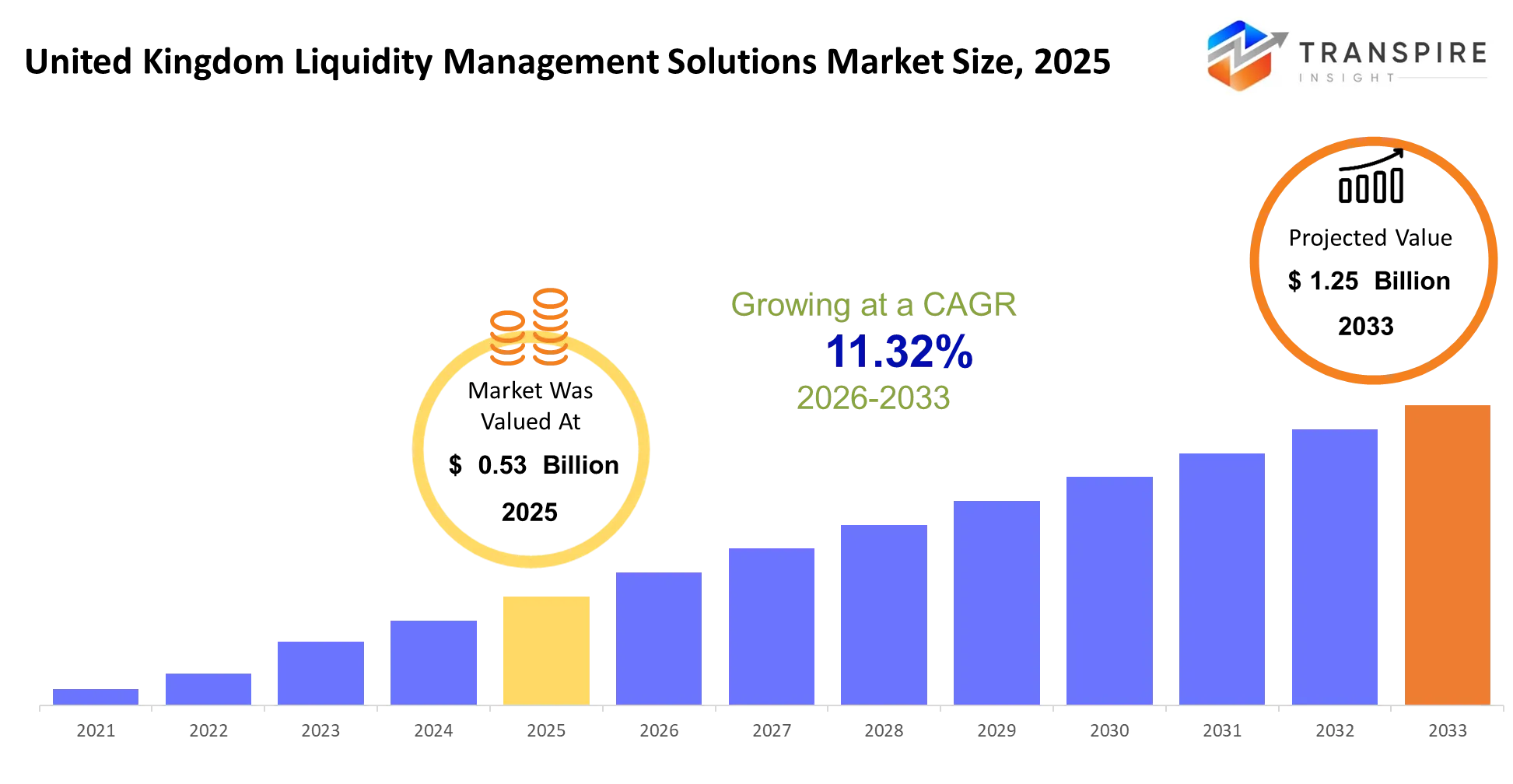
- United Kingdom Liquidity Management Solutions Market Size 2025: USD 0.53 Billion
- United Kingdom Liquidity Management Solutions Market Size 2033: USD 1.25 Billion
- United Kingdom Liquidity Management Solutions Market CAGR: 11.32%
- United Kingdom Liquidity Management Solutions Market Segments: By Component (Software Platforms, Risk Analytics Tools, Treasury Management Systems, Cloud Services, Others); By Deployment (Cloud-based, On-premise, Hybrid Systems, Others); By Application (Cash Flow Management, Risk Management, Regulatory Compliance, Payment Management, Others); By End User (Banks, Financial Institutions, Insurance Companies, Enterprises, Others)
To learn more about this report,  Download Free Sample Report
United Kingdom Liquidity Management Solutions Market Summary
The United Kingdom Liquidity Management Solutions Market was valued at USD 0.53 Billion in 2025. It is forecast to reach USD 1.25 Billion by 2033. That is a CAGR of 11.32% over the period.
Across UK enterprises , liquidity management solutions kinda help treasury teams track and shuffle cash across several bank accounts plus subsidiaries, so they can fund day to day operations, improve working capital, and also stop money getting stuck , or just sitting there unused. In day-to-day usage, these platforms link together fragmented banking data, automate cash pooling, and deliver near live visibility , which in practice replaces spreadsheet driven forecasting.
Over the last 3–5 years , the market has moved in a structural way away from manual treasury setups towards cloud based platforms that use API-driven open banking connectivity, enabling near real time liquidity positioning across different banks. A major spark for this shift has been the sharper interest rate volatility after the 2022 monetary tightening cycle, where corporates started repositioning surplus cash more actively, instead of letting it stay dormant. Because of that, CFOs end up prioritizing automated forecasting and intraday cash governance, and this in turn boosts adoption of integrated liquidity tools and supports subscription based treasury software revenue growth.
Key Market Insights
- The United Kingdom Liquidity Management Solutions Market is, in practice, pushed by real-time treasury digitization, which makes cash forecasting more accurate across big corporate banking ecosystems, almost like everything syncs faster.
- Market growth tends to be supported by a climbing appetite for cloud based liquidity platforms, so companies can get centralized cash visibility and then automate intraday funding choices, more or less on the fly.
- Open banking API integration is a key structural change, and it cuts down manual reconciliation , while also speeding up liquidity positioning across multi bank setups.
- Also, since 2022, interest rate volatility basically nudged liquidity optimization approaches to move harder, and firms started redeploying idle cash into yield generating instruments instead of letting it sit.
- London is the main hub, holding nearly 42% share of the United Kingdom Liquidity Management Solutions Market. This happens because there are so many financial institutions there, plus corporate headquarters clustering in that area , which naturally strengthens adoption.
- Northern England is basically the fastest-growing region, projected at 7.8% CAGR through 2030, largely because SMEs are moving toward digital treasury adoption.
- Cloud-based liquidity management software is in the lead with a 55% share, showing how quickly companies are shifting away from older on-premise treasury setups, and yeah it’s happening fast.
- Consulting and integration services come in as the second-largest segment, and they help with customizing the system as well as enabling bank connectivity, in a more practical way.
- For applications, cash forecasting takes the top spot with roughly a 38% share, and that tends to boost liquidity planning precision for big enterprises.
- Meanwhile, liquidity pooling and optimization is the fastest-growing application area, pulled along by cross-border treasury centralization requirements.
What are the Key Drivers, Restraints, and Opportunities in the United Kingdom Liquidity Management Solutions Market?
The main driver is the fast move toward real-time treasury awareness, enabled by cloud computing and open banking infrastructure. After regulatory pressure that looks like PSD2-style banking access reforms and the UK’s wider digital finance agenda, corporations can now bring together multi-bank cash balances pretty much instantly. That has bumped up adoption of liquidity management platforms, because finance teams are swapping delayed end-of-day reporting for intraday decision tools, which helps with yield optimization and cuts idle cash losses, and it also strengthens those recurring software revenue streams.
A big restraint, though, is the continuing integration headache with older ERP setups and split, fragmented banking systems. A lot of large enterprises still run hybrid infrastructures, so they end up needing costly custom work,plus longer implementation timelines. This structural thing slows full-scale adoption, since firms must sync several subsidiaries, deal with stale reconciliation workflows, and keep strict internal controls in place. All of it, unfortunately, delays the rollout,then dampens near-term subscription revenue growth even when the demand signals are strong.
There’s also an emerging opportunity in AI-led predictive liquidity modeling, paired with embedded finance ecosystems. Early progress shows up in London-based fintech pilots where treasury platforms use machine learning to anticipate cash positions across global subsidiaries. As UK banks grow their API marketplaces, and corporate treasuries put money into automation-first architectures, this could open the next growth phase for the United Kingdom Liquidity Management Solutions Market.
What Has the Impact of Artificial Intelligence Been on the United Kingdom Liquidity Management Solutions Market?
Artificial intelligence is kind of reshaping the United Kingdom Liquidity Management Solutions Market by turning older treasury operations into automated, data-driven set ups that work in near real time, or close enough. In most of these newer liquidity platforms, AI is commonly used to automate cash positioning, reconcile multi-bank transactions, and also optimize liquidity pooling across subsidiaries. The end result is less manual treasury work and faster decision making, especially for large corporations who have to handle fragmented banking relationships, across different providers and accounts.
Predictive capabilities are also moving to the center of platform value. Machine learning models look at historical cash flows, seasonality patterns, and payment cycles, then they produce intraday liquidity forecasts with better accuracy than rule-based systems. On top of that, these models help with scenario planning, so treasury teams can expect funding gaps and optimize short-term investments before volatility starts to disturb working capital. So, in practice, firms often see improved forecasting precision and a more efficient approach to capital allocation.
Operationally, these upgrades can show up as measurable wins, like reduced idle cash balances, quicker reconciliation cycles, and better liquidity utilization across business units. Still, adoption is held back by a structural snag: inconsistent data quality and limited real-time connectivity with certain banking systems. A lot of institutions still depend on delayed or incomplete feeds, and that can lower model accuracy, plus it slows down full scale AI deployment, even when demand for automation in liquidity management platforms stays strong.
Key Market Trends
- Since 2022, interest rate volatility kept climbing, so UK treasuries started moving away from “set and leave” cash holding , toward a more active, intraday liquidity optimization thing and real time repositioning plans, kinda constantly.
- Open banking API expansion after PSD2-like reforms made multi-bank data aggregation faster, and it kinda replaced those old end-of-day style reports across bigger UK enterprises.
- Between 2021 and 2025, cloud migration displaced a lot of legacy on-premise treasury systems, and by now more than 50% of firms have switched to SaaS liquidity platforms, at least in some part of their stack.
- AI driven forecasting tools also gained momentum, because corporations have been improving how accurately they predict cash , which in turn reduced liquidity mismatches across subsidiaries and separate business units.
- And yeah, integration complexity with ERP systems rose, so the demand for consulting services went up too, especially as firms modernize treasury setups that used to be fragmented across multinational operations.
- Meanwhile banks kept expanding their API ecosystems and adding real-time payment rails , helping corporate treasuries connect more tightly with financial institutions across the UK.
- Vendors such as SAP, Oracle, and Kyriba got more aggressive in competition, mainly via AI enabled liquidity analytics platforms.
- Cross-border liquidity pooling sped up as UK corporates centralized treasury operations, to cut down idle cash and improve global capital efficiency, overall.
- For SMEs, adoption rose quickly after 2023, largely because fintech providers offered low-code SaaS treasury tools, plus onboarding models that were a lot simpler than before.
United Kingdom Liquidity Management Solutions Market Segmentation
By Component :
Software platforms are kind of the core of liquidity management operations, because they link fragmented banking information and make it possible to see cash in a more centralized way across several accounts. In practice these tools ditch manual spreadsheets for automated dashboards, which then let teams make decisions in near real time. Risk analytics tools also play a stronger role, they help tighten financial control by surfacing exposure patterns and liquidity gaps, while treasury management systems tie together cash forecasting, payments, and reporting into one operational setting.
Cloud services then assist with scalability and faster rollouts, so enterprises can modernize their treasury workflows without putting too much money into heavy infrastructure. There are also other supporting tools that bring in some specialized capabilities, so reporting looks more accurate and day to day operations run more efficiently.
By Deployment :
Cloud-based deployment drives adoption, as organizations move toward flexible, subscription based treasury solutions that roll out updates quicker, and give real time access to liquidity data. Still, on-premise systems stay in use at big institutions, mostly because they care a lot about internal control and data protection, even if adoption is slowly easing.
Hybrid systems are becoming more typical too, since many firms shift between legacy infrastructure and newer platforms, trying to balance governance with scalability. Other deployment approaches exist in narrower situations, like when custom integrations are needed for complicated banking setups and specific regulatory structures.
By Application :
Cash flow management stays kinda the main application, helping enterprises track inflows and outflows, so they can keep liquidity stable during daily operations. Then risk management applications usually go on to pinpoint liquidity shortages and financial exposure across subsidiaries, in a more measured way.
Regulatory compliance tools make sure reporting is accurate , and stays lined up with financial governance rules, which in turn lowers the chance of operational penalties. Payment management systems handle settlement for both cross-border and local payments, speeding things up while also boosting precision. Other applications also support forecasting and strategic financial planning, for corporate treasury teams and their routines.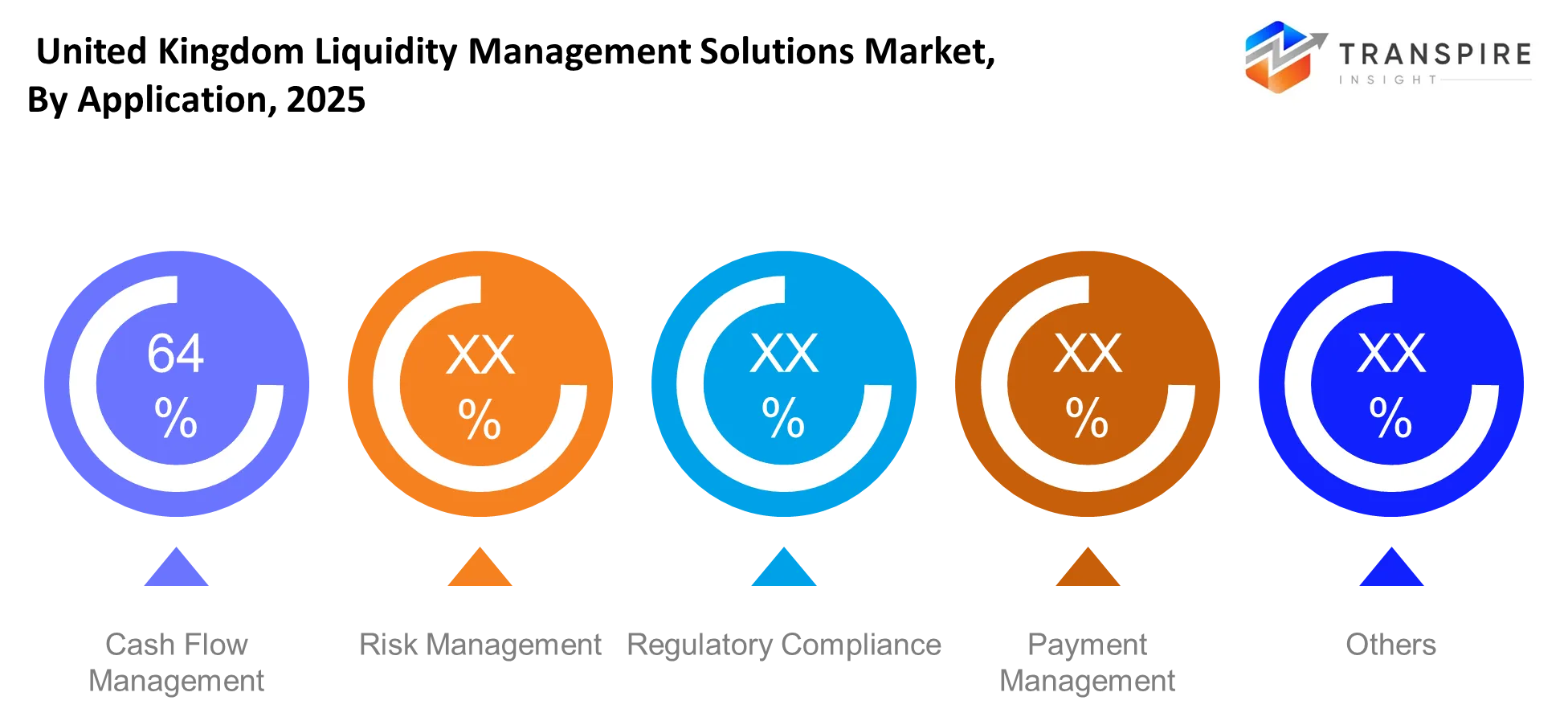
To learn more about this report, Download Free Sample Report
By End User :
Banks use liquidity management solutions to fine tune internal capital allocation and strengthen treasury services that customers actually experience. Financial institutions, in the meantime , use these same tools to steer large-scale investment flows and cut down on operational inefficiencies. Insurance companies lean on liquidity systems to balance long-term liabilities with short-term cash needs, without losing flexibility.
Enterprises are a huge user base, especially since they adopt centralized treasury platforms to improve cash visibility across global operations. Other end users include government-linked organizations and specialized financial service providers that want structured liquidity control systems, not just basic visibility.
What are the Key Use Cases Driving the United Kingdom Liquidity Management Solutions Market?
The core use case is cash flow management in the United Kingdom Liquidity Management Solutions market, mostly driven by enterprises that need real time visibility into fragmented bank balances plus payment cycles. Demand keeps going up because volatile interest rates kind of force more disciplined working capital control , and also quicker funding decisions, in practice.
Expanding applications cover risk management and payment management across banks and insurance companies too. These users tend to adopt automated liquidity tracking to reduce exposure gaps, boost settlement accuracy, and simplify high volume domestic as well as cross border transactions, as digital payment infrastructure becomes more connected, all together.
Newer use cases are starting to show up like AI based liquidity forecasting and real time intraday optimization. Embedded finance integrations with banking APIs , along with cross border cash pooling, are gaining traction as firms look for proactive capital allocation and less idle cash across different jurisdictions.
|
Report Metrics |
Details |
|
Market size value in 2025 |
USD 0.53 Billion |
|
Market size value in 2026 |
USD 0.59 Billion |
|
Revenue forecast in 2033 |
USD 1.25 Billion |
|
Growth rate |
CAGR of 11.32% from 2026 to 2033 |
|
Base year |
2025 |
|
Historical data |
2021 - 2024 |
|
Forecast period |
2026 - 2033 |
|
Report coverage |
Revenue forecast, competitive landscape, growth factors, and trends |
|
Regional scope |
Middle East and Africa (Saudi Arabia, United Arab Emirates, South Africa, Rest of Middle East and Africa) |
|
Key company profiled |
Oracle, SAP, FIS Global, Finastra, Kyriba, GTreasury, Moody’s Analytics, Murex, Infosys Finacle, Temenos, Wolters Kluwer, IBM, Accenture, Deloitte, Calypso Technology |
|
Customization scope |
Free report customization (country, regional & segment scope). Avail customized purchase options to meet your exact research needs. |
|
Report Segmentation |
By Component (Software Platforms, Risk Analytics Tools, Treasury Management Systems, Cloud Services, Others); By Deployment (Cloud-based, On-premise, Hybrid Systems, Others); By Application (Cash Flow Management, Risk Management, Regulatory Compliance, Payment Management, Others); By End User (Banks, Financial Institutions, Insurance Companies, Enterprises, Others) |
Which Regions are Driving the United Kingdom Liquidity Management Solutions Market Growth?
The United Kingdom Liquidity Management Solutions Market is in practice mainly shaped by London, and also the South East, where there’s a kind of financial concentration that keeps pushing adoption. The region does well too because of its proximity to major banks, treasury hubs, and multinational headquarters, they all really want clearer cash visibility tools. On top of that there is strong regulatory supervision from UK financial authorities, which helps standardize reporting, and makes digital treasury systems roll out sooner. There’s also a fairly dense ecosystem, with fintech providers, cloud infrastructure teams, and enterprise software vendors all active, so innovation keeps happening in liquidity management platforms, more or less continuously.
Scotland acts more like a stable but secondary contributor, backed by a solid base of banking operations plus insurance firms. Unlike London’s quick innovation cycle, Scotland’s adoption feels more driven by long-term institutional investment and cautious treasury modernization plans. In Edinburgh and Glasgow, financial services companies tend to prioritize system reliability, and they emphasize regulatory compliance before anything too experimental. As a result demand stays steady, especially for risk management functions and centralized reporting capabilities inside established financial institutions.
Meanwhile the fastest growth is showing up in Northern England, fueled by industrial digitization, and by rising SME adoption of cloud based treasury tools. A few recent investments in regional financial technology hubs, along with upgrades to digital infrastructure, have made real time banking integration easier to access. Manufacturing and logistics organizations there are using liquidity platforms to handle tighter cash cycles, and to smooth out supply chain swings. This momentum points to strong vendor entry potential, because adoption is expected to expand quickly through 2026–2033, with cloud penetration increasing and more automation d
Who are the Key Players in the United Kingdom Liquidity Management Solutions Market and How Do They Compete?
The United Kingdom Liquidity Management Solutions Market looks like it has a moderately consolidated competitive setup, in a way where global enterprise software providers mostly hold the lead, and then specialized treasury technology firms go after opportunity via innovation. The current incumbents typically keep their ground by tightening cloud integration and putting real-time cash visibility inside bigger financial suites. In practice, competition is less about raw pricing and more about tech depth, API connectivity, and the ability to pull together multi-bank data into a unified view, with fewer frictions. New players tend to push faster deployment models and AI-enabled forecasting, so they can nudge established platforms and, yeah, compete in the same space without waiting as long.
SAP and Oracle both show up through ERP-led treasury ecosystems that feel pretty integrated. SAP leans into a more embedded liquidity approach, actually putting liquidity tools right inside enterprise resource planning workflows, which helps reduce those annoying data transfer delays across finance functions. Oracle, on the other hand, leans toward cloud-native architecture, so liquidity tracking can run more continuously across global subsidiaries. Both companies also seem to expand via long-term enterprise contracts, plus partnerships with UK banks, aiming to improve real-time payment connectivity, and keep that feedback loop strong.
Kyriba, FIS, and ION Treasury basically compete by concentrating on treasury-focused advancement rather than trying to be everything at once. Kyriba puts heavy emphasis on AI-driven cash forecasting features, targeting short-term liquidity precision for multinational corporations. FIS leans on its banking network integration strengths, with the goal to streamline payment processing and liquidity control for financial institutions. ION Treasury grows through modular treasury solutions, plus targeted acquisitions, so it strengthens its position in complicated multi-entity cash management deployments, where coordination gets pretty tricky, and you need more than one single system.
Company List
- Oracle
- SAP
- FIS Global
- Finastra
- Kyriba
- GTreasury
- Moody’s Analytics
- Murex
- Infosys Finacle
- Temenos
- Wolters Kluwer
- IBM
- Accenture
- Deloitte
- Calypso Technology
Recent Development News
In April 2026, Clearwater Analytics received European Commission approval for its acquisition by Permira and Warburg Pincus, clearing a major regulatory milestone for the deal to take the investment accounting and liquidity analytics platform private. Source https://en.wikipedia.org/
In March 2026, The Bank of London Group faced a Prudential Regulation Authority enforcement action resulting in a £2 million fine for misleading regulators about its capital position, raising scrutiny over its liquidity and governance controls. Source https://en.wikipedia.org/
What Strategic Insights Define the Future of the United Kingdom Liquidity Management Solutions Market?
The United Kingdom Liquidity Management Solutions Market is shifting, structurally, toward fully autonomous treasury ecosystems where cash positioning and forecasting and allocation get done in real time, through AI-driven platforms. This seems pushed by deeper open banking penetration and also the continued replacement of split up legacy treasury systems with integrated cloud-native architecture, you know. Over the next 5 to 7 years , competitive advantage will depend more and more on how well firms turn raw banking data into predictive liquidity intelligence, not just “basic” reporting tools.
There is also a less visible kind of risk, from growing dependency on a small cluster of cloud infrastructure providers and core banking API standards. If interoperability frameworks get disrupted, or if pricing concentrates among infrastructure vendors, innovation could slow down and operational costs may rise for end users. And honestly that dependency brings a systemic exposure that is not fully captured in the adoption numbers you usually see.
One more thing, a key emerging opportunity shows up in real-time cross-border liquidity orchestration, tied to the evolving UK fintech export corridors and embedded finance networks. Some early pilots, linking treasury systems with instant payment rails across Europe and Asia, are already pointing to measurable efficiency improvements. Market participants should focus on building API-first, bank-agnostic platforms, and they should deepen their partnerships with financial institutions so they can keep long-term interoperability and stronger data access.
United Kingdom Liquidity Management Solutions Market Report Segmentation
By Component
- Software Platforms
- Risk Analytics Tools
- Treasury Management Systems
- Cloud Services
By Deployment
- Cloud-based
- On-premise
- Hybrid Systems
By Application
- Cash Flow Management
- Risk Management
- Regulatory Compliance
- Payment Management
By End User
- Banks
- Financial Institutions
- Insurance Companies
- Enterprises
Frequently Asked Questions
Find quick answers to common questions.
The United Kingdom Liquidity Management Solutions Market size is USD 1.25 Billion in 2033.
Key Segments for the United Kingdom Liquidity Management Solutions Market are By Component (Software Platforms, Risk Analytics Tools, Treasury Management Systems, Cloud Services, Others); By Deployment (Cloud-based, On-premise, Hybrid Systems, Others); By Application (Cash Flow Management, Risk Management, Regulatory Compliance, Payment Management, Others); By End User (Banks, Financial Institutions, Insurance Companies, Enterprises, Others).
Major United Kingdom Liquidity Management Solutions Market players are Oracle, SAP, FIS Global, Finastra, Kyriba, GTreasury, Moody’s Analytics, Murex, Infosys Finacle, Temenos, Wolters Kluwer, IBM, Accenture, Deloitte, Calypso Technology.
The Current United Kingdom Liquidity Management Solutions Market size is USD 0.53 Billion in 2025.
The United Kingdom Liquidity Management Solutions Market CAGR is 11.32% from 2026 to 2033.
- Oracle
- SAP
- FIS Global
- Finastra
- Kyriba
- GTreasury
- Moody’s Analytics
- Murex
- Infosys Finacle
- Temenos
- Wolters Kluwer
- IBM
- Accenture
- Deloitte
- Calypso Technology
Recently Published Reports
-
Apr 2026
3D Optical Profiler Market
3D Optical Profiler Market Size, Share & Analysis Report By Type (Desktop 3D Optical Profiler, and Portable 3D Optical Profiler), By Technology (Confocal Technology, and White Light Interference), By End-Use Industry (Manufacturing, Research Institutions, Automotive, Aerospace and Defense, Medical Devices, and Other), and Geography (North America, Europe, Asia-Pacific, Middle East and Africa, South and Central America), 2021 - 2031
-
Apr 2026
Depth Sensor Market
Depth Sensor Market Size, Share & Analysis Report By Type (Infrared Depth Sensors, Time-of-Flight (ToF) Sensors, Stereo Vision Sensors, Structured Light Sensors, Ultrasonic Depth Sensors), By Application (Automotive, Robotics, Gaming, Consumer Electronics, Industrial Automation, Healthcare, Security & Surveillance, Others), By End Users (Automotive Manufacturers, Consumer Electronics Companies, Healthcare Providers, Industrial Companies, Security Agencies, Gaming Companies, Robotics Companies, Others), and Geography (North America, Europe, Asia-Pacific, Middle East and Africa, South and Central America), 2021 – 2031
-
Apr 2026
Digital Manufacturing Market
Digital Manufacturing Market Size, Share & Analysis Report By Component (Hardware, Software, and Services), By Technology (Robotics, 3D Printing, Internet of Things (IoT), and Others), By Application (Automotive and Transportation, Aerospace and Defense, Consumer Electronics, Industrial Machinery, and Others), By Process Type (Computer-Based Designing, Computer-Based Simulation, Computer 3D Visualization, Analytics, and Others), and Geography (North America, Europe, Asia-Pacific, Middle East and Africa, South and Central America), 2021 – 2031
-
Apr 2026
Digital Visa Services Market
Digital Visa Services Market Size, Share & Analysis Report By Type (Individual Travelers, Group Travelers), By Application (Tourism, Business Travel, Others), and Geography (North America, Europe, Asia-Pacific, Middle East and Africa, South and Central America), 2021 – 2031