
Asia Pacific Artificial Intelligence In Fintech Market Size & Forecast:
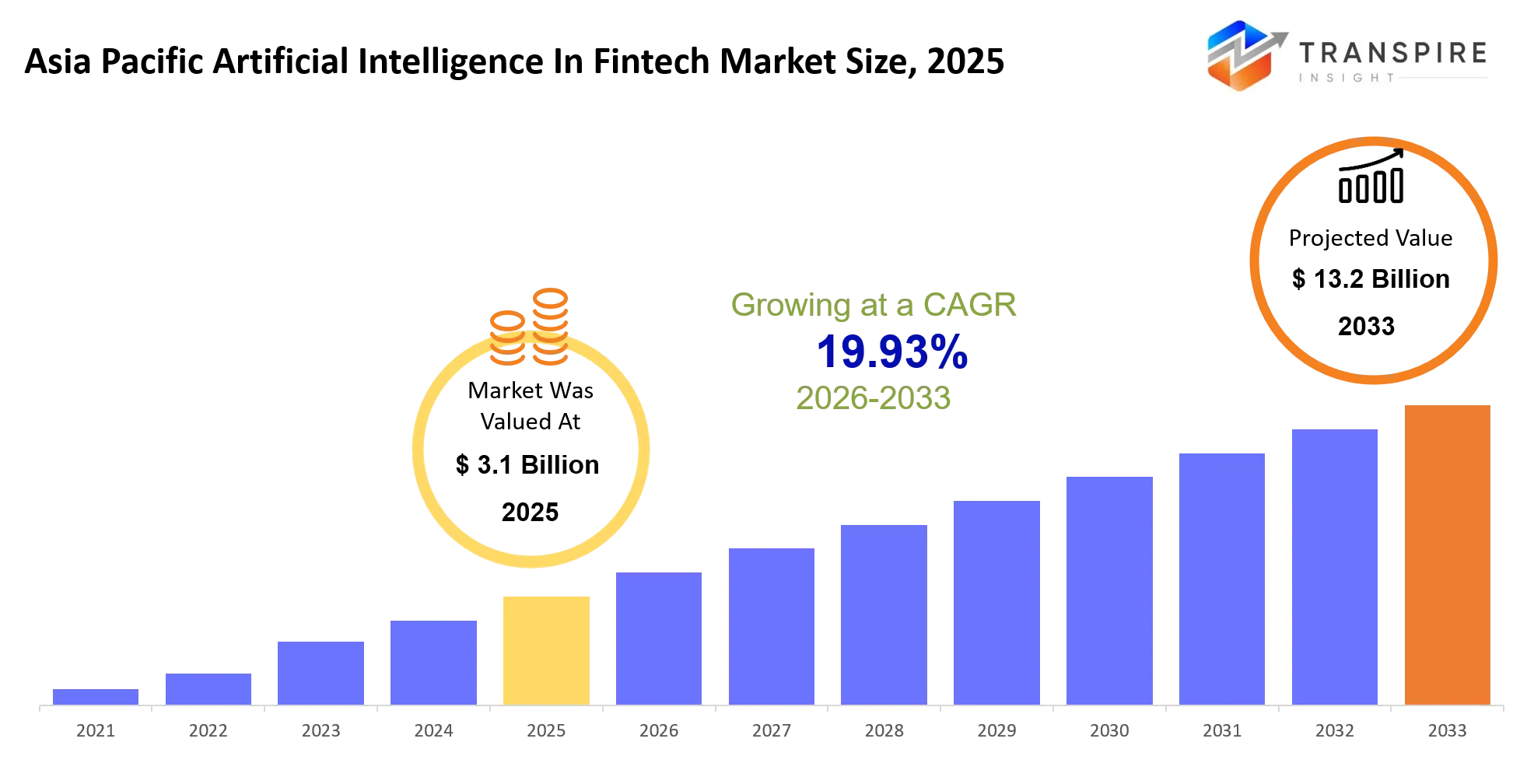
- Asia Pacific Artificial Intelligence In Fintech Market Size 2025: USD 3.1 Billion
- Asia Pacific Artificial Intelligence In Fintech Market Size 2033: USD 13.2 Billion
- Asia Pacific Artificial Intelligence In Fintech Market CAGR: 19.93%
- Asia Pacific Artificial Intelligence In Fintech Market Segments: By Technology (Machine Learning, NLP, Computer Vision, Predictive Analytics, Generative AI, Others); By Application (Fraud Detection, Credit Scoring, Robo-Advisory, Payments, Customer Service, Others); By Deployment (Cloud, On-Premise, Hybrid, Others); By End User (Banks, Insurers, Fintechs, NBFCs, Others)
To learn more about this report,  Download Free Sample Report
Asia Pacific Artificial Intelligence In Fintech Market Summary
The Asia Pacific Artificial Intelligence In Fintech Market was valued at USD 3.1 Billion in 2025. It is forecast to reach USD 13.2 Billion by 2033. That is a CAGR of 19.93% over the period.
The Asia Pacific Artificial Intelligence in Fintech market helps financial institutions automate decision making, detect fraud, assess credit risk, tailor personalized financial products, and handle large volumes of transactions with more speed and accuracy. In day to day practice, banks, insurers, digital lenders, and payment providers use AI to bring down operational costs, support compliance, and create quicker customer experiences across more and more digital financial ecosystems.
Over the last five years, there’s been a bit of a structural shift away from rule based automation toward machine learning, and even generative AI driven platforms that can examine intricate financial data in real time. The swift growth of digital payments and online banking during and after the COVID-19 period worked like a major trigger, it sort of highlighted the weaknesses in older risk assessment methods and customer service routines. As transaction volumes climbed, financial institutions kept investing in AI, mainly to strengthen fraud detection, automate customer conversations, and make smarter lending choices. That whole investment cycle is now feeding into wider enterprise adoption, elevated technology spending, and fresh revenue opportunities for fintech providers who can deliver scalable, data based financial intelligence solutions.
Key Market Insights
- China pretty much dominates the Asia Pacific artificial intelligence in fintech market, taking the biggest market share in 2025 because of its advanced digital payment ecosystems, you know how that goes.
- Ongoing government backed digital finance initiatives keep pushing the market size up and also support longer term industry growth, so it looks stable.
- When it comes to where the money really goes, fraud detection and risk management solutions lead the way and grab the largest revenue share, mainly as transaction volumes keep climbing.
- AI powered customer service platforms sit as the second largest segment, driven by the broad adoption of chatbots across lots of services.
- Generative AI solutions are expected to be the fastest growing segment from 2025 to 2030, changing customer engagement plus financial advisory services in a noticeable way.
- Cloud-based AI deployment models keep getting more share in the market because scalability and those smaller costs to set everything up, are kinda the big pull.
- Fraud detection and anti-money laundering use cases lead the way, they account for a meaningful portion of the overall AI deployments in fintech, so it’s not subtle.
- Credit scoring and underwriting platforms still sit pretty as a major revenue driver across digital lending ecosystems, basically always there.
- Personalized financial advisory and wealth management solutions are showing up as the fastest-growing application category, at least in recent rollouts.
- And real-time transaction monitoring keeps speeding up adoption across regional financial institutions, which seems to be the trend right now.
What are the Key Drivers, Restraints, and Opportunities in the Asia Pacific Artificial Intelligence In Fintech Market?
The main growth driver in the Asia Pacific Artificial Intelligence in Fintech Market is the fast digitalization of financial services, mixed with the expansion of real time payments and digital lending, plus a lot of practical day to day adoption. Most importantly , the spread of mobile banking, open banking frameworks and digital payment networks has created massive quantities of financial data. So financial institutions, more and more, use AI powered fraud detection, credit scoring, and customer analytics tools to handle this information efficiently. Because AI keeps getting better at risk evaluation accuracy, and it also lowers manual processing costs, banks and fintech companies can bring new customers onboard quicker, raise approval rates, and push more revenue generating financial offerings.
Still, the biggest restraint is data privacy, regulatory fragmentation, and governance requirements across Asia Pacific markets. In other words, financial institutions have to follow different national rules around customer data storage, cross border transfers, and even how algorithmic decisions are made. This is kind of structural, not temporary, since regulatory harmonization across many jurisdictions needs long term policy alignment. As a consequence , implementation cycles stretch out, compliance expenses jump higher, and AI solutions take longer to roll out. That, in turn, suppresses some revenue potential and makes it harder for regional fintech providers to scale.
A major chance sits in how generative AI gets pulled together with advanced predictive analytics for financial services, sort of like one does not work without the other. Banks and fintech firms keep putting money into AI powered financial advisors, automated compliance setups, and those personalized wealth management platforms that feel almost tailored. India and Southeast Asia look especially promising too, mostly because the digital finance ecosystems keep expanding, and there are huge underbanked populations. As cloud infrastructure matures and the cost of building AI keeps becoming more reachable, providers can ship very customized financial products at scale and unlock that next phase of market expansion, without all the usual friction.
What Has the Impact of Artificial Intelligence Been on the Asia Pacific Artificial Intelligence In Fintech Market?
Artificial intelligence has kinda fundamentally changed how financial operations work across the Asia Pacific fintech ecosystem, by pushing automation, speeding up decision-making , and making customer engagement more responsive. More and more financial institutions are leaning on AI powered systems to handle fraud screening, transaction monitoring, customer onboarding and regulatory compliance, basically in one smoother flow. In practice, these tools cut down on heavy manual work, while also doing real-time analysis of millions of transactions across digital payment networks
Meanwhile, machine learning models have made predictive abilities a lot better inside lending and risk management roles. Providers use advanced algorithms to read borrower behavior, estimate default likelihood, tune credit choices, and flag questionable transaction patterns before losses show up. There is also AI driven analytics that can power personalized product suggestions, more precise customer retention strategies , and even dynamic pricing models, so profitability ends up improving in a measurable way
On the operational side, these technologies help shrink processing times from days down to minutes, raise the accuracy of fraud detection, reduce compliance spending, and generally improve customer experience by using automated service channels. Digital lenders and payment providers usually see faster decision cycles first, while banks get better operational efficiency and stronger risk oversight
Still, even with all that, AI adoption doesn’t come without constraints. Implementation can be expensive, regulatory requirements are often fragmented, and access to solid, high quality financial datasets is sometimes restricted, which can weaken model performance. On top of that, many organizations struggle to integrate advanced AI platforms into older banking infrastructure , and that ends up delaying broader deployment across the regional fintech environment
Key Market Trends
- Since 2021, major banks in China, Singapore, and Australia kinda shifted their AI budgets away from short pilot work and toward something more large scale operational deployment, yeah.
- In 2024 and 2025, generative AI adoption really picked up, especially when financial institutions started folding in virtual assistants, automated advisory tools, plus compliance support systems all together.
- Digital lenders also moved more often from older rule based credit assessments toward machine learning models, those models then analyze alternative consumer data sources which is a bit more subtle.
- Between 2022 and 2025, regulatory authorities in Singapore, Hong Kong, and Australia rolled out stronger AI governance frameworks, this ended up affecting which vendors get chosen, and how they get chosen.
- Fraud management strategies changed too, from basically post transaction investigations to real time AI driven monitoring, especially once digital payment volumes expanded across Asia Pacific more aggressively.
- After 2022, fintech companies paired up more frequently with cloud providers and technology firms, partly to shorten deployment timelines and make scalability easier.
- The competitive focus shifted from just customer acquisition, toward personalization capabilities, with institutions using AI models to tailor financial products in a dynamic way.
- Cross border payment providers went for advanced analytics platforms so they could improve transaction screening accuracy, particularly as anti money laundering expectations got tighter.
- Since 2023, banks have been upping investment in explainable AI tools, because regulators asked for more transparency in automated lending decisions.
- Market leadership, meanwhile, gradually spread beyond the traditional banks, with companies like Ant Group, Tencent Holdings, and Paytm boosting influence by building AI enabled financial ecosystems.
Asia Pacific Artificial Intelligence In Fintech Market Segmentation
By Technology :
Machine Learning kind of sits at the core in financial services, by helping organizations sift through huge amounts of transaction and customer information. The models can spot patterns, tune risk assessment, support fraud monitoring, and also make lending decisions more solid. Because they keep learning from fresh datasets, the output gets more accurate and the processing becomes faster across a lot of daily financial operations.
Then there's Natural Language Processing , or NLP, which helps with customer interactions using chatbots, virtual assistants, and automated document review . On top of that, Computer Vision is used for identity checks via image recognition plus document authentication. Predictive Analytics, meanwhile, is used to forecast customer actions, payment patterns, and financial threats, so teams can plan better and choose more reliable decisions.
Generative AI is also getting more important for customer engagement , for content creation, and for financial guidance. Other supporting technologies include recommendation engines, robotic process automation, and more advanced data analysis tools. Together these help operational efficiency and strengthen digital financial services across the Asia Pacific Artificial Intelligence In Fintech Market
By Application :
Fraud Detection is still one of the most widely used things in fintech, because financial institutions process millions of transactions each day. Artificial intelligence systems analyze transaction patterns in real time, and this helps flag suspicious activities sooner, which also reduces financial losses. When detection is faster it really strengthens security, and it supports regulatory compliance too.
Credit Scoring uses alternative and regular financial data together, to judge borrower profiles in a more precise way. Then you also get Robo-advisory platforms, they give automated investment recommendations based on financial ambitions , and on risk preferences. In practice these setups help broaden access to financial services , while making operations more efficient for service providers.
Payments and Customer Service applications keep gaining importance as digital transactions grow across the region. Artificial intelligence can optimize payment processing , improve response times, and personalize customer interactions so people feel a bit more cared for. Other examples include compliance monitoring, portfolio management, and financial forecasting , all of which back broader adoption across the Asia Pacific Artificial Intelligence In Fintech Market.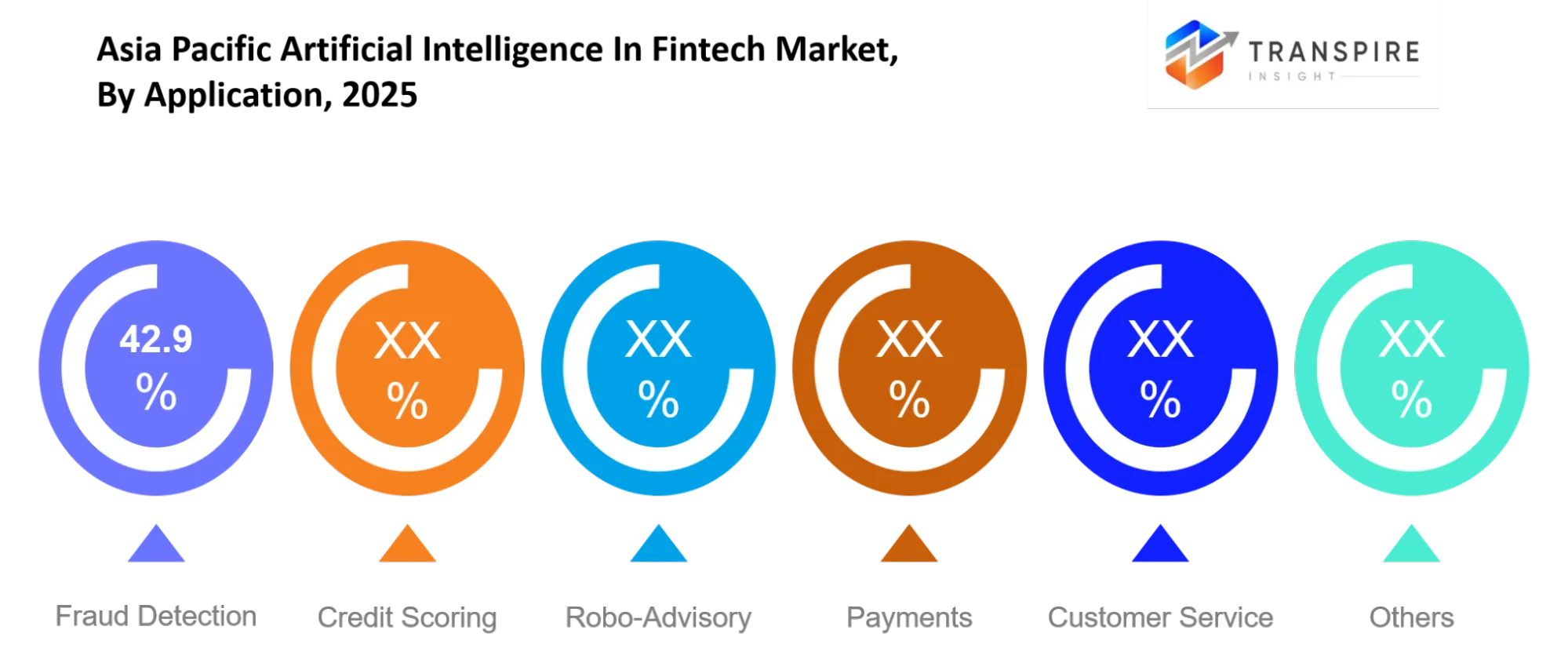
To learn more about this report, Download Free Sample Report
By Deployment :
Cloud deployment is now kind of a preferred choice for a lot of financial institutions, mostly because it feels more flexible and scalable, and it reduces the whole infrastructure burden. With cloud based platforms, organizations can handle huge datasets, roll out artificial intelligence models faster, and keep up with digital services, all without needing major hardware investments up front. It’s, like, the easier way to expand when demand changes, or when new use cases pop up.
Still, on-premise deployment stays relevant, especially for institutions that put data control first, and care a lot about internal governance plus security requirements. This style gives teams direct management of their infrastructure and the sensitive information that sits on it. That can really matter in highly regulated financial settings, or when an organization has specific internal policies it won’t bend.
Then there’s the hybrid deployment option, which basically mixes cloud capabilities with on premise systems, giving a kind of middle ground between agility and control. Many organizations pick hybrid models to modernize what they do, while also keeping the infrastructure they already have. Besides these, you can also see other deployment approaches—like customized architectures that are built to match particular operational, regulatory, or business needs across the Asia Pacific Artificial Intelligence In Fintech Market, depending on what the institution is trying to achieve.
By End User :
Banks are a big end user category, because artificial intelligence is used for fraud prevention, customer boarding, lending choices, plus compliance work, and all of that. With advanced analytics and automation, they tend to boost operational efficiency while also making the customer experience feel smoother across those digital banking channels.
Insurers use artificial intelligence too, mainly to smooth out claims handling, gauge risks, spot fraudulent behavior, and strengthen customer interaction. Fintech firms rely on inventive technologies to power digital payments, lending platforms, wealth management services, and those more customized financial products. Since innovation is moving quickly, these companies keep adopting new tech, pretty much again and again in this segment.
NBFCs use artificial intelligence for tougher credit evaluation, customer acquisition, and portfolio oversight activities. Other end users also show up, like investment firms, payment service providers, and other financial service organizations aiming for better decisions and operational output. Broad adoption across all these groups is still pushing forward the development within the Asia Pacific Artificial Intelligence In Fintech Market.
What are the Key Use Cases Driving the Asia Pacific Artificial Intelligence In Fintech Market?
Fraud detection still feels like the main use case pushing adoption throughout the Asia Pacific Artificial Intelligence In Fintech Market. Banks , payment providers, and digital financial platforms use artificial intelligence to watch transactions live, spot odd patterns, and keep financial losses down. With digital payments growing so fast, advanced fraud monitoring becomes basically a must, so AI-powered security solutions get a lot of pull.
Then there’s credit scoring and customer service. Those applications are getting more traction with fintech companies, NBFCs, and insurers. Artificial intelligence supports lenders by evaluating borrowers with broader data sets, which sharpens lending choices and widens who can access financial services. Meanwhile, virtual assistants and automated support platforms make it easier for organizations to manage heavy customer loads, while also cutting service costs in a very practical way.
More emerging ideas include generative AI style financial advisory services and automated compliance monitoring tools. These are catching attention because financial institutions are dealing with tighter regulatory rules and also a rising need for more personalized financial guidance. Going forward, continued progress in data analytics and machine learning should help expand adoption across the forecast time period, more and more.
|
Report Metrics |
Details |
|
Market size value in 2025 |
USD 3.1 Billion |
|
Market size value in 2026 |
USD 3.7 Billion |
|
Revenue forecast in 2033 |
USD 13.2 Billion |
|
Growth rate |
CAGR of 19.93% from 2026 to 2033 |
|
Base year |
2025 |
|
Historical data |
2021 - 2024 |
|
Forecast period |
2026 - 2033 |
|
Report coverage |
Revenue forecast, competitive landscape, growth factors, and trends |
|
Regional scope |
Asia Pacific (India, China, Japan, Australia, South Korea, Rest of Asia Pacific) |
|
Key company profiled |
IBM, Microsoft, Google, AWS, Oracle, SAP, FIS, Fiserv, Stripe, PayPal, Ant Group, Tencent, Upstart, Revolut, Adyen |
|
Customization scope |
Free report customization (country, regional & segment scope). Avail customized purchase options to meet your exact research needs. |
|
Report Segmentation |
By Technology (Machine Learning, NLP, Computer Vision, Predictive Analytics, Generative AI, Others); By Application (Fraud Detection, Credit Scoring, Robo-Advisory, Payments, Customer Service, Others); By Deployment (Cloud, On-Premise, Hybrid, Others); By End User (Banks, Insurers, Fintechs, NBFCs, Others) |
Which Regions are Driving the Asia Pacific Artificial Intelligence In Fintech Market Growth?
East Asia still feels like the dominant region in the Asia Pacific Artificial Intelligence In Fintech Market,mostly because the digital finance ecosystems in China , Japan ,and South Korea are pretty strong. China drives a lot of the momentum with big digital payment networks , heavy investments in artificial intelligence, and kind of practical innovation policies that push financial technology forward. Big tech firms and established financial institutions keep pouring money into advanced analytics, fraud monitoring, and automated financial services. You can also see how a mature digital infrastructure , a deep technology talent pool, plus high consumer uptake of digital financial products, all team up to keep the region in the lead.
Southeast Asia is second,though the growth story is a bit different. Instead of leaning on huge homegrown technology ecosystems, countries like Singapore, Indonesia , Thailand, and Malaysia tend to benefit from ongoing fintech expansion, regulator upgrades, and broader financial inclusion programs. Singapore works as a kind of regional financial and innovation hub ,so it pulls in investment into artificial intelligence applications for banking, payments, and even wealth management. With regulators staying fairly consistent and financial institutions continuing to invest, the environment stays stable, and that stability helps long term revenue generation.
South Asia, mostly steered by India, shows up as the fastest growing part of the market. In a lot of places, quick digitalization, the rollout of real-time payment systems, and broader take-up of digital lending platforms have basically sped up artificial intelligence use across finance services. With government-backed digital infrastructure programs still pushing forward, and fintech investment rising in parallel, there are now more fresh openings for tech providers, and for financial institutions as well. Overall momentum across South Asia should bring in extra investment, nudge product innovation, and also open appealing expansion paths for market participants between 2026 and 2033
Who are the Key Players in the Asia Pacific Artificial Intelligence In Fintech Market and How Do They Compete?
Competition in the Asia Pacific Artificial Intelligence In Fintech Market is, sort of, moderately concentrated. Big technology players, digital financial platforms, banks, and more specialized fintech firms compete to capture market share. Lately, technology innovation is becoming the main thing people fight over , because everyone wants better fraud detection accuracy, quicker lending decisions, stronger customer engagement, and smoother compliance work flows. Well-known financial institutions keep defending their positions via digital transformation. At the same time fintech companies try to shake up older business models using agile and data-leaning services. Cloud integration, stronger analytics skill sets, and proprietary artificial intelligence models are increasingly what decides who has the edge.
Ant Group stands out because it embeds artificial intelligence deeply across payments, lending, risk management, and wealth management. It also gets a real advantage from huge amounts of transaction data, which helps tune algorithm performance and improve customer personalization. Tencent Holdings, meanwhile, uses its digital ecosystem to link financial services with communication tools and consumer platforms. This helps build strong user involvement, plus it enables data-driven service delivery. Ongoing investment in artificial intelligence infrastructure, along with financial technology partnerships, keeps backing expansion across multiple service areas.
Paytm keeps pushing for more artificial intelligence use inside digital payments, merchant services,and financial products that are fit for India’s fast-growing digital economy, basically. DBS Bank meanwhile leans hard into advanced analytics, automated customer outreach, and a data-centric way of running banking, so things run smoother and service quality goes up. Ping An Group stands out because it uses artificial intelligence deeply in insurance, healthcare, and financial services, and it builds cross sector edge that a lot of other players cannot copy quite as easily. Going forward, strategic partnerships, technology development programs, and regional expansion efforts continue to bolster their competitive stance across the Asia Pacific market, in practice.
Company List
- IBM
- Microsoft
- AWS
- Oracle
- SAP
- FIS
- Fiserv
- Stripe
- PayPal
- Ant Group
- Tencent
- Upstart
- Revolut
- Adyen
Recent Development News
In February 2026, DBS Group entered a three-year strategic partnership with Granite Asia and launched a US$110 million AI-focused IPO fund for wealth clients. The partnership expands AI-related investment opportunities and financing support for high-growth Asian companies, strengthening AI-driven financial services across the Asia-Pacific fintech ecosystem.
Source https://www.reuters.com/
In April 2026, Nava secured funding of US$22 million in a round led by Greenoaks Capital. The investment supports Nava’s expansion of a full-stack AI cloud infrastructure platform across the Asia-Pacific region, enhancing the technological foundation for AI-enabled fintech applications. Source https://economictimes.indiatimes.com/
What Strategic Insights Define the Future of the Asia Pacific Artificial Intelligence In Fintech Market?
The Asia Pacific Artificial Intelligence In Fintech Market is moving toward a kind of deeply integrated intelligence driven financial ecosystem, where artificial intelligence is tucked in across lending, payments, wealth management, insurance, and compliance tasks, not as a standalone tech layer. This change will be pushed by the need to handle more and more complicated financial data in real time, all while still satisfying tougher regulatory expectations and the everyday customer demand for tailored service. And as financial institutions chase better efficiency and higher profitability, the money will likely flow more toward platforms that stitch together automation, predictive analytics, and decision intelligence, instead of scattered tools.
There is also a risk that is a little less visible, basically market concentration around a small set of technology providers and data rich platforms. If a few firms control much of the AI infrastructure, plus the cloud stack, it can lead to pricing pressure, operational dependence, and even competitive barriers for smaller players who can’t just switch vendors quickly, or at all.
At the same time there’s a real opportunity coming up, especially with AI powered regulatory technology solutions across India and Southeast Asia, where digital finance adoption keeps spreading. Market participants should lean on explainable and auditable AI capabilities early, because regulatory transparency demands will probably turn into a major factor for customer outreach, collaboration deals, and longer term market entry.
Asia Pacific Artificial Intelligence In Fintech Market Report Segmentation
By Technology
- Machine Learning
- NLP
- Computer Vision
- Predictive Analytics
- Generative AI
By Application
- Fraud Detection
- Credit Scoring
- Robo-Advisory
- Payments
- Customer Service
By Deployment
- Cloud
- On-Premise
- Hybrid
By End User
- Banks
- Insurers
- Fintechs
- NBFCs
Frequently Asked Questions
Find quick answers to common questions.
The Expected Asia Pacific Artificial Intelligence In Fintech Market size is USD 13.2 Billion in 2033.
Key Segments for the Asia Pacific Artificial Intelligence In Fintech Market are By Technology (Machine Learning, NLP, Computer Vision, Predictive Analytics, Generative AI, Others); By Application (Fraud Detection, Credit Scoring, Robo-Advisory, Payments, Customer Service, Others); By Deployment (Cloud, On-Premise, Hybrid, Others); By End User (Banks, Insurers, Fintechs, NBFCs, Others).
Major Asia Pacific Artificial Intelligence In Fintech Market Players are IBM, Microsoft, Google, AWS, Oracle, SAP, FIS, Fiserv, Stripe, PayPal, Ant Group, Tencent, Upstart, Revolut, Adyen.
The Current Asia Pacific Artificial Intelligence In Fintech Market size is USD 3.1 Billion in 2025.
The Asia Pacific Artificial Intelligence In Fintech Market CAGR is 19.93% from 2026 to 2033.
- IBM
- Microsoft
- AWS
- Oracle
- SAP
- FIS
- Fiserv
- Stripe
- PayPal
- Ant Group
- Tencent
- Upstart
- Revolut
- Adyen
About the Authors

Mayur Shinde
I am Mayur Shinde, a Senior Research Analyst at Transpire Insight, specializing in the Automotive & Transportation and Information & Communication Technology (ICT) Industry. My work focuses on analyzing emerging market trends, technological advancements, competitive landscapes, and industry developments to deliver accurate, data-driven insights. I am passionate about transforming complex market information into clear, actionable content that helps businesses, professionals, and decision-makers stay informed and make confident strategic decisions.

Chakradhar Khansole
Chakradhar serves as the Research Director at Transpire Insight, bringing over 8 years of experience in technology, innovation, and strategic market intelligence. He specializes in transforming complex market data into actionable business insights that enable organizations to make informed, growth-oriented decisions. Recognized for his strategic vision and analytical expertise, Chakradhar leads high-impact research initiatives, delivering comprehensive market assessments, competitive intelligence, and forward-looking industry analysis.
Recently Published Reports
-
Apr 2026
3D Optical Profiler Market
3D Optical Profiler Market Size, Share & Analysis Report By Type (Desktop 3D Optical Profiler, and Portable 3D Optical Profiler), By Technology (Confocal Technology, and White Light Interference), By End-Use Industry (Manufacturing, Research Institutions, Automotive, Aerospace and Defense, Medical Devices, and Other), and Geography (North America, Europe, Asia-Pacific, Middle East and Africa, South and Central America), 2021 - 2031
-
Apr 2026
Depth Sensor Market
Depth Sensor Market Size, Share & Analysis Report By Type (Infrared Depth Sensors, Time-of-Flight (ToF) Sensors, Stereo Vision Sensors, Structured Light Sensors, Ultrasonic Depth Sensors), By Application (Automotive, Robotics, Gaming, Consumer Electronics, Industrial Automation, Healthcare, Security & Surveillance, Others), By End Users (Automotive Manufacturers, Consumer Electronics Companies, Healthcare Providers, Industrial Companies, Security Agencies, Gaming Companies, Robotics Companies, Others), and Geography (North America, Europe, Asia-Pacific, Middle East and Africa, South and Central America), 2021 – 2031
-
Apr 2026
Digital Manufacturing Market
Digital Manufacturing Market Size, Share & Analysis Report By Component (Hardware, Software, and Services), By Technology (Robotics, 3D Printing, Internet of Things (IoT), and Others), By Application (Automotive and Transportation, Aerospace and Defense, Consumer Electronics, Industrial Machinery, and Others), By Process Type (Computer-Based Designing, Computer-Based Simulation, Computer 3D Visualization, Analytics, and Others), and Geography (North America, Europe, Asia-Pacific, Middle East and Africa, South and Central America), 2021 – 2031
-
Apr 2026
Digital Visa Services Market
Digital Visa Services Market Size, Share & Analysis Report By Type (Individual Travelers, Group Travelers), By Application (Tourism, Business Travel, Others), and Geography (North America, Europe, Asia-Pacific, Middle East and Africa, South and Central America), 2021 – 2031