

North America Continuous Renal Replacement Therapy Consumables Market Size & Forecast:
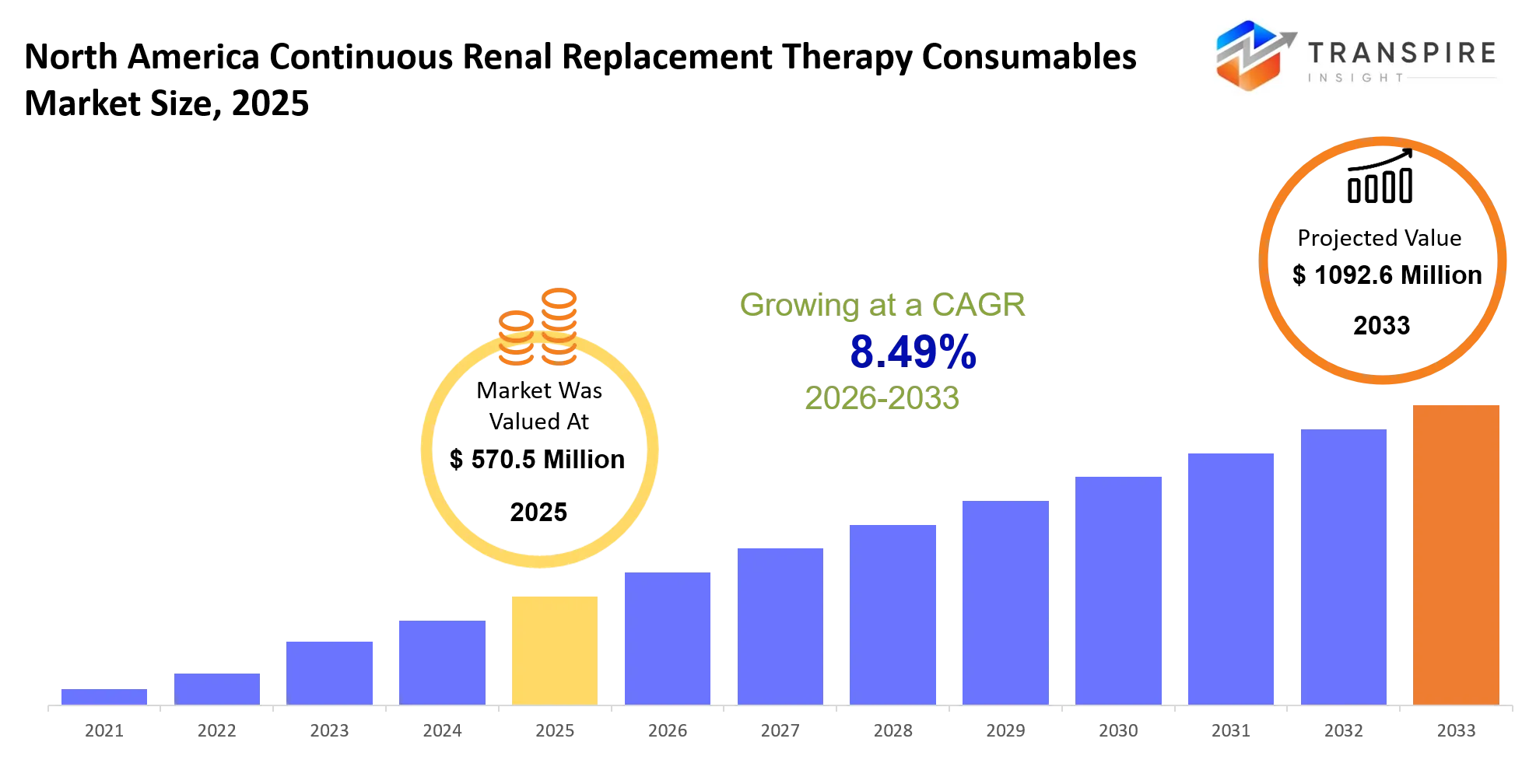
- North America Continuous Renal Replacement Therapy Consumables Market Size 2025: USD 570.5 Million
- North America Continuous Renal Replacement Therapy Consumables Market Size 2033: USD 1092.6 Million
- North America Continuous Renal Replacement Therapy Consumables Market CAGR: 8.49%
- North America Continuous Renal Replacement Therapy Consumables Market Segments: By Product Type (Hemofilters, Bloodline Sets, Dialysate Solutions, Replacement Fluids, Others), By Application (Acute Kidney Injury, Sepsis Management, Fluid Overload Management, Others), By End User (Hospitals, Dialysis Centers, Intensive Care Units, Others), By Modality (CVVH, CVVHD, CVVHDF, Others).
To learn more about this report,  Download Free Sample Report
North America Continuous Renal Replacement Therapy Consumables Market Summary:
The North America Continuous Renal Replacement Therapy Consumables Market size is estimated at USD 570.5 Million in 2025 and is anticipated to reach USD 1092.6 Million by 2033, growing at a CAGR of 8.49% from 2026 to 2033.The North America Continuous Renal Replacement Therapy (CRRT) Consumables Market really sits behind one of the most important things in intensive care. You know, it’s about keeping patients stable, especially those with severe acute kidney injury and multi organ failure, when standard dialysis starts feeling too aggressive. In practical terms, it is the filters, tubing sets, dialysate solutions and replacement fluids that allow hospitals to do continuous blood purification for critically ill patients over long stretches. So these items become a daily requirement for ICU teams, not just a “nice to have”.
In the last three to five years there’s been a kind of structural shift , toward more integrated CRRT platforms. Those systems tend to need highly specialized, manufacturer specific consumables that match their design. Because of that change, the market has seen more steady, recurring revenue, but also a higher focus on supply reliability and continuity. Then COVID 19 showed up, and it acted as a big trigger. It made it clear, how fast demand for renal support therapies can jump , and also how fragile healthcare supply chains can be when pressure hits. At the same time, hospitals keep expanding critical care capacity, and many are moving toward more standardized CRRT protocols. With that, consumable usage per patient episode keeps increasing. Overall this is pushing procurement volumes upward, deepening longer term relationships with suppliers, and supporting more predictable revenue generation across the North American healthcare ecosystem.
Key Market Insights
- The United States is pretty much leading the North America Continuous Renal Replacement Therapy Consumables Market, and in 2025 it takes around 82% of the regional revenue, give or take.
- This is mostly backed by stronger ICU infrastructure , higher overall healthcare spending , and well established CRRT use across hospitals, so yeah the numbers stay solid.
- Canada looks like the quickest mover through 2032, largely because critical care capacity is increasing, plus technology adoption is getting more common. In other words, the growth there is not subtle.
- When it comes to product type, CRRT filters dominate overall, capturing close to 38% of total revenue in 2025. That happens because replacements are needed so often in continuous therapy workflows. Dialysate and replacement fluids also rank high, holding the second-largest share, with demand supported by continuous treatment patterns in intensive care. Meanwhile bloodline tubing sets are the fastest-growing segment during the forecast period, as hospitals ramp up CRRT treatment volumes and move more patients through these systems.
- For application, acute kidney injury , or AKI, stays the main category and contributes roughly 65% of market revenue in 2025.
- Multi-organ failure management is growing faster, which signals broader take-up of continuous renal support therapies across care settings.
- Also, the rising incidence of sepsis related kidney complications keeps feeding new demand into critical care units.
- On the end user side, hospitals and intensive care units control the North America Continuous Renal Replacement Therapy Consumables Market with more than 75% market share.
- Large tertiary care centers are still the biggest buyers, mainly due to high patient throughput and stronger nephrology capabilities.
- And specialized critical care facilities are set to be the fastest-growing end user category through 2032.
What are the Key Drivers, Restraints, and Opportunities in the North America Continuous Renal Replacement Therapy Consumables Market?
The strongest growth driver in the North America Continuous Renal Replacement Therapy Consumables Market is basically the expansion of critical care protocols that lean toward early and continuous renal support for patients who are hemodynamically unstable. This shift kinda picked up speed after the COVID-19 period, when intensive care units started using more standardized treatment pathways and hospitals saw a clear jump in acute kidney injury cases. Since clinicians are initiating CRRT earlier within the treatment cycle, consumables like filters, bloodline sets, and replacement fluids get used more often per patient episode. That increases recurring revenue quite directly, because the consumables have to be swapped out regularly during the therapy, which ends up forming a more predictable and growing purchasing cycle for hospitals.
The most significant restraint is the structural dependence on specialized equipment, trained staff, plus manufacturer-specific consumables. Hospitals can’t just expand CRRT capacity quickly without investing in dedicated machines, clinical education, and inventory management systems. Honestly this barrier is hard to fix in the short term, because it involves capital expenditure and workforce development not just simple procurement. Because of that, many smaller healthcare facilities keep leaning on alternative renal therapies, which reduces consumable utilization, and ends up suppressing potential market revenue.
A big chance sits in bringing next-generation CRRT platforms together with digital monitoring and data analytics, sort of seamlessly. In practice, healthcare systems are investing more and more in connected critical care technologies that help clinicians get more precise therapy results and also make daily workflows less clunky. Like, there are CRRT systems that can optimize treatment in real-time, which tends to make adoption easier not just in tertiary hospitals, but also across integrated healthcare networks. Then you get this longer runway of need for premium consumables, plus value-added service contracts, which is kinda where the real money sits.
What Has the Impact of Artificial Intelligence Been on the North America Continuous Renal Replacement Therapy Consumables Market?
Artificial intelligence, and those advanced digital technologies are starting to change the North America Continuous Renal Replacement Therapy (CRRT) consumables market, sort of, by altering how hospitals run the therapy delivery, handle inventory use, and even influence patient results. AI enabled clinical decision support systems can auto examine patient parameters like fluid balance, electrolyte levels, and hemodynamic status, and then help clinicians tune CRRT settings right away. This kind of automation cuts down on the need for constant hand tweaking, and it also supports a steadier consumption of filters tubing sets, and replacement fluids.
Then there are machine learning models that are being rolled out to guess filter clotting, possible therapy interruptions, and the maintenance timing for the equipment. They do this by looking at prior treatment records and device performance trends so hospitals can plan when consumables need to be swapped, and so there is less of that unpleasant, unexpected downtime. In a way, predictive analytics improves therapy continuity, helps extend equipment uptime, and can reduce operational expenses that show up when treatments get disrupted. Also, some healthcare systems are pairing CRRT platforms with electronic health records, which means automated charting and compliance monitoring, while reducing the usual admin workload.
Overall these tools support better resource planning, fewer treatment delays, and more efficient consumable inventory management across critical care units. But there is still a major constraint, and it’s the availability of high quality clinical data. AI models depend on large and standardized datasets to produce dependable recommendations, plus differences in hospital routines, patient groups, and device platforms can affect accuracy and slow down wider adoption.
Key Market Trends
- Since 2020, hospitals have been leaning more toward earlier CRRT starting protocols, so, on average, consumable utilization rises per acute kidney injury treatment episode, kind of steadily.
- Healthcare providers also seem to favor integrated CRRT systems more and more, which in turn pushes stronger demand for manufacturer specific filters, bloodline sets, and replacement fluids , all together.
- Between 2021 and 2025, supply chain diversification became a kind of strategic must after the pandemic showed shortages and made procurement weak spots easier to see.
- Large players, like Baxter International and Fresenius Medical Care, have expanded service linked contracts, with recurring consumable purchases baked in.
- Since about 2022, hospitals have been adopting digital CRRT monitoring platforms faster too, aiming to cut treatment gaps and improve daily workflow efficiency, without too much extra hassle.
- Clinically the emphasis has shifted from “wait-and-respond” kidney support into proactive renal management, which then increases therapy duration and, naturally, how often consumables must be replaced.
- Group purchasing organizations now carry more weight in procurement calls, so they encourage multi year agreements and a more standardized consumable selection.
- Meanwhile demand for advanced biocompatible membrane technologies has climbed, because clinicians want better filtration performance and fewer therapy complications, generally.
- Starting in 2021, tertiary care centers invested more in critical care infrastructure , expanding CRRT capacity and helping handle higher consumables throughput.
- And data driven inventory management systems have gained real traction, helping healthcare networks avoid stockouts, sharpen forecasting accuracy, and streamline purchasing cycles, pretty consistently.
North America Continuous Renal Replacement Therapy Consumables Market Segmentation
By Product Type
In the product type segment, hemofilters hold the leading market position, because basically every CRRT procedure relies on effective blood purification and on regular filter replacement . Utilization rates stay high, and those recurring replacement cycles keep happening, so hemofilters end up being a major revenue driver across healthcare facilities. Bloodline sets are the other big category, since they get used in every single treatment session, and there are also strict infection control requirements to follow. Dialysate solutions and replacement fluids maintain strong demand too, since treatment intensity and overall duration directly affect consumption volumes.
Then there are other consumables, like accessories and connectors which help support delivery of the therapy, although they end up with a smaller share overall. Demand patterns are shifting more and more toward high-performance and biocompatible products, because they help clinicians improve treatment efficiency, and they also reduce complications. Looking ahead, growth is expected to focus on premium consumables that are integrated with advanced CRRT platforms. That should create opportunities for manufacturers to strengthen recurring revenue streams while helping buyers standardize procurement, and also improve inventory management.
By Application
In application acute kidney injury still, basically, stays the biggest slice because CRRT works as a key intervention for hemodynamically unstable patients who can’t take conventional dialysis. You see high incidence rates in intensive care environments too so that keeps pushing a lot of consumable use. Sepsis handling is becoming a noticeable growth area, in part because more clinicians are appreciating how severe infections can slide directly into kidney dysfunction. There’s also fluid overload control, which adds real demand especially for critically ill patients who need tight, continuous fluid balance regulation.
Other uses pop up as well like post surgical complications and multi organ failure management, where renal support really remains non‑negotiable. Clinical pathways are also leaning toward sooner treatment, and that tends to stretch therapy duration, plus increases consumable consumption. Looking forward, wider uptake of evidence based critical care routines should raise adoption in several indications, and that encourages manufacturers to create more specialized products. At the same time, it opens up further chances for healthcare providers aiming for better patient outcomes.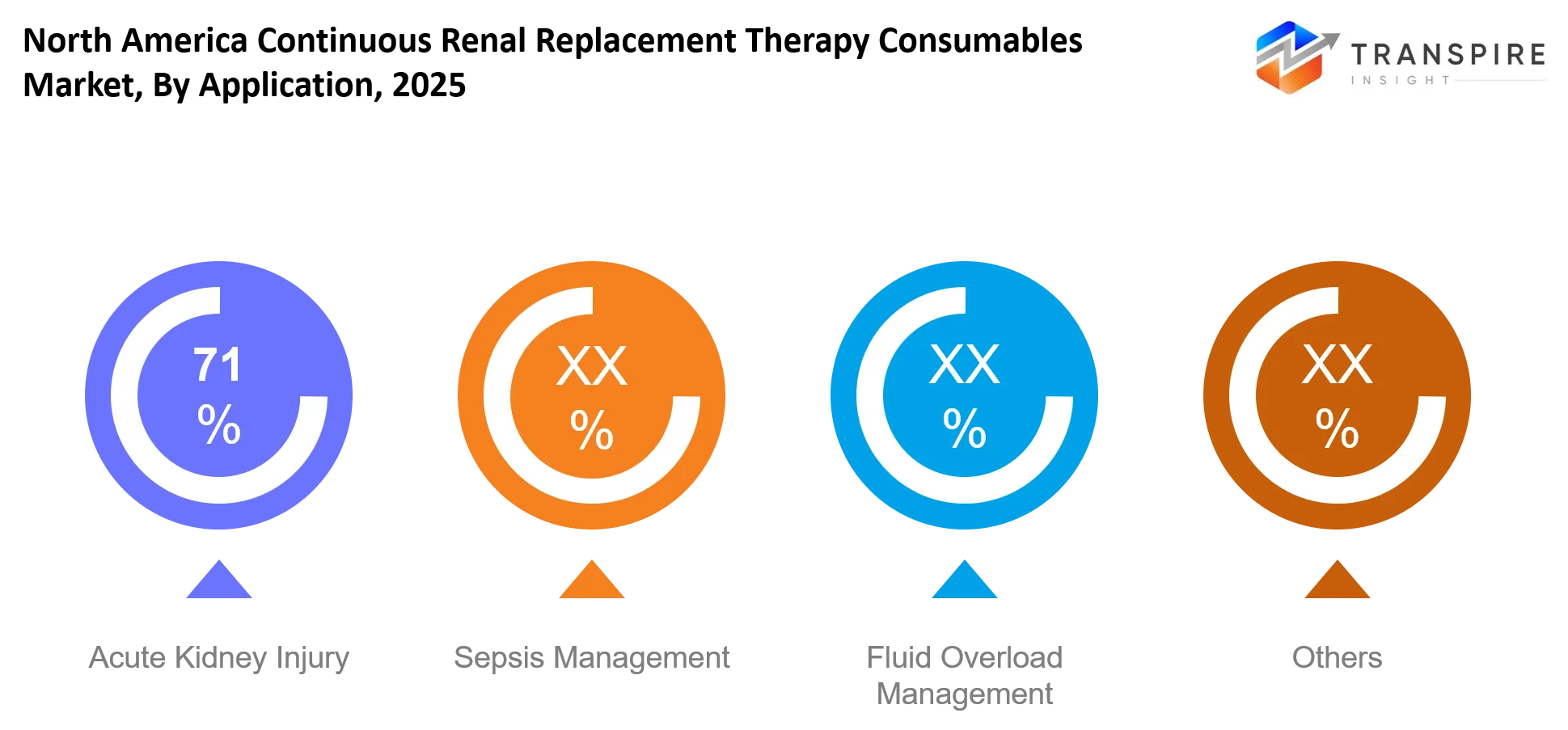
To learn more about this report, Download Free Sample Report
By End-User
The end-user landscape is kind of led by hospitals, mostly, because most CRRT procedures happen inside big acute care facilities that have specialized nephrology and critical care resources. Intensive care units, they’re almost like a very connected piece of the same puzzle, and they stay highly influential too, since critically ill patients who need continuous renal support are typically handled in those units. Dialysis centers show up in a few selected cases, but they dont really show up as much in the market, since CRRT is less often administered outside hospital environments. Other healthcare facilities add some incremental demand when advanced critical care services are already in place.
On the procurement side, decisions are more and more focused on supply reliability, product compatibility, and maintaining long-term vendor partnerships. At the same time, growing investment into critical care infrastructure keeps pushing purchasing activity among major healthcare systems. Looking ahead, market development is expected to lean toward end users that can bring in digital monitoring, more advanced treatment protocols, and centralized purchasing approaches, and that opens up chances for suppliers that can bundle comprehensive service along with consumable packages.
By Modality
In the modality segment, continuous venovenous hemofiltration (CVVH) keeps a strong spot because many clinicians already know it, and it works well for fluid removal in unstable patients, kind of straightforward. Continuous venovenous hemodialysis (CVVHD) also has a notable share since it delivers good solute clearance, while still letting teams manage the treatment in a pretty controlled way. Continuous venovenous hemodiafiltration (CVVHDF) is seen more and more as the most adaptable option, because it blends convective and diffusive clearance at the same time ,and that mix can be appealing when the critical care situation is complicated.
The other modalities are still there for specific clinical needs but they only make up a smaller slice overall use. Demand trends seem to be moving toward more flexible treatment approaches, ones that can handle different patient conditions and still push therapy efficiency higher. As critical care keeps getting more refined, healthcare providers are expected to lean into advanced modalities that also call for higher-value consumables. This change could nudge manufacturers to broaden product lines that are tailored to each modality, and back longer-term innovation across renal replacement therapies.
What are the Key Use Cases Driving the North America Continuous Renal Replacement Therapy Consumables Market?
The main use case for CRRT consumables stays pretty much focused on acute kidney injury in hospital intensive care units, where critically ill patients, you know , may need continuous blood purification together with fluid control for long stretches. In practice this means filters, tubing sets, and replacement fluids get used again and again across the therapy duration, so the consumption pattern stays steady.
And then, beyond acute kidney injury, clinicians are also leaning into continuous renal support for sepsis related organ dysfunction , plus for difficult cases of severe fluid overload. Bigger tertiary hospitals and more advanced critical care centers are pushing these uses forward, largely because clinicians want earlier intervention steps to help steady complicated patients and hopefully lower downstream complications
Looking ahead there are emerging scenarios like personalized renal support that is guided by real time monitoring, and even CRRT being woven into broader multi organ failure management protocols. As data driven critical care platforms keep getting adopted, they may make it easier to support more specialized treatment pathways that need advanced consumables and higher value therapy solutions throughout the forecast period.
|
Report Metrics |
Details |
|
Market size value in 2025 |
USD 570.5 Million |
|
Market size value in 2026 |
USD 617.8 Million |
|
Revenue forecast in 2033 |
USD 1092.6 Million |
|
Growth rate |
CAGR of 8.49% from 2026 to 2033 |
|
Base year |
2025 |
|
Historical data |
2021 - 2024 |
|
Forecast period |
2026 - 2033 |
|
Report coverage |
Revenue forecast, competitive landscape, growth factors, and trends |
|
Country scope |
North America (Canada, The United States, and Mexico) |
|
Key company profiled |
Baxter International, Fresenius Medical Care, B. Braun, Medtronic, Nipro Corporation, Asahi Kasei Medical, Nikkiso, Toray Medical, NxStage Medical, JMS Co., Nikkiso Europe, Cantel Medical, Cytosorbents, Infomed, Bellco |
|
Customization scope |
Free report customization (country, regional & segment scope). Avail customized purchase options to meet your exact research needs. |
|
Report Segmentation |
By Product Type (Hemofilters, Bloodline Sets, Dialysate Solutions, Replacement Fluids, Others), By Application (Acute Kidney Injury, Sepsis Management, Fluid Overload Management, Others), By End User (Hospitals, Dialysis Centers, Intensive Care Units, Others), By Modality (CVVH, CVVHD, CVVHDF, Others) |
Which Regions are Driving the North America Continuous Renal Replacement Therapy Consumables Market Growth?
The United States keeps being the dominant market in North America, mainly because it has this huge web of tertiary hospitals, advanced intensive care units, and generally high take up of continuous renal replacement therapies. On top of that, the reimbursement set ups are favorable, and overall healthcare spending stays strong, so CRRT consumables are consistently purchased across the big hospital networks. Also, there’s a pretty mature ecosystem around it… with major device manufacturers, focused nephrology providers, and established distribution channels. all together, clinical know how plus infrastructure and purchasing power basically keeps the leadership position.
Canada shows up next, as the second-largest regional market, but its trajectory looks a bit different than the U.S. In Canada there’s a publicly funded healthcare model, and that tends to drive standardized treatment protocols and steady procurement habits. so demand for consumables becomes more predictable. Investment choices often lean toward longer term clinical benefit, dependable supply, and evidence grounded uptake, rather than fast expansion. Because of that, Canada stays a dependable contributor to regional revenue, giving manufacturers a more stable day to day setting to operate in.
Mexico is moving up fast and is expected to grow the quickest. Healthcare modernization is pushing broader access to advanced critical care services, and that change keeps building momentum. Newer funding for hospital infrastructure, expanded intensive care capacity, and specialized treatment capabilities has improved how often CRRT procedures are available. Private healthcare providers are also working harder on adoption of advanced renal support technologies, aiming for better results in critically ill patients. For the 2026–2033 period, growth is expected to open attractive opportunities for manufacturers, distributors and investors who want exposure in this segment.
Who are the Key Players in the North America Continuous Renal Replacement Therapy Consumables Market and How Do They Compete?
The competitive landscape for the North America Continuous Renal Replacement Therapy Consumables Market is still kinda consolidated, with a small set of major renal care firms holding a big chunk of consumables and the CRRT platforms that go along with them. What really pushes competition isn’t so much price, it’s more about technology integration, clinical outcomes, dependable supply, and those long term hospital relationships. Also, because the consumables are usually engineered to match specific CRRT systems , providers often stick to the same vendor setup once their clinical protocols are finalized. So rather than going head to head purely on cost, incumbent suppliers usually concentrate on platform compatibility, adding more service options, and making treatment delivery run faster.
Baxter International stands out with a very connected CRRT offering that basically ties together the machines, filters, fluids, and clinical support. This setup gives hospitals a steadier operations feel and it tends to drive repeat consumables buying. Fresenius Medical Care, meanwhile, leans on deep nephrology know how and a wide renal care network to help uptake across critical care settings. Their ongoing work on therapy refinement, hands on clinician training, and digital monitoring tools supports customer loyalty while also increasing usage throughout bigger hospital systems.
- Braun is competing via specialized blood purification technologies and a pretty intense focus on treatment precision, which kinda appeals to institutions looking for advanced critical care solutions. Nikkiso, on the other hand, leans into a narrower expertise in renal support systems and sort of differentiates itself with technology that’s tailored for intensive care settings, not just general use. Then there is Nipro Corporation, which seems to be focused on widening product accessibility and also strengthening its distribution capabilities across healthcare networks.
Overall these companies are pushing growth by building hospital partnerships, improving service support, upgrading products where possible, and getting deeper reach into emerging critical care facilities. And in practice that can create extra opportunities to increase consumables utilization, plus support longer term contract value, which is basically what many institutions end up caring about.
Company List
- Baxter International
- Fresenius Medical Care
- B. Braun
- Medtronic
- Nipro Corporation
- Asahi Kasei Medical
- Nikkiso
- Toray Medical
- NxStage Medical
- JMS Co.
- Nikkiso Europe
- Cantel Medical
- Cytosorbents
- Infomed
- Bellco
Recent Development News
In April 2026, Baxter Beats Quarterly Expectations on Strong Demand for Medical Devices: Baxter remains one of the leading suppliers of CRRT systems and consumables used in intensive care units across North America. The company's latest financial update highlighted continued demand across its medical products portfolio, including critical-care therapies that support renal replacement treatment settings.
Source: https://www.reuters.com
In February 2026, Baxter Forecasts Lower-Than-Expected 2026 Profit: Baxter's financial guidance is closely watched by stakeholders in the CRRT consumables market because the company is a major supplier of renal care and critical-care products throughout North America. Changes in its outlook can influence investment and product strategies across the sector.
Source: https://www.reuters.com
What Strategic Insights Define the Future of the North America Continuous Renal Replacement Therapy Consumables Market?
The North America Continuous Renal Replacement Therapy Consumables Market is kind of moving, more toward a tighter critical care approach where consumables , digital tracking tools, and therapy management platforms start to work like one bigger ecosystem. The push behind it is mostly the increased focus on treatment standardization and data-led intensive care, which in turn makes hospitals lean toward steadier, longer-term vendor relationships and also faster take-up of higher value consumables. In the next five to seven years, competitive strength might rely less on any single product , and more on how well a company can back clinical work flow efficiency plus outcome tuning.
There is also a quieter danger underneath , market concentration. A smaller group of suppliers tends to control the most important consumables and platform technologies, so if something happens like a plant slowdown, a raw material issue, or sudden pricing pressure, hospitals could feel real vulnerability in their purchasing plans.
At the same time, an emerging chance shows up with AI enabled CRRT optimization platforms. These systems can use live patient information to sharpen therapy precision and make resource use more sensible. Market players should probably put priority on investments in digital integration , clinical analytics, and interoperable product suites, so they can keep customers longer and also grab future upside that goes well beyond just selling consumables.
North America Continuous Renal Replacement Therapy Consumables Market Report Segmentation
By Product Type
- Hemofilters
- Bloodline Sets
- Dialysate Solutions
- Replacement Fluids
- Others
By Application
- Acute Kidney Injury
- Sepsis Management
- Fluid Overload Management
- Others
By End User
- Hospitals
- Dialysis Centers
- Intensive Care Units
- Others
By Modality
- CVVH
- CVVHD
- CVVHDF
- Others
Frequently Asked Questions
Find quick answers to common questions.
The Approximate North America Continuous Renal Replacement Therapy Consumables Market size for the Market will be USD 1092.6 Million in 2033.
The key Segments of the North America Continuous Renal Replacement Therapy Consumables Market are By Product Type (Hemofilters, Bloodline Sets, Dialysate Solutions, Replacement Fluids, Others), By Application (Acute Kidney Injury, Sepsis Management, Fluid Overload Management, Others), By End User (Hospitals, Dialysis Centers, Intensive Care Units, Others), By Modality (CVVH, CVVHD, CVVHDF, Others).
Major Players in the North America Continuous Renal Replacement Therapy Consumables Market are Baxter International, Fresenius Medical Care, B. Braun, Medtronic, Nipro Corporation, Asahi Kasei Medical, Nikkiso, Toray Medical, NxStage Medical, JMS Co., Nikkiso Europe, Cantel Medical, Cytosorbents, Infomed, Bellco.
The Current Market size of the North America Continuous Renal Replacement Therapy Consumables Market is USD 570.5 Million in 2025.
The North America Continuous Renal Replacement Therapy Consumables Market CAGR is 8.49%.
- Baxter International
- Fresenius Medical Care
- B. Braun
- Medtronic
- Nipro Corporation
- Asahi Kasei Medical
- Nikkiso
- Toray Medical
- NxStage Medical
- JMS Co.
- Nikkiso Europe
- Cantel Medical
- Cytosorbents
- Infomed
- Bellco
About the Authors

Pankaj Ghogare Patil
I am Pankaj Ghogare Patil, a Senior Research Analyst at Transpire Insight, specializing in the Pharmaceutical, Chemicals & Materials, Healthcare IT, and Biotechnology industry. My expertise lies in conducting comprehensive market research, analyzing industry trends, evaluating competitive landscapes, and translating complex data into actionable insights. At Transpire Insight, I closely follow emerging technologies, regulatory developments, and market innovations to create accurate, well-researched, and informative content that helps businesses and professionals make informed decisions. I am committed to producing credible, evidence-based articles that reflect industry best practices while making technical topics accessible and valuable for a broad audience.

Chakradhar Khansole
Chakradhar serves as the Research Director at Transpire Insight, bringing over 8 years of experience in technology, innovation, and strategic market intelligence. He specializes in transforming complex market data into actionable business insights that enable organizations to make informed, growth-oriented decisions. Recognized for his strategic vision and analytical expertise, Chakradhar leads high-impact research initiatives, delivering comprehensive market assessments, competitive intelligence, and forward-looking industry analysis.
Recently Published Reports
-
Jul 2026
Alopecia Treatment Market
Alopecia Treatment Market Size, Share & Analysis Report By Disease Type (Alopecia Areata, Cicatricial Alopecia, Traction Alopecia, Alopecia Totalis, Androgenetic Alopecia, Alopecia Universalis, and Other Disease Types), By Treatment Type (Topical Treatments, Oral Medications, Injectable Therapies, and Hair Transplantation), By Gender (Male, and Female), By Distribution Channel (Hospitals and Clinics, Retail Pharmacies, and Online Retailers), and Geography (North America, Europe, Asia-Pacific, Middle East and Africa, South and Central America), 2021 - 2031
-
Jul 2026
Medical Ultrasound Probe Market
Medical Ultrasound Probe Market Size, Share & Analysis Report By Type (Linear Type, Convex Type, Endocavitary Probe, Phased Array/Cardiac Probe, Transesophageal (TEE) Probe, and Others), By Application (Ophthalmology, Cardiology, Musculoskeletal, Oncology, Obstetrics & Gynecology, General Imaging, and Others), By End User (Hospitals & Clinics, Diagnostic Centers, Ambulatory Surgical Centers, and Others), and Geography (North America, Europe, Asia-Pacific, Middle East and Africa, South and Central America), 2021 – 2031
-
May 2026
Biosimilars Market
Biosimilars Market By Product Type (Monoclonal Antibodies, Recombinant Hormones, Erythropoietin, G-CSF, Others), By Indication (Oncology, Autoimmune Diseases, Blood Disorders, Diabetes, Others), By Manufacturing Type (In-House Manufacturing, Contract Manufacturing), By Distribution Channel (Hospital Pharmacies, Retail Pharmacies, Online Pharmacies), By Industry Analysis, Size, Share, Growth, Trends, and Forecasts 2021-2033
-
Apr 2026
Gastrointestinal Endoscopy Market
Gastrointestinal Endoscopy Market By Type (Rigid Gastrointestinal Endoscope, Flexible Gastrointestinal Endoscopes, Disposable Gastrointestinal Endoscope), By Procedure Type (Colonoscopy, Gastroscopy, Duodenoscopy, Enteroscopy, Flexible Sigmoidoscopy, Others), By Application (Diagnosis, Treatment), By End-Users (Hospitals, Ambulatory Surgical Centers, Specialty Clinics, Laboratories, Others), By Industry Analysis, Size, Share, Growth, Trends, and Forecasts 2021-2033