United States Continuous Renal Replacement Therapy (CRRT) Market Size & Forecast:
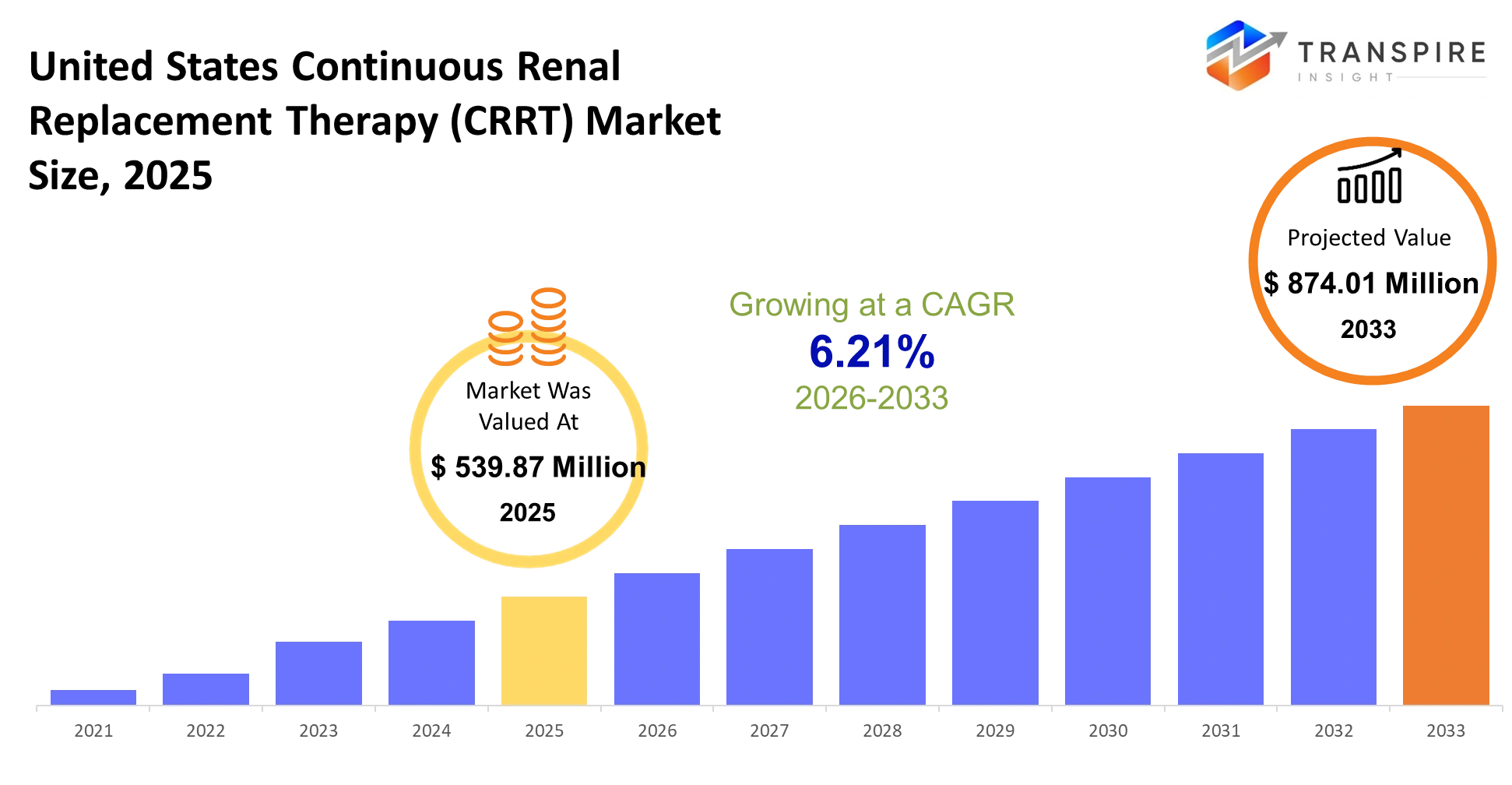
- United States Continuous Renal Replacement Therapy (CRRT) Market Size 2025: USD 539.87 Million
- United States Continuous Renal Replacement Therapy (CRRT) Market Size 2033: USD 874.01 Million
- United States Continuous Renal Replacement Therapy (CRRT) Market CAGR: 6.21%
- United States Continuous Renal Replacement Therapy (CRRT) Market Segments: By Product Type (CRRT Machines, Hemofilters, Bloodline Sets, Dialysate Solutions, Replacement Fluids, Others), By Modality (CVVH, CVVHD, CVVHDF, SCUF, Others), By Application (Acute Kidney Injury, Fluid Overload, Sepsis Management, Multi-organ Failure, Others), By End User (Hospitals, Dialysis Centers, Intensive Care Units, Specialty Clinics, Others).
To learn more about this report,  Download Free Sample Report
United States Continuous Renal Replacement Therapy (CRRT) Market Summary:
The United States Continuous Renal Replacement Therapy (CRRT) Market size is estimated at USD 539.87 Million in 2025 and is anticipated to reach USD 874.01 Million by 2033, growing at a CAGR of 6.21% from 2026 to 2033.The United States Continuous Renal Replacement Therapy, CRRT , market matters a lot for intensive care units, kind of it helps patients where the kidneys just cannot keep up, like fluid balance , toxin removal, or even electrolyte levels during severe illness. Compared with usual dialysis, CRRT runs continuously for long stretches, so it works better for the critically ill who can’t tolerate quick fluid shifts. You often see it used in sepsis, cardiac issues trauma, or multi-organ failure , where patients need gentler support. In the last five years, the market has been moving toward more integrated ICU platforms, meaning CRRT gets bundled with newer patient monitoring tools and data-led treatment protocols. That change also shoved hospitals to invest even more in automated systems that, in practice, end up lowering the nursing workload and making therapy feel more exact, kind of yes. Then the COVID-19 pandemic came in as this big trigger , it showed that acute kidney injury tends to appear pretty frequently alongside serious respiratory infections, and ICUs started getting overloaded across the country. After the pandemic, hospitals kept boosting their critical care setup, so CRRT adoption moved beyond just the leading tertiary centers, which then built a broader installed base and that steady recurring revenue from consumables for the manufacturers.
Key Market Insights
- The Northeast kind of dominates the United States Continuous Renal Replacement Therapy (CRRT) market, with roughly 34% of the market share in 2025, basically because the ICU infrastructure there is more advanced then elsewhere.
- The Southern region is showing up as the fastest-growing regional market through 2030, backed by hospital networks that keep widening and by critical care admissions that are climbing.
- Big metropolitan health systems keep moving the CRRT industry size upward, largely from investments in multi specialty intensive care capabilities and those digital patient monitoring platforms that are becoming standard.
- Across California, Texas, and New York , academic medical centers are accelerating CRRT adoption through technology partnerships, plus more specialized nephrology programs.
- When you look at products, CRRT machines and integrated monitoring systems stay in front, they hold about 46% market share in 2025, driven by high replacement demand.
- Consumables, like hemofilters and tubing sets, sit as the second largest segment, mainly because they are used repeatedly during long-duration renal therapy procedures.
- Disposable CRRT accessories are projected as the fastest-growing segment through 2030 , helped by infection-control priorities and by higher ICU patient turnover rates.
- Automated fluid management systems are also gaining meaningful traction, as hospitals push for workflow optimization and less direct nursing intervention.
- For applications, acute kidney injury treatment leads demand, contributing around 52% of the United States CRRT market share in 2025.
- Sepsis related renal failure is still a major driver, since incidence continues to rise among critically ill ICU patients across the country.
- Multi-organ failure management is the fastest-moving application segment through the forecast period, as hospitals broaden their advanced life-support capabilities, and treat more complex cases.
What are the Key Drivers, Restraints, and Opportunities in the United States Continuous Renal Replacement Therapy (CRRT) Market?
The most powerful force behind the United States Continuous Renal Replacement Therapy (CRRT) Market, is kind of the expansion of advanced critical care infrastructure after COVID-19 , or at least that’s what a lot of analysts keep repeating. Hospitals basically pushed their ICU capacity up once they noticed that acute kidney injury often shows up together with sepsis, respiratory failure and multi-organ dysfunction. That realization then nudged the long-term spend toward CRRT systems meant to run continuously, especially for people who are hemodynamically unstable . At the same time manufacturers started shipping automated fluid balancing features plus integrated monitoring technologies, so clinicians spend less time wrestling with the set-up and more time on bedside care. Once these upgrades actually stuck, hospitals seemed more willing to switch toward premium CRRT platforms, and the constant demand for consumables like filters, tubing and related components made it easier for suppliers to plan revenue.
However there is this structural drag that doesn’t really disappear quickly, which is the operational complexity of the CRRT therapy itself. Getting proper treatment right requires specially trained ICU nurses, nephrologists, and continuous patient monitoring, and that whole setup can slow adoption in mid-sized facilities and rural centers. Also, the situation lingers longer than anyone would prefer because critical care workforce shortages across the United States keep widening. To make it tougher, CRRT systems usually involve substantial capital expenditure, and then ongoing consumable costs keep stacking after the purchase. So even when demand is there, procurement gets postponed by budget constrained healthcare facilities, and market penetration stays thinner outside big tertiary hospitals.
A big growth opportunity is kind of building up via AI-enabled CRRT platforms along with remote ICU monitoring systems . Hospitals are slowly leaning into predictive analytics instruments, they use these to tune fluid management better and also cut down on therapy interruptions, more or less. In fact, huge healthcare networks in states such as Texas and Florida are already piloting centralized digital ICU models, where specialists can supervise CRRT procedures from a distance across several facilities, at once. If this keeps moving forward it might broaden adoption well beyond the major academic centers, and then unlock that next phase of market scalability, sort of.
What Has the Impact of Artificial Intelligence Been on the United States Continuous Renal Replacement Therapy (CRRT) Market?
Artificial intelligence and advanced digital technologies are really starting to reshape the United States Continuous Renal Replacement Therapy (CRRT) market , not just in a “bigger picture” way but also by making the treatment more precise and, at the same time easing ICU workload and keeping real time patient monitoring on a tighter leash. More and more hospitals are rolling out AI-enabled CRRT platforms that are kind of doing the heavy lifting , like automating fluid balance adjustments, anticoagulation management and even sorting alarms by priority using patient data that’s continuously analyzed. They also link up with electronic health records plus bedside monitoring tools so clinicians can react faster when hemodynamic instability shows up or when electrolyte levels start acting strange in critically ill patients.
Then there are machine learning models that are strengthening predictive capabilities across renal therapy operations, which sounds simple but it changes a lot in day to day practice. With advanced analytics platforms, teams can often spot early signs of filter clotting, therapy interruption risk, or sudden fluid imbalance before complications actually take hold. In other words, this more anticipatory method can help hospitals cut down unplanned downtime, push filter lifespan longer, and keep therapy continuity steadier in intensive care units. Some healthcare systems even report directional improvements in nursing efficiency and fewer manual workarounds during long-duration CRRT sessions, especially in high acuity sepsis and multi organ failure scenarios.
Even so, AI adoption still has a big ceiling, mostly because ICU data environments can be fragmented and interoperability is inconsistent between monitoring devices, hospital IT systems, and CRRT equipment. The integration cost stays high, and the lack of standardized clinical datasets can limit how accurate predictive models are when they’re used across different patient populations.
Key Market Trends
- Since 2021, hospitals have started putting more money into automated CRRT platforms ,that cut down nursing intervention time during continuous renal therapy, procedures they seem less time consuming.
- Baxter International and Fresenius Medical Care rolled out AI enabled monitoring improvements from 2022 through 2025, hoping to boost ICU workflow efficiency in a more streamlined way.
- After COVID 19 made manual fluid management delays more visible, ICU operators quietly moved toward integrated CRRT setups plus electronic health record connectivity ,so data is smoother and the handoffs are easier.
- As infection-control protocols got tighter starting around 2020, disposable filter and tubing procurement increased quite a bit ,especially across tertiary care hospitals where compliance is constant.
- Smaller or community hospitals began adopting compact CRRT systems more aggressively after manufacturers introduced simplified interfaces that need less specialized nephrology oversight, and somehow it felt more manageable overall.
- In 2024, predictive analytics tools showed up across several major healthcare networks ,to flag clotting risks earlier and reduce unplanned therapy interruptions ,even when staffing is limited.
- Hospitals increasingly leaned toward long term consumables contracts rather than one time equipment buys ,and that shift helped renal therapy manufacturers build recurring revenue models.
- Because ICU nurse workforce shortages kept getting worse, demand rose for semi automated CRRT systems that can reduce the manual alarm handling and documentation burden, which is a big deal during busy shifts.
- Between 2023 and 2025, regional healthcare systems in Texas and Florida expanded remote ICU monitoring programs ,so CRRT procedures could be supervised across multiple facilities without being physically present all the time.
- During supply chain disruptions in 2021, manufacturers pushed to localize consumables sourcing strategies, and they also tried keeping larger inventories of critical filtration components ,so orders wouldn’t stall as often.
United States Continuous Renal Replacement Therapy (CRRT) Market Segmentation
By Product Type
CRRT machines kind of stay in the lead within that product slice, mostly because hospitals value a more integrated setup that allows continuous monitoring, automated fluid balancing, and well less clinician involvement, day after day, I mean. After the COVID 19 pandemic, hospitals put more funds into intensive care upgrades, and that momentum seemed to nudge the advanced machines into broader adoption across tertiary care networks. Hemofilters and bloodline sets keep showing up as big recurring revenue drivers since they need replacement quite often during longer treatment sessions. Dialysate solutions and replacement fluids also stay in steady demand, since treatment continuity really hinges on having the consumables available in a consistent way.
In 2021, there were some supply chain disruptions, so many healthcare providers started reaching for longer procurement commitments for essential consumables, particularly filtration related products. Product development is leaning harder toward infection-resistant materials, smaller or more compact machine design, and AI enabled monitoring features, rather than only incremental hardware changes. Going forward, competition may move toward service based contracts, stronger digital integration, and better consumable efficiency which can improve revenue predictability for manufacturers while giving healthcare buyers more day to day operational flexibility.
By Modality
CVVHDF is sort of the most dominant choice in the modality segment right now, because many caregivers lean toward a combined diffusion-and-convection approach for those really sick patients who need broad toxin plus fluid removal. Even so CVVH and CVVHD still show up a lot in practice, especially when someone has hemodynamic instability, or when they need careful electrolyte management, and not just “take out fluid” in a basic sense. SCUF stays smaller but it is still strategically useful for treating fluid overload, often in cardiac, and also in post-surgical settings where the plan is usually tight and fast.
More and more hospitals are choosing the modality by considering treatment precision, how heavy the nursing workflow becomes, and whether therapy can stay continuous, rather than focusing only on filtration performance. The spread of automated CRRT machines has also boosted consistency across these complex options like CVVHDF, which makes it easier to use beyond large academic centers. Looking ahead, clinical standardization work, plus digital protocol integration, should start shaping modality decisions over the next several years. Manufacturers that invest in software-driven treatment optimization and user interfaces that feel simpler, may end up with stronger market placement as hospitals push for more efficient renal support workflows.
By Application
Acute kidney injury still feels like the main application area, mainly because serious infections , sepsis , trauma and also cardiac complications keep driving ICU admissions, basically across the United States. Fluid overload management counts as a big treatment category too, especially in critically ill people who have cardiovascular instability and those wobbly hemodynamics. When it comes to sepsis, the clinical relevance has gotten stronger since the pandemic, because it made the link between inflammatory response and fast renal decline way more obvious, at least in practice. Multi-organ failure treatment is also starting to grow, and it is one of the quicker segments, since intensive care units more and more lean on continuous renal therapy during advanced life-support steps.
Demand is shifting toward earlier therapy, rather than waiting and starting renal support late, and that improves patient stabilization, particularly in high-acuity environments where time matters. Going forward, the growth will depend heavily on predictive monitoring tools and on integrated ICU analytics, the kind that can flag renal complications before things turn into severe deterioration. If this keeps moving that way, recurring consumables demand may stay steady, while investments in advanced monitoring software platforms may get encouraged too .

To learn more about this report, Download Free Sample Report
By End-User
Hospitals still hold the strongest position inside the end-user space, largely because big healthcare organizations have the infrastructure, the staffing capacity, and that specialized critical care knowledge that makes continuous renal therapy management possible. In other words , intensive care units remain the most important operational setting, mainly because there are so many hemodynamically unstable patients there who need constant surveillance . Dialysis centers take a smaller share, since most standard outpatient facilities just do not offer enough staff support, or the acute care capabilities, required for continuous therapy delivery. Specialty clinics, meanwhile, keep expanding their involvement bit by bit via collaborations with regional hospitals and remote monitoring initiatives, which is kind of a slow but steady route.
Even so, shortages in the nephrology workforce and in ICU nurses are still acting like a ceiling on adoption across mid-sized healthcare providers, especially in rural areas where resources are thin , and travel times are long. Investment priorities are gradually shifting toward centralized digital monitoring, workflow automation , and compact therapy systems that aim to reduce clinician workload. Looking ahead, broader rollout through secondary hospitals and distributed care networks may end up unlocking growth opportunities for manufacturers who can provide scalable and genuinely user friendly renal support platforms, not just prototypes or hard-to-maintain tools.
What are the Key Use Cases Driving the United States Continuous Renal Replacement Therapy (CRRT) Market?
Acute kidney injury treatment in intensive care units still seems to be the main “real world” use case behind CRRT getting adopted across big United States hospital systems. In the most critical cases , like sepsis, trauma, and cardiac patients, clinicians often need nonstop fluid and toxin management, so CRRT basically becomes a must for high acuity ICU stabilization, you know, when the patient is not stable enough for other approaches.
Also, fluid overload control and recovery after post cardiac surgery care are starting to pick up momentum. You notice it more often in tertiary hospitals and in those specialty critical care centers, where the day to day workflow is already geared toward continuous renal therapy, kinda like always running in the background. Healthcare providers increasingly lean on continuous renal therapy to help stabilize patients who are hemodynamically unstable and who can’t tolerate the standard intermittent dialysis approach, even just for a short window, or so they say.
Then there are the newer directions, like AI supported remote ICU surveillance, and early stage multi organ failure intervention programs. A few healthcare networks are currently piloting predictive renal monitoring platforms, those tools that try to flag risk of decline before severe kidney dysfunction really sets in. If that keeps working, CRRT usage might expand across mid sized hospitals during the forecast period as well, gradually.
|
Report Metrics |
Details |
|
Market size value in 2025 |
USD 539.87 Million |
|
Market size value in 2026 |
USD 573.36 Million |
|
Revenue forecast in 2033 |
USD 874.01 Million |
|
Growth rate |
CAGR of 6.21% from 2026 to 2033 |
|
Base year |
2025 |
|
Historical data |
2021 - 2024 |
|
Forecast period |
2026 - 2033 |
|
Report coverage |
Revenue forecast, competitive landscape, growth factors, and trends |
|
Geographic scope |
United States of America |
|
Key company profiled |
Baxter International, Fresenius Medical Care, B. Braun, Nikkiso, Medtronic, Asahi Kasei Medical, Toray Medical, Nipro Corporation, Cytosorbents, Infomed, Bellco, JMS Co., Medica S.p.A., NxStage Medical, Cantel Medical |
|
Customization scope |
Free report customization (country, regional & segment scope). Avail customized purchase options to meet your exact research needs. |
|
Report Segmentation |
By Product Type (CRRT Machines, Hemofilters, Bloodline Sets, Dialysate Solutions, Replacement Fluids, Others), By Modality (CVVH, CVVHD, CVVHDF, SCUF, Others), By Application (Acute Kidney Injury, Fluid Overload, Sepsis Management, Multi-organ Failure, Others), By End User (Hospitals, Dialysis Centers, Intensive Care Units, Specialty Clinics, Others) |
Which Regions are Driving the United States Continuous Renal Replacement Therapy (CRRT) Market Growth?
The Northeast kind of leads the United States Continuous Renal Replacement Therapy market because the region puts a lot of emphasis on large academic medical centers, advanced ICU networks, and specialized nephrology programs, so it’s natural. States like New York, Massachusetts, and Pennsylvania keep showing high adoption of automated CRRT systems , largely because healthcare funding is strong and technology integration happens early. Big hospital groups in the area also keep paying into AI-enabled monitoring platforms and multi-disciplinary critical care infrastructure. There’s a dense mix of research hospitals, medical device suppliers, and clinician training institutions that keeps the momentum up, and it also helps premium product deployment across tertiary care facilities.
The Midwest is the second-largest regional contributor though the market dynamics are not the same as the Northeast. Healthcare systems across Illinois, Ohio, and Minnesota tend to prioritize operational stability, standardized ICU protocols, and extended equipment utilization , more than they chase aggressive technology expansion. Large integrated hospital networks are still swapping out aging renal support systems using phased procurement steps, which helps reduce operational disruption and keep capital expenditure more controlled. With consistent reimbursement frameworks and steady investment in regional critical care access, the Midwest becomes a dependable recurring source for consumables revenue and equipment upgrades.
The Southern United States is kinda emerging as the fastest-growing region, mainly from rapid hospital expansion along with population growth and also more critical care admissions. Texas and Florida have recently accelerated investment in digital ICU infrastructure, plus remote patient monitoring programs after those post pandemic healthcare modernization initiatives. Across the region, community hospitals are starting to adopt compact, semi automated CRRT systems in order to handle shortages of nephrology specialists, and ICU nursing staff as well. Overall this kind of growth path is building pretty strong opportunities for manufacturers, software providers, and service contractors who want to expand across secondary healthcare markets somewhere between 2026 and 2033.
Who are the Key Players in the United States Continuous Renal Replacement Therapy (CRRT) Market and How Do They Compete?
The United States Continuous Renal Replacement Therapy market still looks, sort of moderately consolidated, with a small set of multinational medical technology companies controlling most of the major hospital contracts and consumables supply agreements, in a way that can feel pretty entrenched. You might see the competition moving more toward technology integration, workflow automation, and long-term service support rather than only equipment pricing, it’s like people are trying to differentiate around the whole process, not just the machine. The established manufacturers keep protecting market share via integrated ICU platforms, clinician training programs, and bundled consumables contracts that keep revenue coming back. Meanwhile, smaller technology-focused companies are slipping into selective areas, with compact systems, digital monitoring tools, and specialized filtration solutions aimed at mid-sized hospitals and decentralized care settings.
Baxter International shows up with deep integration between CRRT systems, ICU monitoring platforms, and hospital data infrastructure, so it’s not only hardware, but also operational alignment. Baxter differentiates through automated fluid management technology that helps reduce nursing workload during continuous therapy sessions. Its expansion tends to emphasize software-enabled renal support platforms and service-based partnerships with large healthcare networks, who want centralized ICU management capabilities, more or less. Fresenius Medical Care leans hard on a broad nephrology ecosystem and long dialysis experience, trying to reinforce hospital relationships across both acute and chronic renal care situations. Cross-platform clinical support paired with consumables integration gives it practical advantages in large, multi-hospital procurement cycles.
Braun leans into precision therapy systems and infection control minded consumables, which seem to suit tertiary care centers running high acuity ICU populations. At the same time they keep expanding via digital workflow optimization tools and those compact therapy systems that fit secondary hospitals, especially where staffing is a bit constrained. Medtronic leans on wide critical care infrastructure, plus monitoring know how, to place renal support technologies inside bigger ICU automation strategies. Meanwhile Nikkiso stands out with specialized blood purification technologies and flexible system configurations, built for harder sepsis cases and multi organ failure treatment environments.
Company List
- Baxter International
- Fresenius Medical Care
- B. Braun
- Nikkiso
- Medtronic
- Asahi Kasei Medical
- Toray Medical
- Nipro Corporation
- Cytosorbents
- Infomed
- Bellco
- JMS Co
- Medica S.p.A
- NxStage Medical
- Cantel Medical
Recent Development News
In April 2026, Baxter Reports Strong Q1 2026 Medical Device Demand Amid CRRT Expansion: Baxter International reported better-than-expected first-quarter 2026 earnings driven by strong demand across its medical products segment, which includes renal care and CRRT-related systems used in U.S. intensive care units. The company also maintained its annual forecast while continuing investments in critical care technologies
Source: https://www.reuters.com
In February 2026, Baxter Issues 2026 Profit Forecast Update Linked to Hospital Product Demand: Baxter International released a lower-than-expected 2026 profit outlook due to uncertainty in infusion systems and softer IV solution demand. The announcement is significant for the U.S. CRRT market because Baxter remains one of the leading suppliers of renal replacement and critical care products used in hospitals nationwide.
Source: https://www.reuters.com
What Strategic Insights Define the Future of the United States Continuous Renal Replacement Therapy (CRRT) Market?
The United States Continuous Renal Replacement Therapy market is kinda moving, in a structural sense, toward fully integrated critical care ecosystems, where renal support systems work inside a centralized digital ICU setup, not as these standalone devices. The push underneath that change, is the mix of persistent ICU workforce shortages and a higher clinical dependence on data-guided decisions, especially with tough sepsis and multi organ failure situations. Over the next five to seven years, hospitals will keep leaning into automated therapy optimization, plus remote monitoring capability, and interoperability with predictive analytics platforms, when they choose CRRT vendors.
There’s also a less obvious risk, market concentration within consumables manufacturing and specialized filtration materials. If there are supply disruptions, or even pricing stress tied to a small set of suppliers, hospitals that run continuous therapy protocols heavily could hit operational bottlenecks. At the same time, an opportunity is quietly forming in secondary hospitals across the Southern United States, where digital ICU expansion and tele-nephrology programs are speeding up adoption beyond the usual academic centers. Market players should focus on scalable service models and AI-enabled workflow integration, instead of mainly racing on hardware pricing, because in the long run real differentiation will hinge on operational efficiency and clinical connectivity, sort of like the whole system, not just one piece.
United States Continuous Renal Replacement Therapy (CRRT) Market Report Segmentation
By Product Type
- CRRT Machines
- Hemofilters
- Bloodline Sets
- Dialysate Solutions
- Replacement Fluids
- Others
By Modality
- CVVH
- CVVHD
- CVVHDF
- SCUF
- Others
By Application
- Acute Kidney Injury
- Fluid Overload
- Sepsis Management
- Multi-organ Failure
- Others
By End User
- Hospitals
- Dialysis Centers
- Intensive Care Units
- Specialty Clinics
- Others
Frequently Asked Questions
Find quick answers to common questions.
The approximate United States Continuous Renal Replacement Therapy (CRRT) Market size for the market will be USD 874.01 Million in 2033.
The key segments of the United States Continuous Renal Replacement Therapy (CRRT) Market are By Product Type (CRRT Machines, Hemofilters, Bloodline Sets, Dialysate Solutions, Replacement Fluids, Others), By Modality (CVVH, CVVHD, CVVHDF, SCUF, Others), By Application (Acute Kidney Injury, Fluid Overload, Sepsis Management, Multi-organ Failure, Others), By End User (Hospitals, Dialysis Centers, Intensive Care Units, Specialty Clinics, Others).
Major players in the United States Continuous Renal Replacement Therapy (CRRT) Market are Baxter International, Fresenius Medical Care, B. Braun, Nikkiso, Medtronic, Asahi Kasei Medical, Toray Medical, Nipro Corporation, Cytosorbents, Infomed, Bellco, JMS Co., Medica S.p.A., NxStage Medical, Cantel Medical.
The current market size of the United States Continuous Renal Replacement Therapy (CRRT) Market is USD 539.87 Million in 2025.
The United States Continuous Renal Replacement Therapy (CRRT) Market CAGR is 6.21%.
- Coursera
- Udemy
- edX
- Pearson
- McGraw Hill
- Blackboard
- Moodle
- Instructure
- SAP
- Oracle
- Microsoft
- LinkedIn Learning
- Byju’s
- Simplilearn
Recently Published Reports
-
Apr 2026
AI in Diabetic Retinopathy Market
AI in Diabetic Retinopathy Market Size, Share & Analysis Report By Type (Screening AI Systems, Diagnostic AI Systems, and Predictive AI Models), By Application Segment (Hospitals, Ophthalmology Clinics, Diagnostic Centers, and Research and Development), and Geography (North America, Europe, Asia-Pacific, Middle East and Africa, South and Central America), 2021 - 2031
-
Apr 2026
Psychometric Tests Market
Psychometric Tests Market Size, Share & Analysis Report By Type (Personality Tests, Ability/Aptitude Tests, Skill/Knowledge Tests, and Others), By Application (Talent Acquisition and Talent Management), and Geography (North America, Europe, Asia-Pacific, Middle East and Africa, South and Central America), 2021 – 2031
-
Apr 2026
Rare Biological Sample Collection Market
Rare Biological Sample Collection Market Size, Share & Analysis Report By Type (Isolation Kits & Reagent, Blood Collection Tubes, and Others), By Application (Oncology, Transcriptomics, Pharmacogenomics, and Others), and Geography (North America, Europe, Asia-Pacific, Middle East and Africa, South and Central America), 2021 – 2031
-
May 2026
Patient Lift Pendant Market
Patient Lift Pendant Market By Product Type (Wired Pendants, Wireless, Programmable), By Operation Type(Manual, Electric), By End-Users (Healthcare Professionals, Patients), By Application (Hospitals, Homecare, Rehabilitation Centers, Others), By Industry Analysis, Size, Share, Growth, Trends, and Forecasts 2021-2033
Our Clients
.jpg)