United States NLP In Healthcare And Life Sciences Market Size & Forecast:
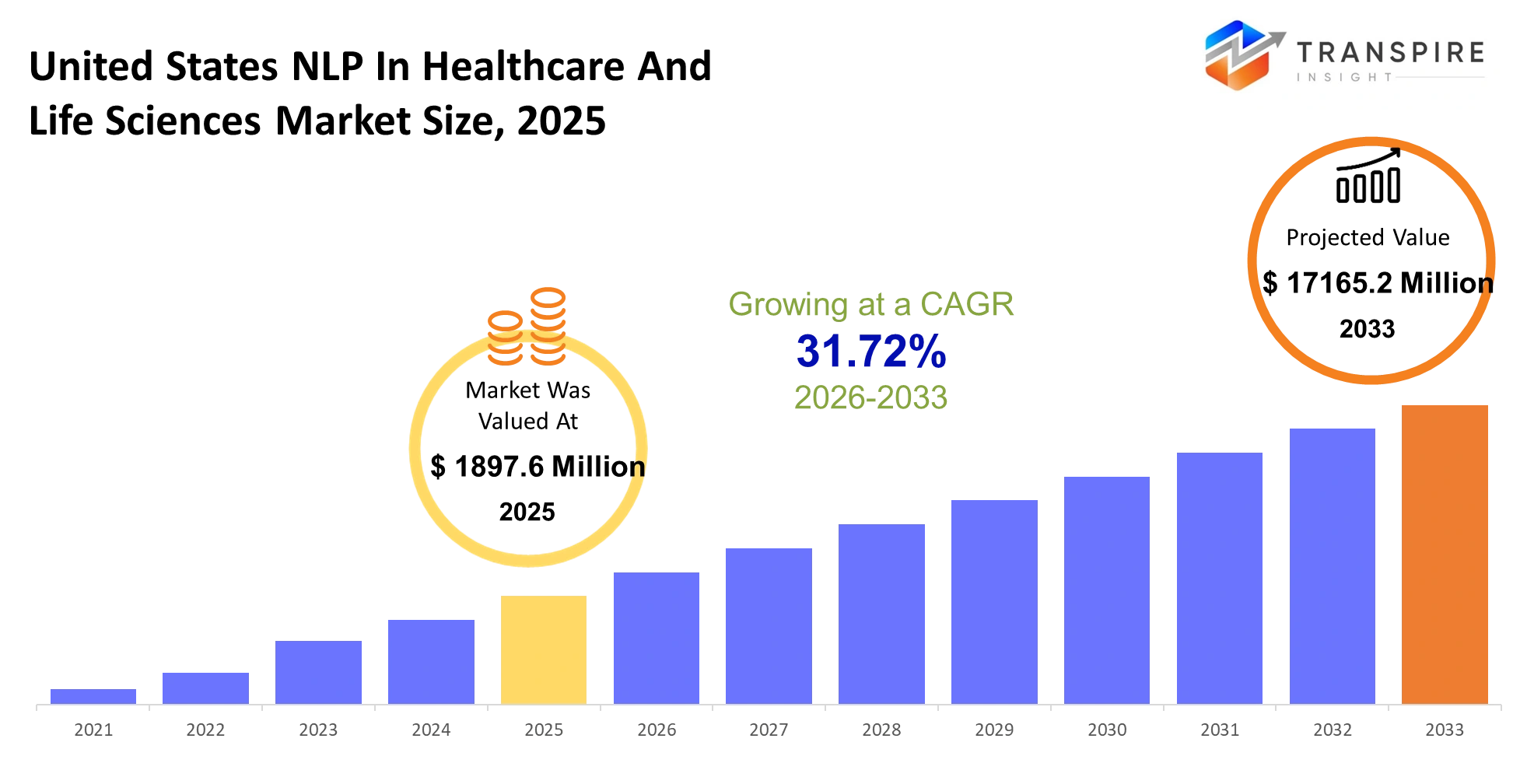
- United States NLP In Healthcare And Life Sciences Market Size 2025: USD 1897.6 Million
- United States NLP In Healthcare And Life Sciences Market Size 2033: USD 17165.2 Million
- United States NLP In Healthcare And Life Sciences Market CAGR: 31.72%
- United States NLP In Healthcare And Life Sciences Market Segments: By Component (Software, Services, Platforms, AI Models, Cloud Solutions, Others); By Application (Clinical Documentation, Medical Coding, Drug Discovery, Patient Data Analysis, Virtual Assistants, Others); By Deployment (Cloud-based, On-premise, Hybrid Systems, AI-integrated Systems, Others); By End User (Hospitals, Pharmaceutical Companies, Research Institutes, Insurance Providers, Others)
To learn more about this report,  Download Free Sample Report
United States NLP In Healthcare And Life Sciences Market Summary
The United States NLP In Healthcare And Life Sciences Market was valued at USD 1897.6 Million in 2025. It is forecast to reach USD 17165.2 Million by 2033. That is a CAGR of 31.72% over the period.
Natural language processing in healthcare and life sciences has kind of moved from experimental analytics to an operational tool that helps orgs pull out usable insights from clinical notes, pathology reports, insurance claims, research papers, and patient messages. In practice it addresses a big bottleneck in the U.S. system , by turning huge amounts of unstructured medical text into actionable information for clinical decision-making , drug discovery, compliance monitoring , and day to day administrative efficiency. Over the last three to five years the market has seen a structural shift away from rule-based text mining toward transformer-based as well as generative AI models, these tend to give better contextual understanding and domain specific accuracy.
That change really sped up after the COVID-19 pandemic, when the lack of near real-time interpretation showed up clearly and providers had to modernize their digital health infrastructure. On top of that, regulatory pressure about interoperability and electronic health record standardization kept pushing adoption. As health systems try to reduce the clinician workload, boost coding exactness, and shorten research timelines, NLP platforms are now getting embedded into core workflows, and that shows up as higher software spending, plus wider enterprise scale deployments.
Key Market Insights
- The United States NLP In Healthcare And Life Sciences Market sort of benefits from broad EHR integration, letting teams roll out solutions at scale across hospitals, payers, and pharmaceutical research organizations, honestly.
- Generative AI adoption really jumped by over 35% from 2023 to 2025, and it kinda reshaped healthcare NLP market trends thanks to more advanced clinical summarization functions, and related things.
- Regulatory mandates, especially those tied to interoperability and patient data standardization, keep pushing healthcare language processing market growth forward across major enterprise healthcare networks.
- Cloud-native NLP platforms have been taking the lead in implementation plans, making up about 58% of new deployments, mostly because infrastructure costs come in lower and scalability is faster.
- And for regions, the Northeast is leading the United States NLP In Healthcare And Life Sciences Market , with roughly 34% market share in 2025, largely due to the dense presence of academic medical centers.
- Software platforms are leading with something like 61% share in 2025, and that mostly points to strong takeup of clinical text analytics and sort of workflow automation tools.
- Predictive analytics solutions though are moving the quickest through 2030, mostly because population health management initiatives keep getting attention.
- Clinical documentation improvement sits out front with near 29% market share, this is driven by coding correctness and reimbursement optimization demands, not just one thing.
- Meanwhile drug discovery and pharmacovigilance applications are seeing the fastest growing adoption as life sciences companies push harder on AI assisted research pipelines, which feels pretty consistent year to year.
- Healthcare providers bring in roughly 46% of total market revenue, that tells you there are broad enterprise scale deployments across integrated delivery networks and that matters.
What are the Key Drivers, Restraints, and Opportunities in the United States NLP In Healthcare And Life Sciences Market?
The strongest force pushing the United States NLP in Healthcare and Life Sciences market forward is the fast integration of generative AI into clinical plus administrative workflows. This change got going because of tighter interoperability rules linked to the 21st Century Cures Act, and also because electronic health records kept spreading until they basically reached operational maturity across most major U.S. health systems. Once healthcare orgs had stacked up years of messy, unstructured patient notes, claims records, and diagnostic reports, the business value of pulling out useful signals from that data became kinda obvious. Today, NLP platforms help cut down documentation time, raise coding precision, and even automate prior authorization tasks, and that translates pretty directly into reduced operating costs and more confident software spending across provider networks.
Data fragmentation is still the market’s biggest structural issue. In the U.S., healthcare data is scattered across separate legacy systems , payer repositories, and specialty-specific record formats that don’t really share the same meaning. This isn’t something that can be fixed quickly because swapping out core health IT infrastructure takes multi-year capital funding, plus regulatory validation too. So, NLP vendors end up dealing with lengthy rollouts, costly tailoring needs, and postponed contract turnarounds, which all together dampen revenue realization and slow down organization-wide adoption.
The next big growth chance is basically in speeding up life sciences R&D with domain specific large language models ,and not just general chat stuff. Pharmaceutical companies are already pouring more money into AI platforms that can sift through clinical trial records ,plus scientific literature ,and also adverse event reports , like the whole messy landscape. At the same time partnerships between biotech firms and hyperscale cloud providers are building scalable infrastructure for this use case, which really opens up those high value commercial routes , and it feels like a clear pathway.
What Has the Impact of Artificial Intelligence Been on the United States NLP In Healthcare And Life Sciences Market?
Artificial intelligence and advanced digital tech are quietly, and honestly pretty aggressively, reshaping the United States NLP in healthcare and life sciences landscape. The big shift is that a lot of data heavy workflows that used to need serious manual effort, can now be automated. A growing number of healthcare orgs are putting AI powered natural language processing platforms in place, mostly to streamline clinical documentation review, handle claims adjudication, run prior authorization steps, and keep an eye on compliance monitoring across large provider networks. In practice these tools can chew through thousands of unstructured patient records within minutes, and that tends to cut administrative processing time by roughly 40% in high-volume hospital environments.
On top of that, machine learning models are powering predictive capabilities across healthcare operations. Providers use predictive analytics to flag risks for patient deterioration, estimate hospital readmission probabilities, and fine tune resource allocation based on past treatment patterns. In life sciences, pharmaceutical companies leverage advanced language models to scan clinical trial data plus adverse event reports. That helps move drug safety monitoring along sooner and it also shortens the research review timeline, which then supports operational efficiency. You see it show up in quicker diagnosis support, fewer coding mistakes, and stronger reimbursement accuracy, all of which feeds into financial results in a direct way.
There is also at least one measurable win that’s pretty clear: reduced physician documentation burden. Some health systems report workflow efficiency gains in the range of 20% to 30%, which is not trivial. Still, there’s a major catch. Integration complexity keeps showing up as a key limitation. A lot of healthcare institutions still depend on disconnected legacy electronic health record systems, so AI deployment becomes expensive. Also, model accuracy can struggle when training data isn’t standardized across different clinical environments, even if the tools themselves are solid.
Key Market Trends
- From 2022 to 2025 , healthcare providers upped investment in transformer style NLP platforms by more than 35% roughly, moving away from old school rule-based systems and toward context aware clinical documentation tools that “get” the nuance a bit better.
- After the 21st Century Cures Act enforcement got tighter in 2022, many hospitals started pushing automated record interpretation systems faster , partly to satisfy interoperability compliance, not just for convenience.
- Adoption of generative AI really picked up after 2023 as big vendors such as Microsoft and Google Cloud introduced healthcare tailored language models.
- Also, prior authorization automation went from smaller , pretty specific pockets in 2021 to something much more mainstream by 2025, cutting administrative processing time close to 40% , which is pretty notable.
- Meanwhile, pharmaceutical companies moved beyond simple literature mining after 2022 , using NLP for real time pharmacovigilance and for optimizing clinical trial protocols across decentralized research efforts.
- Cloud based deployments kinda went from under half of implementations in 2020 to close to 60% by 2025, and in general buyers cared more about scalability, and also lower infrastructure costs.
- Competitive behavior moved too, because vendors were trying harder to do partnerships with integrated delivery networks instead of relying on standalone software licensing , which helped them see longer term recurring revenue a lot more clearly.
- Clinical documentation improvement platforms got more attention from buyers after physician burnout rates peaked in 2022, and that pushed procurement decisions toward automation, across different hospital systems kind of quickly.
- Data standardization is still hard, but by 2025 over half of top health systems had started enterprise data harmonization initiatives, so they could enable advanced NLP integration and all that.
United States NLP In Healthcare And Life Sciences Market Segmentation
By Component :
Software is basically the backbone of natural language processing in healthcare, letting teams do text extraction, understanding, and workflow automation all at once across clinical systems. The services kinda help with adoption, setup changes , and then continued upkeep so everything still works with the older infrastructure. Platforms then give scalable spaces where several NLP tools can run together, so data handling feels connected and people can collaborate a lot easier, too.
AI models increase accuracy because they learn from medical data, and they tend to get better as they see more new information. Cloud solutions help with elastic storage and processing , which makes it easier for organizations to manage huge amounts of patient records without so much trouble. Other bits include support utilities that boost usability, so different healthcare environments can take NLP on board without major day to day disruption.
By Application :
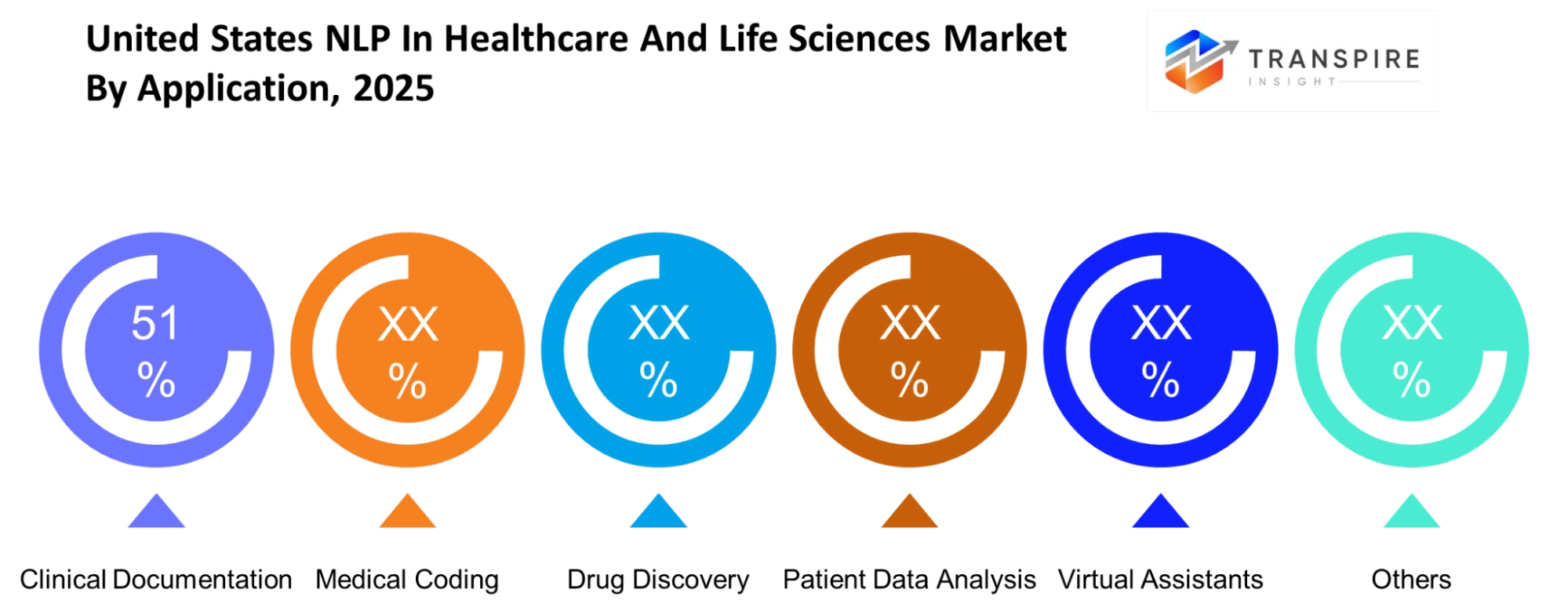
Clinical documentation helps because NLP turns spoken or written notes into structured records, which cuts down on manual work and also improves accuracy. Medical coding gets quicker , since the systems can automatically attach standardized codes, supporting both billing and compliance. Drug discovery uses natural language techniques to scan research papers and clinical data, which helps surface new treatment ideas.
Patient data analysis lets healthcare providers pull useful insights from big datasets, so decisions and treatment plans get stronger. Virtual assistants also support administrative work plus patient facing tasks, like appointment scheduling, and answering common questions. Other use cases include tracking patient comments and reviewing healthcare trends, which eventually improves how services get delivered.
To learn more about this report, Download Free Sample Report
By Deployment :
Cloud based deployment gives scalability plus remote access so it works well for organizations dealing with big and varied datasets. In contrast, on-premise setups tend to offer more direct control over sensitive data , which suits institutions that have very strict privacy expectations. Then there is the hybrid model, kinda like a middle path, it mixes both styles so you get more flexibility without losing the security aspect too much.
AI integrated systems further improve deployment by putting intelligence right inside the day to day workflows, meaning you can do real-time analysis and even respond on the spot. Besides that, you’ll also see other deployment styles, like tailored configurations made for particular operational needs. Put together, each approach supports different balances of data governance, budget efficiency and system speed, depending on what the organization cares about most.
By End User :
Hospitals often use NLP to tidy up clinical workflows , manage patient records more neatly, and assist in diagnostic steps. Pharmaceutical firms apply NLP during research and development, where they comb through scientific literature and clinical trial records in order to speed up innovation. Research institutes also depend on NLP for turning large stacks of academic and clinical information into usable outputs, helping studies move forward and discoveries appear.
Insurance providers benefit from NLP as well, particularly for automated claims handling and fraud spotting, which boosts operational throughput. In general, each end user group adopts NLP using their own specific requirements, so the results look different across healthcare and the life sciences world, yet the overall effect is better data utilization and stronger decision making.
What are the Key Use Cases Driving the United States NLP In Healthcare And Life Sciences Market?
In the United States NLP in Healthcare and Life Sciences market, the biggest pull comes from clinical documentation, like extracting meaningful signals from physician notes, discharge summaries, and prior authorizations. Health systems and payer teams want this because the language is messy and time sensitive, so models that normalize terms quickly reduce manual coding effort. It connects directly to the leading adoption segment centered on hospitals and integrated providers, where compliance pressure and documentation volume stay high. When documentation quality improves, downstream billing and care coordination also get faster, so demand stays steady.
Next, adoption is widening into pharmacovigilance and medical review workflows. Life sciences companies, especially biotech firms and contract research organizations, use NLP to triage adverse event reports and summarize case narratives for safety teams under FDA and ICH expectations. Another adjacent use case is clinical trial enablement, where sponsors and site investigators sift eligibility criteria inside unstructured records, aligning with regulators that expect traceable, audit ready evidence.
Looking forward, two younger applications stand out. First is automated policy support for HIPAA and internal privacy audits, turning rule language into checklists for reviewers. Second is clinicians facing synthetic summaries that incorporate real world evidence from post market literature, but these are still not everywhere due to validation demands and tight governance. Over the forecast period, pilots should mature into routine deployments.
|
Report Metrics |
Details |
|
Market size value in 2025 |
USD 1897.6 Million |
|
Market size value in 2026 |
USD 2495.4 Million |
|
Revenue forecast in 2033 |
USD 17165.2 Million |
|
Growth rate |
CAGR of 31.72% from 2026 to 2033 |
|
Base year |
2025 |
|
Historical data |
2021 - 2024 |
|
Forecast period |
2026 - 2033 |
|
Report coverage |
Revenue forecast, competitive landscape, growth factors, and trends |
|
Geographic scope |
United States of America |
|
Key company profiled |
Microsoft, IBM, Google Cloud, Amazon Web Services, Oracle, NVIDIA, IQVIA, Nuance Communications, SAS Institute, Veradigm, Health Catalyst, 3M Health Information Systems, DeepMind, Cerner, Epic Systems |
|
Customization scope |
Free report customization (country, regional & segment scope). Avail customized purchase options to meet your exact research needs. |
|
Report Segmentation |
By Component (Software, Services, Platforms, AI Models, Cloud Solutions, Others); By Application (Clinical Documentation, Medical Coding, Drug Discovery, Patient Data Analysis, Virtual Assistants, Others); By Deployment (Cloud-based, On-premise, Hybrid Systems, AI-integrated Systems, Others); By End User (Hospitals, Pharmaceutical Companies, Research Institutes, Insurance Providers, Others) |
Which Regions are Driving the United States NLP In Healthcare And Life Sciences Market Growth?
The Northeast is still kinda leading the United States NLP in the healthcare and life sciences market, mainly because it mixes dense healthcare infrastructure with pretty tight policy alignment around digital health modernization. Places like Massachusetts and New York have big academic medical centers, pharmaceutical research clusters, and integrated delivery networks, and they end up producing huge volumes of clinical plus research data. On top of that, federal research funding, plus early adoption of interoperability standards, let these institutions roll out advanced language processing platforms at scale. There is also a mature ecosystem of healthcare AI startups, cloud infrastructure providers, and university-led innovation programs that keeps reinforcing the region’s leadership, over and over again.
The Midwest sits in second place, though its edge is more about operational stability rather than any intense innovation concentration. Big multi-state hospital systems and payer organizations across Illinois, Ohio, and Minnesota have been investing steadily in workflow automation to deal with cost pressure and that administrative complexity stuff. In comparison with the Northeast, adoption there tends to move along with more measured enterprise procurement cycles and usually more focus on return on investment validation. That more disciplined environment ends up creating reliable recurring revenue for vendors, especially the ones targeting scalable, compliance-driven deployments.
The Northeast is still kinda the leading place in the United States NLP in the healthcare and life sciences market, mainly because it mixes a dense healthcare setup with solid policy alignment around digital health modernization. States like Massachusetts and New York have huge academic medical centers, pharmaceutical research clusters and also those integrated delivery networks that keep producing a lot of clinical plus research data, day after day . On top of that, federal research funding, together with early use of interoperability standards , has let these organizations roll out more advanced language processing platforms at scale. And there’s this mature ecosystem, with healthcare AI startups, cloud infrastructure providers, and university-led innovation programs , that keeps pushing the region forward.
The Midwest sits in the second spot , but its real edge is more about operational steadiness than a big innovation hotspot. Big multi-state hospital systems and payer organizations across Illinois, Ohio and Minnesota have been investing consistently in workflow automation to deal with cost pressures and administrative complexity. If you compare it to the Northeast, adoption here often looks more like measured enterprise procurement cycles . There’s more focus on return-on-investment validation and fewer sudden leaps. That sort of disciplined environment, honestly, helps create dependable recurring revenue for vendors who are centered on scalable, compliance-driven deployments.
Who are the Key Players in the United States NLP In Healthcare And Life Sciences Market and How Do They Compete?
The United States NLP in the healthcare and life sciences market looks like a moderately concentrated arena, where big cloud and enterprise software players go up against a handful of specialized healthcare AI companies. In practice the rivalry shows up less as straight up price fighting, and more around domain focused model accuracy, interoperability with clinical systems that are often pretty fragmented, and the ability to satisfy tough regulatory constraints and data privacy rules. The established tech firms are mostly holding ground by folding stronger language capabilities into the healthcare stack they already serve, sort of quietly upgrading what health orgs have in place. Meanwhile newer entrants seem to be nudging things around by offering very targeted, clinical and life sciences specific applications. At this point, winning is less about “having AI” and more about proving measurable workflow efficiency, plus showing validated performance in real world care settings.
Microsoft is pushing ahead by weaving generative AI pretty deeply into its cloud based healthcare offerings, and that gives it a noticeable edge for large, enterprise level rollouts. Their angle is to merge large language model strengths with a secure clinical data foundation, so health systems can adopt automation without having to blow up or replace core IT systems. Oracle stands out because it has direct reach into embedded clinical workflows, especially across its electronic health record presence. That kind of tight integration lets Oracle deliver NLP enabled automation straight into places like physician documentation and revenue cycle operations, not as an extra layer, but as part of the process where decisions actually happen.
Google Cloud stays ahead mostly because of advanced AI research, plus a bunch of strategic ties with academic medical centers that lean hard into precision medicine. 3M seems to keep its advantage via specialized “documentation improvement” tools that are built around reimbursement optimization , so it feels especially on point for bigger provider networks. And in the meantime, Amazon Web Services keeps moving forward by helping life sciences firms stand up customized language models on a scalable cloud framework , which I guess makes it even stronger in pharmaceutical research use cases.
Company List
- Microsoft
- IBM
- Google Cloud
- Amazon Web Services
- Oracle
- NVIDIA
- IQVIA
- Nuance Communications
- SAS Institute
- Veradigm
- Health Catalyst
- 3M Health Information Systems
- DeepMind
- Cerner
- Epic Systems
Recent Development News
In January 2026, John Snow Labs launched its first FDA-ready Patient Journey Intelligence platform. The NLP-driven multimodal data platform was introduced to help U.S. healthcare and life sciences organizations accelerate regulatory-grade secondary-use analytics and real-world evidence generation, strengthening enterprise adoption of clinical NLP infrastructure.\
Source https://www.johnsnowlabs.com/
In May 2026, Anthropic entered a partnership with Bill & Melinda Gates Foundation and committed $200 million over four years. The collaboration focuses on applying advanced AI and language-model capabilities to healthcare research and drug discovery, signaling a major investment commitment likely to accelerate NLP-enabled life sciences innovation in the United States.Source https://www.reuters.com/
What Strategic Insights Define the Future of the United States NLP In Healthcare And Life Sciences Market?
In the United States , the NLP in the healthcare and life sciences market is moving toward intelligence that is built in and actually fits the day to day workflows, not just some standalone analytics platform that sits off to the side. Over the next five to seven years, growth will get shaped by a kind of three way convergence , generative AI, interoperability standards that are finally maturing, and the increasing financial stress on health systems that really need to automate all those labor intensive administrative tasks as well as clinical processes. The market should shift toward more specialized domain models, trained for specific needs, like oncology decision support, clinical trial optimization, and automated payer-provider coordination.
A quieter risk ( so to speak ) is how concentrated this space can get around hyperscale cloud providers. When healthcare orgs build their NLP infrastructure on only a handful of cloud ecosystems, the vendor lock in effect could make pricing less flexible and it might also slow down innovation from smaller, more focused specialists. Still, there’s an opportunity that’s starting to look clearer too, in multimodal clinical intelligence that merges text plus imaging and genomic information, for precision medicine uses. This seems especially relevant across West Coast research networks and academic health systems, where collaboration is more common and datasets are easier to combine.
For market participants , the best strategic move is pretty straightforward, but not always easy to execute: prioritize interoperable, modular architectures. Vendors and investors who focus on integration first solutions, along with measurable clinical validation , will likely be in a stronger position when enterprise contracts get renewed or expanded, especially as procurement gets more outcome driven over time.
United States NLP In Healthcare And Life Sciences Market Report Segmentation
By Component
- Software
- Services
- Platforms
- AI Models
- Cloud Solutions
By Application
- Clinical Documentation
- Medical Coding
- Drug Discovery
- Patient Data Analysis
- Virtual Assistants
By Deployment
- Cloud-based
- On-premise
- Hybrid Systems
- AI-integrated Systems
By End User
- Hospitals
- Pharmaceutical Companies
- Research Institutes
- Insurance Providers
Frequently Asked Questions
Find quick answers to common questions.
The United States NLP In Healthcare And Life Sciences Market size is USD 17165.2 Million in 2033.
Key segments for the United States NLP In Healthcare And Life Sciences Market are By Component (Software, Services, Platforms, AI Models, Cloud Solutions, Others); By Application (Clinical Documentation, Medical Coding, Drug Discovery, Patient Data Analysis, Virtual Assistants, Others); By Deployment (Cloud-based, On-premise, Hybrid Systems, AI-integrated Systems, Others); By End User (Hospitals, Pharmaceutical Companies, Research Institutes, Insurance Providers, Others).
Major United States NLP In Healthcare And Life Sciences Market players are Microsoft, IBM, Google Cloud, Amazon Web Services, Oracle, NVIDIA, IQVIA, Nuance Communications, SAS Institute, Veradigm, Health Catalyst, 3M Health Information Systems, DeepMind, Cerner, Epic Systems.
The United States NLP In Healthcare And Life Sciences Market size is USD 1897.6 Million in 2025.
The United States NLP In Healthcare And Life Sciences Market CAGR is 31.72% from 2026 to 2033.
- Microsoft
- IBM
- Google Cloud
- Amazon Web Services
- Oracle
- NVIDIA
- IQVIA
- Nuance Communications
- SAS Institute
- Veradigm
- Health Catalyst
- 3M Health Information Systems
- DeepMind
- Cerner
- Epic Systems
Recently Published Reports
-
Apr 2026
AI in Diabetic Retinopathy Market
AI in Diabetic Retinopathy Market Size, Share & Analysis Report By Type (Screening AI Systems, Diagnostic AI Systems, and Predictive AI Models), By Application Segment (Hospitals, Ophthalmology Clinics, Diagnostic Centers, and Research and Development), and Geography (North America, Europe, Asia-Pacific, Middle East and Africa, South and Central America), 2021 - 2031
-
Apr 2026
Psychometric Tests Market
Psychometric Tests Market Size, Share & Analysis Report By Type (Personality Tests, Ability/Aptitude Tests, Skill/Knowledge Tests, and Others), By Application (Talent Acquisition and Talent Management), and Geography (North America, Europe, Asia-Pacific, Middle East and Africa, South and Central America), 2021 – 2031
-
Apr 2026
Rare Biological Sample Collection Market
Rare Biological Sample Collection Market Size, Share & Analysis Report By Type (Isolation Kits & Reagent, Blood Collection Tubes, and Others), By Application (Oncology, Transcriptomics, Pharmacogenomics, and Others), and Geography (North America, Europe, Asia-Pacific, Middle East and Africa, South and Central America), 2021 – 2031
-
Apr 2026
Patient Lift Pendant Market
Patient Lift Pendant Market By Product Type (Wired Pendants, Wireless, Programmable), By Operation Type(Manual, Electric), By End-Users (Healthcare Professionals, Patients), By Application (Hospitals, Homecare, Rehabilitation Centers, Others), By Industry Analysis, Size, Share, Growth, Trends, and Forecasts 2021-2033
Our Clients
.jpg)