

Asia Pacific Ketoanalogue For Kidney Disease Market Size & Forecast:
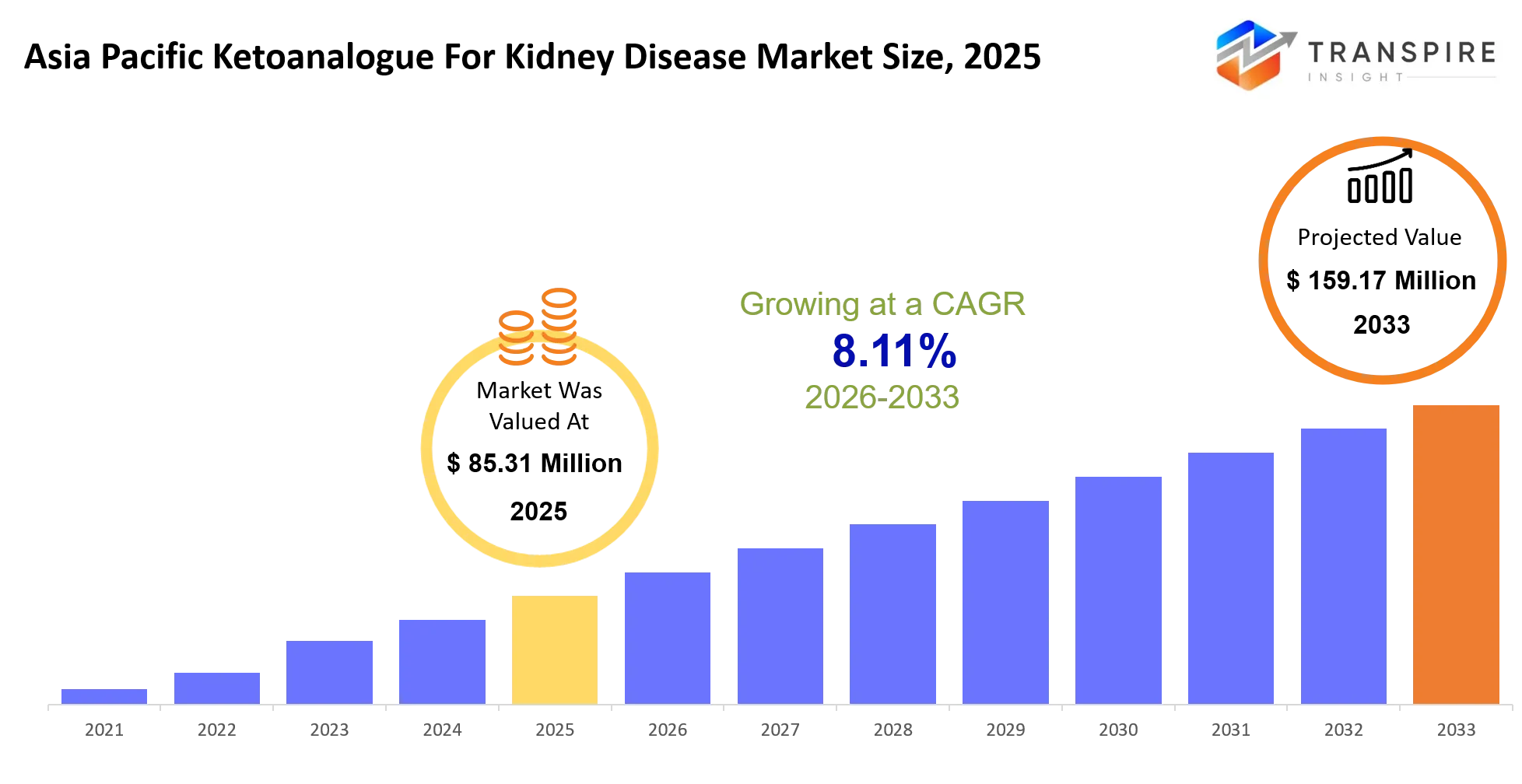
- Asia Pacific Ketoanalogue For Kidney Disease Market Size 2025: USD 85.31 Million
- Asia Pacific Ketoanalogue For Kidney Disease Market Size 2033: USD 159.17 Million
- Asia Pacific Ketoanalogue For Kidney Disease Market CAGR: 8.11%
- Asia Pacific Ketoanalogue For Kidney Disease Market Segments: By Product Type (Tablet Formulations, Capsule Formulations, Powder Formulations, Others); By Application (Chronic Kidney Disease, Dialysis Support, Renal Nutrition Therapy, Others); By Distribution Channel (Hospital Pharmacies, Retail Pharmacies, Online Pharmacies, Others); By End User (Hospitals, Clinics, Homecare Patients, Others)
To learn more about this report,  Download Free Sample Report
Asia Pacific Ketoanalogue For Kidney Disease Market Summary
The Asia Pacific Ketoanalogue For Kidney Disease Market was valued at USD 85.31 Million in 2025. It is forecast to reach USD 159.17 Million by 2033. That is a CAGR of 8.11% over the period.
The Asia Pacific ketoanalogue for kidney disease market really supports clinical nutrition approaches that, in a kind of roundabout way, help people with chronic kidney disease push back dialysis by cutting nitrogen waste, while also keeping nutritional status steady using ketoacid based supplements. These are typically prescribed alongside low protein diets. Basically, nephrologists and renal dietitians end up leaning on these formulations in advanced CKD care, so they can hold onto residual kidney function and slow the march toward dialysis dependence.
Over the last five years, the market has kind of shifted, from mostly hospital only prescribing into wider outpatient renal nutrition adoption, as clinical guidelines increasingly treat medical nutrition therapy like a conservative pathway for CKD management. There’s also been a noticeable structural tilt toward delaying dialysis initiation, and that has widened ketoanalogue use across Asia Pacific health systems, especially in areas where dialysis capacity is tight, or in practice, overstretched. At the same time, diabetes driven CKD rates kept climbing, and COVID 19 related disruptions to regular dialysis access somehow made clinicians lean more toward earlier dietary intervention. That, together, boosted prescription volumes and strengthened commercial uptake across both public and private care settings.
Key Market Insights
- China pretty much leads the Asia Pacific Ketoanalogue For Kidney Disease Market, with about 34% share in 2025, mainly because CKD cases are high and hospitals prescribe a lot.
- Japan keeps a more mature, protocol-following vibe, with steady ketoanalogue take-up inside conservative nephrology care pathways.
- India is the quickest mover from 2025–2030, and it’s fueled by a growing dialysis load, plus low-cost renal nutrition access programs.
- When it comes to the product side, ketoanalogue tablets and amino acid analog formulations take the front seat, holding roughly 62% of the Asia Pacific market.
- Combination renal nutrition supplements are in second place, with support from bundled CKD dietary therapy models, especially across city hospitals.
- For growth though, combination therapy formulations look like the fastest-moving segment going into 2030, largely tied to delayed dialysis strategies.
- By application, Stage 4–5 non-dialysis chronic kidney disease is the biggest bucket, at nearly 58% share in 2025. Meanwhile, pre-dialysis intervention programs are growing the quickest, since they can slow the march toward renal replacement therapy.
- On end users, hospitals and nephrology clinics lead with around 65% share because administration is prescription-led.
- Homecare renal nutrition management is the fastest-growing end-user category too, as outpatient CKD monitoring is expanding.
What are the Key Drivers, Restraints, and Opportunities in the Asia Pacific Ketoanalogue For Kidney Disease Market?
The primary driver is this growing shift toward conservative management of chronic kidney disease, backed by newer nephrology guidelines that push for delaying dialysis through medical nutrition therapy. It kind of got traction as end-stage renal disease costs kept climbing across Asia Pacific healthcare systems, especially in China and India where the dialysis infrastructure is under real pressure, you know. Because of that, ketoanalogue prescriptions are being folded more and more into pre-dialysis treatment protocols, so outpatient adoption rates improve, and there is this steady, almost recurring demand that shows up in hospital pharmacy channels across the Asia Pacific Ketoanalogue For Kidney Disease Market.
The biggest restraint, though, is limited reimbursement coverage, plus uneven awareness among general practitioners outside tertiary nephrology centers. This sort of structural issue stays around because healthcare financing systems in many Asia Pacific countries still lean toward dialysis rather than preventive nutritional intervention. So, a lot of patients end up starting ketoanalogue therapy late, or sometimes not at all, which definitely lowers the possible prescription volumes and slows down early-stage market penetration in practice.
A major opportunity is expanding renal nutrition programs within primary healthcare networks, particularly across India and Southeast Asia. Some pilot efforts that combine tele-nephrology platforms with dietitian-led ketoanalogue supplementation in urban areas of India have already shown higher early CKD intervention rates, that part matters a lot. It suggests a scalable route for broader Asia Pacific Ketoanalogue For Kidney Disease Market expansion, even beyond those initial sites.
What Has the Impact of Artificial Intelligence Been on the Asia Pacific Ketoanalogue For Kidney Disease Market?
Artificial intelligence is getting embedded more and more into marine emission control systems, especially for scrubber performance monitoring and the whole regulatory compliance management piece across the Asia Pacific shipping ecosystem. In practice, operators are now using AI-enabled sensor networks on exhaust gas cleaning systems, so they can continuously follow sulfur oxide removal efficiency, pressure gaps and also washwater quality. What happens then is that the systems basically automate compliance reporting by directly linking vessel-level emissions data to IMO 2020 requirements, which cuts down manual audit workloads a lot and, at the same time, makes reporting more precise.
On top of that, machine learning models are being applied for predictive maintenance in scrubber units. They look at vibration signatures, corrosion indicators and flow irregularities, and then they predict when components will start degrading before any actual failure occurs. That lets shipping companies arrange maintenance around planned port calls, it improves fleet availability and also lowers the cost of unexpected downtime. At the same time emissions forecasting tools help tune fuel and scrubber operating modes based on the voyage path, fuel sulfur content, and what the weather is doing. The result is better fuel efficiency and steadier compliance performance overall.
Still though, AI adoption has a kind of structural constraint because real world maritime data quality is inconsistent. Things like sensor drift, rough operating environments, and limited satellite connectivity during extended ocean legs reduce model reliability and make real time optimization harder to keep running. This limitation basically slows down full scale deployment, even if there’s strong interest from fleet operators in digital scrubber optimization solutions.
Key Market Trends
- Between 2020 and 2025, nephrology guidance in Japan and China sort of drifted more and more toward ketoanalogue based conservative CKD care, instead of jumping into early dialysis right away.
- In China, hospital reimbursement pilots rolled out more broadly in 2023 , which helped patients actually get to ketoanalogue options and it also seemed to speed up prescriptions across major renal care centers.
- In India, private hospital networks picked up ketoanalogue use before dialysis after 2022, partly because dialysis capacity constraints started hitting urban nephrology services harder.
- Fresenius Kabi and Abbott then expanded renal nutrition portfolios across Asia Pacific from 2021 to 2024, using localized formulation launches , so the products fit local practice better.
- By 2024, digital nephrology platforms showed up, and they supported remote diet monitoring, so ketoanalogue adherence among chronic kidney disease patients improved.
- Around that same general time window, COVID 19 supply chain issues pushed regional manufacturing localization of renal supplements across Southeast Asia after 2021, kind of as a pragmatic response.
- Japan’s aging population also played a role , because outpatient clinics ended up writing longer term ketoanalogue prescriptions, moving demand away from inpatient dialysis initiation pathways.
- Meanwhile, tele-nephrology pilots across Southeast Asia since 2023 improved early CKD intervention rates, but they did it using ketoanalogue supplementation guidance remotely.
- Finally, in 2025 regulators leaned harder into recognizing CKD dietary therapy frameworks, which increased clinical acceptance of ketoanalogue based treatment protocols, overall.
Asia Pacific Ketoanalogue For Kidney Disease Market Segmentation
By Product Type :
Tablet formulations are basically the ones that show up most in hospital prescribing systems, largely because dosing stays pretty stable, and patients seem to follow it easier, especially when you are dealing with chronic kidney disease management. Capsule formulations are also getting a steady uptake, mainly for patients who need more flexible intake schedules though. As for powder formulations, they’re getting more attention with people who have swallowing difficulties, plus they fit into diet based renal nutrition plans across Asia Pacific healthcare settings without much trouble.
Over time, powder and other alternative formats start to help with more outpatient care expansion, in particular where long term dietary control really matters. Even so, the market preference keeps leaning toward standardized tablet based ketoanalogue therapies, because hospitals care about controlled dosing and treatment consistency, especially inside conservative kidney disease management programs.
By Application :
Chronic kidney disease is still the main application area as early stage intervention plans expand across Asia Pacific nephrology practices. Dialysis support usage continues to rise too, notably for patients who delay renal replacement therapy by relying on nutritional management. Renal nutrition therapy keeps strengthening adoption as hospitals weave dietary treatment into structured CKD care pathways, more and more.
Clinically, there’s also a noticeable move toward earlier nutritional intervention, with the aim to slow disease progression. Healthcare providers use ketoanalogue therapy more often in pre-dialysis stages, which helps patients stay steadier and, in several regional systems, lowers immediate dialysis dependence.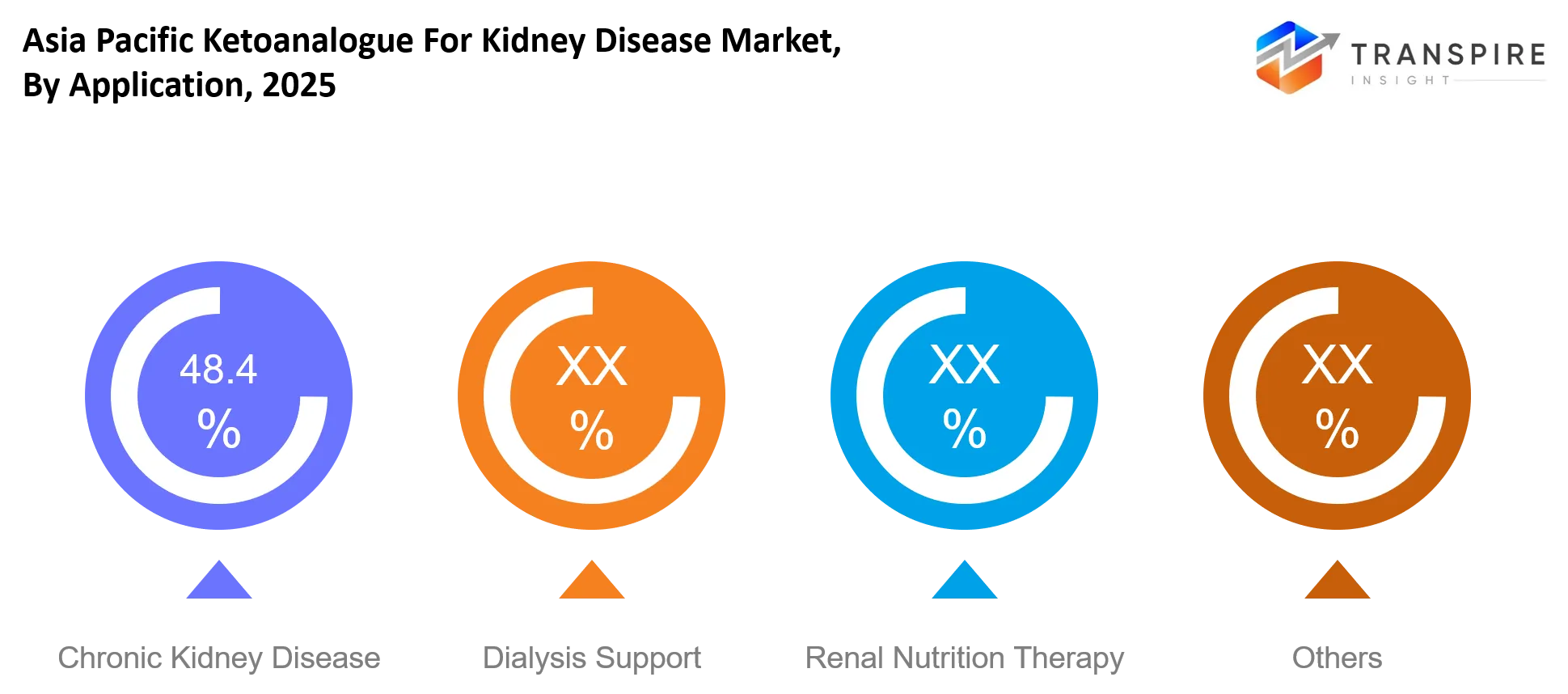
To learn more about this report, Download Free Sample Report
By Distribution Channel :
Tablet formulations are pretty much the default choice across most hospital prescribing systems, mostly because the dosing stays steady and it feels easier for patients to stick with it, especially in chronic kidney disease care. Capsule formulations also keep moving forward at a calm, consistent pace, mainly for people who need more flexible ways to take their medicine. Meanwhile, powder formulations are getting more attention too, particularly for patients who have swallowing difficulties or those in diet-led renal nutrition plans across parts of Asia Pacific.
Over time, powder and alternative formats end up supporting outpatient care expansion, and it tends to matter most when long term dietary control is the goal. At the same time, market preference is still leaning toward standardized tablet based ketoanalogue therapies, because hospitals like controlled dosing, and they want better treatment consistency in conservative kidney disease management programs.
By End User :
Chronic kidney disease stays the primary application area as early stage intervention approaches keep spreading across Asia Pacific nephrology practices. Dialysis support use is increasing as some patients postpone renal replacement therapy, by leaning on nutritional management. Renal nutrition therapy is also becoming more common, since hospitals are weaving dietary treatment into structured CKD care pathways.
In clinical practice, earlier nutritional intervention is being favored more often, to help slow progression. Healthcare providers apply ketoanalogue therapy more frequently in the pre-dialysis stages, and in a few regional healthcare systems this has helped patients remain steadier and, well, it lowers the need for dialysis right away for some patients.
What are the Key Use Cases Driving the Asia Pacific Ketoanalogue For Kidney Disease Market?
Core use case, is managing chronic kidney disease before dialysis using ketoanalogue based medical nutrition therapy, so clinicians are trying to push dialysis start date further out and keep residual kidney function as long as possible , this creates a steady prescription appetite inside hospital nephrology wards across the Asia Pacific region.
Then there is the expansion angle, dialing support nutrition and more structured renal diet programs, often rolled out in hospitals and specialty clinics. At the same time, homecare patients are also using the prescribed ketoanalogue supplements in everyday life, but under outpatient follow up monitoring, which helps with adherence and cuts down on those frequent hospital trips, especially across urban Asia Pacific healthcare systems.
And the emerging stuff is tele-nephrology, where a clinician guides the dietary changes remotely, plus primary care early CKD screening programs. In those models ketoanalogue therapy tends to be introduced sooner, in high risk diabetic and hypertensive populations, with the goal of slowing disease progression earlier rather than later.
|
Report Metrics |
Details |
|
Market size value in 2025 |
USD 85.31 Million |
|
Market size value in 2026 |
USD 92.23 Million |
|
Revenue forecast in 2033 |
USD 159.17 Million |
|
Growth rate |
CAGR of 8.11% from 2026 to 2033 |
|
Base year |
2025 |
|
Historical data |
2021 - 2024 |
|
Forecast period |
2026 - 2033 |
|
Report coverage |
Revenue forecast, competitive landscape, growth factors, and trends |
|
Regional scope |
Asia Pacific (India, China, Japan, Australia,South Korea, Rest of Asia Pacific) |
|
Key company profiled |
Fresenius Kabi, Baxter, Otsuka Pharmaceutical, Sanofi, Nestlé Health Science, Abbott, Vifor Pharma, Cipla, Sun Pharma, Dr. Reddy’s, B. Braun, Ajinomoto, Danone Nutricia, Lupin, AstraZeneca |
|
Customization scope |
Free report customization (country, regional & segment scope). Avail customized purchase options to meet your exact research needs. |
|
Report Segmentation |
By Product Type (Tablet Formulations, Capsule Formulations, Powder Formulations, Others); By Application (Chronic Kidney Disease, Dialysis Support, Renal Nutrition Therapy, Others); By Distribution Channel (Hospital Pharmacies, Retail Pharmacies, Online Pharmacies, Others); By End User (Hospitals, Clinics, Homecare Patients, Others) |
Which Regions are Driving the Asia Pacific Ketoanalogue For Kidney Disease Market Growth?
China is leading the Asia Pacific Ketoanalogue for Kidney Disease Market in a kinda steady way, mainly because it has a huge chronic kidney disease patient base, plus a really strong hospital-led prescription ecosystem. Also, government-backed reimbursement pilots in tertiary hospitals have made it easier for people to access renal nutrition therapies, and this includes ketoanalogue supplements. On top of that, the country has a dense collection of nephrology centers, so early detection and more structured, pre-dialysis care can happen. Even the domestic pharmaceutical distribution setup helps keep the product reliably available across cities and tier 2 hospitals, so demand stays consistent.
Japan, meanwhile, is a more mature and stable contributor, and it’s supported by long run clinical protocols plus pretty disciplined nephrology practice standards. In contrast to China’s more scale driven expansion, Japan’s demand keeps going because treatment adherence is consistent, especially with an aging population that has high CKD prevalence. Healthcare financing is strong there and universal coverage is in place, so prescription behavior stays predictable across hospitals and outpatient clinics. Because of that, Japan ends up as a dependable revenue base for established renal nutrition manufacturers.
India is the fastest growing part of the region, mostly tied to more diabetes connected kidney disease cases, and also the fact that dialysis infrastructure is still under pressure in many areas. New investments in public nephrology programs plus private hospital growth are pushing earlier CKD detection, and nutritional intervention use too. Clinician awareness is growing, and that has sped up ketoanalogue therapy adoption within urban healthcare settings. For investors or market entrants, India feels like it has the best volume expansion prospects between 2026 and 2033, because unmet clinical need is still high and treatment access keeps widening.
Who are the Key Players in the Asia Pacific Ketoanalogue For Kidney Disease Market and How Do They Compete?
Competition in the Asia Pacific Ketoanalogue For Kidney Disease Market stays kinda moderately fragmented, with multinational nutrition companies plus regional pharmaceutical players going after hospital formulary spot placement and reimbursement inclusion. Most incumbents seem to lean on defending share via clinical validation, renal guideline alignment and those pretty established hospital procurement linkages, not only price. Lately, the competitive shape is also driven by product formulation quality, nephrology endorsement, and how well a company can fold ketoanalogue therapy into structured chronic kidney disease care pathways across different Asia Pacific healthcare systems, kind of like “ready to implement” programs.
Fresenius Kabi keeps strengthening its place using hospital focused renal nutrition portfolios built for strict inpatient protocols. The edge here is from deep integration with dialysis and nephrology infrastructure, so bundled care adoption becomes easier across hospitals. Growth and expansion depends a lot on long term supply agreements with tertiary care centers in China and also parts of Southeast Asia, where relationships take time.
Nestlé Health Science leans into clinical nutrition innovation and physician education initiatives, those programs push early stage CKD dietary intervention. Abbott differentiates using a wide spread nutritional product catalogue and strong outpatient pharmacy penetration, which helps access widen beyond the hospital walls. JW Pharmaceutical, instead, builds niche credibility through regionally adjusted renal formulations and partnerships with domestic distributors across East Asia, which makes distribution more resilient.
Baxter International extends its influence by tying ketoanalogue nutrition support to its existing dialysis ecosystem, so transitions across the stages of kidney disease care feel smoother for providers and patients, at least that’s the idea.
Company List
- Fresenius Kabi
- Baxter
- Otsuka Pharmaceutical
- Sanofi
- Nestlé Health Science
- Abbott
- Vifor Pharma
- Cipla
- Sun Pharma
- Dr. Reddy’s
- B. Braun
- Ajinomoto
- Danone Nutricia
- Lupin
- AstraZeneca
Recent Development News
In June 2026, Everest Medicines entered into an exclusive licensing agreement with Travere Therapeutics. This agreement covers the development and commercialization of civorebrutinib, an oral BTK inhibitor targeting immune-mediated rare kidney diseases across markets outside China and selected Asian territories. The deal strengthens Everest Medicines’ nephrology pipeline in Asia Pacific, signaling growing regional investment in advanced kidney disease therapies that complement nutritional management approaches such as ketoanalogue-based CKD care. Source https://www.prnewswire.com/
In June 2026, Everest Medicines entered into an exclusive licensing and collaboration agreement with Travere Therapeutics for civorebrutinib (EVER001). The deal expands development of an oral BTK inhibitor targeting immune-mediated kidney diseases across ex-China Asia Pacific markets, strengthening the region’s pipeline of innovative kidney disease therapies beyond nutritional ketoanalogue-based care. Source https://www.prnewswire.com/
What Strategic Insights Define the Future of the Asia Pacific Ketoanalogue For Kidney Disease Market?
The Asia Pacific Ketoanalogue For Kidney Disease Market is kind of moving, steadily, toward earlier-stage intervention , where renal nutrition becomes like a default component of chronic kidney disease management before dialysis is even needed. That change is mainly pushed by more diabetes-linked CKD cases, plus the extra pressure on healthcare systems to cut dialysis dependency costs across big patient groups in China, India, and Southeast Asia. In the next 5–7 years, adoption will rely more and more on weaving ketoanalogue therapy into day-to-day nephrology and primary care routines, not just hospital-only prescribing, and that’s where the real momentum will be.
A less obvious issue, though, is the possible tightening of reimbursement rules. If budgets lean hard toward acute dialysis over preventive nutritional therapy, uptake could slow down, even while clinical acceptance keeps improving. So, you end up with this mismatch between what the guidelines say and what people can actually access.
There’s also an emerging chance that looks interesting: digitally enabled renal care programs, which pair tele-nephrology checkups with structured ketoanalogue supplementation tracking and oversight. This is showing up particularly in tier-2 and tier-3 areas in India and Indonesia. It’s not widespread yet, but institutional interest is definitely growing.
For market players, the focus should be on creating reimbursement-aligned clinical proof, and on widening partnerships with digital health platforms, so long-term prescription pathways can be secured. At the same time, they should work on strengthening patient adherence across these decentralized care networks, because that part tends to get overlooked.
Asia Pacific Ketoanalogue For Kidney Disease Market Report Segmentation
By Product Type
- Tablet Formulations
- Capsule Formulations
- Powder Formulations
By Application
- Chronic Kidney Disease
- Dialysis Support
- Renal Nutrition Therapy
By Distribution Channel
- Hospital Pharmacies
- Retail Pharmacies
- Online Pharmacies
By End User
- Hospitals
- Clinics
- Homecare Patients
Frequently Asked Questions
Find quick answers to common questions.
The Asia Pacific Ketoanalogue For Kidney Disease Market size is USD 159.17 Million in 2033.
Key Segments for the Asia Pacific Ketoanalogue For Kidney Disease Market are By Product Type (Tablet Formulations, Capsule Formulations, Powder Formulations, Others); By Application (Chronic Kidney Disease, Dialysis Support, Renal Nutrition Therapy, Others); By Distribution Channel (Hospital Pharmacies, Retail Pharmacies, Online Pharmacies, Others); By End User (Hospitals, Clinics, Homecare Patients, Others).
Major Asia Pacific Ketoanalogue For Kidney Disease Market Players are Fresenius Kabi, Baxter, Otsuka Pharmaceutical, Sanofi, Nestlé Health Science, Abbott, Vifor Pharma, Cipla, Sun Pharma, Dr. Reddy’s, B. Braun, Ajinomoto, Danone Nutricia, Lupin, AstraZeneca.
The current Asia Pacific Ketoanalogue For Kidney Disease Market size is USD 85.31 Million in 2025.
The Asia Pacific Ketoanalogue For Kidney Disease Market CAGR is 8.11% from 2026 to 2033.
- Fresenius Kabi
- Baxter
- Otsuka Pharmaceutical
- Sanofi
- Nestlé Health Science
- Abbott
- Vifor Pharma
- Cipla
- Sun Pharma
- Dr. Reddy’s
- B. Braun
- Ajinomoto
- Danone Nutricia
- Lupin
- AstraZeneca
About the Authors

Pankaj Ghogare Patil
I am Pankaj Ghogare Patil, a Senior Research Analyst at Transpire Insight, specializing in the Pharmaceutical, Chemicals & Materials, Healthcare IT, and Biotechnology industry. My expertise lies in conducting comprehensive market research, analyzing industry trends, evaluating competitive landscapes, and translating complex data into actionable insights. At Transpire Insight, I closely follow emerging technologies, regulatory developments, and market innovations to create accurate, well-researched, and informative content that helps businesses and professionals make informed decisions. I am committed to producing credible, evidence-based articles that reflect industry best practices while making technical topics accessible and valuable for a broad audience.

Chakradhar Khansole
Chakradhar serves as the Research Director at Transpire Insight, bringing over 8 years of experience in technology, innovation, and strategic market intelligence. He specializes in transforming complex market data into actionable business insights that enable organizations to make informed, growth-oriented decisions. Recognized for his strategic vision and analytical expertise, Chakradhar leads high-impact research initiatives, delivering comprehensive market assessments, competitive intelligence, and forward-looking industry analysis.
Recently Published Reports
-
Jul 2026
Alopecia Treatment Market
Alopecia Treatment Market Size, Share & Analysis Report By Disease Type (Alopecia Areata, Cicatricial Alopecia, Traction Alopecia, Alopecia Totalis, Androgenetic Alopecia, Alopecia Universalis, and Other Disease Types), By Treatment Type (Topical Treatments, Oral Medications, Injectable Therapies, and Hair Transplantation), By Gender (Male, and Female), By Distribution Channel (Hospitals and Clinics, Retail Pharmacies, and Online Retailers), and Geography (North America, Europe, Asia-Pacific, Middle East and Africa, South and Central America), 2021 - 2031
-
Jul 2026
Medical Ultrasound Probe Market
Medical Ultrasound Probe Market Size, Share & Analysis Report By Type (Linear Type, Convex Type, Endocavitary Probe, Phased Array/Cardiac Probe, Transesophageal (TEE) Probe, and Others), By Application (Ophthalmology, Cardiology, Musculoskeletal, Oncology, Obstetrics & Gynecology, General Imaging, and Others), By End User (Hospitals & Clinics, Diagnostic Centers, Ambulatory Surgical Centers, and Others), and Geography (North America, Europe, Asia-Pacific, Middle East and Africa, South and Central America), 2021 – 2031
-
May 2026
Biosimilars Market
Biosimilars Market By Product Type (Monoclonal Antibodies, Recombinant Hormones, Erythropoietin, G-CSF, Others), By Indication (Oncology, Autoimmune Diseases, Blood Disorders, Diabetes, Others), By Manufacturing Type (In-House Manufacturing, Contract Manufacturing), By Distribution Channel (Hospital Pharmacies, Retail Pharmacies, Online Pharmacies), By Industry Analysis, Size, Share, Growth, Trends, and Forecasts 2021-2033
-
Apr 2026
Gastrointestinal Endoscopy Market
Gastrointestinal Endoscopy Market By Type (Rigid Gastrointestinal Endoscope, Flexible Gastrointestinal Endoscopes, Disposable Gastrointestinal Endoscope), By Procedure Type (Colonoscopy, Gastroscopy, Duodenoscopy, Enteroscopy, Flexible Sigmoidoscopy, Others), By Application (Diagnosis, Treatment), By End-Users (Hospitals, Ambulatory Surgical Centers, Specialty Clinics, Laboratories, Others), By Industry Analysis, Size, Share, Growth, Trends, and Forecasts 2021-2033