

North America Microencapsulated Omega 3 Powder Market Size & Forecast:
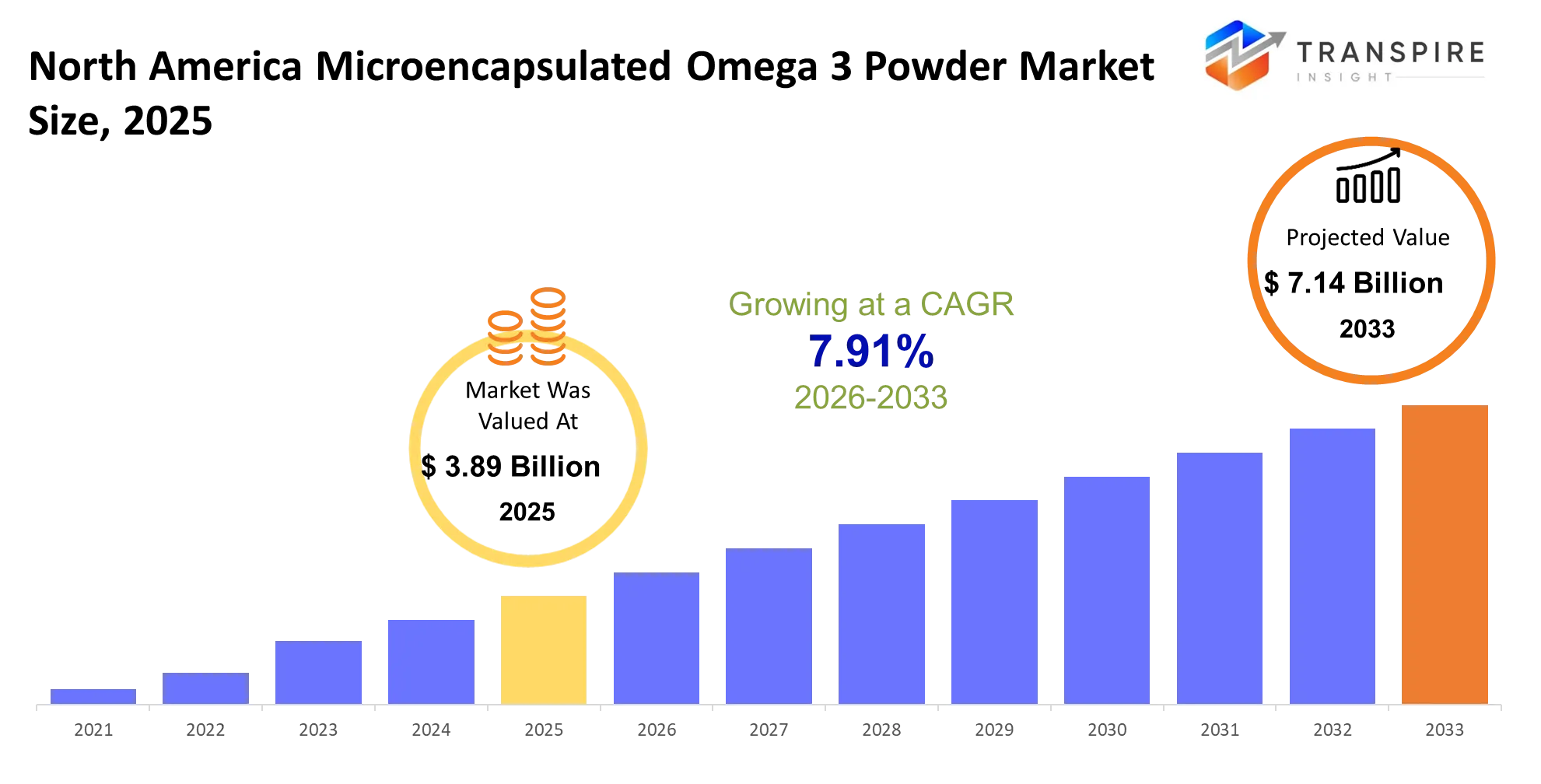
- North America Microencapsulated Omega 3 Powder Market Size 2025: USD 3.89 Billion
- North America Microencapsulated Omega 3 Powder Market Size 2033: USD 7.14 Billion
- North America Microencapsulated Omega 3 Powder Market CAGR: 7.91%
- North America Microencapsulated Omega 3 Powder Market Segments: By Type (Fish Oil-based, Algae-based, Krill Oil-based, Flaxseed-based, Others), By Application (Food & Beverages, Infant Nutrition, Pharmaceuticals, Supplements, Others), By End-User (Food Industry, Pharma, Consumers, Others), By Form (Powder, Granules, Capsules, Others).
To learn more about this report,  Download Free Sample Report
North America Microencapsulated Omega 3 Powder Market Summary:
The North America Microencapsulated Omega 3 Powder Market size is estimated at USD 3.89 Billion in 2025 and is anticipated to reach USD 7.14 Billion by 2033, growing at a CAGR of 7.91% from 2026 to 2033.North America microencapsulated omega 3 powder market really kinda exists because there’s this everyday formulation mess for food, beverage, and nutraceutical makers. I mean basically omega 3 oils are highly sensitive to heat, oxygen, and moisture so you end up with those annoying outcomes like weird unpleasant taste and odor, plus shelf life instability in things like infant formula, sports nutrition blends, dairy alternatives, and clinical nutrition supplements. It’s just a kind of constant headache, you know. Microencapsulation is what lets manufacturers slip omega 3 into dry and shelf-stable formats, without messing up flavor, or the whole processing performance, too.
In the past five years the market has moved away from plain fish-oil enrichment toward more precise delivery systems, using spray drying, algal sources and cleaner-label encapsulation materials. This shift picked up after the pandemic era supply chain messes showed how dependent North America can be on imported marine inputs, and how shaky fisheries output can become. Meanwhile preventive health purchasing kind of broadened beyond those niche wellness shelves and it moved into mainstream grocery, plus medical nutrition categories. So buyer behavior changed, like manufacturers now look for reliable scalable omega 3 fortification platforms that can handle industrial processing while still supporting premium product positioning and longer distribution windows.
Key Market Insights
- In 2025, the United States kinda took over the North America Microencapsulated Omega 3 Powder Market , holding almost 78% share because of stronger nutraceutical manufacturing capacity, you know.
- Meanwhile Canada is showing the quickest rise through 2030. This is being fueled by the push for more functional food production and also more investments in algae-based omega 3, pretty straightforward really.
- Retail presence is also getting stronger, especially with fortified dairy, sports nutrition, and infant formula. That mix keeps nudging regional market growth upward across North America, consistently.
- At the same time, regulatory support around nutritional label transparency is getting tighter, and that’s boosting demand for high-stability omega 3 powder formulations in both food and pharmaceutical sectors.
- When it comes to production style, spray-dried microencapsulated omega 3 powder looked like the main player. It accounted for more than 46% of industry size in 2025, mainly due to cost-efficient scalability that scales well without too many headaches.
- Fish oil-derived formulations stayed in the second spot, largely because sourcing networks are already in place, plus there’s solid capability for high EPA-DHA concentrations.
- Algal omega 3 powder is the fastest-moving segment across the forecast period, driven by vegan nutrition trends and sustainability targets which are getting more attention lately.
- Protein-based encapsulation technologies also gained meaningful traction. Manufacturers are leaning into clean-label inputs, and they’re improving oxidation resistance as well which matters a lot for shelf life.
- Functional foods and beverages accounted for approximately 41% of North America Microencapsulated Omega 3 Powder Market revenue in 2025.
- Infant nutrition remained a dominant application due to clinical demand for stable DHA fortification in powdered formula manufacturing.
- Sports nutrition applications are projected as the fastest-growing category through 2030 because of active lifestyle and recovery-focused product launches.
What are the Key Drivers, Restraints, and Opportunities in the North America Microencapsulated Omega 3 Powder Market?
The most powerful thing pushing the North America microencapsulated omega 3 powder market forward is the fast growth of fortified nutrition items, that kind of need a long shelf life and also flavor staying power. Big food and nutraceutical groups basically leaned into microencapsulation once high-protein drinks, powdered supplements, and infant nutrition products ran into those annoying formulation hiccups—mostly tied to oxidation, and then that sort of fishy aftertaste that people notice. After that, improvements in spray-drying paired with lipid coating methods cut down on ingredient breakdown during hot, high temperature processing. So omega 3 fortification became actually workable for businesses at industrial scale. And that has, in a very practical way , boosted take-up across regular retail nutrition lines, letting makers roll out better quality offerings with stronger pricing leverage, plus wider distribution reach.
Still, the biggest structural obstacle is pretty much the jumpy supply chain for marine omega 3 starting materials. Sourcing fish oil really depends on seasonal fisheries, shifting environmental conditions, and those global quota systems that can’t just be expanded quickly. Because of that instability procurement costs climb and the input pricing for encapsulation processors ends up inconsistent. Smaller ingredient vendors also find it hard to lock in long term agreements, and that slows down production scale-up, plus it keeps them from reaching into more cost sensitive food segments. In the end, commercialization moves slower, and mid tier consumer nutrition brands see less revenue upside than they otherwise could.
Algae-based omega 3 production shows the clearest long term growth opportunity, mostly because North American investment in controlled fermentation and precision cultivation systems is steadily improving yield consistency, and also reducing dependence on marine fisheries. In the meantime, a few nutrition companies are expanding partnerships with algae technology firms, to develop vegan DHA powders for infant formula , and clinical nutrition too. Then once production costs keep sliding down and clean-label requirements get even tighter, these algal microencapsulated omega 3 ingredients are positioned to unlock the next wave of premium product innovation.
What Has the Impact of Artificial Intelligence Been on the North America Microencapsulated Omega 3 Powder Market?
Artificial intelligence and advanced digital technologies are sort of quietly reshaping the North America microencapsulated omega 3 powder market, by making production feel more precise, keeping ingredient stability more stable, and also lifting overall supply chain efficiency. More and more manufacturers lean on AI-driven process control systems to keep tabs on spray-drying temperatures moisture levels the particle size distribution, and oxidation rates in real time. With these automated loops now sitting there, formulation inconsistencies get dialed down, and producers can preserve encapsulation efficiency even when they push high volume manufacturing. Some facilities are even folding machine learning models directly into the production lines, so they can anticipate equipment fouling, tune the drying cycles more tightly, and cut down on material waste during omega 3 powder processing.
At the same time predictive analytics is doing more than people first expect for raw material handling and quality assurance. AI forecasting tools review fish oil and algal feedstock variability, and that lets manufacturers adjust encapsulation parameters before stability issues pop up. The result is better batch uniformity, plus a longer shelf life, especially for infant nutrition and clinical formulations where things have to stay consistent. Digital monitoring platforms have also helped certain processors reduce downtime, and lower production loss while meeting food safety expectations and nutritional labeling standards without as much trouble.
Still, AI adoption has a stubborn downside, namely the integration costs. High costs are often tied to legacy processing infrastructure, and many mid-sized ingredient manufacturers run older systems that don’t really support modern sensor networks or a centralized data architecture. On top of that, limited historical production data can restrict how accurate the machine learning models are in those complicated encapsulation environments, where small shifts matter a lot.
Key Market Trends
- Since 2021 , infant nutrition manufacturers started more aggressively adopting DHA powder systems that can handle high-temperature processing without that oxidation related taste getting worse.
- After 2020, spray-drying technologies kind of changed a lot, allowing producers to boost encapsulation efficiency while also cutting down production waste over those big commercial runs, and not just small batch work.
- Between 2022 and 2025 algae-derived omega 3 formulations really picked up speed , as vegan nutrition products expanded across North American retail shelves.
- Food manufacturers also moved away from liquid fish oil blends toward powdered delivery formats, mainly to make transportation simpler, storage less annoying, and dry-mix formulation easier overall.
- Companies such as DSM-Firmenich and BASF grew their clean-label encapsulation offerings after retailers tightened ingredient transparency expectations in 2023, it was pretty noticeable.
- During the supply chain disruptions in 2020 and 2021, manufacturers looked to diversify omega 3 sourcing away from the usual marine fisheries, and toward controlled algae cultivation setups instead.
- Clinical nutrition brands increasingly leaned into microencapsulated EPA-DHA powders as hospitals prioritized shelf-stable nutritional interventions for older patient groups, especially in aging populations.
- Between 2022 and 2025, protein based coating materials swapped out several synthetic carriers because manufacturers were aiming for positioning that feels non-GMO friendly and allergen-aware, at the same time.
- AI enabled process monitoring systems showed up across encapsulation facilities after manufacturers wanted tighter particle-size consistency, and fewer batch rejections, like it mattered a lot.
- Canadian nutraceutical producers also accelerated regional expansion moves since 2023, to support domestic omega 3 ingredient manufacturing and reduce reliance on imports, even when timelines got tight.
North America Microencapsulated Omega 3 Powder Market Segmentation
By Type
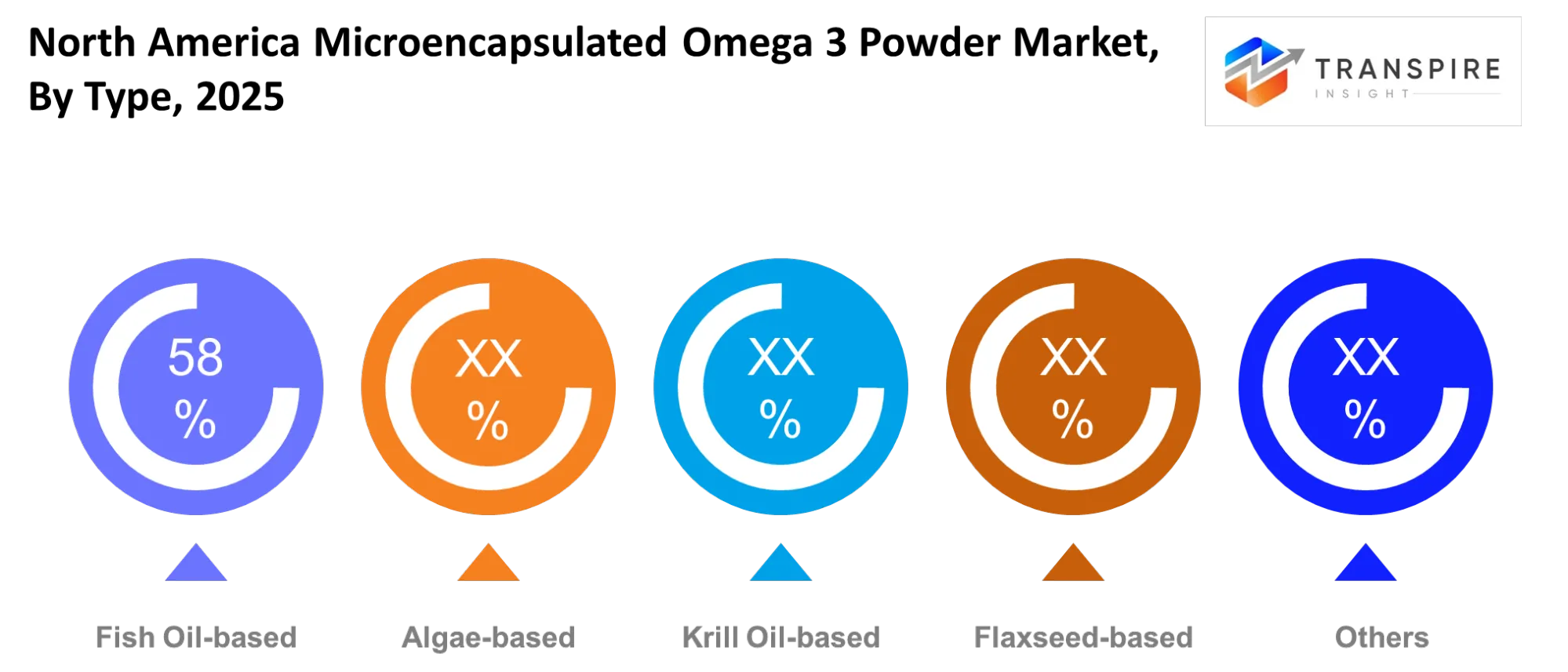
Fish oil based products keep, sort of, the leading edge across the different type categories, mainly because established fisheries infrastructure and the relatively higher EPA-DHA concentration let them do cost efficient large scale manufacturing. Food and nutraceutical companies still lean pretty hard on fish- derived omega 3 ingredients for infant formula, dietary supplements, and fortified foods , mainly because clinical acceptance stays steady and the commercial availability is broad. Algae based formulations , on the other hand, are seeing the fastest expansion , as producers tune themselves to vegan labeling requirements and sustainability goals.
With controlled algae cultivation, you also get reduced exposure to fishery volatility, plus lower contamination risks, so the supply chain feels more predictable. Krill oil and flaxseed based variants stay in comparatively smaller segments, because extraction expenses are higher and the omega 3 conversion efficiency is lower, so it doesn’t break into the mainstream as much. Looking ahead, investment patterns suggest a stronger shift toward hybrid sourcing methods that blend marine and plant derived inputs. Manufacturers are also starting to favor diversified procurement models so they can handle disruptions in raw materials better, even with changing regulatory standards and all that.
To learn more about this report, Download Free Sample Report
By Application
Food and beverage use cases still take the biggest chunk, I mean it’s pretty clear that major consumer brands keep weaving omega 3 fortification into dairy alternatives, protein powder blends, bakery items, and those ready to mix nutritional drinks. On top of that, shelf stability, plus flavor masking type benefits, make microencapsulated formats pretty handy for industrial food processing settings where the traditional oils just don’t behave as well. Then there’s infant nutrition, which stays super influential as well. This is mostly because the DHA inclusion rules are strict, and demand keeps rising for stable powders that store well and mix easier. Pharmaceutical applications are also growing in a steady way.
Clinical nutrition products are moving toward more specialized lipid delivery systems, and they’re asking for better bioavailability. Dietary supplements keep generating major commercial value, largely because brands can go premium, and also push personalized wellness routines. Other areas, like medical foods and sports recovery formulations are getting more attention too, especially as performance nutrition categories mature over time. For future expansion across all these areas, growth is going to lean heavily on encapsulation efficiency, oxidation resistance, and whether the ingredients can still support clean label positioning without quietly hurting processing performance.
By End-User
The food industry still sort of keeps the leading end-user position, mostly because the large scale manufacturers need stable omega 3 integration for these mass market nutritional products, you know, steady blending and all that. Meanwhile, strong retail competition has kind of pushed packaged food companies to try and stand out by adding functional ingredients plus better shelf life performance, even if it seems small on paper. On another lane, pharmaceutical companies grab the second-largest position, driven by the wider use of omega 3 powders in therapeutic nutrition, clinical formulations, and hospital grade dietary products.
At the same time, consumer-driven direct nutrition brands are also growing procurement volumes as e-commerce keeps expanding the way personalized supplements are distributed, sort of more targeted. The smaller end-user categories, like contract manufacturers and specialty wellness producers, stay relevant too, mainly for innovation trials and premium niche launches. Demand patterns indicate that end-users are leaning more and more toward suppliers who can provide tailored encapsulation systems rather than just standardized ingredient solutions. Going forward, the direction of the market looks like tighter cooperation between ingredient developers and finished product manufacturers, so formulation precision improves, regulatory compliance gets cleaner, and production scalability works across several nutrition categories.
By Form
Powder formats kind of dominate the form segment because dry formulations make it easier, transport storage blending and then industrial processing across big food manufacturing operations. Powdered omega 3 ingredients also seem to give better control over oxidation and generally work more nicely with spray dried nutritional products compared with liquid delivery systems, which is kind of a big deal. Granules are getting more traction in specialized uses where controlled release and improved flow properties help keep production more consistent. Capsule based formats still keep relevance in nutraceutical and consumer supplement categories because encapsulated delivery supports dose accuracy and also retail convenience.
But, capsule manufacturing costs and the packaging requirements then, lower scalability for mass market food applications. Other formats, including beadlets and compressed delivery systems, stay limited yet they still draw attention in clinical nutrition and premium wellness segments. Looking ahead, product development is expected to lean heavily on multifunctional powder technologies that can blend improved bioavailability, cleaner ingredient profiles, and higher thermal stability. Manufacturers that invest in advanced particle engineering and coating technologies are likely to secure stronger long term commercial positioning.
What are the Key Use Cases Driving the North America Microencapsulated Omega 3 Powder Market?
Infant nutrition still feels like the main, core use case for microencapsulated omega 3 powder because formula manufacturers need stable DHA delivery during high-temperature spray drying, and long storage cycles. Big pediatric nutrition brands tend to lean on encapsulated powders so they can keep the taste neutral-ish and the nutritional output consistent, across those mass-market lines.
Meanwhile sports nutrition and functional beverages are growing fast, like really fast, since protein shake and wellness drink makers are adding omega 3 fortification into ready-to-mix compositions. Clinical nutrition providers are jumping in more too, especially inside hospital dietary products where shelf stability matters and controlled nutrient delivery helps recovery programs for patients.
New directions are showing up, including personalized nutrition sachets, and also fortified plant-based dairy alternatives. Nutraceutical companies are looking at, sort of, targeted omega 3 delivery systems for cognitive health and healthy aging formulations, particularly through premium subscription wellness platforms and medical nutrition channels.
|
Report Metrics |
Details |
|
Market size value in 2025 |
USD 3.89 Billion |
|
Market size value in 2026 |
USD 4.19 Billion |
|
Revenue forecast in 2033 |
USD 7.14 Billion |
|
Growth rate |
CAGR of 7.91% from 2026 to 2033 |
|
Base year |
2025 |
|
Historical data |
2021 - 2024 |
|
Forecast period |
2026 - 2033 |
|
Report coverage |
Revenue forecast, competitive landscape, growth factors, and trends |
|
Country scope |
North America (Canada, The United States, and Mexico) |
|
Key company profiled |
DSM-Firmenich, BASF, Kerry Group, Cargill, ADM, Croda, Omega Protein, GC Rieber, Polaris, Epax, Arjuna Natural, Aker BioMarine, Stepan Company, KD Pharma, Orkla Health |
|
Customization scope |
Free report customization (country, regional & segment scope). Avail customized purchase options to meet your exact research needs. |
|
Report Segmentation |
By Type (Fish Oil-based, Algae-based, Krill Oil-based, Flaxseed-based, Others), By Application (Food & Beverages, Infant Nutrition, Pharmaceuticals, Supplements, Others), By End-User (Food Industry, Pharma, Consumers, Others), By Form (Powder, Granules, Capsules, Others) |
Which Regions are Driving the North America Microencapsulated Omega 3 Powder Market Growth?
The United States still shows up as the leading region in the North America microencapsulated omega 3 powder market, mostly because big food and nutraceutical manufacturers keep running advanced processing and formulation facilities all across the country . With strong FDA oversight and the already well known nutritional labeling expectations, companies feel more willing to invest in stable omega 3 delivery systems that actually hit tough product consistency demands. A lot of major infant nutrition brands , sports nutrition leaders and functional beverage companies also maintain wide manufacturing networks, which in turn supports high procurement volumes for encapsulated omega 3 ingredients. Over time, a mature ecosystem of ingredient suppliers , contract manufacturers , research laboratories and retail nutrition brands keeps stacking advantages and keeps reinforcing the country’s leadership role, even when demand cycles.
Canada stays right behind as the second-largest regional market, but the growth story is a bit different, because the whole market leans more toward sustainability driven nutrition plans and more specialized product development. Here, Canadian producers have been steadily upping investments in algae-derived omega 3 production and clean-label encapsulation approaches, so they can ride along with premium wellness categories. Regulatory execution remains relatively steady and public interest in preventive healthcare products stays consistent, which helps create a reliable setting for longer supplier commitments and smoother product commercialization. Plus there’s strong collaboration between biotechnology firms, nutraceutical businesses and food processors, and that collaboration has helped the market keep expanding at a steady pace, even if overall production volumes are smaller.
Mexico seems to be emerging as the fastest growing regional market, basically because modernization is speeding up within packaged food manufacturing and the consumer nutrition sector keeps getting bigger. In the last few years, large multinational food businesses stepped up their investments into local production facilities, to strengthen regional supply chains and also lower import dependence. Demand is also rising for fortified dairy items, powdered beverage formats, and affordable nutritional supplements, and that mix is pushing a faster adoption of cost efficient encapsulated omega 3 ingredients. Overall this momentum is opening up pretty attractive chances for ingredient manufacturers and investors who are looking for production expansion plus distribution partnerships across the 2026–2033 period.
Who are the Key Players in the North America Microencapsulated Omega 3 Powder Market and How Do They Compete?
In North America the microencapsulated omega 3 powder market looks like it’s quietly consolidating, not totally calm but also not chaotic. There’s this small cluster of multinational ingredient companies that hold big commercial supply contracts , while more specialized players keep showing up with formulation know-how and specific niche delivery technologies. Lately, competition seems to revolve around encapsulation efficiency, oxidation stability, clean-label fit, and dependable raw material sourcing, not just on price like it used to. More established suppliers still defend their share by using vertically integrated production networks, plus long-term arrangements with infant nutrition and functional food makers. Meanwhile algae-focused ingredient developers and biotechnology companies are stirring things up in ways that feel different. They are shifting away from the old marine-based supply chain model by offering sustainable alternatives with better traceability and vegan certification features, kind of like a simpler route for compliant claims.
DSM-Firmenich competes by leaning hard into advanced lipid encapsulation technology, and also by being tightly connected with infant nutrition manufacturers who really care about DHA staying stable during spray drying, storage and all that. It differentiates with clinical validation depth, plus customized formulation support, especially for pharmaceutical and pediatric nutrition use cases. BASF is putting emphasis on production scalability and process optimization, so big food manufacturers can keep getting a consistent omega 3 ingredient supply across various product categories. BASF has also broadened partnerships with functional food producers, to improve penetration in fortified beverage and performance nutrition segments.
Croda International has made its competitive position stronger by using specialty delivery systems that are built for clean-label and high-bioavailability kinds of uses. The company aims at premium wellness brands that really put emphasis on allergen-conscious approaches and non-GMO ingredient profiles, you know the usual. KD Pharma Group stands out because of concentrated omega 3 purification technologies , along with pharmaceutical-grade production standards that help clinical nutrition and medical food applications. Cargill meanwhile leans on wide distribution networks across the food industry and it also pushes regional manufacturing expansion , which helps it improve supply reliability for packaged food companies that want big-volume omega 3 fortification solutions.
Company List
- DSM-Firmenich
- BASF
- Kerry Group
- Cargill
- ADM
- Croda
- Omega Protein
- GC Rieber
- Polaris
- Epax
- Arjuna Natural
- Aker BioMarine
- Stepan Company
- KD Pharma
- Orkla Health
Recent Development News
In April 2026, dsm-firmenich Debuts Veramaris O3 Max Pure at Petfood Forum 2026 in the U.S.: dsm-firmenich introduced Veramaris O3 Max Pure, a microalgal omega-3 ingredient designed to replicate the natural EPA:DHA ratio found in fish oil. The launch at Petfood Forum 2026 in Kansas City highlighted the company’s push into sustainable and contaminant-free omega-3 delivery systems for nutrition applications, including powder-based formulations and functional foods in North America.
Source: https://www.nutritioninsight.com
In March 2026, DSM-Firmenich Expands U.S. Nutrition Manufacturing With $10 Million Facility Upgrade: dsm-firmenich completed a major modernization program at its Schenectady, New York premix facility, positioning the site as a flagship nutrition hub for the Americas. The investment strengthens the company’s North American production capabilities for advanced nutritional ingredients, including omega-3 premixes and encapsulated nutrition solutions used in powders and supplements.
Source: https://www.dsm-firmenich.com
What Strategic Insights Define the Future of the North America Microencapsulated Omega 3 Powder Market?
North America microencapsulated omega 3 powder market seems to be moving, kind of quietly, toward precision nutrition and delivery systems that look more like pharmaceutical-grade tech than standard commodity fortification. In the next five to seven years, the real growth is likely to come from higher value uses such as medical nutrition, healthier aging products, and formulations that are built for specific conditions, these need controlled bioavailability plus long lasting shelf stability. Underneath, this change is being pushed by tighter formulation expectations and by the rising commercial worth of nutrition products that are clinically validated.
One less obvious risk sits in raw material concentration and the heavy tech dependency. A big portion of advanced encapsulation capacity, along with premium omega 3 sourcing, is still handled by just a few suppliers, which puts smaller manufacturers in a spot where pricing pressure, supply disruptions, and margin squeeze become more common. Meanwhile, alternative lipid technologies and even synthetic nutrient delivery systems might reduce reliance on conventional omega 3 approaches in certain use cases.
There’s also an emerging opportunity, kinda like a new lane. Fermentation-derived algae omega 3 production, especially when it’s tied to AI-enabled process optimization, could become a strong play. Firms that begin early by building scalable algae collaborations, developing proprietary encapsulation platforms, and maintaining traceable supply networks will probably be better placed to lock in long term agreements with pharmaceutical and clinical nutrition makers.
North America Microencapsulated Omega 3 Powder Market Report Segmentation
By Type
- Fish Oil-based
- Algae-based
- Krill Oil-based
- Flaxseed-based
- Others
By Application
- Food & Beverages
- Infant Nutrition
- Pharmaceuticals
- Supplements
- Others
By End-User
- Food Industry
- Pharma
- Consumers
- Others
By Form
- Powder
- Granules
- Capsules
- Others
Frequently Asked Questions
Find quick answers to common questions.
The approximate North America Microencapsulated Omega 3 Powder Market size for the market will be USD 7.14 Billion in 2033.
The key segments of the North America Microencapsulated Omega 3 Powder Market are By Type (Fish Oil-based, Algae-based, Krill Oil-based, Flaxseed-based, Others), By Application (Food & Beverages, Infant Nutrition, Pharmaceuticals, Supplements, Others), By End-User (Food Industry, Pharma, Consumers, Others), By Form (Powder, Granules, Capsules, Others).
Major players in the North America Microencapsulated Omega 3 Powder Market are DSM-Firmenich, BASF, Kerry Group, Cargill, ADM, Croda, Omega Protein, GC Rieber, Polaris, Epax, Arjuna Natural, Aker BioMarine, Stepan Company, KD Pharma, Orkla Health.
The current market size of the North America Microencapsulated Omega 3 Powder Market is USD 3.89 Billion in 2025.
The North America Microencapsulated Omega 3 Powder Market CAGR is 7.91%.
- DSM-Firmenich
- BASF
- Kerry Group
- Cargill
- ADM
- Croda
- Omega Protein
- GC Rieber
- Polaris
- Epax
- Arjuna Natural
- Aker BioMarine
- Stepan Company
- KD Pharma
- Orkla Health
About the Authors

Pankaj Ghogare Patil
I am Pankaj Ghogare Patil, a Senior Research Analyst at Transpire Insight, specializing in the Pharmaceutical, Chemicals & Materials, Healthcare IT, and Biotechnology industry. My expertise lies in conducting comprehensive market research, analyzing industry trends, evaluating competitive landscapes, and translating complex data into actionable insights. At Transpire Insight, I closely follow emerging technologies, regulatory developments, and market innovations to create accurate, well-researched, and informative content that helps businesses and professionals make informed decisions. I am committed to producing credible, evidence-based articles that reflect industry best practices while making technical topics accessible and valuable for a broad audience.

Chakradhar Khansole
Chakradhar serves as the Research Director at Transpire Insight, bringing over 8 years of experience in technology, innovation, and strategic market intelligence. He specializes in transforming complex market data into actionable business insights that enable organizations to make informed, growth-oriented decisions. Recognized for his strategic vision and analytical expertise, Chakradhar leads high-impact research initiatives, delivering comprehensive market assessments, competitive intelligence, and forward-looking industry analysis.
Recently Published Reports
-
Jul 2026
Alopecia Treatment Market
Alopecia Treatment Market Size, Share & Analysis Report By Disease Type (Alopecia Areata, Cicatricial Alopecia, Traction Alopecia, Alopecia Totalis, Androgenetic Alopecia, Alopecia Universalis, and Other Disease Types), By Treatment Type (Topical Treatments, Oral Medications, Injectable Therapies, and Hair Transplantation), By Gender (Male, and Female), By Distribution Channel (Hospitals and Clinics, Retail Pharmacies, and Online Retailers), and Geography (North America, Europe, Asia-Pacific, Middle East and Africa, South and Central America), 2021 - 2031
-
Jul 2026
Medical Ultrasound Probe Market
Medical Ultrasound Probe Market Size, Share & Analysis Report By Type (Linear Type, Convex Type, Endocavitary Probe, Phased Array/Cardiac Probe, Transesophageal (TEE) Probe, and Others), By Application (Ophthalmology, Cardiology, Musculoskeletal, Oncology, Obstetrics & Gynecology, General Imaging, and Others), By End User (Hospitals & Clinics, Diagnostic Centers, Ambulatory Surgical Centers, and Others), and Geography (North America, Europe, Asia-Pacific, Middle East and Africa, South and Central America), 2021 – 2031
-
May 2026
Biosimilars Market
Biosimilars Market By Product Type (Monoclonal Antibodies, Recombinant Hormones, Erythropoietin, G-CSF, Others), By Indication (Oncology, Autoimmune Diseases, Blood Disorders, Diabetes, Others), By Manufacturing Type (In-House Manufacturing, Contract Manufacturing), By Distribution Channel (Hospital Pharmacies, Retail Pharmacies, Online Pharmacies), By Industry Analysis, Size, Share, Growth, Trends, and Forecasts 2021-2033
-
Apr 2026
Gastrointestinal Endoscopy Market
Gastrointestinal Endoscopy Market By Type (Rigid Gastrointestinal Endoscope, Flexible Gastrointestinal Endoscopes, Disposable Gastrointestinal Endoscope), By Procedure Type (Colonoscopy, Gastroscopy, Duodenoscopy, Enteroscopy, Flexible Sigmoidoscopy, Others), By Application (Diagnosis, Treatment), By End-Users (Hospitals, Ambulatory Surgical Centers, Specialty Clinics, Laboratories, Others), By Industry Analysis, Size, Share, Growth, Trends, and Forecasts 2021-2033