

Europe Nutraceuticals Market Size & Forecast:
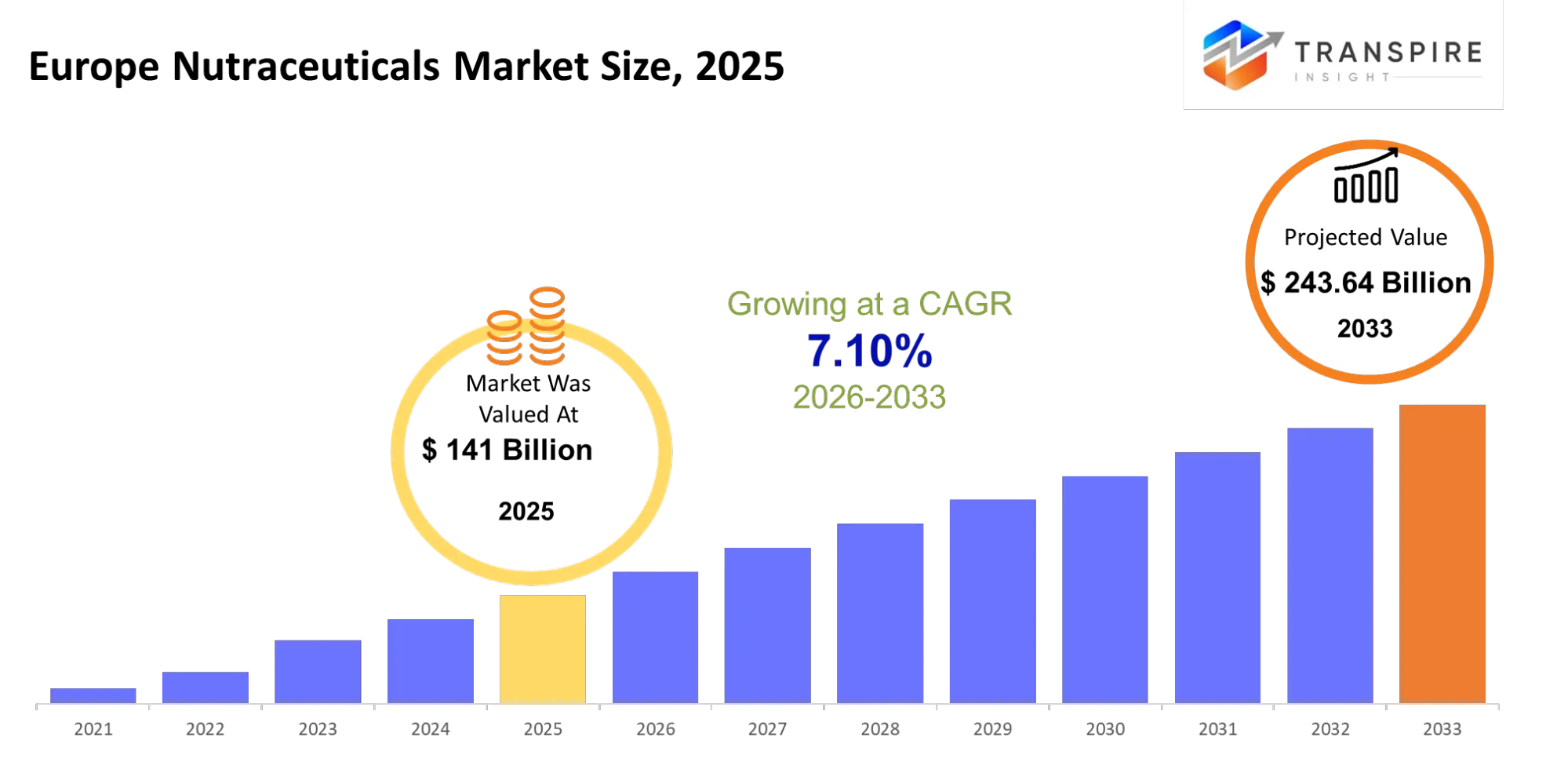
- Europe Nutraceuticals Market Size 2025: USD 141 Billion
- Europe Nutraceuticals Market Size 2033: USD 243.64 Billion
- Europe Nutraceuticals Market CAGR: 7.10%
- Europe Nutraceuticals Market Segments: By Type (Dietary Supplements, Functional Foods, Functional Beverages, Others), By Application (Immunity, Digestive Health, Heart Health, Others), By End-User (Adults, Elderly, Athletes, Others), By Form (Tablets, Capsules, Powders, Others).
To learn more about this report,  Download Free Sample Report
Europe Nutraceuticals Market Summary:
The Europe Nutraceuticals Market size is estimated at USD 141 Billion in 2025 and is anticipated to reach USD 243.64 Billion by 2033, growing at a CAGR of 7.10% from 2026 to 2033. The European nutraceuticals market exists between food products and preventive healthcare solutions because it provides products which enable consumers to treat daily health problems that include fatigue and immunity deficiencies and digestive problems and age-related health decline without using prescription medications. The system decreases healthcare demands because it allows people to handle their health through their regular consumption patterns.
The market has shifted from its previous state toward clinically validated personalized nutrition solutions during the past 3–5 years because EU health claim regulations became stricter and microbiome testing and biomarker testing advanced. The COVID-19 pandemic served as the main catalyst because it caused consumers to change their habits toward active protection of their health and their health management for extended periods.
The combination of both elements has driven companies to allocate resources toward developing products which combine scientific support with transparent methods of obtaining their materials. The business now operates through value generation which creates higher profit margins by delivering trustworthy products and successful digital health solutions to customers.
Key Market Insights
- Western Europe maintains the largest market share within the European Nutraceuticals Market because it controls more than 45% of the market share in 2025 through its established market regulations and its high rate of consumer adoption.
- The regional demand in Germany and France and the UK exists because both aging populations and established functional food consumption patterns drive demand.
- The fastest expansion of Eastern Europe will occur until 2030 when the region achieves an annual growth rate above 8% because of increasing disposable income and health-conscious spending habits.
- Functional foods lead the market with almost 40% market share in 2025 because people consume them daily and make them part of their everyday meals.
- The second largest market share belongs to dietary supplements which provide health solutions for specific needs that include immunity protection and bone strength and heart health.
- The personalized nutraceuticals market segment shows the most rapid growth potential because microbiome and DNA-based nutrition advances will fuel its expansion until 2030.
- The post-pandemic preventive health behavior leads to immunity and general wellness applications which now hold a market share that exceeds 35% of total market share for 2025.
- The demand for probiotics and gut-health products drives the digestive health market to become its fastest growing segment.
- The Europe Nutraceuticals Market receives its highest market share from adults aged 30 to 60 because they spend money on preventive healthcare and deal with lifestyle-based health issues.
- The elder population has become the fastest expanding group of end-users because they seek products that promote healthy aging and support their joint health and cognitive functions.
What are the Key Drivers, Restraints, and Opportunities in the Europe Nutraceuticals Market?
The European Nutraceuticals Market experiences its main growth driver because people now prefer preventive healthcare after post-pandemic public health policies and increasing healthcare expenses have emerged throughout European Union nations. The government and insurance companies now support self-managed wellness programs because these programs help decrease expenses for extended medical treatment. The direct result of this trend has been an increase in consumer purchases of products that support immunity and gut health and cognitive function. The companies now develop their premium products which contain scientific evidence based formulations to generate higher profits while expanding their business through existing customer base.
The European Food Safety Authority health claims inspection process and ingredient approval system creates the most severe institutional obstacle. The system needs prolonged clinical studies which require both financial resources and time to complete before products can be marketed. The smaller companies face major difficulties when trying to comply with these standards which results in slower development processes and extended time until they can sell their products. The restriction decreases market activity while decreasing the count of new businesses entering the market which leads to slower product expansion and revenue generation.
The future holds great potential for expansion through personalized nutrition development which uses microbiome testing and digital health systems. Home diagnostic equipment advancements and AI-based dietary recommendation systems now provide users with customized nutraceutical solutions. Companies now put their money into subscription services which offer gut health assessments together with personalized supplement recommendations. The digital health systems in Europe will enable this method to boost customer value throughout their lifespan while creating fresh revenue sources that will generate recurring income.
What Has the Impact of Artificial Intelligence Been on the Europe Nutraceuticals Market?
Advanced digital technologies and artificial intelligence are changing the operational methods of nutraceutical companies throughout Europe which affects their production methods and their ability to maintain product quality and their supply chain efficiency. The system performs automated backing of formulation design because it uses AI technology to study material sources and production oversight through real-time ingredient interaction analysis and stability assessment. Automatic Smart manufacturing systems use IoT-based platforms and sensors to ensure consistent batch production while they handle automatic compliance documentation.
Machine learning models now serve multiple purposes because they predict consumer health trends and help companies manage their inventory while supporting detailed demand forecasts. For example, predictive analytics can align production volumes with seasonal spikes in immunity or digestive health products, minimizing overstocking and reducing waste. Companies use AI to improve product performance because they study clinical data sets and biomarker responses which leads to better product launch outcomes and faster product development processes.
The deployment of these technologies produces measurable benefits which include lower operational expenses and quicker regulatory approval times and enhanced product quality. The main barrier to growth exists because companies need to spend large amounts on AI system integration with their existing systems and their various health data storage facilities.
Key Market Trends
- The European Union established stricter rules for health claims in 2020 which resulted in longer product approval processes and forced companies to spend 20 to 30 percent additional funds on proving clinical efficacy before they could launch their products.
- After 2021 consumers started using multivitamin products which specifically supported their immunity and gut health and cognitive abilities because this new trend required major brands to change their product offerings.
- The microbiome testing personalized nutrition platforms will achieve widespread adoption by 2024 when subscription-based supplement services develop throughout Germany and France and the Netherlands.
- Nestlé and Danone increased their funding for functional foods while they expanded their product assortments from standard dairy products to health-focused fortified items.
- E-commerce platforms have taken more than 25 percent of nutraceutical sales in important markets since 2022 which has allowed businesses to connect directly with customers while decreasing their need for pharmacies.
- The supply chain disruptions in 2021 created a clean-label and traceability trend which required manufacturers to reveal their material sources and stop using synthetic additives.
- The period from 2021 to 2025 will witness a fast growth of probiotic and gut health products because clinical studies demonstrated that maintaining a microbiome balance enhances both immune functions and mental health.
- The European Union member states face regulatory harmonization problems which prevent efficient cross-border product distribution and force mid-sized manufacturers to spend more on compliance expenses.
- Companies started using artificial intelligence formulation tools by 2023 which enabled them to develop products faster while achieving higher success rates for their targeted nutraceutical products.
Europe Nutraceuticals Market Segmentation
By Type
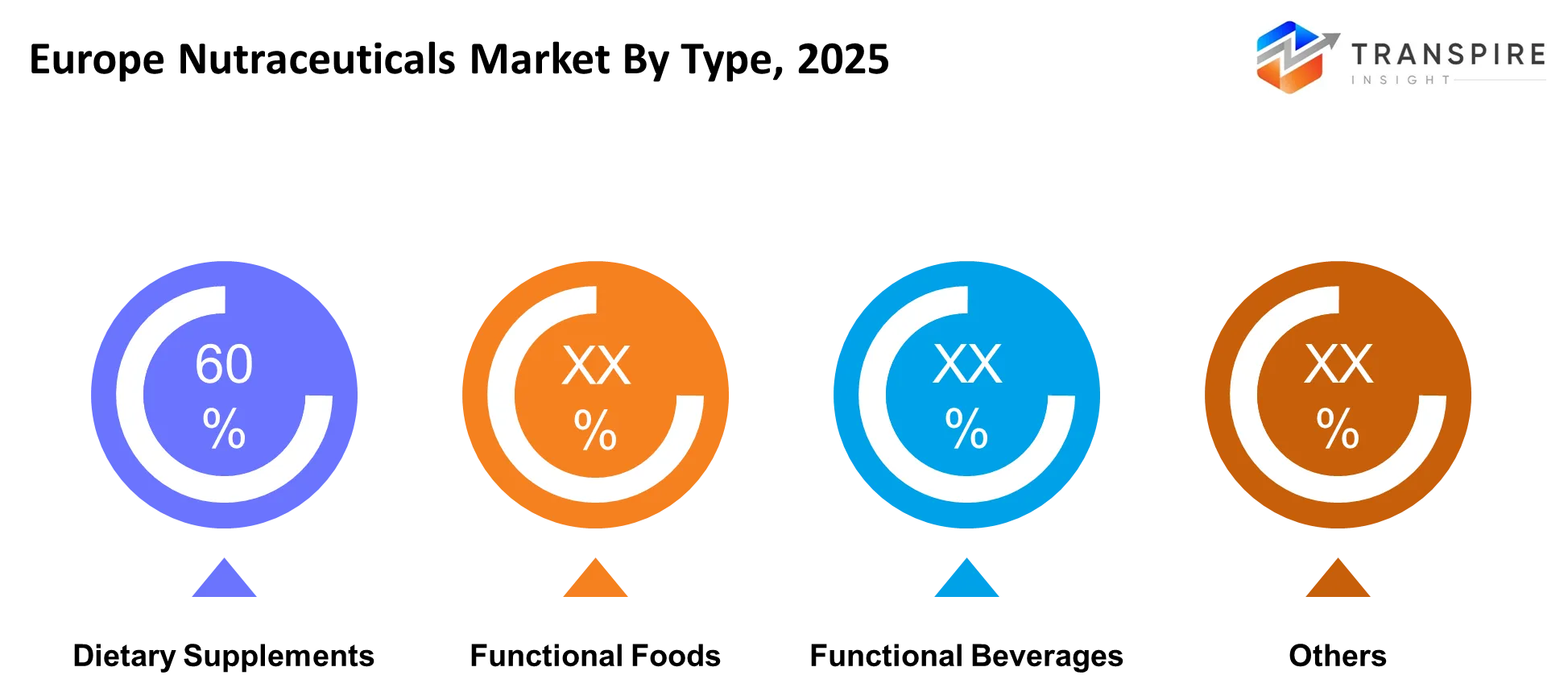
The dietary supplement market maintains its leading status because products target specific health needs and their dosage can be easily managed and pharmaceutical companies provide extensive distribution throughout Europe. Functional foods maintain a strong market position because people consume their products daily as they become part of common dietary patterns that include dairy and fortified cereal products. Functional beverages maintain their current market size but they are growing through their adoption in sports nutrition and their use as portable wellness solutions.
The supplement industry experiences growth because customers seek products that address specific health needs, such as immunity and joint health, while functional foods achieve success through their regular use by consumers who prefer to eat them frequently. The industry will experience future development through a process that unites two trends, which will result in manufacturers creating hybrid products that include tested supplement-grade components.
To learn more about this report, Download Free Sample Report
By Application
The research shows that people developed permanent health behavior changes which resulted in immunity and general wellness becoming the main health application. The market for digestive health products has reached its second highest point because more people begin using probiotics and prebiotics according to gut health research findings. The two markets for heart health and metabolic support have maintained their current status but now experience reduced growth rates because consumers take longer to make choices and need medical help to decide.
The different application paths lead to different growth patterns because immunity requires immediate health risk responses while digestive health depends on people making extended lifestyle adjustments. The future of application segmentation will achieve better accuracy because businesses will develop multi-benefit products that handle multiple health conditions which will force them to create precise product claims and support their marketing through scientific research.
By End-User
The adult population between the ages of 30 and 60 years who control most of the market because they have greater buying power and they want to deal with their stress and fatigue problems. The elderly segment is growing faster because people live longer and they want products which support their bone health and cognitive function and mobility needs. Athletes and fitness-focused consumers form a niche but influential category that drives innovation in protein, amino acids, and performance-enhancing formulations.
Each group demonstrates their individual purchasing patterns through their different preferences, which show that adults need easy access while elderly people need products which are trustworthy and secure and athletes need items which boost their performance. The future expansion of the business will depend on two factors, which are customized communication and product design, while manufacturers will create formulations and delivery systems that match the bodily requirements and usage patterns of their products.
By Form
Tablets and capsules maintain their market dominance because these forms provide users with better convenience and longer shelf life and they have established themselves as the standard supplement form which people know. Powders are becoming more popular because they offer active consumers who need to control their intake between sports nutrition products and their personalized mixes. Functional foods and beverages provide alternative delivery methods that people can use to achieve their health benefits through regular consumption but face challenges in developing stable product formulations.
People now prefer user-friendly formats because they want products which taste good and allow simple consumption through gummies and liquid shots. Delivery system innovation will become essential for future development as businesses work to improve product bioavailability and absorption efficiency and customer sensory experience across different consumer segments.
What are the Key Use Cases Driving the Europe Nutraceuticals Market?
The main purpose of this application revolves around daily health maintenance which focuses on maintaining immunity and overall well-being. The most popular product in this market exists because customers use nutraceuticals as part of their regular meals while they try to decrease their need for future medical treatment and control their health-related risks.
The market shows growing interest in digestive health and sports nutrition products which urban adults and fitness enthusiasts are starting to adopt. The research-backed gym tradition supports the increasing use of probiotic products and protein supplements within diet programs and athletic training schedules.
People are now developing cognitive health solutions and individualized nutrition systems which use microbiome and biomarker assessment tests. These medical applications have not yet achieved widespread use because digital health platforms and home testing equipment are becoming more accessible to people throughout European countries.
|
Report Metrics |
Details |
|
Market size value in 2025 |
USD 141 Billion |
|
Market size value in 2026 |
USD 150.73 Billion |
|
Revenue forecast in 2033 |
USD 243.64 Billion |
|
Growth rate |
CAGR of 7.10% from 2026 to 2033 |
|
Base year |
2025 |
|
Historical data |
2021 - 2024 |
|
Forecast period |
2026 - 2033 |
|
Report coverage |
Revenue forecast, competitive landscape, growth factors, and trends |
|
Regional scope |
Europe (Germany, United Kingdom, France, Italy, Spain and Rest of Europe) |
|
Key company profiled |
Nestle, Amway, Herbalife, GSK, Bayer, Pfizer, Abbott, Danone, DSM, BASF, Nature’s Bounty, Blackmores, NOW Foods, Himalaya, Dabur |
|
Customization scope |
Free report customization (country, regional & segment scope). Avail customized purchase options to meet your exact research needs. |
|
Report Segmentation |
By Type (Dietary Supplements, Functional Foods, Functional Beverages, Others), By Application (Immunity, Digestive Health, Heart Health, Others), By End-User (Adults, Elderly, Athletes, Others), By Form (Tablets, Capsules, Powders, Others) |
Which Regions are Driving the Europe Nutraceuticals Market Growth?
Western Europe leads the Europe nutraceuticals market because its strict regulatory system controls health claims which European Union laws permit. The healthcare systems in Germany, France and the UK provide advanced services which support their citizens to practice preventive nutrition. The retail and pharmacy network creates a system which enables customers to find products while building trust in the products. The research ecosystem together with ingredient suppliers and global companies creates an environment which enables ongoing product development and premium brand status.
The second important area for growth in Southern Europe develops through the cultural tradition which integrates functional foods into regular dining instead of following strict supplementation practices. The consumption patterns in Italy and Spain maintain stability because people follow traditional eating customs while showing increased interest in fortified products. The combination of economic recovery with modern retail channel expansion creates a system which produces consistent income for businesses. The region uses food-based nutrition systems as its main method of nutrition while Western European countries depend on their high-profit medical supplements which require clinical evidence.
Eastern Europe experiences the highest growth rate because its citizens now have more spending power and organized retail and e-commerce services are expanding rapidly. The recent regulatory improvements which align with EU standards enable easier product access and enhanced cross-border trade capabilities. Consumers are changing their preferences from basic nutrition products toward specialized health products which create demand for new market segments. The period between 2026 and 2033 presents excellent chances for new market players and investors who want to create affordable products that serve specific local needs.
Who are the Key Players in the Europe Nutraceuticals Market and How Do They Compete?
The Europe nutraceuticals market exhibits moderate fragmentation because global food and pharmaceutical companies operate alongside specialized wellness companies and local businesses. Market leaders maintain their market share through their extensive distribution systems and their deep understanding of industry regulations, while new businesses introduce custom products that use digital systems to enter the market. Companies now use clinical validation and ingredient traceability and brand credibility as their primary competitive factor instead of using cost as their main advantage. Premium market segments provide companies with a competitive edge when they demonstrate their product effectiveness while meeting strict European Union health claim requirements.
Nestlé develops science-supported nutritional products through its health science division by spending substantial funds on clinical research and personalized nutritional testing. The company establishes its unique identity by conducting food-scale production while using pharmaceutical-grade methods to assess product validity. Danone uses its dairy and probiotics expertise to develop gut health products that incorporate clinically proven strains and functional foods in Western European markets.
Bayer AG uses its pharmaceutical knowledge to develop over-the-counter dietary supplements which rely on established formulas that pharmacies distribute. Herbalife Nutrition creates its market advantage through direct-to-consumer sales which the company supports with personalized coaching services to improve customer loyalty. The Amway company controls its supply chain by using organic ingredient sourcing, which helps them track product movement and ensure product quality while they grow their business through online sales in new European markets.
Company List
- Nestle
- Amway
- Herbalife
- GSK
- Bayer
- Pfizer
- Abbott
- Danone
- DSM
- BASF
- Nature’s Bounty
- Blackmore
- NOW Foods
- Himalaya
- Dabur
Recent Development News
In May 2026, OURVITA Launches New Longevity and Gut-Health Nutraceutical Concepts: OURVITA Product Launch unveiled multiple new nutraceutical concepts focused on hydration, longevity, and gut health ahead of Vitafoods Europe 2026. The launch includes electrolyte delivery systems and anti-ageing formulations designed for the European wellness market.
Source: https://nutraceuticalbusinessreview.com
In March 2026, Danone Acquires UK Nutrition Brand Huel in $1.15 Billion Deal: French food giant Danone-Huel Acquisition agreed to acquire UK-based nutrition company Huel to strengthen its position in functional and plant-based nutrition products. The deal reflects growing European demand for meal-replacement and high-protein nutraceutical products among health-conscious consumers.
Source: https://www.reuters.com
What Strategic Insights Define the Future of the Europe Nutraceuticals Market?
The European nutraceuticals market is heading towards precision health ecosystems which will show products that work together with diagnostic tools and digital systems and subscription delivery models. The market shift occurs because biomarker testing has improved and regulations have become stricter and the industry needs to provide evidence of specific health results instead of general wellness claims. Companies that will achieve value creation between 2023 and 2027 will succeed by merging clinical research evidence with customized customer solutions through their operations.
The less visible danger of the business emerges from its dependence on raw materials and its focus on particular supply chains which impact the availability of botanical extracts and specialty ingredients that the company imports from non-European countries. The industry will face higher costs and longer production times when import standards become more stringent or actual imports face interruptions because these changes will reduce profit margins for mid-sized manufacturers.
The fusion of digital therapeutics with nutraceuticals creates a new business opportunity for companies operating in Germany because this country shows increasing health technology adoption. Companies that begin investing in data partnerships and outcome-based models during the early stage will create a competitive advantage. The company should create a vertical supply chain system which combines all business operations while using clinical validation funding to protect its product lineup from future market changes.
Europe Nutraceuticals Market Report Segmentation
By Type
- Dietary Supplements
- Functional Foods
- Functional Beverages
- Others
By Application
- Immunity
- Digestive Health
- Heart Health
- Others
By End-User
- Adults
- Elderly
- Athletes
- Others
By Form
- Tablets
- Capsules
- Powders
- Others
Frequently Asked Questions
Find quick answers to common questions.
The approximate Europe Nutraceuticals Market size for the market will be USD 243.64 Billion in 2033.
The key segments of the Europe Nutraceuticals Market are By Type (Dietary Supplements, Functional Foods, Functional Beverages, Others), By Application (Immunity, Digestive Health, Heart Health, Others), By End-User (Adults, Elderly, Athletes, Others), By Form (Tablets, Capsules, Powders, Others).
Major players in the Europe Nutraceuticals Market are Nestle, Amway, Herbalife, GSK, Bayer, Pfizer, Abbott, Danone, DSM, BASF, Nature’s Bounty, Blackmores, NOW Foods, Himalaya, Dabur.
The current market size of the Europe Nutraceuticals Market is USD 141 Billion in 2025.
The Europe Nutraceuticals Market CAGR is 7.10%.
- Nestle
- Amway
- Herbalife
- GSK
- Bayer
- Pfizer
- Abbott
- Danone
- DSM
- BASF
- Nature’s Bounty
- Blackmore
- NOW Foods
- Himalaya
- Dabur
Recently Published Reports
-
Apr 2026
Biosimilars Market
Biosimilars Market By Product Type (Monoclonal Antibodies, Recombinant Hormones, Erythropoietin, G-CSF, Others), By Indication (Oncology, Autoimmune Diseases, Blood Disorders, Diabetes, Others), By Manufacturing Type (In-House Manufacturing, Contract Manufacturing), By Distribution Channel (Hospital Pharmacies, Retail Pharmacies, Online Pharmacies), By Industry Analysis, Size, Share, Growth, Trends, and Forecasts 2021-2033
-
Apr 2026
Gastrointestinal Endoscopy Market
Gastrointestinal Endoscopy Market By Type (Rigid Gastrointestinal Endoscope, Flexible Gastrointestinal Endoscopes, Disposable Gastrointestinal Endoscope), By Procedure Type (Colonoscopy, Gastroscopy, Duodenoscopy, Enteroscopy, Flexible Sigmoidoscopy, Others), By Application (Diagnosis, Treatment), By End-Users (Hospitals, Ambulatory Surgical Centers, Specialty Clinics, Laboratories, Others), By Industry Analysis, Size, Share, Growth, Trends, and Forecasts 2021-2033
-
Apr 2026
Rare Inherited Metabolic Disorder Drug Market
Rare Inherited Metabolic Disorder Drug Market By Drug Class (Enzyme Replacement Drugs, Gene Therapy Drugs, Substrate Reduction Drugs, Small Module Drugs, Protein Drugs), By Route of Administration(Parenteral, Oral, Intrathecal), By Clinical Development (Marketed Drugs, Late Stage Clinical Phase III, Early Stage Clinical Phase I-II, Preclinical Candidates), By Indication (Lysosomal Storage Disorders, Urea Cycle Disorders, Amino Acid Metabolic Disorders, organic Acidemias, Peroximal Disorders), By Industry Analysis, Size, Share, Growth, Trends, and Forecasts 2021-2033
-
Jan 2026
Pharmaceutical Cleanroom Technology Market
Pharmaceutical Cleanroom Technology Market By Product (Equipment, Consumables, Services); By Cleanroom Type (Standard Cleanrooms, Modular Cleanrooms); By End Use (Pharmaceutical Companies, Biotechnology Companies), By Industry Analysis, Size, Share, Growth, Trends, and Forecasts 2021-2033