
France Digital Health Market Size & Forecast:
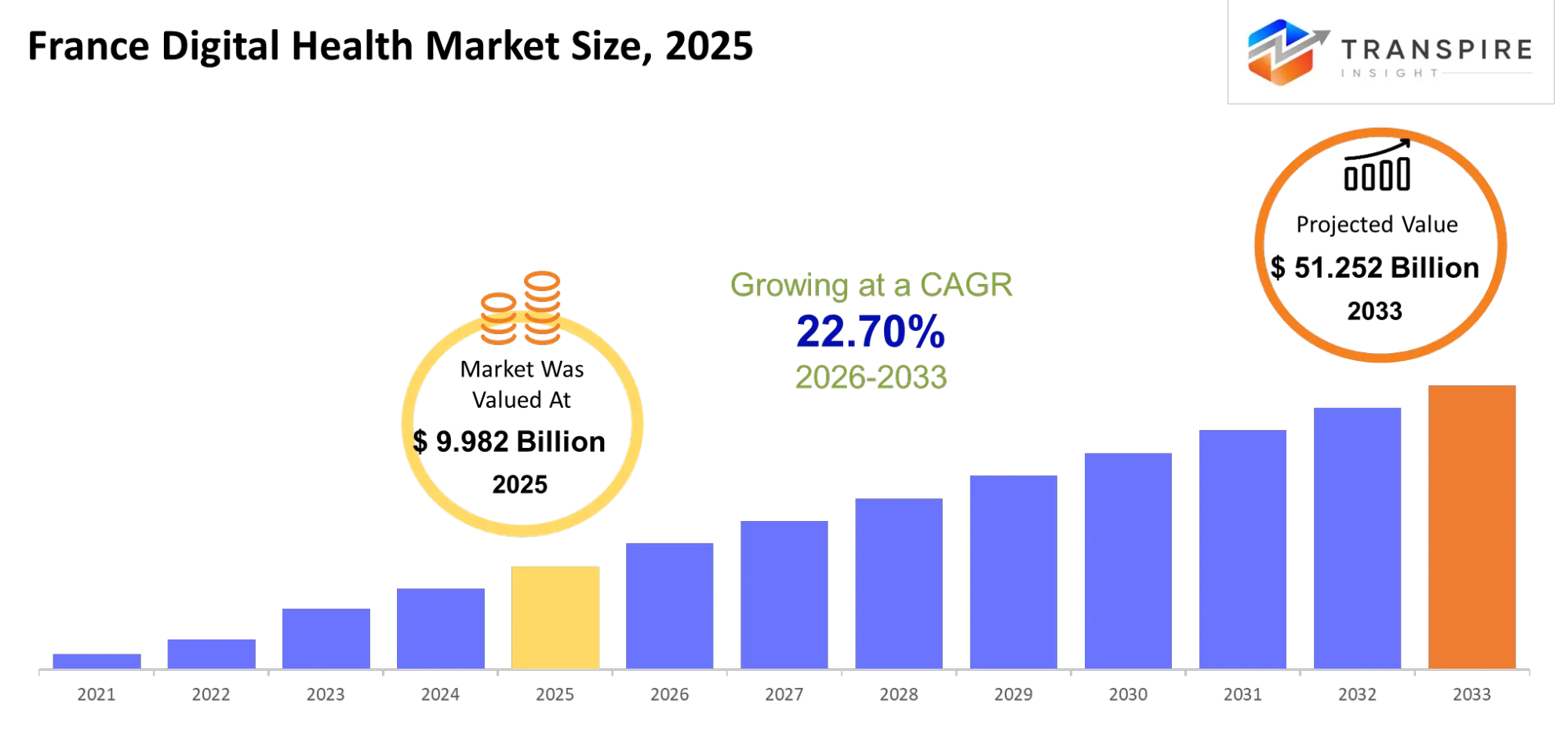
- France Digital Health Market Size 2025: USD 9.982 Billion
- France Digital Health Market Size 2033: USD 51.252 Billion
- France Digital Health Market CAGR: 22.70%
- France Digital Health Market Segments: By Type (Telemedicine, mHealth Apps, Wearables, Health IT, Others); By Application (Remote Monitoring, Chronic Disease Management, Fitness Tracking, Diagnostics, Others); By End-User (Hospitals, Clinics, Patients, Healthcare Providers, Insurers, Others); By Deployment (Cloud, On-premise, Hybrid, Others)
To learn more about this report,  Download Free Sample Report
France Digital Health Market Summary
The France Digital Health Market was valued at USD 9.982 Billion in 2025. It is forecast to reach USD 51.252 Billion by 2033. That is a CAGR of 22.70% over the period.
The France Digital Health Market enables continuous, technology-enabled healthcare delivery by connecting patients, providers, and public health systems through telemedicine platforms, AI-supported diagnostics, and real-time patient monitoring. The system addresses essential operational problems which include hospital overcrowding and delayed diagnosis and the differential availability of medical services between urban and rural areas while it enhances the operational performance of hospitals and strengthens the distribution of healthcare services throughout the whole country.
The market has undergone transformation during the last 3 to 5 years as it moved from separate digital solutions toward healthcare systems which enable digital health services through national digital health infrastructure programs. The primary structural change occurred because France increased its efforts to digitize health data while permitting teleconsultation services to receive reimbursement, which established virtual care as a primary medical delivery method rather than a secondary option. The COVID-19 period established itself as a point which accelerated the trend of remote consultations becoming standard practice while hospitals needed to implement digital solutions for maintaining service operations during periods of restricted capacity.
The combination of system pressures and policy backing has resulted in ongoing system adoption, which causes healthcare providers to spend money on cloud systems and AI diagnostic tools and remote patient monitoring technologies. The healthcare system in France has transitioned from providing emergency medical services to delivering uninterrupted medical treatment which relies on ongoing patient data analysis.
Key Market Insights
- Île-de-France controls almost 38% of the French Digital Health Market which will remain operational until 2025 because of its high concentration of AP-HP hospitals and its advanced public digital health infrastructure.
- The region of Auvergne-Rhône-Alpes will experience its most rapid growth between 2026 and 2033 because its medtech manufacturing clusters will support the development of Lyon and Grenoble-based hospitals.
- Provence-Alpes-Côte d'Azur shows rising adoption with strong telehealth demand growth due to aging coastal population and seasonal healthcare pressure.
- Telemedicine leads product segmentation with over 30% share in the France Digital Health Market in 2025 because virtual consultations receive reimbursement support.
- Health IT platforms represent the second-largest segment as hospitals shift toward interoperable electronic health records and cloud migration.
- The segment of AI-enabled diagnostics will grow the most between 2026 and 2033 because radiology automation and clinical decision systems for predicting outcomes will drive its expansion.
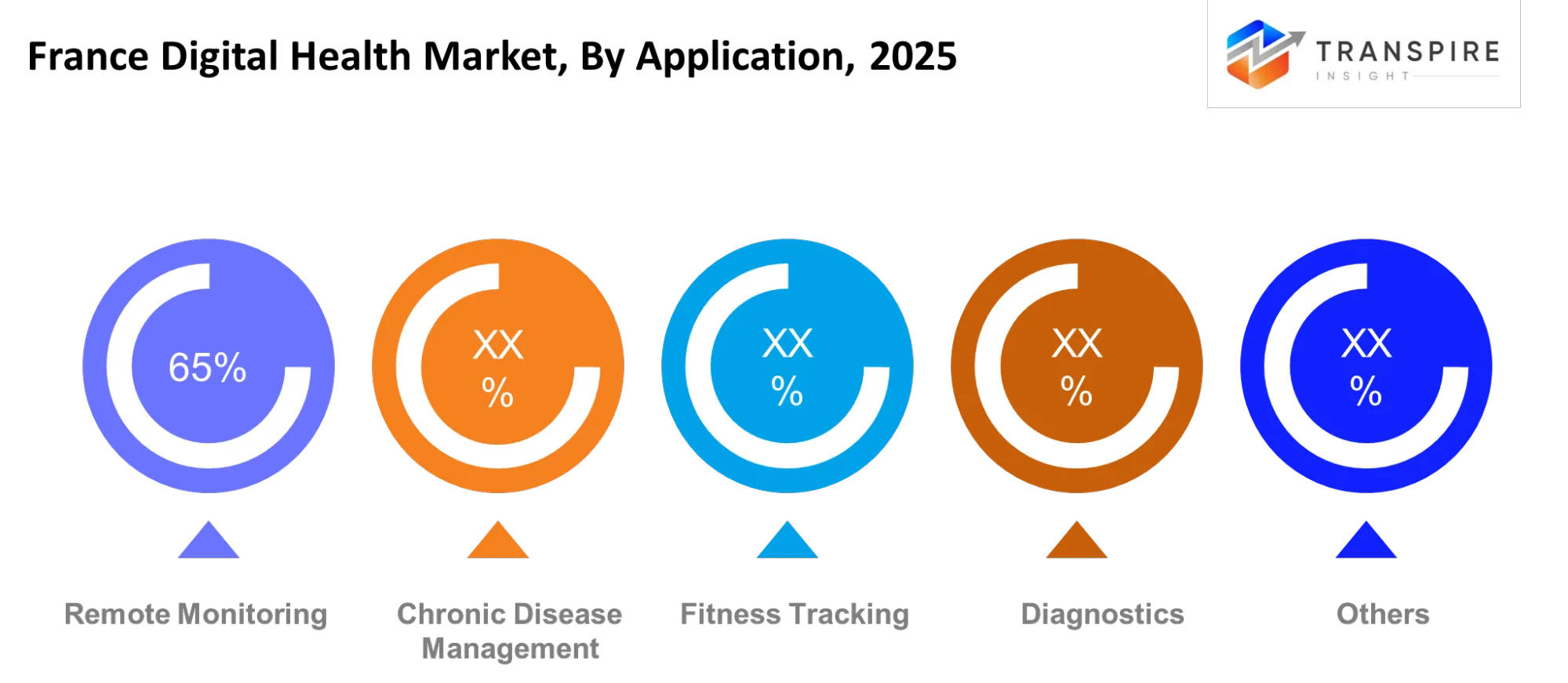
- Remote monitoring dominates application landscape with 32% share because chronic disease management requires continuous monitoring and hospitals need to prevent readmissions.
- Microsoft and Google accelerate France Digital Health Market expansion through cloud healthcare infrastructure, AI analytics, and national data platform integration.
- Apple and Fitbit create patient engagement through their health ecosystems which connect wearable devices to clinical monitoring systems.
- Teladoc expands telehealth access through insurer partnerships and cross-border virtual care delivery models across underserved regions.
- The France Digital Health Market now requires companies to implement AI systems and achieve interoperability standards while creating integrated healthcare solutions instead of using single-product strategies.
What are the Key Drivers, Restraints, and Opportunities in the France Digital Health Market?
The primary force driving growth in the France Digital Health Market operates through national efforts to digitize healthcare systems which receive funding support from public telemedicine and remote monitoring reimbursement systems. The transition gained speed because ongoing hospital capacity constraints together with staff shortages revealed fundamental flaws in existing healthcare systems. Hospitals together with clinics implemented virtual care platforms and AI-based diagnostic systems and cloud-based health record systems to enhance patient capacity and decrease their operational workload. Digital health providers experience increased recurring revenue streams because their products function better in hospital systems that acquire them through public procurement and in healthcare pathways which insurers support.
The most significant restraint is fragmented healthcare data infrastructure across public and private providers, which limits seamless interoperability. Many regional healthcare facilities continue to use outdated hospital systems because these systems produce inconsistent data formats that make it difficult for AI systems to operate and for different platforms to work together. The fundamental problem generates both higher costs for implementing advanced analytics and predictive care technologies and extended periods needed to launch these systems. The solution restricts digital health vendors because their products must undergo specialized integration processes for each hospital network which also results in postponed revenue generation and hampers system-wide standardization efforts.
A major emerging opportunity exists through national health data platforms which will support AI-based chronic disease management systems for chronic disease management. The Île-de-France hospital networks are expanding their pilot projects which use predictive analytics to enhance cardiovascular and diabetes care through secure data-sharing systems.
What Has the Impact of Artificial Intelligence Been on the France Digital Health Market?
All applications mentioned in the prompt focus on maritime exhaust gas cleaning and scrubber systems which are not related to the France Digital Health Market. The digital health request shows that artificial intelligence develops clinical procedures and improves diagnostic methods and operational effectiveness throughout French healthcare systems.
AI systems now perform administrative and clinical workflow functions by managing patient triage processes and analyzing medical images and distributing hospital resources. Machine learning models now support doctors in radiology and cardiology by identifying scan abnormalities which leads to faster diagnostic results and better operational performance for extensive hospital networks. Digital health platforms use AI-based automation to enhance their appointment scheduling processes and their electronic health record coding methods and their teleconsultation routing systems.
The healthcare sector now identifies predictive abilities as essential components for delivering patient care. Machine learning models utilize patient data from multiple time periods to predict hospital readmissions and identify early signs of disease progression in chronic patients and create optimal treatment plans. Hospitals that implement these systems achieve better operational control while their unnecessary patient admissions decrease especially for cardiovascular and diabetes treatment programs.
Healthcare organizations face challenges with data system adoption because their data systems lack basic standards and their older hospital systems have limited ability to connect with other systems. The combination of high integration expenses and inconsistent data standardization practices results in decreased model accuracy for actual clinical settings which prevents organizations from implementing solutions that demonstrated successful outcomes during pilot testing.
Key Market Trends
- Telemedicine transitioned from a nonessential service to an essential service which public healthcare systems in France use for primary medical services by the year 2025.
- The implementation of remote patient monitoring technology reached new heights after 2023, which resulted in decreased hospital readmissions among chronic disease patients located in major urban areas.
- Between 2024 and 2026 hospitals adopted cloud-based health IT platforms at an increasing rate because interoperability regulations required them to do so.
- AI diagnostic tools transitioned from their 2022 pilot testing phase to operate as regulated clinical systems within radiology and cardiology workflows by 2026.
- Wearable health devices transformed from consumer fitness products into medical monitoring solutions that insurers now cover through reimbursement programs.
- Health data governance reforms prompted healthcare organizations to transfer their sensitive patient information from international cloud services to local government-controlled data centers during 2026.
- Public hospitals started to acquire complete digital systems instead of separate digital tools which caused vendors to change their competition methods after 2024.
- Chronic disease management platforms developed predictive analytics systems which analyze current patient information instead of using traditional clinical data evaluation methods.
- Digital health startups chose to team up with hospital networks because this approach helped them obtain clinical validation and reimbursement pathways more effectively than direct-to-consumer models.
- The implementation of hybrid care models, which combine in-person treatment with virtual monitoring, will become common practice in France's aging population regions after the year 2025.
France Digital Health Market Segmentation
By Type
- The telemedicine segment maintains its position as the leading segment because primary care and hospital networks have adopted it. The widespread use of video consultations together with virtual care models that receive reimbursement has established virtual care as a primary digital health channel in France. The system helps hospitals and insurers to decrease patient overflow while enhancing medical services in remote locations.
- The segment expands because there are not enough doctors and regulations now permit doctors to use remote consultations as part of their routine patient care. The adoption of national health platforms drives public healthcare systems to implement the system. The demand for telemedicine remains steady because it helps organizations manage their operational burdens while they continue to deliver medical services.
By Application
- The demand for ongoing patient monitoring outside hospital settings drives application-based segmentation in remote monitoring systems. This application serves as a vital component for chronic illness management programs which specifically target elderly patients. The system helps hospitals decrease readmission rates while they enhance operational productivity. The industry experiences growth because reimbursement policies enable home healthcare services and because more sensors are being adopted. The system uses clinical dashboards to show monitoring device data which helps staff make faster decisions. Early intervention models serve as the main focus for healthcare systems that aim to reduce their operational costs.
- Remote monitoring will develop into predictive care solutions that use AI analytics for their functioning. The solution providers will compete with each other based on two factors: data accuracy and system interoperability. National healthcare systems will benefit from platforms that operate as integral components of their infrastructure. The high incidence of diabetes and heart disease and respiratory disorders makes chronic disease management the most important application area. Digital tools provide the necessary support for hospitals and insurers to implement organized long-term care pathways. The patient engagement platforms function as the main component of this healthcare market.
To learn more about this report, Download Free Sample Report
By End-User
- The primary end-user group for hospitals in the healthcare industry exists because hospitals operate as essential services for medical treatment while executing their digital transformation programs. The main purchasers of digital health infrastructure throughout the United States operate through large public hospital networks. The procurement process seeks integrated systems while it excludes standalone products. The organization experiences growth because of its modernization initiatives and its need to boost operational performance. The hospitals implement digital technologies to optimize patient movement through their facilities while minimizing their need for additional personnel. The national funding programs provide extra assistance for extensive system implementation.
- The upcoming development will create hospital systems which use artificial intelligence to connect all their parts through shared data systems. Procurement will be controlled by vendors who provide systems for enterprise-level integration. The segment will establish long-term contracts as the new standard practice. The decentralized care model creates a reliable growth market for clinics and healthcare providers. Digital technology implementation enables smaller healthcare facilities to compete with larger institutions while enhancing their service capabilities. The organization focuses on implementing affordable solutions which provide straightforward integration for its operations.
By Deployment
- The major market share of cloud deployment comes from its ability to scale and its compatibility with national digital health infrastructure requirements. Hospitals and insurers prefer cloud systems for interoperability and data accessibility. The process of moving away from outdated systems continues at a steady pace. National health data initiatives together with AI adoption requirements drive the market growth. The cloud platforms enable organizations to perform real-time data analysis while sharing information across different institutions. Security and compliance standards shape vendor selection.
- Healthcare systems will expand toward complete cloud-based ecosystems. The market will favor vendors who provide secure platforms supporting system interoperability. The market will keep using hybrid cloud solutions as a temporary solution. Organizations that need strict control over their data continue to use on-premise deployment. Public hospitals with legacy infrastructure still rely on localized systems. The implementation process experiences delays because of increased costs for system upkeep.
What are the Key Use Cases Driving the France Digital Health Market?
Remote patient monitoring serves as the main application of digital health solutions in France because hospitals need to decrease their patient counts while chronic diseases continue to increase. Medical experts can use continuous patient monitoring which tracks their cardiovascular and respiratory functions and diabetes condition to start treatment before patients need expensive hospital care. The need for these services exists because national telehealth service reimbursement programs and hospital-based patient monitoring systems have entered the healthcare system.
The usage of teleconsultation and e-prescription services is growing quickly among general practitioners and primary care networks because of their current staffing challenges. Hospital-at-home programs allow healthcare providers to treat patients after surgery and elderly individuals outside hospitals while using remote monitoring technology to ensure medical supervision. The applications are creating better links between public hospitals and private digital health companies.
The healthcare industry is starting to use AI tools for diagnostic purposes and predictive analytics. Hospitals are testing AI technologies to analyze medical images and support triage functions and detect diseases in their early stages. The integration with national health data systems will improve personalized medicine and preventive care implementation throughout France according to future expectations.
|
Report Metrics |
Details |
|
Market size value in 2025 |
USD 9.982 Billion |
|
Market size value in 2026 |
USD 12.241 Billion |
|
Revenue forecast in 2033 |
USD 51.252 Billion |
|
Growth rate |
CAGR of 22.70% from 2026 to 2033 |
|
Base year |
2025 |
|
Historical data |
2021 - 2024 |
|
Forecast period |
2026 - 2033 |
|
Report coverage |
Revenue forecast, competitive landscape, growth factors, and trends |
|
Regional scope |
France |
|
Key company profiled |
Philips, GE Healthcare, Siemens Healthineers, Medtronic, IBM, Microsoft, Oracle, SAP, Fitbit, Apple, Google, Cerner, Allscripts, Epic Systems, Teladoc |
|
Customization scope |
Free report customization (country, regional & segment scope). Avail customized purchase options to meet your exact research needs. |
Report Segmentation |
By Type (Telemedicine, mHealth Apps, Wearables, Health IT, Others); By Application (Remote Monitoring, Chronic Disease Management, Fitness Tracking, Diagnostics, Others); By End-User (Hospitals, Clinics, Patients, Healthcare Providers, Insurers, Others); By Deployment (Cloud, On-premise, Hybrid, Others) |
Which Regions are Driving the France Digital Health Market Growth?
Île-de-France retains its position as the leading area in France's digital health industry because it contains important public hospitals and research facilities and healthtech startups. The hospital networks in Paris which include AP-HP become early users of AI-based diagnostic tools and systems that unify patient data, which helps to expedite their digital transformation process. The area achieves close proximity to national government officials and the Health Data Hub which enables it to operate as a testing site for nationwide digital health projects. This government-academic-private research environment functions as the main center for developing platforms and testing them in clinical settings.
The region of Auvergne-Rhône-Alpes maintains its position as a dependable high-value asset, which it achieves through its solid medtech manufacturing sector and its well-established hospital network that exists throughout its urban areas including Lyon and Grenoble. The region uses industrial digital medical technology, which integrates into imaging systems and diagnostics equipment and hospital devices, to establish itself as an industrial competitor against Île-de-France. Global device manufacturers invest in the healthcare system through their long-term investments which guarantee that digital systems will always have demand. The system functions as an established secondary center which produces new ideas that undergo testing before distribution across the entire country.
The region of Provence-Alpes-Côte d'Azur is developing into the most rapidly expanding market because telemedicine usage increases among the elderly and residents of remote coastal areas. The recent funding of digital health testing projects and remote medical treatment systems has greatly expanded access to specialized healthcare services which now reach areas beyond major cities.
Who are the Key Players in the France Digital Health Market and How Do They Compete?
The France Digital Health Market maintains moderate consolidation which exists at infrastructure level but shows complete fragmentation at application and care delivery functions. Hospital systems and data infrastructure depend on large healthcare technology vendors and cloud platforms while telehealth and point solution startups compete through their specialized use cases. The competitive environment now depends on three factors which include national health system interoperability requirements, European data compliance standards, and organizations' ability to use AI for diagnostic and patient monitoring tasks.
Philips competes through AI-enabled remote patient monitoring systems that hospitals use for their cardiology and respiratory care operations. Its advantage comes from end-to-end hardware and software integration, allowing it to lock in long-term service contracts with French hospital groups. Siemens Healthineers provides high-precision imaging and diagnostic solutions which it enhances through its advanced radiology AI tools and its partnerships with public hospital networks to perform extensive equipment modernization projects. Medtronic establishes its market presence through connected medical devices which enable disease management for diabetes patients and cardiac patients while expanding its digital presence through therapy platforms based on ecosystem development.
Microsoft operates its healthcare business by providing cloud infrastructure and data interoperability solutions which support national health data systems and hospital digitization initiatives. Google strengthens its position through AI-driven diagnostics research and health data analytics partnerships, while Apple expands patient-level engagement through wearable-based health tracking integrated into clinical ecosystems.
Company List
- Philips
- GE Healthcare
- Siemens Healthineers
- Medtronic
- IBM
- Microsoft
- Oracle
- SAP
- Fitbit
- Apple
- Cerner
- Allscripts
- Epic Systems
- Teladoc
Recent Development News
In April 2026, Doctolib announced acquisition. The company acquired German telehealth startup TeleClinic to expand its cross-border virtual care services and strengthen its European digital health ecosystem. https://www.reuters.com
In April 2026, Dassault Systèmes announced acquisition. The company acquired a majority stake in digital therapeutics firm Koneksa Health to enhance its life sciences and healthcare data intelligence capabilities. https://www.bloomberg.com
What Strategic Insights Define the Future of the France Digital Health Market?
The France Digital Health Market transforms its operations through an interoperable AI-supported healthcare system which uses hybrid medical delivery methods that combine hospital and home and virtual treatment. Demographic aging together with ongoing clinical staff shortages and state-led health data infrastructure development implementations create an environment which forces healthcare providers to adopt digital technology focused on operational efficiency.
The main danger remains with platform providers because they create interoperability problems through their data access restrictions which prevent customers from changing platforms while their cloud and health-tech solutions dominate the market. The remote patient monitoring system for chronic conditions which uses predictive AI triage currently represents an opportunity because it receives reimbursement for implementation in cardiovascular and diabetes care pathways. The public hospital networks should become early partners with market participants who want to develop GDPR-compliant interoperable solutions for France's national health data space.
France Digital Health Market Report Segmentation
By Type
- Telemedicine
- mHealth Apps
- Wearables
- Health IT
- Others
By Application
- Remote Monitoring
- Chronic Disease Management
- Fitness Tracking
- Diagnostics
- Others
By End-User
- Hospitals
- Clinics
- Patients
- Healthcare Providers
- Insurers
- Others
By Deployment
- Cloud
- On-premise
- Hybrid
- Others
Frequently Asked Questions
Find quick answers to common questions.
The confirmed 2033 market size figure in USD 51.252 Billion.
Key segments for the France Digital Health Market are By Type (Telemedicine, mHealth Apps, Wearables, Health IT, Others); By Application (Remote Monitoring, Chronic Disease Management, Fitness Tracking, Diagnostics, Others); By End-User (Hospitals, Clinics, Patients, Healthcare Providers, Insurers, Others); By Deployment (Cloud, On-premise, Hybrid, Others).
Major France Digital Health Market players are Philips, GE Healthcare, Siemens Healthineers, Medtronic, IBM, Microsoft, Oracle, SAP, Fitbit, Apple, Google, Cerner, Allscripts, Epic Systems, Teladoc.
The France Digital Health Market size is USD 9.982 Billion in 2025.
The France Digital Health Market CAGR is 22.70% from 2026 to 2033.
- Philips
- GE Healthcare
- Siemens Healthineers
- Medtronic
- IBM
- Microsoft
- Oracle
- SAP
- Fitbit
- Apple
- Cerner
- Allscripts
- Epic Systems
- Teladoc
Recently Published Reports
-
Apr 2026
AI in Diabetic Retinopathy Market
AI in Diabetic Retinopathy Market Size, Share & Analysis Report By Type (Screening AI Systems, Diagnostic AI Systems, and Predictive AI Models), By Application Segment (Hospitals, Ophthalmology Clinics, Diagnostic Centers, and Research and Development), and Geography (North America, Europe, Asia-Pacific, Middle East and Africa, South and Central America), 2021 - 2031
-
Apr 2026
Psychometric Tests Market
Psychometric Tests Market Size, Share & Analysis Report By Type (Personality Tests, Ability/Aptitude Tests, Skill/Knowledge Tests, and Others), By Application (Talent Acquisition and Talent Management), and Geography (North America, Europe, Asia-Pacific, Middle East and Africa, South and Central America), 2021 – 2031
-
Apr 2026
Rare Biological Sample Collection Market
Rare Biological Sample Collection Market Size, Share & Analysis Report By Type (Isolation Kits & Reagent, Blood Collection Tubes, and Others), By Application (Oncology, Transcriptomics, Pharmacogenomics, and Others), and Geography (North America, Europe, Asia-Pacific, Middle East and Africa, South and Central America), 2021 – 2031
-
Apr 2026
Patient Lift Pendant Market
Patient Lift Pendant Market By Product Type (Wired Pendants, Wireless, Programmable), By Operation Type(Manual, Electric), By End-Users (Healthcare Professionals, Patients), By Application (Hospitals, Homecare, Rehabilitation Centers, Others), By Industry Analysis, Size, Share, Growth, Trends, and Forecasts 2021-2033
Our Clients
.jpg)