
Europe Automotive Digital Cockpit Market Size & Forecast:
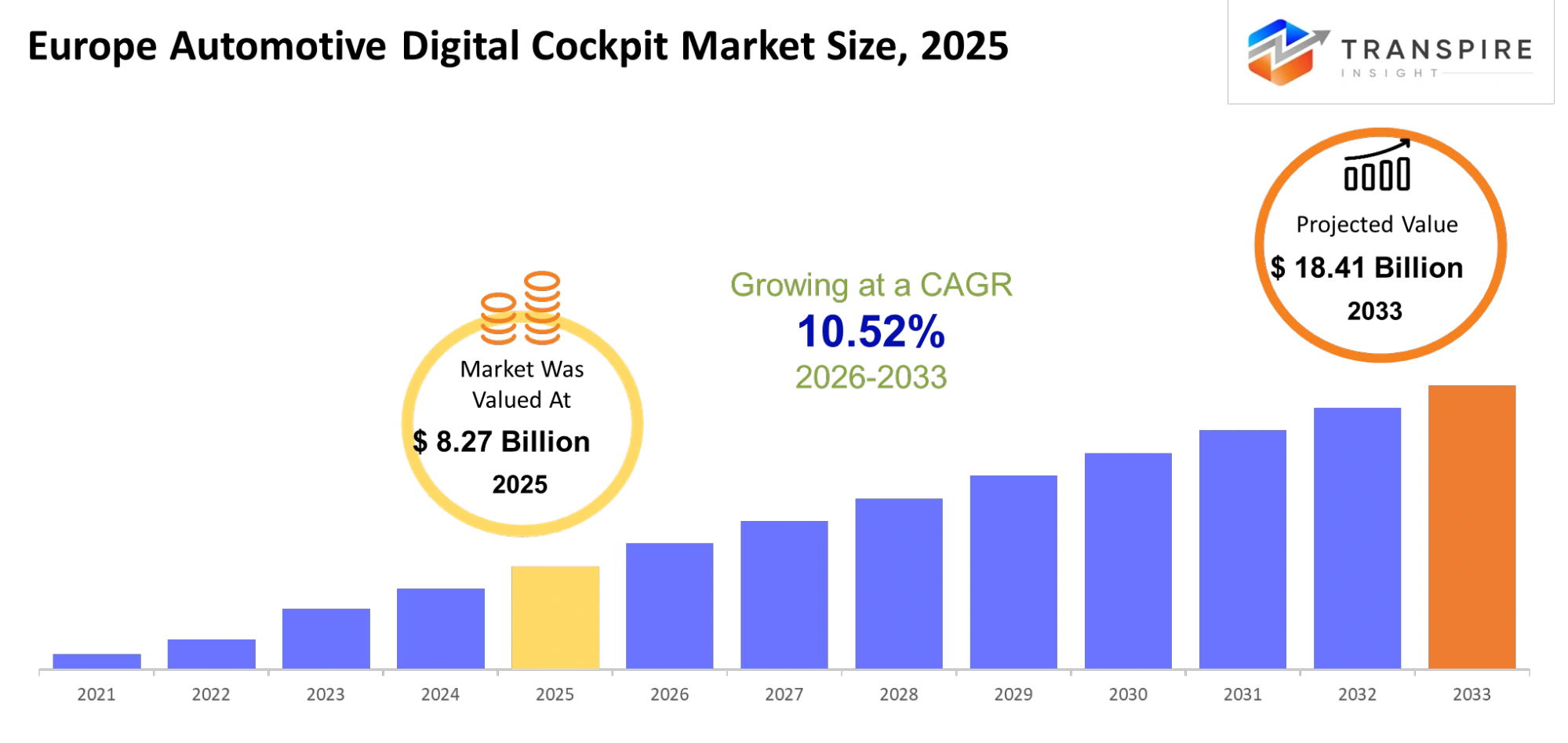
- Europe Automotive Digital Cockpit Market Size 2025: USD 8.27 Billion
- Europe Automotive Digital Cockpit Market Size 2033: USD 18.41 Billion
- Europe Automotive Digital Cockpit Market CAGR: 10.52%
- Europe Automotive Digital Cockpit Market Segments: By Type (Instrument Clusters, Infotainment Systems, HUDs, Others), By Application (Passenger Vehicles, Commercial Vehicles, EVs, Autonomous Vehicles, Others), By End-User (Automakers, Tier 1 Suppliers, Electronics Firms, Others), By Technology (LCD, OLED, AI-based Interfaces, Others).
To learn more about this report,  Download Free Sample Report
Europe Automotive Digital Cockpit Market Summary:
The Europe Automotive Digital Cockpit Market size is estimated at USD 8.27 Billion in 2025 and is anticipated to reach USD 18.41 Billion by 2033, growing at a CAGR of 10.52% from 2026 to 2033. The automotive digital cockpit industry in Europe exists at a point which combines driver safety features with entertainment systems and unique vehicle design elements. The systems in this study create unified display systems which show navigation information and vehicle metrics and driver assistance system outputs and connected services through a single interface which decreases mental workload for drivers while enabling automakers to produce software-based user experiences.
The market has undergone a complete structural transformation from hardware-defined clusters to software-based cockpit platforms which permit upgrades during the past three to five years. The semiconductor shortages which occurred during global supply chain disruptions made manufacturers create electronic systems which needed to use common computing resources.
The manufacturers create cockpit systems which allow centralized control and handle remote software updates and revenue-generating features. The new system enables companies to earn money through extended vehicle lifecycles while simplifying hardware requirements and accelerating the introduction of digital innovations across multiple vehicle models.
Key Market Insights
- Germany controls more than 30% of the European automotive digital cockpit market, which it will achieve by 2025 because of its strong original equipment manufacturer operations and high-end vehicle production.
- France and the UK represent significant share contributors due to rising connected car penetration and regulatory push for vehicle safety systems.
- Eastern Europe becomes the fastest-growing region until 2030 because it operates efficient manufacturing centers and develops its automotive supply chain network.
- Digital instrument clusters control the market with approximately 35% market share during 2025 because car manufacturers implement full digital display systems to their mid-range and premium vehicle lines.
- Infotainment systems hold the second-largest share of the market, which grows because people want to use voice assistants while connecting to app-based systems.
- The head-up display segment shows the highest growth rate until 2030 because safety innovations and augmented reality technology become more common.
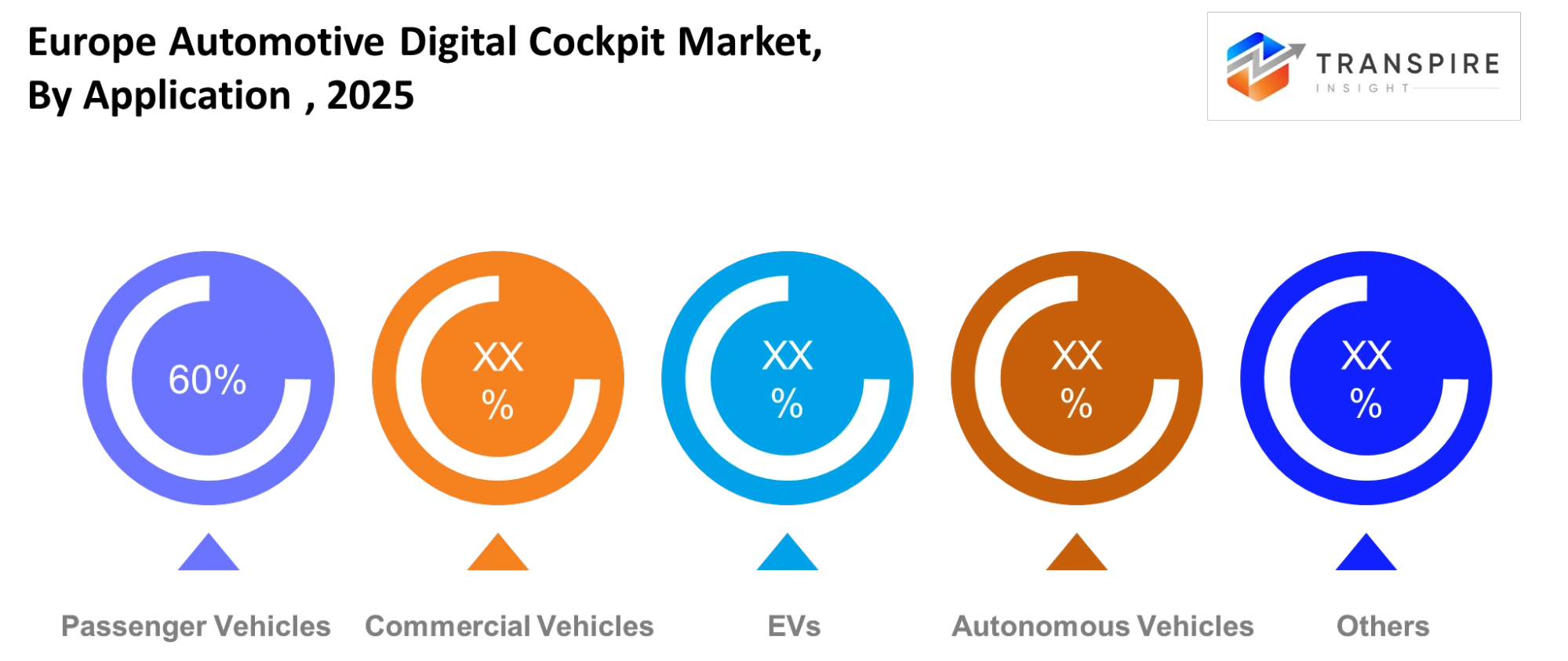
- Passenger vehicles account for more than 80% of the market, which demonstrates how digital cockpit systems have become popular among premium and electric vehicle drivers.
- Electric vehicles represent the fastest-growing application, which results from vehicle architecture that depends on software and needs better user interface design.
- The original equipment manufacturer market will reach its peak during 2025 because manufacturers will implement cockpit systems throughout their vehicle development process.
- The aftermarket market experiences rapid expansion, which the industry supports through increasing demand for infotainment system upgrades and digital cluster system retrofitting.
What are the Key Drivers, Restraints, and Opportunities in the Europe Automotive Digital Cockpit Market?
The Europe Automotive Digital Cockpit Market experiences its main growth driver through the transition to software-defined vehicles which stems from the quick adoption of advanced driver assistance systems together with connected services. The European safety regulations require driver monitoring systems together with real-time alert systems which force OEMs to implement common digital interface systems. The value of cockpit systems per vehicle increases through this transition because automakers use high-resolution displays together with domain controllers to replace analog clusters. The company generates revenue through both hardware sales and software-enabled features which include navigation subscriptions and voice assistants and over-the-air upgrades.
The most significant barrier is the high integration complexity across legacy vehicle architectures. European OEMs continue to use separate electronic control unit systems which prevents them from unifying their control systems into centralized cockpit platforms. The redesign of vehicle electrical architecture constitutes a structural problem because it requires multiple years of development and major financial resources. The advanced cockpit features which mid-range models require will take extra time to develop because they need advanced technology which will delay their release. The advanced cockpit features will be postponed until they reach mid-range models which will hinder their market entry and impede the development of production efficiency.
The use of augmented reality head-up displays together with AI-based personalization systems provides a vital opportunity for market expansion. The premium electric vehicle market shows increasing interest in immersive cockpit platforms which display navigation and hazard information through windshield overlays. The mass-market segments will adopt these technologies because component costs will decrease and computing power will be accessible, creating new revenue opportunities, which will differentiate user experience for European automotive brands.
What Has the Impact of Artificial Intelligence Been on the Europe Automotive Digital Cockpit Market?
The combination of artificial intelligence with digital technology advancements creates new marine emission control systems through the implementation of real-time intelligence which improves scrubber performance and compliance assessment processes. AI-enabled control platforms now perform automatic scrubber monitoring through their ability to adjust washwater flow rates and alkalinity dosing and exhaust parameters throughout the entire engine load range which includes different types of fuel with varying sulfur content. The system automatically handles operations which enable ships to maintain emission limits throughout different operational situations
Machine learning models use sensor data from pumps and nozzles and filtration units to detect early signs of fouling or corrosion which supports predictive maintenance. Operators can schedule maintenance before failures occur which improves system uptime and avoids costly port-side repairs. Predictive analytics estimate emission outputs across different voyage scenarios which enables operators to develop fuel switching strategies while ensuring compliance with regional sulfur regulations. The system has achieved measurable benefits through its ability to decrease chemical usage and fuel penalties and increase operational efficiency throughout long-haul fleet operations.
The structural barrier to AI adoption emerges from two main challenges which include inconsistent data quality and limited sea connectivity. Many vessels operate with fragmented sensor systems and intermittent data transmission which constrains model accuracy and slows large-scale deployment of fully autonomous scrubber optimization systems.
Key Market Trends
- European OEMs have moved to centralized domain controllers from their earlier multi-ECU dashboard systems which started in 2020. This change to centralized domain controllers allows for simplified wiring systems while establishing the framework required to develop cockpit software systems that can expand with future needs.
- The automotive industry completed its shift from analog displays to digital instrument clusters which now appear in more than 70 percent of newly introduced vehicles by 2025. This shift demonstrates which digital driver interfaces provide complete customization options.
- Automakers such as BMW Group and Mercedes-Benz Group expanded curved and panoramic displays, which now function as essential tools for building unique cockpit designs that help establish their respective brands.
- During the period from 2021 to 2023 semiconductor shortages forced OEMs to concentrate their resources on developing high-margin digital cockpit elements which subsequently led to the rapid growth of premium and electric vehicle markets.
- After 2022 manufacturers began using over-the-air update capabilities as a standard feature which enabled them to install navigation systems and infotainment systems and user interface updates after they had delivered vehicles to customers.
- The automotive industry saw a significant increase in voice assistant integration with AI interface systems which started developing after 2021 because drivers wanted to experience the same level of interaction that smartphones provide when they drive their vehicles.
- The European Union's regulatory requirement to implement driver monitoring systems by 2024 led to the faster development of camera and sensor systems which became essential components of cockpit design systems.
- The adoption of fully digital cockpits by electric vehicle platforms surpassed the adoption rates of internal combustion engine vehicles because their design used simple electronic components and prioritized software development for vehicle construction.
- Suppliers such as Continental AG and Visteon Corporation now provide complete cockpit solutions which include all system components through their development of end-to-end cockpit systems that surpass traditional component supply methods.
Europe Automotive Digital Cockpit Market Segmentation
By Type
European passenger vehicles now use digital instrument clusters as their primary instrument display because these systems have replaced traditional analog displays. Automakers prefer clusters because clusters deliver essential driving information while showing ADAS notifications and enabling users to personalize their display settings. The second largest segment of the market consists of infotainment systems which experience growth due to customer needs for seamless smartphone connectivity and navigation capabilities and media integration functions.
Head-up displays demonstrate their fastest expansion rate because safety innovations drive their use in premium vehicles which manufacturers particularly adopt in Germany and France. The increasing availability of affordable components will reduce entry-level model production costs although budget constraints still prevent its widespread use. Future development points toward fully integrated display ecosystems which will enable clusters and infotainment systems and HUDs to operate on a single software platform, allowing manufacturers to decrease hardware costs while generating continuous income from software enhancements.
By Application
Passenger vehicles make up the largest market share because they have the highest production rates and customers prefer their ability to offer connected driving and personalized driving experiences. The electric vehicle market shows the fastest growth because EV architectures depend on software-defined systems and centralized displays. The commercial vehicle market operates at a smaller capacity because customers in this sector prefer to keep their costs low while new technologies take time to become accepted.
The field of autonomous vehicle technology has started to develop its applications, but these applications currently exist only as pilot projects and premium segmented offerings. The increasing adoption of electric vehicles in Germany and Norway leads manufacturers to develop advanced cockpit interfaces, which they use to distinguish their new vehicle models. Future application requirements will demand vehicles that deliver superior automation capabilities, which will increase the use of complete immersive cockpit systems that integrate safety features with navigation tools and entertainment resources into one operational system.
To learn more about this report, Download Free Sample Report
By End-User
Automakers take the biggest market share because they use cockpit systems during their production process according to end-user data. European OEMs invest heavily in in-house software capabilities to control user experience and data ownership. Tier 1 suppliers hold the second-largest position by delivering integrated cockpit platforms, displays, and domain controllers to automakers.
The electronic companies have built their power because both software and semiconductor technologies have become essential for cockpit functionality. Since 2021 OEMs have partnered with technology companies more frequently because they need advanced computing and connectivity solutions. The upcoming industry developments will create collaborative partnerships between suppliers and electronics companies which will enable them to create platforms that support rapid feature development while decreasing costs and development time for automakers.
By Technology
The combination of cost efficiency and established supply chains and their common use in mid-range vehicles has made LCD technology the leading display solution. The premium market segment is experiencing rapid growth for OLED technology because it provides better contrast and design options for both flexible and curved and panoramic displays. AI-driven interfaces represent a major expansion sector because they provide three key features which include voice recognition capabilities and driver monitoring functions and customized user experiences.
The deployment of advanced AI systems across entire vehicle fleets faces challenges because limited processing power and complex system integration create obstacles. The process of establishing standardized high-performance computing platforms will result in faster technology adoption according to current trends. The upcoming technological progress will create integrated systems which combine AI with advanced displays and cloud connectivity to deliver predictive user interfaces and continuous feature enhancements that improve both security and user interaction.
What are the Key Use Cases Driving the Europe Automotive Digital Cockpit Market?
The main use case operates with passenger cars which utilize digital cockpits to display navigation systems and ADAS alerts and vehicle diagnostics. The combination of European safety rules and premium brand requirements forces automotive companies to create standard interfaces which help drivers stay focused while they make quick decisions, which creates higher demand for this system.
The use of electric vehicles and fleet-operated commercial vehicles creates new opportunities for application development. Digital cockpits in electric vehicle production allow manufacturers to show battery information and charging pathways and energy-saving features, while fleet operators use connected dashboards for driver monitoring and route efficiency. The use cases match operational needs of OEMs and fleet managers who want to control their operations while providing special user experiences.
The development of new applications has produced augmented reality head-up displays and AI-based systems for customizing user experiences. The systems show navigation directions through windshields while they modify display settings according to driver actions, which has started to become popular in premium vehicles that use semi-autonomous technology throughout Europe.
|
Report Metrics |
Details |
|
Market size value in 2025 |
USD 8.27 Billion |
|
Market size value in 2026 |
USD 9.14 Billion |
|
Revenue forecast in 2033 |
USD 18.41 Billion |
|
Growth rate |
CAGR of 10.52% from 2026 to 2033 |
|
Base year |
2025 |
|
Historical data |
2021 - 2024 |
|
Forecast period |
2026 - 2033 |
|
Report coverage |
Revenue forecast, competitive landscape, growth factors, and trends |
|
Regional scope |
Europe (Germany, United Kingdom, France, Italy, Spain and Rest of Europe) |
|
Key company profiled |
Bosch, Continental, Denso, Visteon, Harman, Panasonic, LG Electronics, Samsung, Aptiv, Valeo, Nvidia, Qualcomm, Intel, Renesas, NXP |
|
Customization scope |
Free report customization (country, regional & segment scope). Avail customized purchase options to meet your exact research needs. |
|
Report Segmentation |
By Type (Instrument Clusters, Infotainment Systems, HUDs, Others), By Application (Passenger Vehicles, Commercial Vehicles, EVs, Autonomous Vehicles, Others), By End-User (Automakers, Tier 1 Suppliers, Electronics Firms, Others), By Technology (LCD, OLED, AI-based Interfaces, Others) |
Which Regions are Driving the Europe Automotive Digital Cockpit Market Growth?
The European market depends on Germany because the country has numerous premium car manufacturers and regulations that require vehicle safety and digital technology. The implementation of driver monitoring systems and advanced safety interfaces through national and EU regulations has resulted in increased cockpit digitization across all new vehicle models. The company maintains its market position because of its comprehensive supplier ecosystem which includes Tier 1 manufacturers and semiconductor companies and software developers who work with original equipment manufacturers. The company can achieve rapid product development because its industrial base supports the ongoing introduction of valuable cockpit technologies to both its luxury and mid-range vehicle lines.
France and the United Kingdom follow as stable contributors, supported by balanced vehicle production and steady consumer adoption of connected car features. These markets depend on high-volume production combined with ongoing development of industry-wide technological standards, in contrast to Germany's premium-based market expansion. Digital cockpit systems, which both countries support through their regulatory frameworks, receive priority because of the safety regulations and emissions mandates that organizations must follow. The market provides automakers and suppliers with predictable revenue through investment planning which enables them to develop long-term strategies.
The automotive industry and supply chain development since 2022 have enabled Eastern Europe to achieve its highest economic growth rate. The Polish, Hungarian, and Czech Republic regions successfully attracted new investments which established electronics assembly and vehicle production operations while reducing operational costs for OEMs. The automotive industry now requires digital cockpit platforms which provide both scalability and cost efficiency to meet the needs of mainstream vehicle manufacturing.
Who are the Key Players in the Europe Automotive Digital Cockpit Market and How Do They Compete?
The European digital cockpit market exhibits moderate competition because a few Tier 1 suppliers control most OEM projects while new software developers establish their own in-car experience control systems. The established companies maintain their market position through advanced integration solutions and extended supply agreements while their opponents now concentrate on software solutions and user interface development and system expansion capabilities rather than hardware expenses. Automakers increasingly evaluate partners based on their ability to deliver centralized computing, over-the-air update readiness, and cybersecurity compliance. The industry now welcomes technology companies who possess the ability to enhance traditional automotive design through their expertise in cloud computing and artificial intelligence.
Continental AG creates complete cockpit domain controllers which function as complete systems that integrate display technology with processing units and software components to provide original equipment manufacturers a simplified system design. Visteon Corporation creates a unique market position through its SmartCore platform, which enables automotive manufacturers to run multiple cockpit functions on a single hardware system, resulting in both cost savings and better upgrade options. The two companies develop their business operations through co-development projects with European OEMs, which allow them to integrate their platforms into upcoming vehicle production.
The company Robert Bosch GmbH uses its sensor technology to develop AI systems which monitor drivers while providing safety features to be integrated directly into cockpit systems. Harman International uses its partnerships with consumer electronics platforms and its connectivity ecosystem to create competitive advantages which allow users to integrate their smartphones and access cloud services without interruption. The companies establish strategic partnerships with electric vehicle manufacturers and software development companies to create stable revenue streams while maintaining control of their cockpit systems which are transforming into software-based systems.
Company List
- Bosch
- Continental
- Denso
- Visteon
- Harman
- Panasonic
- LG Electronics
- Samsung
- Aptiv
- Valeo
- Nvidia
- Qualcomm
- Intel
- Renesas
- NXP
Recent Development News
In April 2026, Qualcomm–Bosch Expand Digital Cockpit & ADAS Partnership: Qualcomm and Bosch expanded their strategic collaboration to scale Snapdragon-based automotive cockpit and ADAS platforms across global OEM programs. The deal strengthens in-vehicle digital cockpit integration combining infotainment, safety systems, and AI-driven interfaces widely deployed in European vehicle programs.
Source: https://www.qualcomm.com
In January 2026, Aptiv Showcases Next-Gen Digital Cockpit Technologies at CES 2026: Aptiv unveiled advanced digital cockpit technologies at CES 2026, focusing on personalized in-vehicle user experience, ADAS integration, and software-defined cockpit platforms. These technologies are positioned for deployment across global OEMs including European automotive manufacturers.
Source: https://www.aptiv.com
What Strategic Insights Define the Future of the Europe Automotive Digital Cockpit Market?
The Europe Automotive Digital Cockpit Market is shifting toward centralized software-based cockpit systems which operate as commercial digital ecosystems instead of permanent hardware systems. The automotive industry is now developing electric vehicle systems because regulatory organizations require driver monitoring systems and original equipment manufacturers (OEMs) want to sell car access to their services throughout the entire vehicle lifespan. The distribution of processing power to domain controllers will enable cockpit systems to function as the main user interface for subscription services and unique brand features.
The industry now faces a hidden danger because companies increasingly rely on a few specific semiconductor and software platform vendors. The concentration of vendors will restrict original equipment manufacturers (OEMs) from making operational choices while raising their integration expenses and creating vulnerabilities to market interruptions and unequal pricing power situations.
Automakers can now seize a new market opportunity through the implementation of augmented reality head-up displays in mid-range vehicles which became possible because component prices decreased and high-performance chip technology reached standardization. Companies should invest in modular upgradeable cockpit platforms which enable them to deploy new features quickly while generating ongoing revenue streams and retaining vehicle segment flexibility.
Europe Automotive Digital Cockpit Market Report Segmentation
By Type
- Instrument Clusters
- Infotainment Systems
- HUDs
- Others
By Application
- Passenger Vehicles
- Commercial Vehicles
- EVs
- Autonomous Vehicles
- Others
By End-User
- Automakers
- Tier 1 Suppliers
- Electronics Firms
- Others
By Technology
- LCD
- OLED
- AI-based Interfaces
- Others
Frequently Asked Questions
Find quick answers to common questions.
The approximate Europe Automotive Digital Cockpit Market size for the market will be USD 18.41 Billion in 2033.
The key segments of the Europe Automotive Digital Cockpit Market are By Type (Instrument Clusters, Infotainment Systems, HUDs, Others), By Application (Passenger Vehicles, Commercial Vehicles, EVs, Autonomous Vehicles, Others), By End-User (Automakers, Tier 1 Suppliers, Electronics Firms, Others), By Technology (LCD, OLED, AI-based Interfaces, Others).
Major players in the Europe Automotive Digital Cockpit Market are Bosch, Continental, Denso, Visteon, Harman, Panasonic, LG Electronics, Samsung, Aptiv, Valeo, Nvidia, Qualcomm, Intel, Renesas, NXP.
The current market size of the Europe Automotive Digital Cockpit Market is USD 8.27 Billion in 2025.
The Europe Automotive Digital Cockpit Market CAGR is 10.52%.
- Bosch
- Continental
- Denso
- Visteon
- Harman
- Panasonic
- LG Electronics
- Samsung
- Aptiv
- Valeo
- Nvidia
- Qualcomm
- Intel
- Renesas
- NXP
Recently Published Reports
-
Apr 2026
ATV & UTV Market
ATV & UTV Market Size, Share & Analysis Report By Type (ATV, and UTV), By Variants (Less Than 400 CC, 400 CC To 800 CC, and More Than 800 CC), and Geography (North America, Europe, Asia-Pacific, Middle East and Africa, South and Central America), 2021 - 2031
-
Apr 2026
Automotive Central Gateway Module Market
Automotive Central Gateway Module Market Size, Share & Analysis Report By Type (Ethernet Central Gateway Module, CAN Central Gateway Module, LIN Central Gateway Module, and FlexRay), By Application (Powertrain Control, Body Control, Infotainment System, Advanced Driver Assistance Systems (ADAS), and Others), By End User (Passenger Vehicles, and Commercial Vehicles), and Geography (North America, Europe, Asia-Pacific, Middle East and Africa, South and Central America), 2021 - 2031
-
Apr 2026
Automotive Engine Oil Filter Market
Automotive Engine Oil Filter Market Size, Share & Analysis Report By Filter Type (Fuel Filter, Engine Oil Filter, Hydraulic Oil Filter, and Others), By Filter Media (Cellulose, Synthetic, and Micro), By Sales Channel (OEMs, and Aftermarket), By Vehicle Type (Passenger Cars, Light Commercial Vehicles, Heavy Duty Trucks, Buses and Coaches, and Off-road Vehicles), and Geography (North America, Europe, Asia-Pacific, Middle East and Africa, South and Central America), 2021 - 2031
-
Apr 2026
Automotive Parts Aluminium Die Casting Market
Automotive Parts Aluminium Die Casting Market Size, Share & Analysis Report By Production Process (Pressure Die Casting, Vacuum Die Casting, Squeeze Die Casting, Gravity Die Casting), By Application (Body Parts, Engine Parts, Transmission Parts, Battery And Related Components, Other Application Types), and Geography (North America, Europe, Asia-Pacific, Middle East and Africa, South and Central America), 2021 - 2031
Our Clients