
France Dynamic Positioning System Market Size & Forecast:
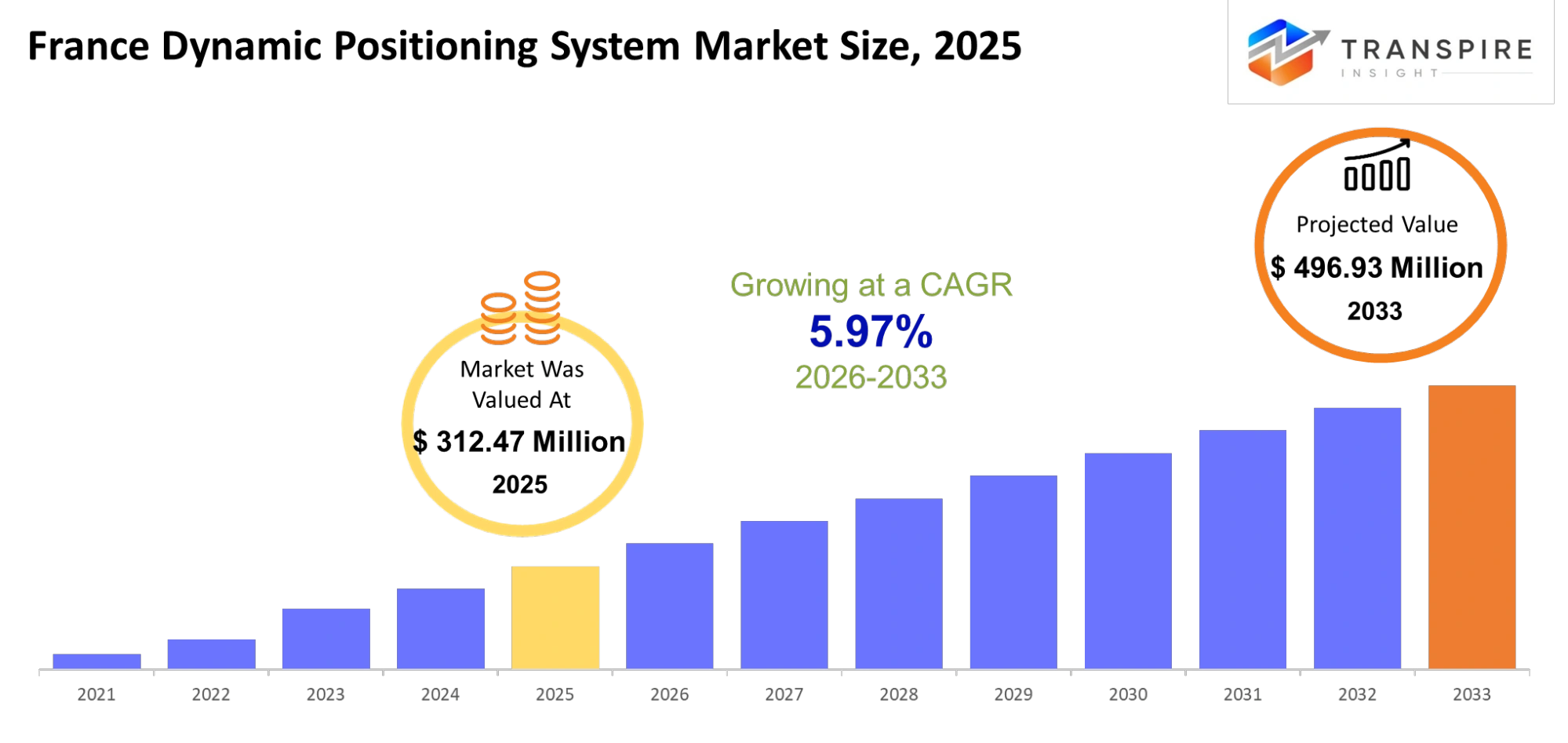
- France Dynamic Positioning System Market Size 2025: USD 312.47 Million
- France Dynamic Positioning System Market Size 2033: USD 496.93 Million
- France Dynamic Positioning System Market CAGR: 5.97%
- France Dynamic Positioning System Market Segments: By Type (Class 1, Class 2, Class 3, Others); By Application (Offshore Oil & Gas, Marine Operations, Naval Defense, Renewable Energy, Others); By End-User (Shipping Companies, Oil & Gas Firms, Defense Sector, Offshore Wind Operators, Others); By Component (Control Systems, Thrusters, Sensors, Others)
To learn more about this report,  Download Free Sample Report
France Dynamic Positioning System Market Summary
The France Dynamic Positioning System Market was valued at USD 312.47 Million in 2025. It is forecast to reach USD 496.93 Million by 2033. That is a CAGR of 5.97% over the period.
Dynamic positioning systems maintain vessel and offshore unit stability without using anchors through continuous position adjustments that utilize thrusters and GPS and motion sensors. France needs this capability for offshore energy operations and subsea construction and specialized maritime services because even small drift can cause operational disruptions and safety hazards.
The market has transformed during the last 3 to 5 years from mechanical positioning systems that depend on human operators to automated systems that utilize software for complete control through real-time sensor fusion and redundancy systems. The primary operational transformation has occurred because digital vessel control platforms now combine DP with predictive analytics to deliver fuel and motion efficiency solutions. The European maritime industry requires operators to replace old systems because new safety standards and emissions regulations make existing manual and semi-automatic systems unfit for use. Supply chain interruptions from worldwide logistics disruptions forced offshore projects to increase retrofitting requirements because they needed to protect their operational reliability and system uptime.
Key Market Insights
- The Dynamic Positioning System Market in France operates with 40 percent market share through its Northern France and Atlantic offshore areas which have high concentrations of offshore energy resources.
- The Mediterranean coastal operations experience their highest growth between 2025 and 2033 because of port modernization and marine infrastructure upgrades.
- The southern maritime regions generate consistent demand which results from both commercial shipping operations and coastal engineering projects.
- The France Dynamic Positioning System Market receives its highest market share from integrated DP systems which offer dependable automated operation across their 45 percent market share.
- DP2 systems hold the second-largest share, widely used in offshore support vessels and construction ships. DP3 systems represent the fastest-growing segment, which becomes important for safety-critical operations that take place in deepwater offshore environments.
- The France Dynamic Positioning System Market sees its highest market share from offshore oil and gas operations which require accurate positioning technology.
- The offshore wind installation sector experiences its strongest growth because of renewable energy targets which extend until 2033.
- Subsea construction and marine research continue steady adoption across specialized vessels and scientific missions. Offshore service vessel operators hold leading shares at around 42% due to continuous offshore project deployment.
- Energy companies represent the fastest-growing end-user category as offshore wind and hybrid energy projects accelerate investment.
- Defense maritime applications show stable demand for advanced navigation and mission-critical positioning accuracy.
- Strategic partnerships with offshore energy operators are expanding deployment scale across European waters.
- The continuous advancements in redundancy systems and sensor fusion technologies lead to better operational security and productivity.
What are the Key Drivers, Restraints, and Opportunities in the France Dynamic Positioning System Market?
The France Dynamic Positioning System Market experiences its main growth force from offshore renewable energy projects which are developing rapidly in offshore wind projects that operate along the Atlantic and Mediterranean coastal regions of France. The shift happened because France established its national energy transition roadmap while European Union maritime safety regulations required operators to use precise vessel positioning systems for their operations. The offshore construction industry requires dynamic positioning systems because they enable ships to maintain stability without using anchors during operations which leads to increased demand for DP2 and DP3 systems. The equipment manufacturers and marine automation providers experience higher system integration revenue because their products achieve seamless interconnections with other technologies.
The most significant restraint is the high capital and lifecycle cost of advanced dynamic positioning systems which includes installation costs and calibration expenses and software maintenance needs. The cost barrier exists because DP systems require certified redundancy together with skilled operators and ongoing maintenance to fulfill international maritime safety requirements. The market adoption of advanced technologies gets delayed because smaller vessel operators and mid-tier marine contractors continue using semi-automated navigation systems instead of upgrading their systems.
A key opportunity lies in the integration of AI-driven predictive navigation and hybrid energy-efficient thruster control systems. French offshore wind expansion zones now use smart vessel coordination platforms which help decrease fuel usage while enhancing accuracy of their position tracking systems.
What Has the Impact of Artificial Intelligence Been on the France Dynamic Positioning System Market?
The France Dynamic Positioning System Market experiences transformation through Artificial intelligence which redirects ship control from traditional navigation methods to modern data-based optimization techniques. The onboard AI control units now operate automated systems that manage thrust distribution and sensor setup while measuring environmental conditions through real-time data from GPS and motion reference units and wind sensors. The system enhances offshore operational efficiency through automatic station-keeping operations and precise operational execution of subsea installation and offshore wind turbine maintenance work.
Machine learning models serve as the main tool for predictive maintenance, which uses system data analysis to identify early indicators of thruster deterioration and power system faults and control system delays. Advanced marine emission control systems and integrated vessel platforms use the same analytics to achieve fuel optimization through automatic propulsion load adjustments based on predicted weather and sea-state conditions. The operators experience better uptime and operational efficiency through reduced unexpected shutdowns and steadier fuel usage patterns throughout extended offshore operations.
The industry faces difficulties because it lacks sufficient high-standard maritime training data and offshore areas face challenges with inconsistent internet access. The real-time AI decision systems operate through satellite links which provide limited access to cloud-based systems for complete system optimization. The high expenses required to combine existing dynamic positioning systems with current systems create delays in implementation especially for mid-sized shipping companies that operate within France's coastal maritime industry.
Key Market Trends
- The offshore wind expansion after 2022 has led to increased upgrades of DP systems because operators now use automated systems for vessel stabilization instead of manual methods.
- By 2025 nearly 60 percent of new offshore vessels in France integrated DP2 or higher systems because EU maritime safety regulations required stricter compliance.
- The AI-enabled navigation systems which became available after 2023 enhanced real-time thruster control capabilities, which resulted in lower fuel usage and better offshore positioning performance.
- The demand for retrofitting services experienced rapid growth from 2021 until 2024 because French offshore fleets that were aging implemented digital DP software solutions to replace their outdated analog control systems.
- The implementation of predictive maintenance tools which started in 2023 has led to decreased unplanned downtime for offshore service vessels, which enhances operational dependability for energy contracting companies.
- The maritime industry demands energy-efficient DP systems which enable hybrid-electric propulsion development between 2024 and 2026.
- The Kongsberg Maritime company established partnerships with European offshore operators to increase deployment of high-redundancy DP3 systems which operate in deepwater environments.
- The EU maritime emission regulations have become stricter which has increased the use of smart DP systems that optimize both fuel consumption and emission control.
- Offshore construction companies now choose software-upgradable DP platforms as their primary option because these systems enable them to switch to modular vessel automation systems which require less physical hardware.
France Dynamic Positioning System Market Segmentation
By Type
- The France Dynamic Positioning System Market shows dominant market share for Class 2 systems because they provide operators with cost-effective solutions that maintain operational performance. The two systems meet redundancy requirements for offshore service vessels and medium-scale construction ships because their systems operate without needing Class 3 certification. European safety guidelines forced operators to replace their basic systems with upgraded systems which created demand for Class 2 products after 2022.
- Class 1 systems use restricted offshore capabilities and limited redundancy which makes them suitable only for small coastal vessels. The share of Class 3 systems in market operations remains low but these systems show high demand for use in deepwater operations with minimal allowance for failures. Class 3 adoption increases because offshore wind projects and subsea energy infrastructure developments need complete positioning accuracy. The forecast period will show Class 3 systems becoming vital for offshore energy contractors while Class 2 systems will function as the main operational system for mid-tier marine fleets.
By Application
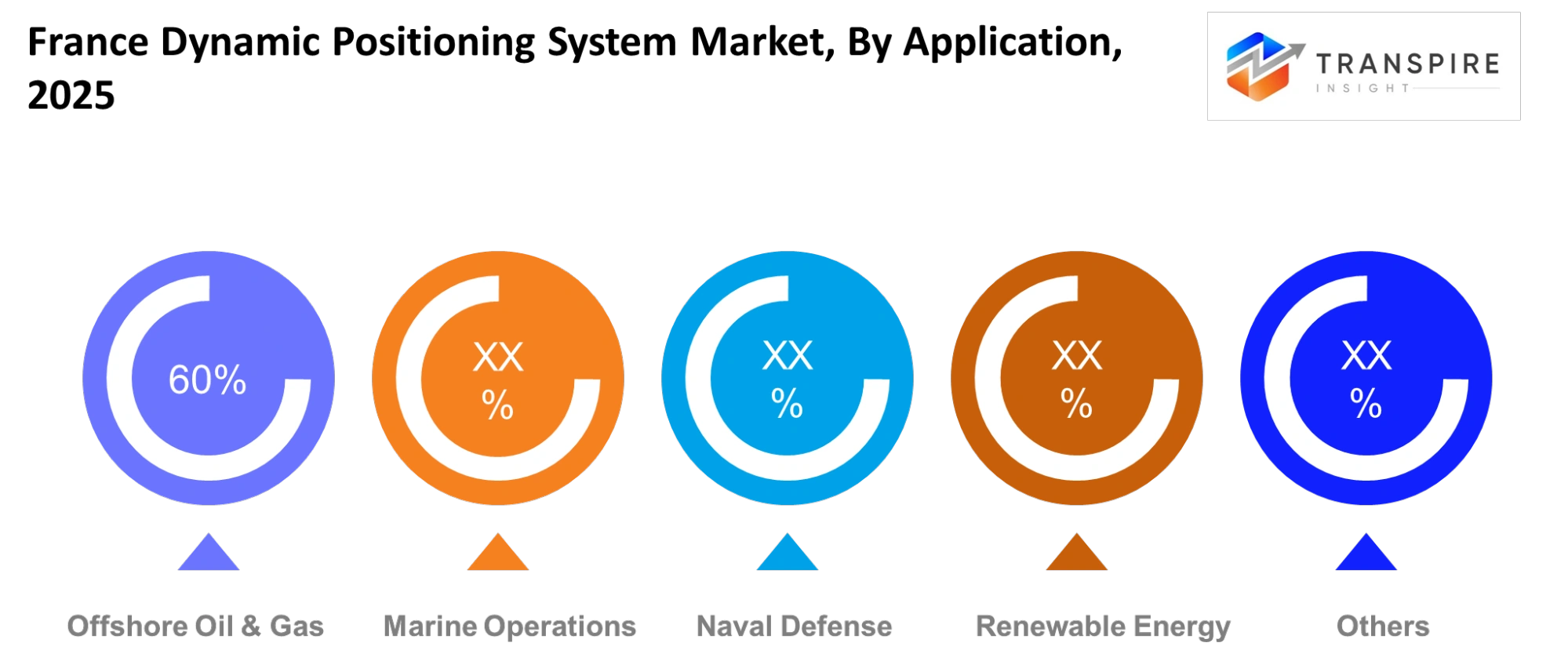
- The offshore oil and gas operations maintain their predominant position because their drilling and subsea installation work requires special vessel stability which needs to be maintained through precise equipment operations. The segment showed strong performance during energy transition periods because European offshore fields require ongoing maintenance of their existing operations. Marine operations provide a continuous source of work which results from cargo handling operations and survey missions and coastal engineering projects.
- The naval defense sector experienced growth after 2023 because the fleet navigation systems received modernization and the military established new operational requirements. Renewable energy stands as the most rapidly expanding application field because offshore wind expansion projects now operate throughout French maritime zones. The industry has increased its use of advanced positioning technologies because companies now invest in turbine installation vessels and maintenance fleets. The demand for renewable energy will force suppliers to develop software-integrated positioning solutions which will provide energy-optimized performance.
To learn more about this report, Download Free Sample Report
By End-User
- The process of end-user segmentation demonstrates that oil and gas companies sustain their top market position through their extensive experience with offshore drilling and maintenance operations. The shipping industry ranks second because its commercial fleets receive upgrades that enhance their ability to navigate safely through busy maritime routes. The defense industry maintains constant demand because its modernization initiatives and naval reconnaissance requirements need permanent operational support.
- The renewable capacity expansion and offshore construction development in France make offshore wind operators the fastest-growing group of end users. The energy transition shift shows permanent policy changes instead of temporary market demand fluctuations. The upcoming years will see offshore wind operators become major factors that shape procurement practices, which will compel vendors to develop positioning systems that combine digital technology with scalable functions.
By Component
- Control systems become the primary category in component segmentation because they create the operational intelligence layer which dynamic positioning systems utilize. The system uses sensor data to control thrusters which helps maintain the stability of the vessel. The thruster segment accounts for 40 percent of the market because it directly affects vessel operation and shipbuilders continuously improve it through efficiency enhancements. AI-based navigation systems require sensors to provide real-time data which becomes essential for maintaining system accuracy.
- The system integration process receives backing from power management units and communication interfaces which exist as smaller system components. The company experiences growth because its software-based architecture enables better performance assessment through control system and sensor movements. The market will demand modular systems during the forecast period which allow component upgrades for predictive analytics and hybrid propulsion system development.
What are the Key Use Cases Driving the France Dynamic Positioning System Market?
Offshore oil and gas operations remain the dominant use case in the France Dynamic Positioning System Market because drilling support vessels and subsea installation ships require continuous station-keeping in deepwater environments. The operations use DP systems because operators need thrust control systems to achieve safe and efficient equipment operations which require heavy equipment movement.
Marine survey operations and offshore wind installation support are expanding secondary use cases, driven by energy transition projects and growing investment from offshore wind operators. Offshore service vessels increasingly use DP-enabled platforms for turbine installation, cable laying, and maintenance activities, while naval defense fleets apply the technology for surveillance and mission positioning in restricted maritime zones.
Remote-controlled and autonomous vessels for oceanographic research and unmanned systems for offshore inspections represent emerging use cases. These applications are gaining attention as AI-based navigation and hybrid propulsion technologies mature, enabling longer missions with reduced human intervention and improved operational precision.
|
Report Metrics |
Details |
|
Market size value in 2025 |
USD 312.47 Million |
|
Market size value in 2026 |
USD 331.11 Million |
|
Revenue forecast in 2033 |
USD 496.93 Million |
|
Growth rate |
CAGR of 5.97% from 2026 to 2033 |
|
Base year |
2025 |
|
Historical data |
2021 - 2024 |
|
Forecast period |
2026 - 2033 |
|
Report coverage |
Revenue forecast, competitive landscape, growth factors, and trends |
|
Regional scope |
France |
|
Key company profiled |
Kongsberg, Wärtsilä, ABB, Rolls-Royce, Siemens, GE, Honeywell, L3Harris, Thales, Marine Technologies, Navis Engineering, Praxis Automation, Caterpillar, Brunvoll, Fugro |
|
Customization scope |
Free report customization (country, regional & segment scope). Avail customized purchase options to meet your exact research needs. |
|
Report Segmentation |
By Type (Class 1, Class 2, Class 3, Others); By Application (Offshore Oil & Gas, Marine Operations, Naval Defense, Renewable Energy, Others); By End-User (Shipping Companies, Oil & Gas Firms, Defense Sector, Offshore Wind Operators, Others); By Component (Control Systems, Thrusters, Sensors, Others) |
Which Regions are Driving the France Dynamic Positioning System Market Growth?
The Dynamic Positioning System Market in France gets its highest demand from Northern France and Atlantic coastal areas because of their active offshore wind farms and their developed maritime facilities. The major ports of Saint-Nazaire and Le Havre enable equipment installation through their support of large-vessel operations which drives ongoing need for cutting-edge positioning technology. The government supports renewable energy projects through funding which enables fleet upgrades for all offshore operations in this area. The established offshore services market together with skilled ship operators creates an environment where high-redundancy dynamic positioning systems become standard practice.
Southern France functions as a consistent but minor contributor to economic activity which depends on Mediterranean maritime routes and coastal development projects. The southern region of the country depends on commercial shipping operations and special service vessels that assist with port activities and construction tasks at sea. The local shipowners keep their investment patterns steady which minimizes fleet growth and creates a continuous requirement for mid-tier dynamic positioning systems. The region maintains its structural integrity through EU maritime safety regulations which enable incremental improvements that do not create major performance changes.
The most rapid growth of this region occurs around the development of new offshore wind corridors and the expansion of existing deepwater project areas which extend through western maritime zones. The renewable capacity targets established after 2023 created new vessel needs and infrastructure demands which affected offshore areas that had remained undeveloped. The rising number of turbine farms and subsea cable systems establishes a fresh requirement for construction and operational vessels which utilize dynamic positioning technology.
Who are the Key Players in the France Dynamic Positioning System Market and How Do They Compete?
The France Dynamic Positioning System Market maintains its current competitive state because international marine automation companies and industrial technology companies control all important business deals. The certification process together with offshore operational safety standards and system integration requirements create entry barriers which remain difficult to overcome. Companies that have established themselves in the market compete through their software intelligence and system redundancy and lifecycle service offerings instead of using hardware prices to compete. The market leaders protect their market share by using digital control systems for their new shipbuilding projects and ship conversion activities through their entire European offshore fleet.
Kongsberg Maritime competes through its sophisticated DP software framework and its highly reliable control systems which are designed for offshore wind and deepwater operations. The company achieves its competitive edge through its sensor fusion technology which operates together with its complete vessel automation system to minimize human system operation. Wärtsilä develops fuel-efficient DP systems which help maritime operators reduce emissions while they upgrade their hybrid propulsion systems to modern standards. ABB establishes its unique value through its DP systems which use electrification to connect power management functions with thruster control systems that enhance energy use efficiency during offshore operations.
Thales establishes its competitive position through its defense and security systems which provide navigation-grade capabilities while it develops DP systems for naval and surveillance vessels with high operational demands. Rolls-Royce competes in the offshore market by providing advanced positioning systems which combine propulsion technology with navigation capabilities to withstand severe maritime conditions and handle technical installation work on advanced vessels.
Company List
- Kongsberg
- Wärtsilä
- ABB
- Rolls-Royce
- Siemens
- GE
- Honeywell
- L3Harris
- Thales
- Marine Technologies
- Navis Engineering
- Praxis Automation
- Caterpillar
- Brunvoll
- Fugro
Recent Development News
In April 2026, Kongsberg Maritime expanded its maritime digital training and simulation ecosystem for advanced vessel navigation systems used in offshore and DP-enabled operations.This reflects growing integration of automation and simulation tools supporting European naval and offshore fleets.
Source:https://www.navaltoday.com
What Strategic Insights Define the Future of the France Dynamic Positioning System Market?
The France Dynamic Positioning System Market will develop into software-based vessel control systems which use artificial intelligence technology within the next five to seven years because of increasing offshore wind development and growing European maritime safety regulations. The market shows a shift towards integrated digital control systems which use single-system architecture to manage both propulsion and energy operations while executing predictive positioning functions. The current shift shows that marine automation systems will eventually connect with energy optimization platforms through their future development process which goes beyond conventional hardware updates.
The less obvious danger exists when semi-autonomous vessel systems replace complete dynamic positioning systems for some offshore inspection and survey tasks. Faster than anticipated developments in autonomous navigation technology will lead to decreased demand for mid-tier DP systems while creating new patterns for equipment updates. The existing market structure, which relies on a limited number of global OEMs, creates dependency dangers for operators who face challenges during times of component shortages and software licensing changes.
The next-generation DP3-class precision technology, which floating turbine installations need for their upcoming offshore wind expansion corridors, has created an emerging opportunity. The market participants need to develop modular DP platforms which can be upgraded and will incorporate AI energy efficiency tools to secure long cycle offshore contracts while decreasing their obsolescence danger.
France Dynamic Positioning System Market Report Segmentation
By Type
- Class 1
- Class 2
- Class 3
- Others
By Application
- Offshore Oil & Gas
- Marine Operations
- Naval Defense
- Renewable Energy
- Others
By End-User
- Shipping Companies
- Oil & Gas Firms
- Defense Sector
- Offshore Wind Operators
- Others
By Component
- Control Systems
- Thrusters
- Sensors
- Others
Frequently Asked Questions
Find quick answers to common questions.
The confirmed 2033 market size figure in USD 496.93 Million.
Key segments for the France Dynamic Positioning System Market are By Type (Class 1, Class 2, Class 3, Others); By Application (Offshore Oil & Gas, Marine Operations, Naval Defense, Renewable Energy, Others); By End-User (Shipping Companies, Oil & Gas Firms, Defense Sector, Offshore Wind Operators, Others); By Component (Control Systems, Thrusters, Sensors, Others).
Major France Dynamic Positioning System Market players are Kongsberg, Wärtsilä, ABB, Rolls-Royce, Siemens, GE, Honeywell, L3Harris, Thales, Marine Technologies, Navis Engineering, Praxis Automation, Caterpillar, Brunvoll, Fugro.
The France Dynamic Positioning System Market size is USD 312.47 Million in 2025.
The France Dynamic Positioning System Market CAGR is 5.97% from 2026 to 2033.
- Kongsberg
- Wärtsilä
- ABB
- Rolls-Royce
- Siemens
- GE
- Honeywell
- L3Harris
- Thales
- Marine Technologies
- Navis Engineering
- Praxis Automation
- Caterpillar
- Brunvoll
- Fugro
Recently Published Reports
-
Apr 2026
ATV & UTV Market
ATV & UTV Market Size, Share & Analysis Report By Type (ATV, and UTV), By Variants (Less Than 400 CC, 400 CC To 800 CC, and More Than 800 CC), and Geography (North America, Europe, Asia-Pacific, Middle East and Africa, South and Central America), 2021 - 2031
-
Apr 2026
Automotive Central Gateway Module Market
Automotive Central Gateway Module Market Size, Share & Analysis Report By Type (Ethernet Central Gateway Module, CAN Central Gateway Module, LIN Central Gateway Module, and FlexRay), By Application (Powertrain Control, Body Control, Infotainment System, Advanced Driver Assistance Systems (ADAS), and Others), By End User (Passenger Vehicles, and Commercial Vehicles), and Geography (North America, Europe, Asia-Pacific, Middle East and Africa, South and Central America), 2021 - 2031
-
Apr 2026
Automotive Engine Oil Filter Market
Automotive Engine Oil Filter Market Size, Share & Analysis Report By Filter Type (Fuel Filter, Engine Oil Filter, Hydraulic Oil Filter, and Others), By Filter Media (Cellulose, Synthetic, and Micro), By Sales Channel (OEMs, and Aftermarket), By Vehicle Type (Passenger Cars, Light Commercial Vehicles, Heavy Duty Trucks, Buses and Coaches, and Off-road Vehicles), and Geography (North America, Europe, Asia-Pacific, Middle East and Africa, South and Central America), 2021 - 2031
-
Apr 2026
Automotive Parts Aluminium Die Casting Market
Automotive Parts Aluminium Die Casting Market Size, Share & Analysis Report By Production Process (Pressure Die Casting, Vacuum Die Casting, Squeeze Die Casting, Gravity Die Casting), By Application (Body Parts, Engine Parts, Transmission Parts, Battery And Related Components, Other Application Types), and Geography (North America, Europe, Asia-Pacific, Middle East and Africa, South and Central America), 2021 - 2031
Our Clients