
Europe Offshore Oil and Gas Equipment Market Size & Forecast:
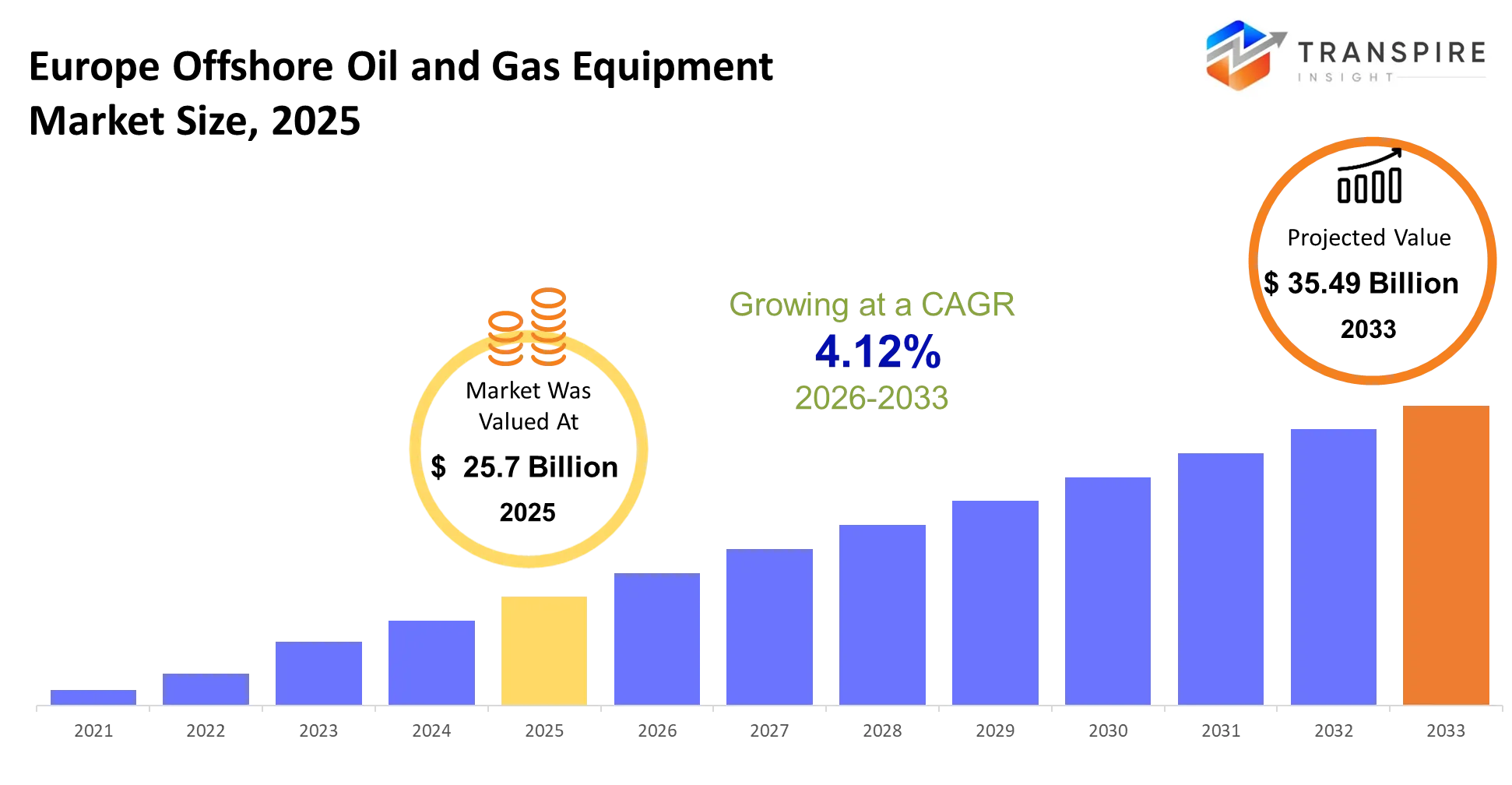
- Europe Offshore Oil and Gas Equipment Market Size 2025: USD 25.7 Billion
- Europe Offshore Oil and Gas Equipment Market Size 2033: USD 35.49 Billion
- Europe Offshore Oil and Gas Equipment Market CAGR: 4.12%
- Europe Offshore Oil and Gas Equipment Market Segments: By Type (Drilling Equipment, Production Equipment, Subsea Equipment, Processing Equipment, Others); By Application (Exploration, Drilling, Production, Well Intervention, Decommissioning, Others); By End-User (Oil & Gas Companies, Offshore Operators, Drilling Contractors, Energy Companies, Service Providers, Others); By Water Depth (Shallow Water, Deepwater, Ultra-deepwater, Others)
To learn more about this report,  Download Free Sample Report
Europe Offshore Oil and Gas Equipment Market Summary:
The Europe Offshore Oil and Gas Equipment Market size is estimated at USD 25.7 Billion in 2025 and is anticipated to reach USD 35.49 Billion by 2033, growing at a CAGR of 4.12% from 2026 to 2033. The Europe Offshore Oil and Gas Equipment Market will experience ongoing development because engineering design improvements and safety standard enhancements and digital monitoring system deployments will transform operational procedures in North Sea and adjacent basins. Environmental regulations in Europe have grown more stringent which forces producers to reduce their carbon emissions and this has created new standards that must be met for offshore asset design and maintenance and monitoring activities. The European offshore oil and gas equipment market will see investment changes because stakeholders will demand different energy solutions while new technology like autonomous subsea inspection systems and real-time data platforms will enhance operational dependability according to increased regulatory requirements.
What Has the Impact of Artificial Intelligence Been on the Europe Offshore Oil and Gas Equipment Market?
Artificial intelligence has transformed decision-making processes and operational intelligence methods throughout the European Offshore Oil and Gas Equipment Market because companies now use data-driven systems to make both strategic and technical decisions. The European Offshore Oil and Gas Equipment Market uses artificial intelligence to improve how businesses analyze intricate offshore data, which leads to faster market research processes and precise demand prediction results. Europe Offshore Oil and Gas Equipment Market systems use artificial intelligence to enable operators to process seismic data and equipment usage records and environmental data in real time, which enhances their ability to track market patterns that traditional methods could not detect.
The combination of smart automation and machine learning technologies has improved production efficiency through its implementation in all aspects of the European Offshore Oil and Gas Equipment Market split between offshore monitoring and maintenance scheduling. The European Offshore Oil and Gas Equipment Market uses predictive analytics tools to forecast equipment breakdowns, which helps organizations decrease operational downtime while maintaining equipment reliability on offshore facilities. The Europe Offshore Oil and Gas Equipment Market experiences reduced operational inefficiencies through artificial intelligence-based supply chain optimization, which improves its logistics and inventory control and procurement operations. The European Offshore Oil and Gas Equipment Market companies will gain better market position through artificial intelligence solutions, which will enable them to cut costs and operate their businesses more effectively and adapt their operations to offshore energy market shifts.
Key Market Trends & Insights:
- The European offshore oil and gas equipment market will reach 38% market share in 2025 because North Sea offshore infrastructure and energy operations in the region have reached advanced development stages.
- The European offshore oil and gas equipment market shows its strongest activity from Norway and the UK, which benefit from their investment in advanced subsea engineering and deepwater drilling technologies.
- The European offshore oil and gas equipment market experiences its fastest growth in Southern Europe from 2025 to 2030 because Mediterranean offshore exploration activities increase.
- The European offshore oil and gas equipment market records its highest market share through subsea production systems, which account for approximately 34% of the market because deepwater development projects are increasing.
- The European offshore oil and gas equipment market ranks drilling equipment as its second largest segment because offshore exploration activities continue to be conducted.
- Automation-enabled monitoring systems represent the fastest-growing segment in the europe offshore oil and gas equipment market from 2025 to 2030 because AI-based asset tracking technology drives demand.
- The European offshore oil and gas equipment market shows its highest market share through offshore exploration applications, which account for 41% of the market because upstream investments continue to be made.
- Oil and gas operators lead as the main end-user group in the European offshore oil and gas equipment market, which will reach 55% market share in 2025.
- Offshore service contractors represent the most rapidly expanding end-user segment in the European offshore oil and gas equipment market because they outsource their intricate operational tasks.
- Companies in the European offshore oil and gas equipment market achieve greater market share through ongoing advancements in predictive analytics and offshore operations at sea.
Europe Offshore Oil and Gas Equipment Market Segmentation
By Type:
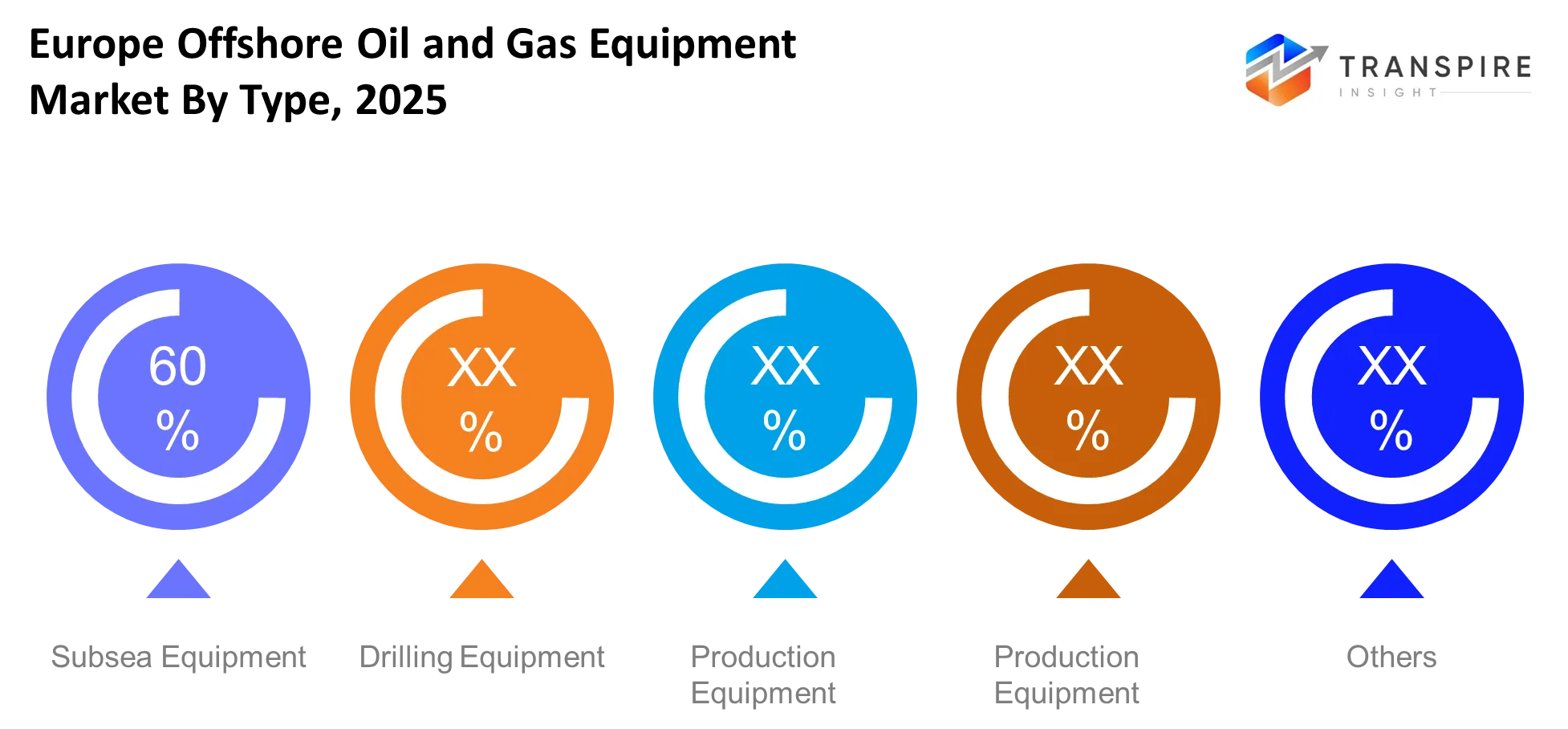
The market segments of this analysis include five types of equipment which are classified as Drilling Equipment, Production Equipment, Subsea Equipment, Processing Equipment and Other Equipment. Drilling equipment maintains a strong market position because European countries continue their offshore drilling operations throughout their entire ocean regions. Production equipment maintains its essential function because offshore fields which have reached maturity still need constant production monitoring. Subsea equipment demand increases as offshore projects move toward deeper waters which require operations to occur below the ocean surface. Processing equipment enables efficient movement of extracted hydrocarbons while other equipment ensures safe operations during difficult offshore situations.
To learn more about this report, Download Free Sample Report
By Application:
Exploration remains a key application as new offshore reserves continue to be identified across the North Sea and surrounding regions. Drilling activities maintain importance for accessing underground reserves. Production applications support long-term output from offshore platforms. Well intervention activities help maintain and restore production efficiency. Decommissioning grows as older offshore infrastructure reaches end-of-life stages which require safe removal and environmental compliance. Other applications support specialized offshore operations.
By End-User:
The research report presents its findings through two main sections which include the results and analysis of the study. Oil and gas companies own offshore assets which they use for their long-term production goals. Offshore operators manage daily field activities and maintain operational safety. Drilling contractors provide their specialized services for exploration and extraction activities. Energy companies expand their business operations because offshore resources play a crucial role in maintaining energy supply stability. Service providers deliver maintenance support together with logistics and technical operations throughout all offshore installations.
By Water Depth:
Shallow water operations remain common because they require less operational work and their costs are more affordable. Deepwater projects gain importance as shallow reserves decline and demand shifts toward deeper offshore zones. Ultra-deepwater operations need specialized equipment together with advanced technical skills because of their extreme pressure and depth requirements. The other water depth categories include transitional zones and mixed-depth operations which enable European countries to develop their offshore resources through different development methods.
What are the Main Challenges for the Europe Offshore Oil and Gas Equipment Market Growth?
The Europe offshore oil and gas equipment market faces ongoing difficulties because offshore sites require equipment to operate reliably under extreme pressure and corrosive conditions. The Europe offshore oil and gas equipment market encounters equipment stability problems that occur during deepwater and ultra-deepwater operations because these conditions are affected by high failure risks from severe ocean weather patterns. The European offshore oil and gas equipment market experiences performance challenges because its installation procedures require complex steps and its maintenance requires extended time periods, which disrupt continuous production operations.
The Europe offshore oil and gas equipment market faces restricted growth because manufacturing and commercialization barriers exist, which exist because offshore operations need to maintain full compliance with their regulatory and safety requirements. European offshore oil and gas equipment market operators face increased financial burden because advanced system deployment requires them to wait long periods for system approval while production costs remain elevated. The equipment delivery and installation process experiences delays because of supply chain disruptions that occur due to the need for specific components, which results in restricted commercialization progress throughout different projects.
The European offshore oil and gas equipment market faces two main challenges because of adoption issues and infrastructure constraints which particularly affect areas that lack skilled offshore engineering professionals. The market expansion process experiences delays because smaller operators cannot afford advanced systems which require high capital investment. The Europe offshore oil and gas equipment market face two main challenges because its existing offshore infrastructure needs updates which cannot work with current automation and digital monitoring technologies.
The Europe offshore oil and gas equipment market faces new challenges because market competition and external risks continue to rise while investment patterns shift toward alternative energy technologies. The equipment suppliers from around the world establish pricing pressures which decrease profit margins while the new environmental regulations create challenges for companies to forecast their future business operational needs. The combination of these factors creates persistent obstacles for growth, which will determine future market adoption trends in the European offshore oil and gas equipment industry.
Regional Insights
The Europe Offshore Oil and Gas Equipment Market shows Northern Europe as its primary market because this region has advanced offshore operations and superior engineering capabilities. Norway and the United Kingdom operate as offshore production leaders because they possess established North Sea operational infrastructure. The region maintains its offshore operational capacity because companies invest heavily in subsea technology and they keep their existing offshore fields operational through ongoing maintenance activities.
Northern Europe maintains its position as the primary force behind the Europe offshore oil and gas equipment market through its continuous production activities and its effective safety and environmental regulations. The region utilizes its extensive offshore expertise to establish efficient systems for equipment deployment and monitoring operations. The Europe offshore oil and gas equipment market maintains its consistent activity because offshore operators require new equipment to replace their aging assets.
Southern and Western Europe show gradual offshore development progress because they have begun to explore specific deepwater areas. The regions create new offshore operational possibilities because they develop different energy solutions while exploring their newly discovered resources. The development of Mediterranean offshore projects creates moderate equipment needs which progress at a slower rate than Northern European projects. The supply structure and investment patterns together with operational strategies across the Europe offshore oil and gas equipment market will continue to be influenced by the current balance between the two regions.
Recent Development News
In April 2026, Schlumberger announced expansion of offshore digital drilling solutions for European subsea projects. The company strengthened its European offshore portfolio by integrating AI-based monitoring systems to improve equipment efficiency and reduce downtime across North Sea operations. The move aligned with increasing demand for smart automation which offshore oilfield services needed to operate deepwater equipment throughout Europe.https://www.reuters.com
|
Report Metrics |
Details |
|
Market size value in 2025 |
USD 25.7 Billion |
|
Market size value in 2026 |
USD 26.76 Billion |
|
Revenue forecast in 2033 |
USD 35.49 Billion |
|
Growth rate |
CAGR of 4.12% from 2026 to 2033 |
|
Base year |
2025 |
|
Historical data |
2021 - 2024 |
|
Forecast period |
2026 - 2033 |
|
Report coverage |
Revenue forecast, competitive landscape, growth factors, and trends |
|
Regional scope |
United States; Canada; Mexico; United Kingdom; Germany; France; Italy; Spain; Denmark; Sweden; Norway; China; Japan; India; Australia; South Korea; Thailand; Brazil; Argentina; South Africa; Saudi Arabia; United Arab Emirates |
|
Key company profiled |
Schlumberger, Halliburton, Baker Hughes, TechnipFMC, Saipem, NOV, Aker Solutions, Subsea 7, Tenaris, Vallourec, Weatherford, Wood Group, Petrofac, McDermott, Oceaneering |
|
Customization scope |
Free report customization (country, regional & segment scope). Avail customized purchase options to meet your exact research needs. |
|
Report Segmentation |
By Type (Drilling Equipment, Production Equipment, Subsea Equipment, Processing Equipment, Others); By Application (Exploration, Drilling, Production, Well Intervention, Decommissioning, Others); By End-User (Oil & Gas Companies, Offshore Operators, Drilling Contractors, Energy Companies, Service Providers, Others); By Water Depth (Shallow Water, Deepwater, Ultra-deepwater, Others) |
How Can New Companies Establish a Strong Foothold in the Europe Offshore Oil and Gas Equipment Market?
New companies entering the europe offshore oil and gas equipment market will need to focus on clear positioning, since competition remains strong and established players already control major offshore contracts. The europe offshore oil and gas equipment market rewards firms that solve specific offshore challenges such as equipment reliability in deepwater zones, faster maintenance cycles, and safer subsea operations. Startups that specialize in compact subsea monitoring systems or AI-based predictive maintenance tools will have better chances of securing early contracts and building trust with offshore operators.
Partnership strategy will play a key role in the europe offshore oil and gas equipment market, as new entrants rarely succeed alone in capital-heavy offshore environments. Collaborations with engineering firms, offshore service providers, and energy operators will help reduce entry barriers and improve access to real project data. Emerging companies like subsea analytics startup OceanEdge Systems and digital offshore monitoring firm BlueRig Tech (illustrative examples) show how innovation in automation and real-time diagnostics can create strong differentiation in the europe offshore oil and gas equipment market.
Technology focus will remain central, especially as the europe offshore oil and gas equipment market shifts toward smart automation and remote operations. Companies that invest in machine learning tools for equipment failure prediction or digital twins for offshore assets will gain stronger visibility. New entrants to the europe offshore oil and gas equipment market will achieve faster growth through strict environmental regulation compliance and safety standard adherence which builds their credibility with clients and partners.
Key Europe Offshore Oil and Gas Equipment Market Company Insights
Europe Offshore Oil and Gas Equipment Market analysis shows that established offshore engineering companies and energy service providers who possess major project contracts and ongoing maintenance work hold dominant market power. The europe offshore oil and gas equipment market remains highly competitive because of its high capital requirements and its enforcement of demanding safety regulations. Large companies maintain their market advantage through their superior offshore technologies and their worldwide supply chains and their binding contracts with oil and gas companies that operate in European waters.
The leading participants in the europe offshore oil and gas equipment market dedicate their resources to developing technical skills needed for deepwater and subsea operational activities. Companies invest in automation systems, predictive maintenance tools, and digital monitoring platforms to improve efficiency and reduce downtime. Offshore projects require reliable equipment which works according to environmental standards and engineering expertise that supports long-term operational safety.
The europe offshore oil and gas equipment market has developed into a growing competitive space because technology-based companies now enter the market to deliver specific products which include smart sensors and remote monitoring systems and modular offshore equipment. Companies use strategic partnerships with offshore operators and service providers to increase their business footprint while obtaining initial project agreements. The europe offshore oil and gas equipment market experiences intense competitive activities as companies that achieve cost savings and deliver products more quickly and make assets more efficient will build their market share over time.
Company List
- Schlumberger
- Halliburton
- Baker Hughes
- TechnipFMC
- Saipem
- NOV
- Aker Solutions
- Subsea 7
- Tenaris
- Vallourec
- Weatherford
- Wood Group
- Petrofac
- McDermott
- Oceaneering
What are the Key Use-Cases Driving the Growth of the Europe Offshore Oil and Gas Equipment Market?
The primary use cases that drive the European offshore oil and gas equipment market depend on offshore exploration and production activities which require dependable systems to extract resources from difficult ocean environments. The European offshore oil and gas equipment market benefits from deepwater drilling operations and subsea extraction systems and offshore platform maintenance because these activities rely on sophisticated equipment which delivers safe and uninterrupted operations. The rising demand for energy security throughout Europe leads to increased utilization of advanced offshore systems.
The Europe offshore oil and gas equipment market uses predictive maintenance and asset monitoring as its main application which enables operators to monitor equipment health through smart sensors and data-driven tools that provide real-time tracking. The Europe offshore oil and gas equipment market gains advantages from these applications because they minimize operational interruptions and stop equipment breakdowns while they prolong the operational life of offshore facilities. The offshore inspection systems which include remotely operated vehicles enable operators to conduct underwater inspection and repair work at deepwater locations to enhance operational efficiency.
The Europe offshore oil and gas equipment market experiences growth through decommissioning operations which involve the secure dismantling of obsolete offshore platforms that require environmental safety measures. The phase of well intervention and platform recycling operations needs equipment which enables safe termination of offshore operations. Offshore energy stability which benefits manufacturing and heavy engineering industries leads to uninterrupted production operations. The Europe offshore oil and gas equipment market will experience expansion of its use cases through automation and digital offshore system developments which will create new opportunities in upcoming years.
Europe Offshore Oil and Gas Equipment Market Report Segmentation
By Type
- Drilling Equipment
- Production Equipment
- Subsea Equipment
- Processing Equipment
- Others
By Application
- Exploration
- Drilling
- Production
- Well Intervention
- Decommissioning
- Others
By End-User
- Oil & Gas Companies
- Offshore Operators
- Drilling Contractors
- Energy Companies
- Service Providers
- Others
By Water Depth
- Shallow Water
- Deepwater
- Ultra-deepwater
- Others
Frequently Asked Questions
Find quick answers to common questions.
The approximate Europe Offshore Oil and Gas Equipment Market size for the market will be USD 35.49 Billion in 2033.
Key segments for the Europe Offshore Oil and Gas Equipment Market are By Type (Drilling Equipment, Production Equipment, Subsea Equipment, Processing Equipment, Others); By Application (Exploration, Drilling, Production, Well Intervention, Decommissioning, Others); By End-User (Oil & Gas Companies, Offshore Operators, Drilling Contractors, Energy Companies, Service Providers, Others); By Water Depth (Shallow Water, Deepwater, Ultra-deepwater, Others).
Major Europe Offshore Oil and Gas Equipment Market players are Schlumberger, Halliburton, Baker Hughes, TechnipFMC, Saipem, NOV, Aker Solutions, Subsea 7, Tenaris, Vallourec, Weatherford, Wood Group, Petrofac, McDermott, Oceaneering.
The Europe Offshore Oil and Gas Equipment Market size is USD 25.7 Billion in 2025.
The Europe Offshore Oil and Gas Equipment Market CAGR is 4.12%.
- Schlumberger
- Halliburton
- Baker Hughes
- TechnipFMC
- Saipem
- NOV
- Aker Solutions
- Subsea 7
- Tenaris
- Vallourec
- Weatherford
- Wood Group
- Petrofac
- McDermott
- Oceaneering
Recently Published Reports
-
Apr 2026
Active Power Filter Market
Active Power Filter Market Size, Share & Analysis Report By Type (Shunt Active Power Filters, Series Active Power Filter, Hybrid Active Power Filter), By Application (Harmonics Mitigation, Reactive Power Compensation, Voltage Regulation, Power Factor Correction), By Phase (Single Phase, Three Phase), By End-User Industry (Manufacturing, Healthcare, Commercial, Automotive, Oil and Gas, Others), and Geography (North America, Europe, Asia-Pacific, Middle East and Africa, South and Central America), 2021 - 2031
-
Apr 2026
Electrical Transformer Market
Electrical Transformer Market Size, Share & Analysis Report By Core (Closed, Shell, and Berry), By Insulation (Gas, Oil, Solid, Air, and Other), By Phase (Single, and Three), By Rating (100 MVA to 500 MVA, 501 MVA to 800 MVA, and 801 MVA to 1200 MVA), and Geography (North America, Europe, Asia-Pacific, Middle East and Africa, South and Central America), 2021 – 2031
-
Apr 2026
Hydraulic Piston Pumps Market
Hydraulic Piston Pumps Market Size, Share & Analysis Report By Type (Axial Piston Pumps, Radial Piston Pumps), By Operating Pressure (Low Pressure, Medium Pressure, High Pressure), By Application (Construction, Mining, Agriculture, Automotive, Oil & Gas, Industrial Machinery, Others), By End-User (OEMs, Aftermarket), and Geography (North America, Europe, Asia-Pacific, Middle East and Africa, South and Central America), 2021 – 2031
-
Apr 2026
Laboratory Gas Generators Market
Laboratory Gas Generators Market Size, Share & Analysis Report By Product (Nitrogen Gas Generator, Hydrogen Gas Generator, Zero Air Gas Generator, Purge Gas Generator, TOC Gas Generators, Others), By Application (Gas Chromatography, Liquid Chromatography-mass Spectrometry (LC-MS), Gas Analyzers, Others), By End-user (Life Science, Chemical & Petrochemical, Food & Beverage, Others), and Geography (North America, Europe, Asia-Pacific, Middle East and Africa, South and Central America), 2021 – 2031