
North America Chronic Wound Care Medications Market Size & Forecast:
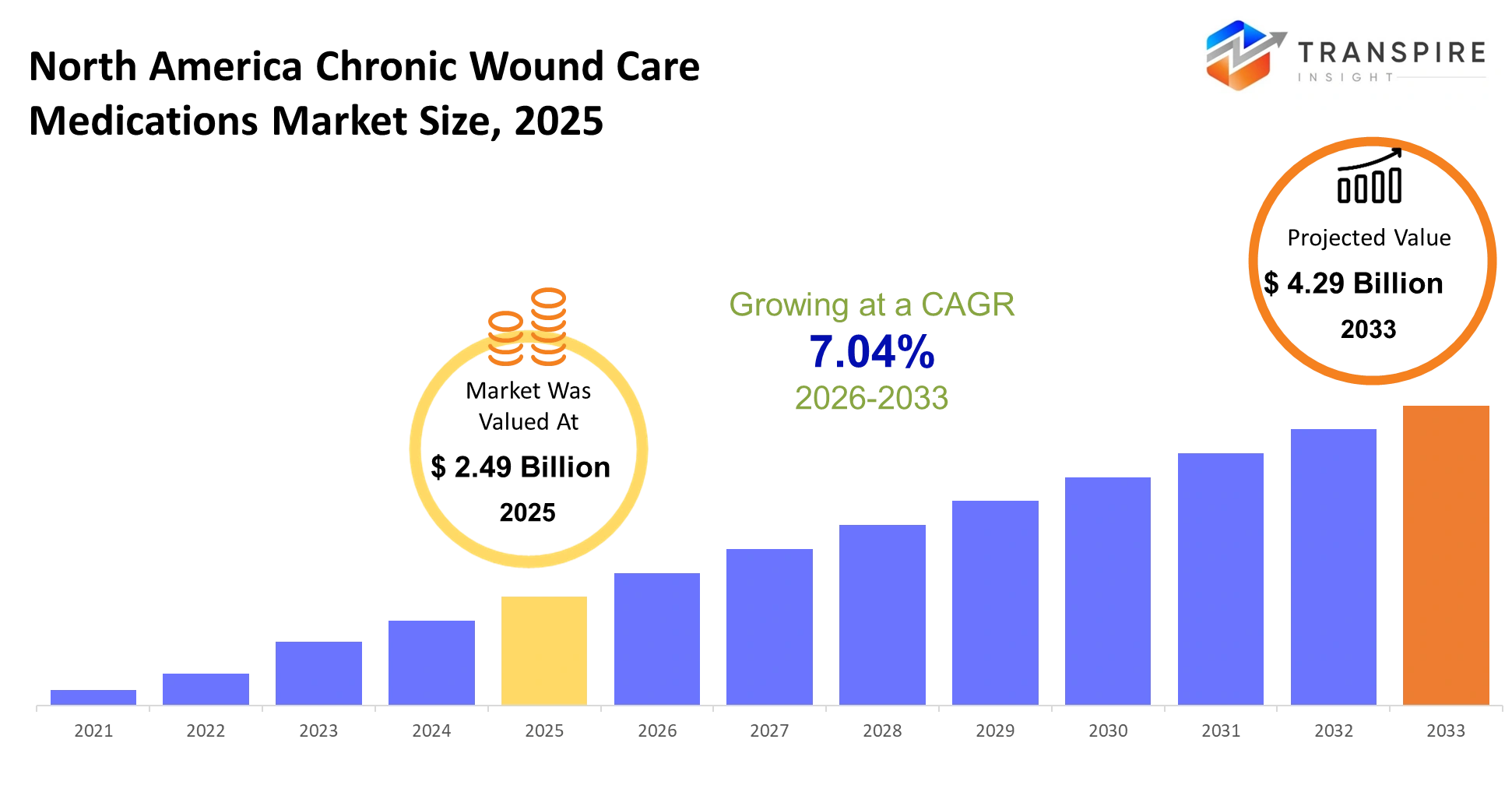
- North America Chronic Wound Care Medications Market Size 2025: USD 2.49 Billion
- North America Chronic Wound Care Medications Market Size 2033: USD 4.29 Billion
- North America Chronic Wound Care Medications Market CAGR: 7.04%
- North America Chronic Wound Care Medications Market Segments: By Type (Antibiotics, Growth Factors, Antimicrobials, Pain Management Drugs, Others); By Application (Diabetic Ulcers, Pressure Ulcers, Venous Ulcers, Burns, Others); By End-User (Hospitals, Clinics, Homecare, Others); By Form (Topical, Oral, Injectable, Others)
To learn more about this report,  Download Free Sample Report
North America Chronic Wound Care Medications Market Summary
The North America Chronic Wound Care Medications Market was valued at USD 2.49 Billion in 2025. It is forecast to reach USD 4.29 Billion by 2033. That is a CAGR of 7.04% over the period.
North America Chronic Wound Care Medications Market has a key part in cutting down infection risk , stopping amputations and also helping patients recover sooner, especially those dealing with diabetic ulcers, pressure injuries, venous leg ulcers, and wounds after surgery. In practice hospitals, outpatient wound centers, and even homecare providers lean on advanced antimicrobials, biologics, and regenerative approaches to handle sores that can sit for months or longer, which then leads to big long run treatment costs.
Over the past five years, things have moved away from the old dressing-first way of managing wounds. More and more it’s about biologic therapies , portable negative pressure options and digitally supported outpatient models that feel less disruptive. A big part of this change came from the post-pandemic strain on hospital capacity, it pushed wound care into home settings, while telehealth monitoring became more normal across the United States. At the same time, Medicare reimbursement updates started to reward therapies that showed quicker healing and fewer readmissions. So, commercial incentives got stronger for advanced wound care adoption, and manufacturers were able to grow premium product lineups, while providers focused on treatments that reduce total cost of care instead of only looking at short-term procedural expenses .
Key Market Insights
- North America Chronic Wound Care Medications Market, sort of dominates the globe with almost 40–45% share in 2025. That’s usually put down to more advanced reimbursement systems and an overall heavy chronic disease burden, you know, the usual story.
- The US is leading regional demand, taking 80%+ share because Medicare-backed biologic adoption is strong and outpatient wound care infrastructure keeps getting expanded, steadily.
- Asia Pacific is growing the quickest all the way through 2033, although North America Chronic Wound Care Medications Market still keeps its innovation edge thanks to early technology uptake and that early mover kind of behavior.
- Antimicrobials are still holding the top position at close to 35%, mostly because infection control needs stay constant especially in diabetic and venous ulcer treatment pathways.
- Growth factors and biologics come next as the second-largest segment, supported by a rising clinical preference for regenerative wound healing approaches, rather than plain treatment.
- Injectable biologics are the fastest-growing segment from 2026–2032, mainly due to strong efficacy in complex chronic wounds.
- Diabetic foot ulcers take the biggest slice, about 45% share, so they end up being the main revenue engine behind North America Chronic Wound Care Medications Market expansion.
- Pressure ulcer treatment is the quickest-growing application because stricter hospital-acquired condition penalties are pushing adoption, and also the aging population trend, is feeding the demand.
- Hospitals remain the leading end-user segment at over 50% share due to acute care reliance and the ability to manage high-cost biologic administration.
- Homecare settings are the fastest-growing end-user category as telehealth keeps expanding and portable wound therapy systems become more common, after discharge care delivery.
What are the Key Drivers, Restraints, and Opportunities in the North America Chronic Wound Care Medications Market?
Driver: The main growth push behind the North America Chronic Wound Care Medications Market seems to be a steady lift in diabetes and obesity related complications, that really swells the number of people who end up needing longer term wound management. You can also see this backed up by Medicare reimbursement policies, which are now more and more inclined to cover advanced wound approaches, like biologics and negative pressure wound systems, when clinicians show faster healing time or better outcomes. Because of that, hospitals and outpatient wound clinics have been picking up high value therapies faster, mainly because it can speed up recovery efficiency and also helps lower readmission penalties, kinda indirectly.
Restraint: The biggest stop factor is more or less cost scrutiny that payers drive, especially around skin substitutes and biologic treatments. Medicare and many private insurers have tightened what they’ll cover after the spending ramped up quickly, and they now ask for stronger comparative evidence as well as stricter paperwork and clinical documentation. That tends to stretch out the adoption cycle for newer, innovative products and it makes it harder to scale revenue, even if the clinical results look solid. This is extra visible in smaller outpatient clinics where the admin workload for reimbursement compliance is already pretty heavy, and there’s simply less bandwidth.
Opportunity: A promising next step is combining AI based wound diagnostics with home delivered care models, mainly via telehealth platforms that are already common in US provider programs such as hospital-at-home initiatives. Firms like Smith+Nephew and ConvaTec are putting money into digital wound imaging tools, which can help with remote monitoring and treatment fine tuning. If reimbursement rules keep expanding for virtual care, then this overlap could open more scalable outpatient revenue opportunities and extend treatment access well beyond classic in clinic settings.
What Has the Impact of Artificial Intelligence Been on the North America Chronic Wound Care Medications Market?
AI plus advanced digital tools are changing chronic wound care in hospitals, outpatient clinics, and homecare settings kinda fast, mostly by automating the assessment part and also nudging clinical decision-making to be more consistent. Right now computer vision systems basically look at wound photos, and then estimate things like size, depth, and even tissue makeup, which means less time for clinicians writing everything down by hand. This also helps care teams stay aligned, even when different people are involved. Some of the integrated platforms then sync up with electronic health records, so treatment tracking becomes standardized and reimbursement paperwork is supported with less extra hassle.
Meanwhile machine learning models try to forecast wound healing paths, and also infection risk, using patient background, existing conditions, and how similar patients responded to treatment before. With that kind of prediction, clinicians can sort of focus first on higher-risk patients, adjust follow-up routines, and hopefully lower the chances of avoidable readmissions after acute care ends, especially in post-acute environments.
On the operations side, AI-enabled triage and monitoring systems can make the whole process more efficient by cutting down on unnecessary clinic visits and adjusting dressing change intervals. In practice, this can lead to lower total treatment costs, and more repeatable healing results across outpatient and homecare. A big catch though is that there still aren’t enough standardized, high-quality wound imaging datasets , and on top of that the integration cost for AI platforms is often high. That combination makes large-scale adoption slower than everyone would like, even though the potential seems pretty clear.
Key Market Trends
- Advanced biologic therapies started being used way more after 2023, kind of, as payers leaned toward outcome based reimbursement instead of those older dressing reimbursement arrangements.
- Home healthcare utilization jumped between 2022 and 2025 , mostly because hospitals moved faster with early discharge plans for chronic wound patients, like sooner than before, it seems.
- Negative pressure wound therapy adoption also looked like it was shifting toward portable devices after 2024, enabling treatment continuity for outpatient care and homecare maybe , in a kind of smoother way.
- Meanwhile antimicrobial stewardship programs got stricter around antibiotic use in wound care settings, and that sort of pushed manufacturers toward more focused antimicrobial approaches, but also toward biologic alternatives , too.
- Then there were Medicare policy changes in 2024–2025, tightening reimbursement oversight for skin substitutes. That boosted demand for clinically proven products from companies like ConvaTec and Organogenesis, overall.
- Digital wound assessment tools picked up after 2023 , with AI supported imaging helping reduce clinical variability in chronic wound diagnosis and monitoring workflows.
- Supply chain consolidation, including among distributors such as Medline , improved procurement efficiency, but it also made hospital networks more dependent on large scale suppliers.
- Competitive pressure shifted toward innovation pipelines. Smith & Nephew and Integra LifeSciences, for instance, prioritized regenerative, and portable care technologies rather than commoditized dressings.
- Finally , pressure ulcer prevention mandates in long term care facilities increased adoption of proactive wound care protocols across skilled nursing institutions starting in 2023.
North America Chronic Wound Care Medications Market Segmentation
By Type
Antimicrobials that end up in the strongest spot for chronic wound care, mostly because they linger right where infection control is happening in diabetic and venous ulcers, seen across outpatient and hospital settings too. Antibiotics are still needed, but their use is more constrained, partly because stewardship programs keep a tighter leash on prescribing, and resistance worries make teams reluctant to stick with them for the long run. Growth factors and other biologic agents only take up a smaller slice, yet they matter a lot strategically, since reimbursement often ends up higher and adoption is growing faster in stubborn, non-healing cases.
This segment keeps moving upward because infection severity is rising in diabetic populations, and clinicians are also showing a stronger preference for advanced biologics that improve healing timelines, or at least shorten the wait. There are stewardship policies too that, in a way, steer demand toward more targeted, high-efficacy options rather than broad-spectrum antibiotic use. Pain management drugs stay in the mix at a steady pace during dressing changes and after surgical wound care, but they don’t really spark big innovation waves.
Looking across the forecast, biologics and growth factors should expand faster than the conventional categories, mainly because payers are leaning into value-based outcomes. Developers are likely to concentrate on combination therapies that blend antimicrobial defense with regenerative healing capabilities. Investors will, over time, favor companies that hold patented biologic platforms, instead of firms whose offerings feel more like commoditized antibiotic portfolios.

To learn more about this report, Download Free Sample Report
By Application
Diabetic ulcers show up as the main application segment, basically because diabetes prevalence stays high and the care timeline is pretty long, so patients need continued medication support along with more advanced wound management, etc. Venous ulcers then come next as a fairly strong secondary slice, pushed by aging demographics and chronic venous insufficiency situations, which are often handled in outpatient clinics. Pressure ulcers still matter a lot in long-term care, also in hospital environments, especially with immobile patients where movement is limited.
The momentum for diabetic ulcer treatment is tied to increasing metabolic disease rates and earlier diagnosis, both of which end up extending the overall treatment duration. For pressure ulcer demand, the main driver is regulatory pressure on hospitals to cut down avoidable inpatient complications, and reimbursement penalties end up connected to prevention results. Venous ulcer care is helped by better integration of compression therapy and by more structured outpatient wound programs.
Going forward, expansion will likely center on diabetic ulcer therapies, particularly biologics and advanced antimicrobial dressings, since those can shorten healing time. Manufacturers will tend to emphasize clinical proof to support payer reimbursement for higher priced treatments. Buyers, meanwhile, are expected to lean toward bundled care approaches, combining medications and monitoring services to help lower recurrence rates.
By End-User
Hospitals take the biggest slice right now, mainly because wound cases tend to be higher acuity, there are more surgical complications, and there’s immediate access to advanced therapies and biologics, kind of a “start here” situation. Clinics, especially the specialized wound care centers, are growing too, because a lot of outpatient care is slowly migrating away from the inpatient setting. Homecare is still smaller but it’s moving fast, mostly since early discharge policies are common and because chronic disease management keeps pushing need for ongoing attention at home.
The push behind clinic growth is reimbursement alignment, it tends to reward outpatient treatment, and payers like the lower inpatient costs. For homecare, expansion is tied to telehealth integration and portable negative pressure systems, which help patients keep receiving consistent care outside the usual clinical rooms. Hospitals still see steady demand, but they feel pressure on volume as more care shifts outward, a bit like the center of gravity is changing.
Looking ahead, homecare will likely become the fastest-expanding end-user group as remote monitoring and digital wound assessment tools keep getting better. That means manufacturers will want to build therapies that actually work well in non-clinical administration settings. Investors will probably favor companies that make care decentralization easier, especially through portable products and formulations that are simple to administer without too much fuss.
By Form
Topical formulations kind of win, mostly because they are applied straight into the wound bed and they still work well with dressings, biologics, and those antimicrobial barrier layers. Injectable therapies, on the other hand, take up a smaller share but they’re still high value, especially for growth factor and regenerative regimens used in very severe chronic wounds. Oral medications help as a kind of side support for infection control and managing other conditions, but they generally stay secondary when it comes to actual wound healing.
Growth in topical treatments happens because they are easier to use in outpatient or homecare settings and they plug in nicely with newer dressing technologies. Injectable products expand too, mainly from clinician demand for faster repair in wounds that don’t respond, plus the reimbursement tilt toward biologic interventions. Oral formats stay steady, largely because systemic infection management is still the main driver.
Looking ahead, development will likely lean toward hybrid delivery strategies that mix topical biologics with sustained-release formulations. Manufacturers will push for recipes that raise absorption efficiency, and also cut down how often dressings have to be changed. Buyers will keep moving toward multi-modal products that lower the overall treatment mess and bring down the cost per healing cycle.
What are the Key Use Cases Driving the North America Chronic Wound Care Medications Market?
The core use is, sort of treatment of diabetic foot ulcers and venous leg ulcers in hospital outpatient wound clinics and specialized care centers, mostly pulled along by a pretty high chronic disease burden, reimbursement–supported biologics plus advanced dressings, and yeah also infection control requirements in diabetic populations.
It can keep expanding too, like for post surgical wound management and pressure ulcer prevention in skilled nursing facilities, and long-term care hospitals where the aging patient mix and longer recovery cycles create this ongoing need for sustained therapy. This is particularly true within Medicare funded post-acute care pathways in the US.
Then there are newer use cases such as home based telehealth wound monitoring and AI assisted evaluation in ambulatory surgery centers. That’s backed by digital care platforms and remote reimbursement approaches that extend post discharge treatment continuity, since payers push for fewer hospital readmissions and earlier discharge, which makes sense for everyone.
|
Report Metrics |
Details |
|
Market size value in 2025 |
USD 2.49 Billion |
|
Market size value in 2026 |
USD 2.665 Billion |
|
Revenue forecast in 2033 |
USD 4.29 Billion |
|
Growth rate |
CAGR of 7.04% from 2026 to 2033 |
|
Base year |
2025 |
|
Historical data |
2021 - 2024 |
|
Forecast period |
2026 - 2033 |
|
Report coverage |
Revenue forecast, competitive landscape, growth factors, and trends |
|
Regional scope |
North America (Canada, The United States, and Mexico) |
|
Key company profiled |
Smith & Nephew, 3M, ConvaTec, Coloplast, Molnlycke, Medline, Cardinal Health, Integra LifeSciences, Organogenesis, Acelity, Baxter, Johnson & Johnson, Pfizer, Novartis, Roche |
|
Customization scope |
Free report customization (country, regional & segment scope). Avail customized purchase options to meet your exact research needs. |
|
Report Segmentation |
By Type (Antibiotics, Growth Factors, Antimicrobials, Pain Management Drugs, Others); By Application (Diabetic Ulcers, Pressure Ulcers, Venous Ulcers, Burns, Others); By End-User (Hospitals, Clinics, Homecare, Others); By Form (Topical, Oral, Injectable, Others) |
Which Regions are Driving the North America Chronic Wound Care Medications Market Growth?
North America is still sort of leading the Chronic Wound Care Medications Market, mostly because the United States sits in the driver seat. There , you see a high prevalence of diabetes, obesity, and vascular disease, which keeps demand from really slowing down for advanced wound therapies. Also the reimbursement landscape through Medicare and private insurers is pretty mature , so adoption of biologics, skin substitutes, and negative pressure wound therapy can happen at scale. On top of that, the region has a dense set of specialized wound care clinics, hospital outpatient departments, and home healthcare providers that help patients stay on treatment longer than one would expect. Clinical guideline uptake is strong, and early tech rollouts are happening too, which just reinforces why the position looks dominant.
Europe, on the other hand, feels more cautious but also more organized in how demand shows up. There universal healthcare systems and strict clinical evaluation rules guide how and when products are adopted. Compared with North America’s quicker reimbursement- led uptake, European markets tend to lean on standardized treatment protocols, plus cost-effectiveness checks, before things get broadly used. In places like Germany, the UK, and France, demand stays steady , supported by aging populations and well established community care systems. So commercialization is predictable, but it moves slower. Manufacturers usually end up competing on compliance strength and longer term health economic validation, rather than on rapid product cycling or flashy refreshes.
Asia Pacific is moving the fastest, largely due to expanding healthcare infrastructure, rising diabetes incidence, and governments investing more in chronic disease management programs. In recent years, hospital modernization efforts in China and India helped, and with growing insurance penetration, access to advanced wound care therapies has improved quite a lot. What used to be mostly limited to major urban centers is now spreading outward , at least in many areas. Unlike mature markets, growth here is more about expanding access than replacement-type demand, so you end up with a wider patient base, kind of. For investors and people entering the market, this change means big scale chances from 2026 to 2033, especially for companies that can localize their pricing playbooks, and also stitch in distribution partnerships in those fragmented healthcare systems that are, honestly, a bit hard to navigate.
Who are the Key Players in the North America Chronic Wound Care Medications Market and How Do They Compete?
The competitive landscape is sort of moderately consolidated at the top but still fragmented in general across biologics, dressings, negative pressure wound therapy, and even distribution channels. A lot of what shapes the competition comes down to clinical efficacy , how well reimbursement lines up, and whether companies can actually integrate care pathways from hospital to home. It is not really price alone, at least not in a straightforward way.
Smith & Nephew drives technology-led innovation in negative-pressure wound therapy and advanced dressings, and they seem to really emphasise portable systems that extend treatment beyond inpatient care into outpatient settings. ConvaTec stands out by focusing on extracellular matrix skin substitutes, plus there is a strong emphasis on reimbursement continuity in the US payer environment. Coloplast, meanwhile, leans into home care distribution strength, and they also build integrated chronic care solutions that connect wound management with wider patient self-care programs.
Organogenesis is centered on regenerative biologics and cell-based therapies for chronic wound healing, and they try to grow adoption through hospital-based clinical networks along with evidence driven protocols. Medline competes using scale and cost efficiency , taking advantage of its distribution footprint to serve hospitals and long-term care facilities. Integra LifeSciences goes after more niche surgical and reconstructive wound care segments, focusing on specialized biomaterials, and then backing it with partnerships across acute care providers.
Company List
- Smith & Nephew
- 3M
- ConvaTec
- Coloplast
- Molnlycke
- Medline
- Cardinal Health
- Integra LifeSciences
- Organogenesis
- Acelity
- Baxter
- Johnson & Johnson
- Pfizer
- Novartis
- Roche
Recent Development News
“In September 2025, Smith+Nephew announced the US launch of its CENTRIO Platelet-Rich Plasma (PRP) System. The autologous biologic wound therapy is designed for chronic exuding wounds such as diabetic foot ulcers and venous leg ulcers, strengthening its shift toward regenerative, point-of-care wound care solutions that align with CMS reimbursement-supported pathways.https://www.smith-nephew.com
“In December 2025, ConvaTec confirmed continued Medicare coverage for its InnovaMatrix skin substitute through 2026 under CMS Local Coverage Determinations. The decision preserves reimbursement access for chronic wound patients in the US and stabilizes adoption of extracellular matrix therapies amid tightening pricing scrutiny in the advanced wound care segment.https://www.convatecgroup.com
What Strategic Insights Define the Future of the North America Chronic Wound Care Medications Market?
The North America Chronic Wound Care Medications Market is sort of slowly but surely shifting toward decentralized, home based and outpatient led care. That’s happening because ageing populations keep growing and diabetes rates are also climbing, so treatment is gradually moving away from the acute hospital vibe. The momentum now seems to be sitting on advanced biologics, antimicrobial agents, and different kinds of combination therapies, which help speed up healing while also lowering the long term care bills as reimbursement rules get tighter.
One quieter issue, though, is payer-driven cost containment. It can unintentionally squeeze access to those higher cost biologics, particularly if the comparative effectiveness evidence doesn’t move as fast as adoption. And still, at the same time, there is a fresh opening—AI enabled wound assessment plus remote monitoring platforms. These integrate with telehealth workflows and can make treatment feel more precise even outside the usual clinical environment.
So market players might want to focus on building integrated digital therapeutic ecosystems early. Also, getting payer partnerships secured early matters , to protect reimbursement positioning and basically set up steady long range clinical adoption routes.
North America Chronic Wound Care Medications Market Report Segmentation
By Type
- Antibiotics
- Growth Factors
- Antimicrobials
- Pain Management Drugs
- Others
By Application
- Diabetic Ulcers
- Pressure Ulcers
- Venous Ulcers
- Burns
- Others
By End-User
- Hospitals
- Clinics
- Homecare
- Others
By Form
- Topical
- Oral
- Injectable
- Others
Frequently Asked Questions
Find quick answers to common questions.
The expected North America Chronic Wound Care Medications Market size is USD 4.29 Billion in 2033.
Key segments for the North America Chronic Wound Care Medications Market are By Type (Antibiotics, Growth Factors, Antimicrobials, Pain Management Drugs, Others); By Application (Diabetic Ulcers, Pressure Ulcers, Venous Ulcers, Burns, Others); By End-User (Hospitals, Clinics, Homecare, Others); By Form (Topical, Oral, Injectable, Others).
Major North America Chronic Wound Care Medications Market players are Smith & Nephew, 3M, ConvaTec, Coloplast, Molnlycke, Medline, Cardinal Health, Integra LifeSciences, Organogenesis, Acelity, Baxter, Johnson & Johnson, Pfizer, Novartis, Roche.
The North America Chronic Wound Care Medications Market size is USD 2.49 Billion in 2025.
The North America Chronic Wound Care Medications Market CAGR is 7.04% from 2026 to 2033.
- Smith & Nephew
- 3M
- ConvaTec
- Coloplast
- Molnlycke
- Medline
- Cardinal Health
- Integra LifeSciences
- Organogenesis
- Acelity
- Baxter
- Johnson & Johnson
- Pfizer
- Novartis
- Roche
Recently Published Reports
-
Apr 2026
AI in Diabetic Retinopathy Market
AI in Diabetic Retinopathy Market Size, Share & Analysis Report By Type (Screening AI Systems, Diagnostic AI Systems, and Predictive AI Models), By Application Segment (Hospitals, Ophthalmology Clinics, Diagnostic Centers, and Research and Development), and Geography (North America, Europe, Asia-Pacific, Middle East and Africa, South and Central America), 2021 - 2031
-
Apr 2026
Psychometric Tests Market
Psychometric Tests Market Size, Share & Analysis Report By Type (Personality Tests, Ability/Aptitude Tests, Skill/Knowledge Tests, and Others), By Application (Talent Acquisition and Talent Management), and Geography (North America, Europe, Asia-Pacific, Middle East and Africa, South and Central America), 2021 – 2031
-
Apr 2026
Rare Biological Sample Collection Market
Rare Biological Sample Collection Market Size, Share & Analysis Report By Type (Isolation Kits & Reagent, Blood Collection Tubes, and Others), By Application (Oncology, Transcriptomics, Pharmacogenomics, and Others), and Geography (North America, Europe, Asia-Pacific, Middle East and Africa, South and Central America), 2021 – 2031
-
May 2026
Patient Lift Pendant Market
Patient Lift Pendant Market By Product Type (Wired Pendants, Wireless, Programmable), By Operation Type(Manual, Electric), By End-Users (Healthcare Professionals, Patients), By Application (Hospitals, Homecare, Rehabilitation Centers, Others), By Industry Analysis, Size, Share, Growth, Trends, and Forecasts 2021-2033
Our Clients
.jpg)